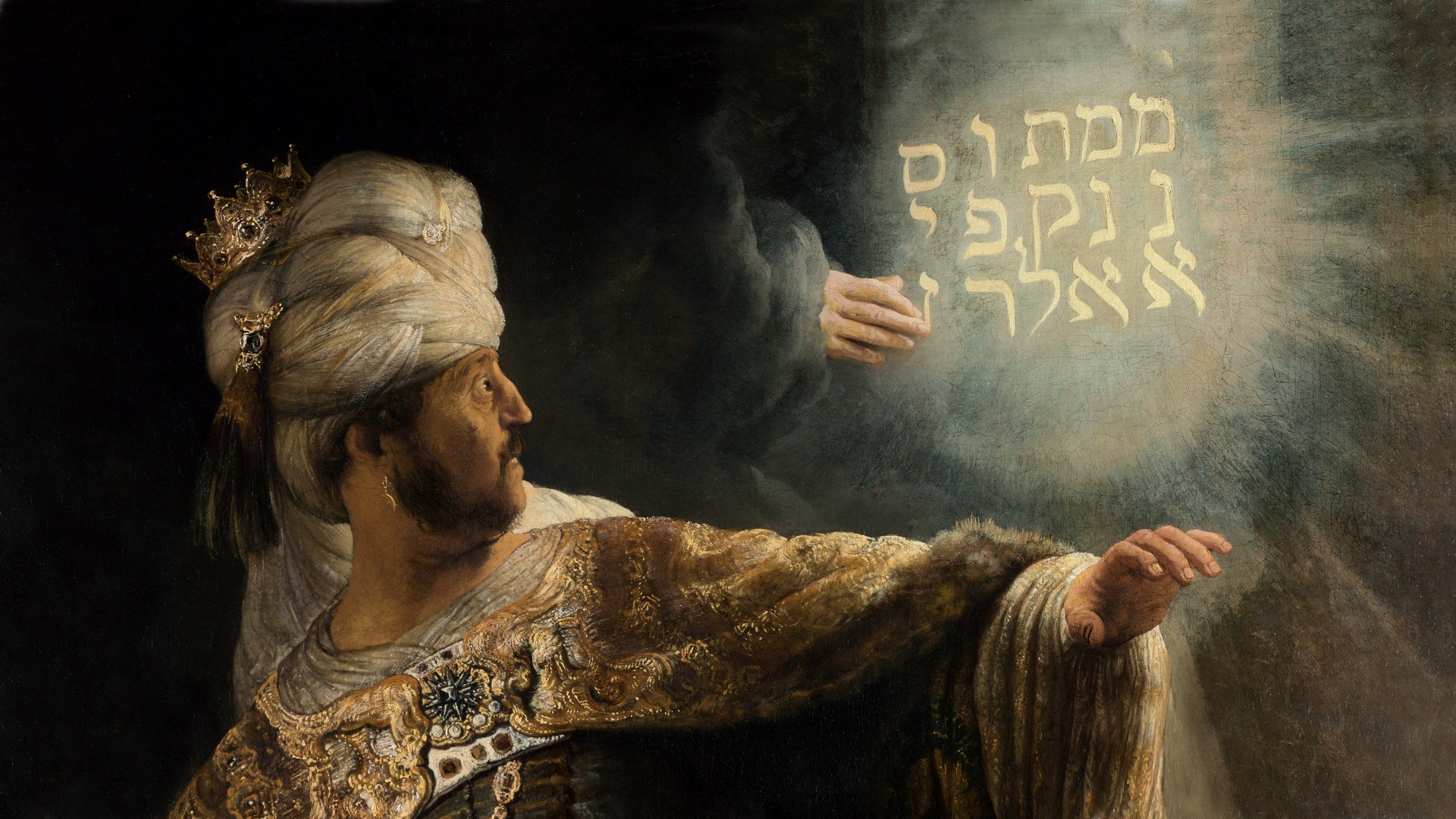
One of the most well-known stories in Scripture is also one of the most baffling. Nearly everyone in the Western world has heard the phrase “the writing on the wall,” whether or not they have ever read Daniel 5.
Many people use the phrase in ordinary speech. Visitors to the National Gallery of London can view the Rembrandt painting “Belshazzar’s Feast,” with its depiction of a terrified king and miraculous handwriting. Plenty will have heard Sam Smith’s “Writing’s on the Wall,” the title song for a recent James Bond film, or the Destiny’s Child album with a nearly identical name. I have seen the words “Mene, Mene, Tekel, Parsin” (Dan. 5:25) quoted in all sorts of odd places, including a bestselling marketing paperback.

On the surface, the story is fairly simple. Four enigmatic words of divine handwriting appear while the Babylonian king Belshazzar is feasting with vessels stolen from the Jerusalem temple, and Daniel explains what the words mean: Belshazzar is about to be deposed by the Medes and Persians.
Yet the meaning of the handwriting—like the Book of Daniel as a whole—is multilayered and mysterious, full of puns, wordplays, numbers, and changes of language. Interpreting it requires a combination of understanding and spirituality, as the queen points out in this chapter (v. 11). We might call it Danielic hermeneutics.
We can start at the most literal level. Each individual word is a term of weight and measurement in Aramaic. Teqel is a shekel, a silver coin weighing around ten grams, that served as Israel’s basic unit of currency. Mene is a mina, familiar to readers of Luke’s Gospel and worth 60 shekels in Babylon. And peres (“half”) is probably a half mina, weighing 30 shekels. If we read these words as nouns, we get measurements of weight, adding up to 91 shekels.
Unsurprisingly, Belshazzar is both terrified by the writing and perplexed by what it might mean. What on earth is the significance of the numerical figures spelled out by the words? (We will come back to that in a moment.)
Daniel, however, interprets the words not just as nouns but as verbs. “Mene: God has numbered [menah] the days of your reign and brought it to an end. Tekel: You have been weighed [teqal] on the scales and found wanting. Peres: Your kingdom is divided [peras] and given to the Medes and Persians [paras]” (vv. 26–28).
The first two words have a double meaning: a numerical weight and a warning of judgment. The final word has a triple meaning: a weight, a warning, and a specific prediction that the Medes and Persians (paras) will inherit the kingdom (which they promptly do). A fourth meaning to this final word—that the kingdom of the Persians (paras) will itself be divided (peras) with the Medes—is hovering in the background.

After moving from nouns to verbs, the next element to consider is numbers. We recall that the combined weight of the measurements is 91 shekels, for whatever reason. Well, there are 91 Aramaic words in Daniel’s interpretation. And based on the Hebrew custom of assigning numerical values to letters, Elohim, the Hebrew word for God, yields a figure of 91.
This is unlikely to be a coincidence. It suggests that there is number play happening alongside wordplay in the passage. In Daniel as a whole, numbers like 3½, 7, 70, and 2,300 play significant roles in the book’s enigmatic prophecies. Given these symbolic patterns, we might also ponder a possible connection between a shekel, two minas, and a half mina and “a time, times and a half-time,” a mysterious phrase appearing twice in Daniel’s later chapters (7:25; 12:7).
One further layer to the riddle may be a piece of ancient Aramaic snark, aimed squarely at Belshazzar himself. In the dream of Daniel 2, Nebuchadnezzar was the great king of Babylon, represented by a head of gold, and Cyrus the Great was the great king of Persia, represented by a head of silver. But there was no mention of Belshazzar, who came between these giants and was a very minor figure by comparison.
The handwriting on the wall tells the same story. There is a weighty “mina” king (60-shekel Nebuchadnezzar), and a fairly weighty “half-mina” king (30-shekel Cyrus). But sandwiched in between them is a one-shekel featherweight who will be dead by the end of the evening. As Daniel declares to Belshazzar, “you … have not humbled yourself … Instead, you have set yourself up against the Lord of heaven” (5:22–23). We all know what happens to kings who do that.
Sometimes, reading Scripture is like watching a Christopher Nolan film. When you first see The Prestige or read the Book of Daniel, you get the main idea, but the finer details and triple meanings pass you by. When you keep looking, however, you find all sorts of wisdom and creativity lurking beneath the surface, which reinforce the main point and illuminate its significance. Daniel 5 asks readers the searching question at the heart of Danielic hermeneutics: Are you watching closely?
Andrew Wilson is teaching pastor at King’s Church London and the author of Remaking the World: How 1776 Created the Post-Christian West.
Spirited Life: Spirited Life is a collision between biblical reflection and charismatic practice, aiming to make people happier in God.
Related