On Memorial Day we are meant to visit the dead.
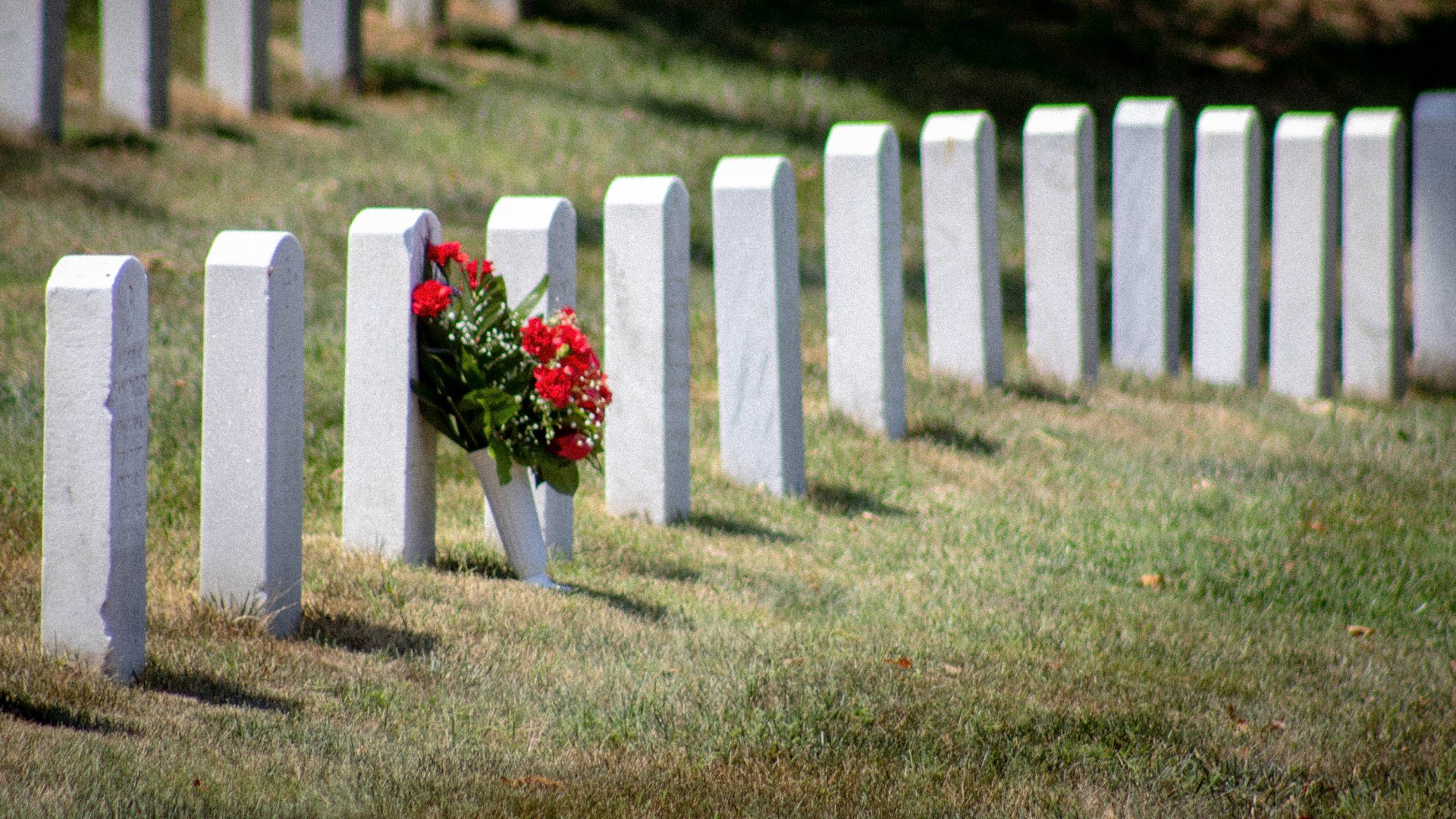
This duty was clearer when the Grand Army of the Republic (GAR) first inaugurated the holiday, then known as Decoration Day, in 1868. In General Orders No. 11, the GAR proclaimed that the 30th of May would be given to the “purpose of strewing with flowers or otherwise decorating the graves of comrades who died in defense of their country.”
These days, the legal proclamation for Memorial Day no longer encourages Americans to decorate cemeteries. Yet the tradition endures. Across the country, local officials, veteran and military family organizations, and ordinary citizens still put flowers, flags, and other markers on service members’ graves.
That’s not to say we find it the easiest tradition to keep. For many Americans, visiting a cemetery is an uncomfortable thought. Our spiritual but irreligious age shies away from the physicality of death.
We prefer memorials that emphasize life, as if the final act is an inconvenience we can ignore. We rationalize our preference by saying it’s what the dead would want, when in truth, it reflects our waning capacity to confront death. We’ve lost “rituals of closure,” the forms and customs that once enabled us to embrace both ends and beginnings, as philosopher Byung-Chul Han argues in The Disappearance of Rituals. Absent such rituals, we “slip through” time, incapable of carving out the space to experience both the full magnitude of loss and the much greater promise of resurrection found in death.

The military is a rare domain that preserves a ritualistic approach to death. By necessity and custom, death is treated not as an aberration or inconvenience but as an inevitability. It shows up in daily events—with mission briefs, for example, detailing who will assume command should leaders fall in battle.
Similarly, death has a prominent presence in institutional ceremonies. At the battalion ball my unit held before we deployed to Afghanistan, we kept a table empty, a place for our “missing man,” to honor our fallen, missing, or imprisoned brethren. These rituals, lacking in most civilian contexts, help the military community treat death with reverence, holding space for both intense grief and a profound sense of awe.
Such reverence is visible to anyone who goes to a military cemetery on Memorial Day. This holiday brings hard men and women to their knees. Warriors who can stay calm as bullets and explosive devices rip through steel, bone, and flesh will kneel before graves, tears pouring from their eyes as they place their hands on the headstones of fallen brothers or sisters in arms.
Yet however painful such moments are—and they are painful—the day ends in gratitude, not grief. We honor the men and women beneath the ground for their willingness to die for our country. Before we depart the cemetery, we stand and salute, knowing that what Abraham Lincoln once called America’s “new birth of freedom” comes through the willingness of Americans to lay down their lives.
For even longer years and deeper reasons, the church, too, approaches death with reverence. We know that death is neither a discomfort to avoid nor an ethereal abstraction; it is a viscerally physical reality and, in some senses, a necessity. As Paul writes, “We were buried therefore with him by baptism into death, in order that, just as Christ was raised from the dead by the glory of the Father, we too might walk in newness of life” (Rom. 6:4, ESV throughout). As Christians, we believe in the resurrection not only of the soul but of the body as well. Our rituals for death embrace the physical, reminding us of our complete rebirth and renewal through Christ’s sacrifice.
related


Early Christians manifested this embrace with a commitment to burying the deceased, even though that went against many of the prevailing customs. In funeral liturgies, we continue, as theologian Timothy George put it, to “solemnize the departure of our loved ones.” In so doing, we recall the words of Isaiah, who rejoiced that God “will swallow up death forever” (25:8).
For the church and military alike, our rituals make the gravesite sacred terrain. Joyce Kilmer, a Catholic soldier who fought in World War I, gave voice to this truth in a poem he wrote about a new grave formed in the woods of France:
In a wood they call the Rouge Bouquet
There is a new-made grave to-day,
Build by never a spade nor pick
Yet covered with earth ten metres thick.
There lie many fighting men,
Dead in their youthful prime.
…
There is on earth no worthier grave
To hold the bodies of the brave
Than this place of pain and pride
Where they nobly fought and nobly died.
Kilmer wrote in honor of the men of his unit, the 165th Infantry Regiment, American Expeditionary Force, who were killed in March 1918 near the Rouge Bouquet part of the Parroy Forest in France. Their graves, formed by falling shells and explosions, became a “place of pain and pride” that fused death and life, he said. Kilmer himself would die in battle shortly after composing this verse.
Over 1 million Americans have died in service to our country, and over 5 million people are buried across more than 150 national cemeteries maintained by the Department of Veterans Affairs. Arlington National Cemetery alone is the resting place for more than 400,000 service members and their families, and hundreds of thousands of others lie in family burial grounds or small local cemeteries.


Yet regardless of whether a grave is marked by a solitary headstone buried by overgrowth or found among the thousands of immaculate tombstones in Normandy or Tunisia, each is a place for remembrance and contemplation. For me, words come to mind from the hymn first composed for Lincoln’s burial in 1865: “Grant that the cause, for which he died, / May live forevermore.”
As Americans, we visit graves on Memorial Day to hear those words. Even more, we can own those words. We sit with the dead to recognize that the future for which they died is only what we, the living, make of it. Rituals of death foster our determination to make that future worthy of the sacrifices so many have made.
And for us as Christians, visiting gravesites is a way to physically bear witness to the words Jesus said to Lazarus’s sisters: “I am the resurrection and the life. Whoever believes in me, though he die, yet shall he live, and everyone who lives and believes in me shall never die” (John 11:25–26). With every grave we pray over and headstone we touch, we can give thanks to Christ, who forever vanquished death, our final enemy.
Dan Vallone is an Army veteran and founder of Polarization Risk Advisory. He writes on the Army and its place in American society at Army 250.