
Two years ago, CT declared New Atheism dead, referring to an angry and vitriolic form of unbelief that arose in the early 2000s. Writer and editor Christopher Beha tackles today’s atheism—what he calls “romantic idealism”—more than 20 years later in his book Why I Am Not an Atheist: The Confessions of a Skeptical Believer.
Beha defines romantic idealism as an irrational worldview that elevates free will and personal experience, whereas older forms of atheism focused on scientific materialism that looks to the physical world as the extent of existence.
Why I Am Not an Atheist explores these two forms of unbelief, documenting Beha’s own journey out of organized religion, through atheism and agnosticism, and eventually back to the Catholic church.
Beha, a former Harper’s Magazine editor known for his novels, including What Happened to Sophie Wilder and The Index of Self-Destructive Acts, spoke over the phone with Christianity Today from his home in Brooklyn Heights, New York, about his journey as a skeptic. This interview has been edited for length and clarity.
Kara Bettis Carvalho: Tell me why you wanted to write this specific book.
Christopher Beha: I had made this return to faith after leaving a Catholic church in my childhood, being an atheist for a long time, being somewhat of a seeker, and eventually finding my way back into the church. And there were a lot of people in my life who found this development puzzling—not, I really want to emphasize, that anyone was hostile or antagonistic about it—but they found it puzzling and inconsistent with what they understood about me and my intellectual values.
It’s one of those things that people often have a hard time having conversations about. And I found that when I could talk at some length with people about these things, those conversations were often very valuable. But it was difficult for me to give a short, encapsulated answer to the question of why I’m not an atheist anymore. So I kind of sat down in an effort to answer the question in a way that I hope will be of interest to people of any faith background who are interested in the journey that one person went on that led them out of and back into the Christian faith.
KBC: You discuss two different categories of atheism: scientific materialism and romantic idealism. How did you come to those categories?
CB: Part of my goal was not just to give an account of a plausible form of religious belief to people who are atheists but to give a fair and, in some ways, compelling account of atheism to religious believers. Because if you’ve been raised in a religious faith and you’ve never had that faith shaken, it may be that the idea that people could not believe in God seems a little nuts.
As someone who has been on both sides of the fence, I think I can describe both sides fairly and from the inside in a way that I hope would make them mutually comprehensible. If you’re describing atheism and what it would mean to hold atheist beliefs to a person who has spent their whole life within a religious tradition and is not really familiar with these things, the first thing you could note is that there isn’t just one kind of atheism, in the same way that religion is not a monolithic category. Even Christianity is not monolithic.
Some of the loudest atheists would like to claim as much because they would like a monopoly on what people who don’t believe in God do believe. That’s where the New Atheists are obvious spokespeople. Roughly speaking, the tradition that the New Atheists advocated was scientific materialism.

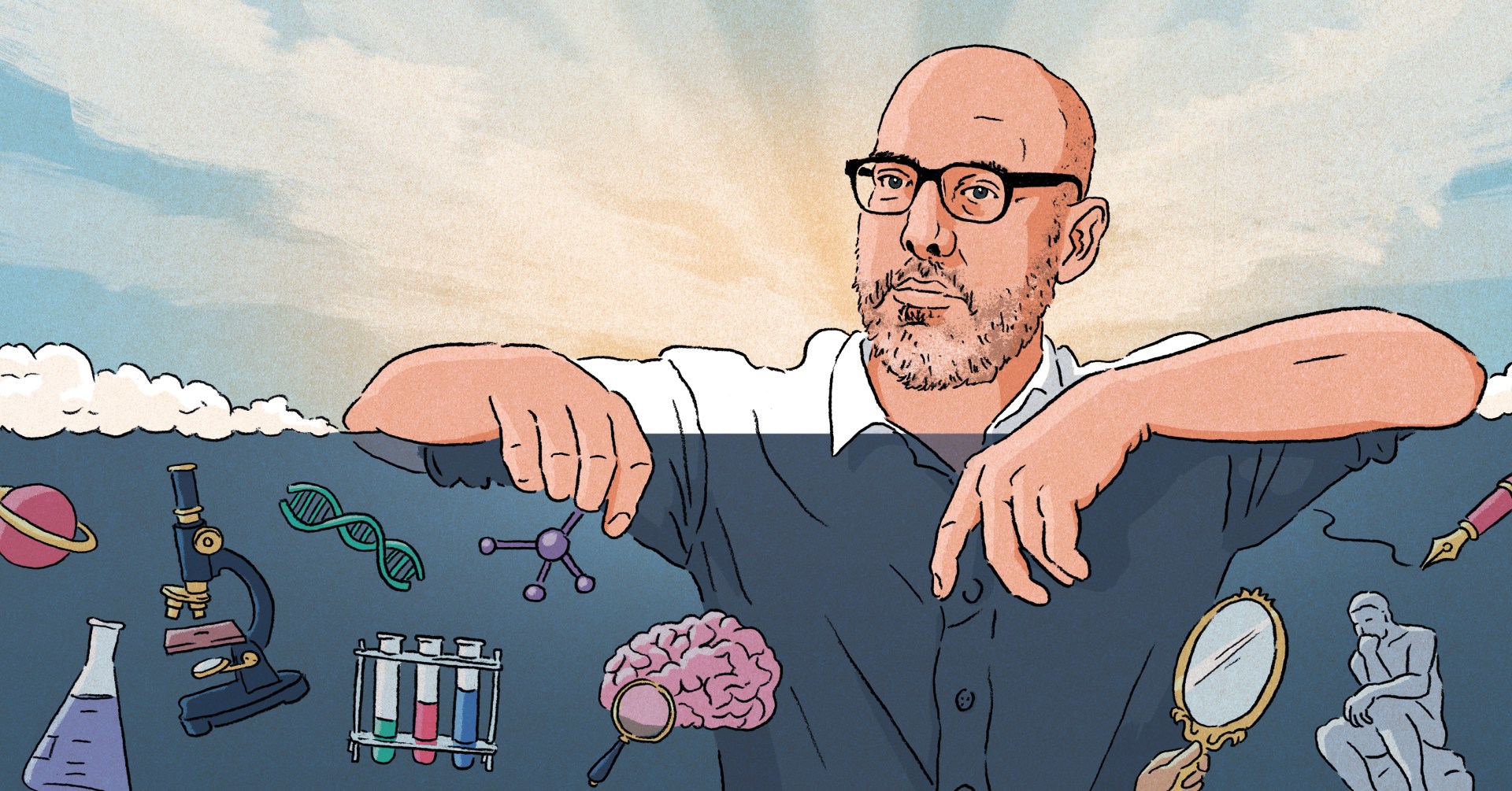
Scientific materialism is the belief that physical matter is all that exists, that we come to have knowledge about the physical world through the empirical sciences. Accordingly, knowledge about the physical world delivered through the empirical sciences is the only real kind of knowledge.
Scientific materialism often goes hand in hand with an ethic of utilitarianism, which attempts to ground ethics in the physical sensations of pleasure and pain and then tries to similarly quantify those sensations in a way that allows us to make a science of ethics.
Utilitarian scientific materialism is what most people imagine to be atheism. When I started on my own intellectual journey through this at the beginning of the 21st century, at the height of New Atheism, that really was the dominant form.
But that version of atheism does not apply to many of the most famous atheist thinkers. It does not apply at all to Nietzsche, for example, who is possibly the most famous atheist philosopher. Nietzsche was incredibly hostile to the utilitarians. And it doesn’t apply to many of the thinkers who followed Nietzsche, including Heidegger and the whole line of existentialists through Camus and others. They tend to coalesce into a tradition that I call romantic idealism.
If materialism tells you physical reality is all there is, idealism tends to emphasize not objective reality but subjective mind or subjective experience of reality. And it tends to have an ethic of authenticity. Our job—our sort of life project—is creating our own meaning in this desolate, godless existence by somehow living in a way that is authentic to our subjective experiences.
These two traditions can give you one view or the other, but they do a very poor job of synthesizing the two. And what I eventually came to think is that the tradition that could synthesize these two and give you the best of both atheist traditions was a theistic tradition—one that understood the physical world as created by something other than our own minds, and thus something we can’t entirely control and within whose terms we have to live. But this view also recognizes the reality of our subjective selves within that world, the reality of other subjective selves, and our obligation to recognize their lives as just as meaningful as our own.
KBC: CT has covered the New Atheist movement over the years, including some of those who have converted, as you mention in your book, to Christianity. But it doesn’t necessarily seem that your goal is to convert anyone. So who are you trying to persuade? What is your goal in this intellectual journey through these two ways of thinking?
CB: I don’t know that I’m trying to persuade anyone. That sounds like a cop-out, probably, or just a rhetorical move, but it’s true. I want to convey as accurately as possible what I believe, and I would like to make those beliefs comprehensible to others.
There is a dream of a particular kind of philosopher that the truth can be proven in the way of a mathematical proof, that one can start from certain premises and work logically out from them and then arrive at points that are indisputable. And I don’t believe that, in part because I do believe that so much of what we think about reality has to do with our subjective experiences. And my sense is that our subjective experiences are widely different. So what I can say is “This feels true to me, and here’s why it feels true.”
The New Atheists loomed large for me because they were a big deal at the time I became an atheist. But I don’t think they have a particularly large influence at this moment. I don’t hear a lot of people citing Christopher Hitchens.
And it does seem like what I’ve called romantic idealism is increasingly, among younger people, the primary mode of atheism. Again, there is a strong ethic of authenticity. There is a sense that we are capable of creating ourselves from nothing, that we are not created by something larger than ourselves, and that we don’t have to conform to that creation. This view says, “My great responsibility in life is to be authentic to myself, and if other people don’t like my behavior, they have to get with the program.”
related


KBC: You talk about love being one of the things that drew you out of your introspection and gave you meaning. How did understanding God as love change your spiritual understanding of who he is?
CB: Love is a thing that both of those atheist traditions have a hard time engaging with. The scientific materialism tradition understands the feelings that we call love as being essentially neurochemical responses to brain chemistry, and it understands us as having evolved the capabilities for these feelings for evolutionary reasons (for mating and kinship).
We all know that’s not a very convincing description of the feelings we actually have. But the romantic idealists don’t do a great job with it either. They are very attuned to these profound psychological states, but they do not think of them as something emanating from outside ourselves. And they do not do a great job of taking seriously the object of our love and thinking about what a commitment to that object would actually mean.
This view says we are meant to act, again, in a way that is authentic to our passions. But it is not going to make great demands on us and insist that we put someone other than ourselves at the center of our lives.
So if you think of love as coming from outside ourselves—as neither a chemical state nor simply a psychological state—then what is it? And that’s the question that starts to bring you down the tradition that says that God is love, that love is God, and allows you to understand all of creation as a product of this love. And that understands this love as a gift to us but also a gift that creates certain obligations, because we are being commanded to love God and love others, to love the rest of God’s creation with the same love that he bestows on us.
KBC: We have a broad decline in religion, especially in the West, but we’re also seeing a lot of young people who are increasingly spiritual. And in our current moment, some American Christians are feeling that maybe we’re on the brink of revival, and they feel some kind of spiritual awakening happening. How do you see our current spiritual moment?
CB: Almost everybody thinks we’re in a tough place right now—and not just economically and politically, but psychologically. People are struggling. People are very unhappy. There’s a lot of different things this can be blamed on, but it does seem that one thing it can’t be blamed on is religion, for the simple reason that the rise of these problems has coincided with the decline of religion.
If you go back again to the New Atheists, circa 2001, you had an evangelical Christian as president; and you had someone like John Ashcroft as his attorney general attempting to dictate many of the rules, the laws of the United States; and then you had foreign threats that struck people as being very bound up with certain expressions of Islam, et cetera. It was at least plausible for some people to say, “Religion and theistic belief in particular—that’s our real problem. That’s at the core of why we have all the problems we do.”
I don’t think anybody could say that right now with a straight face, wherever they are on the political spectrum or whatever they have identified as our problems. That in itself raises an opportunity to say to people, “Okay, we ruled out the idea that ‘religion poisons everything,’ as Hitchens put it. Let’s talk through what the real problems are, and let’s open ourselves up to the possibility that some form of religion might be among the possible solutions.”
KBC: Is the present-day lack of religion caused by people’s serious philosophical dilemmas and intellectual challenges? Or is it more about selfishness—desires around different vices, pleasures, sex, that kind of thing, and the moral code that religion demands?
CB: It is perfectly possible to, just as a kind of metaphysical matter, believe in God and then live whatever life you want. And you may eventually start finding that you are drawn away from some of those vices.
You may give out an Augustinian “Lord, give me chastity, but not yet.” I don’t find that—for anyone I know—the thing keeping them from belief is a sense that they want to be able to live a self-indulgent life that Christianity forbids.
I’m coming at it as a Catholic. For Catholics, obviously the institution of the church is very important. And in my lifetime, the Catholic church has done a lot to undermine its own authority as an institution. We live in a time where people are very suspicious of institutions in general because many institutions have done a lot to undermine their authority.
The hypocrisy of church leadership, not just Catholic church leadership but across the board, has been a real problem. People see some of the behavior of those who lead various churches, and they find the idea that these people are going to act as moral arbiters to be kind of a joke.
Again, that doesn’t have to mean you then stop believing. You could just exist outside a tradition while still believing. But I do think various
Christian institutions have something to answer for in this decline.
Secular society offered a competing worldview that struck many as persuasive for a long time, but for a whole host of reasons that too has lessened recently.
When you talk about the possibility of revival, that’s part of it. So the secular institutions too have done a lot to undermine their own authority in recent generations.
KBC: This kind of gets back to the original questions you asked throughout the book: “What can I know?” “What must I do?” and “What may I hope?” Do you see any objective answers to those questions? Even Jesus saying he’s the Way, the Truth, and the Life implies there is one way. Do you see one true, objective answer?
CB: I think the way is love and the two commandments Jesus held above all others—to love God with all your heart and love your neighbor as yourself.
The problem that Christian existentialists like Kierkegaard talked about at great length is what Jesus doesn’t give you—in the way of other traditions that are highly legalistic—which is a day-by-day, minute-by-minute of every rule you’re supposed to follow and the assurance that as long as you’re following all of those rules you’re one of the good ones. He says, “Love.” And you can’t always be sure you’re doing it right. We all need to be approaching it with humility.
Jesus also teaches that we’re all fallible and that we should spend a lot more time thinking about the ways we are coming up short ourselves in that commandment to love than thinking about what other people should be doing differently.
We see through a glass darkly. I do think there is an objective truth. At the same time, I don’t think I have a complete understanding of that truth, because part of what I think about that truth is that it outstrips human understanding.
I expect I’m always going to be working through these questions. There is never going to be the time when I tell myself I can stop asking these because now I “have the answer.” This again gets to the existential part of it. Even if you have the right answer, you must keep answering it. I guess that’s the best I can do.
Kara Bettis Carvalho is a features editor at Christianity Today.
This article appeared in the January/February 2026 issue of Christianity Today as "Christopher Beha".
Related