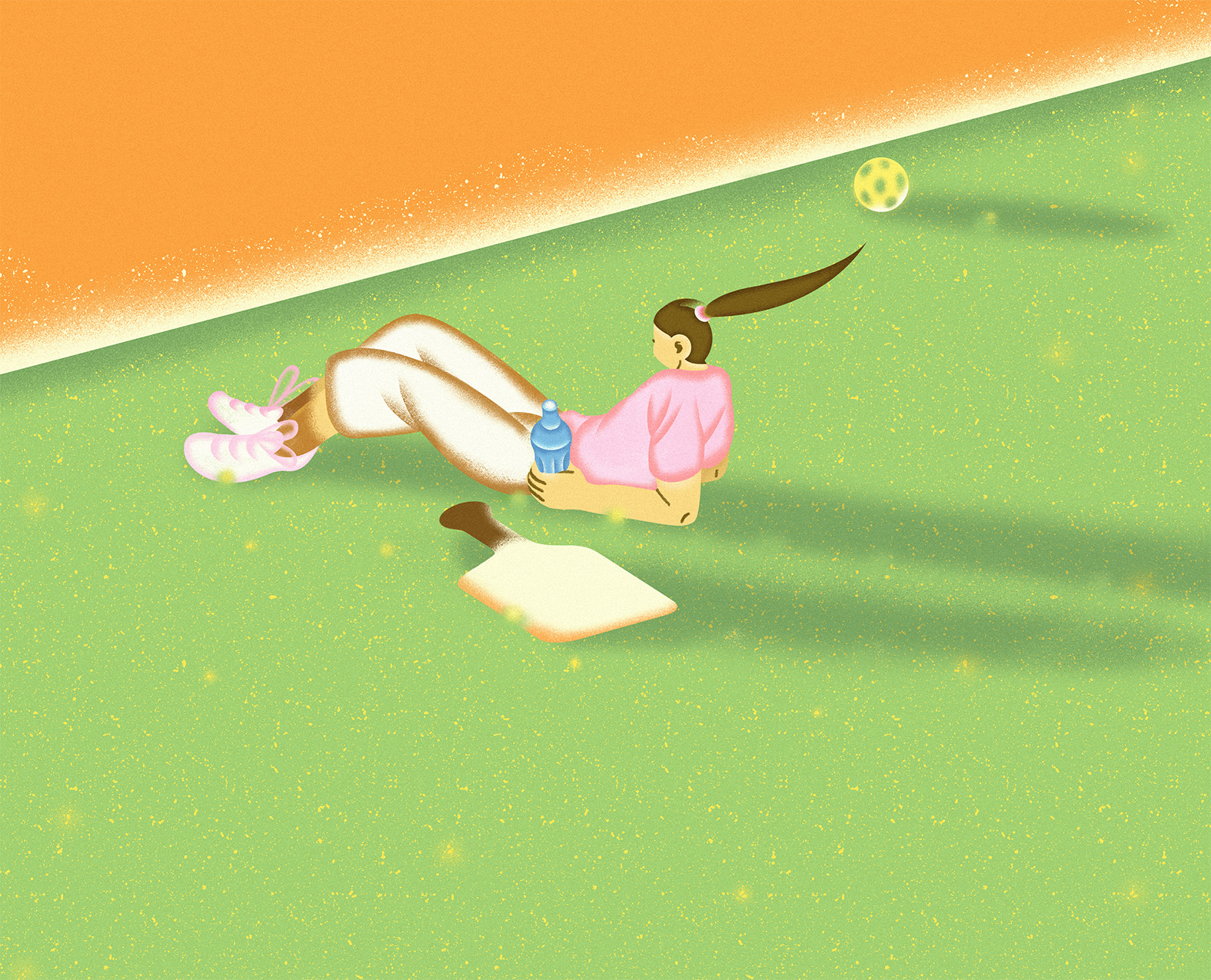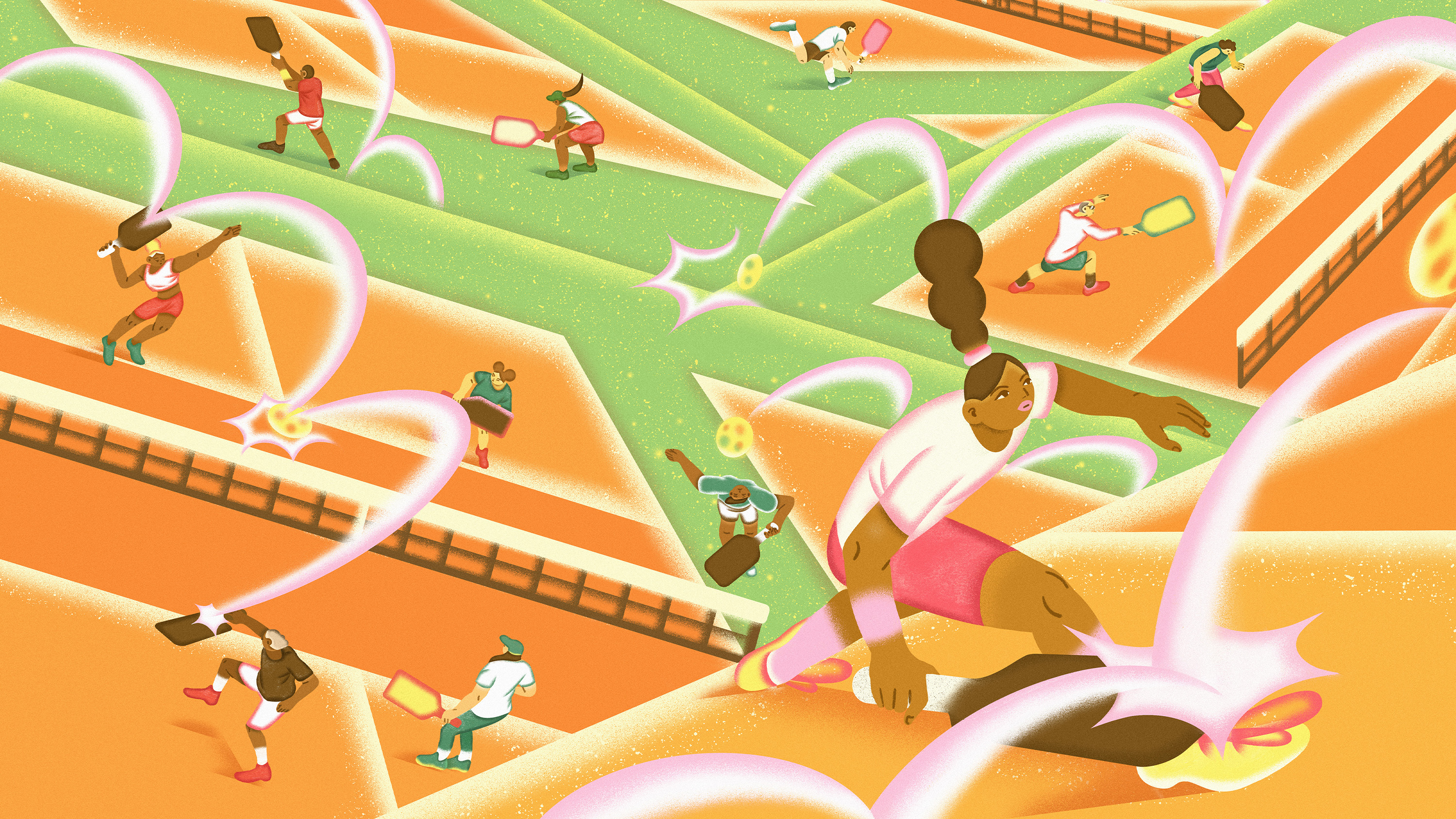
On our way to church every weekend, my family and I pass two sets of tennis courts, one municipal and one belonging to the local university. We’ve been taking this route for more than a decade, and for the first two-thirds of that time, the courts were empty on Sunday mornings. During COVID-19, these spots came alive. Now they are crowded with people—old and young, women and men of every shape and size. They’re not playing tennis, though. They’re playing pickleball.
What accounts for the explosion? I have a couple of theories. For starters, the bar to entry is far lower than that of tennis. You can pick up the game in an hour or so, no matter your age. The fact that it’s usually played outdoors is another plus, as is the fact that it gets the body moving. Legs pump and hearts beat—but not too much. The fitness requirements are modest in comparison with tennis, where there is far more ground to cover. It also helps that pickleball is an inherently social game. Singles play is almost nonexistent, which is no small thing considering one in three older adults and one in four adolescents are socially isolated, according to the World Health Organization.
But people don’t take up pickleball primarily to ward off loneliness—or to counterbalance rising levels of “workism,” for that matter. It’s simply fun. There’s something delightful about the ball’s little pops, something faintly ridiculous about the use of words like kitchen and, of course, pickle. The newness of the game means nearly everyone is a novice, so the stakes are low. In a time when the world feels heavy, pickleball feels like a respite. Pickleball has become a thing because we are starved for play.
Much has been made of the decline of free play in the lives of American children. Statistics generally focus on the consistent reductions in recess times that elementary schools have instituted over the past few decades. The strategy consultant company EAB (Education Advisory Board) reported that between 2001 and 2019, average weekly recess time in US schools declined by 60 minutes to make room for more instruction. Of the time for recess that remains, it is still a common practice for educators to withhold it from rowdy students as a disciplinary tool. Equally notable is the way extracurricular excess has squeezed out afterschool downtime, with the demands of college-transcript-enhancing activities ramping up earlier and faster.
When that pattern is combined with increased parental vigilance, kids simply play less than they once did. They certainly play less freely. Social psychologists like Jonathan Haidt link this decline to inversely high rates of anxiety, depression, and suicide among young people.
The decline applies to adults as well. What once were hobbies are now, for many of us, side hustles. A weekend scrapbooking project morphs into an Etsy shop. A brisk jog in the woods is now a training session for the next trail-running 5K. Add smartphones to the mix, allowing the workday to bleed into off-hours, and play doesn’t stand a chance.

The decline of play is lamentable not just for its social consequences; it is also lamentable for what it signals about contemporary spiritual conditions. A life in which play is sparse is one in which joy is sparse. This alone ought to grieve believers who consider joy a fruit of the Spirit and a core aspect of the Christian life and God’s character. More than that, Christians are bold enough to claim that God’s fundamental disposition toward the world he created, as revealed in Christ, is one of grace.
Play describes a way of being in the world that divine grace makes possible—a way that is dynamic and delight-filled, outward-oriented yet faithful. As such, it represents an urgent if tragically undertapped opportunity for Christian witness to a world drowning in dreariness. Those who champion grace might do well to champion play as a response to it.
Play, is, admittedly, a tricky word to pin down. It’s almost impossible to dissect play in a playful way. It is one of those know-it-when-you-see-it experiences. Yet if play is as vital to the human soul and spirit as I suspect it is, it may be worth attempting a definition.
Psychologist and ethologist Gordon Burghardt offers a few key traits that characterize play, three of which are worth listing here. These traits were originally identified in the animal kingdom but translate to a Homo sapiens context.
First, something can be considered play if it does not immediately serve our need to survive. Play, in this sense, is unnecessary activity.
Second, play is voluntary and not a response to some external influence. It is something we do simply because we like it. If you undertake a given activity out of fear or coercion, it is not play, but when that same activity is unhooked from threat and pressure, it becomes play. There may be winners and losers in a game, but it won’t truly be play unless the stakes are benign.
Third, play occurs when and only when, Burghardt says, “the animal is well-fed, safe, and healthy.” An expression of freedom, play happens when our basic needs are met. One reason researchers like psychologist Peter Gray believe free play is so essential to children’s development is because it is where they can experiment, take risks, and fail without suffering consequences.
There are other attributes we can highlight. Play is usually noninstrumental. We understand and experience something as play when we do it for its own sake rather than as a means to an end. It may produce a result, but that’s not why we do it. Many of us play pickleball because we genuinely enjoy the sport, not because it yields any concrete reward.
Play also tends to be relational and transportive, like a trip to another universe where alternate rules apply. Spike a ball at someone on the street, and you will be reproved at best. Do it on a volleyball court, and you’ll be cheered. Furthermore, play tends to be motivated by delight rather than judgment. The fact that few people grew up playing pickleball competitively is no coincidence when it comes to the game’s popularity. It means that when we play it, we are free from comparison with our past selves.
Yet we make a mistake when we limit our understanding of play to games and other ostensibly nonserious pursuits. Play may include frivolity, but the reality is more expansive than that. Indeed, everyone plays. Grandmas play, and so do middle-aged moms with demanding careers. Their forms of play may or may not resemble fun in the conventional sense. For some, play may look like doing a jigsaw puzzle after dinner. For others, it may look like baking something delicious. Gardening can be a form of play. Kids in war-torn towns find ways to play. So do folks in elder-care facilities.
Learning about something you’re deeply interested in can be a form of play. Plenty of people experience an aspect of play at work; that element is usually what they like most about their jobs. Indeed, the opposite of play is not work but depression. Part of what makes certain circumstances so difficult—for example, being a single parent struggling to make ends meet—is the lack of play they afford.
Researcher Stuart Brown writes in his book Play,
Life without play is a grinding, mechanical existence organized around doing the things necessary for survival. Play is the stick that stirs the drink. It is the basis of all art, games, books, sports, movies, fashion, fun, and wonder—in short, the basis of what we think of as civilization. Play is the vital essence of life.
Christians have long had a conflicted relationship with play. On the one hand, a church without a playground is hardly a church. Kids may go to Sunday school to learn, but there’s usually an overlay of fun. Vacation Bible school tends to be light on the “school” part and heavy on Technicolor wackiness.


And then there’s youth group, one of the last bastions of nonperformative fun available to teenagers in the age of the travel-sports industrial complex. The youth group mixer game is the height of this sort of play, a mix of silliness and exuberance pioneered by organizations like Young Life and elevated into big entertainment by Dude Perfect. Shaving a balloon, playing lights-out hide-and-seek, seeing how many marshmallows you can fit in your mouth—these things are proudly and subversively ridiculous. They do not serve the college transcript.
For adults, there are church softball and basketball leagues, watercolor classes, and movie nights. In these ways, churches prioritize play whether they realize it or not.
This unconscious reverence for play makes sense, given the references we find in the Bible. In 2 Samuel, we read of David joyfully dancing before the Lord after the ark of the covenant enters Jerusalem (6:14). Later, when Zechariah prophesies about the building of the second temple, he equates the Lord blessing Zion with “city streets … filled with boys and girls playing there” (8:5). In Proverbs, the portrayal of wisdom as being “filled with delight day after day, rejoicing always in [God’s] presence” suggests a playful disposition lies at the very heart of creation (8:30–31).
On the other hand, we have the stereotype of the Christian killjoy, embodied in Dana Carvey’s “Church Lady” skit on Saturday Night Live and rejuvenated via Angela on The Office. This is the religious person we experience as “the fun police”—serious in the extreme, the opposite of playful toward other Christians or the culture at large. These caricatures, while incomplete, have an undeniable basis in reality.
My grandfather tells the story of growing up in Porterville, California, in the 1920s as the son of a pietist Lutheran pastor. When he was 10 years old, he and a friend were caught playing a drum in the street on Good Friday. The full-throated chastisement he received from his parents, who characterized his play as ill-conceived and even blasphemous, stuck with him the rest of his life. He would often cite the incident as a key contributor in his decision to leave not only Porterville but also the Christian faith itself.
I doubt my great-grandparents would have openly equated gaiety with sin, but that’s what their reaction communicated to their preteen son. Truth be told, I can see where they were coming from. Our faith deals with the heaviest subjects imaginable—sin, death, evil—and if there’s any particular day we should defer to the seriousness on offer, that day is Good Friday.
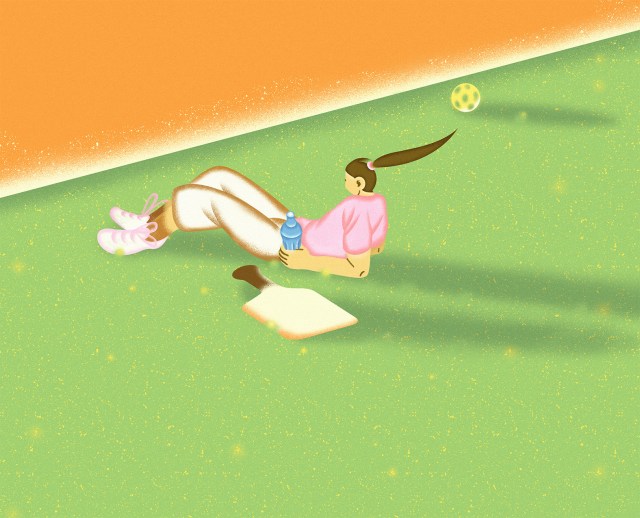 Illustration by Chiara Xie
Yet it’s precisely from the blood of Christ on Good Friday that we might begin to construct a theology of play. I’m referring to the assurance afforded Christians by the blood of Christ shed on Calvary. This “blessed assurance,” as we have come to know it, flows from the claim that forgiveness of sins is tethered to the death and resurrection of Jesus Christ rather than anything you and I do or don’t do. We can therefore move into life with the confidence that the gospel applies to us personally.
My church tradition foregrounds this assurance in the baptismal liturgy, which ends with the pronouncement that the person is “sealed by the Holy Spirit in Baptism and marked as Christ’s own for ever.” This unshakable guarantee of God’s love, presence, and power frees the Christian from worrying about the state of his or her soul. “All those the Father gives me will come to me, and whoever comes to me I will never drive away,” Jesus says in John 6:37.
The blessed assurance of grace announces that the high-wire game of proving ourselves is finished. By grace, the lingering threat of judgment has been removed, establishing precisely the sort of safety that Burghardt’s definition requires for a person to play, albeit on a deeper, existential level. What this means is that, when it comes to God, the Christian is set free from the spur of necessity and can enter into a new relation of play. Nigerian theologian Nimi Wariboko connects the dots when he writes, “The logic of grace is the logic of play.”
In more gut-level terms, the key question of the Christian life becomes one of freedom: What would you do, what risk would you take, what would you say if you weren’t afraid? What would you do if you truly believed your standing with God was secure, the ultimate threat of judgment was removed, and you didn’t have to do anything? How would you spend your time and energy if you could undertake something for the sheer joy of doing it rather than any outcome it might produce?
These are scary questions, but I suspect their answers have something to do with exercising the unique gifts God has given each of us. We may even find ourselves free to think of others and their well-being rather than anxiously safeguarding our own.


Fortunately, a theology of play is built on more than the absence of judgment. It also takes seriously Christ’s exalting of children. In Matthew 18:2–3, we read how Jesus “called a little child to him, and placed the child among them. And he said: ‘Truly I tell you, unless you change and become like little children, you will never enter the kingdom of heaven.’” There are many ways to interpret his words: as an invitation to humility, as a beatitudinal valorization of the least, as a rebuke to the social hierarchies of the day. But certainly an endorsement of childlikeness should make the list. The only thing children do is play. At least, that’s what they do after their immediate needs are provided for—and before extracurriculars get ahold of them. There is no becoming like a child that does not involve play.
Last, a theology of play depends on a robust view of the Holy Spirit. After all, the Christian cannot speak about freedom without speaking of the Holy Spirit as its engine. “The Lord is the Spirit, and where the Spirit of the Lord is, there is freedom,” writes Paul in 2 Corinthians 3:17. It is no coincidence that the images the Bible gives us for the Spirit—fire, water, wind—are united by their uncontrollability, spontaneity, and dynamism, three attributes that apply to play as well. As Wariboko puts it, “Play is an expression of the freedom of the spirit.”
The Spirit is not our instrument; if anything, we are the Spirit’s instrument. And the way the Spirit works in the world is not formulaic but creative, surprising, and free-flowing. This means that the Spirit-driven Christian life in the key of play looks less like a game of pickleball and more like a game of “Calvinball,” the hilarious recreation improvised by Calvin and his stuffed tiger Hobbes in the legendary comic strip of the same name. It is a made-up game where the same rule can never be used twice.
A few implications of a theology of play present themselves at this point. First, understanding play as an essential part of the Christian life does not mean Christians are exempt from suffering. Even the most cursory reading of Paul’s letters would discount any suggestion in that direction. However, it does mean there may be something inescapably fun about being a Christian.
Laughter and joy are not incidental. Perhaps this hints at what Augustine meant when he articulated a vision of Christian life as focused on delight rather than obligation: delight in creation, delight in others, delight in God. In other words, church may be a great place to cry, but if it doesn’t inspire a smile now and then, something may have gone awry.
Second, there is a difference between commending playfulness and endorsing the sort of indulgence that religious folks may associate with the specter of lawlessness. Play isn’t insipid but fundamentally constructive. Theologian (and my brother) Simeon Zahl writes,
In play a person is free to engage with the world creatively, actively, energetically, but without fear of ‘serious’ consequences. The Christian is free to play with things that once seemed deadly serious, to find delight in what were formerly objects of fear, and to take themselves much less seriously.
If play is truly an essential dimension of a Spirit-driven Christian life, a sense of humor is not spiritually negligible. Silliness and self-deprecation become not just virtues but acts of resistance in a world (and a church) that enshrines productivity more with each passing day. You will know them not just by their works of love but by the “useless” laughter that accompanies those works.
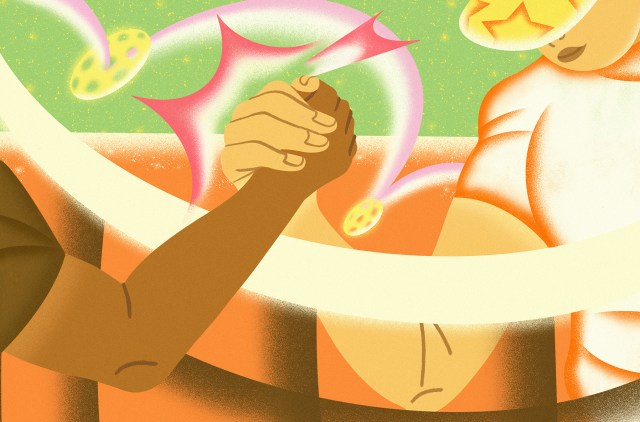 Illustration by Chiara Xie
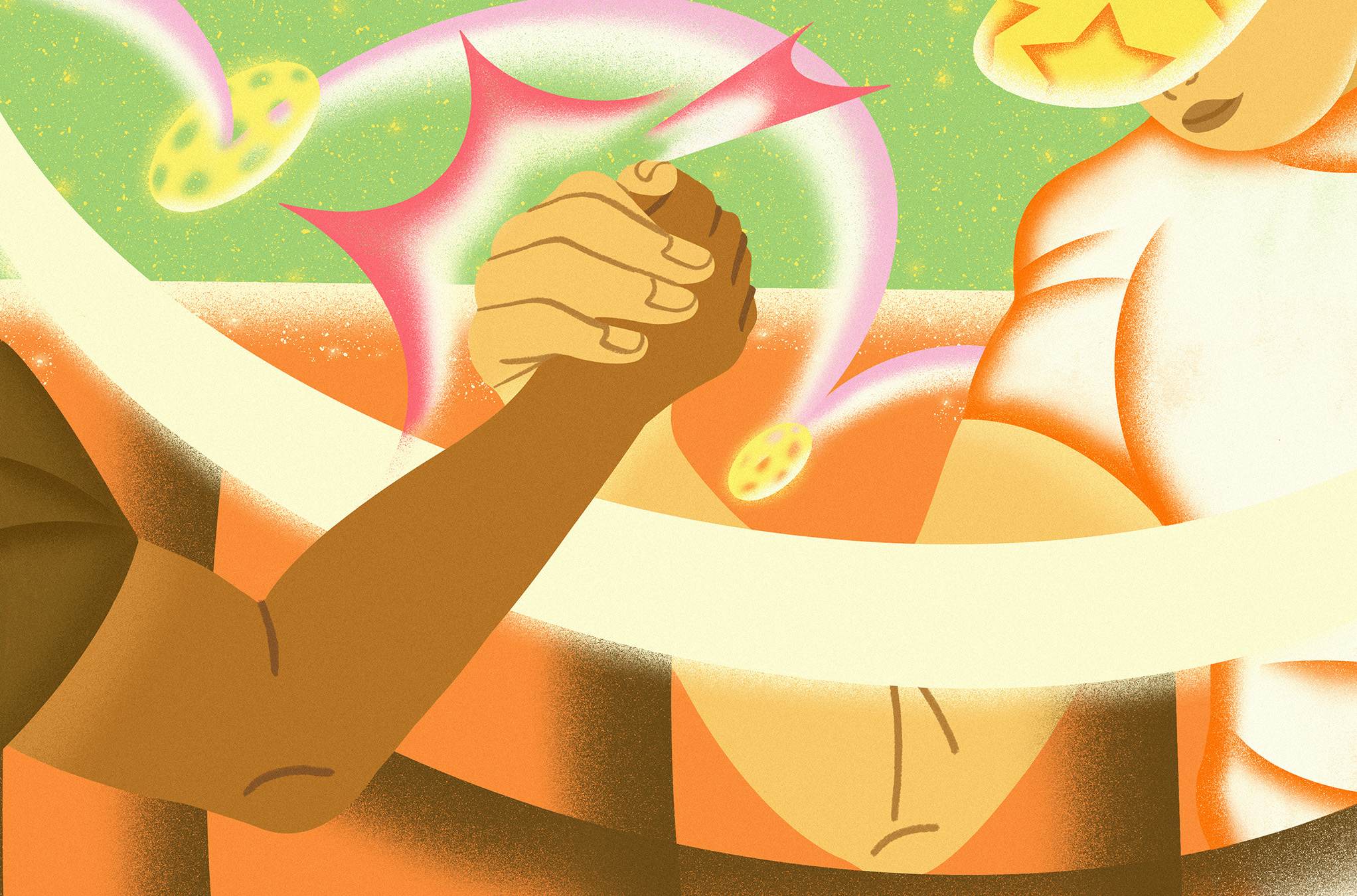
Does play matter now? It feels as if the world is on fire, collapsing as we speak under waves of acrimony, fear, and exploitation. The doom is palpable, and not just on social media (though particularly there). Am I really saying the Christian response to the state of the world is to … play? To be like a modern-day Nero, callously batting around a pickleball as Rome burns? Isn’t the proper Christian response to suffering one of service and sacrifice and reconciliation? Absolutely it is.
Yet to iterate an earlier point, work and play are not mutually exclusive categories. Adopting a playful attitude toward your work on behalf of others doesn’t make that work any less urgent; it merely ensures you won’t burn out as quickly. To serve others in a way that makes you smile, that even brings delight, means you will serve your neighbor better. Like a child in a sandbox, you will take bigger risks if you believe eternity isn’t at stake.

In addition, I doubt anyone believes the solution to present distress will come from amplifying the gravity of our predicament even more. Self-seriousness is already at critical levels. In fact, I often wonder if our culture’s current heaviness invites Christians to turn up the volume on their witness to a lighter way of being in the world. As the world grows steadily more grave, our playfulness points that much more clearly to a different world, a kingdom full of forgiven sinners, where children laugh and angels, you know, play.
Fortunately, the ultimate contribution Christians make in the world isn’t the injunction to play more or harder. I consider this a relief since we all know there’s nothing less fun than the command to have fun. No, our ultimate contribution is the message of salvation that we cling to and share, the gospel of Jesus Christ. That good news is rendered incomprehensible if not wedded to a sympathetic mode of delivery: grace spoken graciously, love conveyed lovingly, and freedom communicated freely, which is to say, playfully.
Back to those pickleball courts. I visited the other day, paddle in hand, and the vibe had shifted. The skills were stronger, the smiles less abundant. It was clear that certain contestants had invested the game with ranking and identity. Play had taken a back seat to competition. The outing reminded me that while the playful sharing of the gospel in word and deed remains a high and worthy calling, it is also one we will inevitably foul up. But maybe that’s okay. There are no grades at recess, after all.
David Zahl is founder and director of Mockingbird Ministries. He is the author of The Big Relief: The Urgency of Grace for a Worn-out World; Low Anthropology; and Seculosity.
This article appeared in the January/February 2026 issue of Christianity Today as "Blessed Are the Pickleball Players".
Related




Corresponding Issue