
Jennifer Bute, the executive partner at a large general practice in Southampton, UK, was driving to her office in 2004 when she got lost. Suddenly, the 59-year-old doctor couldn’t remember how to get to the medical center she had worked at for the past 25 years.
When she finally showed up and told the staff why she was late, no one believed her. Bute realized something was wrong.
Over the next four years, more troubling things happened. She began forgetting her passwords. Her sister came over for a visit and on her way out the door remembered she’d left her phone back at Bute’s apartment. Bute offered to go get it. When she returned with the phone, she didn’t recognize her sister.
“Are you going to give me that phone?” her sister asked.
“No,” Bute told her, “I’m going to give it to my sister.” Only when her sister looked puzzled and moved her head in a certain way did Bute recognize her mannerism and realize who she was.
The last straw came when she arrived at a case conference she was leading and asked all the attendees to introduce themselves. They were confused. “Don’t be so stupid, Jenny,” said one colleague. “We’ve worked together for 20 years!” She didn’t recognize any of the 22 people in the room, but they all knew her.
That same year, Bute diagnosed herself with dementia and visited a neurologist she knew professionally. Bute said he refused to examine her, insisting he could tell just by looking at her that nothing was wrong. It took five years before she got an official diagnosis of early-onset Alzheimer’s at age 64. She resigned her job and stopped working as a doctor. In 2011, she and her husband moved into an assisted-living village in Somerset, England. Her husband died a few months later.
Today she lives at Richmond Villages Cheltenham Care Home, an advanced-dementia care facility, as she needs more daily help, including reminders to eat and drink. The day we spoke, the 80-year-old had looked in every cupboard for the mug she uses for her morning tea. She eventually found it in the microwave—full of yesterday’s tea.
Yet one thing she hasn’t forgotten is her call to go out and make disciples of all the nations—including the residents at her care facility and others in the UK who are losing their memories.
When Bute first moved into Richmond Villages in 2022, she invited a few of her fellow dementia-unit residents to attend her church, C3 Church Cheltenham. But after only a few visits, her friends stopped coming. When her pastor, Christian Walsh, asked her why, she responded that the service was too long. “But people are interested,” she added.
So Walsh started running a Friday-afternoon course at Bute’s facility called Life’s Difficult Questions that mirrored an Alpha course. Some attendees were Christians; some were not. When the course ended, they kept meeting. Bute said she is seeing people in her building accept Jesus. “I wouldn’t call it a trend, but they are coming—slowly,” she said.

Pastors and leaders who minister to the elderly around the world are also seeing people return to their faith in Christ or believe in him for the first time. They note the extraordinary opportunity and challenges in reaching this demographic. On the one hand, they have more time to consider Christianity and are often more open to discussing matters of life and death as their lives near the end. On the other hand, some struggle with their memory, like Bute, while still others have lost their sense of purpose, especially as many of their friends and loved ones have died. Their time is limited, making evangelism more urgent.
As the world’s population ages and birthrates drop, ministry to the elderly is becoming increasingly important, since those over the age of 65 represent a larger population and mission field. In the US, the senior-citizen population is expected to nearly double in the next few decades, with more than 94 million Americans 65 and older by 2060, according to US Census Bureau projections.
Some church leaders are encouraging Christians to get involved and not to neglect the older adults in their communities. CT spoke with ministry leaders in the UK, the US, Australia, and Uganda about how they are seeking to love and reach this population.
“God is so not finished with these people,” said Elisa Bosley, a chaplain in Colorado. “Unfortunately, the rest of our society thinks they’re finished. But the harvest is there. And we can pray for God to send workers into the harvest to see the beauty of this work and to jump into it with commitment.”
In Australia, believers Are mourning the national decline of Christianity. For the first time in the country’s colonial history, less than 50 percent of residents claim to be Christian, according to its 2021 census.
When demographer and social analyst Mark McCrindle looked closely at the longitudinal data, he discovered a surprising trend: Despite the general decline in self-identified Christians, nearly 195,000 Australians over the age of 55 moved from no religion to Christianity in the last five years, making up 25 percent of the country’s Christian converts. In the last decade, the proportion of Christian converts over 55 increased by 11 percentage points. His team interviewed 3,000 Australians to find out why.
They found that many people who converted to Christianity had grown up attending church or were familiar with the religion but had rejected it. As they age, McCrindle said, the veneer of secularism wears off. “They realize that secularism and materialism can’t answer loss and grief and frailty,” he said.
According to his team’s interviews, the older generation sees younger generations growing up in uncertain geopolitical and technological times. Those cultural changes motivate them to look at the faith that held the society they used to know together.
For instance, Christine Hill of Geelong, Victoria, didn’t become a Christian until she was 75. Although she attended a local Methodist church on her own as a child, she stopped going when the church sent her home with a packet of tithing envelopes to fill.
Years later, she was baptized into a New Age spiritualist church and visited fortunetellers, looking for answers about the future of her youngest son as he struggled with mental health issues. In 2022, he went missing, and Hill remembers desperately praying to God to bring him home safely. Hours later, she found him at the beach near their home, and he told her that he had found the Lord.
Hill began reading books about Christianity and bought a King James Bible. She stopped going to yoga and tai chi classes. She was baptized at a nearby Pentecostal church and started attending a Christian Reformed church.
Hill said Jesus has changed her. She said she’s a gentler, softer person now. “I keep asking the Holy Spirit to make me more like Jesus,” she said. “I want to be changed—heart, mind, and soul.”
And she’s sharing the gospel with others, including her former neighbor who is in his 80s. She gave him a Bible, and a few weeks later he asked her how he could “speak to the Lord and give him [my] heart.” Right there, Hill helped her neighbor pray the sinner’s prayer.
“I wasn’t evangelizing him,” she said. “I just asked him about the Bible and talked with him about the things of life.”
In Boise, Idaho, Stephanie Smith has also seen an openness to the gospel among older generations. As the leader of Calvary Chapel Boise’s Twilight Hope, a ministry to the elderly, Smith visits eight different elder care facilities with her team to hold services or Bible studies.
On a recent Tuesday afternoon, the group visited Grace Memory Care, a home for patients with dementia. Residents gathered in the common room with a large-screen TV playing a 1980s sitcom. Smith handed out stapled songbooks with classic hymns like “The Old Rugged Cross” and “I’ll Fly Away” printed in a large font. The room swelled with cracking yet joyful voices. In a lull between two songs, one woman from a back couch called out, “I love them all!”


Smith followed the worship time with an exposition of Psalm 3 and exhorted the residents to cry out to God even in their confusion.
She recalled the impact the Bible had on a Korean War commander in his late 80s at Avista Senior Living several miles away in Garden City, Idaho. Living there forced him to finally sit and be still, but he had trouble sleeping, and his thoughts tormented him. He listened as Smith taught through the Book of John. After one gathering, the Word of God pierced the veteran’s conscience, and he asked Smith, “Who told you that about me?”
At first Smith didn’t understand what he was talking about. Then she responded, “I think that’s the Holy Spirit. It’s God pursuing your heart.” He became a Christian after that meeting.
In the ensuing months, he shared with Smith his guilt over being the only survivor of his battalion after an attack in the war. Smith prayed with him.
Before his death, he told Smith, “When I’m praying, I don’t feel that stress anymore. It just goes away, and I just feel joy and calm.”
Twilight Hope was founded in 2000. Under Smith’s leadership, the team now has a rotating team of about 19 people. Because of their visits, she’s seen the residents—who can’t leave the facilities to attend worship services—learn more about the love of Jesus. Her volunteers have grown in their faith and love for God through their interactions with residents, she said. And the Christians living in the facilities have encouraged Smith as they model what it looks like to finish the race well.
Still, finding enough volunteers for the ministry is a challenge. Many people will help with Christmas caroling events at the retirement homes or attend special classic-movie nights that Twilight Hope puts on at facilities. But only a few volunteers come out consistently.
Some people find long-term care facilities intimidating. “I think it’s because there’s weird smells, there’s scary noises, sometimes there’s bells going off,” Smith said. “Some of the facilities feel like hospitals, and that freaks people out.”
Yet she believes those feelings fade quickly. “Once you get in there, and once you get over that, and once you start to get to know the people, you’re gonna fall in love with them,” she said. “They’re so wise. They have whole histories behind them, a life to share.”
She noted that residents especially enjoy when children visit. One volunteer, Jake Alger, has been serving and bringing his children with him for the past 18 years. His youngest is 6 and is a favorite among the residents.
“Jesus tells us to love our neighbor, and the reality is a lot more of our neighbors are going to be older,” Smith said. “There’s a real sense
of urgency.”
A 2024 Barna Group report found that about half of pastors say ministry to older adults is a high priority for their church. But 60 percent say they don’t have anyone at the church specifically dedicated to ministering to older adults. Meanwhile, when McCrindle surveyed Australian pastors, he found that churches spend a large portion of their budget on children’s and youth ministry.
Bosley, the chaplain at a long-term care facility in Boulder, Colorado, noted that churches often don’t invest in the elderly “because there’s no return on investment—they will not grow your church rolls or grow your budget.”
She noted that American society prizes youthfulness, vitality, and cognition. “We avoid working with elderly people because we’re afraid of death ourselves, so we don’t want to stare at it in the face all the time.”
In the early 2000s, Bosley’s father-in-law developed Alzheimer’s, and she spent the next decade caring for him. After his death, she became a licensed chaplain for dementia patients, but she couldn’t find resources that fit the needs of many of her residents.
So she founded Spiritual Eldercare, creating specialized Bible discussion guides, large-print hymnals with fewer verses of the age-old favorites set in lower keys, YouTube versions of the songs, and suggestions for full-length worship services.


She noted that by serving people struggling with dementia, she is obeying God’s command to care for widows, orphans, and aliens. Bosley sees dementia patients as all three—many have lost their spouses and their parents. They also feel like aliens. “They’re really living in a different land than we are,” Bosley said. “They’re in a different reality. It’s our job to go to them and to speak their language.”
When Bosley is at Balfour Cherrywood, a dedicated memory-care residence facility, she invites everyone she meets to the church services she leads. Some decline, saying they aren’t Christian, but she tells them to come anyway—no conversion required. “I don’t want them to feel like I’m only there for our little clique,” Bosley said.
And often they show up. “God is at work. They’re lonely. They’re bored. They’re curious.”
Bosley crouches or kneels in front of a resident she’s speaking to so she can look the person directly in the eyes. She finds that they pause to process her questions, but if she waits a few seconds, she usually gets a response. “Like anyone else, they respond to being seen, listened to, treated with dignity, and not talked to as if they were children or, worse, absent altogether,” she said.
Oftentimes, the residents in long-term care don’t remember the church services that she prepared. They don’t remember that she prayed for them. They don’t remember singing the same song every week. But Bosley said that is beside the point.
“It’s still worth it because they are affected and reached in that moment,” Bosley said. They often weep when they sing the old hymns or when she prays with them. “God is so active in reaching his people. I get to see these miracles all the time. I used to write them all down … but there were just so many.”
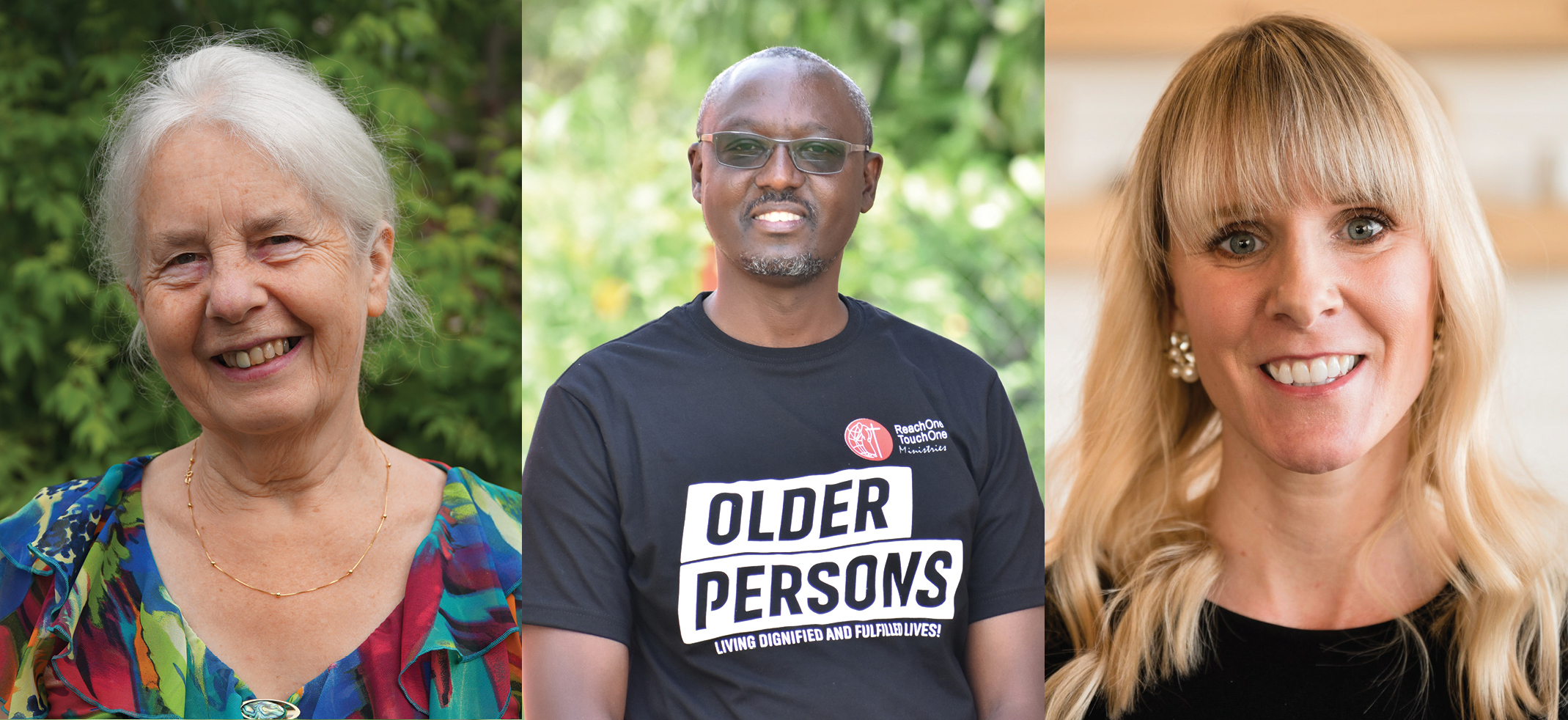
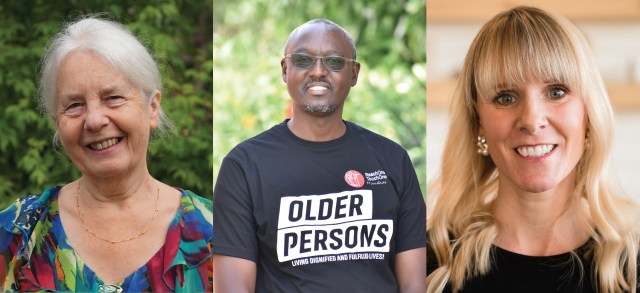 Source: Jennifer Bute, Kenneth Mugayehwenkyi, Stephanie Smith. Images used with permission.
Mark Wormell, 67, acting rector of St. Peter’s Anglican Church in Cremorne, Australia, began researching in 2016 how older adults, especially those with dementia, come to Christ. When he visited care facilities and spoke with chaplains, every person had stories of conversions.
He began to study the theology behind conversions within that demographic: What does faith look like for someone with dementia? What does repentance mean for those who can’t remember what they’ve done and are not that sure what is right or wrong?
He realized that repentance comes by the sovereign help of the Holy Spirit and doesn’t need to be articulate or detailed.
“It’s knowing that there is a God … that God loves you, and knowing that that God will care for you and that you are dependent upon him,” he said.
His professors encouraged him to publish his resulting paper, “Coming to Christ in Dementia,” as a book, but his classmates, 30 years his junior, wondered why he would even bother trying to lead people with dementia to Christ.
“It made me sick, as if they didn’t matter to God,” he said.
Today, Wormell continues to visit dementia wards at care facilities and run Communion services. Some of the people in the care home are blind. Some are deaf. But for those who have taken Communion all their lives, “they know what to do, even if their mind isn’t totally switched on,” he said.
When he approaches residents with a piece of bread or cup, they just reach out their hands. “They know they’re receiving something good from God.”
During one visit, Wormell explained to the residents that Communion was a meal for anyone who trusted in Jesus. As he brought the bread and cup around, one man named Peter said he had never taken Communion before. He considered himself a Christian but had never been a regular member of a church. He felt like an outsider there, so he had never gone forward. “It’s the first time that anyone had asked him to take Communion—at the age of 95—and he just sat there in tears,” Wormell said.
Kenneth Mugayehwenkyi of Mukono, Uganda, said working with seniors also helps other generations, as many grandparents care for orphaned grandchildren. In 2002, two orphaned girls approached Mugayehwenkyi’s wife, who worked for Compassion International in Seeta, Uganda, for help. Yet her current program was full. So Mugayehwenkyi, who was working as a social worker in the US at the time, started sending part of his income home to help them.


Later that year, he returned to Uganda to help rebuild the shack where the orphans lived with their 70-year-old widowed grandmother, Elizabeth. The girls’ parents had died of AIDS, and Elizabeth had no way to support herself or her granddaughters.
Then he met Elizabeth’s friends and found them in similar circumstances—raising the kids of their own dead children in their old age. Mugayehwenkyi changed his plans, and instead of seeking to move his family to the US, he moved back to Uganda. He began meeting weekly with these destitute grandparents to study the Bible and pray about their circumstances.
He noted that many nonprofits, government organizations, and ministries in Uganda invest money to reach children not only because they are vulnerable but also because of their potential. For Christian groups, children ages 4–14 are statistically more likely to embrace Christianity than other age groups are. Sometimes ministries use these children as success stories they can show to wealthy donors overseas.
Mugayehwenkyi believes that focusing only on children treats people like commodities, especially as the elderly also have great needs. Many widows and widowers are raising their orphaned grandchildren with few resources.
What started as a few grandparents meeting weekly quickly grew to dozens. He founded Reach One Touch One Ministries (ROTOM) in 2003 and started to provide food for hungry grandparents at the meetings, but they would save it to take home to their grandchildren. So his group began making extra food and providing containers so the grandparents could both eat and take leftovers home. His ministry began alternating home visits with group meetings, where the grandparents could share their stories and difficulties, study the Bible, and pray.
One member of his group died due to difficulty accessing a hospital to treat his malaria, so Mugayehwenkyi decided to open two clinics specifically for geriatric care. Mugayehwenkyi said the average age of the grandparents in his group has increased from 72 to 80 years old in a country where the life expectancy is 68.
When the program began in 2003, about 80 percent of the grandparents claimed they were Christians. But as Mugayehwenkyi got to know them, he found that only half truly believed in Jesus as their Lord and Savior.
Now, after 22 years of ministry, Mugayehwenkyi says at least 87 percent of the attendees have a relationship with Jesus and about 70 percent of them share their faith with other people in their lives. In these two decades, ROTOM has ministered to more than 2,000 older people—along with 600 orphans.
He noted that because many already consider themselves Christ-ians, they don’t think they need salvation. They take “a different path,” Mugayehwenkyi said. “It takes a relationship, sometimes over many years of trust.”
Back in Cheltenham, England, Bute or a member of her church leads a group of about a dozen people between the ages of 70 and 90 every Friday afternoon. Some of the attendees used to travel or knit. They remember their pets fondly. “But they’re more likely to mention life’s experiences that have been hard and how God fits into that than spend time talking about their interests,” Bute said.
Among dementia patients, familiar songs are important, since music memory is one of the last things to fade. So they sing either “It Is Well with My Soul” or “In Christ Alone” each week, as Bute believes those songs tell the story of the gospel. For many, the songs were initially unfamiliar, so Bute spent time telling them the backstory of the former and explaining the latter line by line. Now the songs have become firm favorites even for those with more advanced dementia.
After singing, the group discusses a topic that relates to their everyday lives. One recent topic was grace—the words we say at the table before we eat, the way we’re graceful in movement, and ultimately God’s grace to us in Christ. Not all participants are Christians—one woman comes just because she attends every activity at the care facility. Some of the staff members have Buddhist tendencies, but they have shown an increased interest as the weeks go by. “ ‘By all means, save some’—isn’t that what the Good Book says?” Bute asked (1 Cor. 9:22).
She noted that Mike, a 90-year-old attendee of the study, was virulently anti-God and “anti-everything.” Later they learned that he had a bad experience at his Catholic school.
Mike came to the Friday meetings for years but was “on the fence” about following Jesus. A few weeks ago, Walsh asked Mike if he was still on the fence. “I don’t think so,” Mike told him. Bute gave him an orange book with the Gospel of Luke interspersed with questions.
When I first scheduled an interview with Bute, she forgot our appointment. When we finally connected, she was apologetic but realistic about her forgetfulness. “I laugh over it,” she said. “I can’t help it, and there’s no point getting upset.” She added, “But with faith, I’m just grateful. I think I’ve learned more about God. I’m very grateful to God.”
Bute noted that since her diagnosis she has trusted God more. People ask her if she’s worried about her son who lives in Ukraine. “No,” she said. “All our days are numbered, and if he dies, then I shall be very upset, of course. But I know where he’s going, so I don’t need to worry about it. What good is worrying going to do? God’s important to me, and I trust him.”
Her faith in God amid hard circumstances has been a witness to those she lives with at the care facility: “We need to live close to God if we want to help other people find God,” she said.
Correction: An earlier version of this article misspelled Christina Hill’s name and misstated Smith’s involvement in the founding of Twilight Hope as well as the description of Mike’s experience at Catholic school.
Amy Lewis is a writer located in Geelong, Australia.
This article appeared in the January/February 2026 issue of Christianity Today as "The Silver Harvest".
Related