
Science fiction from my high school English class should have prepared me for a postliterate culture.
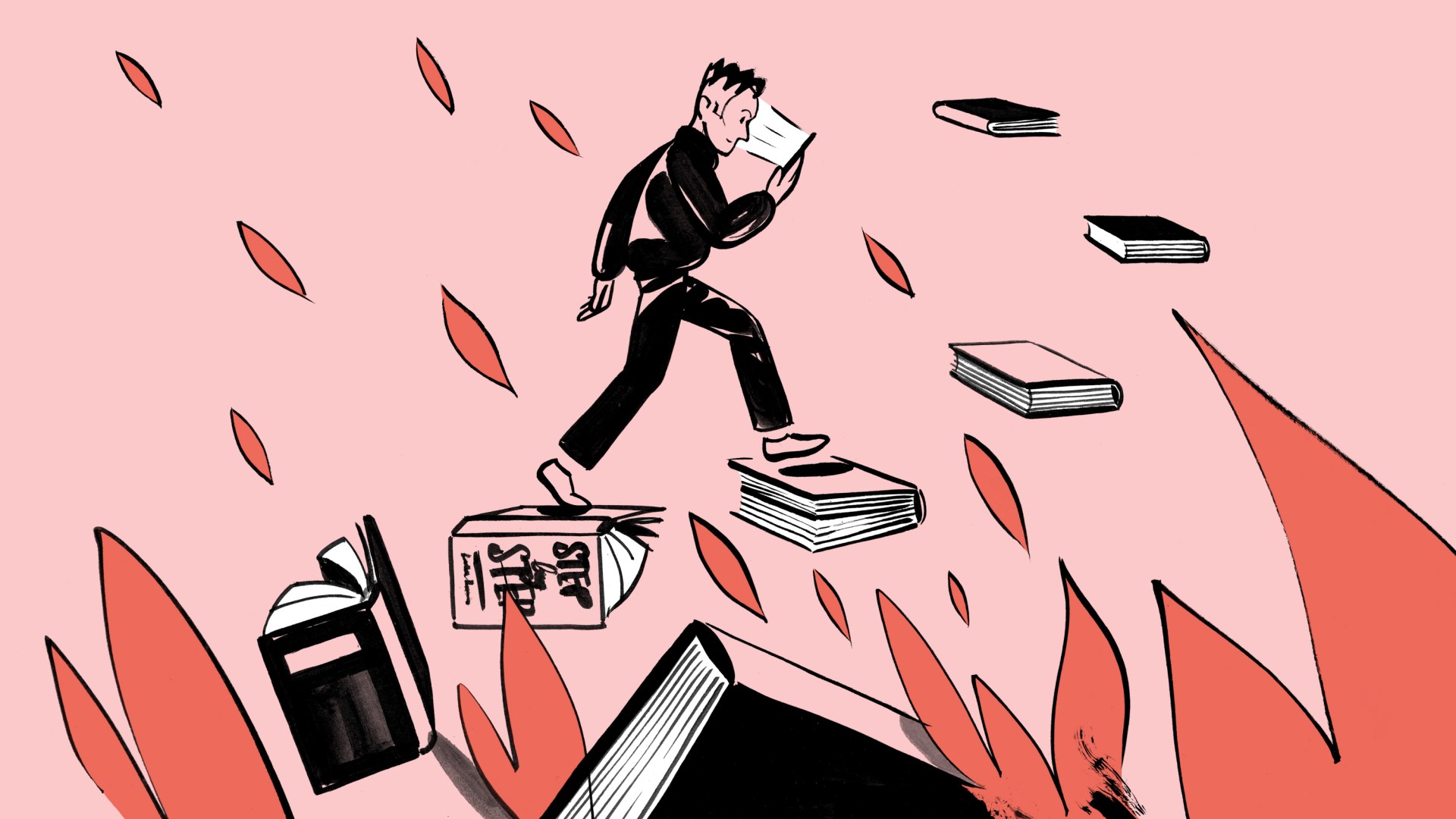
We were assigned to read Ray Bradbury’s Fahrenheit 451 and Walter M. Miller Jr.’s A Canticle for Leibowitz, both of which picture a dystopian future without written words. In those depictions, the enemy of books and reading is fire. Fahrenheit gives us an authoritarian regime employing “firemen” to find bootleg books and burn them in an attempt to keep the population docile. Leibowitz imagines a nuclear holocaust that incinerates human knowledge, leaving only a small band of monks to preserve scraps of civilization.
Today, the firemen are here.
Of course, the revolt against reading happened in a different way than Bradbury imagined—not imposed from the top down but embraced from the bottom up, nudged along not by government censors but by invisible algorithms. We click our way through short-form videos, chatbot summaries, and nonstop dopamine hits, each promising a new distraction every 29 seconds. No government needs to ban Fahrenheit 451 in high schools if students are satisfied with a synopsis on YouTube or ChatGPT. Our culture is full not of burned books but of unread ones.
Christians, the sort who read this magazine, will likely see this as a loss. The danger, though, is that we’ll simply sigh and say, “Well, what are we going to do?”—just as we’ve resigned ourselves to our own smartphone-addled attention spans. Many urge us to “meet people where they are,” even if that means a world without the sustained narrative of the book. There’s certainly wisdom in being present in every Areopagus, virtual or otherwise, from Twitch to TikTok. But to leave it at that would be a mistake.
Richard Mouw once compared Christian denominations and traditions to monastic orders, each devotee taking a vow to emphasize some aspect of the faith. Lutherans pledge themselves to justification by faith alone, Pentecostals to the power of the Spirit. Among these, evangelicalism’s vow is to guard the gospel’s emphasis on the personal.
It is not enough that the church is holy, we say—each Christian must be born again. God loves the world, yes, but also “Jesus loves me.” The Scriptures anchor the whole church, but they also shape the heart of each person.
Even if everyone else forgets it, evangelicals should be those who create generation after generation of people “examining the Scriptures daily to see if these things were so” (Acts 17:11, ESV throughout). That kind of discipleship requires more than knowing how to search a Bible app for a verse on anxiety or guilt. It requires immersion in the story line of Scripture—like Jesus in the wilderness, wielding Deuteronomy in a way that showed he knew precisely where he was in the story.
Such inward familiarity happens only when people learn to sit still long enough to read, to reflect, to internalize. Without that interior encounter, Christianity devolves into a tribal chanting of slogans, the very thing the gospel came to disrupt.
In an oral or digital-oral culture, truth is often collective and performed. But the gospel presses further in. It calls not just for a crowd’s assent but for a conscience’s recognition. When Jesus asked, “Who do you say that I am?” (Matt. 16:15), he wasn’t polling all of Galilee. He was summoning Peter. Personal Bible reading is not just piety—it’s the soil in which that question can be heard and answered.
Paul told Timothy, “Continue in what you have learned … how from childhood you have been acquainted with the sacred writings, which are able to make you wise for salvation through faith in Christ Jesus” (2 Tim. 3:14–15). That wisdom was not tribal knowledge but rather Scripture lodging in the mind and heart. The shift to reading—a shutting out of noise in order to listen inwardly—makes possible a faith that is not inherited like folklore but encountered as Word.
So what is to be done?
A generation ago, Wendell Berry noted that language was being hollowed out by those who mistook the practical for the immediate. “For such people a strip mine ceases to exist as soon as the coal has been extracted,” he wrote in his essay “In Defense of Literacy.” “Short-term practicality is long-term idiocy.”
This idiocy is spurred along, he said, by language reduced to marketing and propaganda. “What is our defense against this sort of language—this language-as-weapon? There is only one. We must know a better language.”
I am a biblical conservative, meaning that I believe the Bible is true not just in its broad themes but in its very words. Many of us have rightly defined such conservativism in terms of biblical authority, infallibility, and inerrancy. But we are not biblical conservatives if we conserve concepts about the Bible without cultivating the attention spans we need to read it.
The firemen have been here before. When King Jehoiakim grew angry at Jeremiah’s warnings, he took the prophet’s scroll, hurling it into the fire. God’s response was simple: Write it down again (Jer. 36:23, 28). The ensuing act of resistance was not dramatic:
Then Jeremiah took another scroll and gave it to Baruch the scribe, the son of Neriah, who wrote on it at the dictation of Jeremiah all the words of the scroll that Jehoiakim king of Judah had burned in the fire. (v. 32)
At the end of Fahrenheit 451, the ex-fireman protagonist finds a band of resisters, each of whom has memorized a book—Plato’s Republic, Lord Byron’s poems, Ecclesiastes. They embody those words in their minds, ready to pass them down, hoping that the world will listen. “If not, we’ll just have to wait,” one of them says, “and let our children wait, in turn, on the other people. … And when the war’s over, some day, some year, the books can be written again.”
So too with us. We can study and embody what it means to know and love the Bible. We can relearn the habits of quieting the mind, opening the page, and asking, “What saith the Lord?” We can write the words down again, for our children and for theirs, even if the wider culture yawns.
The very idea of the book is burning down all around us. But this one book, our Book, is a story inhabited by God himself. Even as it burns, it is not consumed. And out of the fire, if you listen carefully enough, you can still hear a voice.
Russell Moore is editor at-large and columnist at Christianity Today and leads its Public Theology Project.
This article appeared in the January/February 2026 issue of Christianity Today as "The Bible is Burning".
Related