
Ryan Burge “stumbled” into ministry, as he put it. He left the pastorate with his church in decline, but he has not yet given up on reviving religion in America.

Burge is a sociologist who has carved out a nearly singular online profile as a prominent purveyor of charts and graphs about religious life in America. In his new book, The Vanishing Church: How the Hollowing Out of Moderate Congregations Is Hurting Democracy, Faith, and Us, he reveals more of the man behind the numbers than usual in this data-driven but heartfelt (and heart-wrenching) narrative of religious change and decline in American life.
Readers rarely hear from pastors whose work in pastoring comes to, in Burge’s words, an “unceremonious end” or who describe their own two decades of ministry as an “abject failure” when assessed by “traditional metrics of attendance, number of baptisms, and giving.” Pastors of 50-member churches rarely get book deals (as Burge has). Yet not many pastors of 50-member churches have shaped the way thousands of academic, religious, and civic leaders think about religion and society. Though Burge may be uniquely positioned to write this book, his pastoral experience is not unique.
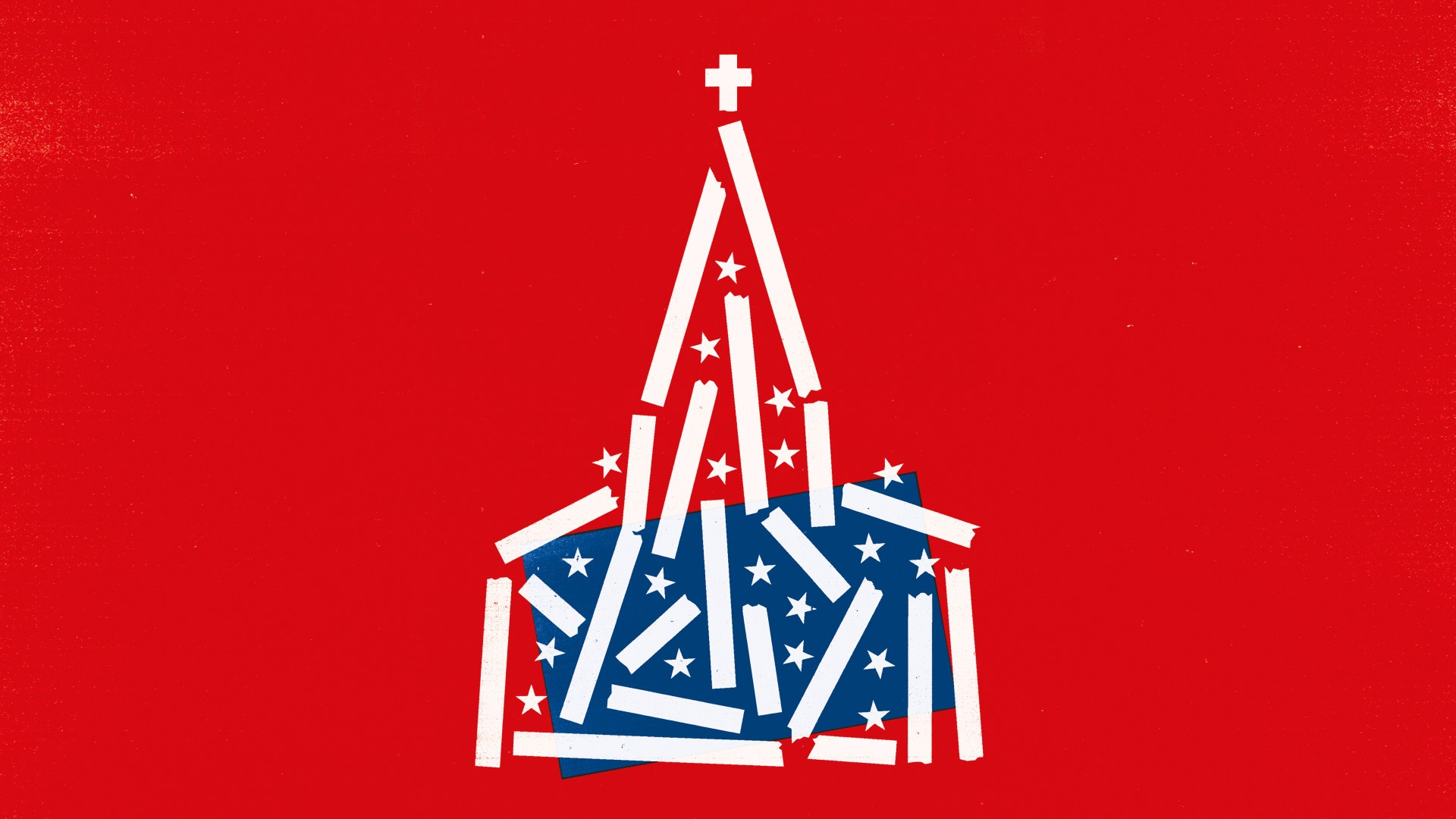
What Burge mourns is not just the decline of his church but the “hollowing out” of American religious life as a place to belong before believing. Forty years ago, he observes, “there was a place to feel welcomed and embraced no matter how much or how little one believed in Jesus Christ that particular Sunday—or how one cast their ballot on Election Day. But that’s no longer the case.”
Instead, Burge argues that “American religion has become an ‘all or none’ proposition—conservative evangelical religion or none at all.” This, then, “leaves tens of millions of theological and political moderates with no place to find community and spiritual edification, or to work collectively to solve societal problems”—effectively religiously homeless. He widens the lens, surveying five decades of religious fracturing and polarization, focusing on evangelicals, mainline Protestants, Catholics, and the religiously unaffiliated.
Burge’s discussion of evangelicals will be particularly interesting to readers of Christianity Today. The height of evangelical identification in America occurred during the 1990s, when American evangelicals were the least politically polarized they’ve ever been. Specifically, evangelicals’ “numerical peak” in 1993 occurred when 3 in 10 Americans identified as evangelical. This was also when they were the most politically diverse and when their political affiliation was fairly evenly split between the Democratic and Republican parties.
How convenient it would be for Burge to argue that the more polarized evangelicals become, the less they attract and retain adherents. But that’s not what he sees in the data. He affirms the exceptional resilience of American evangelicalism in the context of broader religious decline. The polarization of American evangelicalism over the past three decades may have contributed to its broader decline, but as Americans have increasingly identified Christianity with a particular political ideology, culture, and aesthetic, Burge is clear that the data “doesn’t suggest that becoming more politically conservative equated to a net negative for evangelicalism’s share of the population.”
What Burge does argue, as I have said elsewhere, is that Americans, including evangelicals, increasingly look to their churches to affirm their political views: “There are people who have begun attending evangelical churches more for their partisan leanings than their theological views.”

Evangelicals should be wary of a dynamic in which people go to politics to get their spiritual needs met and go to church to get their political views affirmed. We may think it’s a happy coincidence—or, worse, an intrinsic fact—that Christianity maps onto a specific political ideology, but if we are attentive, we might find that our political ideology is eating our theology for breakfast.
How did we get here? Burge turns his attention to what he calls the “Big Church Sort”: naming the cultural fault lines that lead to a siphoning across political and socioeconomic divides. Socioeconomically, he contends that “religious practice has become a thing of privilege,” as higher education and income relate to increased church attendance and religious commitment.
Culturally, Burge sees the 1990s as the hinge point for the Big Church Sort. “Between 1991 and 1998,” Burge writes, “the share of eighteen- to thirty-five-year-olds who said that they had no religious affiliation went from 8.1 to 20.5 percent, while the share who were Christians dropped from 87 to 73 percent.” Religion became polarizing, Burge argues, and moderation became viewed as a liability.
While the Religious Right polarized religion—not just politics—in a way that favored evangelicalism, this polarization harmed Christianity overall, demographically speaking. According to Burge, the Religious Right “absolutely led to a surge in the share of Americans who aligned with an evangelical tradition, but it also led to a rapid weakening of other major Protestant denominations, and it pushed a growing number of Americans, especially young adults, to no longer align with any religious tradition at all.”
Major technological and global shifts in the ’90s likely contributed to America’s religious decline, including the end of the Cold War (and thus the need for American leaders to strike a contrast with the Soviet Union and “godless communism” with affirmations of the centrality of religious virtue in America), as well as the widespread availability of the internet. Whatever the reasons, the decline of religion in 1990s America, and especially the disappearing of the religious middle, is central to understanding religious life in America today.
Given that religious commitment of any kind is less common today, Burge suggests that shared interests and understanding are more likely to emerge among people who practice religion in any form, even different faiths and traditions.
This does not minimize or erase the significance of the differences between those varied religious traditions—between Christianity and Islam, for instance. But in civic life, people who hold religious commitments of any kind might increasingly find that the very nature of being religious results in similar interests and experiences. Indeed, diverse religious groups already collaborate to promote and protect religious freedom in the courts.
Of course, while we lament the decline in religious practice and a rise in religious disaffiliation, America still remains an exceptionally religious nation. “About 85 percent of Americans believe in God in some way, over 60 percent of Americans identify with a Christian tradition, and 55 percent of adults attend religious services at least once a year,” Burge writes. It is hard to think of any meaningful characteristic more Americans hold in common than religious adherence.
We cannot think about the future of American democracy without thinking about the future of faith in this country. In this book,Burge solidifies his standing as one of the leading scholars who will help us do just that.
As he closes the book, Burge passionately pleads for readers to identify “fringe beliefs”—positions not held by a significant percentage of the public. He encourages readers to reject using those beliefs, or political processes, to impose unpopular views or engage in “burn it all down” nihilism.
Burge encourages Americans to willingly participate in religious communities that do not perfectly fit or affirm their political views and to resist a tribal approach to politics, noting how siloed churches can dehumanize others. As his analysis of religious decline heavily focuses on lost social capital, Burge’s case for returning to faith relies on a recognition of its personal and civic benefits. It is a case worth making, and I hope it is heard by those who believe religion does more harm than good.


Yet his case for returning to religion is insufficient. For one, Burge argues for a religious future on the grounds that are not all that religious. It may be that “the fate and future of American democracy” are at stake when we consider Americans belonging to a local religious institution, but I am doubtful Americans will make their way to a local church to save democracy—nor should they.
Democracy might require the return of religion, but the return of religion cannot be motivated by democracy or political needs of any kind. For Americans to return to the religious middle, the religious middle must rediscover their own sense of confidence, commitment, and conviction in Christian belief itself. While Burge emphasizes the value of the religious middle as a home for those who doubt, who aren’t quite “all in,” I am not sure this is viable or advisable.
The problem for Burge, it seems, is that mainline churches were too reasonable, victims of a polarizing politics and a “branding problem.” Burge affirms the analysis of scholars Dean Kelley and Larry Iannaccone, whom he summarizes, saying, “Mainline churches have tried to be too many things to too many people.”
While evangelicals “often place a strong emphasis on regular attendance and consistent engagement,” Burge writes, “the same is not often the case for mainline Protestants.” He does not offer a clear correction of this disposition.
It is insufficient to value Christianity solely for what it contributes to the well-being of Americans and their communities.
While the church should have room for people who struggle with doubt, churches should not be organized to affirm and encourage doubt. Although pastors do not need to act as if they have all the answers, Christianity offers not just good works but knowledge about reality. Churches should permit doubt without anxiety or penalty, and those who struggle with doubt should receive understanding and care, buoyed by the faith of those around them. Doubt can be a terrible thing—it should not be confused with humility.
The reason local congregations can bring together people across differences is Christ, who holds them together in shared love of God. This, too, is dogma.
The immense social capital local churches produce, so thoroughly documented by Burge in this book, is not the cause of the local church, but its effect. The civic contributions of local churches and the Christians who make them up must flow from their rootedness in the life and gospel of Jesus Christ.
The Vanishing Church is a valuable, provocative book. It will help clarify beliefs concerning the role of the church and both personal and communal expressions of faith, as well as Christianity’s relevance to American society. Whether or not one agrees with Burge’s prescriptions, the book helpfully complicates preferred narratives across political and religious spectra.
For those who celebrate the decline of religious attendance, Burge forces them to count the costs of this development, including the social and civic losses it entails. For those who mourn this decline, Burge demands that we acknowledge America’s broad exceptionalism when it comes to Christianity, especially considering that the 20th century relied on a broad Christ-ian diversity of tradition, politics, and even conviction.
Even with Burge’s own doubts and discomforts, he continues to tell the story of faith within this country, making his case for the good it contributes one graph and data point at a time.
Michael Wear is the president and CEO of the Center for Christianity and Public Life and author of The Spirit of Our Politics: Spiritual Formation and the Renovation of Public Life.
This article appeared in the January/February 2026 issue of Christianity Today as "The Hollowing Out of American Religious Life".
Related