If we are honest, many of us do not know what to do with Holy Saturday.
Good Friday is terrible, but it is also dramatic and full of passion. Easter Sunday is triumphant, radiant, and full of song. But Holy Saturday is quieter and thus harder for us to inhabit. It asks us to remain near the tomb and to resist the urge to hurry toward resurrection before we have reckoned with the weight of Christ’s death and burial .
The Apostles’ Creed confesses that Jesus “was crucified, died, and was buried; he descended to the dead,” while the Nicene Creed declares that the eternal Son “became man” and, for our sake, “suffered death and was buried.” We should not mistake these as spare liturgical phrases placed between cross and resurrection merely to mark the passage of time between Friday and Sunday. They are the church’s way of insisting that the gospel is anchored in history, with a real flesh and blood body in a real tomb.
From the beginning, Christians have had to answer those who tried to make Christ’s humanity into a phantom thing. Docetists claimed that Jesus only seemed to have a real body and only appeared to suffer and die. Basilides taught that Simon of Cyrene was crucified in Jesus’ place. Even Apollinaris, seeking to protect Christ’s divinity, diminished Christ’s full humanity by denying him a rational human soul. Each heresy originated as an attempt to escape the reality of the Son of God lying dead in a tomb. Yet, against all such evasions, the creeds teach the church to say plainly what Scripture declares: The Son of God truly took our nature, truly entered our sorrow, truly passed through death, and truly lay in the grave.
Even so, this is the part of the story we are often tempted to rush past. We move quickly from the agony of Good Friday to the alleluias of Easter morning, as though the silence of the tomb were only an inconvenience between sorrow and joy. We prefer resurrection in full bloom to the hard fact that our Savior lay in the grave. But the church, at its best, lingers here.
On Holy Saturday, the church confesses that the Lord of life entered death itself, so that by going all the way down into our mortal condition, he might raise us up with him. It teaches us not to avert our eyes from the burial of Christ, because only those who have learned to keep watch at the tomb on Saturday will feel the full wonder of the stone rolled away on Sunday.
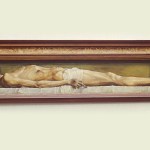
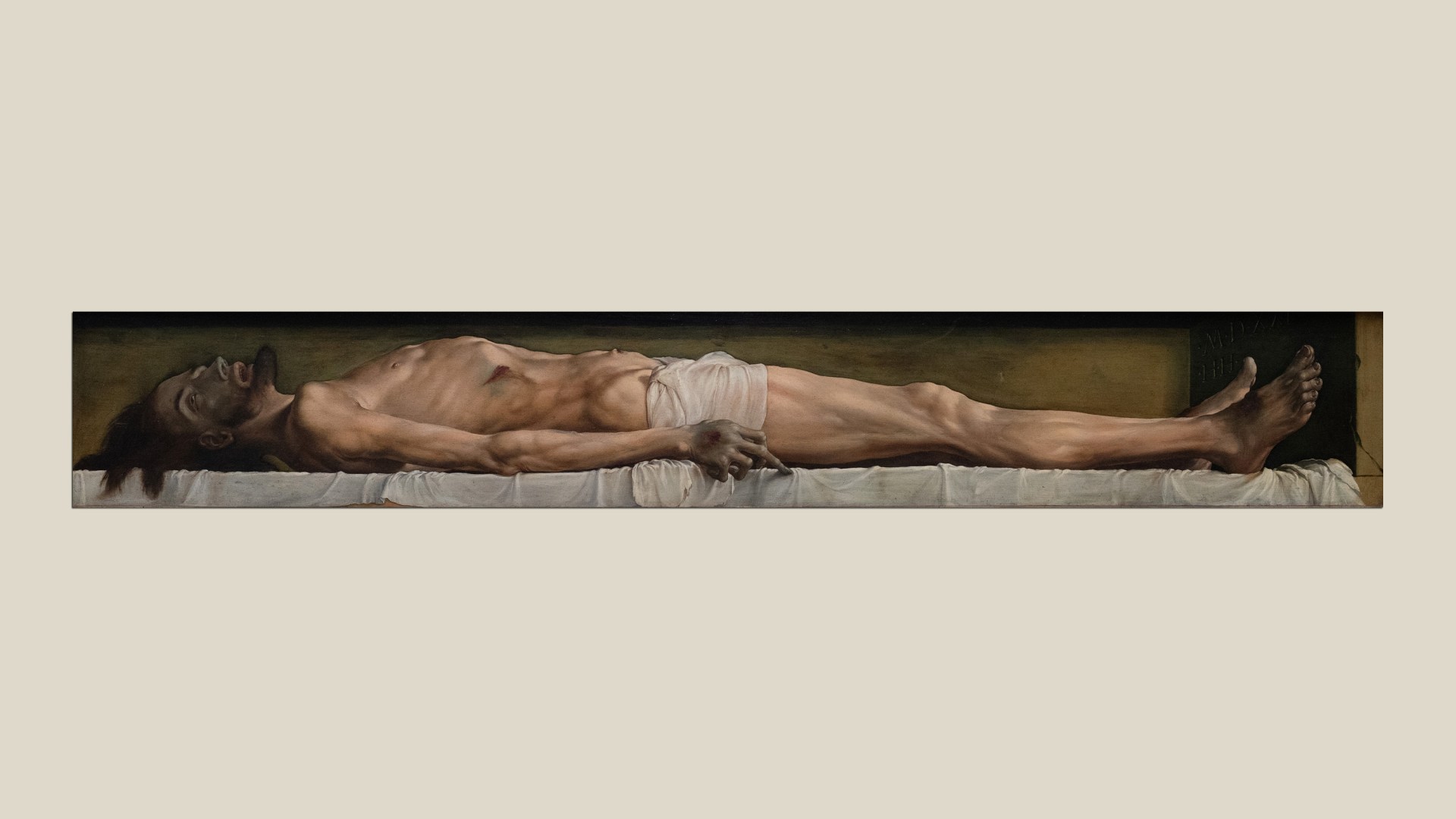
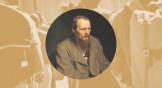
That instinct to rush from cross to empty tomb helps explain why Hans Holbein the Younger’s painting The Body of the Dead Christ in the Tomb struck the Russian writer Fyodor Dostoevsky so deeply. Holbein was a 16th-century German painter of the Northern Renaissance, remembered for his striking realism and unsparing eye for detail. Dostoevsky, the great 19th-century novelist, was famous for his exploration of themes of suffering, doubt, guilt, and the hard-won hope of Christian faith.
When Dostoevsky saw Holbein’s painting in 1867, according to the later recollection of his wife Anna, he stood before it as if transfixed, and she feared the shock might provoke one of his epileptic seizures. This story has been told and retold so often that it now feels almost legendary. But the deeper point is not that Holbein nearly destroyed Dostoevsky’s faith but that this painting forced Dostoevsky to look straight at one of Christianity’s hardest claims: that God entered death fully before conquering it.
I believe that is why Holbein’s painting impacted Dostoevsky so deeply. The painting does not soften the death of Jesus. It offers no halo of serenity, no early hint of Easter radiance. Art historians and theologians alike have noticed the same thing: Holbein refuses the pious instinct to make death look already defeated. Christ’s face is not peaceful. It is lifeless and spent. Holbein does not preserve what scholar Mia Mochizuki calls the “comfortable fiction of sleep.” Rather, he chooses to present Christ as unmistakably dead, and the painting’s long, narrow format makes the tomb feel claustrophobic, almost coffin-like. Christ’s body is gaunt, wounded, discolored, and hemmed into the narrow confines of the tomb. Put plainly, Holbein paints what Christian confession requires, though Christian sentiment sometimes resists: If Christ truly took our nature, then he truly entered our mortality. When Holbein paints Christ in the tomb, he paints a corpse.
Dostoevsky was never interested in a Christ sheltered from the raw conditions of human life. He was drawn instead to the God-man who entered them fully. J. I. Packer captured something essential about Dostoevsky’s imagination when he described its recurring burden as “the nightmare quality of unredeemed existence and the heartbreaking glory of the incarnation.” Holbein seems to hold both in a single frame. That is what made the painting so important to Dostoevsky. He had little patience for sentimental religion. He distrusted every version of faith that tried to speak of redemption without grief, repentance, suffering, or grace. Ernest Gordon put it well, too, when he said that Dostoevsky’s “hosanna of faith was hammered out on the anvil of doubt.” Holbein’s dead Christ belongs on that anvil. The painting gave visible form to one of the most searching questions a believer can face: What can faith say when the eye sees only death and defeat?
Dostoevsky returned to that question repeatedly, but nowhere more memorably than in The Idiot, his novel of innocence, suffering, and belief in a world too damaged to know what to do with goodness. At the center of the novel stands Prince Lev Myshkin, a man whose gentleness, honesty, and almost childlike openness make him seem foolish in the eyes of a society schooled in vanity, calculation, and appetite. He enters a world of damaged souls, restless desires, and spiritual confusion, and one of the clearest signs that this is no mere social novel is Dostoevsky’s decision to place a copy of Holbein’s dead Christ in the house of Parfyon Rogozhin, Myshkin’s dark rival and double. Rogozhin is wealthy, obsessive, and possessed by a destructive love that draws much of the novel’s violence into itself. As the publishers of The Gospel in Dostoevsky note in their introduction to this work, in such a house, the painting feels like a silent theological challenge, fittingly lodged in a place shadowed by jealousy, possession, and despair.
Again and again, the image radiates outward through the novel’s spiritual atmosphere. When Myshkin sees it, he recognizes at once the danger it poses. Myshkin sees right away that this is not a pious image that gently leads the soul upward. It is an image that presses the viewer down into the scandal of the tomb. The image depicts a Christ in the stark humiliation of death itself, stripped of even the dignity of sacred sorrow. In this way, it is a perfect foundational image for the novel, because in the fictional world of The Idiot, Dostoevsky is exploring the idea of what happens when goodness enters a world that has lost the capacity to receive it. As Sarah J. Young argues, Holbein’s Christ is not incidental in The Idiot. It is central to the novel’s theological architecture.
The protagonist, Myshkin, for all his tenderness and pity, moves through the story almost as a Christ-haunted presence, yet again and again his goodness seems only to expose the sickness around him. In that sense, Holbein’s painting becomes an emblem of the novel’s deepest tension: Can holiness survive contact with a world bent on deforming whatever is pure?
Then comes the meditation of Ippolit, a brilliant and bitter young man dying of illness, who speaks with the desperation of someone already staring into the grave. Looking at Holbein’s Christ, he sees in it only “nature,” only the body of a man crushed by torture and subjected to physical decay. And from that sight comes the dreadful question: “If Christ’s disciples had seen such a body, how could they possibly have believed he would rise again?” It is one of the sharpest statements of the modernist spiritual crisis that plays out in so many of Dostoevsky’s works. If nature is all, then beauty is crushed, innocence is crushed, and Christ himself is crushed. In Ippolit’s imagination, Holbein’s painting becomes a picture of a world ruled by impersonal force, a world in which even the best and holiest life can be broken and thrown aside.
Dostoevsky lets that possibility speak in all its bitterness because he knew how plausible it had become. He does not silence the modern voice of despair with quick religious slogans. He allows it to speak fully, and then he places it within a novel where pity, innocence, guilt, longing, and love continue to bear witness to realities that nature alone cannot explain. That is part of what makes Holbein’s painting so important across The Idiot. It hangs over the whole book like the atmosphere of Holy Saturday, teaching the reader how to inhabit the terrible interval between death and resurrection, between the collapse of visible hope and the possibility that grace has not yet said its last word.
Holy Saturday is the day between promise and sight. Good Friday has done its work. Easter morning has not yet dawned. The body of Jesus lies in the tomb, and the church waits in silence. It is the day when believers must reckon with the full weight of Christ’s death before they can speak of resurrection. Holbein paints that day with unnerving severity. And Dostoevsky understood, perhaps better than most modern writers, that many people live much of their lives there.
People rarely lose faith first in the seminar room. More often they lose it at the graveside, in the hospital room, in the prison cell, in the long aftermath of betrayal, in the spectacle of innocent suffering, or in the slow realization that the world does not seem arranged for justice. Holbein gave Dostoevsky an image for that crisis. Dostoevsky, in turn, made it part of his lifelong witness that Christian faith must be sturdy enough to stand before the tomb and still confess Christ.
That is why the painting did not make Dostoevsky less Christian. It made him less sentimental. It drove him toward a sterner, deeper theology of incarnation, passion, and resurrection. It confirmed that Christianity cannot be an anesthetic, an ideology, or a moral improvement program for the already capable. It is the announcement that the Son of God has entered the grave itself and come out the other side in victory.
In the end, Holbein’s dead Christ did not drive Dostoevsky away from the gospel. It drove him deeper into it. The painting stripped away every religious nicety and forced him to reckon with the awful realism of redemption: The Son of God truly took our flesh, truly bore our griefs, truly suffered under the curse, and truly entered the darkness of death.
But that is not the end of the Christian story. Holy Saturday gives way to Easter. The body Holbein painted so starkly is the body that did not remain in the tomb. The one who lay there cold and lifeless is the same Lord who rose in glory on the third day. That means the gospel speaks not only to the tasteful and the composed but also to the guilty, the grieving, the doubting, and the undone.
Christ has gone all the way down into the worst we fear, and he has come back with death’s keys in his hand. Because he truly died, sinners can truly live. Because he entered the grave, the grave is no longer the end. And so, even in a world that often looks as bleak as Holbein’s painting, the church still dares to say that Jesus Christ is risen, mercy is stronger than judgment, and the light shines in the darkness, and the darkness has not overcome it.
Hardin Crowder is pastor of Dover Baptist Church in Manakin-Sabot, Virginia. He writes regularly on art and faith on his Substack, This Blessed Plot.