The twentieth century showed us, through every decade and in terrifying living color, how easily we humans succumb to mass hysteria or propagandist group-think. Left and right, religious and atheist, fascist and communist, first and third world: given enough fear, and an attractive enough human savior, we are capable of genocide, ignorance, hatred, and cruelty that, by geographic or chronological distance, seems insane, irrational, bizarre.
Perhaps the most vivid of these instances is the Holocaust. What could have made not just power-mad politicians, but ordinary citizens and churches assent to or just ignore genocide?
While filmmakers have tried to deal with this question (for instance, in last year’s The Reader), Michael Haneke’s The White Ribbon—winner of the prestigious Palme d’Or at the 2009 Cannes Film Festival—eschews heavy-handed moralizing in favor of an austerely told story (parable? dream? twisted fairy tale? truth?) set in the last few days before Archduke Ferdinand is assassinated and World War I begins.

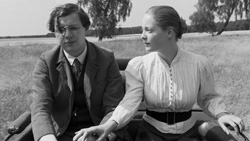
The tale is purportedly told to “explain later events,” though the narrator warns us that he’s not sure he’s got all the details right. A small, quiet town in Germany is populated by farmers and their families who work for the Baron, a genial sort of boss with a wife, an adorable son, and twin baby girls. One day, the town’s doctor is out riding his horse across his land when the horse trips over a wire strung between two trees. The doctor is badly injured and forced to stay in the hospital, but the woman next door—the town’s midwife and the doctor’s assistant, who has a young mentally disabled son—takes care of his children. The wire mysteriously disappears a few days later.
What seems like an isolated incident develops into a series of progressively more bizarre cruelties—kidnappings, beatings, fires, and more. Curiously, nobody seems to be putting too much energy into investigating the crimes.
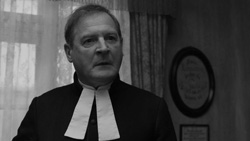
Meanwhile, the town’s schoolteacher (and our narrator) falls in love with the new girl in town, who is working as a nanny for the Baron’s twins. He is occupied with his love, but also troubled by the crimes happening in the town, and by the strange and sometimes inexplicable actions of his students, especially the minister’s two oldest children. As the events grow stranger, so do the explanations.

Haneke’s films always contain, more or less, a growing sense of dread executed with an exquisite, almost tortuous restraint. The actual acts of violence typically take place off-screen. While Haneke’s films can be, quite literally, torture (consider his twice-made Funny Games), they are not “torture porn” in the usual sense of the term (like Eli Roth’s Hostel series). There is something much more psychologically terrifying in these films.
One could probably read the story as just another heavy-handed critique of church authority, but to do so would be to jump to conclusions and overlook the layers of this story. As in his film Cache, Haneke seems to leave us to identify the perpetrators according to how we interpret the circumstances—and he doesn’t give us any help. Nothing lines up, and when the narrator’s view into the situation ends, so does ours.
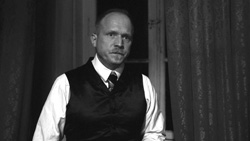
The titular ribbon is a physical one, tied by parents onto their children to remind them to obey and act rightly. (Whether or not it works is another manner.) This surface of innocence is echoed in the film’s plainly framed black-and-white cinematography, which appear to show us everything that’s occurring while, we come to realize, obviously obscuring or ignoring details.
The White Ribbon throws us continually off balance, veering from the strange happenings to engage us in a conversation while the real action is happening elsewhere. We are always too late to the scene, seeing nothing, understanding little. It’s maddening, but also addictive: maybe, as this story slowly unwinds with no discernable conclusion, we will discover what’s going on.
But The White Ribbon gives no easy answers, no reductive conclusions. It simply looks deeply at the cruelty the human heart is capable of, and leaves us to ponder the rest. We can only imagine what happens after the credits roll.
Talk About It
Discussion starters- Who do you think was perpetrating the terror? Did your opinion change over the course of the movie? If so, what changed it?
- Besides the problems in the village, there are many other cruelties inflicted throughout the film. How does the withholding or giving of knowledge to the audience affect the way we look at characters? How does this mirror real life?
- Do you think you could ever be swept into cruelty? What do you think makes it so easy? Read Jeremiah 17:5-10.
The Family Corner
For parents to considerThe White Ribbon is rated R for some disturbing content including violence and sexuality. All the violence takes place off screen. Two characters discuss a father who is sexually abusing his daughter. Some of the violence in the narration happens to young children; a small mentally disabled child is cruelly treated and we see the evidence. A man and woman have sex, but we see nothing except their movements. A father discreetly but inaccurately discusses the perils of masturbation with his young teenage son, who is punished for the act.
Photos © Sony Pictures Classics
Copyright © 2009 Christianity Today. Click for reprint information.