
The Gospel Flourishes In The Ussr’S Second Largest City
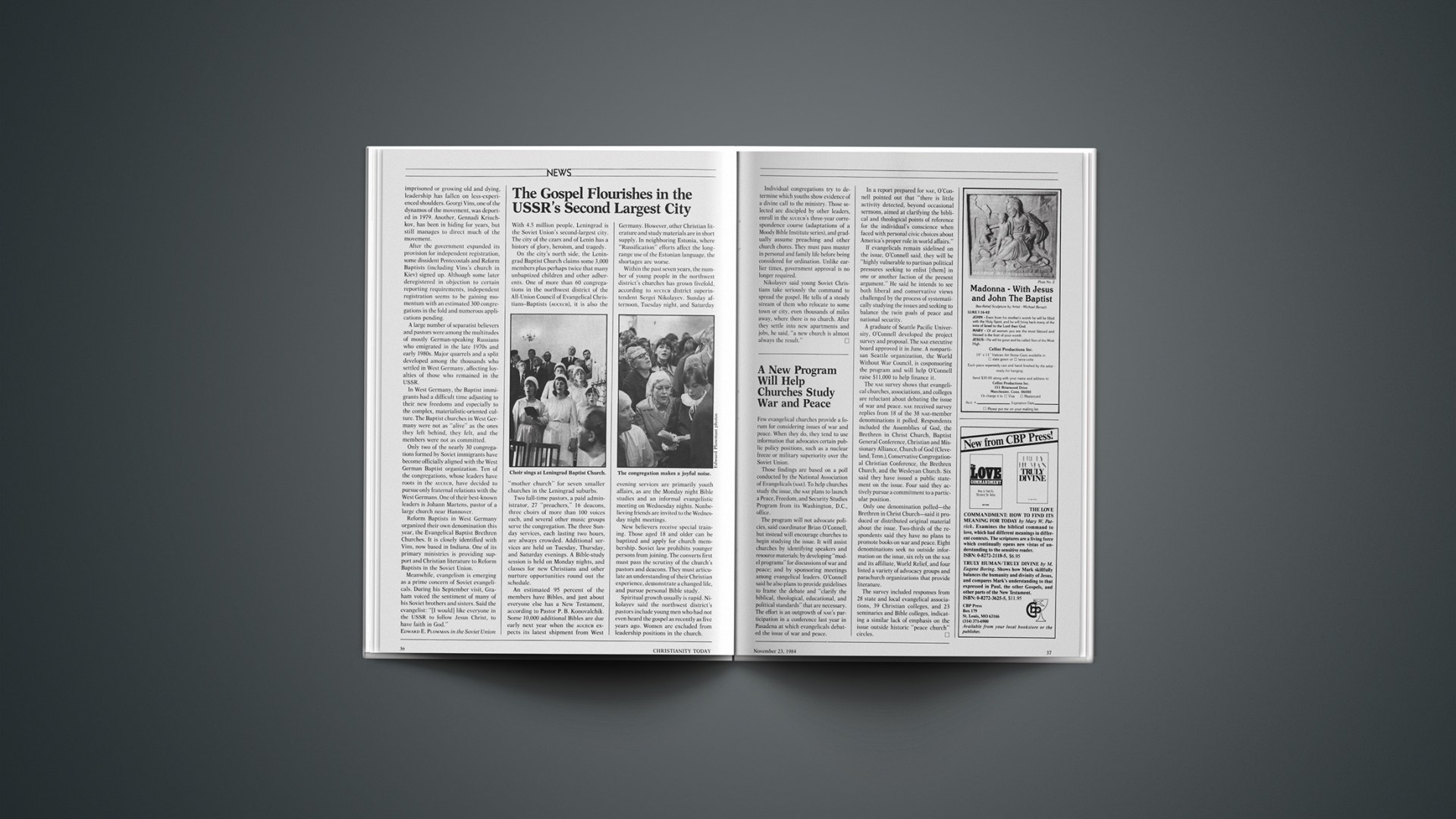
With 4.5 million people, Leningrad is the Soviet Union’s second-largest city. The city of the czars and of Lenin has a history of glory, heroism, and tragedy.
On the city’s north side, the Leningrad Baptist Church claims some 3,000 members plus perhaps twice that many unbaptized children and other adherents. One of more than 60 congregations in the northwest district of the All-Union Council of Evangelical Christians-Baptists (AUCECB), it is also the “mother church” for seven smaller churches in the Leningrad suburbs.
Two full-time pastors, a paid administrator, 27 “preachers,” 16 deacons, three choirs of more than 100 voices each, and several other music groups serve the congregation. The three Sunday services, each lasting two hours, are always crowded. Additional services are held on Tuesday, Thursday, and Saturday evenings. A Bible-study session is held on Monday nights, and classes for new Christians and other nurture opportunities round out the schedule.
An estimated 95 percent of the members have Bibles, and just about everyone else has a New Testament, according to Pastor P. B. Konovalchik. Some 10,000 additional Bibles are due early next year when the AUCECB expects its latest shipment from West Germany. However, other Christian literature and study materials are in short supply. In neighboring Estonia, where “Russification” efforts affect the long-range use of the Estonian language, the shortages are worse.
Within the past seven years, the number of young people in the northwest district’s churches has grown fivefold, according to AUCECB district superintendent Sergei Nikolayev. Sunday afternoon, Tuesday night, and Saturday evening services are primarily youth affairs, as are the Monday night Bible studies and an informal evangelistic meeting on Wednesday nights. Nonbelieving friends are invited to the Wednesday night meetings.
New believers receive special training. Those aged 18 and older can be baptized and apply for church membership. Soviet law prohibits younger persons from joining. The converts first must pass the scrutiny of the church’s pastors and deacons. They must articulate an understanding of their Christian experience, demonstrate a changed life, and pursue personal Bible study.
Spiritual growth usually is rapid. Nikolayev said the northwest district’s pastors include young men who had not even heard the gospel as recently as five years ago. Women are excluded from leadership positions in the church.
Individual congregations try to determine which youths show evidence of a divine call to the ministry. Those selected are discipled by other leaders, enroll in the AUCECB’s three-year correspondence course (adaptations of a Moody Bible Institute series), and gradually assume preaching and other church chores. They must pass muster in personal and family life before being considered for ordination. Unlike earlier times, government approval is no longer required.
Nikolayev said young Soviet Christians take seriously the command to spread the gospel. He tells of a steady stream of them who relocate to some town or city, even thousands of miles away, where there is no church. After they settle into new apartments and jobs, he said, “a new church is almost always the result.”