
SUPREME COURT
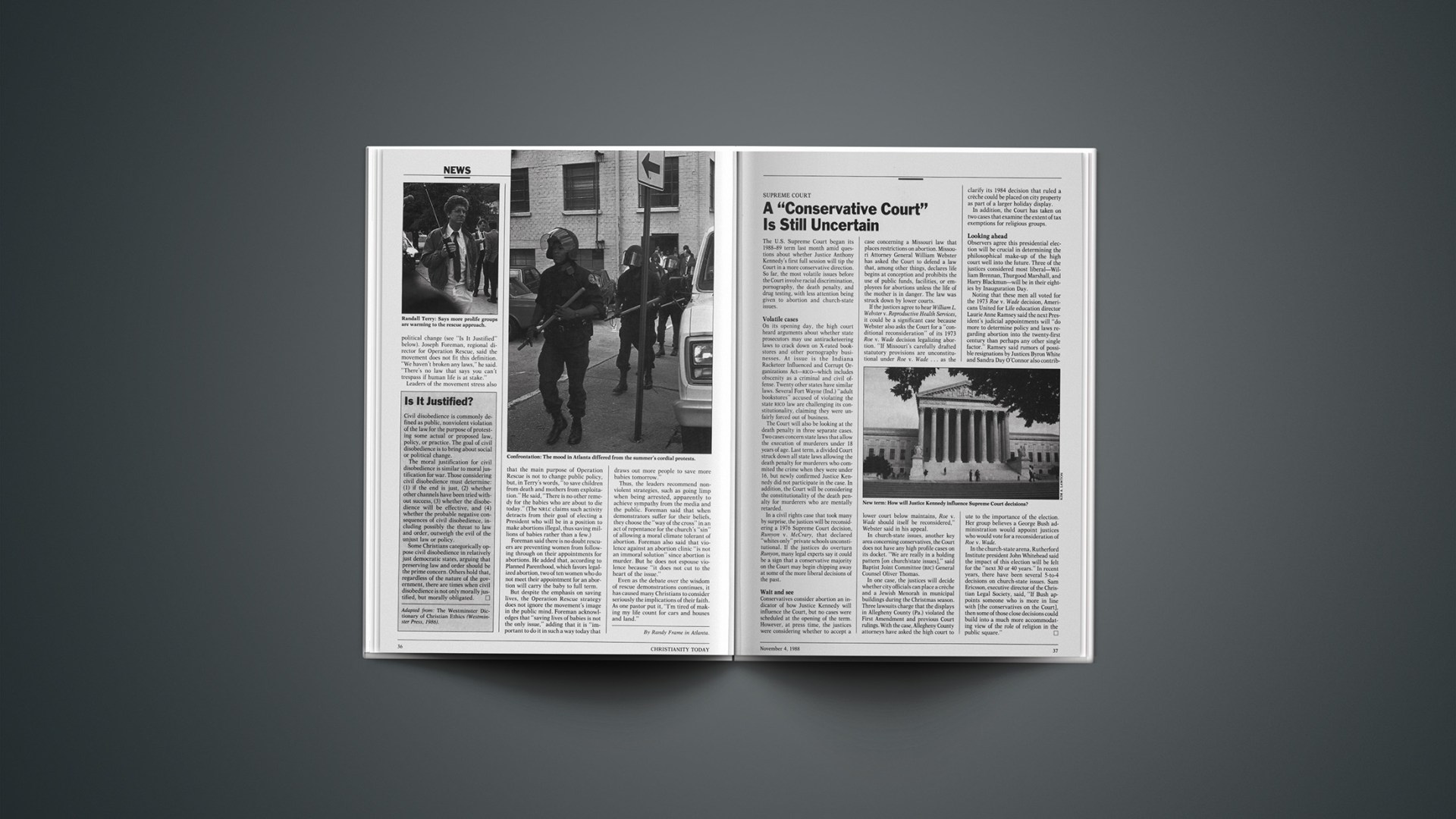
The U.S. Supreme Court began its 1988–89 term last month amid questions about whether Justice Anthony Kennedy’s first full session will tip the Court in a more conservative direction. So far, the most volatile issues before the Court involve racial discrimination, pornography, the death penalty, and drug testing, with less attention being given to abortion and church-state issues.
Volatile Cases
On its opening day, the high court heard arguments about whether state prosecutors may use antiracketeering laws to crack down on X-rated bookstores and other pornography businesses. At issue is the Indiana Racketeer Influenced and Corrupt Organizations Act—RICO—which includes obscenity as a criminal and civil offense. Twenty other states have similar laws. Several Fort Wayne (Ind.) “adult bookstores” accused of violating the state RICO law are challenging its constitutionality, claiming they were unfairly forced out of business.
The Court will also be looking at the death penalty in three separate cases. Two cases concern state laws that allow the execution of murderers under 18 years of age. Last term, a divided Court struck down all state laws allowing the death penalty for murderers who commited the crime when they were under 16, but newly confirmed Justice Kennedy did not participate in the case. In addition, the Court will be considering the constitutionality of the death penalty for murderers who are mentally retarded.
In a civil rights case that took many by surprise, the justices will be reconsidering a 1976 Supreme Court decision, Runyon v. McCrary, that declared “whites only” private schools unconstitutional. If the justices do overturn Runyon, many legal experts say it could be a sign that a conservative majority on the Court may begin chipping away at some of the more liberal decisions of the past.
Wait And See
Conservatives consider abortion an indicator of how Justice Kennedy will influence the Court, but no cases were scheduled at the opening of the term. However, at press time, the justices were considering whether to accept a case concerning a Missouri law that places restrictions on abortion. Missouri Attorney General William Webster has asked the Court to defend a law that, among other things, declares life begins at conception and prohibits the use of public funds, facilities, or employees for abortions unless the life of the mother is in danger. The law was struck down by lower courts.
If the justices agree to hear William L. Webster v. Reproductive Health Services, it could be a significant case because Webster also asks the Court for a “conditional reconsideration” of its 1973 Roe v. Wade decision legalizing abortion. “If Missouri’s carefully drafted statutory provisions are unconstitutional under Roe v. Wade … as the lower court below maintains, Roe v. Wade should itself be reconsidered,” Webster said in his appeal.
In church-state issues, another key area concerning conservatives, the Court does not have any high profile cases on its docket. “We are really in a holding pattern [on church/state issues],” said Baptist Joint Committee (BJC) General Counsel Oliver Thomas.
In one case, the justices will decide whether city officials can place a crèche and a Jewish Menorah in municipal buildings during the Christmas season. Three lawsuits charge that the displays in Allegheny County (Pa.) violated the First Amendment and previous Court rulings. With the case, Allegheny County attorneys have asked the high court to clarify its 1984 decision that ruled a crèche could be placed on city property as part of a larger holiday display.
In addition, the Court has taken on two cases that examine the extent of tax exemptions for religious groups.
Looking Ahead
Observers agree this presidential election will be crucial in determining the philosophical make-up of the high court well into the future. Three of the justices considered most liberal—William Brennan, Thurgood Marshall, and Harry Blackmun—will be in their eighties by Inauguration Day.
Noting that these men all voted for the 1973 Roe v. Wade decision, Americans United for Life education director Laurie Anne Ramsey said the next President’s judicial appointments will “do more to determine policy and laws regarding abortion into the twenty-first century than perhaps any other single factor.” Ramsey said rumors of possible resignations by Justices Byron White and Sandra Day O’Connor also contribute to the importance of the election. Her group believes a George Bush administration would appoint justices who would vote for a reconsideration of Roe v. Wade.
In the church-state arena, Rutherford Institute president John Whitehead said the impact of this election will be felt for the “next 30 or 40 years.” In recent years, there have been several 5-to-4 decisions on church-state issues. Sam Ericsson, executive director of the Christian Legal Society, said, “If Bush appoints someone who is more in line with [the conservatives on the Court], then some of those close decisions could build into a much more accommodating view of the role of religion in the public square.”