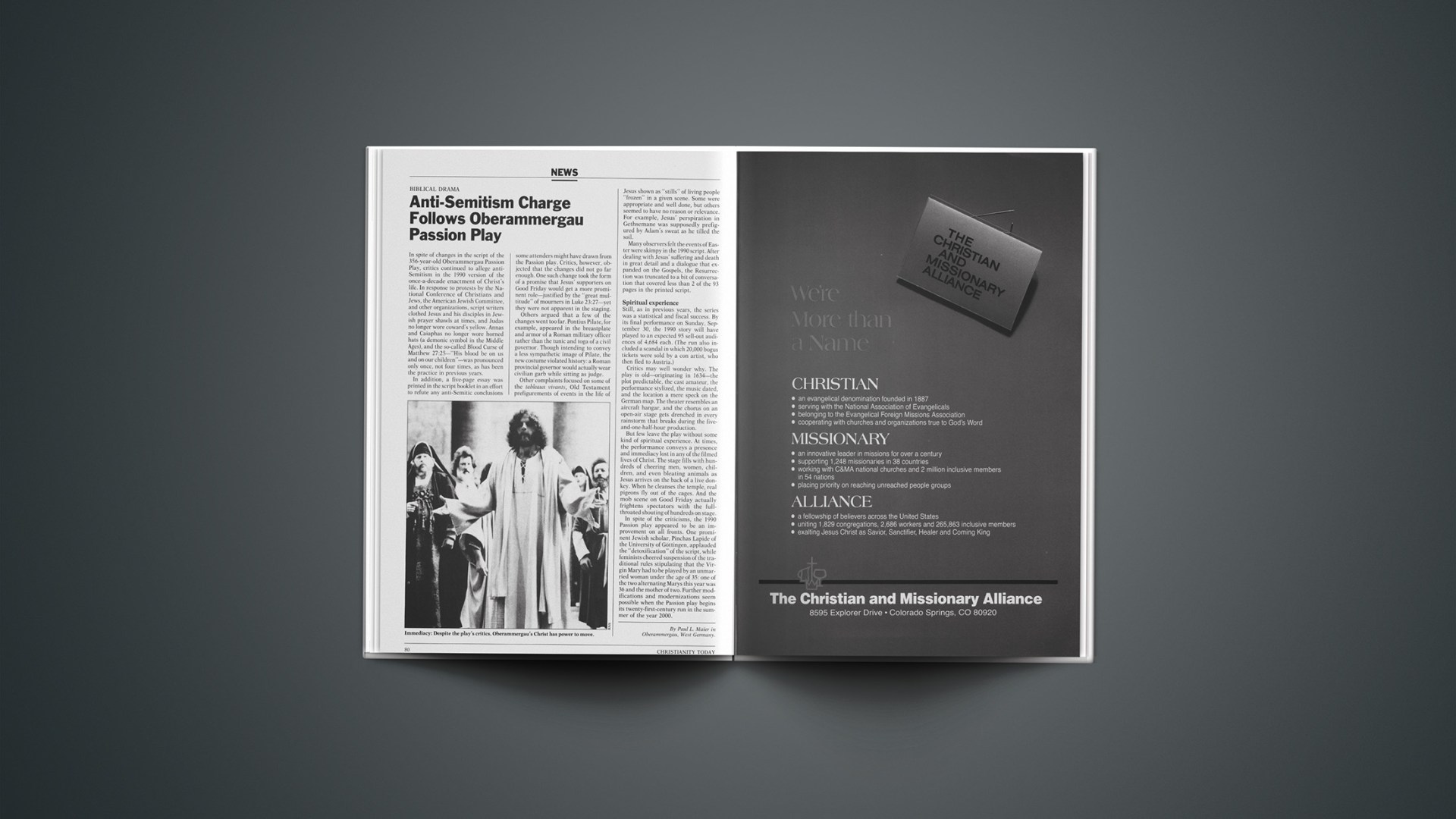

In spite of changes in the script of the 356-year-old Oberammergau Passion Play, critics continued to allege anti-Semitism in the 1990 version of the once-a-decade enactment of Christ’s life. In response to protests by the National Conference of Christians and Jews, the American Jewish Committee, and other organizations, script writers clothed Jesus and his disciples in Jewish prayer shawls at times, and Judas no longer wore coward’s yellow. Annas and Caiaphas no longer wore horned hats (a demonic symbol in the Middle Ages), and the so-called Blood Curse of Matthew 27:25—“His blood be on us and on our children”—was pronounced only once, not four times, as has been the practice in previous years.
In addition, a five-page essay was printed in the script booklet in an effort to refute any anti-Semitic conclusions some attenders might have drawn from the Passion play. Critics, however, objected that the changes did not go far enough. One such change took the form of a promise that Jesus’ supporters on Good Friday would get a more prominent role—justified by the “great multitude” of mourners in Luke 23:27—yet they were not apparent in the staging.
Others argued that a few of the changes went too far. Pontius Pilate, for example, appeared in the breastplate and armor of a Roman military officer rather than the tunic and toga of a civil governor. Though intending to convey a less sympathetic image of Pilate, the new costume violated history: a Roman provincial governor would actually wear civilian garb while sitting as judge.
Other complaints focused on some of the tableaux vivants, Old Testament prefigurements of events in the life of Jesus shown as “stills” of living people “frozen” in a given scene. Some were appropriate and well done, but others seemed to have no reason or relevance. For example, Jesus’ perspiration in Gethsemane was supposedly prefigured by Adam’s sweat as he tilled the soil.
Many observers felt the events of Easter were skimpy in the 1990 script. After dealing with Jesus’ suffering and death in great detail and a dialogue that expanded on the Gospels, the Resurrection was truncated to a bit of conversation that covered less than 2 of the 93 pages in the printed script.
Spiritual Experience
Still, as in previous years, the series was a statistical and fiscal success. By its final performance on Sunday, September 30, the 1990 story will have played to an expected 95 sell-out audiences of 4,684 each. (The run also included a scandal in which 20,000 bogus tickets were sold by a con artist, who then fled to Austria.)
Critics may well wonder why. The play is old—originating in 1634—the plot predictable, the cast amateur, the performance stylized, the music dated, and the location a mere speck on the German map. The theater resembles an aircraft hangar, and the chorus on an open-air stage gets drenched in every rainstorm that breaks during the five-and-one-half-hour production.
But few leave the play without some kind of spiritual experience. At times, the performance conveys a presence and immediacy lost in any of the filmed lives of Christ. The stage fills with hundreds of cheering men, women, children, and even bleating animals as Jesus arrives on the back of a live donkey. When he cleanses the temple, real pigeons fly out of the cages. And the mob scene on Good Friday actually frightens spectators with the full-throated shouting of hundreds on stage.
In spite of the criticisms, the 1990 Passion play appeared to be an improvement on all fronts. One prominent Jewish scholar, Pinchas Lapide of the University of Göttingen, applauded the “detoxification” of the script, while feminists cheered suspension of the traditional rules stipulating that the Virgin Mary had to be played by an unmarried woman under the age of 35: one of the two alternating Marys this year was 36 and the mother of two. Further modifications and modernizations seem possible when the Passion play begins its twenty-first-century run in the summer of the year 2000.
By Paul L. Maier in Oberammergau, West Germany.