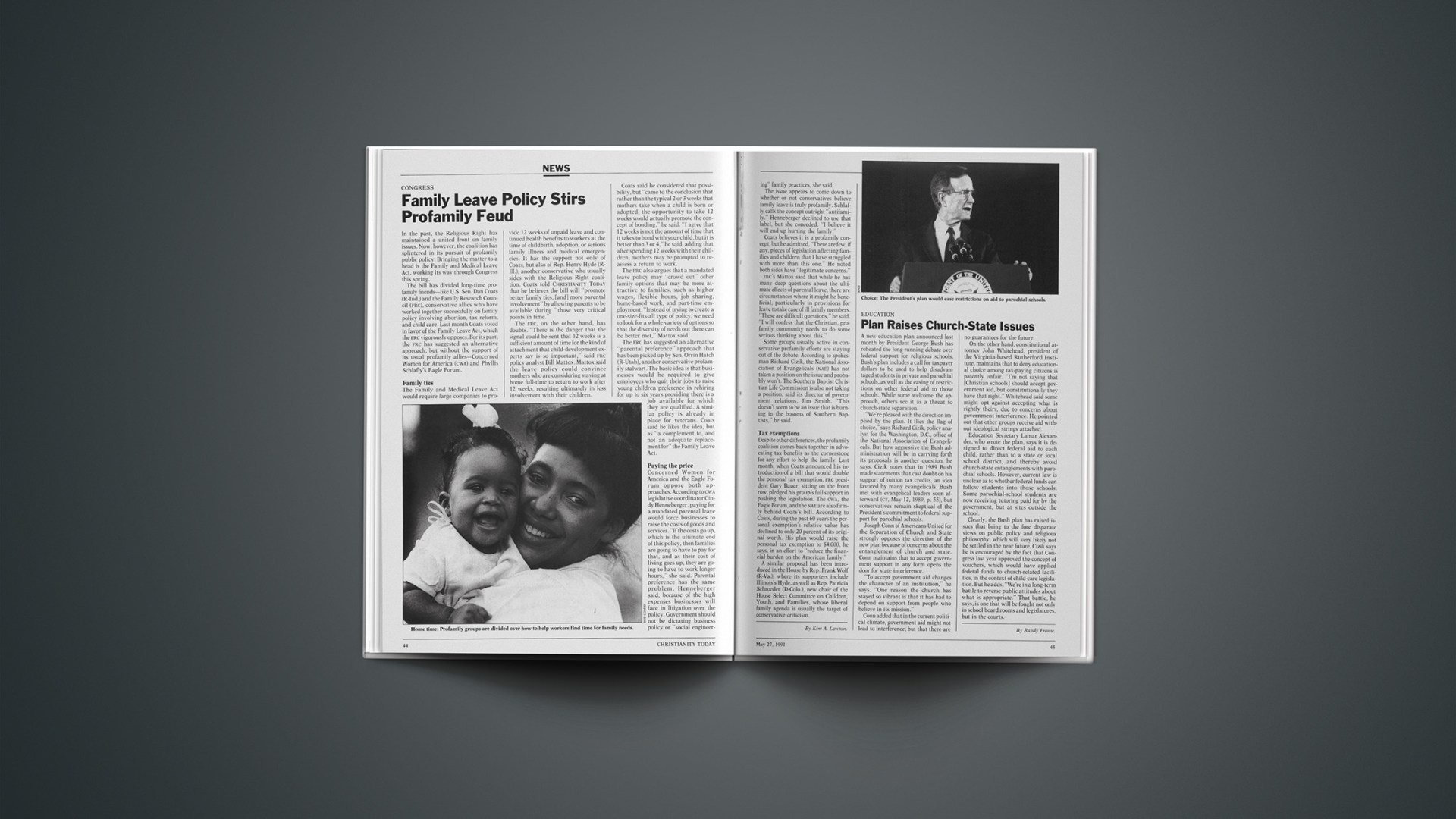

A new education plan announced last month by President George Bush has reheated the long-running debate over federal support for religious schools. Bush’s plan includes a call for taxpayer dollars to be used to help disadvantaged students in private and parochial schools, as well as the easing of restrictions on other federal aid to those schools. While some welcome the approach, others see it as a threat to church-state separation.
“We’re pleased with the direction implied by the plan. It flies the flag of choice,” says Richard Cizik, policy analyst for the Washington, D.C., office of the National Association of Evangelicals. But how aggressive the Bush administration will be in carrying forth its proposals is another question, he says. Cizik notes that in 1989 Bush made statements that cast doubt on his support of tuition tax credits, an idea favored by many evangelicals. Bush met with evangelical leaders soon afterward (CT, May 12, 1989, p. 55), but conservatives remain skeptical of the President’s commitment to federal support for parochial schools.
Joseph Conn of Americans United for the Separation of Church and State strongly opposes the direction of the new plan because of concerns about the entanglement of church and state. Conn maintains that to accept government support in any form opens the door for state interference.
“To accept government aid changes the character of an institution,” he says. “One reason the church has stayed so vibrant is that it has had to depend on support from people who believe in its mission.”
Conn added that in the current political climate, government aid might not lead to interference, but that there are no guarantees for the future.
On the other hand, constitutional attorney John Whitehead, president of the Virginia-based Rutherford Institute, maintains that to deny educational choice among tax-paying citizens is patently unfair. “I’m not saying that [Christian schools] should accept government aid, but constitutionally they have that right.” Whitehead said some might opt against accepting what is rightly theirs, due to concerns about government interference. He pointed out that other groups receive aid without ideological strings attached.
Education Secretary Lamar Alexander, who wrote the plan, says it is designed to direct federal aid to each child, rather than to a state or local school district, and thereby avoid church-state entanglements with parochial schools. However, current law is unclear as to whether federal funds can follow students into those schools. Some parochial-school students are now receiving tutoring paid for by the government, but at sites outside the school.
Clearly, the Bush plan has raised issues that bring to the fore disparate views on public policy and religious philosophy, which will very likely not be settled in the near future. Cizik says he is encouraged by the fact that Congress last year approved the concept of vouchers, which would have applied federal funds to church-related facilities, in the context of child-care legislation. But he adds, “We’re in a long-term battle to reverse public attitudes about what is appropriate.” That battle, he says, is one that will be fought not only in school board rooms and legislatures, but in the courts.