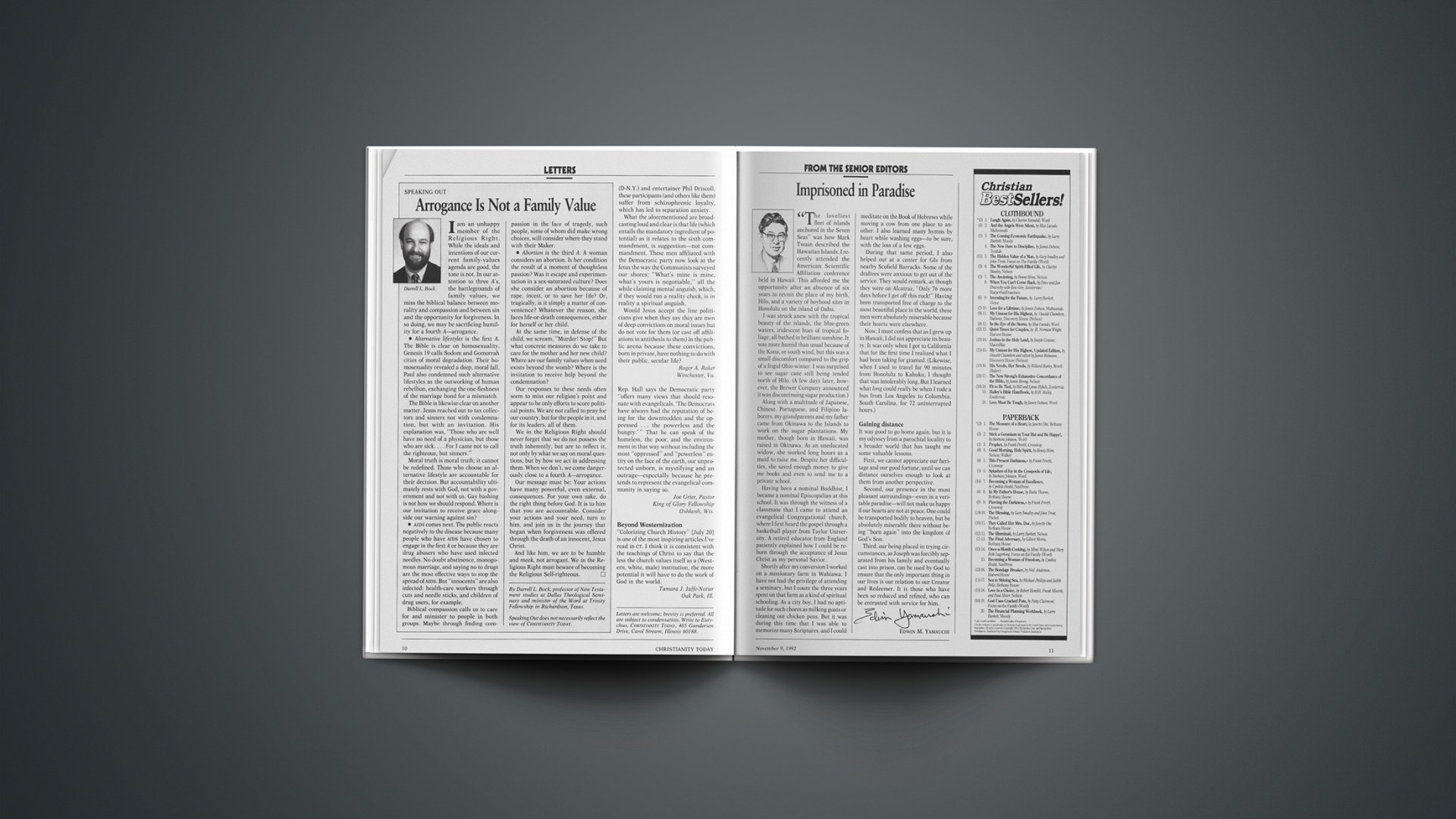

“The loveliest A fleet of islands anchored in the Seven Seas” was how Mark Twain described the Hawaiian Islands. I recently attended the American Scientific Affiliation conference held in Hawaii. This afforded me the opportunity after an absence of six years to revisit the place of my birth, Hilo, and a variety of boyhood sites in Honolulu on the island of Oahu.
I was struck anew with the tropical beauty of the islands, the blue-green waters, iridescent hues of tropical foliage, all bathed in brilliant sunshine. It was more humid than usual because of the Kona, or south wind, but this was a small discomfort compared to the grip of a frigid Ohio winter. I was surprised to see sugar cane still being tended north of Hilo. (A few days later, however, the Brewer Company announced it was discontinuing sugar production.)
Along with a multitude of Japanese, Chinese, Portuguese, and Filipino laborers, my grandparents and my father came from Okinawa to the Islands to work on the sugar plantations. My mother, though born in Hawaii, was raised in Okinawa. As an uneducated widow, she worked long hours as a maid to raise me. Despite her difficulties, she saved enough money to give me books and even to send me to a private school.
Having been a nominal Buddhist, I became a nominal Episcopalian at this school. It was through the witness of a classmate that I came to attend an evangelical Congregational church, where I first heard the gospel through a basketball player from Taylor University. A retired educator from England patiently explained how I could be reborn through the acceptance of Jesus Christ as my personal Savior.
Shortly after my conversion I worked on a missionary farm in Wahiawa. I have not had the privilege of attending a seminary, but I count the three years spent on that farm as a kind of spiritual schooling. As a city boy, I had no aptitude for such chores as milking goats or cleaning out chicken pens. But it was during this time that I was able to memorize many Scriptures, and I could meditate on the Book of Hebrews while moving a cow from one place to another. I also learned many hymns by heart while washing eggs—to be sure, with the loss of a few eggs.
During that same period, I also helped out at a center for GIs from nearby Scofield Barracks. Some of the draftees were anxious to get out of the service. They would remark, as though they were on Alcatraz, “Only 76 more days before I get off this rock!” Having been transported free of charge to the most beautiful place in the world, these men were absolutely miserable because their hearts were elsewhere.
Now, I must confess that as I grew up in Hawaii, I did not appreciate its beauty. It was only when I got to California that for the first time I realized what I had been taking for granted. (Likewise, when I used to travel for 90 minutes from Honolulu to Kahuku, I thought that was intolerably long. But I learned what long could really be when I rode a bus from Los Angeles to Columbia, South Carolina, for 72 uninterrupted hours.)
Gaining Distance
It was good to go home again, but it is my odyssey from a parochial locality to a broader world that has taught me some valuable lessons.
First, we cannot appreciate our heritage and our good fortune, until we can distance ourselves enough to look at them from another perspective.
Second, our presence in the most pleasant surroundings—even in a veritable paradise—will not make us happy if our hearts are not at peace. One could be transported bodily to heaven, but be absolutely miserable there without being “born again” into the kingdom of God’s Son.
Third, our being placed in trying circumstances, as Joseph was forcibly separated from his family and eventually cast into prison, can be used by God to ensure that the only important thing in our lives is our relation to our Creator and Redeemer. It is those who have been so reduced and refined, who can be entrusted with service for him.
EDWIN M. YAMAUCHI