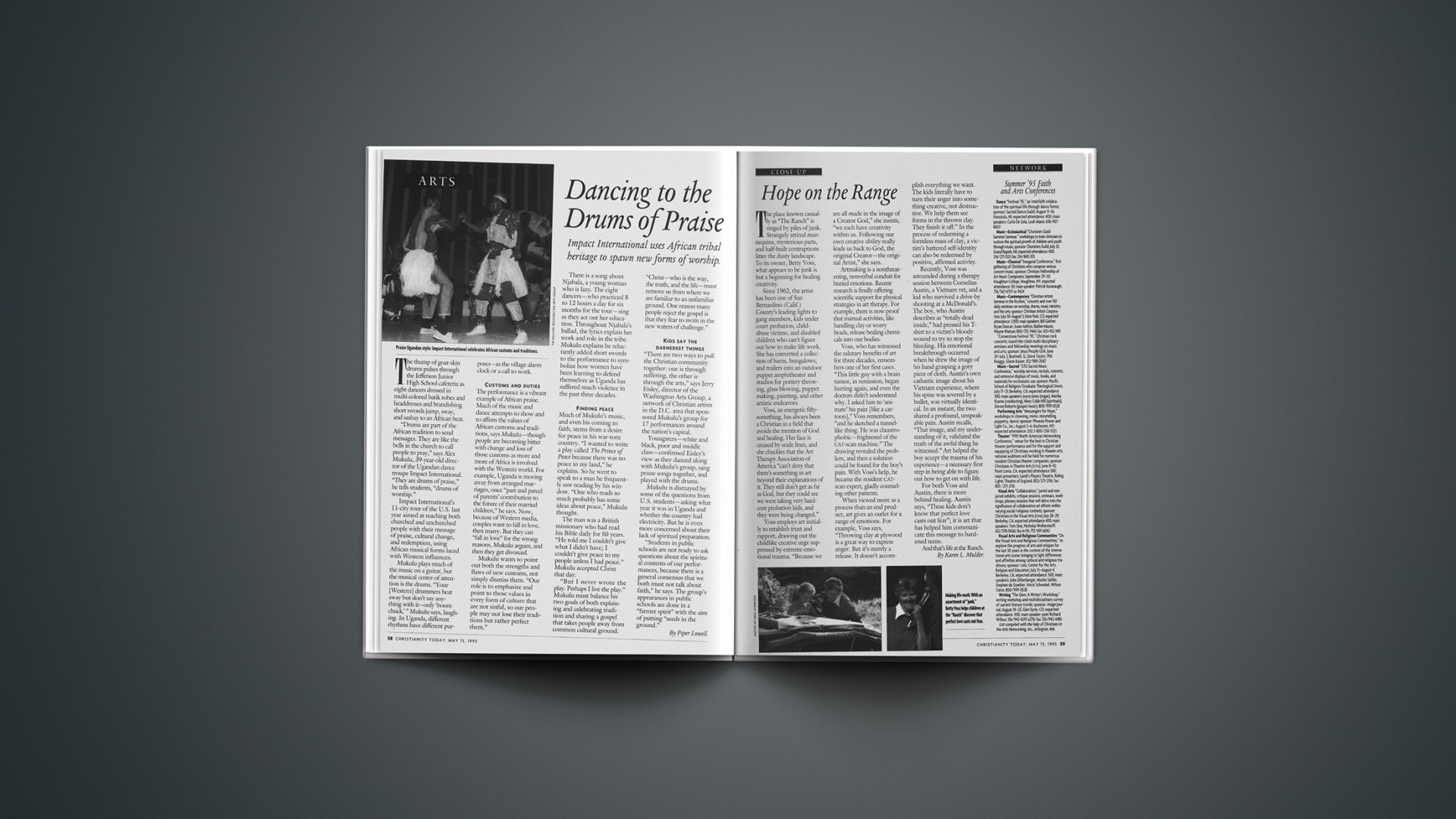

The thump of goat-skin drums pulses through the Jefferson Junior High School cafeteria as eight dancers dressed in multi-colored batik robes and headdresses and brandishing short swords jump, sway, and sashay to an African beat.
“Drums are part of the African tradition to send messages. They are like the bells in the church to call people to pray,” says Alex Mukulu, 39-year-old director of the Ugandan dance troupe Impact International. “They are drums of praise,” he tells students, “drums of worship.”
Impact International’s 11-city tour of the U.S. last year aimed at reaching both churched and unchurched people with their message of praise, cultural change, and redemption, using African musical forms laced with Western influences.
Mukulu plays much of the music on a guitar, but the musical center of attention is the drums. “Your [Western] drummers beat away but don’t say any-thing with it-only ‘boom chuck,’ ” Mukulu says, laughing. In Uganda, different rhythms have different purposes-as the village alarm clock or a call to work.
CUSTOMS AND DUTIES
The performance is a vibrant example of African praise. Much of the music and dance attempts to show and to affirm the values of African customs and traditions, says Mukulu-though people are becoming bitter with change and loss of those customs as more and more of Africa is involved with the Western world. For example, Uganda is moving away from arranged marriages, once “part and parcel of parents’ contribution to the future of their married children,” he says. Now, because of Western media, couples want to fall in love, then marry. But they can “fall in love” for the wrong reasons, Mukulu argues, and then they get divorced.
Mukulu wants to point out both the strengths and flaws of new customs, not simply dismiss them. “Our role is to emphasize and point to those values in every form of culture that are not sinful, so our people may not lose their traditions but rather perfect them.”
There is a song about Njabala, a young woman who is lazy. The eight dancers-who practiced 8 to 12 hours a day for six months for the tour-sing as they act out her education. Throughout Njabala’s ballad, the lyrics explain her work and role in the tribe. Mukulu explains he reluctantly added short swords to the performance to symbolize how women have been learning to defend themselves as Uganda has suffered much violence in the past three decades.
FINDING PEACE
Much of Mukulu’s music, and even his coming to faith, stems from a desire for peace in his war-torn country. “I wanted to write a play called The Prince of Peace because there was no peace in my land,” he explains. So he went to speak to a man he frequently saw reading by his window. “One who reads so much probably has some ideas about peace,” Mukulu thought.
The man was a British missionary who had read his Bible daily for 50 years. “He told me I couldn’t give what I didn’t have; I couldn’t give peace to my people unless I had peace.” Mukulu accepted Christ that day.
“But I never wrote the play. Perhaps I live the play.”
Mukulu must balance his two goals of both explaining and celebrating tradition and sharing a gospel that takes people away from common cultural ground. “Christ-who is the way, the truth, and the life-must remove us from where we are familiar to an unfamiliar ground. One reason many people reject the gospel is that they fear to swim in the new waters of challenge.”
KIDS SAY THE DARNEDEST THINGS
“There are two ways to pull the Christian community together: one is through suffering, the other is through the arts,” says Jerry Eisley, director of the Washington Arts Group, a network of Christian artists in the D.C. area that sponsored Mukulu’s group for 17 performances around the nation’s capital.
Youngsters-white and black, poor and middle class-confirmed Eisley’s view as they danced along with Mukulu’s group, sang praise songs together, and played with the drums.
Mukulu is dismayed by some of the questions from U.S. students-asking what year it was in Uganda and whether the country had electricity. But he is even more concerned about their lack of spiritual preparation.
“Students in public schools are not ready to ask questions about the spiritual contents of our performances, because there is a general consensus that we both must not talk about faith,” he says. The group’s appearances in public schools are done in a “farmer spirit” with the aim of putting “seeds in the ground.”
Copyright © 1995 Christianity Today. Click for reprint information.
ctmay95mhg5T60585508