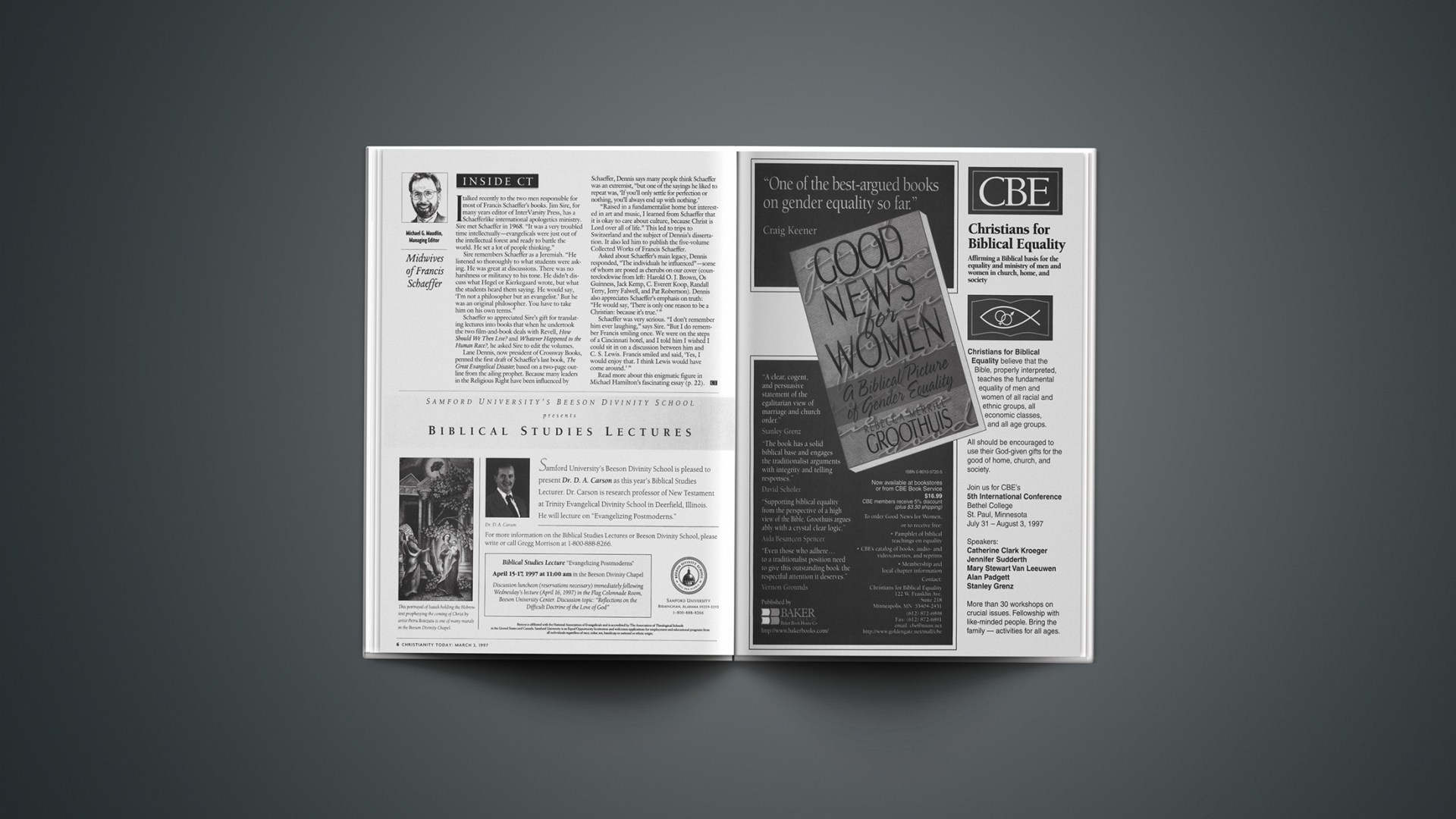

I talked recently to the two men responsible for most of Francis Schaeffer’s books. Jim Sire, for many years editor of InterVarsity Press, has a Schaefferlike international apologetics ministry. Sire met Schaeffer in 1968. “It was a very troubled time intellectually—evangelicals were just out of the intellectual forest and ready to battle the world. He set a lot of people thinking.”
Sire remembers Schaeffer as a Jeremiah. “He listened so thoroughly to what students were asking. He was great at discussions. There was no harshness or militancy to his tone. He didn’t discuss what Hegel or Kierkegaard wrote, but what the students heard them saying. He would say, ‘I’m not a philosopher but an evangelist.’ But he was an original philosopher. You have to take him on his own terms.”
Schaeffer so appreciated Sire’s gift for translating lectures into books that when he undertook the two film-and-book deals with Revell, How Should We Then Live? and Whatever Happened to the Human Race?, he asked Sire to edit the volumes.
Lane Dennis, now president of Crossway Books, penned the first draft of Schaeffer’s last book, The Great Evangelical Disaster, based on a two-page outline from the ailing prophet. Because many leaders in the Religious Right have been influenced by Schaeffer, Dennis says many people think Schaeffer was an extremist, “but one of the sayings he liked to repeat was, ‘If you’ll only settle for perfection or nothing, you’ll always end up with nothing.’
“Raised in a fundamentalist home but interested in art and music, I learned from Schaeffer that it is okay to care about culture, because Christ is Lord over all of life.” This led to trips to Switzerland and the subject of Dennis’s dissertation. It also led him to publish the five-volume Collected Works of Francis Schaeffer.
Asked about Schaeffer’s main legacy, Dennis responded, “The individuals he influenced”—some of whom are posed as cherubs on our cover (counterclockwise from left: Harold O. J. Brown, Os Guinness, Jack Kemp, C. Everett Koop, Randall Terry, Jerry Falwell, and Pat Robertson). Dennis also appreciates Schaeffer’s emphasis on truth: “He would say, ‘There is only one reason to be a Christian: because it’s true.’ “
Schaeffer was very serious. “I don’t remember him ever laughing,” says Sire. “But I do remember Francis smiling once. We were on the steps of a Cincinnati hotel, and I told him I wished I could sit in on a discussion between him and C. S. Lewis. Francis smiled and said, ‘Yes, I would enjoy that. I think Lewis would have come around.’ “
Copyright © 1997 Christianity Today. Click for reprint information.