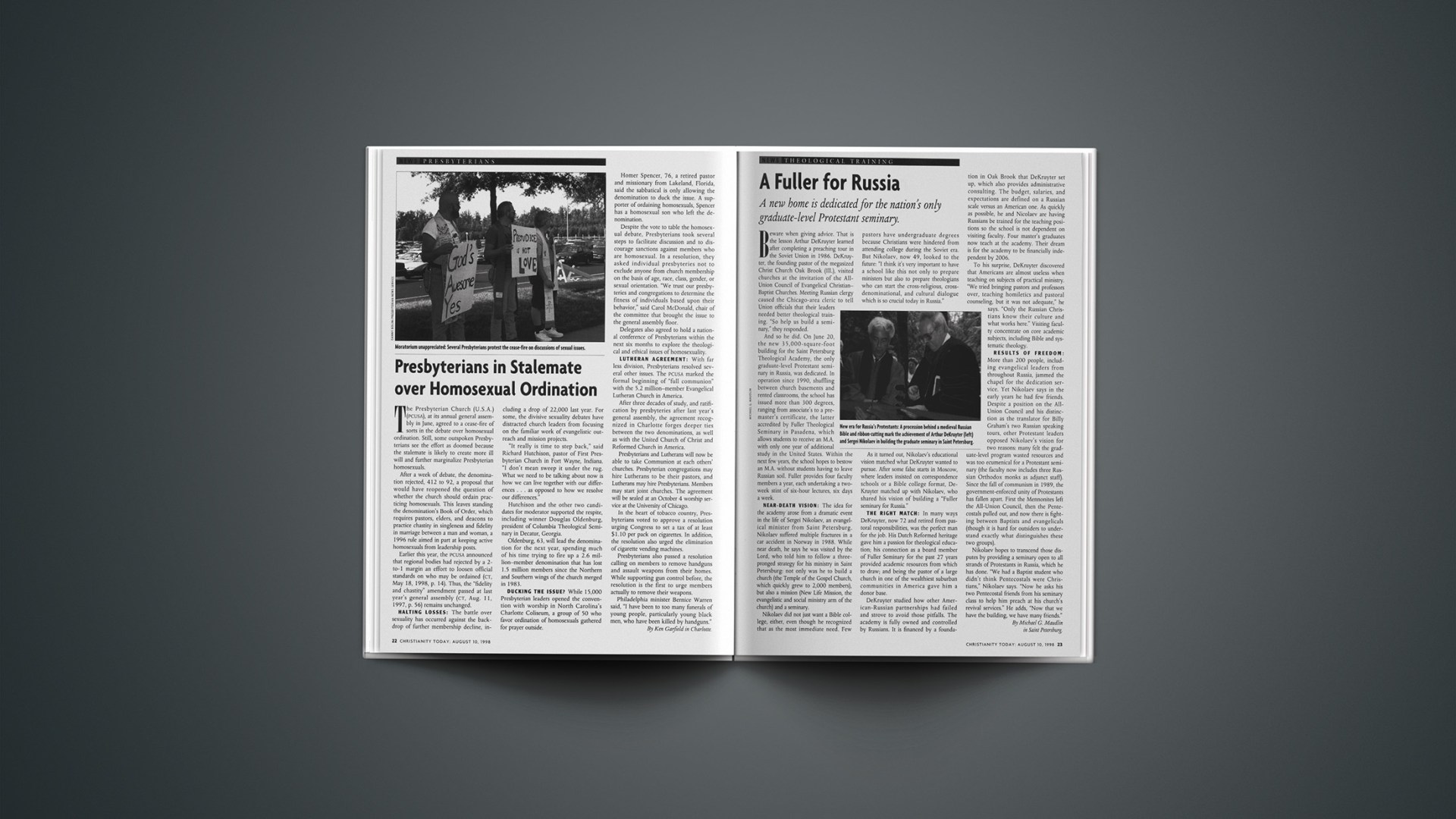

Beware when giving advice. That is the lesson Arthur DeKruyter learned after completing a preaching tour in the Soviet Union in 1986. DeKruyter, the founding pastor of the megasized Christ Church Oak Brook (Ill.), visited churches at the invitation of the All-Union Council of Evangelical Christian- Baptist Churches. Meeting Russian clergy caused the Chicago-area cleric to tell Union officials that their leaders needed better theological training. “So help us build a seminary,” they responded.
And so he did. On June 20, the new 35,000-square-foot building for the Saint Petersburg Theological Academy, the only graduate-level Protestant seminary in Russia, was dedicated. In operation since 1990, shuffling between church basements and rented classrooms, the school has issued more than 300 degrees, ranging from associate’s to a premaster’s certificate, the latter accredited by Fuller Theological Seminary in Pasadena, which allows students to receive an M.A. with only one year of additional study in the United States. Within the next few years, the school hopes to bestow an M.A. without students having to leave Russian soil. Fuller provides four faculty members a year, each undertaking a two-week stint of six-hour lectures, six days a week.
NEAR-DEATH VISION: The idea for the academy arose from a dramatic event in the life of Sergei Nikolaev, an evangelical minister from Saint Petersburg. Nikolaev suffered multiple fractures in a car accident in Norway in 1988. While near death, he says he was visited by the Lord, who told him to follow a three-pronged strategy for his ministry in Saint Petersburg: not only was he to build a church (the Temple of the Gospel Church, which quickly grew to 2,000 members), but also a mission (New Life Mission, the evangelistic and social ministry arm of the church) and a seminary.
Nikolaev did not just want a Bible college, either, even though he recognized that as the most immediate need. Few pastors have undergraduate degrees because Christians were hindered from attending college during the Soviet era. But Nikolaev, now 49, looked to the future: “I think it’s very important to have a school like this not only to prepare ministers but also to prepare theologians who can start the cross-religious, cross-denominational, and cultural dialogue which is so crucial today in Russia.”
As it turned out, Nikolaev’s educational vision matched what DeKruyter wanted to pursue. After some false starts in Moscow, where leaders insisted on correspondence schools or a Bible college format, DeKruyter matched up with Nikolaev, who shared his vision of building a “Fuller seminary for Russia.”
THE RIGHT MATCH: In many ways DeKruyter, now 72 and retired from pastoral responsibilities, was the perfect man for the job. His Dutch Reformed heritage gave him a passion for theological education; his connection as a board member of Fuller Seminary for the past 27 years provided academic resources from which to draw; and being the pastor of a large church in one of the wealthiest suburban communities in America gave him a donor base.
DeKruyter studied how other American-Russian partnerships had failed and strove to avoid those pitfalls. The academy is fully owned and controlled by Russians. It is financed by a foundation in Oak Brook that DeKruyter set up, which also provides administrative consulting. The budget, salaries, and expectations are defined on a Russian scale versus an American one. As quickly as possible, he and Nicolaev are having Russians be trained for the teaching positions so the school is not dependent on visiting faculty. Four master’s graduates now teach at the academy. Their dream is for the academy to be financially independent by 2006.
To his surprise, DeKruyter discovered that Americans are almost useless when teaching on subjects of practical ministry. “We tried bringing pastors and professors over, teaching homiletics and pastoral counseling, but it was not adequate,” he says. “Only the Russian Christians know their culture and what works here.” Visiting faculty concentrate on core academic subjects, including Bible and systematic theology.
RESULTS OF FREEDOM: More than 200 people, including evangelical leaders from throughout Russia, jammed the chapel for the dedication service. Yet Nikolaev says in the early years he had few friends. Despite a position on the All-Union Council and his distinction as the translator for Billy Graham’s two Russian speaking tours, other Protestant leaders opposed Nikolaev’s vision for two reasons: many felt the graduate-level program wasted resources and was too ecumenical for a Protestant seminary (the faculty now includes three Russian Orthodox monks as adjunct staff). Since the fall of communism in 1989, the government-enforced unity of Protestants has fallen apart. First the Mennonites left the All-Union Council, then the Pentecostals pulled out, and now there is fighting between Baptists and evangelicals (though it is hard for outsiders to understand exactly what distinguishes these two groups).
Nikolaev hopes to transcend those disputes by providing a seminary open to all strands of Protestants in Russia, which he has done. “We had a Baptist student who didn’t think Pentecostals were Christians,” Nikolaev says. “Now he asks his two Pentecostal friends from his seminary class to help him preach at his church’s revival services.” He adds, “Now that we have the building, we have many friends.”
Copyright © 1998 Christianity Today. Click for reprint information.