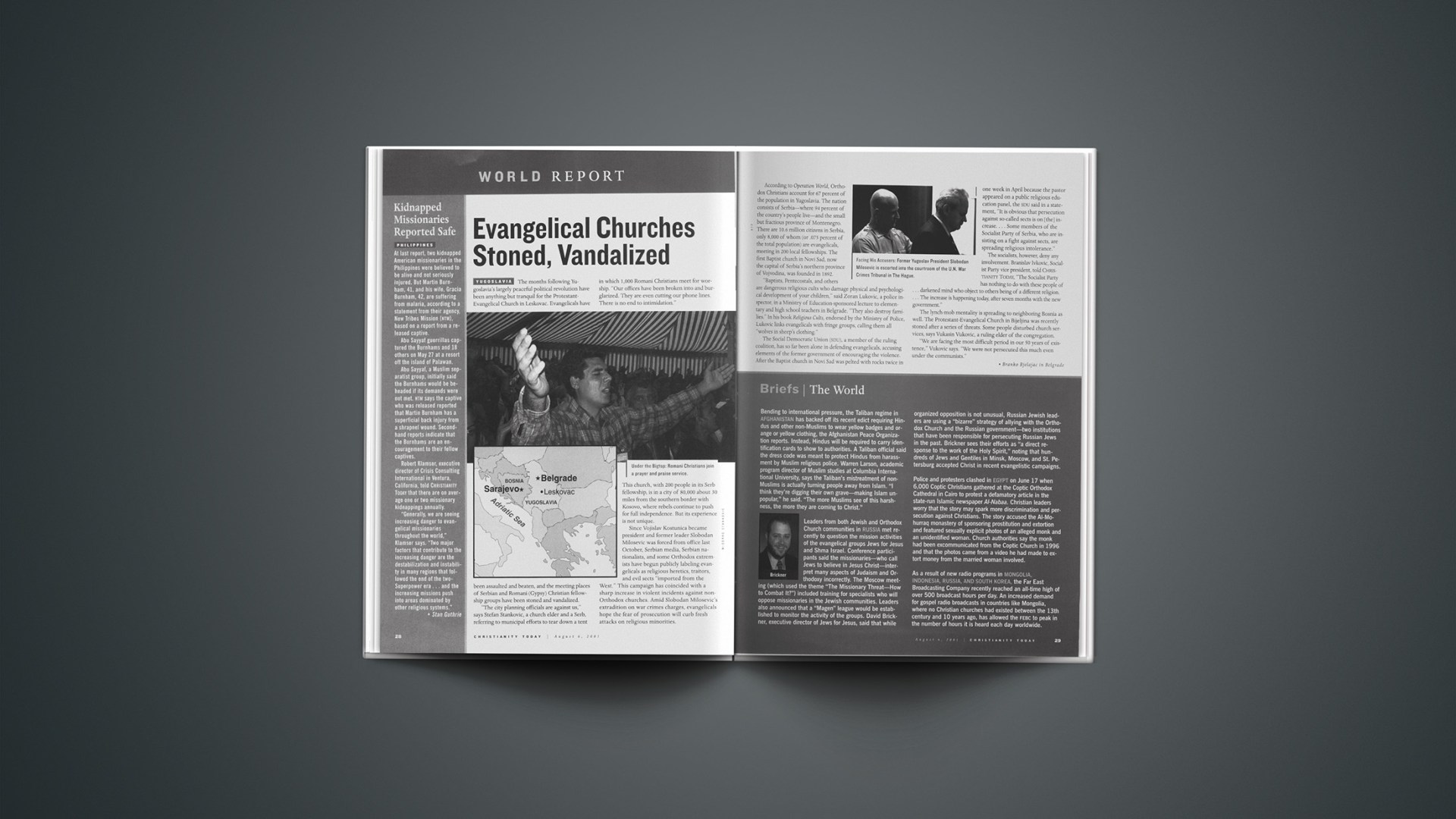

“The city planning officials are against us,” says Stefan Stankovic, a church elder and a Serb, referring to municipal efforts to tear down a tent in which 1,000 Romani Christians meet for worship. “Our offices have been broken into and burglarized. They are even cutting our phone lines. There is no end to intimidation.”
This church, with 200 people in its Serb fellowship, is in a city of 80,000 about 30 miles from the southern border with Kosovo, where rebels continue to push for full independence. But its experience is not unique.
Since Vojislav Kostunica became president and former leader Slobodan Milosevic was forced from office last October, Serbian media, Serbian nationalists, and some Orthodox extremists have begun publicly labeling evangelicals as religious heretics, traitors, and evil sects “imported from the West.” This campaign has coincided with a sharp increase in violent incidents against non-Orthodox churches. Amid Slobodan Milosevic’s extradition on war crimes charges, evangelicals hope the fear of prosecution will curb fresh attacks on religious minorities.
According to Operation World, Orthodox Christians account for 67 percent of the population in Yugoslavia. The nation consists of Serbia—where 94 percent of the country’s people live—and the small but fractious province of Montenegro. There are 10.6 million citizens in Serbia, only 8,000 of whom (or.075 percent of the total population) are evangelicals, meeting in 200 local fellowships. The first Baptist church in Novi Sad, now the capital of Serbia’s northern province of Vojvodina, was founded in 1892.
“Baptists, Pentecostals, and others are dangerous religious cults who damage physical and psychological development of your children,” said Zoran Lukovic, a police inspector, in a Ministry of Education-sponsored lecture to elementary and high school teachers in Belgrade. “They also destroy families.” In his book Religious Cults, endorsed by the Ministry of Police, Lukovic links evangelicals with fringe groups, calling them all “wolves in sheep’s clothing.”
The Social Democratic Union (SDU), a member of the ruling coalition, has so far been alone in defending evangelicals, accusing elements of the former government of encouraging the violence. After the Baptist church in Novi Sad was pelted with rocks twice in one week in April because the pastor appeared on a public religious education panel, the SDU said in a statement, “It is obvious that persecution against so-called sects is on [the] increase. … Some members of the Socialist Party of Serbia, who are insisting on a fight against sects, are spreading religious intolerance.”
The socialists, however, deny any involvement. Branislav Ivkovic, Socialist Party vice president, told Christianity Today, “The Socialist Party has nothing to do with these people of. … darkened mind who object to others being of a different religion. … The increase is happening today, after seven months with the new government.”
The lynch-mob mentality is spreading to neighboring Bosnia as well. The Protestant-Evangelical Church in Bijeljina was recently stoned after a series of threats. Some people disturbed church services, says Vukasin Vukovic, a ruling elder of the congregation.
“We are facing the most difficult period in our 50 years of existence,” Vukovic says. “We were not persecuted this much even under the communists.”
Copyright © 2001 Christianity Today. Click for reprint information.
Related Elsewhere
Yugoslavia’s revolution saw Slobodan Milosevic’s generally peaceful resignation of power to President Vojislav Kostunica in the wake of a “roller coaster election” and a wide public movement.For more articles, see Yahoo’s full coverage on Yugoslavia.
See Christianity Today’s persecution section and previous articles on the Balkans:
Bishops Worry War Crime Tribunal Will Create Martyrs | Four government ministers resign in protest of Croatia’s handing over of generals. (July 20, 2001)
The Case for Compassion in Serbia | A year after NATO bombing, Yugoslav Christians discover unity in caring for the poor. (March 6, 2000)
Doing Church Amidst Bombs and Bullets | Balkan evangelicals feel strain of ethnic cleansing (May 24, 1999)
Bridging Kosovo’s Deep Divisions | A tiny evangelical minority has a vision for how to overcome the explosive mix of religion and nationalism. (Feb. 8, 1999)
Orthodox Condemn Milosevic (Oct. 4, 1999)
Evangelicals Resent Abandonment (July 12, 1999)
Church Planting Faces Uphill Battle (Sept. 1, 1997)
Serbian Baptists Hope for Return to Croatia (Nov. 11, 1996)