Contraception

Court to decide if state can require Catholic ministries to pay for birth control

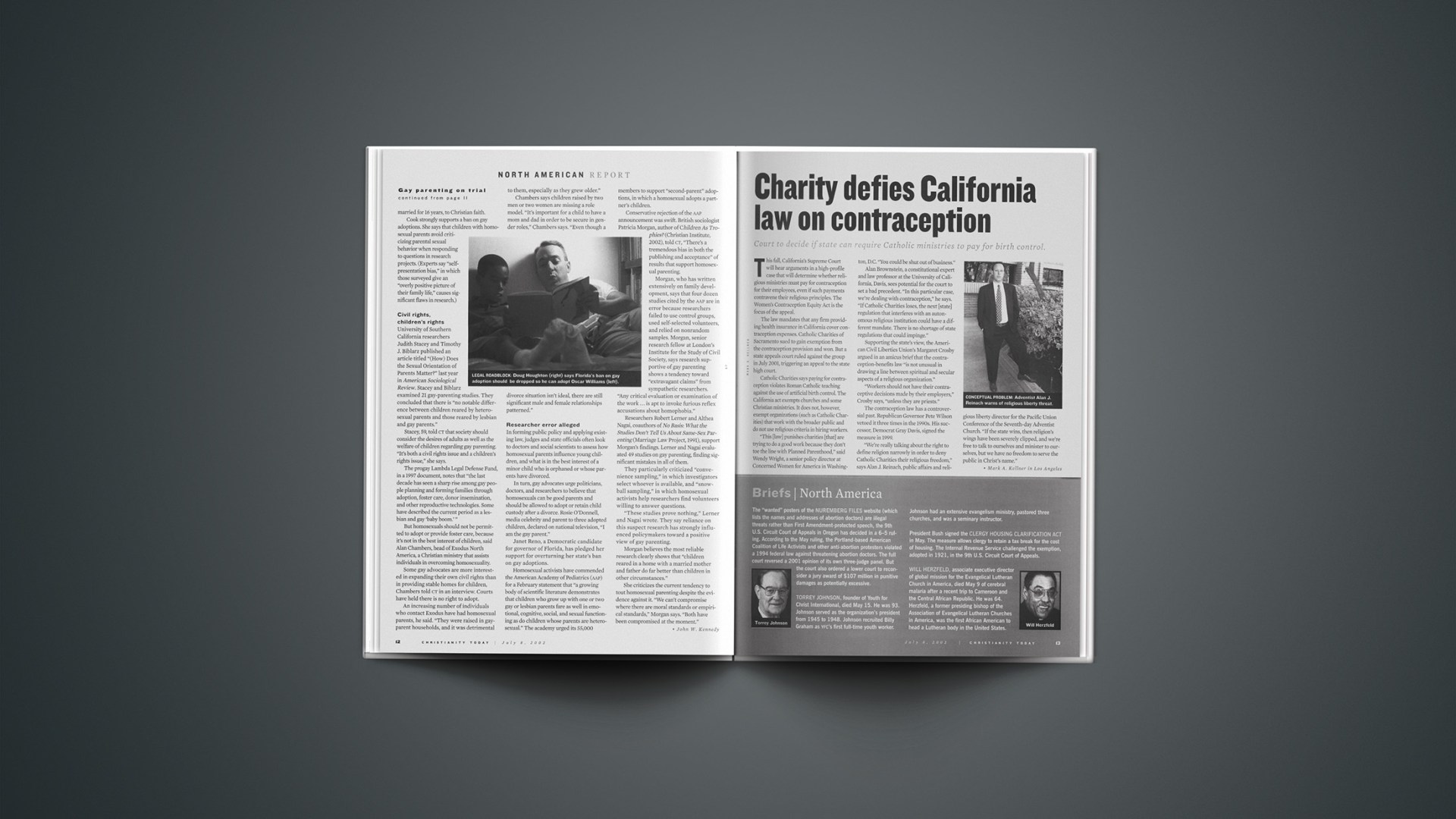
This fall, California’s Supreme Court will hear arguments in a high-profile case that will determine whether religious ministries must pay for contraception for their employees, even if such payments contravene their religious principles. The Women’s Contraception Equity Act is the focus of the appeal.

The law mandates that any firm providing health insurance in California cover contraception expenses. Catholic Charities of Sacramento sued to gain exemption from the contraception provision and won. But a state appeals court ruled against the group in July 2001, triggering an appeal to the state high court.

Catholic Charities says paying for contraception violates Roman Catholic teaching against the use of artificial birth control. The California act exempts churches and some Christian ministries. It does not, however, exempt organizations (such as Catholic Charities) that work with the broader public and do not use religious criteria in hiring workers.

“This [law] punishes charities [that] are trying to do a good work because they don’t toe the line with Planned Parenthood,” said Wendy Wright, a senior policy director at Concerned Women for America in Washington, D.C. “You could be shut out of business.”

Alan Brownstein, a constitutional expert and law professor at the University of California, Davis, sees potential for the court to set a bad precedent. “In this particular case, we’re dealing with contraception,” he says. “If Catholic Charities loses, the next [state] regulation that interferes with an autonomous religious institution could have a different mandate. There is no shortage of state regulations that could impinge.”

Supporting the state’s view, the American Civil Liberties Union’s Margaret Crosby argued in an amicus brief that the contraception-benefits law “is not unusual in drawing a line between spiritual and secular aspects of a religious organization.”

“Workers should not have their contraceptive decisions made by their employers,” Crosby says, “unless they are priests.”

The contraception law has a controversial past. Republican Governor Pete Wilson vetoed it three times in the 1990s. His successor, Democrat Gray Davis, signed the measure in 1999.

“We’re really talking about the right to define religion narrowly in order to deny Catholic Charities their religious freedom,” says Alan J. Reinach, public affairs and religious liberty director for the Pacific Union Conference of the Seventh-day Adventist Church. “If the state wins, then religion’s wings have been severely clipped, and we’re free to talk to ourselves and minister to ourselves, but we have no freedom to serve the public in Christ’s name.”

Copyright © 2002 Christianity Today. Click for reprint information.

Related Elsewhere

Articles on the case include:

The State of California vs. the Catholic Church—Los Angeles Times (March 3, 2002)

Birth-control benefits law upheld in appellate courtSan Francisco Chronicle (July 3, 2001)

Catholic Charities must cover prescription contraceptives, rules California court—The Associated Press (July 3, 2001)

Catholic leaders file suit over contraceptive coverage lawKaiser Daily Health Reproductive Report (August 22, 2000)

Catholic clerics fight law on contraceptionSan Francisco Chronicle (August 19, 2000)

Also in this issue

Double Jeopardy: An interview with former Taliban hostages Heather Mercer & Dayna Curry

Cover Story

Double Jeopardy

Stan Guthrie and Wendy Murray Zoba

"Watchtower Ousts Victims, Whistle-Blowers"

Prison Rape Is No Joke

Give Us Liberty

Christianity Today Editorial

Probable First Cause

Christianity Today Editorial

The Long View: Why I Don't Imitate Christ

How to Deal with Criminals

Lewis B. Smedes

Remedial History

Preaching

Richard A. Kauffman

Sheepish

Banning Banns

Christian College Denied Accreditation

LaTonya Taylor

Two Hostages Die In Attempted Missionary Rescue In Mindanao

Martin Burnham: Willing to Go

Ediborah Yap: The Almost-Forgotten Hero

LaTonya Taylor

"Stretch Pants, Beer, and Other Controversies"

From Afghanistan Aid Workers to Hostages of the Taliban

Gay Parenting On Trial

John W. Kennedy

Bills Would Unmuzzle Churches in Politics

Kevin Eckstrom

Assualt on Purity: ACLU Claims Abstinence Program has a Christian agenda.

Corrie Cutrer

Light Sabers and Self-Sacrifice

Douglas LeBlanc

The Uncommon Benefits of Common Grace

interview with Richard Mouw

How to Confront a Theocracy

Jeff M. Sellers

Patrons of the Evangelical Mind

Michael S. Hamilton and Johanna G. Yngvason

Why God Enjoys Baseball

Prophetic Habits of a Sociologist's Heart

John G. Stackhouse Jr

News

Go Figure

Assualt on Purity: How Effective Are Abstinence Programs?

Corrie Cutrer

Power Shift: Canadian Alliance replaces lightning rod Stockwell Day.

Irving Hexham

Cuba No Es Libre

Jesus for President

Quotation Marks

Is Male-Only Ordination Illegal?

Buffy's Religion

Seat Belt Salvation

View issue

Our Latest

News

Died: John M. Perkins, Who Lived and Preached Racial Reconciliation

The civil rights leader believed in a gospel bigger than race or self-interest.

Review

Decoding the Supreme Court

Three books to read this month on politics and public life.

The Bulletin

Cost of Iran War, Quiet Southern Border, and Anglican Church Split

Mike Cosper, Clarissa Moll, Russell Moore

The financial and moral toll of war, immigration slows but ministry continues, and why denominations split.

The Year of the Evangelical

America prepared for a bicentennial, and religious identity dominated the presidential campaign.

Q&A: Eric Mason on Ministering to Men and Witnessing in Politics

Interview by Benjamin Watson

The Philadelphia-based pastor discusses how the church can engage Black men and have a biblical approach to government.

Review

‘The Secret Agent’ Explores Memory and Authoritarianism in Brazil

Mariana Albuquerque

The Oscar-nominated film reminds viewers to learn from the past—and to share our stories with the next generation.

Jan Karon Looks Back on 89 Years of God’s Faithfulness

The author of the Mitford Years series married at 14, protested segregation, and wrote her first book at 57.

The Just Life with Benjamin Watson

Michel Lusakueno: Why the World Can’t Ignore Congo

Exploring the sobering connection between modern convenience and human suffering.

Apple PodcastsDown ArrowDown ArrowDown Arrowarrow_left_altLeft ArrowLeft ArrowRight ArrowRight ArrowRight Arrowarrow_up_altUp ArrowUp ArrowAvailable at Amazoncaret-downCloseCloseEmailEmailExpandExpandExternalExternalFacebookfacebook-squareGiftGiftGooglegoogleGoogle KeephamburgerInstagraminstagram-squareLinkLinklinkedin-squareListenListenListenChristianity TodayCT Creative Studio Logologo_orgMegaphoneMenuMenupausePinterestPlayPlayPocketPodcastprintRSSRSSSaveSaveSaveSearchSearchsearchSpotifyStitcherTelegramTable of ContentsTable of Contentstwitter-squareWhatsAppXYouTubeYouTube