Borrowing from various “wisdom traditions,” New Paradigm business spirituality includes biblical values, but the vocabulary is often two-faced. It can take a neutral term—self-actualization, for example, which originally described just one human need among others in Abraham Maslow’s hierarchy—and give it a decidedly New Age spin.
From a biblical view, the term self-actualization means realizing personal potential as stewards of God-given abilities. Philosopher Elton Trueblood asserted that, as beings made in God’s image, we are obligated to realize our potential as a means of fulfilling and glorifying that image. Irenaeus of Lyons wrote that God’s glory is man “fully alive.”
When a business strives to develop its workers/managers with education, training, and greater autonomy or latitude for creativity, it helps them fulfill their potential as creatures made in God’s image. Thus jobs designed or redesigned to fit employee gifting and development can serve kingdom ends. Often it will also improve the company.
“What people can be is more important than what they can do, because what they can do will flow from what they can be,” wrote Max De Pree, who directed the Herman Miller furniture company with Christian regard for his employees’ personal and professional development.
Such a people-first philosophy is a key in both biblical and New Paradigm business models. Very quickly, however, the New Paradigm movement hijacks the term self-actualization. In the more radical New Business wing, self-actualization becomes synonymous with transformation and other code words—enlightenment, inner wisdom, authentic or higher self, and higher consciousness—for states equated with deity.
“The purpose of business,” said one woman during a Spirit in Business workshop, “is to awaken myself and others to the higher self and the interconnectedness with all others.”
Her ethos may reflect a values-based approach to business, but the value of the “higher self” could well refer to becoming absorbed into the divine oneness to realize infinite potential. The value of “interconnectedness,” likewise, could well go beyond awareness of social responsibility to pure monism. The values, in other words, may well put humanity on the throne of God.
In combination with New Age meanings for the otherwise harmless terms intuition and creativity, New Business spirituality ties self-actualization to even greater cosmic ends.
Creaturely Creativity
Creativity is the greatest virtue in the New Paradigm. It also occupies a high place in the biblical view of business. The Creator delights in the creative endeavor of a humanity made in his image. Catholic lay theologian Michael Novak lists creativity as one of the three cardinal virtues—and one of the seven signs of grace—in a business. Trueblood goes so far as to say that, in the interest of realizing one’s potential in God’s image, a Christian should accept a lower-paying position if it allows for greater use of creative powers.
New Business spirituality, however, routinely ties creativity to development of intuition through altered states of consciousness that, in turn, often carry New Age presuppositions of monism (all is one), pantheism (God is nature, and vice versa), or panentheism (God is in nature, and vice versa).
Thus New Paradigm business affirms development of intuition and altered states of consciousness—dreams, trances, intuitive flashes, or other nonrational states achieved through deep relaxation, self-hypnosis, and guided imagery —as the keys to tapping creativity. For many in the New Age movement, intuition is code for a range of telepathic, psychic, or other metaphysical phenomena.
In New Business thought, intuition usually crops up in management decision-making. Rationality does not fade away altogether, but its exercise in business—such as cost effectiveness analysis and statistical quality control—serves intuition.
As Gary Zukav writes in “Evolution and Business” in The New Paradigm in Business (coedited by Stanford University’s Michael Ray of the World Business Academy), “Intuition will replace rationalization as the primary source of data in the development of long-term strategies, the means of implementing those strategies, and in the resolution of everyday challenges.”
To be sure, in her survey of Christian CEOS (Believers in Business), Laura Nash of Harvard Business School found that successful executives leave room for intuition. But New Paradigm adherents encourage intuitive powers that tend to steer people away from trust in the transcendent God.
One way of developing intuition is through visualization. Traditionally, visualization was merely a means of clarifying goals by beginning “with the end in mind”—that was the sense in which Stephen R. Covey used it in The Seven Habits of Highly Effective People.
But in the New Paradigm, visualization becomes a means of tapping into the powers of the Universal Consciousness to create or manipulate reality. Businesspersons create a vivid mental image of the goal, which then “works through the individual’s intuition and unconscious mental processes as he or she makes the multitude of everyday decisions that bring the goal ever near,” the late futurist Willis Harman wrote in Global Mind Change.
In the cosmic scheme of the New Paradigm, these intuitive powers form part of the means by which humanity evolves toward spiritual utopia. In Harman’s vision, this is the “Transcendental Monism” of consciousness as a “causal reality.”
Work in Christ, by contrast, helps build the kingdom that only the Second Coming will bring about in fullness.
Copyright © 2003 Christianity Today. Click for reprint information.
Related Elsewhere
Also appearing on our site today:
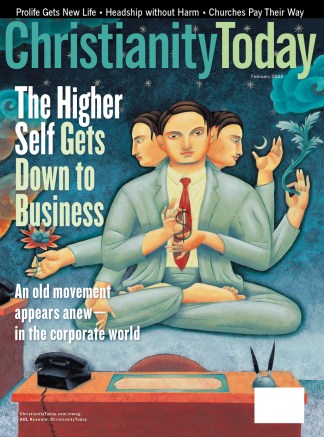
The Higher Self Gets Down to Business | An old movement appears anew—in the corporate world.
Prosperity Consciousness | How the higher self gets down to business.
Organizations or conferences mentioned in the article include:
- Spirit in Business
- Institute of Noetic Sciences
- World Business Academy
- The Message Company
- Spirit at Work
- International Conference on Business and Consciousness
Scruples‘ online sites offer resources, articles, and web forums on spirituality in the workplace.
Marketplace Ministries exists to share God’s love through chaplains in the workplace by on-site Employee Assistance Program for client companies.
In November 1999, BusinessWeek looked at the growing presence of spirituality in Corporate America in the article, “Religion in the Workplace.”
Beliefnet.com has an archive of articles on spirituality and religion in business.