Cutting in line is getting expensive. But is it a moral concern?
On some urban freeways, you can pay to use the lanes that once were restricted to cars carrying two or more passengers to encourage carpooling. For a fee, so-called High Occupancy/Toll (HOT) lanes are available to single-occupant cars in Houston and California and have been proposed for Washington, D.C.; Maryland; Georgia; Minnesota; Washington; Colorado; Florida; Minnesota; and Dallas and San Antonio, Texas
You can avoid long lines in some amusement parks by renting a pager that holds your place. At Six Flags Great Adventure in New Jersey, the cost for this service is $20, plus $10 for each additional member of the group.
Soon, you may be able to avoid long security lines at airports by purchasing a special pass. A pilot program at five airports is free, but the Transportation Security Administration plans to charge for the service when it becomes widely available.
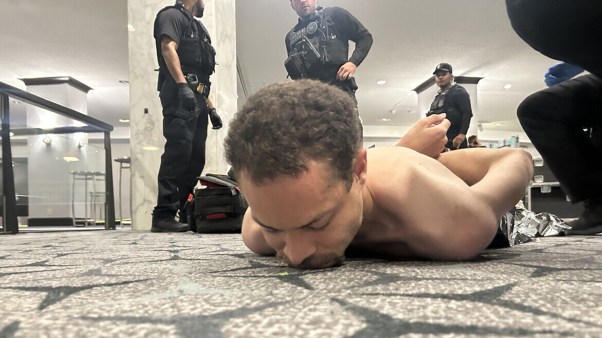
And in August, a Texas man zipped past 17,000 liver-transplant candidates because his family had the financial resources to advertise on billboards and in newspapers for a new liver. He found a donor and underwent transplant surgery, thus circumventing a national system designed to give everyone an equal shot at a transplant.
We asked two theologically trained experts whether we should be concerned because these are new ways for the rich to seal themselves off from the unwashed masses, or whether they are simply examples of a free market working correctly.
Eugene McCarraher, a Villanova University historian who is working on a theologically informed critique of corporate capitalism, said it is both—with one important disclaimer.
“I take it on socialist and Catholic principles of ‘solidarity’ that we should reduce in every way we can the ability of the wealthy both to control and degrade the non-wealthy—in this case by visibly asserting their ability to exempt themselves from rules and conventions—and to erode the sense of commonality which is essential to any flourishing democracy,” said McCarraher.
“While current Catholic social thought doesn’t, I think, address the problem of class as forthrightly as it should, I think its injunctions to solidarity are quite compatible with a traditional socialist emphasis on a common culture of fellowship as well as a common control of production,” he said.
Making highway lanes available to those who are willing to pay is precisely the way the market is supposed to work, said McCarraher. But when that point is considered in light of the injunction against exerting class privilege, “the capitalist market stands indicted as a systematic attack on solidarity.”
Dennis McCann is co-convener of a group of Protestant and Catholic scholars who are studying the theological presuppositions and consequences of “the common good.” The Center of Theological Inquiry in Princeton, New Jersey, sponsors the three-year project. A former Catholic priest who received his theological training at Gregorian University in Rome, McCann now serves as Alston Professor of Bible and Religion at Agnes Scott College in Decatur, Ga.
A major question for the scholars is whether privatization of goods somehow undermines the social fabric.
“If you privatize (an item), if you put a price tag on it where people are making their individual decisions regarding their own self-interest, you’re more likely to get an efficient use of that resource than if you just simply left it open as a free good,” he said.
For example, hospital emergency rooms are viewed as the health care provider of last resort for the poor, but some hospital administrators say this practice has led to overuse and abuse of ER services.
The theological scholars are trying to point out that economics is not the last word. There are trade-offs in each situation, McCann said, and a judgment must be made whether sub-optimal economic decisions may be justified because they lead to greater social harmony.
Another area of inquiry for the group has to do with assumptions regarding the meaning of property. That inquiry, he said, is helpful in resolving the question of whether there’s anything wrong with paying to cut in lines.
In the chapter on property in John Locke’s second treatise on civil liberty, the author confronts the line from Psalms, “The earth is the Lord’s and the fullness thereof.”
As a Christian, Locke had to defeat or at least neutralize this concept in order to have his theories on private property heard, said McCann. His resolution was to say that God is the ultimate owner of everything, but that the mixing of one’s labor with the goods of the earth creates an entitlement.
This entitlement allows the producer to use what she or he earns for one’s self, one’s family and possibly for charity. Thus, the common good in a Lockean universe is marginal, said McCann.
By contrast, Thomas Aquinas described “an obligation to charity,” in which sharing one’s goods is neither optional nor heroic. Instead, it is required of those who confess that God is the creator of all things and that people serve only as stewards.
Yet the Lockean model prevails in most Christian circles.
“How do you get out from under the idea which has actually been fostered in some parts of Christianity—somewhat unwittingly—that this is mine, I can do with it what I want?” McCann asked. “In other words, there are notions of unrestricted free choice that I find profoundly at odds with any Christian worldview because my choice is always contextualized by my relationship with God. Therefore, trying to figure out what to do with my time, my property, all of it, should involve a discernment process.”
Theologian James Gustafson asked “What is God in this situation enabling or calling me to do?” said McCann. “If you’re involved in the discernment process, you know that the choice here is not simply how it appears to you. God has to be a central partner in the deliberative process as we consider the choices we have to make.”
In his own family, McCann said, the discernment process has played out in conversations with God about how much money to contribute to the children’s education vs. how much to retain for retirement.
The family of a friend held prayerful conversations with God to determine whether a daughter should accept a full scholarship to a prestigious university or consider other, less-prestigious colleges where she might find it easier to grow in her faith.
Even such matters as paying to use highway lanes that are not available to people with lesser means should raise a question of whether one is being a good steward of money, said McCann.
The large question for Christians, he said, is whether they have a stake in determining whether there is a robust or a weak appreciation of the common good. Should Christians favor public policies that appeal to a narrow construal of self-interest and further erode the common good?
This article originally appeared in Vital Theology, a newsletter published twenty times a year offering timely and concise theological interpretation of the news.
David W. Reid is the editor of Vital Theology.
Copyright © 2004 Christianity Today. Click for reprint information.
Related Elsewhere:
Eugene McCarraher is the author of Christian Critics: Religion and the Impasse in Modern American Social Thought. His book in progress is The Enchantments of Mammon: Corporate Capitalism and the American Moral Imagination.
Dennis McCann is co-editor of On Moral Business: Classical and Contemporary Resources for Ethics in Economic Life. In Search of the Common Good, edited by McCann and Patrick D. Miller, is scheduled to be published in 2005.