Warner Pacific College has served students in southeast Portland for 71 years. During this time, our commitment to deliver an excellent Christian liberal-arts education has never wavered. But there have been moments when the challenge of limited space in our urban setting and the need to grow enrollment led to talks about leaving the city and moving to a suburban or rural location. Only recently has it become clear as to why God placed us in the heart of the city.
In the past 20 years, many Christian higher education institutions experienced dramatic growth. Yet during this period, Warner Pacific experienced a series of financial setbacks that led to a clouded future. Warner Pacific, affiliated with the Church of God denomination, has always had smart and passionate staff and faculty, and its unique approach to liberal arts education has always been deep and intentional. But growth comes out of coherence, and Warner Pacific’s institutional identity was disconnected from God’s strategic placement of the institution in the heart of the city. Higher education institutions, even Christian ones, are too often focused on comparing ourselves with each other. As a result, we fail to live, with authenticity, into the calling that God has for each of us in our particular context.
When I arrived at Warner Pacific six years ago as the vice president for institutional advancement, I was struck by the power of this comparison game in the life of the institution. Early on, as I was learning the ethos and environment, I constantly heard “we’re like” and “we’re not like.” We didn’t really know who we were or who we should be. This was a huge liability as the institution worked to grow enrollment and raise funds to support programs—both assignments of which were mine. Our mission statement said that “Warner Pacific College is an urban Christian liberal arts college,” but the word urban reflected the street address rather than our educational philosophy. We missed the fact that to be educating future leaders in the city meant that our daily reality and institutional identity were inextricably linked to the life and environs of our location in Portland.
It became clear that to survive, let alone thrive, we needed to stop acting like exiles and intentionally live out of our physical and theological location—letting it shape and inform how we prepared students to lead and serve in the world. Through this new lens, our mission began to jump off the page. We lowered tuition by 23 percent and began focusing on providing access and transformation for non-traditional and under-represented students. The relational nature of our instruction and mentoring is focused on encouraging students, particularly those who might never have imagined the possibility of enrolling at a Christian college, to engage and persist as they discover their purpose and calling. We increased our institutional flexibility to create collaborative relationships within the city, and we empowered our employees to leverage our location and innovate.
Martin Luther King Jr., in his Letter from a Birmingham Jail, wrote, “We are caught in an inescapable network of mutuality, tied in a single garment of destiny. Whatever affects one directly, affects all indirectly.” King’s message calls us to recognize that to be urban is to embrace the idea that we are not only a city institution but that we are one piece of an interrelated community—both in Portland and in the Council for Christian Colleges and Universities. I am convinced that we cannot answer our world’s “big questions” as a mere intellectual exercise, but must consider how the answers immediately impact our cities. Therefore, we must be held accountable to asking questions like: How do cities function, and what is our response to Portland? How does our academic vision create citizen-servants who are embedded and bring influence in urban Portland? How are we, as a Christian college, committed to making our education available to all students?
The future is percolating in urban America, yet cities are also the center of our country’s most vexing problems. If Christian colleges are going to take seriously the calling to seek peace, prosperity, and shalom for our cities, our imperative is to get involved in finding solutions instead of hedging against the impact of the problem. We cannot sit idly by. As an urban, Christ-centered, liberal arts institution, Warner Pacific is prepared to embrace the beautiful complexities of our city.
We’ve decided that from this point forward, our curriculum, student recruitment, service priorities, internship opportunities, student-teacher placements, adult education offerings, and church relations will all be run through the organizing principle of our urban identity. And as we dream into the future for our city, we have a newfound sense of freedom.
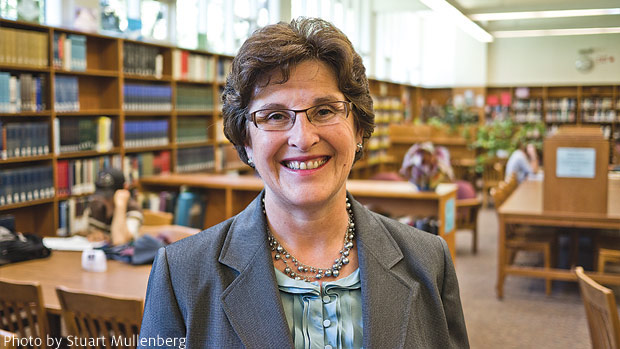
Andrea Cook is president of Warner Pacific College in southeast Portland.