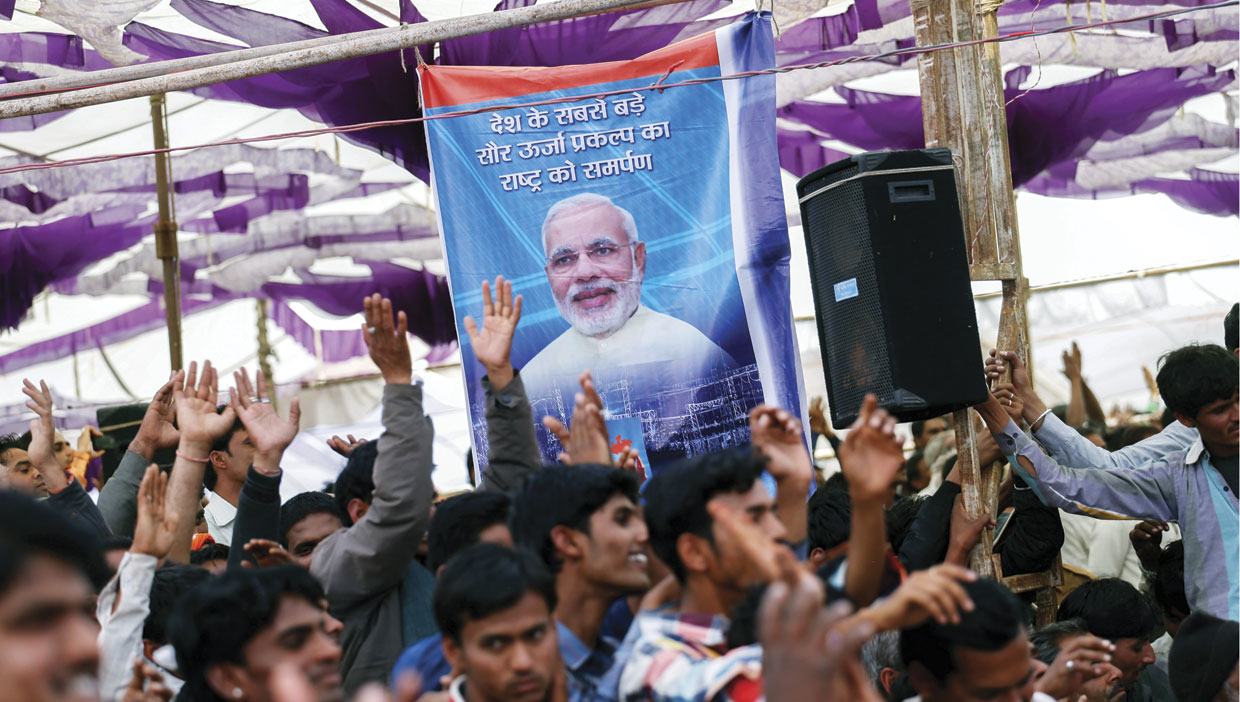

Narendra Modi, leader of India's divisive Bharatiya Janata Party (BJP), will almost certainly become the country's next prime minister. But given the party's platform of Hindu nationalism and association with religious violence, it's surprising that many Christians aren't concerned about his election.
The reason? Modi is promising jobs.
"Believers . . . don't have any difficulties with Modi. In fact, they applaud his developmental efforts," the head of the Jacobite Syrian Church told reporters in January.
Since the economy peaked at 9.3 percent annual growth in 2011, growth has plummeted to about 5 percent. India's Christian minority has long backed the Congress party, which has been in power since 2009. But corruption, scandals, and ineffective economic policies have tarnished the party. "Congress can no longer be sure it retains the trust of the poor, the Dalits, the tribals, and the minorities, [who] voted for it all these years," John Dayal, cofounder of the All India Christian Council, announced on his blog.
The nation's economic downturn has allowed for the resurgence of the BJP, the Hindu nationalist group that governed India from 1998 to 2004. Many Christians have accused the BJP of inciting violence against Christians and Muslims.
Modi, 63, has been chief minister of the western Indian state of Gujarat since 2001. To the delight of India's corporate class, Gujarat now accounts for 72 percent of all new Indian jobs.
But Modi will find it hard to distance himself from one of India's worst recent cases of religious violence. In February 2002, Hindu rioters killed 1,000 people, mostly Muslims, in Gujarat. The attacks have been labeled a pogrom, taking place after 58 Hindu pilgrims died in a train fire that Muslim radicals allegedly started. Human rights groups believe Modi incited violence against Muslims by blaming the fire on Pakistan. Others accuse the Gujarat government of failing to stop the postfire ethnic cleansing. In 2010, India's foreign minister compared the riots to the Holocaust.
Modi's political star rose after a special investigation absolved him of any wrongdoing during the 2002 riots. But since then, critics have accused him of discriminating against religious minorities to further develop the Hindu middle class. Both the United Kingdom and the United States have refused to grant him a visa. And U.S. Congressmen Frank Wolf, Joseph Pitts, and Chris Smith have led the charge to keep the visa ban in force, even as Modi has led the race for prime minister.
Bishop Taranath Sagar, president of the National Council of Churches, an umbrella group representing 12 million Christians, says Modi has been emphasizing economic development. But once in office, some fear he may be pressured to further advance the Hindu nationalist agenda (Hindutva), which his party has promoted in recent years. This would include tough anticonversion laws, a crackdown on public criticism of Hinduism, and further limits on religious minorities. The BJP has pushed for anticonversion laws in several states, and Modi himself signed into law one of the most infamous ones in 2003.
"You can look at Modi as a Nebuchadnezzar or a Darius in Babylon, who helped the Jewish remnant there—or you can look at him like a Herod, who is synonymous with the persecution of God's people," said church studies professor Dexter Maben, who teaches at United Theological College in Bangalore. "We believe we have to engage with the new leader and the government and see how we can live in peace and live the Christian faith in the cultural context. It will be a challenge, but a welcome one."