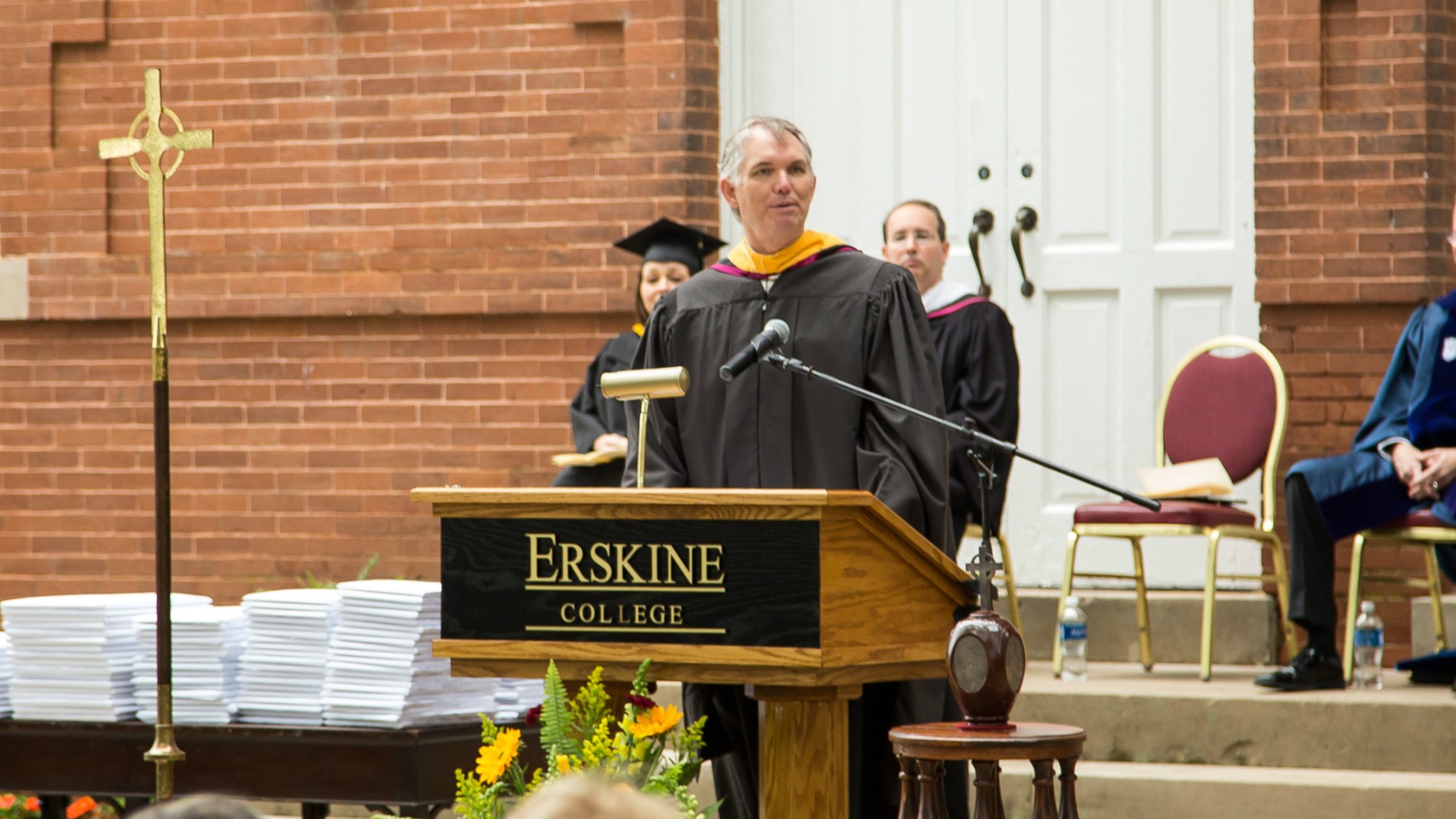
At a time when many seminaries are merging with other seminaries or related colleges for financial reasons, Erskine Seminary in South Carolina asked its board if it could be a standalone school.
Currently, the seminary is part of Erskine College and Theological Seminary, the only college affiliated with the Associate Reformed Presbyterian Church (ARPC), a small evangelical denomination with fewer than 300 churches.
The reason for the requested break-up? Money problems.
Unlike Erskine, cash-strapped seminaries tend to go the other way; sharing facilities can be a way for schools to ease tight budgets. More are affiliated with colleges than ever.
Thirty years ago, about 20 percent of the members of the Association of Theological Schools (ATS)—the accrediting body for Erskine College and Theological Seminary—were affiliated with larger institutions, Daniel Aleshire, the association’s executive director, told Inside Higher Ed. Now it’s up to 40 percent.
In 2010, Moody Bible Institute merged with Michigan Theological Seminary in order to save money by sharing technology and some operations costs. In 2013, Assemblies of God Theological Seminary merged with both Central Bible College and Evangel University in Missouri. And in April, two Lutheran seminaries in Pennsylvania announced a plan to close down, join together, and then open again.
The pressure to consolidate comes from rising costs and stagnant financial support, Aleshire said. While public schools can offset that cost with the higher tuition that out-of-state students pay, seminaries look to individual or denominational donors, according to Inside Higher Ed.
This year, ARP gave Erskine $407,000, which was split between the college and seminary. The seminary received tuition from the equivalent of 67 full-time students, fewer than they’d hoped. At last month’s annual denominational meeting, the seminary reported to the denomination an anticipated operating loss of more than $100,000 for the year.
With the pressure of a reaccreditation visit looming, the seminary “must begin to operate in a fiscally sound manner,” Erskine reported.
The seminary’s operating budget is a little more than $1 million, while the college—with an enrollment of about 600—operates with a $30 million budget. Erskine College was placed on probation from its accrediting institution for financial reasons in 2014. It earned back full accreditation in December 2015, after $2 million in budget cuts.
Those cuts hit the seminary hard. Unfairly hard, seminary faculty said in a petition to the board. The seminary swallowed a 25 percent budget cut while the college only took a 2 percent cut, and seminary faculty were not paid for overload classes even though college faculty were. In addition, 3 of the 12 seminary faculty were laid off, and the rest saw their salary cut by 25 percent.
Those budget cuts are part of the reason the seminary wants to cut ties with the college, seminary faculty told the Erskine board.
The seminary spends 43 percent of its budget—to the tune of $500,000 to $600,000—in institutional support, they wrote. The latest numbers from ATS show that member schools spend, on average, about 22 percent of their budget on institutional support.
“The current structure, a single administrative umbrella for college and seminary, has not served the mission of the seminary well, particularly in a time when resources are constrained and the seminary’s viability is in question,” the faculty wrote.
In response, the board created an ad hoc committee to study the split, along with other strategies, in order to get the seminary to financial viability. Last month, the denomination backed the move, voting after “a lot of discussion” to support the split “if it is deemed in the best interest of both.”
The denomination also threw its financial backing behind the seminary. Instead of splitting its annual financial support as it usually does, with 60 percent to the college and 40 percent to the seminary, the synod decided to give 100 percent to the seminary, Erskine vice president for communications Cliff Smith told Inside Higher Ed.
The move is symbolic, since for now the two entities share one pool of money. But it’s an important message to the college, especially after its clashes in recent years with the denomination.
Five years ago, a commission found evidence of financial irregularities—along with administrative failures and mission drift—at Erskine. The denomination attempted to replace half of the school’s trustees, and Erskine responded with a lawsuit, which was eventually dropped.
The battle lines are drawn along issues of academic freedom: whether the school has too little (accrediting agency Southern Association of Colleges and Schools warned that ARP’s move to replace trustees was a bridge too far) or too much (the commission report found that “a significant majority of the professors interviewed had no understanding of how the Christian faith could be meaningfully integrated into their discipline” and “some seminary professors cannot affirm inerrancy as defined by the General Synod”).
In 2013, the board and denomination agreed that the board does have the authority to remove trustees with cause, and voted to change Erskine’s charter to make it clear that the school is under the ARP’s authority.