





In 1970, evangelist and author Tom Skinner delivered an iconic speech entitled “The U.S. Racial Crisis and World Evangelism” at InterVarsity’s Urbana student missions conference, held that year in its namesake Champaign-Urbana, Illinois.
The Harlem-based speaker brought with him a soulful worship band and drew hundreds of black students to the mostly-white gathering. During his remarks, Skinner boldly held the church accountable for racial injustice. He delineated the country’s racial history, charging that “there is no possible way you can talk about preaching the gospel if you do not want to deal with the issues that bind people.” His speech is remembered as a groundbreaking moment in the history of Urbana and of American missions—a Christ-centered call to see our racial realities through a gospel lens.
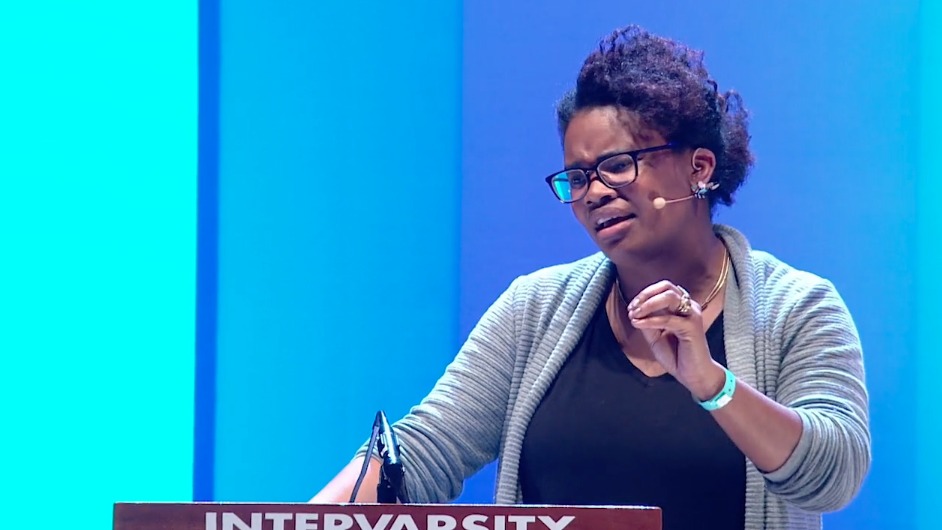
The most recent Urbana conference, held last week in St. Louis, was reminiscent of his powerful message in 1970. This time it was speaker and minister Michelle Higgins who put out a call for a new generation of Christians to stand up for racial justice and declare that Black Lives Matter.
As a blogger focused on Christianity and race, I’ve spent the past few years following evangelical responses to racial injustice and the burgeoning Black Lives Matter movement. These recent events have challenged Christians to reexamine what it means to love thy neighbor and “do good; seek justice, correct oppression” (Is. 1:17). At Urbana, 2015 came to a close with one of the strongest statements I’ve seen on the topic from an evangelical organization.
Early in the conference, the worship team took the stage wearing Black Lives Matter T-shirts, and I could tell this year’s event was going to be significant. How could it not? It was the first Urbana conference since Michael Brown’s death—and the subsequent heighted awareness around racialized police killings—and it was being held only about 10 miles from Ferguson.
Several musicians shared songs and testimony from the black church and how their experiences of being black in the United States had shaped their walk with Christ. Then Higgins, director of worship and outreach at South City Church in St. Louis, shared a powerful and prophetic testimony that set the tone for the rest of the event.
Shortly after Michael Brown’s death, “we began looking for churches to host discussion groups…and all of our evangelical partners said, ‘We’re not ready to talk about race and justice,’” Higgins recalled. When evangelicals hesitate to enter this discussion, they unwittingly perpetuate racism and the belief that the status quo is acceptable. “Your indifference is not hate,” she said, “but it is not love.”
Urbana and InterVarsity Christian Fellowship have long been known for promoting diversity and racial reconciliation, but this year’s event went beyond simply acknowledging these issues. Organizers took the critical next step to stand firmly with those across the country declaring that Black lives matter. A combination of heighted national awareness, spiritual conviction, and physical proximity intensified the strength of the message, setting an example for moving beyond lukewarm requests for cultural understanding, in favor of a renewed call to justice and solidarity.
There are undoubtedly aspects of the Black Lives Matter movement with which Urbana disagrees. Indeed, the phrase itself was coined in 2013 by Alicia Garza, Patrisse Cullors, and Opal Tometi, two of whom are queer women of color, though Urbana and its hosting organizations have traditionally taken a more conservative stance on gender and LGBTQ issues. Urbana has also found itself reiterating its pro-life position on abortion in the wake of Higgins’s address. Nevertheless, there are a range of perspectives within the Black Lives Matter movement itself, and Urbana15’s example demonstrates how Christians, like Jesus, sometimes have to take risks to be in community with one another.
Urbana15 reminded its participants that we worship a Christ born into a working-class, brown, Middle Eastern family that fled state-sanctioned violence to become refugees in another country. Throughout the conference, they pressed forward in this sentiment as they affirmed the many cultures represented in the Body of Christ. Worship director Erna Hackett repeatedly encouraged participants to recognize the history of oppression and marginalization that some of these cultures have faced, and to listen deeply to their stories to build understanding and solidarity.
Of note, Urbana15 also set a powerful example by featuring women of color in particular, living out the values they profess in real-time on stage. In addition to Higgins and Hackett, Urbana15 also featured Shaylen Jackson, Christena Cleveland, Ashley Moore, and many others in prominent roles on the mainstage. In yet another year when too many Christen conferences featured homogenous lineups, Urbana15 was decisively intentional in its selection of speakers.
And so the message was clear: Black Lives Matter. It doesn’t mean that other lives don’t matter, or even that we fully understand the complexities of a racialized systems and the history that got us here. It simply gives special cover to those lives that have repeatedly been undervalued and unprotected.
Higgins encouraged participants to remember that we need not agree on everything to link arms in defense of the oppressed and marginalized. If evangelical organizations wait until they are perfectly aligned with all aspects of a movement, they will end up missing an important moment for the church to speak. And the silence will be a defining witness to the world about our convictions as followers for Christ.
Higgins also challenged participants to refrain from “only doing activism that makes you comfortable.” Indeed, as Tom Skinner observed at Urbana in 1970, “Jesus was turning the whole thing upside-down, so that they finally had to arrest him too… Jesus came to change the system. And so they had to arrest him too.” Thus, we must be willing to take risks, moving forward on faith that extends beyond our safety and comfort.
As Christians we cannot call for reconciliation without unapologetically declaring that the lives we seek to be unified with matter deeply, both to us and to Christ. Therefore, declaring Black lives matter, loudly and publicly, represents an important and deeply meaningful moment at Urbana15.
Black lives matter. Let the Church say Amen.
Katelin Hansen, PhD serves as the Director of Experiential Learning for the faith-based nonprofit, Community Development for All People, and as the Minister of Music for the United Methodist Church for All People, a multirace and multiclass church in Columbus, Ohio. She is also the editor for By Their Strange Fruit (@BTSFblog), an online ministry facilitating justice and reconciliation across racial divides for the sake of the gospel.







