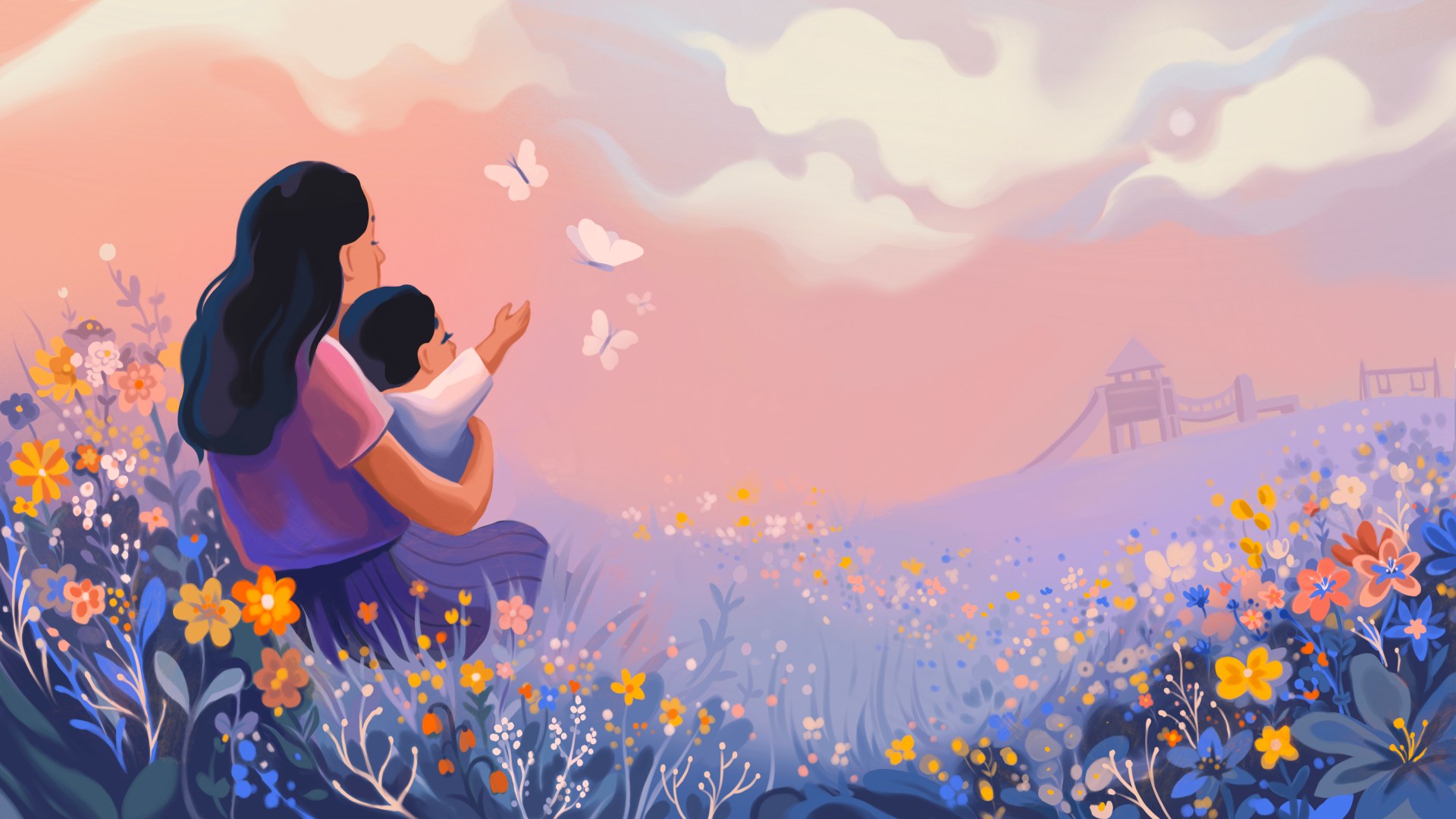
This evening we are at the park.
My son collects sticks and rocks and tennis balls and trash, dirt on his pants, drool on his shirt. He decides to go down the slide headfirst. I laugh. It is quiet, spring chilly, close to dinnertime; the other kids are home already. Not my kid. He would live outside, among the seed pods and marigold petals.
More days than not, we are here at this playground, or else in our backyard, where instead of sticks, our son picks up desiccated orange peels. Before he was able to sit, I laid him on a quilt, and once he could sit, I brought out pans of water for splashing. Once he could walk, all bets were off. Now he can run. “Run!” he proclaims. I laugh.
“How are you?” ask the friends and family who call on the phone, often while we are walking, once again, to the park. A different park this time, with a stone turtle in a sandbox. “What are you doing?” “We’re outside,” I say.
We’re at the park, trading toy trucks with other children. “Vroom,” says my son, running their wheels over concrete ledges. We fill their beds with gravel.
I can’t say I wasn’t prepared for this. Day after day, the park. Night after night, the same books. Morning after morning, the same toast with almond butter. And now the same noes to hitting, biting, and throwing. Crises punctuate the monotony: sickness and sleep regressions and teething, technical explanations for what might just be grumpiness.
“But how are you?” the callers ask, sometimes with a note of concern. Having a toddler seems like “a lot.” Well, yes. And also, I don’t quite know how to tell them the truth. “I’m good,” I say, which sounds like I’m being evasive. But that’s not it at all. I’m great! Well, of course, not always. Think of the fatigue. The untethered tantrums.
But joy persists. I don’t know how to talk about it without sounding as if I’m bragging or dissembling. I don’t know how to talk about it without being annoying.
Here we are once again, in the grass beneath the big tree, sticky with spilled bubble liquid. I’m spending more time than ever in the sun. I’m studying the shape of the pale “moon!” that shows up in the daytime sky. I wouldn’t have noticed it at all save for the small finger pointed up, directing my attention.
The online motherhood chatter had warned: You’ll be bored. At the same time, panicked. Overwhelmed. At the same time, understimulated.
It is hard to be a mom and work for pay; it is hard to be a mom and not work for pay. It is hard to make palatable vegetables and keep the floors swept and also potty train and be emotionally available. Comics about the “mental load” of school spirit days and medical appointments are viral. Books have come out: Screaming on the Inside: The Unsustainability of American Motherhood; Touched Out: Motherhood, Misogyny, Consent, and Control. A 2021 novel about a stay-at-home mom turning into a dog became a Netflix series. It was written from the author’s pained exploration of early motherhood, “this sort of rage at where I found myself,” she told NPR.
Recently, another angle has appeared: Maybe being a mom is not so bad. The writer of a 2024 book titled When You Care: The Unexpected Magic of Caring for Others tentatively confessed her love of motherhood—at the same time worrying that admitting as much might “undermine political efforts to get necessary and overdue support for parents from the government and workplaces.” In their 2024 treatise What Are Children For?, authors Rachel Wiseman and Anastasia Berg wonder whether all the literary emphasis on motherhood’s burdens might have something to do with our precipitously declining birth rate. They sound a note of caution: If you make parenthood sound awful, people won’t want to be parents.
These titles aside, the falling birth rate has not been arrested. Neither has a vague, data-backed sense that motherhood is misery making, bad for your pocketbook, and bad for your body. In 2024, the surgeon general put out a warning about parents’ declining mental health. In 2025, The New York Times released a video series titled “ ‘Motherhood Should Come with a Warning Label,’ ” in which tearful women express both their love for their kids and their abiding frustration: “Having children cost me around $750,000 in career earnings.” “The system is set up to shaft women.”
Of course (of course!) there’s some truth to these assessments. Since having my son, I’ve felt fuzzier at work and find my focus interrupted by family to-dos. There are new pajamas to buy and slow-cooker soups to start. Our part-time nanny is texting me asking where the other box of size-6 diapers is located. Or do we want to switch to pull-ups? We’ve had some terrible nights of stomach flu and an allergy scare that ended in the ER, and that’s all with the caveat that my husband and I are fortunate, with lots of support and a healthy child. Not everyone has that.
So yes, there are challenges. We mothers worry that if we don’t talk enough about the challenges, we won’t get the support (and sometimes the slack) that we need.
But I also think that we focus on the hard parts of parenting because it’s easier to talk about suffering as a burden than a blessing. Obviously, it stinks to clean up after carsickness, and it’s stressful to be running late again because someone won’t put on their shoes. For me, it’s easier to describe this torment (and receive sympathy) than it is to get at how satisfying it can be to rock a child who is hot with fever then lay him in his crib at the end of an exhausting day—the deep contentment of that self-giving. It sounds like masochism to explain how the pain is often part of the pleasure. And yet that paradox is the very essence of discipleship to Jesus: losing in order to gain, emptying and being filled.
I know where God is in suffering. In the wee hours, in the ER, he’s near. The Lord accompanies his people through dark valleys and deep waters; his Spirit soothes the brokenhearted and uplifts the downtrodden (Isa. 43:2; Ps. 23:4; 34:18). Grieving and put-upon people are blessed (Matt. 5:4; 1 Pet. 4:14). None of their pain is for nothing. Persevering amid trials—imprisonment, persecution, estrangement—garners the sufferer a crown of life (James 1:12). Troubles lend themselves to eternal glory (2 Cor. 4:17). Bad things work together for good (Rom. 8:28). Difficulties refine our faith, nestle it in the coals, and burnish it to gold (1 Pet. 1:6–7).
This teaching is good news for people in bad situations. It has been good news for me in the past, and it will be good news for me again. But is it good news for me now? If “suffering produces perseverance; perseverance, character; and character, hope” (Rom. 5:3–4), then what are my afternoons at the park producing?
Blessed are the mourners, the hungry, the persecuted. Blessed are the joyous? That’s not in Jesus’ list. I don’t mean joy in spite of, joy in the midst of, joy in the dark valley.
I mean joy at the park next to the stone turtle. Joy in the morning after a toddler has slept all night in small pajamas and now is eating a stack of banana pancakes. Joy that is straightforward, delightful, funny, and so often, praise God, uncomplicated.
Now it is summer, and we walk around the backyard with a hose, watering herbs and tomatoes. The slides at the park are hot to the touch. We take trips to the public pool instead: tepid water, the acid smell of chlorine, my son’s face tilted back, droplets in his eyelashes.
This time feels tenuous, like something I must safeguard—perhaps even from the Lord, who may intrude with bad news, an accident, or a grief to teach me something tough, make me wise, or build my character.
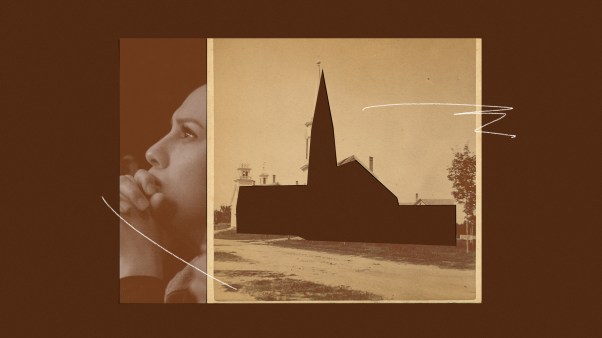
 Illustration by Nicole Xu
That’s not the way to approach our good God, whose ways are not our ways, who works all things together for our good, who is generous. I know that. But in my all-too-human framework, I shy away from suffering, mistakenly understanding it at as the only way the Lord offers his lessons. I’m a solider who doesn’t want her draft number called; I’m a student hoping she isn’t asked to put what she’s learned into practice.
Sometimes I catch myself as an ingrate, annoyed with my son’s whining. He tries to dive back into the pool when it’s time to leave. He digs fistfuls of dirt from the base of the bougainvillea. I huff and puff and then hope God didn’t see. No, Lord, really, I know how good I have it. Please, please don’t take it away from me.
All this happiness lends itself to anxious generosity. Perhaps I can earn what I’ve been given after all. I wash and fold hand-me-down baby clothes for new parents in our church. I lend out the bassinet. I put cards in the mail for birthdays I usually forget. I cook for meal trains and shelter dinners, marinating chicken in the early morning hours, chopping vegetables once my son has gone to sleep.
On the one hand, this feels like a right response. God has blessed me so abundantly that there’s simply nothing to be done but to turn around and bless others, to “abound in every good work,” having all that I need (2 Cor. 9:8).
And yet all the donating and chopping and stamp licking also feel like fear. Like a boat throwing dead weight overboard, I toss my blessings at others, desperate not to sink. God, don’t you see that I’m living up to this? I’m being good. Please don’t take it away from me.
At evening services, the summer sun still in the sky outside the sanctuary, I pray a compline prayer.
Keep watch, dear Lord, with those who work, or watch, or weep this night, and give your angels charge over those who sleep. Tend the sick, Lord Christ; give rest to the weary, bless the dying, soothe the suffering, pity the afflicted, shield the joyous; and all for your love’s sake. Amen.
“Shield the joyous.” What a relief. Other Christians have felt this way. Reveling in their romances, gathered with friends, struck by natural beauty, they could only say, “Safeguard this.” Please, please don’t take it away from me. That may not be a theologically astute prayer—God isn’t capricious like that. But it’s an understandable one.
In her book Prayer in the Night, Tish Harrison Warren writes about anticipating a new baby after two miscarriages, trying to hold off celebration: “I hedge my bets, wait for the other shoe to drop, and protect myself from pain by avoiding the wonder and beauty before me. I try to shield myself from disappointment by not embracing joy.”
I understand the inclination. Some part of me knows that my son is vulnerable to sickness and death. (God forbid.) At the very least, he will move out of my house someday. (God willing!)
But rather than resist the vulnerability of joy, I keep giving myself over to it in fits of risk. Amid the day-to-day pleasures, there enters in that deeper ache.
At another park down the road, older children use broken-up cardboard boxes to slide down a hill, and my son tries too. We notice a “ladybug” and watch games of “basketball” and trace the path of an “airplane” and then a “bird,” “caw caw!” I want to keep his new words in the air forever. And yet I know they will be replaced.
There it is. The sense, even when I am most alive to the moment, that all this is fleeting, that my joy won’t ever be satisfying this side of eternity, so long as children grow up and summer cools to fall. C. S. Lewis describes this sensation in his conversion narrative, Surprised by Joy:
Joy (in my sense) has indeed one characteristic [in common with pleasure]; the fact that anyone who has experienced it will want it again. Apart from that, and considered only in its quality, it might almost equally well be called a particular kind of unhappiness or grief. But then it is a kind we want. I doubt whether anyone who has tasted it would ever, if both were in his power, exchange it for all the pleasures in the world.
For so many of these months, I’ve been happy—and oftentimes that happinesshas proved conducive to joy, fertile as the compost growing our lettuces. If joy is the river running through the Christian life, happiness at its best pulls me to the banks and demands that I dip my feet in the current. Happiness is ice cream and sun-warmed towels pilly from washing; joy is “the stab, the pang, the inconsolable longing” of the one from whom they came, like a hand gesturing toward the moon.
Put another way, happinessis mine for now, as I carve cherry flesh from the pits and wander the fields in the evenings, tracing the trampled steps of a small pair of tennis shoes. Happiness is a gift. But joyis my portion. It is that feeling: Please don’t take it away from me. And then, rightly directed, it is the turn: I know, God, that even when these days end, you will still be God. We look for the resurrection of the dead and the life of the world to come.
And it is greediness. In the pool, amid the shrieks, getting sunburned shoulders, all I want is more. “The very nature of Joy makes nonsense of our common distinction between having and wanting,” writes Lewis. “There, to have is to want and to want is to have.”
In September, we visit a different park, where children have left behind buckets and shovels. My son takes these as his birthright. He opens a tap, lets water flow through concrete rivulets. Now it’s fall, and soon it will be winter, and because we live in California, I can’t make a big deal about that. A little rain, that’s all. But still—things will change.
I am pregnant with our second child—an absolute blessing, and yet a little sadness. These days spent with just my son are numbered. (God willing!) We’ll count it all gain. But that doesn’t mean something won’t be lost.
Take heart, encourages Warren: “Christians unapologetically embrace that good, earthy gifts bring joy, even as we also proclaim an enduring joy that remains even when all pleasures are burned away. To practice joy then is to seek the source of all that is lovely and bright.”
Maybe that’s what these hours outside have been: the good, earthy gifts. The happiness. And then, seeking their source as a discipline, craning my head through the chlorinated droplets. To “rejoice in the Lord always” (Phil. 4:4)—not just when I am sowing with tears (Ps. 126:5) but when I am sun-kissed and cheerful, which can be more difficult. Happiness can bring you to the river’s edge—or it can make you believe that you don’t need the river at all, that you’ll quench your thirst from another source.
Understood rightly, “Shield the joyous” isn’t a petition for endless watermelon afternoons. It means to shield the joy itself as a reality independent of circumstances, even when our lives slip into affliction. It is a prayer to clear up the river, to let it flow freely, cutting through any accumulated silt. Warren writes, “We pray that God himself would shield us, that as lesser delights dissolve in the face of pain, we might slowly find where enduring joy lies.”
 Illustration by Nicole Xu
I start and end these autumn days putting apples in the oatmeal to soften, planning a near-2-year-old’s train-themed birthday party. Christmas twinkles on the horizon. By the time this essay is in print, spring again, we pray he will have a healthy sister.
So much of Christian teaching on joy emphasizes its durability—its indifference to outward conditions, its steadfastness to a steadfast God. That’s right. There’s also its bittersweetness—its falling short as long as Christ has not yet come. That’s right too.
But Lewis, defining joy as a “kind of unhappiness or grief,” is too dour for me. At least today.
I don’t want to hide from suffering. I don’t want to marinate chicken out of anxiety. I don’t want my joy to be as fleeting as the summer, a river that dries up at first heat. I don’t want to be naive, seeing fleeting things rather than our constant God.
But I also want to enjoy the gifts I’ve been given rather than always anticipating the other shoe dropping, the change in the weather, the unexpected pain. I want to revel in the joy of the Lord not just because I know I’ll need it in the trials ahead—I will—but because I get to have it now.
In short, I want to talk about how good it is to be a mom. What a privilege. How I spend my days awestruck by my child.
“Whenever I feel the presence of God, then my heart is lifted up, and I see more positively into the future of the coming of God. Thus, hope is awakened in me,” theologian Jürgen Moltmann said in an interview about joy with fellow theologian Miroslav Volf. “Hope is for me anticipated joy, as anxiety is anticipated terror.”
Maybe the relationship can go the other way. If hope anticipates joy, then maybe joy, even joy that comes not from suffering but from happiness, can make us hopeful. Maybe we can savor the foretaste instead of always craving more sweetness.
We hold the cherries on our tongues, hold the small hand in ours. “Please don’t take it away from me” becomes “Thank you, thank you, thank you. Thank you that this is what is promised.”
That timeworn phrase already but not yet emphasizes a gap. Not yet we understand all too well. But joy always precedes. Already, little boy. Already, little girl. Already, here with the two of you.
Kate Lucky is a senior features editor at Christianity Today.
This article appeared in the March/April 2026 issue of Christianity Today as "Shield the Joyous".
Related