Writing a comprehensive history of American Christianity is a mammoth undertaking that few historians attempt. It’s been more than half a century since the best-known landmark in the field—Sydney Ahlstrom’s 1,100-page A Religious History of the American People—and after that, some scholars expected we’d never see such an ambitious work again.

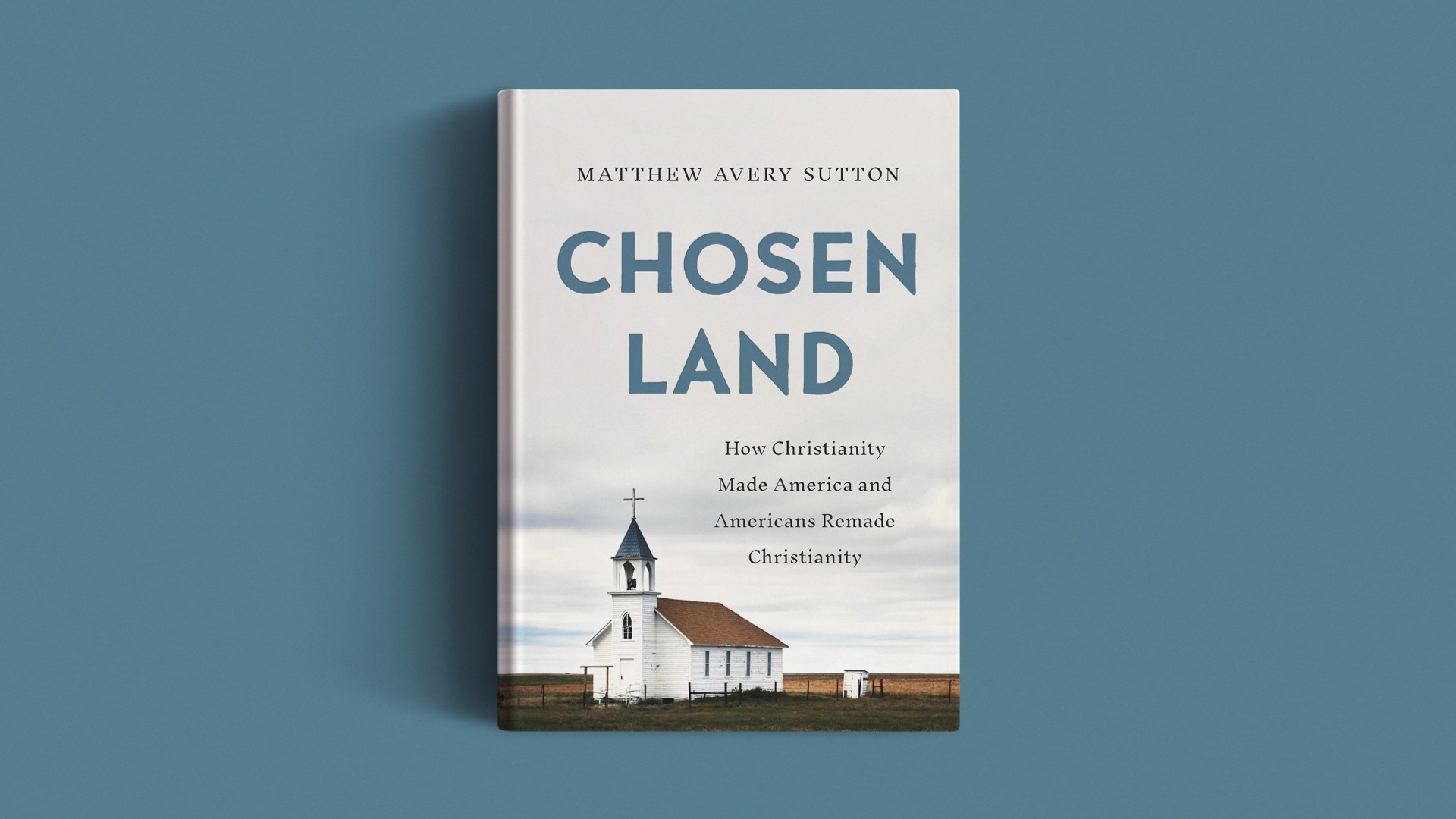
Yet in Chosen Land: How Christianity Made America and Americans Remade Christianity, Matthew Avery Sutton has perhaps accomplished something even more impressive. Not only has he produced a comprehensive history of Christianity in American public life; he has also made it a highly engaging read. And he has done so in half the pages Ahlstrom required. (Full disclosure: I read part of this book in draft form and offered Sutton my feedback before it went to press, which is why my name is listed in the acknowledgments.)
Unlike some magisterial histories, so densely packed with information that they function more as reference works than as readable books, Chosen Land is the type of popular work you can read on a plane or a bus. It’s filled with colorful stories and even more colorful quotations, and it covers an enormously wide range of material. But in its focus on Christian pursuit of power, Sutton’s book offers a better history of American Christian politics than of American Christianity itself.
Beginning with the Spanish Catholics who brought Christianity to the Americas in the 16th century and continuing through the stories of the New England Puritans, the Virginia Anglicans, and the frontier revivalists, Sutton’s 500-year narrative covers all the major Christian leaders in America (and numerous others whose stories are much less remembered). With an eye to telling the stories of the marginalized, Sutton is particularly attentive to the lives of women, racial minorities, and their respective oppressors.
The story of American Christianity, Sutton argues, is the story of America itself, because for most of our history, nearly all the significant political players in every major debate were Christians. It was Christians who made the American nation, and as they did, they created a version of the faith that is uniquely American. They built a country that was uniquely—but not, as many American Christians tend to assume today, monolithically—Christian. Far from propagating an unchanging “Christian worldview,” for most of US history, the nation’s Christianity was a fractious set of competing perspectives.
Long at the center of those fights, Sutton contends, were four opposing groups of Christians: conservatives, revivalists, liberals, and liberationists. Though all wanted in some way to make America Christian, they had very different views on what that might mean.
For most of their history, conservatives (not to be confused with modern political conservatives, though some have certainly been conservative in politics as well as religion) mainly wanted one thing from the government: to be left alone to practice their own religious tradition. Nearly all 19th- and early 20th-century Catholics fell into this conservative tradition, as did most 19th- and early 20th-century Lutherans, some Dutch Reformed Christians, and some Episcopalians.
For these conservatives, the historic liturgical practices of the faith—the recitation of the creeds, preservation of the sacraments, and authority of the Christian tradition—were both supremely important and sufficient for salvation. They did not see the church as a liberating social force or an agent of moral reform. They did not join the 19th-century religious campaigns against alcohol or slavery, nor did they campaign for legislation to make America a more overtly Christian nation.
related
Instead, conscious of their status as religious minorities in a nation that was dominated by Protestant revivalists and liberals, they wanted to protect their own traditions from a potentially hostile state. Only in the 20th century did many of these groups make common cause with revivalists in an effort to defend against liberal attacks on the historic verities of the tradition or the nation’s Christian-inspired moral framework.
Sutton uses the term revivalist to denote Christians whom many other historians have called evangelical. This is the stream of Protestant Christianity that emerged from the Great Awakenings of the 18th and 19th centuries and gave rise to the fundamentalist movement of the early 20th century and the preaching campaigns of Billy Graham in the postwar era.
Unlike Sutton’s conservatives, revivalists were (and are) mission oriented. Driven by a sense that individuals’ relationships with God are sustained not through sacraments, liturgy, and ecclesiastical connections but through conversion and Spirit-induced revivals, revivalists have always wanted to convert the lost at home and abroad. That mission has led them to build large organizations and, at times, to seek political power.
While revivalists want to Christianize the nation, liberals are pluralists and rationalists who historically favored a publicly Christian democracy and educational system only if it could be nonsectarian and harmonized with modern science. Though the number of liberals has shrunk dramatically in recent decades, for much of the late 19th and 20th centuries, they dominated American Christianity, especially in the North. Many 19th-century Congregationalists were liberals in this sense, but so were some Methodists and Northern Baptists.
Though sometimes incorrectly labeled liberal, liberationists were committed not to rationality but to freedom for the oppressed. Consisting disproportionately of African American Christians, liberationists of the 19th and 20th centuries preached a Jesus who emancipated the oppressed and challenged the white power structure. They were the catalyst for the Civil Rights Movement and the voice of justice for the oppressed.
related
Today, Sutton argues, these four strands of American Christianity have largely narrowed to two, at least as far as debates about religion in American politics go.
On one side are those he says want to “reassert Christian dominance in American governance,” a category that now includes most revivalists and conservatives. This group wants to see abortion made illegal, traditional views of sex and gender reflected in public law, and (above all) a Christian-based framework adopted for the nation’s legislation and politics.
On the other side are liberationist and liberal Christians who believe Christianity has a place in public life but only if it is pluralistic, inclusive, and focused on social justice for the oppressed. In pursuit of policy goals like environmental and racial justice or the rights of immigrants, they’re sometimes in an uncomfortable alliance with a growing group of religious nones who believe Christianity should be excluded altogether from the public square.
Sutton tries to be fair to each of his subjects, but his sympathies are clearly with the marginalized. Thus, for much of his narrative, the liberals seem out-of-touch, the revivalists appear to be agents of oppression, the conservatives cooperate in preserving inequities, and the liberationists alone offer a prophetic word to a society that is structured around the oppression of the weak.
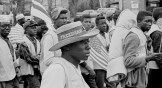
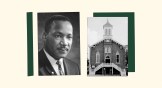
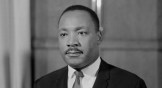
During the Civil Rights Movement, for instance, liberationists such as Martin Luther King Jr. and Fannie Lou Hamer drew on Christian principles to challenge the nation’s racial injustice. Meanwhile, white liberal churches offered only belated support and denied their “complicity in racism,” Southern revivalists actively opposed the Civil Rights Movement, and conservatives showed little interest in the problem.
And looking at the two broad streams of today, it’s not difficult to guess which Sutton prefers. As he says, Christians of the late 20th century faced a bifurcated choice: “Would they rally behind Christian nationalism or stand as prophetic voices against injustice?”
related
Sutton’s 500-year analysis offers a helpful corrective to two historical misconceptions that stem from our unusual contemporary situation of rising irreligiosity paired with minority governance by the conservative-revivalist alliance.
One misconception is the belief of many nones that American politics were largely secular until the religious right polarized the country beginning in the 1980s. Actually, Sutton correctly contends, American politics and society have always been deeply infused with Christianity, because Christians created and repeatedly reshaped the nation’s culture and politics.
The second misconception is the unconsidered belief of many Christians that Christianity in our country is monolithic—and that if we could just make society and politics more Christian, a Christian-based morality would automatically follow.
On the contrary, as Sutton’s narrative reminds us, American Christians have not all believed the same things. There were prominent Christians on both sides of debates over slavery in the 19th century, Prohibition in the 20th, and the gay rights movement in the late 1960s (which received support from some liberal Christian ministers who were gay, even though the vast majority of Christian churches opposed homosexuality).
This was also the case with abortion rights—a cause that was supported by most mainline Protestant denominations, even as Catholics (and eventually evangelicals) opposed it—and with school-prayer debates too. The organization leading the campaign against religion in public-school classrooms was explicitly religious and was originally named Protestants and Other Americans United for Separation of Church and State.
Similar conflicts continue today as the conservative-revivalist coalition meets a liberal-liberationist alliance that carries on old battles under a newly nonreligious label.
related


But what should we as Christians do with all this? It’s discouraging, after all, to realize that the faith we profess has so often been used as an agent of oppression and that American Christians have spent much time infighting on a quest for power.
There’s no question that this is part of the American story, and that should be an admonition for us, especially if we’re tempted to quest for political power ourselves. But the narrative of Chosen Land is not the only story. Sutton’s attention to power makes for a first-rate history of American Christian politics—yet that’s not quite the same thing as a history of American Christianity.
Sutton says very little about theological belief, spiritual practice, and transformed lives. He devotes two pages to Jim and Tammy Faye Bakker, three to David Koresh, five to Donald Trump, and six to Jim Jones, but never mentions the Christian origins of Habitat for Humanity and World Vision or Rick Warren’s announcement that he was giving away 90 percent of his income through “reverse tithing.” Nor does Sutton mention the Bible translations American Christians have read or say much about their prayers or hymns. Perhaps such discussions of religious devotion do not fit into a narrative of “how Christianity made America,” but they are certainly a central part of the American Christian story.
Evangelical historian Mark Noll concluded his history of American Christianity, The Old Religion in a New World, with a chapter titled “Day-to-Day Christian Spirituality and the Bible,” a discussion of Bible reading and sermons. Sutton concludes with a discussion of religious rhetoric at Trump’s second inauguration in 2025 and the observation that the inauguration symbolized what, he claims, American Christianity always was: “a battle for power in order to define the nation’s soul through its politics, policy, and culture.”
If we look only at Christianity’s public face in the United States, Sutton’s observation may be more correct than we’d like to admit. But Noll’s earlier history suggests there is another side of American Christianity that is equally important: the transformation of individual human hearts.
related
Chosen Land is a superbly written history of American Christians’ political culture and our relationship with the country. It gives us a new understanding of the place of religion in American exceptionalism and public life. It gives us new tools to understand our political history and current moment.
What it doesn’t give us is everything we need to know about American Christians’ faith. Sutton is unsurpassed when he tells us how American Christians have loudly prayed “on the street corners” (Matt. 6:5). That’s a story we need to know. But until we also examine what Christian believers are saying to God when they go into their inner rooms, much more remains to be told of the story of the kingdom of God in America.
Daniel K. Williams is an associate professor of history at Ashland University and the author of books including Abortion and America’s Churches: A Religious History of “Roe v. Wade.”