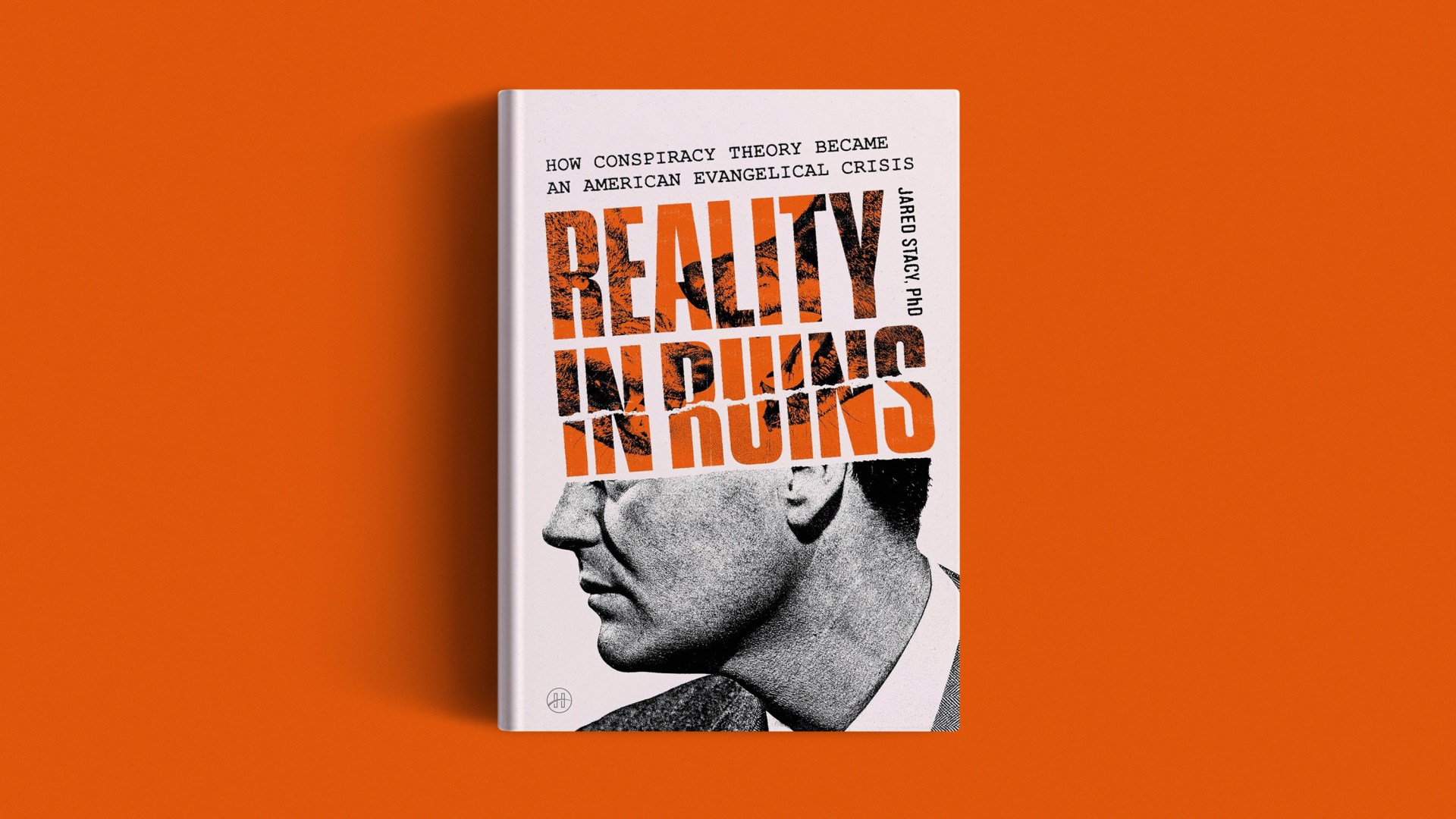
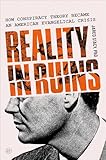
No good editor will let you start an article with a dictionary definition, which is perhaps the surest sign that a writer has no idea where to begin. But for this review, I must break the rule, because grasping a handful of related terms is vital to understanding the focus of Jared Stacy’s Reality in Ruins: How Conspiracy Theory Became an American Evangelical Crisis—and to understanding how and why it is an unsuccessful book.
First is conspiracy theory, a belief (and its explanation and evidence) that a group of people have secretly colluded in some project or event. The people who collude are conspirators, their plan is the conspiracy, and their thoughts and activities in executing that plan are conspiratorial.
Then there’s the mindset of conspiracism. This is not a discrete theory but an attitude, a comprehensive posture of suspicion that combines cynicism toward enemies and gullibility toward friends. Where conspiracy theories attempt to marshal specific fact claims and chains of evidence, conspiracism relies on leading questions, bald assertions, and bad vibes.
It’s possible to be a conspiracy theorist without being a conspiracist, provided your theorizing doesn’t expand into a broadly conspiracist worldview. And though a given conspiracy theory may be true—because sometimes conspiracies do happen (like Watergate), and sometimes people do suss them out (see All the President’s Men)—conspiracism is always pernicious, more interested in grievance and power than truth.
Here’s why these definitions matter: The subtitle of Reality in Ruins says it’s about conspiracy theories, and so it is. But it’s also about conspiracies and conspiracism, and Stacy neither distinguishes between these phenomena nor keeps his terms straight. He defines both conspiracy theories and conspiracism as an unjustified, simplistic, comforting “act of storytelling” and uses the two interchangeably. He repeatedly says conspiratorial when he means conspiracist and conspiracy when he means conspiracy theory, in each case mixing up those inside the supposed plot with those who imagine themselves exposing it.
If this were the sole problem with the book, it would be unfair to treat it as anything more than a tragic lapse of copyediting. It is not the sole problem but rather indicative of the whole quality of the work.
Stacy is right to be worried about conspiracism in the church. He correctly grasps the mindset’s real and intelligible appeal, how it flourishes amid modern information overload, takes advantage of Christian instincts to fight evil, and is rarely overcome through head-on, argument-driven confrontation. When he meditates on trust in Christ, Reality in Ruins soars.
But on its primary subjects of evangelicalism and conspiracism, the book falls flat. Beyond terminological sloppiness, Reality in Ruins fails in its aspiration to be gracious to the evangelicalism Stacy has left behind. He traffics in overstatement and ultimately spins conspiracy theories of his own.
related


Before I come to all that, let me offer two asides. First, I’m not praising the goods of Reality in Ruins merely to cushion the coming critique.
Particularly in the opening gambit against conspiracism and the final quarter of the book, in which Stacy introduces practices of self-interrogation to avoid conspiracist thinking, I repeatedly wrote “good” and “yes” in my notes. He’s right to emphasize that conspiracism tells us primal stories about the world and our place in it, exerting “great force on those for whom the desire to be good and do good are driving factors.” This is more widely appealing—and therefore more insidious—than the classic conspiracy theorizing of The X-Files or Glenn Beck’s chalkboard.
And Stacy is at his best when he contrasts the confusion and suspicion of our data-drowned age with the rest and trust we find in Jesus. The Christian life does not come with a promise of omniscience, Stacy observes. God’s Word as “a lamp for my feet, a light on my path” (Ps. 119:105) often shows us just a little way ahead. The lie of conspiracism, Stacy argues, is that it promises us more control in this life than God himself promises.
Second, I should mention before I go further that CT appears in this book. “Christianity Today is”—present tense—“a flashpoint for the way the totality of holy paranoia was reinforced by and evolved through the Cold War,” Stacy alleges. “It’s not that conspiracy theory was universally upheld by evangelicals, it’s more that it was never exorcised for reasons of political and economic expediency.”
His two pieces of evidence are CT publishing the writing of FBI Director J. Edgar Hoover during the Cold War and running an ad for a Conservative Book Club in 1966—an ad to which some CT readers volubly objected. (You can see the ad on the final page of this issue PDF, and reader responses are here and here.)
The ad controversy, Stacy says, “illustrates the way in which this evangelical totality of holy paranoia persists and evolves. The conspiratorial [actually, conspiracist] narrations, charged by theology and contained in a leading evangelical publication for advertising profit, show how a nexus of variables can contribute to its spread.” That is a jargony way of accusing CT of promoting and sanctifying conspiracism to make money.
I’ll leave this matter here, adding only that it’s surprising that Stacy follows this by touting his own history of writing for CT in his author bio on the book’s jacket.


Now to the core of Reality in Ruins. Stacy says that the right way to resist conspiracism, disinformation, and propaganda “doesn’t begin with pointing out where others are wrong” but with examining our own hearts, recognizing that we can’t “change anyone but ourselves” and that “we can only convince through patience and a willingness to dialogue” and to “be dispossessed of our own certainties.” That’s all to the good, but it’s not how Stacy wrote this book.
His thesis is that “conspiracy theory and evangelical Christianity in America run together” and “always have.” And though he occasionally adds a dash of caveat or nuance, much of his language is extreme. It’s certainty about how wrong evangelicals are, over and over again.
American evangelicals have inherited a “disoriented Christianity,” Stacy says, one that “uses the name of Jesus to sanction authoritarian politics in the pursuit of totalitarian primacy.” He calls this version of Christianity “a denial and betrayal of the Word that sustains Christian faith itself,” which leaves us unable to “talk about the living God” and fails to recognize “Jesus as the living Word of God.”
Stacy accuses American evangelicals of “trampling the weak, robbing the poor, and claiming it all in the name of Jesus,” whom he claims we “cannot see” as anything but “a Christian and a white American.” He states that our faith is “deeply rooted in falsehood and violence,” that it “endorses nationalism, authoritarianism, and strains of late fascism,” that it “empowers death,” that it is “marked by denial of the reality that is Jesus,” that it has become an “agent of Disreality” and “the enemy of truth.” According to Stacy, American evangelicals generally have embraced “raging conspiracism” and worship a different god than the God of the Bible.
I could add more quotes, but you get the gist. Unquestionably there are evangelicals under the sway of conspiracism and doing real harm to their relationships at home, in church, in politics, and online. But Reality in Ruins is unrelenting and overblown, far afield from the experience and thinking of tens of millions of ordinary evangelicals in ordinary churches all over America, people who are normal, kind, and sincerely interested in studying the Bible and bringing you a casserole.
A crucial chapter runs through aspects of American history from the Salem witch trials through Jim Crow to contemporary evangelical politics. Despite this breadth, Stacy musters few actual conspiracy theories originating with or unique to evangelicals, let alone demonstration of pervasive evangelical conspiracism across four centuries.
Other history he mentions is deserving of reckoning, absolutely, but it is a stretch to say it concerns conspiracist thinking. Great Awakening-era anxiety that slaves might revolt, for instance, was less a conspiracy theory than an observation of fact and a reflection of guilty consciences. Likewise Stacy’s recounting of Reconstruction and Jim Crow: There is grotesque evil here—evil in which some evangelicals undeniably participated, while others opposed it—but it is not specifically the evil of conspiracism.
If this is primarily a book about conspiracism, not general castigation of evangelicals, that distinction matters. My inclination, though, is to say it’s primarily castigation. By his own account, Stacy’s perspective is shaped by difficult experiences at church in and around that miserable summer of 2020. That’s a sorrowful and understandable context for his perspective here, but it does not make his sweeping accusations true.
related
There are far too many accusations for me to treat them all in detail, but let me address a few.
An important question for the whole framing of the book is whether American evangelicals are uniquely and constitutionally under the sway of conspiracism or whether we’re just Americans, sometimes falling into conspiracism but more often merely attracted to conspiracy theories as Americans tend to be. (The answer, incidentally, is the latter, and for those interested in the raucous and fascinating history of American conspiracy theorizing, Jesse Walker’s The United States of Paranoia is a sharper, more readable, and more carefully researched book.)
Stacy sometimes recognizes that this national proclivity extends well beyond evangelicalism. The “prominence and popularity of conspiratorial [actually, conspiracist] narratives in themselves do not mark out evangelicals as actually that much different from many Americans who also trafficked in particular conspiracies [actually, conspiracy theories] about specific historical events,” he writes in one such passage. Indeed, “conspiracy theories don’t often originate with evangelicals themselves,” he says in another.
Evangelicals’ specific offense, then, is to “take the content that conspiracy theory generates and set it inside their own theological imagination.” But that’s hardly evidence of the “hermetically sealed world” that’s “impervious” to factual pushback in which Stacy says we live. It’s evidence that evangelicals are Americans—with characteristically American foibles and sins—who take our faith seriously, try to be consistent in our thinking, and sometimes get things wrong.
Or consider the element of class and race analysis Stacy introduces, describing (white) evangelicals as telling scary stories about those socially beneath us. Throughout US history, he charges, “evangelicals in America have always suspected those at the bottom of the social order, on the margins.”
In my experience, evangelicals are far more given to what Walker calls conspiracy stories of “the Enemy Above, hiding at the top of the social pyramid” than stories about “the Enemy Below, lurking at the bottom.” The conspiracy theories I’ve heard from evangelicals over the past 30 years—fantastic tales of the deep state and the New World Order, of Pizzagate and the Clintons murdering people in Arkansas, of birtherism and FEMA camps—are all stories about elite collusion, not threats from below.
Moreover, for much of American history, which Stacy claims as the scope of his inquiry, many evangelicals were those on the bottom of the social order, as historian Nathan O. Hatch has documented—the people “forging moral communities among the poor, the sick, the ignorant, and the elderly.” Our heritage includes many a backwoods fundamentalist, many a rural Bible college, and we still see evangelicals disparaged as stupid and lower-class today. If we’re serious about helping evangelicals avoid conspiracism—and we should be—these details matter.
Or there’s the question of evangelical ethics, which Stacy argues are “disoriented” and closely linked to our conspiracism. Evangelicals are wrong to talk about and strive to follow Christian values, he contends, because the “knowledge of good and evil” is “off-limits” for God’s people, which means that “there are no values or principles, ‘Christian’ or otherwise. There is only the waiting on and hearing of God’s command.”
That waiting and hearing doesn’t seem to mean more time in Scripture, though, because Stacy also disapproves of how evangelicals read the Bible, studying it (in part, I’d argue) to discover and apply moral principles. In Reality in Ruins, “biblical worldview” is in scare quotes, and evangelicals are people who always think we’re right because we follow the Bible and others don’t.
And yes, that’s a risk that comes with a high view of Scripture, and a warning to humility is always welcome. But in reality, Stacy is making the very mistake of which he accuses evangelicals: confusing confidence in Scripture for confidence in ourselves.
related


The most curious parts of Reality in Ruins, however, are the conspiracy theories proffered by Stacy himself. I counted at least three, all concerned with “Enemies Above.”
One is about President Donald Trump’s lies regarding the 2020 election. Stacy writes that “it’s little wonder that the Big Lie was so effective among evangelical Christians” because conservative activists and organizations have long colluded to “engineer panic,” then “exploit it” for “a particular purpose. And evangelical Christianity is bound up in this problem.”
This is a massive and vague allegation of deliberate conspiracy. The simpler and more natural explanation is that many Americans of every political ilk are prone to panic and susceptible to fantastic promises when the most powerful office in the world goes to rivals whom they believe to be immoral and irresponsible.
Second, reflecting on the attendance of tech titans like Jeff Bezos and Mark Zuckerberg at Trump’s inauguration in 2025, Stacy speculates that America’s political polarization is also engineered. It’s a manufactured “feature of digital infostructure,” he speculates, designed so that huge tech companies can “outflank and outmaneuver democratic oversight.” These companies function as “rogue networks (which defy common accounts of oligarchy or autocracy),” Stacy theorizes, threatening “anyone who interfaces with their many products and services.” Swap out a few words and this could be a New World Order diatribe from arch-conspiracist Alex Jones.
Third, Stacy’s discussion of the evangelical response to the murder of Cassie Bernall in the mass shooting at Columbine High School—which later reporting said did not involve a confession of faith—is particularly notable. It neatly fits his own definition of a conspiracy theory: “a storytelling act that (1) claims what it cannot know and (2) goes beyond what it claims.” Here’s Stacy:
This [martyrdom] ethos evolved and expanded, but it was given life by a single solitary commitment: do not let facts get in the way of a good story. The idea of a martyred teenager was, in the end, too compelling for an evangelical culture not only looking for content to narrate its time but also trying to find its footing so as to deliver its gospel with urgency and relevancy. …
These myths of Columbine emerged from a place of deep grief, yes. But there are those who exploited them, propagated them, in youth groups and on radios across America, to give the rising generation a “radical” faith based less on truth and more on perception, on suspicion, on what resonated and worked.
Stacy writes that The Denver Post, a newspaper local to Columbine, corrected the record about Bernall’s death soon after the shooting. But this was in a largely pre-internet era in which a report like that couldn’t have traveled as it could today. How many of the evangelicals sharing stories of Bernall’s supposed martyrdom had any knowledge of that reporting?
It’s possible to critique the evangelical persecution complex without making unproven accusations of deliberate disregard for the truth—down to the level of the local youth pastor. Stacy is telling a story that claims what it cannot know and goes beyond what it claims.


Reality in Ruins is focused on the unique expression of conspiracism in American evangelicalism, and that is a problem worthy of focus. Conspiracism is a scourge, an active harm to good-faith conversation and cooperation in the church and American society more broadly. Stacy is quite right that conspiracism has “a tragic ability to distort the dimensions of the Christian story,” to divide congregations and deceive their members.
It’s unfortunate, then, that Stacy writes with such vehement rejection of evangelicals and such explicit disinterest in reforming the evangelical movement. “It would be a mistake to assume evangelicalism has the corner on conspiracism,” he says early on. “Especially if the driving motivation for that assumption is to generalize and pathologize, to shore up our own ideological defenses.” That’s exactly right—and why it’s a pity that this book generalizes and pathologizes American evangelicals at just about every turn.
Bonnie Kristian is deputy editor at Christianity Today.