Malcolm Guite was looking for a place to sit.

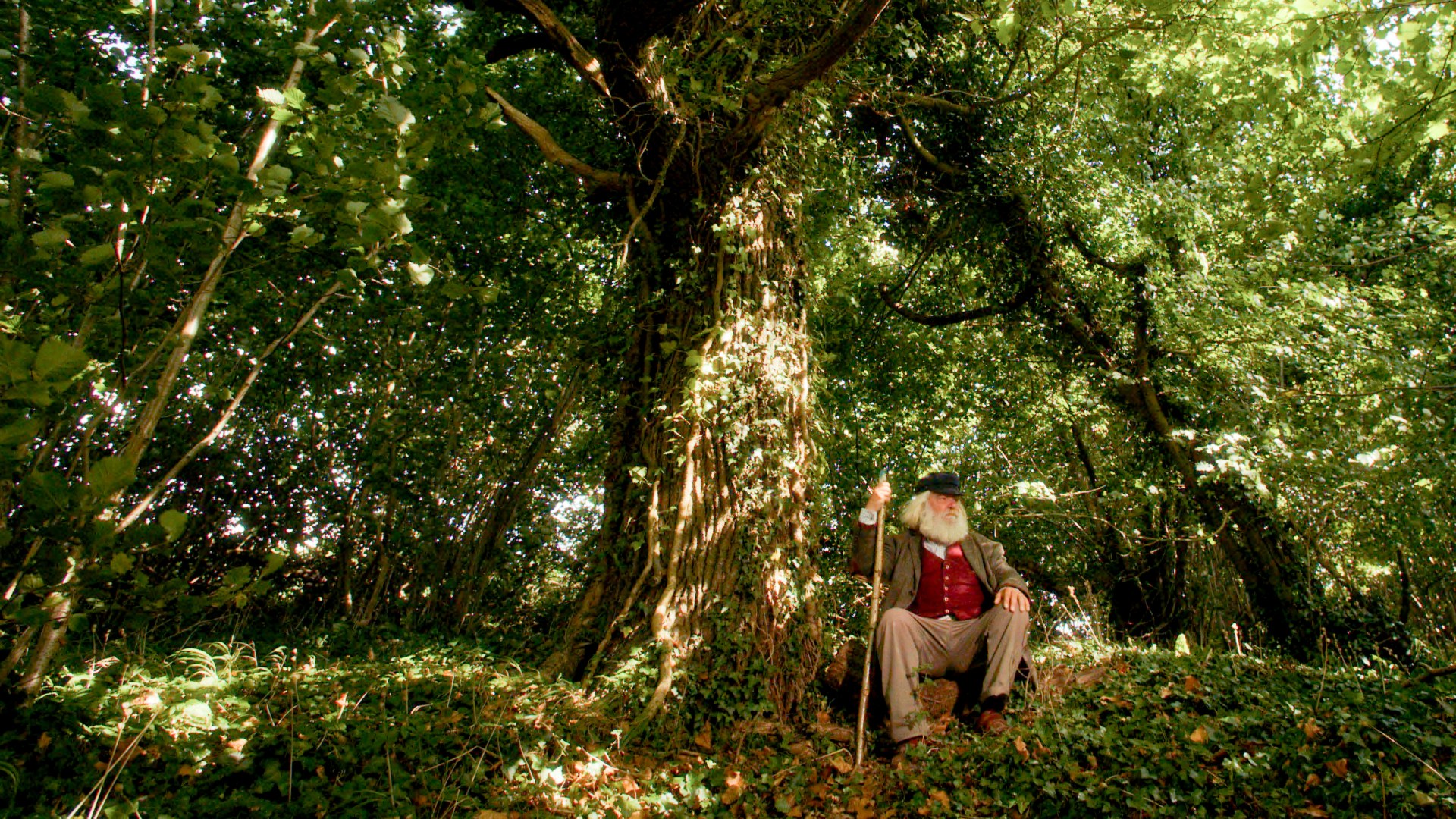
The poet wandered between branches and over tangled roots, through a British wood, with a few loyal companions. They were filming a documentary about his new epic ballad, Galahad and the Grail, and they wanted to feature a grove of oak, ash, and thorn trees—three significant characters in the poem. But they couldn’t seem to find a good spot with those trees close together, and they’d forgotten a stool for Guite.
“Not to worry,” Guite told his friends as they searched, according to his illustrator, Stephen Crotts, who was there that day. “In the poem, there is a fallen log by the oak. The woods will know the poem. There will be an oak. There will be a log.”
Sure enough, just as Crotts happened upon the three species of trees growing close together, Guite spied the perfect log, nestled beneath an oak. “He goes, ‘Oh, very well, there it is,’” Crotts recalled. “He just sat down and started puffing on his pipe.”
Crotts wasn’t surprised. “There’s a level of coincidence that follows him around,” he told me of Guite in an interview last month, smoking his own pipe on a wooden porch just outside Nashville, spring peeking out around us after a long, icy winter. Crotts hesitated, his voice dropping to an almost conspiratorial register: “Magic things happen.”


Guite’s new book, at least, does seem magical. Galahad and the Grail rollicks and captivates with a rhythm that feels as if Guite is casting a long-forgotten spell. It’s the story of Camelot and the grail quest, old and familiar but still delightfully strange. It’s also apt for our time, particularly in its vision of knighthood.
Some false knights, Guite laments in the beginning of the book,
Lust for might and mastery,
they only prate of courtesy,
and keep a code of chivalry
they scarcely understand.
Galahad, the perfect knight at the heart of the story, offers a different standard: one of gentleness and courage, faith and boldness, and the vision to see where, with God’s help, broken things can be restored.
“We’re effectively entering a new dark age,” Guite told me in an interview. “This story is about a light that wasn’t extinguished in the Dark Age. And we kind of need it again.”
A poet-musician-priest, Guite believes the old stories about King Arthur and his knights still hold power—and ultimately point to hope in Jesus Christ.
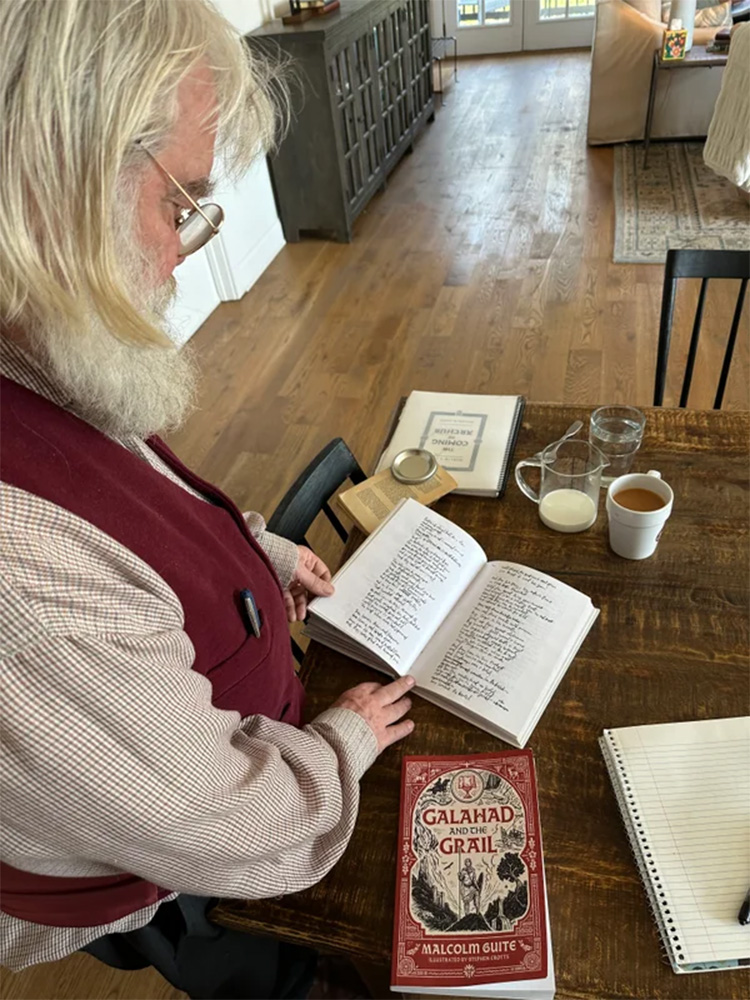
Galahad and the Grail is the first of a four-volume Arthurian epic, written in the nearly singing, rhyming style of an English ballad, which Guite advises readers to experience aloud. Guite himself is given to quoting lines in conversation. If you’re lucky, he’ll share the whole introduction to the poem, where he describes hearing a voice urging him to “take up the tale” as he walked outside one summer morning a few years back. (That’s not a metaphor or a mere poetic device, he told me: He really did hear the voice.)
Guite looks every bit the author of an epic ballad—or, yes, the kind of person who would expect a forest to know a poem. Imagine Father Christmas on a long sojourn to the Shire, often in colorful vests, hands never too far from a pipe to puff. While Crotts made him a cup of tea and we settled in for a conversation about the book, Guite’s white hair and beard shook with fervor as he recited his lines. His hands tried to do the story justice, waving about in the air.
And when Guite talks about myth and poetry, diving into Christ’s true and better fulfillment of old folklore, his sentences stop only when he runs out of breath, the words crammed together as close as possible. A great gulp of air, and he’s at it again.


“There’s this meeting of the Christian and the possibly pre-Christian, and how do you interpret that?” he said of the Arthurian legends. “The fashionable thing became to say that this is all pagan material which was still remembered but kind of banned by the church. The idea is that it was given a light Christian gloss to make it acceptable to a 12th-century audience.”
“I don’t think that’s the case,” he told me. “My view is that it’s not that an essentially pagan story was given a light Christian gloss. It’s that the Christian story, when it’s told in the midst of the cultural memory of these pagan stories, suddenly brings new life to them and makes sense of them.”
“Once you get Christ, once you know who the Messiah really is, suddenly it lights a backward path through all the old stories,” he said.
Arthurian legends can be tricky to market, for the very reason Guite loves them so much: These stories can be far too religious for many non-Christians, yet they feel too pagan for some Christian readers.
Guite also knew, even as he started writing Galahad and the Grail, that to print these books with any kind of institutional publishing support might be a long shot in an era of minuscule attention spans and ubiquitous screens. Many publishers, trying to convince people to pick up books instead of their phones, are gravitating toward sex-addled stories, tropes they can sell on TikTok, and books with so many subheadings that each new bold-faced summary is almost insulting.
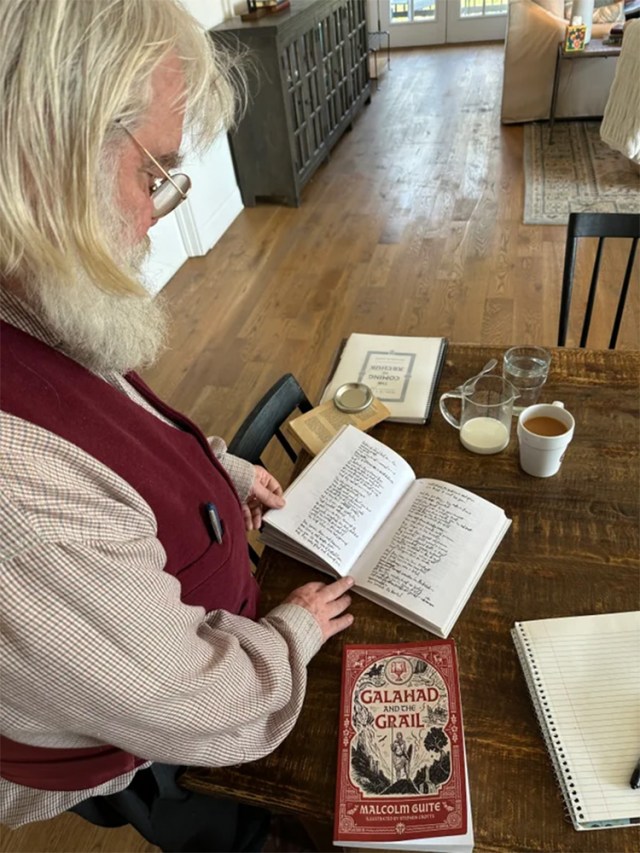 Image courtesy of Haley Byrd Wilt
Guite’s poem is the polar opposite of those trends. His regular publisher was at first “not enthusiastic” about his pitch, he told me. Two larger presses in the UK weren’t interested either, with one suggesting he write a much shorter book about T. S. Eliot’s Four Quartets instead. “They just weren’t willing to go there,” he said of an original epic ballad.
In many ways, Guite seems a man from a different time. Was this a tale for a different time, too? He quietly resolved that even if it were, and even if he never found a publisher, he’d take up the tale anyway.
The book finally did find a home with Rabbit Room Press. It’s the publishing arm of a nonprofit faith-and-arts organization founded 20 years ago by the singer and author Andrew Peterson. The Rabbit Room’s willingness to take on Galahad and the Grail, Guite said, helped convince his UK publisher, Canterbury Press, to publish the poem in Britain too.
The Rabbit Room’s book-filled North Wind Manor, a farmhouse outside Nashville, has the air of a modern monastery, where people with ink-stained hands scribble away to preserve old texts. In a way, that’s exactly what Guite’s poem aims to do: to reclaim and pass on an almost-forgotten story by telling it again for a new audience. Crotts, who really does have ink-stained hands, emphasized that the poem points to Christ in a time when many are looking for him, even if they do not know he’s the object of their search.
“We don’t want to hear about a story. We want to be in the story,” he said. “And the Eucharist is the place where we step into it. Jesus really is pulling up a seat at his table for us.”
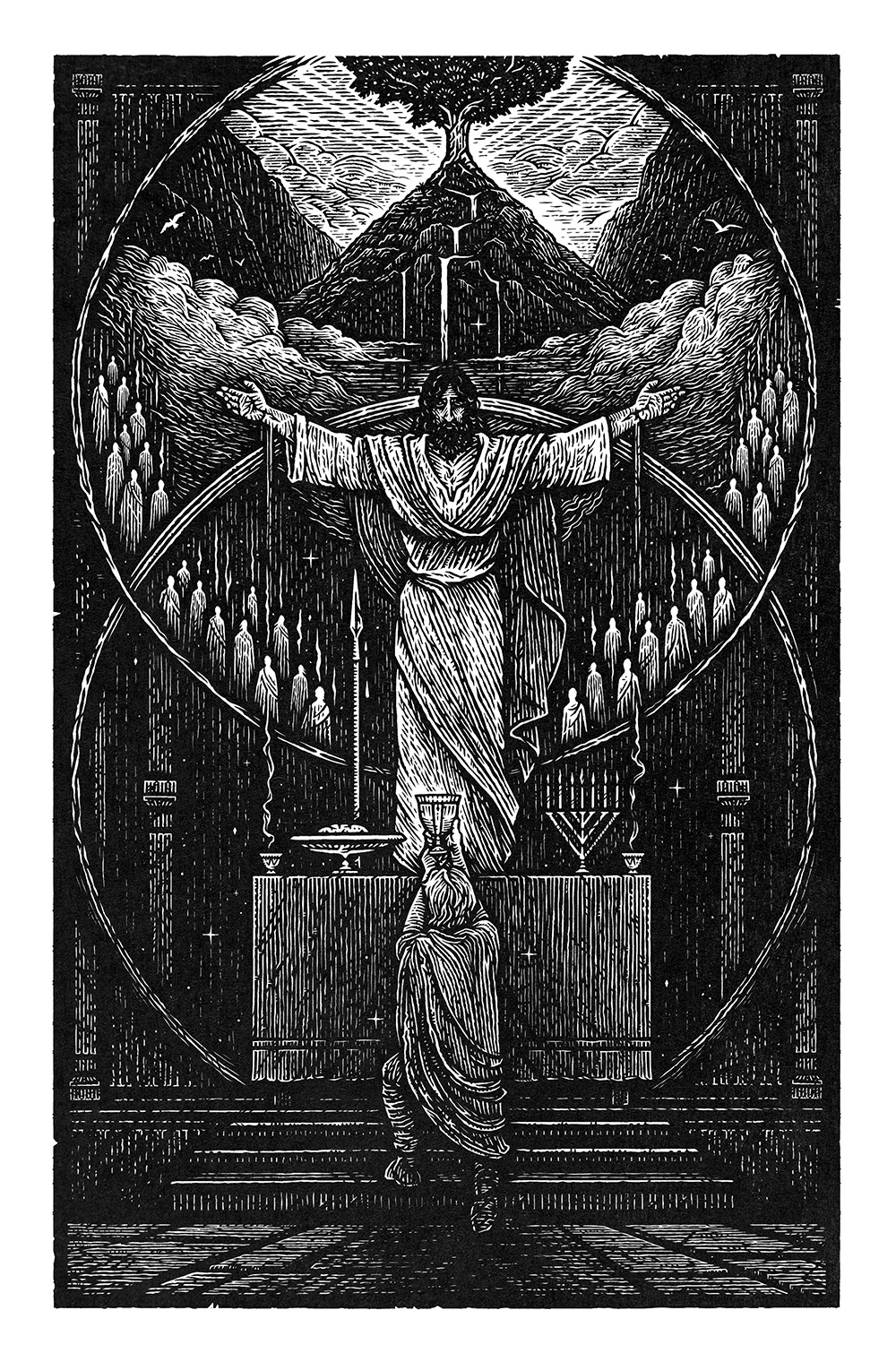
Crotts told me that illustrating the Lord’s Supper upon Galahad’s completion of the grail quest was the image he “had the most fear of approaching.”
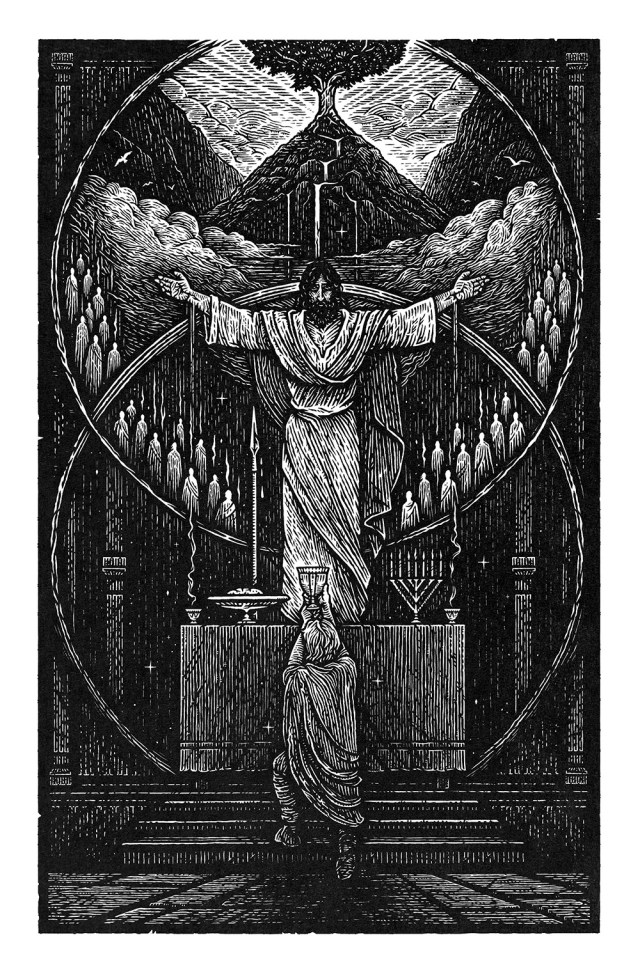 Image courtesy of Stephen Crotts
“It’s like, ‘Oh, all I have to do is, in one image, sum up the story of the universe,’” he said. (I think he did a stunning job.)
For the illustrator, the poem is a daunting project with a fast timeline. Guite hopes to release the second book, The Coming of Arthur, later this year, the third volume in 2027, and the fourth in early 2028. Guite seems unbothered by the pace, but Crotts is striving to keep up.
“My blood pressure went up so high that I started going blind,” he said of illustrating Guite’s work. That’s partly due to the ambitious timeline, he told me, but mostly because he feels a burden to do the story justice. The Rabbit Room’s support has helped, Crotts said. “I was just laboring in obscurity and frustration until I met these people.”
Pete Peterson, publisher of Rabbit Room Press and brother to Andrew Peterson, told me that when he heard of Guite’s work through mutual friends, he prepared to fight it out with all the major publishing houses to win the rights to Guite’s epic. In the end, he didn’t have to. “The Rabbit Room and Rabbit Room Press are just kind of weird enough,” he said, “that we maybe understood it in a way that other people didn’t.”
“I feel really blessed,” Guite said of publishing a book that requires attention from modern readers. But he added, “I hope this is actually not an exception but a presentiment of things to come.”
“I think we want the real thing and the real deal,” he said. “We want deep nourishment of mind and soul and heart.”
I came to Galahad and the Grail already a fan of Guite and his publisher. In fact, journalistic integrity demands I disclose: I’m so taken with the Rabbit Room’s mission that I sent a sad little email to Andrew Peterson last summer begging for an editing gig after I became fed up with reporting on the US Congress. (I did not get the imaginary job I’d tried to wish into existence.)
But I don’t think that sort of affection is a prerequisite for enjoying Galahad and the Grail. Guite writes of dryads and naiads of trees and streams with all the whimsy of those old Oxford dons, J. R. R. Tolkien and C. S. Lewis. He handles his characters, even those who stray from God, with a balm-like tenderness. One moment in the story centering on the knight Lancelot was so beautifully done it brought me to tears. Even when Arthur’s knights face darkness and evil, Guite doesn’t revel in it, and he carefully preserves a sense of innocence—sometimes lost, yes, but never too far from being found again.
Newcomers to poetry may take a little while to warm up to the style, but Guite’s work is deliberately accessible. He describes the ballad form as “a not-very-distant cousin” of the nursery rhyme, designed for all kinds of people to be able to remember and recite through the ages if only they’ll give it their attention.
“It’s not like weird, arcane, academic free verse,” he said of ballads. “They’re meant to be lucid. They’re meant to tell a story. But that doesn’t mean that they can’t also be profound and beautiful.”

Pete Peterson said he won’t mind, though, if the poem doesn’t go viral. “We’ve had, especially in publishing, a real mission of wanting to publish things that we feel like are in danger of falling between the cracks,” he told me. “Maybe it’s a little too Christian for the secular market, too secular for the Christian market, or maybe it’s just a little too weird and people don’t know what to do with it.”
“Andrew and I used to joke that we wanted to look back in 30 years and realize we had published a whole bunch of books that nobody bought,” he continued. “Which is—you know, I’m kidding. I want people to buy them. But we’re interested in things that just have a hard time finding a home.”
He thinks Guite’s epic already belongs in the canon of great literature beside the likes of Homer and John Milton. But even if this new Arthuriad is hardly noticed, if it’s only—“only”!—an admirable effort at beauty in a slop-soaked world, the mere fact of that effort hews to the greatest and most Christlike virtues of Camelot.
“Before Arthur takes the sword from the Lady of the Lake, she asks him, ‘Are you prepared to do the right thing and make a kingdom and then see everything you’ve done unmade?’” Guite told me. “‘To know that what you’re doing is right but may not win?’”
The tale of Arthur and his knights is “not about being on the winning side,” Guite said. “It’s about being on the right side.” Galahad and the Grail sure feels right.
Haley Byrd Wilt is a writer based in the DC area. Her reporting has appeared in Foreign Policy, The New York Times, and NOTUS, among others. Her poetry has been published in Mere Orthodoxy.