

News

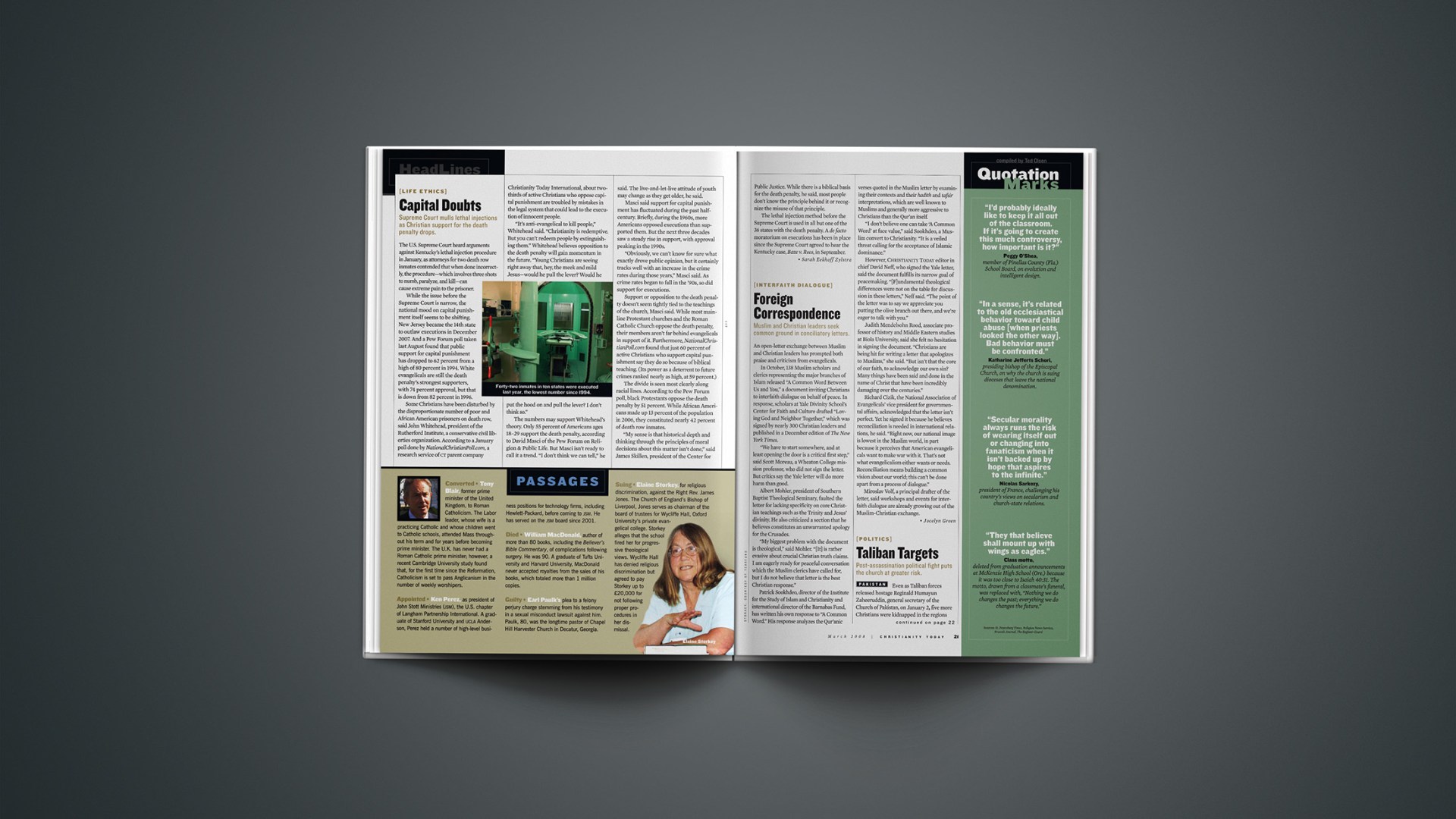
Foreign Correspondence

Muslim and Christian leaders seek common ground in conciliatory letters.

An open-letter exchange between Muslim and Christian leaders has prompted both praise and criticism from evangelicals.

In October, 138 Muslim scholars and clerics representing the major branches of Islam released “A Common Word Between Us and You,” a document inviting Christians to interfaith dialogue on behalf of peace. In response, scholars at Yale Divinity School’s Center for Faith and Culture drafted “Loving God and Neighbor Together,” which was signed by nearly 300 Christian leaders and published in a December edition of The New York Times.

“We have to start somewhere, and at least opening the door is a critical first step,” said Scott Moreau, a Wheaton College mission professor, who did not sign the letter. But critics say the Yale letter will do more harm than good.

Albert Mohler, president of Southern Baptist Theological Seminary, faulted the letter for lacking specificity on core Christian teachings such as the Trinity and Jesus’ divinity. He also criticized a section that he believes constitutes an unwarranted apology for the Crusades.

“My biggest problem with the document is theological,” said Mohler. “[It] is rather evasive about crucial Christian truth claims. I am eagerly ready for peaceful conversation which the Muslim clerics have called for, but I do not believe that letter is the best Christian response.”

Patrick Sookhdeo, director of the Institute for the Study of Islam and Christianity and international director of the Barnabas Fund, has written his own response to “A Common Word.” His response analyzes the Qur’anic verses quoted in the Muslim letter by examining their contexts and their hadith and tafsir interpretations, which are well known to Muslims and generally more aggressive to Christians than the Qur’an itself.

“I don’t believe one can take ‘A Common Word’ at face value,” said Sookhdeo, a Muslim convert to Christianity. “It is a veiled threat calling for the acceptance of Islamic dominance.”

However, Christianity Today editor in chief David Neff, who signed the Yale letter, said the document fulfills its narrow goal of peacemaking. “[F]undamental theological differences were not on the table for discussion in these letters,” Neff said. “The point of the letter was to say we appreciate you putting the olive branch out there, and we’re eager to talk with you.”

Judith Mendelsohn Rood, associate professor of history and Middle Eastern studies at Biola University, said she felt no hesitation in signing the document. “Christians are being hit for writing a letter that apologizes to Muslims,” she said. “But isn’t that the core of our faith, to acknowledge our own sin? Many things have been said and done in the name of Christ that have been incredibly damaging over the centuries.”

Richard Cizik, the National Association of Evangelicals’ vice president for governmental affairs, acknowledged that the letter isn’t perfect. Yet he signed it because he believes reconciliation is needed in international relations, he said. “Right now, our national image is lowest in the Muslim world, in part because it perceives that American evangelicals want to make war with it. That’s not what evangelicalism either wants or needs. Reconciliation means building a common vision about our world; this can’t be done apart from a process of dialogue.”

Miroslav Volf, a principal drafter of the letter, said workshops and events for interfaith dialogue are already growing out of the Muslim-Christian exchange.

Related Elsewhere:

Last week, some Wheaton College administrators removed their names from “Loving God and Neighbor Together.”

Dudley Woodberry responded to the initial letter from Muslim leaders in, “The Peacemaking Process.”

“A Common Word Between Us and You” has an official website, with Christian responses, Jewish responses, the letter, media coverage, and more resources.

The Yale Center for Faith & Culture has made its response to “A Common Word” available online.

Also in this issue

The CT archives are a rich treasure of biblical wisdom and insight from our past. Some things we would say differently today, and some stances we've changed. But overall, we're amazed at how relevant so much of this content is. We trust that you'll find it a helpful resource.

Cover Story

Help for the Sexually Desperate

John W. Kennedy

Carbonated Holiness

News

Sacred Harp Resurgence

Review by Rob Moll

News

Not Your Father's L'Abri

Molly Worthen

The Grace Escape

Amy Tracy

IRS Rules to Remember

Paul Hughes

California Dreams

Paul Hughes

Bookmarks

John Wilson, editor of 'Books & Culture'

Why Evangelize the Jews?

Fiction from the Headlines

Review by Betty Smartt Carter

News

Bearing the Silence of God

Ziya Meral

Starter Books on Ancient-Future Faith

Death and Resurrection

Compiled by Richard A. Kauffman

Count Your Surprises

J.I. Packer

New Atheists Are Not Great

Tony Snow

News

Why Culture War May Never End

Walter Russell Mead

Our Geopolitical Moment

Review

Haunting Salvation

Jeffrey Overstreet

News

Church in State

Porn's Stranglehold

Timothy C. Morgan

'These Guys Are Really Screwed Up'

John W. Kennedy

Review

Pushing Daises

Todd Hertz

What Makes a Church Missional?

J. Todd Billings

News

News Briefs: March 01, 2008

Editorial

Hating Hillary

A Christianity Today Editorial

The 8 Marks of a Robust Gospel

Scot McKnight

News

Go Figure

News

What <em>Reveal</em> Reveals

A Christianity Today Editorial

News

Passages

News

Quotation Marks

Q&A: John Dilulio

Interview by Paul Hughes and Madison Trammel

A Kinder, Gentler Shari'ah?

Obed Minchakpu in Jos, Nigeria

News

Capital Doubts

Sarah Eekhoff Zylstra

$300K Settlement

Sarah Pulliam

News

Premeditated Mobs

Vishal Arora, Compass Direct

News

Taliban Targets

Susan Wunderink

News

Post-Mayhem Woes

Sheryl Henderson Blunt, with reporting by Sue Sprenkle in Nairobi, Kenya

View issue

Our Latest

A Christmas Conspiracy for Zoomer Men

They’re not wrong to believe in a contested world. But they’ve misidentified the villains.

The Bulletin

Social Media Bans, Hep-B Vaccine, Notre Dame Snubbed, and the 1939 Project

Mike Cosper, Clarissa Moll

Australia bans social media for kids, CDC’s recommendations change, college football uproar, and the far right lens on history.

The Russell Moore Show

What Makes a Song Good for Corporate Worship?

Russell takes a listener question about whether some songs are better than others for worshipping in a congregational setting.

Being Human

Finding Peace in the Chaos: Five Emotional Well-Being Tips for Christmas

How can you maintain your Christmas sanity amid holiday stress?

Christ Welcomes Us So That We Might Welcome Him

Oghosa Iyamu

The Incarnation is an act of divine hospitality, and the church is the cohost.

News

A Year After Assad, Evangelicals Help Syria Heal

Heather M. Surls

While uncertain about life under the new Islamist-led government, Christians are providing spiritual and material aid to their neighbors

News

Nigerian Parents Pray for Children’s Return After Mass Kidnapping

Emmaneul Nwachukwu

“I just wish someone can help me get my child back home soon.”

Lord Over LinkedIn

Jacob Zerkle

As layoffs mount amid economic uncertainty, lots of us are looking for work. Here’s how to approach the process.

Apple PodcastsDown ArrowDown ArrowDown Arrowarrow_left_altLeft ArrowLeft ArrowRight ArrowRight ArrowRight Arrowarrow_up_altUp ArrowUp ArrowAvailable at Amazoncaret-downCloseCloseEmailEmailExpandExpandExternalExternalFacebookfacebook-squareGiftGiftGooglegoogleGoogle KeephamburgerInstagraminstagram-squareLinkLinklinkedin-squareListenListenListenChristianity TodayCT Creative Studio Logologo_orgMegaphoneMenuMenupausePinterestPlayPlayPocketPodcastRSSRSSSaveSaveSaveSearchSearchsearchSpotifyStitcherTelegramTable of ContentsTable of Contentstwitter-squareWhatsAppXYouTubeYouTube






