
It’s like going to church on Easter.
Whenever the White House holds a religious service, the nation’s elite show up—church-goers and otherwise. Fine dress abounds. The East Room offers the elegance of golden tapestries, spacious windows, flower-decked fireplaces. And many of those who attend spend as much time people-watching as worshiping.
President Richard Nixon began the practice of holding occasional Sunday services at 1600 Pennsylvania Avenue shortly after his inauguration—in part, at least, to solve security problems involved in presidential church attendance. By the end of July, ten services had been held and the press was calling them a “national institution.”
At first, Mr. Nixon drew fire from liberal churchmen for so-called narrowness in his selection of speakers (the first three: Billy Graham, Richard Halverson of Washington’s Fourth Presbyterian Church, and House of Representatives chaplain Edward Latch).
That criticism has diminished, however, as the list has been expanded to include National Council of Churches general secretary Edwin Espy, Terence Cardinal Cooke of New York, Rabbi Louis Finkelstein of Jewish Theological Seminary, and Dr. Paul Smith, president of Whittier (Friends) College in California.
More recent criticism has centered on alleged dishwater ecumenicity in many services. Attenders sometimes feel efforts to satisfy all religious tastes have dulled the pungency of the preaching.
On the Sunday Rabbi Finkelstein spoke, the congregation sang the Christian “Doxology” (with the rabbi’s approval). On the Sunday of the moon landing. Dr. Smith’s sermon contained hardly a reference to God or religion. Most Sundays the sermons obviously avoid criticism of host Nixon.
This, plus the American tradition of church-state separation, caused the Washington Post to criticize the White House services in an editorial as inappropriate “in the politically charged atmosphere of the residence of a President.”
Public reaction, however, generally has been good, with numerous letters of praise for the innovation. “Everyone we talk to thinks it’s a delightful idea,” said a press officer. “For one thing, it gives White House staff family members (who usually never see a president) a chance to meet the Nixons. A lot of them are invited each time—and they love it.”
What takes place at this new American institution, the White House service? A typical Sunday:
10:45A.M. A staffer led the press pool into the East Room. An organist was playing as 350 persons waited quietly. First impression: So many VIPs (the Dirksens, the Burgers, the Agnews, the Mansfields, the Thurmonds, the …). Second impression: Everyone looking around to see who else was there.
10:50. Mr. Nixon entered and introduced the participants. He called it “an historic day” (the moon landing) and referred to the speaker (Paul Smith) as “the professor who most inspired me.”
10:53. The congregation sang the Doxology. Weakly. Then sat down.
10:55. Everyone stood right back up for Senator Mark Hatfield’s prayer. He prayed that the nations would “trust not in the power of their arms but in the Prince of Peace,” lest “we perfect the means for destroying human life and then believe we have found security.” He also asked God “to permit the invasion of the Holy Spirit.”
10:58. Everyone sang the “Navy Hymn” (“Lord, guard and guide the men who fly/Through the great spaces in the sky”), starting softly, ending loudly.
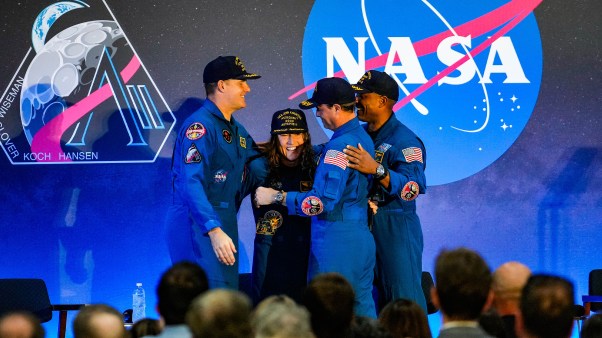
11:01. Apollo 8 commander Frank Borman read from Genesis 1—the words he and his crew sent to earth while circling the moon last Christmas Eve.
11:04. Smith spoke on “Reaching for the Moon.” He compared the Apollo 11 trip to the President’s upcoming Pacific tour. “Our intrepid President himself will soon go into orbit reaching boldly for the moon of peace. God grant that he, too, may return in glory.” In the next-to-last row, an elder statesman dozed. Next to him, a lady stared absently out the window.
11:12. The congregation stood again to sing “O God, Our Help in Ages Past.” Most reporters were silent.
11:14. Congressman John Buchanan, a Baptist minister from Alabama, gave the benediction. He prayed for the safe return of the astronauts and for “victory over man’s ancient enemies of hunger, disease, tyranny, and war.”
11:16. The service ended, dignitaries formed reception lines, and guests crowded into the Blue Room, the Green Room, and the State Dining Room for coffee, orange juice, rolls, and a chance to shake the President’s hand.
Mr. Nixon visited a minute or two with most of the guests, often slowing the line. He appeared tanned, signed occasional autographs (with a look of resignation), and talked as animatedly after two hours of hand-shaking as he had at first. Mrs. Nixon, the Smiths, and the Burgers also greeted worshipers.
1:15. The line of guests had dwindled to a few reporters waiting to ask the President how he felt about Senator Edward Kennedy’s accident. He made no comment, said he was too busy reading eighteen books for his Asia trip. The other guests had gone home for more star-gazing, this time at Armstrong and Aldrin—on the moon.
JAMES HUFFMAN