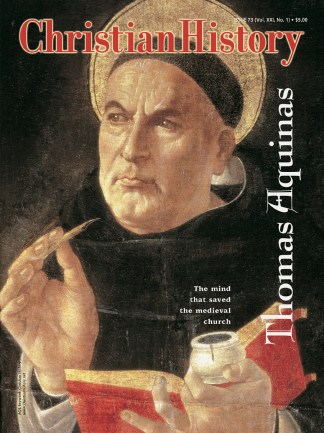
Most material on Aquinas gets very philosophical very quickly. This is unfortunate, as the first sight of a passage like “every essence or quiddity can be understood without knowing anything about its existing (esse)” makes a typical non-philosopher put down the book and pick up the remote. Some authors have realized this, though, and have made noble attempts to put Thomas’s ideas on the low shelf. Below are several examples, followed by some weightier matter.
Aquinas 101: Crash courses
Thomas Aquinas in 90 Minutes, by Paul Strathern (Ivan R. Dee, 1998), mixes wisecracks and information in roughly equal proportions, but it does give readers a basic understanding of Aquinas’s big ideas. Hooked on Philosophy: Aquinas Made Easy, by Robert O’Donnell (Alba House, 1995), is more enlightening while still very readable.
G.K. Chesterton’s famous Saint Thomas Aquinas: “The Dumb Ox” scores high on readability and flair (“The gown that could contain the colossal friar is not kept in stock” is just one memorable phrase) but lacks a bit in coherence. Not quite a biography, but not quite anything else, the book reveals as much about Chesterton and his era as it does about Aquinas. Still, eminent scholar Etienne Gilson called it “the best book ever written on St. Thomas.”
A First Glance at St. Thomas Aquinas: A Handbook for Peeping Thomists, by Ralph McInerny, is another beginner’s gem—if you can find it (it’s out of print).
Aquinas 201: Original sources
Reading Thomas’s work can never be classed as “easy,” but some versions are friendlier than others. Summa Theologiae: A Concise Translation, edited by Timothy McDermott (Thomas More, 1997), could be considered the “Living Thomas.” Peter Kreeft uses an older translation but offers many comprehension hints in A Summa of the Summa (Ignatius, 1990) and A Shorter Summa: The Essential Philosophical Passages of Saint Thomas Aquinas’ Summa Theologica (Ignatius, 1994).
In December 2001, Sophia Institute Press issued another summary: Aquinas’s Shorter Summa: Saint Thomas’s Own Concise Version of His Summa Theologica. Aquinas wrote it two years before his death, in response to his secretary Reginald’s request for a condensed guide to the masterwork. This book is significantly longer than Kreeft’s Shorter Summa (432 pages to 162). Authors always have a hard time editing their own work. For quickest access to some of Aquinas’s work, visit the Christian Classics Ethereal Library online, http://www.ccel.org/a/aquinas/. Thomas Aquinas: Selected Writings, edited and translated by McInerny (Penguin, 1998), is another good collection, with an introduction and notes.
Aquinas 301 and beyond
Readers seeking more than 90 minutes of Aquinas’s philosophy might enjoy An Introduction to the Metaphysics of St. Thomas Aquinas, collected and translated by James F. Anderson (Regnery, 1997); Aquinas, by F.C. Copleston, S.J. (Viking, 1992); Gilson’s The Christian Philosophy of St. Thomas Aquinas, translated by I.T. Shook (Notre Dame, 1994); or The Cambridge Companion to Aquinas, edited by Norman Kretzmann and Eleanore Stump (Cambridge, 1993). Fair warning, though: the “quiddity” quote comes from the Cambridge volume.
In addition to books, some online resources feature in-depth looks at selected Aquinas topics. Dr. Joseph Magee’s Thomistic Philosophy page, http://www.aquinasonline.com, is excellent. The Web site for the Jacques Maritain Center at Notre Dame, http://www.nd.edu/~maritain/, has readings, papers, bibliographies, and more. Joseph Kenny, O.P., who provided the translations on pages 22 and 38 of this issue, has more information on Thomism and on Muslim-Christian interactions at his Web site, http://www.op.org/nigeriaop/kenny/.
Copyright © 2002 by the author or Christianity Today/Christian History magazine. Click here for reprint information on Christian History.