My mother's favorite chapter in the Bible was the "High Priestly Prayer" of Jesus in John 17. This chapter is a prayer of Jesus that believers may share the kind of love and unity that he shares with the Father. "May they all be one, just as you, Father, are in me and I am in you, may they also be one in us so that the world may believe that you have sent me."
There is a sorry irony about John 17, however, for if it is a chapter we Christians love, it is surely one we fail to emulate. Among the least attractive aspects of Christianity is the divisiveness woven into the warp of church history. Worse yet, many church divisions occur for reasons that, at least in the judgment of later generations, seem petty rather than substantive. It is tempting to conclude that Christians don't take Jesus' prayer seriously. I don't believe that is the case. Most Christians, I think, take the prayer seriously, and probably even pray for its implementation.
In my judgment, our failure is rooted in two other factors. First, I think we take "May they all be one" to mean "may they all be like us." If I constitute the epicenter of the Kingdom of God on earth, and others are not like me, then they are obviously not at the epicenter, and maybe not even be in the circle of faith. We make ourselves rather than Jesus the measure of unity.
Second, I think we assume "May they all be one" should be understood formally— uniformity on things like church order, liturgy, polity, and so forth—rather than confessionally, i.e., unity on the essential elements of faith.
There are endless mutations of traditions, divisions, factions, and experimentations in church history, but has there ever been a time when the church was united, truly one? I am aware of an extraordinary moment when deep divisions and distrust were, if not overcome, set aside for a worship service in which it can be said that the church was finally—perhaps for the last time—united.
The year was 1453. For 55 days the city of Constantinople had been in the vise grip of an Ottoman siege. Constantinople had, of course, been besieged many times before by the Ottomans, or their Muslim predecessors, or Vandals, pirates, and warring tribes and peoples. Surrounded propitiously by sea on three sides and on its western side by the impregnable Theodosian walls—which ranked as one of the greatest architectural achievements of the Middle Ages—Constantinople had withstood countless attacks since it was founded by Constantine 1123 years earlier. Apart from a freak defeat in 1204, the capital of the Byzantine empire had never been conquered, and many believed it never would be. The spring of 1453 was different, however, and everyone knew it. Mehmet II, the 21-year-old Ottoman sultan, had something in excess of 100,000 trained Turks in his army; and Constantine XI, the Byzantine emperor, had barely 7,000 soldiers, lacking provisions and equipment, to defend the city.
It is of course easier to defend a position than to attack it, but Mehmet's numerical superiority vastly compensated for this fact. So did his tactical expertise. The first sultan to develop and perfect a navy, Mehmet found himself unable to break the massive Byzantine chain that spanned the Golden Horn. In a combination of desperation, genius, rage, and determination, Mehmet cut a mile-and-a-half long swath up and over the Galata hill opposite Constantinople, over which he dragged 70 warships on rolling logs, dropping them inside the Byzantine defenses of the Golden Horn. From there he pursued his naval attack against Constantinople's innermost and weakest sea walls. His land attack was even more invincible. Mehmet's arsenal included a cannon, built by a German engineer named Urban, with a bronze barrel 20 feet long and 8 inches thick. Urban's supercannon could hurl a 1340-pound cannonball a mile with devastating accuracy and impact, burying its projectile six feet deep into earth or fortified wall The three-tiered Theodosian walls could not withstand the repeated concussions of such a weapon.
It was clear to attackers and defenders alike that the eternal city could not withstand the siege. Constantinople's nadir was the inevitable outcome of a long, slow, and irreversible decline since the sack of the city by Latin Crusaders in 1204. Forsaking their declared objective of freeing the Holy Land from Islamic control, the Fourth Crusade attacked Constantinople instead, perpetrating in the name of Roman Catholicism indescribable atrocities on the Orthodox Christians of that city. The Latins ruled Constantinople for the next 60 years. That rule, combined with the savagery of 1204, and the still earlier bitter division of Eastern and Western Christianity in 1054, produced a deep loathing of the Byzantine Orthodox toward the Catholic West. Formal attempts had been made to bridge the rift between Catholics and Orthodox, most especially the Council of Florence in 1438, but the bridge collapsed, leaving Constantinople, weak and isolated, to face the formidable Ottomans 15 years later.
During the siege, Constantinople still contained many different Christian contingents, confessions, and sects that had populated the city in happier days. There were, of course, Orthodox bishops, priests, monks, and nuns. But non-Byzantine Christians were also present, including a Metropolitan of Kiev, and Christians from Greece, the Holy Land, and from other places and Christian traditions as well. In its bleak hour, Constantinople's morale had been bolstered, if only symbolically, by several hundred soldiers of fortune from Genoa—all Roman Catholics—who had succeeded in penetrating the Ottoman naval blockade with their three galleys in order to fight for Byzantium.
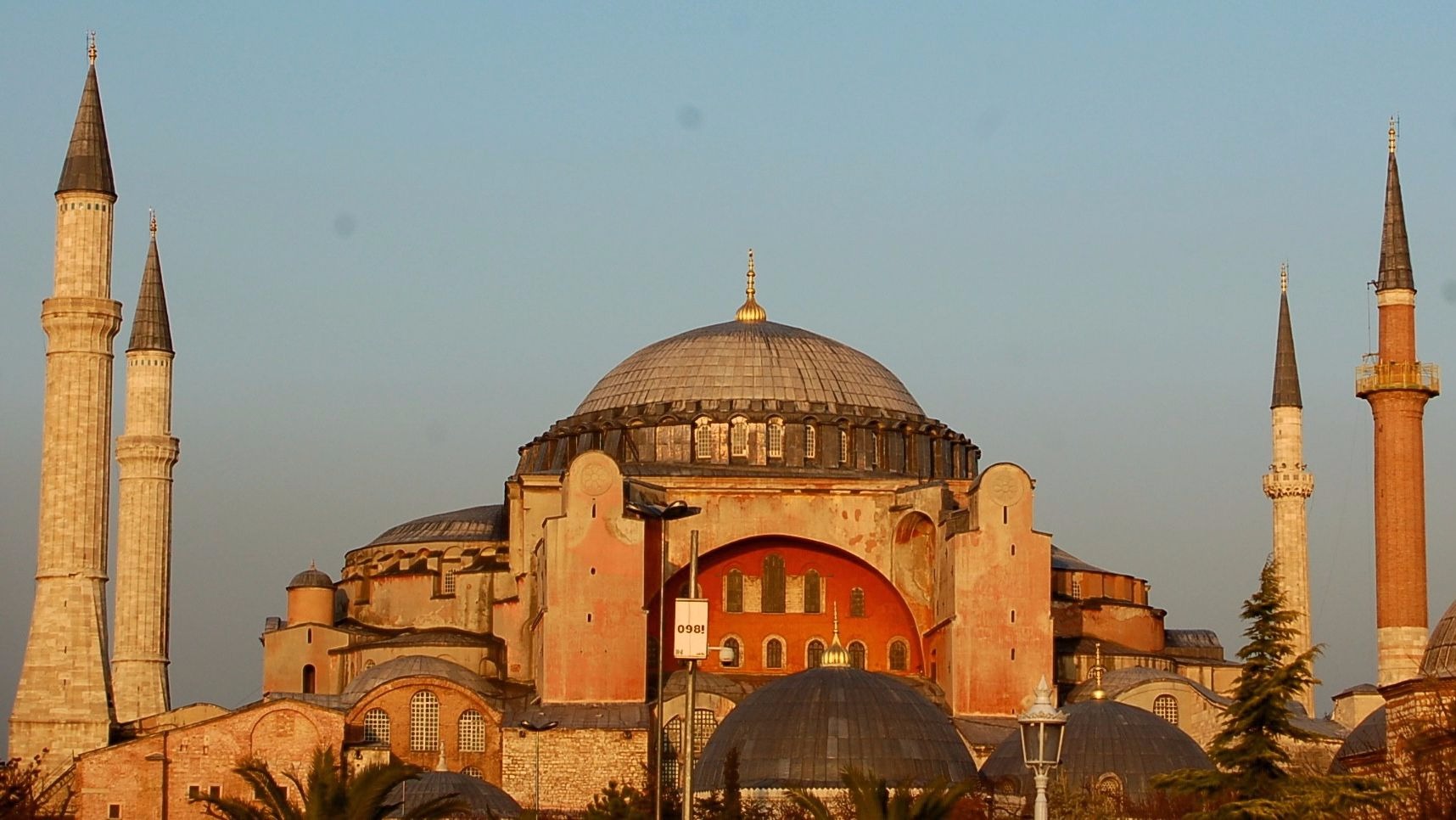
Mehmet scheduled his final assault on Constantinople for Tuesday, May 29. On Monday night, May 28, 1453, the last Christian worship service was held in Hagia Sophia, which had been the spiritual heart and head of Byzantine Orthodoxy for more than 11 centuries. All Christians in Constantinople, whatever their tradition, were invited for a final worship service in Hagia Sophia. The emperor asked forgiveness of his sins from all bishops present, both Orthodox and Catholic. All Christians—Orthodox, Catholics, and those of other traditions—then shared the Holy Eucharist. At midnight the service concluded. An hour and a half later, Mehmet's assault shattered the stillness, and by late morning on May 29, 1453, Constantinople became—and has been ever since—Istanbul.
From a Christian perspective, this worship service seems to me more significant than the more dramatic and tragic events surrounding the fall of Constantinople. In that momentous event, Christians at last—and for the last time—experienced a single ecclesial reality. True, there was less diversity in Hagia Sophia than we know today, but the divisions between Orthodox and Catholics were far deeper, and the unity of the hour the more remarkable. Equally true, the unity was constrained by external factors rather than by any particular virtues of the participants, but could that not be said of so many "triumphs" of Christian history? Jesus Christ uses many means to accomplish his will with his bride. Today, Hagia Sophia is no longer a church, but a vast museum. Nevertheless, inside its nearly 1600-year-old walls, I feel like I am standing in a very holy place. What happened on the evening of May 28, 1453, was, if only for an hour, a realization of John 17, and an empirical foretaste of the oneness that all believers will share with their exalted Lord in the world to come.
Guest blogger James Edwards teaches New Testament at Whitworth College in Spokane, Washington. He is the author, most recently, of The Hebrew Gospel and the Development of the Synoptic Tradition (Eerdmans, 2009). This essay appeared in the summer 2009 edition of his newsletter, The Edwards Epistle. For subscription information, contact the Rev. Phil Olson.
Image of Istanbul's Hagia Sophia courtesy of Wikimedia Commons user Markus Mark, July 2009.