Died: Walter Brueggemann, Scholar of Prophetic Imagination

The Old Testament professor was widely taught in seminaries and influenced many mainline and evangelical ministers.

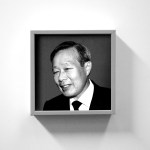
Walter Bruggeman obit image
Christianity Today June 6, 2025
Westminster John Knox Press / edits by Christianity Today

Walter Brueggemann, one of the most widely respected Bible scholars of the past century, died on June 5 at his home in Michigan. He was 92.

The author of more than 100 books of theology and biblical criticism, Brueggemann was professor emeritus of Old Testament studies at Columbia Theological Seminary in Decatur, Georgia, until his retirement in 2003.

His specialty was the Hebrew Bible and especially the Hebrew prophets, and his books were aimed primarily at clergy and church leaders. But through sermons, Brueggemann’s concepts, have become familiar to many churchgoers.

Though ordained, Brueggemann never served as a pastor of his own church. He was, however, a much sought after and eloquent preacher and lecturer.

“He had incredible way to discern what was happening in the world and the church and to speak into that with a much needed word,” said Conrad L. Kanagy, professor emeritus at Elizabethtown College in Pennsylvania, who wrote a biography of Brueggemann and edited some of his books.

Brueggemann’s books were broadly influential, especially in mainline Protestant circles, but his work impacted many evangelicals as well. His 1978 The Prophetic Imagination sold more than a million copies and remains a classic that is still frequently assigned in seminaries. In the book, he showed how the biblical prophets, called to imagine a different world, disrupted politics and the dominant culture and its assumptions.

“It is the vocation of the prophet to keep alive the ministry of imagination, to keep on conjuring and proposing future alternatives to the single one the king wants to urge as the only thinkable one,” he wrote.

Brueggemann himself was critical of American consumerism, militarism and nationalism.

“Walter Brueggemann is one of the world’s great teachers about the prophets,” said On Being podcast host Krista Tippett. “He translates their imagination from the chaos of ancient times to our own. He somehow also embodies this tradition’s fearless truth-telling together with fierce hope—and how it conveys ideas with disarming language.”

As news of his death spread online, several evangelical professors spoke of his influence on them.

“His Theology of the Old Testament reframed how I approached the Bible when I was a 23 year old seminary student. His other works continued to challenge me,” Steve Benzer, professor of pastoral ministry and theology at George W. Truett Seminary at Baylor University, said on social media.

Kaz Hayashi, professor of Old Testament at Bethel Seminary in Minnesota called Bruggemann “a great blessing for me and for the church.”

Breuggemann was text-focused but resisted the dominant modes of biblical interpretation because they put distance between the reader and the text. He sought to help pastors hear God’s voice within the biblical text.

Brueggemann was born in Tilden, Nebraska, in 1933. His father, a pastor in the German Evangelical Synod of North America, ordained him. He and his brother, Ed, grew up in Blackburn, Missouri.

As a teenager, Brueggemann and his brother visited a Black church on the edge of town. It later influenced his commitment to social justice.

His academic journey began at Elmhurst College (now university), in Elmhurst, Illinois. He went on to study at Eden Theological Seminary and Union Theological Seminary. He received a Ph.D. in education from St. Louis University, while teaching at Eden Theological Seminary in St. Louis. He left Eden for Columbia Theological Seminary, a Presbyterian school, in 1986.

Brueggemann, however, remained an active minister in the United Church of Christ. He was a frequent speaker at its conferences as well as a mentor to countless church leaders.

He is survived by his wife, Tia, and by his sons James and John and their families.


News

Facing a Precarious Future in Hong Kong

While Beijing has not yet clamped down on religion in the city, three churches are preparing.

Island Evangelical Community Church (IECC)

Island Evangelical Community Church (IECC)

Christianity Today June 6, 2025
Courtesy of IECC

It’s 7:30 p.m. on a Saturday night, and Marian is waiting with her friends for the evening service to begin at Flow Church in Tsim Sha Tsui. She talks animatedly about how she felt after Beijing imposed a strict national security law in 2020 that silenced critics, decimated press freedom, and curtailed civic action in Hong Kong. At the time, Marian was filled with questions about how Christians should respond, “but my former church couldn’t answer my questions,” she said. CT agreed not to use her real name, as criticism of the government is sensitive in Hong Kong.

She started looking for a church that was discussing these issues. Later that year, she heard several sermons by John Chan, the founding pastor of Flow Church, on Romans 12, where Paul urges his readers not to “conform to the pattern of this world.” Chan didn’t shy away from discussing Hong Kong’s political situation but urged Hong Kongers to focus on integrating Christ into their lives without being overly concerned about worldly politics.

“People have questions about how to be a Christian in today’s situation,” Marian says. “Flow had practical answers.”

Marian joined a cell group of a dozen people who quickly became her friends. They meet twice a month and talk about their lives and challenges.

The Cantonese-speaking Flow Church began in 2018, the year before pro-democracy protests rocked Hong Kong, leading the government to clamp down on the former British colony. Chan’s original goal was to establish a church unburdened by traditions or denominational constraints, one that would attract the large contingent of young people, like Marian, who no longer felt a connection with the churches they grew up in.

“I felt God called me to establish a church for these people, one that was relevant to their lives,” Chan said. “They needed something new.” Flow Church has no office, no elders, no permanent home, an ethos summed up in its name. Their worship team sets up each week in a hall owned by another church and packs everything up after the service is over.

This type of flexibility explains how Chan and Flow Church plan to take on the religious persecution that Hong Kong may soon face. So far, the national security law has focused only on politics, not religion. Yet many are preparing for the day when restrictions may be placed on how and where they worship, much like in mainland China.

CT spoke with Flow Church and two international churches about how they are preparing for Hong Kong’s uncertain future and found three different strategies. While Flow Church is taking a malleable approach, the Vine plans to plant smaller churches, and Island Evangelical Community Church (IECC) plans to invest in an expensive new church building.

Many young Hong Kong people who were sympathetic to the goals of the 2019 protest movement joined Flow Church. Although the church did not overtly support the protests, its leaders provided counseling and mental health resources to young people who were impacted by the conflict.

“We’re not critiquing the government,” Chan said about the church’s stance. “We’re focused on the Bible.”

Chan believes that Hong Kong churches are within a 10-year grace period before the government imposes any significant changes. He says Flow is willing to cooperate to a certain degree. For example, he would put a Chinese flag on their stage if the government requires it. (In a June 12th call, Chan clarified that the church would try to seek alternatives or compromises rather than strictly following certain government directives, such as displaying a flag in the building.)

Yet for requirements that go against the Bible, “we will follow Jesus,” Chan said. “We will not compromise our faith. We’re mentally prepared for the future.”

That preparation includes a deliberate decision not to keep a database of members and an expectation that the Flow Church might disappear soon.

“We don’t expect Flow to have a long future,” Chan said. “The church is an event, a happening. We will focus on our lives.”

Flow Church has regular attendance of about 400 people each week, with up to 8,000 more online. Hong Kongers who have resettled overseas have started Flow Church branches. “We’re a megachurch,” he says with a laugh. “But not financially.” While offering collections cover the bills, only about 30 people give regularly, Chan said.

Chan noted that he doesn’t plan to plant more churches in Hong Kong because his focus is on “spiritual space, not physical space.” Instead, he sees his role as building relationships with people and facilitating small groups. That approach differs from how the Vine, an international church based in the busy urban area of Wan Chai, is planning for the future.

Unlike in China, where only foreign-passport holders can attend international churches, Hong Kongers make up a majority of the worshipers at the city’s international congregations. They are drawn not only by the English-language services but also by the more casual and relational style.

The Vine’s multistory building seats hundreds and has multiple meeting spaces. But the church’s senior pastor, Andrew Gardener, says the Vine is intent on planting smaller churches around Hong Kong with fewer than 200 people each.

The first church plant is located near Hong Kong’s border with Shenzhen, China, and has a nonprofit status separate from the main Vine Church. This allows the new church more autonomy and its own identity. Because it’s in an area where English is not widely spoken, the church has both English and Cantonese services.

“I would rather have a group of smaller churches tailor-made for the communities we are trying to reach than one large church in a static location that we expect everyone to come to,” Gardener said. “It’s a great way to serve Hong Kong.”

Gardener agrees with Chan that currently the Hong Kong government is refraining from intruding into religious affairs. Some international pastors believe that the government is systematically working its way through other sectors of society before turning its attention to churches. Gardener said opportunities to share the gospel are still open, and the Vine is able to hold Alpha courses in schools and corporate offices around the city.

“Day to day, nothing of substance has changed,” he noted.

Still, some Cantonese-language churches have come under the Hong Kong government’s scrutiny for being alleged incubators of “soft resistance”—the government’s vague term for actions that subtly oppose the new system imposed in 2020. Several Hong Kong clergy have been arrested in recent years on national security–related offenses, and others have chosen voluntary exile.

International churches face different challenges as the government suspects them of being tied to “foreign forces” and disapproves of their ministries to refugees, according to pastors CT spoke to.

Some of these churches have become the targets of anonymous attacks that use email and other means to accuse them of assisting anti-government forces in Hong Kong, according to international church pastors.

“The Vine is committed to justice work in our city, and at times this has put us on the government’s radar,” Gardener said. “But it’s community service—it’s not political.”

Meanwhile, another international church, IECC, is planning to plant its roots in one central location. While it currently rents several floors of a skyscraper for worship space, the congregation recently purchased a decrepit former theater and adjacent structure, which they plan to renovate into a new 100,000-square-foot church building.

The building costs nearly $100 million and will require an additional $30 million in renovation costs. Senior pastor Brett Hilliard said some church members and Christians outside the church have questioned why IECC would spend so much money on a massive new church building in Hong Kong when uncertainty looms.

“It’s a great investment, considering that we’re already spending a lot on rent,” Hilliard said. But beyond the financial considerations, “this makes a statement to the community that we choose faith over fear,” Hilliard said. “The church isn’t going away.”

Hilliard plans to use the ground floor of the building for “redemptive retail,” such as cafés and shops staffed by people with disabilities or ex-convicts.

Like many churches, IECC had difficult choices to make when protests engulfed Hong Kong in 2019 and the government cracked down.

“We didn’t participate or condemn,” Hilliard said. He acknowledged the challenge of maintaining a focus on the gospel message during that chaotic time when “our worship team included several police officers while some members of the congregation sat with placards that they intended to take to the protest after the service.”

That was six years ago. Today, Hilliard says he feels no overt pressure to avoid any topics. He stays away from predicting what the Hong Kong government will do but believes IECC will be able to gather as they serve the community and focus on the gospel message. He encourages the congregation to put aside political allegiances as they prepare for the future.

Meanwhile, during the Saturday night Flow Church service Marian attended, hundreds of young people sang worship songs like “Jesus Be the Center” and prayed for their city, one another, and their future.

Marian noted that she and her cell group are prepared for the day when the church is shut down. “It’s likely to happen,” she said. “If one day we can’t go to church, then the cell groups will be able to carry on.”

News

Kenya Keeps Losing Nurses It Can’t Afford to Keep

A Christian nurse looks to God and emigration for a way out of debt and overwork.

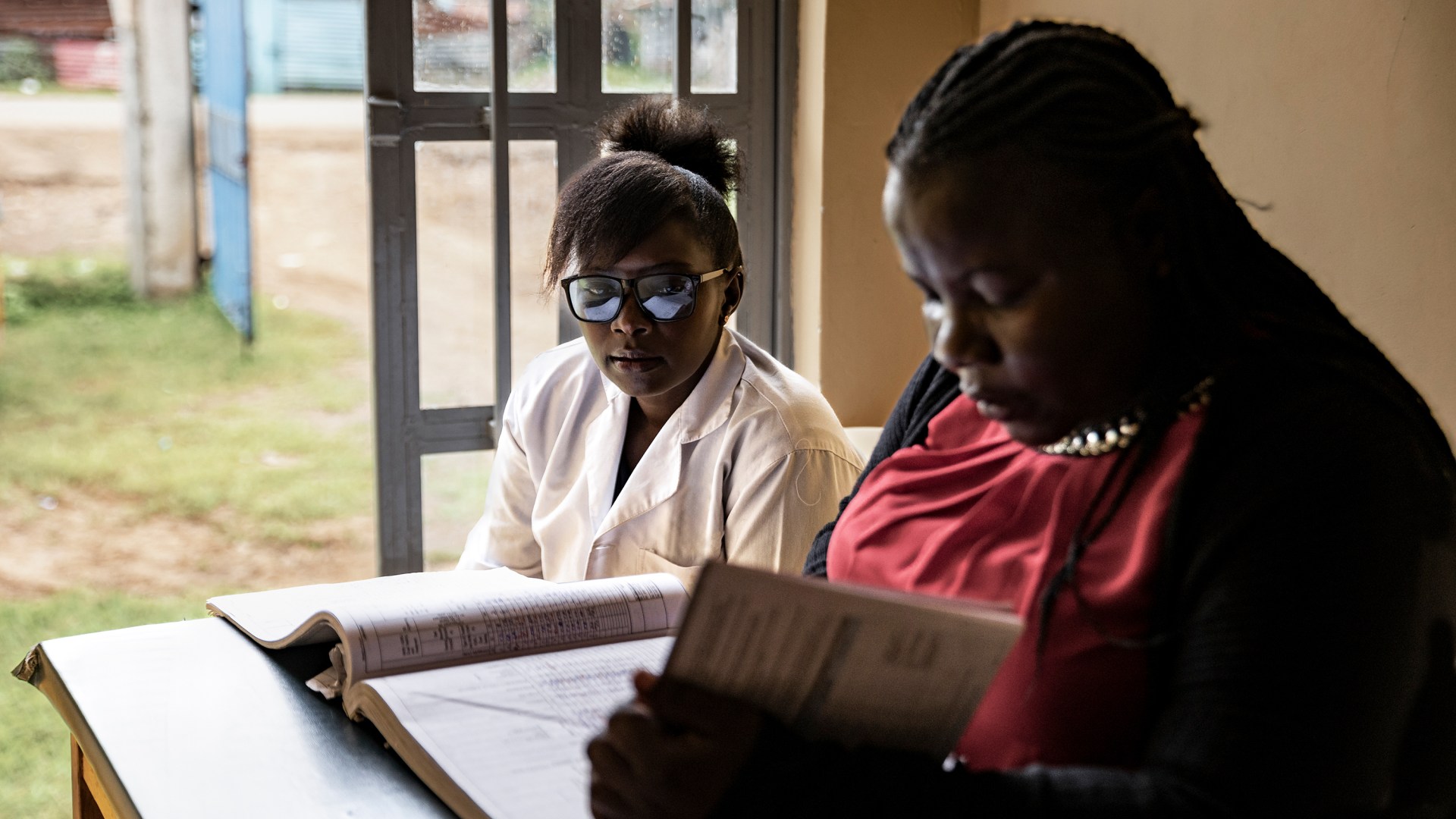
Nurses check a patient registry book at a hospital in Kenya.

Nurses check a patient registry book at a hospital in Kenya.

Christianity Today June 6, 2025
Michel Lunanga / Stringer / Getty

Every time she opens her email, 35-year-old Caroline Mutama looks for a notification from US government officials to see if they have set the date for her visa interview at the US Embassy in Nairobi, Kenya. She hopes to work as a nurse in Illinois. Mutama has already processed the travel documents for herself, her husband, and her two children.

Now all she can do is wait.

On weekdays, Mutama wakes up early, feeds her children, and prepares her oldest child for school. Then she walks five kilometers (about three miles) to her job as a registered nurse and midwife at Shiyunzu Health Center in Kakamega County. Like many nurses in Kenya, she works long hours for low pay.

Kenya’s frequent worker strikes—due to poor salaries and benefits—have undermined her efforts to make a living. She owes money to her bank, to her friends, and to her microloan savings group. Her husband has been unemployed since the COVID-19 pandemic shut down his company.

With her future in Kenya looking grim, Mutama has joined a rising number of Kenyan nurses hoping to immigrate to the United States or Europe in search of better pay and working conditions. In 2023, she began the application process for an EB-3 visa, which allows skilled workers and professionals to immigrate to the United States.

In February 2025, the Kenya National Union of Nurses raised alarm over the “acute shortage of nurses” in the country, a shortage that’s forcing some health facilities to close. In some cases, chronic understaffing has led to rationing care and to patients’ deaths in some emergency situations.

About 4,000 doctors and nurses leave Kenya every year, said Ouma Oluga, former secretary general of the Kenya Medical Practitioners, Pharmacists and Dentists Union. TruMerit, an organization that processes nurses’ credentials to see if they are eligible to emigrate, reported that Kenya accounts for 6.5 percent of African nurses applying for VisaScreen certification—a key requirement for foreign-trained nurses in the US. This places Kenya first in Africa and third in the world after Philippines and Canada. In July 2021, Kenya signed a bilateral labor agreement with the UK to send 20,000 nurses to UK hospitals. By April 2024, 280 Kenyan nurses had immigrated to the UK via this program.

Kenya’s public hospitals can’t afford to lose these nurses, but they can’t afford to keep them either.

“While we are complaining we’re having a brain drain of doctors and nurses who are going to the Western world, we as a government are not able to afford to employ them because we do not have the resources,” Tharaka Nithi County governor Muthoni Njuki told a national news network.

Kenya president William Ruto admitted last year that the country only absorbs 200,000 of the 1 million qualified workers who enter the job market each year. This includes recent nursing school graduates. Nationwide economic struggles since Ruto’s government took power in September 2022 haven’t helped. Kenyan nurses continue to live and work in subpar conditions, despite frequent nurses’ union strikes.

Nurses have long struggled with high workloads and poor resources. For example, one study showed that a single neonatal nurse may be responsible for up to 40 sick babies at a time—all requiring a high degree of care. 

In 2024, the council of governors in Kenya raised concern over the high rate of health workers leaving the country because the government couldn’t pay them well.

Some estimates place registered nurses’ salary range at 23,000 to 140,000 Kenyan shillings per month (about $178–$1,084 USD), including nursing directors. Kenya’s minimum wage is 15,200 shillings per month (about $118 USD). The median pay for a nurse in the US is $7,800 per month.

“We train our students for the international markets,” said Eunice Nyasiri Atsali, a nurse trainer at Kenyatta University. “The situation [in Kenya] is worse today because government has relocated the nurses to the counties and most of the counties have no capacity to pay the nurses. A degree-holder nurse is now earning 25,000 Kenya shillings [about $194 USD].”

Some nurses have fallen into debt. Traditional banks may deny loans to nurses if their account balances are too low, forcing them to look elsewhere for credit. Ruto’s government has also introduced new taxes—such as a those imposed on all public employees in Finance Bill 2024, sparking antitax demonstrations by Ruto’s critics last year.

Because of these challenges, many nurses do not want to remain in Kenya.

Mutama worries about family obligations in addition to her debts. Family funds helped her through school, but she hasn’t been able to repay them. Her three sisters and brother are now unemployed. Mutama said she feels guilty she can’t support everyone on her salary.

“[When I get to the US,] I will do my best to see that I support my siblings,” Mutama said. “I need their prayers so that I succeed. And when I move to the US, I will not forget them.”

Mutama’s application process hasn’t been easy. She’s had to prepare for nurses’ licensing exams and an English proficiency test, fill out visa applications, and wait endlessly for approval.

“Going to the US is not a joke. There are no shortcuts for nurses,” Mutama said. “The process is quite complicated, as you must be qualified to work as a nurse in the US.”

She has stayed up all night reading online materials on her laptop to prepare for licensing exams. Night shifts at her small health center receive fewer new patients than daytime shifts do. She said she took those shifts whenever possible so she could study while at work.

In early 2024, she raised money for an airline ticket so she could travel to South Africa to sit for her licensing exams. Three days prior to travel, she had only half the money she needed. A friend loaned her the remaining money at the last minute.

“This was the hand of God,” Mutama said.

She passed the exams for licensure—valid in the state of Illinois—but many of her friends did not. Eighteen months later, Mutama passed her English proficiency exam in Kenya.

But immigration policies have complicated the process. In 2020, the US slowed visa retrogression due to COVID-19. Processing backlogs at the US Embassy in Nairobi continue.

Mutama still waits for that all-important email, but she prays to God for the visa process to reopen soon and end her waiting.

“I hope that God will open the way for me,” she said.

News

Evangelical Fault Lines Revealed in South Korean Election

Some Christians are troubled by politicians’ anti-Communist rhetoric. Others are preoccupied with it.

A woman comes out of a booth to cast her early vote in a polling station for the presidential election in South Korea.

A woman comes out of a booth to cast her early vote in a polling station for the presidential election in South Korea.

Christianity Today June 6, 2025
Chung Sung-Jun / Getty

Third time’s the charm for Democratic Party candidate Lee Jae-myung, now South Korea’s 14th president.

The 61-year-old former human rights lawyer ran for presidency twice unsuccessfully, first in 2017 and then in 2022, when he lost narrowly to impeached president Yoon Suk Yeol.

In the June 3 snap election—triggered by Parliament’s impeachment of Yoon on April 4 for breaching the constitution and other laws by declaring martial law—Lee beat five other presidential candidates and garnered close to 3 million votes more than Kim Moon-soo from the ruling conservative People Power Party. 

When 36-year-old Yoon Go-eun (no relation to Yoon Suk Yeol) cast her ballot last Thursday during the early voting period at an elementary school in Gangnam, Seoul, she prayed God would raise up someone who could bring peace to the nation in a time of confusion.

Since Yoon’s martial law declaration last December, South Korea has experienced a season of political turmoil. Millions of people took to the streets for months, either protesting against Yoon or shoring up support for him. 

Yoon Go-eun, a middle school teacher who attends a Presbyterian megachurch in Seoul, pinned her hopes on Lee. “In this moment of national instability, we need a leader who is capable, pragmatic, and able to restore order, especially in light of the recent crisis involving discussions of martial law,” she said.

When Yoon heard Lee had won, she felt a sense of release, “as if things were finally falling into place.” She thought of Proverbs 16:9 (“In their hearts humans plan their course, but the Lord establishes their steps”) and prayed that God would help Lee to carry out his responsibilities for the good of the people.

Although Kim, the conservative candidate who trailed behind Lee, is a churchgoer, Yoon did not vote for him. She’s troubled by Kim’s associations with pastor Jun Kwang-hoon and far-right ideologies, like the belief that there are Communist forces secretly colluding with China to aid North Korea within the country.

In South Korea, far-right politics are characterized by an anti-Communist and anti-China posture. These ideas have become entrenched within some Korean evangelical circles, leading them to label people who “criticise conservativism or conservative policies as pro-North Korean communists and antichrists,” Hawaii Pacific University professor Yong Jae Kim wrote in 2023.

Yoon felt disappointed by Kim Moon-soo’s lack of contrition for remarks he made last year that the Jeju islanders involved in an uprising between 1947 and 1954 were part of a “Communist riot.” In that incident, Korean military forces killed around 30,000 citizens on the island for protesting against the 1948 election in the belief that the results would divide the country permanently.

“To me, this is not the fruit of a healthy, biblically grounded faith,” Yoon said. “Such positions distort the gospel—and make me question whether [Kim] is truly a Christian.”

Yoon is not alone. The Korean evangelicals whom CT interviewed reflect a deepening political polarization in their voting decisions. Some favored Lee because they are against anti-Communist rhetoric, and others supported Kim because they believe he can protect South Korea from Communist influences.

Like Yoon, Kim Jiwon (no relation to Kim Moon-soo) voted for Lee. The 45-year-old manager at a logistics company, who worships at Jeju Youngnak Presbyterian Church, kept thinking of Jesus’ command to love our neighbors as he prayed over the election. 

Although Kim does not think Lee’s policies are perfect, he felt they reflect “more consistent concern for issues of justice, equality, and the well-being of marginalized people.” 

The new South Korean president grew up in poverty, working as a child laborer at factories, where he suffered a wrist injury that left him with a permanent disability. After securing a full scholarship to Seoul’s Chung-Ang University to study law, he became a human rights lawyer who defended industrial-accident victims and residents facing eviction amid urban redevelopment projects.

“We will not tolerate violations of rules that harm others—such as endangering lives, infringing workers’ rights, oppressing the weak or manipulating stock markets for unfair gain,” he said in his inaugural speech.

Lee begins his term immediately even as he faces five trials for various charges, including corruption, involvement in suspicious development projects, illegal money transfers to North Korea, misuse of official funds, and instigation of perjury.

Despite these scandals, Lee gained approval across the country as he led efforts to impeach Yoon. Ahead of the election, around half (50.2%) of Koreans polled in a nationwide survey were supportive of Lee.

Conservative candidate Kim Moon-soo, meanwhile, opposed Yoon’s impeachment, did not cut ties with Yoon, and refused to bow to the nation as an apology for declaring martial law.

Kim Moon-soo has also used divisive language, like referring to Koreans who fought for democracy during President Park Chung-hee’s dictatorship in the ’60s and ’70s  as “commies,” Kim Jiwon said.

When Kim Moon-soo was a teenager, his high school suspended him for protesting against Park Chung-hee. Today, however, the presidential candidate “defends authoritarian measures and justifies state violence, including the possibility of martial law under the former president,” Kim Jiwon said. “To me, these are not the actions of someone who has faith.”

But some evangelicals think otherwise. They support Kim Moon-soo because of his hard-line stance against Communist infiltration in the country.

Kang Gwi-ran, a 60-year-old pro-Yoon supporter and Presbyterian pastor in Seoul, voted for Kim, as she believes South Korea is “politically, economically, and culturally infiltrated by the Chinese Communist regime.” She prayed fervently that Kim would be elected so he could carry out Yoon’s vision to eradicate pro-China influences in the country.

Kim and members of his party have accused Lee’s party of undermining the country’s ties to America by seeking stronger linkages with China. Right-wing YouTube channels also claimed that the impeached Yoon was a victim of China’s electoral influence.

“China was our enemy, whose Communist Party invaded our country during the Korean War,” Kim said in a televised presidential debate last month. “Then how can we treat China at the same level with the United States?”

“The church must awaken and help save the nation” from such “dangers,” Kang added.

Other evangelicals, like 70-year-old Gil Min-hwa, voted for Kim because she wants to see North and South Korea reunified. In her view, Kim values the alliance between South Korea and the US, which would help encourage a reunification that is “led by the South and grounded in democratic principles.”

“I believe God desires to use a unified Korea to play a key role in global evangelization,” said Gil, a retired pastor in the central city of Daejeon.

Two years ago, North Korea’s leader Kim Jong Un declared that unification between North and South was “impossible,” breaking from the country’s historical approach—articulated by Kim Il Sung in 1991—of seeking unification through establishing a confederacy with two systems.

Presidential candidates Kim and Lee have adopted starkly different approaches to reunification. Kim condemned North Korea’s human rights abuses and pushed to boost South Korean military prowess against North Korean nuclear threats.

Lee, meanwhile, pledged to rekindle dialogue and communication channels between North and South and make improvements to policies relating to North Korean defectors and humanitarian aid to the North.

Gil remains undeterred by Kim’s loss. “I will continue to trust God’s sovereign plan,” she said. “He can use both good and evil for his purposes.”

As anxiety over South Korea’s future and its newly minted leader continue to rock evangelical relationships in South Korea, Yoon finds that her church has been a refuge from the ongoing political storm.

At one small group meeting with fellow Christians who held dissimilar views, the group had honest conversations with one another and prayed for wisdom and for God’s justice to prevail, instead of praying only for their preferred election outcomes.

“Moments like these have shown me that our church values humility and love even amid political differences,” Yoon said. “We must stop using Scripture to justify our political opinions. The Bible is not a partisan weapon.”  

Culture
Review

What’s the Point of ‘The Life of Chuck’?

A new movie based on a Stephen King novella aims at profundity—and comes up short.

Tom Hiddleston as Charles Krantz in The Life of Chuck.

Tom Hiddleston as Charles Krantz in The Life of Chuck.

Christianity Today June 6, 2025
Neon

There’s a scrap of homespun philosophy that resembles, at first glance, Christian anthropology. Life’s value doesn’t come from the big things but from the small. The most precious of things is the ordinary. Such are the implicit theses of a subgenre one might term “life-affirming cinema.” At one point in the new film The Life of Chuck, Nick Offerman’s faux-authoritative narrator, observing strangers caught up in an impromptu dance, says, “That is why God made the world. Just that.”

Although it’s not exclusive to the 1990s, I often associate the life-affirming subgenre with that era. Its mood is ubiquitous, from Dead Poets Society to The Shawshank Redemption to Forrest Gump. These films value simplicity, authenticity, and innocence over sophistication, structure, and society, a sort of transcendentalism for the modern age.

Perhaps unsurprisingly then, it’s Shawshank and The Green Mile author Stephen King who wrote the short story upon which The Life of Chuck is based. It’s as pure a specimen of life-affirming cinema as is possible to find. Expanded here to full length by writer-director Mike Flanagan, the film’s premise is rich with opportunities for reflection on mortality, human value, and vocation.

But instead of turning to philosophers or theologians for answers, the film hangs itself on one line of Walt Whitman, his most famous: “I am large, I contain multitudes.” It’s too slender a strand upon which to suspend such heavy realities.

The story starts in a bourgeois apocalypse. A teacher, Marty (Chiwetel Ejiofor), reasons with parents over their children’s infractions, though it all seems rather pointless. After all, the world is ending. Every disaster has hit simultaneously—internet outages, earthquakes, famines. Somehow, a grim but functioning suburban life remains in the ennui of a dying world, and Marty and his ex-wife Felicia (Karen Gillan) find each other before the stars blink out, one by one. We probably shouldn’t be surprised, Marty says, because, as Carl Sagan explained in the documentary Cosmos, we’re living in the last moments of the universe.

Contrasted against this dystopia is one bright spot: a chipper ad resembling a retirement card for a smiling man. “Thank you, Chuck! Thirty-nine great years,” the ad exults. It’s a sort of grim, ironic meme, the origin of which is lost. No one remembers who Chuck (Tom Hiddleston) is anymore.

Not even Chuck, because as it turns out, all of this is the “universe” in his head. He’s in a coma, dying in the arms of his wife, at the age of 39. The next two acts of the film follow one life-affirming day, not in the middle of his life but nine months from its end, when he impulsively dances to the beat of a drummer. Then the film finally jumps back to childhood (where he’s portrayed by a winsome Jacob Tremblay as an adolescent, and Benjamin Pajak as a child). At a young age, he’s orphaned; his early life is shaped by his grandparents’ tastes, his school career as a dancer, and his final confrontation with a premonition of what Sagan knew: The end is inevitable.

Over the course of Chuck’s childhood, we discern the origin of both his imagined apocalypse and his dance in the second act. He associates dancing primarily with his grandmother (Mia Sara), who would swing her hips to rock music while cooking. Arithmetic, meanwhile, Chuck connects with his grandfather, Albie (Mark Hamill), who once softened a stern speech about the poor job market for dancers by waxing poetic about numbers. (Chuck will eventually become an accountant.) Albie’s speech is one of the story’s more graceful moments, avoiding tired clichés that may have made the old man an easy villain—the grim authority figure on the side of math, certainty, and death.

But Albie is associated with death all the same. The only moment in the film shot like Stephen King’s normal horror milieu is when Chuck decides to look into the locked cupola, the one room in the house banned from his entry.

If we really are living in the last gasp of the universe, how can we fully live under this shadow? Knowing death will come, what is the use of dancing? The math never lies.

The film’s pretensions to profundity come up short here, partly due to failures of craft. You can hear the typewriter behind each character. Everyone loves to soliloquize, even a charming neighbor who drops his chipper small talk to meander about how the end is near. It may make sense when everyone is in one person’s head, as in the beginning act, but the tic continues through the other stories. This is all topped off by a cloying and unnecessary voice-over. One wishes the script had mined a richer vein of transcendentalist rhetoric than one line of Whitman or plumbed a deeper well of cultural knowledge than Cosmos.

But does the film at least ask the right questions? Why do we celebrate celebrities, sports stars, and astronauts instead of the ordinary man? Why do we look for fame and glory when we should rather rejoice in the perfection of a flower or savor a well-prepared meal?

Ultimately, what doesn’t land about The Life of Chuck is that the life it affirms is so curated that it doesn’t ring true. In such stories, the “ordinary” is never actually ordinary. The ordinary man, supposedly an Everyman pacing through a universal life, in fact often shows extraordinary virtues and talents and an exceptionally childlike innocence. He rarely breaks from his secular sainthood to descend to the level of foibles and flaws.

At first, he may seem like a Christ figure, but he’s not. He’s the natural man, untouched by society. Instead of having a heart tempted by sin, the life-affirming hero has an inner light which external forces—society, death—seek to snuff. His purity is achieved by living an authentic, mindful life. He doesn’t need to be saved. He has pulled himself up by his spiritual bootstraps.

Christians, rather than trusting in these self-oriented virtues, believe that purity leads to authenticity, not the other way around. And whence comes purity? From without and within at the same time, through the work of God. It may seem a fine distinction, but it explains why there’s always something a bit phony about the Everyman hero.

There’s a sentimentality in life-affirming stories that shortchanges the viewer. The problem with sentiment is not that it glamorizes bad things but that it makes good things into ultimate things (to paraphrase Tim Keller).

If life is really just a collection of experiences and memories, is the meaning of life then to be found in the multiplying of those things? A sort of tourism as telos? At a certain point, the “multitudes” in our heads, the other people remembered, are only valuable to the degree that we value them. If the self is all—Chuck’s “wonderful” self, living life fully—then when his world ends, the world ends. There’s a narcissism and a nihilism beneath this chipper exterior of a film mimicking transcendence without actually providing it.

Of course, that sounds more serious than it should—this is still a movie where a boy teaches his class to moon walk. And Chuck is indeed wonderful, but it would be nice for someone to remind him, as Gandalf does Bilbo at the end of The Hobbit, that he is “only quite a little fellow in a wide world after all.” And as Bilbo responds, “Thank goodness!”

Hannah Long is an Appalachian writer living in New York City. Her writing has appeared in Angelus NewsThe Dispatch, and Plough Magazine.

Ideas

The Real Problem with AI Prayers

A computer’s praise or petition sounds a lot like our human Christianese. That doesn’t make them equivalent. 

Glitching praying hands on a computer screen.
Christianity Today June 5, 2025
Illustration by Elizabeth Kaye / Source Images: Pexels, Unsplash

At a recent Gospel Coalition conference, celebrity pastor John Piper told his audience about a task he had given ChatGPT: Write a prayer informed by the theology of Don Carson. He proceeded to read the resulting text. ChatGPT’s “prayer” seemed to tick all the theological boxes; the crowd murmured, seemingly impressed. But John Piper was not. He declared that such a “prayer” was not a prayer at all, being the product of a soulless machine rather than the expression of a worshipful human heart.

Recent developments in artificial intelligence have raised unsettling questions about our own humanity; indeed, each new advance in AI technology might seem to erode a once-secure realm of human uniqueness. Formerly situated in the vast expanse between beasts and the gods, our territory is now threatened by the rising capacities of our creations, raising the specter of our obsolescence. What remains to set human beings apart? As AI leaves a wave of redundancies in its wake, will it make humanity itself redundant?

These questions about human distinctiveness are important. People are made in the image of God; code is not. I imagine that’s much of what John Piper was getting at in his critique.

But his exercise also raised interesting questions about language itself. Machine-generated prayers really can sound just like human-generated ones, prone as we are to fall back on generic formulations and common clichés. If an AI prayer isn’t truly prayer, what implications might that have for our own praise and petition, which too often evince our programming in Christianese and other habitual forms?

In the Sermon on the Mount, Jesus warns his disciples not to “heap up empty phrases [“use vain repetitions,” in other translations] as the Gentiles do” (Matt. 6:7, ESV throughout). He then proceeds to teach the disciples the specific words of the Lord’s Prayer.

At first blush, it might seem that such a prescribed prayer is contrary to the warning of the preceding verses. Rather than “empty phrases,” staid and overly familiar, we should privilege spontaneity in our communication with God.

But in the AI era, the “spontaneity” of our prayers (indeed, of anything we say) might be less convincing. Large language models have shown us that speech initially presumed to manifest thoughtful, individual, creative expression may merely be routinized functions operating on generic data, no internal reflection required.

In the Lord’s Prayer, Jesus addressed the problem of “vain repetitions” not by extolling the authenticity of spontaneous and personally composed—or generated?—prayers but by giving his hearers a specific prayer, with petitions whose depths his followers have meditated on for around 2,000 years.

Clearly, Jesus’ prior warnings must have some bearing on how we use the Lord’s Prayer. If we mindlessly and distractedly repeat its words with no regard for their import, we might as well be turning a Tibetan prayer wheel, automating the practice. Critics of liturgy have frequently complained of “reading set prayers” and often with genuine cause. Set prayers are there to be prayed. The words must become our words.

The words are ours neither by virtue of composition nor, in the context of a liturgy, by virtue of spontaneity or individuality. We did not come up with the words of the Lord’s Prayer, and we did not independently determine to pray them at a certain juncture in a service. While our mouths might be speaking the words, this does not seem to be sufficient to make them truly ours either. Scripture frequently calls for an integration of heart, word, and action, condemning these who honor God with their lips while their hearts are far from him (Matt. 15:8).

If we look for our human uniqueness in our capacity to produce textual artifacts, AI poses an existential threat. Not only does it show the difficulty of distinguishing the products of machines from those of human beings; it also reveals just how mindless and machine-like much human speech and writing can be, especially in a bureaucratic society.

Yet there is another way of regarding our relationship to language, a relationship more apparent in a society before the dominance of the written and printed word. In an oral culture, words are encountered not in autonomous texts but in speakers, ceremonies, and performances—in poets and singers, liturgies and plays, storytellers and orators, priests and public readers, politicians and philosophers. The primary vehicle of the word is the person.

While the apparent difference between human beings and AI as generators of words might be diminishing, the difference between human beings and AI as creatures of the word is vast and categorical.

Evangelicals have typically thought about Holy Scripture according to the mindset of literate moderns: Holy Scripture is equated with the physical object of our personal Bibles, which we study for knowledge of God. Yet Holy Scripture itself presents us with a more complicated picture. Yes, there are physical scriptural texts external to us—this is important. However, throughout the Scripture, God’s Word is progressively taking humanity itself as its proper vehicle. Also, for much of the history of the people of God, Holy Scripture was chiefly encountered not in the latent textual object of a privately owned Bible but in the living words of public reading and preaching, in liturgies, in the singing of psalms, and in texts treasured in personal memory.

The Lord is a speaking God. He delivers the Law to his people at Sinai, calling them to give their assent to it, to observe all its commandments, to take them to heart, and to serve him in love. The Law is an external word, standing over against resistant people and judging them for their rebellion.

The Book of Psalms opens with the figure of the blessed man who delights in and meditates on the Law day and night (1:1–2). It describes a righteous man who has the Law in his heart, speaking justice and having wisdom (37:30–31). In the Psalms, the second-person imperatives of the Law are encountered in the form of first-person expressions of delight and commitment—“Oh how I love your law! It is my meditation all the day” (119:97).

The Book of Psalms depicts and encourages a relationship with the Law characterized by meditation, memorization, delight, elevation of words in song, and collective performance. Something similar can be seen in the Wisdom Literature, where external commands of the Law give way to the declarations of the wise man, who has internalized the wisdom and justice of the Law and can speak with insight and authority.

In the Prophets, human beings become bearers of God’s word in a new, more pronounced way. Ezekiel ate the scroll so that he could speak God’s word to the people with authority (Ezek. 3:1–9). Isaiah’s lips were touched with a coal from the divine altar so that he could speak with a burning holiness (Isa. 6:5–8). Jeremiah’s mouth was touched so that he might bear God’s words and thus be equipped with authority over nations “to pluck up and to break down, to destroy and to overthrow, to build and to plant” (Jer. 1:9–10).

In Jesus Christ, the Word of God comes to humanity in person. In Jesus, the wisdom, authority, righteousness, justice, and life of God’s Word is fully realized in the medium of our flesh. Although the world would not contain the books that could be written about him, Jesus himself never wrote a book. He himself is the Word.

And he is forming people as living words. In 2 Corinthians 3:3, the apostle Paul described the Corinthian Christians as a “letter from Christ delivered by us, written not with ink but with the Spirit of the living God, not on tablets of stone but on tablets of human hearts.” Elsewhere, in Colossians 3:16, he spoke of “the word of Christ dwell[ing] in you richly” in the singing of psalms and hymns and spiritual songs. The church is a living message of Christ, a people who are formed as word bearers as Holy Scripture is metabolized into us through memorization, meditation, song, prayer, sermons, reading, and praise.

This, of course, is the purpose of something like the Lord’s Prayer: that in constantly returning to these words, we might be formed by them, becoming the sort of people who can pray them fully. Spontaneity and originality can be worthwhile in their place, but far more important than the words that we produce are the words that go down into our bones and are treasured in our hearts.

In Plato’s Phaedrus, Socrates observes how writing can substitute external reminder for internal memory and therefore risk encouraging forgetfulness in those who depend on it. Relying on writing, they no longer need to take words into themselves, forfeiting wisdom in the process.

In many respects, AI is a radical intensification of the externalization of the word first encouraged by writing. Perhaps its greatest danger is a deeper forgetfulness and forfeiture of wisdom. Within creation, it is only in human beings that the word enjoys its proper living character, being found with delight, wisdom, willing obedience, justice, and authority. Although AI can simulate the products of such creatures, it remains lifeless.

When we pray, presenting ourselves to God as creatures of his words is more important than presenting our own verbal creations. The words of our seemingly spontaneous prayers, seldom as original or expressive as they might appear, are of considerably less value than hearts and lives that treasure, internalize, and embody God’s own words. This is worship that no AI will ever be able to offer.

Alastair Roberts is an adjunct Senior Fellow for the Theopolis Institute and a professor at Davenant Hall. You can follow his work on The Anchored Argosy Substack.

News

Mexican Evangelicals Navigate Ministry in Cartel Strongholds

Rural churches face the threat of violence, extortion, kidnappings, and forced displacement.

Members of Guerreros Buscadores pray at the Izaguirre Ranch where they located three human crematoriums while searching for their relatives in Mexico.

Members of Guerreros Buscadores pray at the Izaguirre Ranch where they located three human crematoriums while searching for their relatives in Mexico.

Christianity Today June 5, 2025
Ulises Ruiz / Contributor / Getty

When members of Iglesia Bautista Refugio de Generaciones go out to evangelize, pastor Esaú Aguilar knows they will have company.

Los halcones (“the falcons”), young men working for local drug cartel bosses, flock right behind them. 

In El Refugio, a small town west of Guadalajara, Mexico, the halcones alert criminals when police, rival gangs, or any other group could threaten business. The 7,000-person town is located in the center of the Mexican state of Jalisco, home to one of the smallest evangelical populations in the country (just 4.7%) as well as to the powerful Cartel Jalisco Nueva Generación, considered a terrorist organization by the American government.

In March of this year, authorities discovered Rancho Izaguirre, a training camp and killing site run by the cartel. This “Mexican Auschwitz,” as the newspaper El País called it, is a 10-minute drive from Aguilar’s rural church.

At the ranch, a 2.5-acre compound with a single small building and a pair of rearing horses painted on its front gates, authorities found ashes and bone fragments, as well as 200 pairs of shoes, hundreds of clothing items, backpacks, and books.

People searching for missing loved ones can consult an online catalog of the findings. A Bible and a pair of sneakers collected at Rancho Izaguirre led a family to identify their daughter.

The drug cartels impose such fear over large sectors of Mexican society that the site’s discovery brought a kind of strange relief to Aguilar.

“We are in a complicated area,” the pastor said. “When all this happened, we felt a little more at peace. Many soldiers came, and the soldiers are more respected than the ordinary police.”

According to government reports analyzed by the newspaper El Universal, criminal organizations operate in 75 percent of Mexico—making it almost impossible for the country’s churches and ministries not to feel threatened by the cartels. 

Most of the time, criminal groups don’t choose churches or evangelicals as primary targets. The cartel leaders “say we are taking care of their families,” said Constantino Varas, president of the Convención Nacional Bautista de México. 

But even without gang leaders directly forcing places of worship to close, their presence makes churchgoers feel uneasy.

“In some cases, there were no services because there was no quorum,” said Varas. “Families had to flee because gangs were recruiting all the young people, and there were no people to gather with.”

Last year, churches in at least 10 municipalities in Southern Mexico closed their doors over fears of cartel violence. 

Reports spread of criminal gangs kidnapping and extorting pastors. 

“These criminal organizations have obvious financial interests. When someone receives donations or has a large amount of tithes, they can become a target,” said Teresa Flores, director of the Observatory for Religious Freedom in Latin America (OLIRE).

Flores said authorities usually don’t treat such violence as religious persecution. Since it’s widespread, it cannot be labeled as “systematic hostility or ill-treatment encountered by an individual or group because of their religious beliefs.”

But criminal activity in Mexico still puts pressure on the country’s evangelical minority. 

“Violence leads to changes in worship times or days because people can’t go out at night, for example,” Flores said. “It also causes people to not attend the services because it might be risky; shootings may occur.”

These incidents interfere with the work of religious ministries, which are promoters of peace. “Churches work to give hope and make the community more resilient; they help people navigate this space of violence,” she said.

Chiapas, located along the southern border with Guatemala, is the most evangelical state in Mexico, with a third of the population identifying as Protestant or evangelical. It’s also one of the places where persecution against evangelicalism is more prevalent. 

In regions inhabited by Indigenous ethnic groups, who practice a form of Catholicism blended with local spiritual practices, Protestant converts face community retaliation that can turn violent. Some may have basic services like clean water and electricity cut off, and children from evangelical families can be barred from attending community schools.

The persecution has intensified in recent years, as criminal groups form alliances with local leaders who were already exerting pressure on evangelicals, Flores said.

“For many years we’ve had people close to us who speak about this intersection of organized crime and persecution in some communities in that area,” she said. “That alliance is not something public, and these are things very difficult to quantify in a report.”

One ministry worker described how villagers in Chiapas ask missionaries to help them travel elsewhere to access services that they’ve been blocked from, like going to the doctor or requesting documents at a government office.

“In one occasion, the criminals had stolen all the cars in the town,” the worker said. (CT is not identifying her by name because of the safety risks in the region.)

The criminal organizations in these areas leverage the special treatment and accommodations Indigenous communities have been granted by Mexican law to run their communities according to their ancestral practices—called usos y costumbres (“uses and customs”).

Local sources told CT that the cartels illegally take control of ejidos—land designated for communal farming—through threats or bribes.

Currently, the region faces an ongoing territory dispute between the Cartel Jalisco Nueva Generación and the Sinaloa Cartel, with both recognizing the area as a hub for smuggling drugs and migrants bound for the US.

Conflict in the region dates back decades. Paramilitary fighters that once belonged to the Ejército Zapatista de Liberación Nacional, a Marxist-oriented guerrilla group, now work for the cartels. And violence is spreading into the local communities, ministry leaders say. 

“Before, [the drug traffickers] didn’t mess with the people, but they have been getting involved with society over the last three years,” said one evangelical pastor, who is not being named to protect his safety. 

The drug dealers in town demand that local leaders send people to help block highways or collect money from merchants. Those who refuse risk beatings or torture.

The cartel’s requests for volunteers have also reached the evangelical pastor’s church. “We decided not to go, so they imposed a fine,” the pastor said. It’s 800 pesos (around $40 USD) per person per day. The upkeep of the cartel camps also weighs on the community—a monthly fee of 100 pesos to feed the gang members. 

More than a fine, people fear that those recruited for a task won’t ever come back.

Criminal organizations in Mexico rely on forced recruitmentkidnapping young people from homes or luring them with false job offers on social media. According to the Network for Children’s Rights in Mexico, at least 145,000 children and teenagers are at risk, most between the ages of 12 and 14

In rare, more specific cases, the groups sell recruits on the criminal lifestyle with free housing, food, and military training, offering high salaries to former police officers and military personnel. Once in organized crime, they can be assigned to different jobs, like working in clandestine call centers that run frauds of various types or even becoming hitmen for the cartel. 

Authorities believe the compound in Jalisco, Rancho Izaguirre, served as a center for forced recruitment.

“Families in our congregations, relatives, neighbors have been affected by the disappearances,” said Moisés Contreras Pelayo, pastor of Iglesia Bautista Vida Nueva in Tala (Jalisco), 12 miles east of Rancho Izaguirre. “My neighbor on one side, her son disappeared two years ago, and it is now known that he had been at Rancho Izaguirre.”

In search of her son, the woman joined a group of madres buscadoras, mothers who look for their missing children. One of these groups discovered Rancho Izaguirre and reported it to authorities. The women involved have since received death threats, and one was killed in April.

Up the road from the gruesome site, El Refugio de Generaciones continues to gather 15 to 20 people to worship on Sundays. Pastor Aguilar hands out evangelistic pamphlets, but even with their proximity, he has not heard of anyone involved with the cartels approaching the church.

Aguilar divides his time between church duties and his job at a tomato packaging company—now at risk of closure due to US tariffs on Mexico.

He prays for the young people who get trapped by the cartels.

“It’s a life of slavery and sin,” he said. “The only thing that can free you from it is the Lord Jesus Christ.”

Books
Review

Mother Emanuel and the Witness of Black Christian Faith

A decade after the racist massacre at the oldest AME Church in the South, a new book explores the congregation’s deep history.

Mother Emmanuel church and congregation after the attack
Christianity Today June 5, 2025
Illustration by Mallory Rentsch Tlapek / Source Images: Getty, WikiMedia Commons

When people walk through the doors of a church, they’re ushered into living history. This is true whether the church is an established pillar of a community or was recently planted, like the congregation where I serve. Visitors and guests who walk into the doors of our meeting place, an elementary school in Charlottesville, Virginia, often do not realize they’ve walked into one of the first schools in the state to be racially integrated. Like many other places, its history tells stories about race and belonging that run deeper than what meets the eye.

Mother Emanuel: Two Centuries of Race, Resistance, and Forgiveness in One Charleston Church, written by Pulitzer Prize–winning journalist Kevin Sack, is a sweeping tale that bears witness to a living history of African American Christianity rooted in one singular congregation: Emanuel African Methodist Episcopal Church in Charleston, South Carolina.

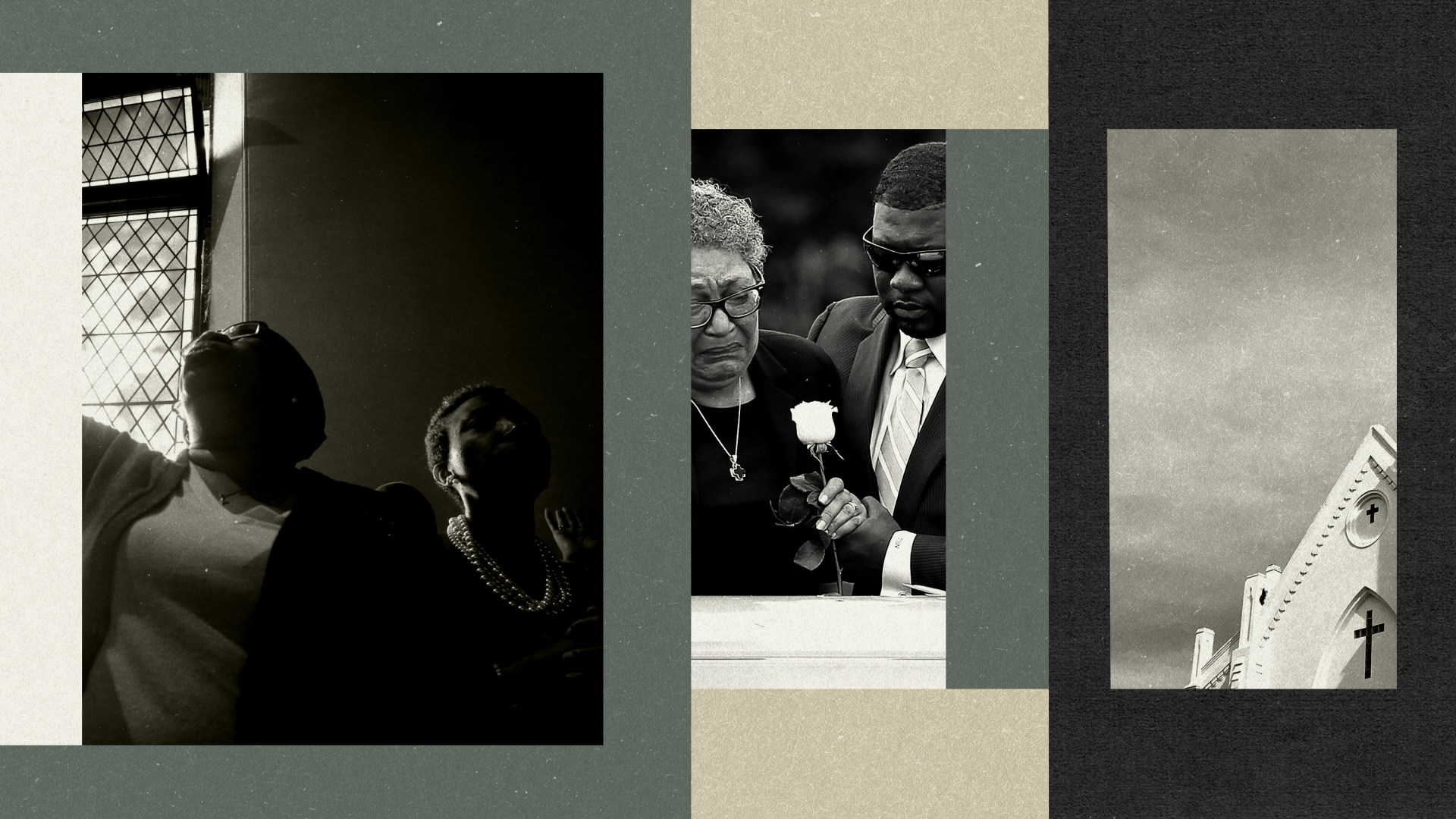
Best known as Mother Emanuel, the church catapulted into America’s consciousness through one of the most heinous acts of racial violence in the nation’s history. On June 17, 2015, 21-year-old Dylann Roof entered a Wednesday-night Bible study inside the church, by all accounts unaware of its historical significance. Roof, who had been radicalized by white-supremacist ideology online, sat silent during the meeting for roughly 45 minutes before taking out his gun and killing nine people: Rev. Clementa Pinckney, Cynthia Hurd, Susie Jackson, Ethel Lee Lance, DePayne Middleton-Doctor, Tywanza Sanders, Rev. Sharonda Coleman-Singleton, Rev. Daniel L. Simmons, and Myra Thompson.

In the aftermath of the callous evil, illusions of a post-racial society in the wake of President Barack Obama’s second term deflated. But something remarkable also happened. Two days after “the tragedy,” as it came to be known by congregants, the world witnessed several of the victims’ surviving family members publicly voice forgiveness for the unrepentant killer. Thus the tragedy bore witness not only to the evil of racial hatred but also to the strength of Christian faith. And through it, the world witnessed America’s unvanquished racial animus and the resilience of Black Christians in the face of unthinkable grief and persistent injustice. 

In Mother Emanuel, Sack puts forth a gripping exploration into how centuries of white supremacy impacted the church and the witness of faith against a deluge of hatred. The book examines how forgiveness could be granted in light of shocking evil. And after centuries of Black suffering, is forgiveness radical or repressive?

Sack makes the case that the answers come only by “studying the church’s historical and theological origins” to “better understand the grace summoned” by those who pronounced forgiveness. Resistance, forgiveness, and race form the book’s subtitle, and rightly so. There is no accurate portrayal of the African American Christian experience without these three realities. The history of Mother Emanuel as a congregation can be summarized as resistance—of which forgiveness is a practice—in the face of centuries of racism.

A poetic and captivating storyteller, Sack details the birth of the church through a walkout of thousands of enslaved and free Black worshipers from a local Methodist church in 1818. He explains how adherents left to “protest indignities in [public] governance and worship,” including plans by the church’s white trustees to “build a garage for the church’s horse-drawn hearse” on the Black half of its burial grounds. The bulk of chapters narrate the church’s vital work and key figures through the pre–Civil War and Reconstruction eras, its pivotal role in the advancement of Black Methodism, and its advocacy for desegregation in the 20th century.

At the same time, the book paints an honest picture of the congregation in the lead-up to the tragedy, including its reputation as a church with a hard-to-manage vocal minority, resulting in a fair amount of pastoral turnover. “If we don’t like a minister, we know how to get rid of them,” one member admitted. The church saw declining membership and waning influence due to an aging congregation and forces like gentrification. But it sought to carry on its mission.

On the day of the tragedy, Myra Thompson, a member and aspirant for ordination, was prepared to lead Bible study, a responsibility that Sack writes “she took so seriously she had barely left home during two weeks of preparation.” Cynthia Hurd, a busy librarian and Bible study regular, had planned only to drop off an item at the church and depart. Sack reports that after being lovingly chided by a friend, Hurd gave in: “The weary librarian took a seat and grabbed a Bible.”   

Such details, found throughout the book, provide a close look into the lives of the victims and add gravitas to the forgiveness pronounced by several of their family members in the aftermath. Their decision to forgive captivated many people but left others confused. Meanwhile, some didn’t want to hear it. One week after the shooting, the writer Stacey Patton wrote an op-ed in The Washington Post titled “Black America should stop forgiving white racists,” and she argued that “quick absolution” cannot produce real justice. But the forgiveness offered was neither cheap nor quick. It was formed by two centuries of trial, triumph, and resilient faith.

Forgiveness functions as the narrative frame of Mother Emanuel, anchoring its opening chapter (“The Open Door”) and epilogue (“On Forgiveness and Grace”). For Christian readers, the drumbeat of forgiveness is of course vital. The Lord’s Prayer teaches us our Christian life is framed at all points and junctures by forgiveness. Martin Luther recognized Christians as simultaneously righteous and sinful (simul iustus et peccator). As those made righteous in Christ, we have a continual duty to extend forgiveness in a world vandalized by sin. As those who are still sinful, we extend continually the very thing we need constantly—forgiveness from God himself and from others.

Culturally, it’s easy to see that forgiveness has fallen on hard times. It is viewed as a means of revictimizing sufferers and a loophole for evading true accountability. Far too often, the act has been distorted from its scriptural vision. Biblically, forgiveness is not the denial of accountability. Forgiveness names a wrong and releases it while seeking repair and reconciliation rather than resentment and personal revenge.

Part of the gift of Mother Emanuel is that readers, by entering the 200-year history of this church, will reckon with how those who have suffered greatly sought somehow to forgive freely. When forgiveness is offered without coercion and in the context of centuries of injustice, even secular audiences take note. 

Readers will benefit from Sack’s refreshingly nuanced portrayal of the “idiom of forgiveness.” Mother Emanuel acknowledges the surviving family members who forgave—and those for whom such an act is a work in progress. Forgiveness is depicted as a discipline of spirituality, a reality forged in and from one’s heart, soul, and psyche through true human agency—but not powered solely by us. 

Notably, Sack writes that the forgiveness displayed after the “tragedy” was in some form “mystical.” Nadine Collier, the first person to speak at Roof’s bond hearing, where she voiced her forgiveness, said, “[I] didn’t know what I was going to say” and “something just came over me.” Chris Singleton testified of a similar experience, akin to an “out-of-body” feeling. Singleton said he “knows it was God,” for he offered forgiveness with “zero premeditation.” “There is no way in a million years,” Singleton declared, “someone could tell me I would forgive the person who murdered my mom.”

Though Sack accurately notes these acts of forgiveness are described in “mystical terms,” it’s not entirely a mystery for theologically minded readers. In the face of heart-wrenching evil, the in-breaking grace of God shines mysteriously forth. The late pastor Tim Keller said it well: “Human forgiveness is dependent on divine forgiveness.” The type of forgiveness that is impossible with humanity is possible with and through God. It may flow forth in an instant or by a longer process. In either instance, Christians can grasp both manifestations as the prevenient work of the Lord. 

Desmond Tutu, a famous South African bishop who led resistance to apartheid, asserted there is no future without forgiveness. In Mother Emanuel, the act of forgiving is widely described among family members as a power that releases bitterness, enabling them to move forward without being overcome by hate. Historically, for Black Christians forgiveness has been an act of resistance that preserves faith, dignity, and agency against the harsh winds of systemic racial violence.

The implicit challenge of Mother Emanuel is this: Ten years later, what future has forgiveness wrought? If the story of Mother Emanuel is a microcosm of America’s living history with the injustice of racism, has the forgiveness extended been met by accountability and works of righteousness? Although those from Mother Emanuel bore witness to forgiveness, one is right to wonder whether Americans have not quite received the message. 

Far from sparking revival, this act of forgiveness and resilience has perhaps faded from national memory. In its place, America’s national touchstone has increasingly become resentment and resignation across the board—racially, politically, and culturally. In the wake of intensified racial hatred, Martin Luther King Jr.’s 1967 book asked, “Where Do We Go from Here: Chaos or Community?” In this radical act of forgiveness depicted in Mother Emanuel, readers see an option beyond chaos.

While the sweeping history of Mother Emanuel is honestly pessimistic about America’s racism, it is hopeful about the counterculture of Christ’s church, even with all its human imperfection. When Sack set foot in Mother Emanuel after the tragedy and attended services for his research, the church, despite its traumatic recent history, welcomed him. The people chose community over chaos. Even in grief, Mother Emanuel embodied a resistance to hate by the work of forgiveness and welcome.

If any retrieval of justice, mercy, and forgiveness will occur in America in the decades to come, the house from which such a revolutionary resistance will come is the church of Jesus Christ, particularly its Black remnant, which can teach us in theory and practice what it means to persevere in a sin-stricken world.

Claude Atcho is pastor of Church of the Resurrection in Charlottesville, Virginia. He is the author of Reading Black Books: How African American Literature Can Make Our Faith More Whole and Just and the forthcoming Rhythms of Faith: A Devotional Pilgrimage through the Church Year.

Books
Review

Psalms, Hymns, and Spiritual Songs in a Spotify Age

A new book says streaming platforms have “broken” how we make and hear music. Can the church model a better way?

Christianity Today June 5, 2025
Illustration by Elizabeth Kaye / Source Images: Getty, Wikimedia Commons

There’s an old joke about the evolution of music technology that goes something like, “How many times do I have to buy the White Album?” Perhaps the move to streaming—the subject of Liz Pelly’s new book Mood Machine: The Rise of Spotify and the Costs of the Perfect Playlist—makes that question moot.

If Pelly is right that “music has been reimagined by streaming,” then despite her book’s focus on secular pop music, it has implications for the church and people of faith. And maybe we have something to offer to conversations about reinvigorating the culture of music.

At its heart, Mood Machine chronicles a music world Pelly deems “broken.” She assigns most of the blame to Spotify and the major labels. This broken system has fostered more broken ways of relating to music, which in turn breaks or hurts musicians and creativity. Pelly bases her story on “more than 100 interviews with industry insiders, former Spotify employees, and musicians.” As she chronicles the shift from piracy panic to playlist culture, Pelly argues that Spotify’s roots as an advertising company in search of internet traffic have shaped its policies and payment practices in the nearly 20 years since its founding.

Pelly ties the shift to streaming—and Spotify’s dominance thereof—to a playlist-fueled propensity for increasingly passive listening. She says the company has spent years pursuing “an elusive vision … where the Spotify user could simply open the app, press ‘play,’ and instantaneously get the perfect soundtrack for any given moment or context, without having to search, click or think.” Pursuit of this Holy Grail has helped foster listening that’s more self-centered, utilitarian, and impersonal, Pelly says, while shifting fans’ focus from individual artists to the ever-changing prescience of playlists.

Aspiring to or expecting such perfectly personalized soundtracks must be a relatively recent historical phenomenon, given all the technological developments required. But this desire speaks to the eternal human longing to be known and understood. For Christians, such longings ultimately go back to our post-Eden alienation from God. We all long for the pre-Fall intimacy God intended humans to enjoy with one another and, most of all, their all-knowing Creator.

Pelly does not acknowledge Spotify’s possibly godlike ambitions as such. She does, though, lament how the company indirectly constrains the horizons for new music. Because of its app and payment structures, Pelly says, Spotify discourages both musical experimentation and collaboration. “One independent musician told me that she felt like [the app’s hidden classifications] made musicians hesitant to change their sounds,” Pelly writes. “So many factors in Spotify’s algorithmic systems were determined at the artist level, and not the track or album level.” This might explain some of Spotify’s more jarring suggestions for my gospel playlist, which sometimes included secular music and even one patriotic song.

Paltry payments create another constraint. If you make only $0.0035 per stream, a figure to which Pelly devotes a whole chapter, it makes more sense to share that pittance with as few people as possible. (She doesn’t cite a source for this specific number, but various music distribution sites show similar rates.) Pelly closes her largely damning account of the company’s impact in grand terms. “We can’t just think about changing music, or changing music technology,” she writes. “We need to think about the world we want to live in, and where music fits into that vision.”


For all her interviews and her impressive sleuthing of even Spotify’s internal Slack channels, Pelly tells an incomplete story. At the most basic level, she gives no demographic information on the musicians she interviewed. Because she strives to keep nearly all of them anonymous, the most we ever learn is an occasional pronoun or sometimes the genre of music. This opaque treatment echoes some of the secretiveness she criticizes Spotify for.

I understand Pelly’s desire to help artists speak without fear of blowback from a powerful entity. But giving so little detail about interview subjects obscures her reporting’s strengths and weaknesses. We never learn how representative her interviews are or why she speaks so little of certain genres and musical experiences.

In a chapter on “ghost artists,” Pelly describes Spotify’s push to pad playlists with songs attributed to fake artist profiles but actually developed by a relatively small group of musicians. This practice, according to an unnamed “Spotify affiliate” she quotes, meant that “spots for Black and brown artists making this music started getting cut down to make room for a few of these white Swedish guys in a studio.” That sounds really alarming, but she offers no genre specifics or corroborating details from musicians.

In journalism, it’s standard practice to report due diligence when one doesn’t include a statement from all sides. When you can’t reach a source or that source refuses to comment, you document this so readers understand why the resulting story excludes that perspective. Other times, researchers explicitly state the limits they chose or faced. In my book on singleness, for which I interviewed nearly 350 Christians around the world, I acknowledge that I, as a Protestant, struggled to include enough Catholic and Orthodox singles.

If Pelly’s book omits or underrepresents certain genres or types of musicians, that may be perfectly valid, as long as she can give reasons for those gaps. Yet without such disclosures, readers can’t know whether her broadest claims stand up to scrutiny.

Pelly says more-instrumental genres like jazz and classical tend to fare “well on playlists for relaxing, sleeping, or focusing,” but she doesn’t address the classical music listening experience on Spotify. That’s striking, because classical music particularly suffers under Spotify’s default setting, which allows nonpaying customers to hear only albums interrupted by frequent ads—including between symphony movements—or randomly ordered playlists. This makes it very difficult to enjoy multimovement works like symphonies or concertos. When I subscribed, Spotify also suggested movements divorced from a larger work. Even the ad-based classical station in Anchorage, Alaska, (where I live) would never play music like that.

Pelly’s relative silence on classical music also stands out given its place in the long history of Western music. She closes Mood Machine by inviting readers to consider the place we want music to occupy in our world, implying that recorded music largely dictates this. But despite all the past century’s evolution, recordings remain a very recent innovation.

Perhaps that’s easier to see for Christians, whose songs and hymnody focus on a story two millennia old: Jesus’ life, death, and resurrection. When we sing the psalms, we draw on music even older than that, though only the words and occasional music notations remain. Because of that, music plays a profound role in reminding the gathered community who and whose we are. (Perhaps this is why songs re-encountered during exile to Babylon caused such pain for the Israelites, as Psalm 137 describes.)

Singing is one of the most basic and perhaps universal ways that humans make music. Corporate singing, in particular, provides one of our best opportunities to experience community in the unity and diversity that God intended. In communal singing, we both unite our voices and, when we sing in parts, demonstrate through harmony the great beauty created by our diversity.

The local church is probably one of the most enduring settings where people who vary greatly in skill sing and make music together. That arguably makes the church one realm where music hasn’t suffered as much. Yet church music plays no part in Mood Machine. (The only religious reference I found involves an “anti-Christian song.”)

It may be that, in many cases, “artists’ careers have become increasingly managed by algorithms, and listening has become more and more mechanized.” But that simply doesn’t account for the weekly musical life of churches all over the country and around the world, dozens of which I worshiped with during fieldwork for Solo Planet. From Handel’s Messiah to Jon Batiste, church music has long influenced the broader culture. Its exclusion from Pelly’s account limits the force of her argument.


At the end of Mood Machine, Pelly writes, “To address the root causes of our ailing music culture, we need to have deeper conversations about why music matters, why universal access to music matters, and what systemic political and economic realities currently prevent so many people from engaging deeply with music.”

Surely such a conversation ought to include more of the places where music thrives. Her conclusion lists some very interesting examples, especially of library-hosted music collections. But it’s worth considering others from the Christian music scene. Pelly might have reckoned with how Josh Garrels gives so much music away. Or she might have highlighted The Porter’s Gate, an arts collective responsible for a steady output of new songs, almost entirely digital, through an unusually large team of collaborators. How have these Christian musicians survived what seems like such risky generosity and collaboration?

By the same token, Christians could stand to heed the problems Pelly so meticulously chronicles. Many schools have ended or reduced music education in the classroom. But years ago, I attended a church whose worship minister believed the local church could help fill this gap, perhaps by teaching people how to sing parts. The church I presently attend (and play piano for) also supports broader cultural efforts to preserve and reclaim Indigenous languages by including some translated songs in our worship.

Churches can provide space to practice or perform as well. The Lutheran church where I worship rents its space to multiple community choirs for rehearsal. Others sometimes come to play one of the many pianos in the building—either for practice or just for fun. Historically, church support of musicians has also given some the financial stability to produce other work. Individual Christians have an important role too.

Reading Pelly’s book made me realize that for all the money I spent on Spotify the past few years, I had not bought a single song from my most-played playlists. When I first started using Spotify, I was doing international fieldwork and had almost no access to the music I loved. Like library ebooks, Spotify initially helped connect me to home, in some sense.

Once I settled in Anchorage but still had most of my huge CD library in storage, Spotify provided a way to stay connected to music. After discovering The Porter’s Gate in early 2020 and later building out my worship and gospel playlists, the app helped extend much older habits of compiling lists of recordings I might gradually acquire. Over time, I lost sight of that goal.

Today I finally changed that by buying a few of those songs as MP3s. Over time, I hope to buy more music again, while continuing to support local arts too. Although few of my favorite acts come through Anchorage, life here has taught me the importance of supporting local musicians. Unlike my prior stints in New York and San Francisco, Anchorage has far fewer concert options each week—particularly for ensembles like orchestras. Many community groups offer just a few concerts a year. That’s okay. In reality, I’ve rarely attended more than one or two per month, no matter where I lived. Now I just have to work harder at attending the concerts we do have. 

These days, my biggest barrier to supporting music is low income. But I’m grateful to the church choir that lets me practice with them each week, despite rarely attending their services. Some secular choirs here charge singers to participate!

And when a compassionate house manager recently bought me a ticket to a concert I couldn’t afford to hear, it reminded me of another long-term goal. As my post-book career hopefully stabilizes at a higher income level, I want to be someone who introduces others—especially younger people or those who can’t afford it—to the music that’s brought me such joy. What could you do to bring more flourishing to the music and musicians in your community?

Anna Broadway is the author of Solo Planet: How Singles Help the Church Recover Our Calling and Sexless in the City: A Memoir of Reluctant Chastity.

Inkwell

Confessions of a Bad Host

Throw parties in a lonely world—deliberately, self-consciously, and a little bit fanatically.

Inkwell June 5, 2025
"Le dance" by Albert Guillaume

It all started when I saw Footloose.

Though my Christian high school was not so strict that it banned dancing, I must have felt some subconscious spiritual connection to Kevin Bacon’s character. Shortly after watching it, I invited my entire senior class over for a dance party. I wanted to be cool, to party, to shout, “Let’s dance!!!”

As you might guess, absent the charisma of Kevin Bacon, the party left something to be desired. In a desperate attempt to ignite the dance floor, I struck up a vigorous “crisscross” step. But I was too vain, too inexperienced. I rolled my ankle so badly that I missed a month of basketball. I then had to tell my coach and teammates that the culprit was Rick Astley’s “Never Gonna Give You Up.”

Those are the kinds of scars that never heal.

After the Footloose debacle and some rough events in the interim, I thought my problems were solved when I read The 2-Hour Cocktail Party by Nick Gray. It’s basically “Hosting for Dummies,” presenting scripts to invite friends and step-by-step guides to set up a drink table, and the author even gave free consultations. It literally could not be simpler.

Nevertheless, the first time I hosted a party using his method, it bombed. The guide said to offer wine and a self-serve bar, but no one seemed capable of making a drink for themselves. No one wanted to open a bottle of wine, so most people chose to drink sparkling water.

There weren’t enough people, so there were a few distinct conversation circles that you couldn’t leave. You could also sort of hear everybody else in the room, and everyone took turns speaking one at a time. Some guests came, made one lap around the room, and left. We never spoke again. Others had promised they would be there, and I treasured their RSVP only to watch the minutes and then hours go by, slowly realizing they weren’t coming. By the end of the night, I was itching to send everyone home. I wanted to put them out of their misery. Then I wanted to crawl in a hole and die.

This was my first and most important lesson. Hosting is a skill, and with our rampant loneliness epidemic, it takes a lot of effort to put together a successful, well-attended event. Your guests will not kiss your feet for taking on this public health crisis. A lot of hosting discourse almost sounds resentful about this: “Here I am, busting my butt to build community, and these ungrateful guests can’t even be bothered to honor an RSVP!”

While I wouldn’t advocate for creating a village while hating on all the villagers, the way Leah Libresco Sargeant said it to me was helpful: It’s not impossible, but it is hard. So you can either use your energy complaining and exonerating yourself, or you can work to overcome the well-documented impediments to community building. I choose the latter. 

The second biggest lesson I learned is that there is no right way to host. Like so much of internet writing, the fringe on both ends is loud, certain, and allergic to nuance. Within the various schools of thought on hosting, the spectrum runs from what I call the “Planners” to the “Chillers.”

The Planners are represented by The 2-Hour Cocktail PartyThe Art of GatheringBuilding the Benedict Option, and many others. Planners are an articulate, intellectual, conscientious bunch who present a compelling case for how and why to host. This methodical, didactic approach gives them credibility. They’ve thought this stuff through.

Of course, their nuanced books end up dumbed down and radicalized for the algorithms. In my head, the voice of the extreme Planner is shouting something like this: Events need an explicit purpose! Guests need to RSVP ASAP so that subsequent invitees will be impressed with the cool people at your party. Events are for connections! In this room could be your future spouse, your next client, or your new chess partner.

The mentality that undergirds it all: This is serious business! We’re talking about the rebuilding of the infrastructure of the frayed, atomized, post-industrial, post-capitalist, post-Christian society, dang it! This is the village. This is what everyone’s whining about, but you’re doing it, you’re making a difference, you’re not like the rest of those pro-community keyboard warriors. You’re actually doing the work.

This approach pricks the conscience of other would-be Planners. Ask me how I know. 

While the planners dominate the conversation, there is a vocal minority of Chillers. They are reacting against the barriers to entry that make hosting seem out of reach for ordinary mortals. You may have heard of “scruffy hospitality,” a concept popularized by the Anglican priest Jack King.

Come as you are, serve simple dishes, and host far more than you would if you were shackled by impossible expectations. Parents of young children do not have spotless homes, and they should not delay hosting until the day their floors are free of dirt and Magna-Tiles.

Chillers and Planners find some overlap on their acknowledgement of the need for third places, “calling culture,” and other social technologies that don’t require constant text messaging and rescheduling to maintain. But Chillers probably wouldn’t actually use terms like social technologies to describe wanting to hang out with friends more.

Of course, Chillers can still end up radical and sanctimonious. The militant Chiller in my head sounds something like this: When I go over to someone’s house and the Cheerios are on the floor and the diapers are piled in the corner and the dinner is spaghetti and meatballs, I’m not offended. I’m honored.

The undergirding mentality: I haven’t showered in three days, I wear John Cena T-shirts around the house, and sometimes, when we’ve run out of milk, I put water in my cereal. And I want to bring you into all of that unfiltered, unedited, unguarded life.

I kid, I kid. But only a little.

For all the talk about wanting “a village,” most Americans are atomized because they prefer it. At least, that’s what they choose when given the option. Suburbs grew out of consumer demand, and a lot of communitarian living of yore was actually an inescapable result of impoverished living conditions. If you wanted community bad enough, you could still find it. But you might have to give up your lawn, your privacy, your autonomy. 

As Helen Roy reflects after a year abroad with her family, when your child cries on a bus in Budapest, a babushka materializes out of thin air to soothe the baby. By the same token, when your child isn’t wearing her winter coat, a babushka materializes to scold you. Most Americans have chosen the lawn over the babushka.

While everyone knows that relationships are important generally, it is easy, moment-to-moment, evening after evening, to choose the path of least resistance. 

This is a broader trend of life in the digital age that Ross Douthat recently wrote about: “The new era is killing us softly, by drawing people out of the real and into the virtual, distracting us from the activities that sustain ordinary life, and finally making existence at a human scale seem obsolete. In this environment, survival will depend on intentionality and intensity.”

If you are unwilling to fight for more humane ways of relating, they will slip away.

I put no stock in hosts complaining about the flaking, the busyness, and the inconvenience of it all. Not because the complaints aren’t true, but because that’s the whole point. Other people infringe on us and inconvenience us, and so we withdraw, and that’s what got us into this mess in the first place. On a spiritual level, we shouldn’t be surprised that our culture seems to be accelerating in the wrong direction.

As Douthat concludes in that same column, the challenge is not merely to talk, perform, or post about the changes we want. Instead, it’s to “go out into reality and do” because if we are not “deliberate and self-conscious and a little bit fanatical about ensuring that the things [we] love are carried forward,” then they won’t be. 

Deliberate, self-conscious, and a little bit fanatical—now that’s a hosting philosophy I could get behind. 

While it might sound cliché or even self-aggrandizing, I try to think about hosting as something to offer up to God rather than something grand that I am doing. For my guests, I hope to carve out a very human space in a dehumanizing culture. And for myself, I accept that my ego will take some body blows. It’s not always pleasant, but like any hard experience, there are also moments of joy, growth, and satisfaction at a job well done.

You have to be prudent about what approach best fits your community and temperament, knowing that any strategy will require some ingenuity and grit. Going against the grain guarantees some resistance. While some throw up their hands in frustration, I see those challenges as a sign that I’m on the right track.

If you want greatness, you must struggle.

If you want a village, you must embrace the villagers.

If you want a dance party, you’ve gotta break some ankles.

Ben Christenson is a writer and editor who has written for Hearth & FieldFront Porch RepublicMere Orthodoxy, and others. He writes while his (amazing) wife watches their three kids, three dogs, one cat, and innumerable chickens. You can read more of his work at benjaminchristenson.com.

addApple PodcastsDown ArrowDown ArrowDown Arrowarrow_left_altLeft ArrowLeft ArrowRight ArrowRight ArrowRight Arrowarrow_up_altUp ArrowUp ArrowAvailable at Amazoncaret-downCloseCloseellipseEmailEmailExpandExpandExternalExternalFacebookfacebook-squarefolderGiftGiftGooglegoogleGoogle KeephamburgerInstagraminstagram-squareLinkLinklinkedin-squareListenListenListenChristianity TodayCT Creative Studio Logologo_orgMegaphoneMenuMenupausePinterestPlayPlayPocketPodcastprintremoveRSSRSSSaveSavesaveSearchSearchsearchSpotifyStitcherTelegramTable of ContentsTable of Contentstwitter-squareWhatsAppXYouTubeYouTube