Ideas

To Grow Resilient Kids, Don’t Take Away Struggle

Editor in Chief

A Q+A with Tish Harrison Warren on resilience, raising children, and technology.

Cartoon illustration of a kid clinging to a giant thorny vine sprouting from a smartphone, watched by his mother.
Illustration by Kyle Smart

How do parents and teachers build resilience in kids?

All cultures have stories that shape them. Children look to adults to learn resilience. If the story we suggest to children is that your chief identity is as a consumer and your main goal in life is individual happiness or having an Instagrammable life, then anything that seems hard and threatens a sense of bliss is something to be avoided. If that’s the story we tell ourselves, our goal will be to be as comfortable as possible for as long as we can.

Does that search for comfort end up weakening us?

If you never stress your muscles or your bones, they become weaker. If we teach kids that the story of their life is to avoid difficulty, they’ll end up weaker. What brings our life meaning—faith, relationships, generative work, the commitment of celibacy or of marriage and parenting—is difficult. It makes your average Wednesday much harder. Just ask any mother of a kindergartner
in this room.

If we agree that the Christian life does not include cheat codes, how do we get our kids not to cheat when it’s common to do so?

The entire digital experience is aimed at making things as easy as possible in order to addict us to our devices. Corporations keep the barrier to entry low so their products can consume more and more of our attention. We set kids up for being so habituated to instant gratification that we do not give them the muscles to follow a commitment through the long haul. I feel like I’m alarmist when I say this, but I cannot overstate the disaster that is upon us if we lose the ability to sit with difficult, complex ideas and hash them out with people over time and with sustained attention.

In your forthcoming book, you write about Antony, a fourth-century desert monk who nearly died, asking God, “Where were you? Why didn’t you … stop my distresses?” He says God told him, “I was here, Antony, but I waited to watch your struggle.” How do teachers and parents keep from intervening prematurely when they see struggle?

It’s hard to know with an individual kid when to jump in, which is why we need community. The beautiful thing about schools like this is that they’re built to be human-scale.

We’re built to do hard things but not to do them in isolation. We help our kids not by taking away every struggle but by accompanying them as they struggle. When they struggle socially, we can’t just jump in and take over. (As a mother, I know this is hard.) They have to learn to do things on their own. As they struggle, they need roots to help ground them. They need a community. They need to know the name of the trees in their yard or the history of their town. Most especially, they need a church.

Your book explores how Christian resilience is different from the stoic idea that life is suffering and you bear it.

The Christian idea of perseverance and resilience is born of the idea that Jesus will set all things right, that the reason for resilience now is participation in this eternal story of God making the world whole and right. If life is tragic and then we die and that’s the end of the story, why not spend life on a screen? But if what we do today matters because it participates in an eternal reality, then there’s meaning in today—even in the things that feel hard or heavy. Our future hope changes the meaning of the present.

You describe in your new book one example of the way we should guide children toward excellence in art.

My book is not about resilience in children, per se. But I use this example in the book to discuss how all of us—kids and adults alike—learn from those who come before us. Teachers at my kids’ school do not lay out art materials and let students “decide their own path.” They expose them to artists—Georgia O’Keeffe, Henri Matisse, or Pierre-Auguste Renoir—and ask them to copy their work. They seek to teach them what is good and true and beautiful. It’s harder than just following their own impulses, but it teaches them the craft.

It’s not indoctrination; it’s laying before them a feast. Our culture lays before them the high-fructose corn syrup of the mind: addictive, easy distractions. We need to help them develop a palate for what is good, true, and beautiful. A school does this by exposing kids to classics, to beauty, to lasting truth. You learn art better by mimicking those who have gone before us and then, of course, taking those skills and making your own masterpiece—but not until you’re ready.

How do we teach children about the uses and abuses of artificial intelligence?

The conversation about AI, even among Christians, often goes like this: “Will it be something that cures cancer and helps us live better lives, or will it destroy us?” I want to say instead that, even if it doesn’t destroy us, even if it turns out that good can come from AI, we simply do not understand what we are losing in our social world that we deeply need—things in our everyday social interactions that we don’t even notice. I’m talking about intimate conversation but also the chat with the cashier in the grocery line. Those interactions nourish us in ways we don’t fully understand and will not know until they’re gone and there’s a massive mental health crisis.

That brings us back to resilience.

Technology promises us a frictionless world of ease, but there’s something about the goodness of even a broken material reality—even the hard things in our lives—that make us human. When we become disconnected from that, we will lose
our humanity.

Tish Harrison Warren is an award-winning author and Anglican priest. Her most recent book is What Grows in Weary Lands.

Marvin Olasky is editor in chief at Christianity Today.

Ideas

We Need More than Grit

Staff Editor

A note from our editorial director for features in our May/June issue.

Black-and-white cartoon illustration of a smiling runner jogging through puddles in the rain while holding a striped umbrella against a yellow background.
Illustration by James Yates

Some people are born to run. I am not. I can still recall the feeling of dread during the walk from my junior high school to my class’s off-campus running spot. Inevitably, burning in my lungs followed. But after about eight minutes, I finished the run. I never got a runner’s high or figured out my stride. Growth mindset hadn’t yet entered the pedagogical lexicon, so I found myself trying to “just do better” next time, to will my body to speed up. You might say I bypassed growth in resilience and went straight to determination and grit. But resilience is more than an act of the will. 

In this issue, we bring you the story arc of resilience—from those who failed or overcame, and those whose faith held fast through hardship. Historian Thomas S. Kidd shows us the resilience of missionary Adoniram Judson, who ministered in Burma (now Myanmar), translating the Bible into the country’s language and establishing Baptist churches amid much hardship (p. 38). 

Stories of resilience aren’t confined to the past. Haleluya Hadero reports about the civic work churches today are doing to revitalize Gary, Indiana, a city once prosperous due to the steel industry (p. 46). 

Resilience is also never confined to the self; it always requires a community, a place and people in which to be rooted. Marvin Olasky interviews Tish Harrison Warren on her community and on modeling resilience for children (p. 80). We also review her newest book, alongside two others, on page 68. 

We seem to go off course when we ruminate and isolate. Bonnie Kristian argues that our incessant focus on gender neglects the real work of being virtuous men and women who are embedded in relationship (p. 62). And our Roundtable contributors—Justin Whitmel Earley, Katelyn Walls Shelton, and Matthew Lee Anderson—discuss the interconnectedness of Christian virtue and the practices of elective vasectomies and hysterectomies (p. 109). 

When we read stories of resilience, we want to see the best parts of humanity and know that those are attainable for us. Emily Belz reports from Minnesota’s Twin Cities, where the US government had welcomed Christians from the Karen people group who were fleeing violence in Myanmar. But now immigration officers have gone after them. Local churches have responded with aid and legal help. 

What motivates churchgoers in Minneapolis to risk themselves on behalf of others? What prompts church leaders in Gary to care for their city? What kept Adoniram Judson in Burma when family members died? It is more than simple grit, an act of will before a hard run. As Christians, we know resilience for its own sake rarely motivates. Resilient faith is less about the process, the hardship, or the outcome and more about the object of our faith—Jesus Christ. Jesus models not grit but sacrifice, not rumination but reliance, not grasping but giving his very life.

Belz’s news story on the Karen Christians reminds us of the point of resilience. She records that when she asked one detained Christian if he was mad at God, he replied, “Jesus himself, when he came on earth, he had to go through worse than this. . . .He also commanded us that we have to go through trouble while we live in this world, and we will have peace in the afterlife.” Union with Christ through the power of the Spirit is what motivates our resilience. 

Ashley Hales is editorial director, features at Christianity Today.

History

Pornography Has Always Been a Moral Blight

A look back at evangelical prescience concerning a “moral sickness.”

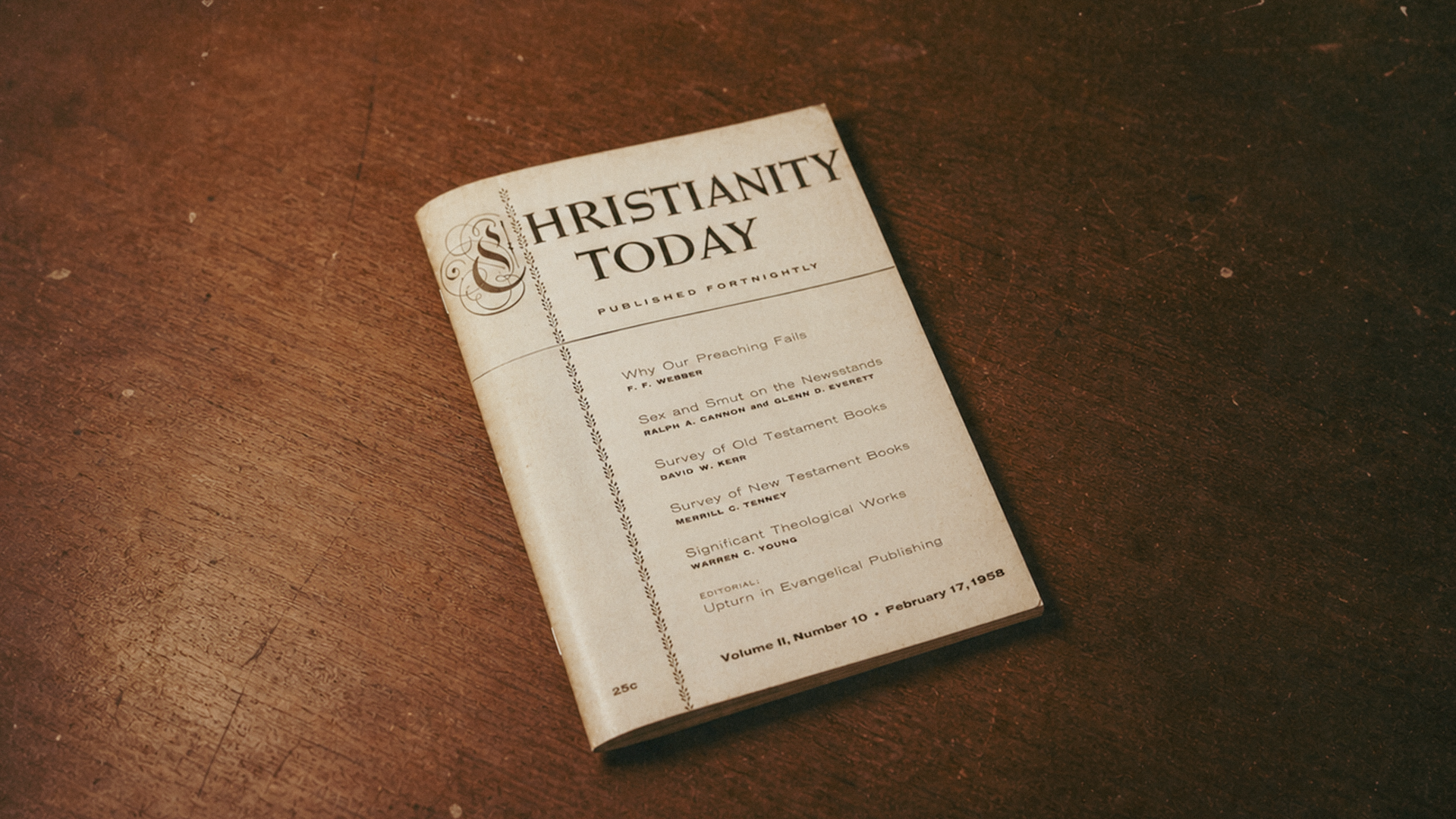
A vintage Christianity Today magazine from February 17, 1958 rests on a worn wooden table.

When Russell Moore late last year reported about “sexbots”—the new wave of high-tech pornography that gives “sad, lonely people artificial intimacy with images and machines pretending to be persons”—he was advancing the warnings that Christianity Today has offered since it began 70 years ago. 

Every Friday since last October we have presented on our website glimpses of how CT from the 1950s to the 1980s covered a variety of issues. We’ve quoted perspectives on abortion, race, politics, wars, rumors of wars, and much besides. I’ll summarize here some early articles on pornography, because over the years some people mocked evangelicals for being culturally behind the times by worrying about such matters—but it now looks as if CT was ahead of the times.

The February 17, 1958, cover story—sensationally headlined “Sex and Smut on the Newsstands”—began, “A virulent moral sickness is attacking American society. Its obvious symptoms may be seen at any newsstand in large cities or small. American society is becoming mentally, morally and emotionally ill with an unrestrained sex mania.”

Some restraints existed then, but CT “watched, appalled, as scores of new titles have made their appearance in the magazine field, many of them violating every standard of decency which has hitherto been recognized in the publishing field.” A CT writer at the time said, “It is high time that our churches awaken to the kind of material being circulated to teen-agers and young adults of both sexes, sold openly at drug stores and newsstands under the guise of sophistication and respectability.”

Exactly one month later, CT ran an investigative “Report on Obscenity: Indiscriminate Sale.” “Two young women learned that the ‘best’ literature in the nation’s capital is readily available to them, even though they are ministers’ daughters,” it said. “On a special research project for Christianity Today, they found easy access to the magazine stocks of three newsstands in downtown Washington.” 

Within three blocks of the White House, they were able to buy “the May issue of Hush-Hush, which features ‘the inside story of the nude model who pinch-hit for Princess Meg,’ ” “the April issue of Ace, which includes the story of ‘a voluptuous wench,’ ” “the spring edition of Sunbathing Review, with more than 85 pictures of nude women and children,” and “the March edition of Night and Day, carrying several advertisements that offer by return mail pictures of women posed to order.” 

On March 12, 1965, CT published “A Time for Moral Indignation,” in which editor in chief Carl F. H. Henry declared, 

“The millions of Christians in America have a special duty,” Henry said. “They know that when anything becomes a national idol, it is because God has first been displaced and his moral law set aside. The final resolution lies with God, who alone can give purity of heart. But until such a time, Christians are summoned to reflect his holy wrath against every unclean thing.”

Every American dedicated to common decency must become morally indignant and let this indignation burn righteously in an articulate protest against an exploitation of sex that is unparalleled in the history of the world. Never before in human civilization has sex been so pervasively prostituted to financial gain, for the technological possibilities were not present until our time.

One month later, CT declared in “Facing the Tide of Obscenity” that “the decline of decency imperils wide reaches of modern culture and life. We are headed for doom unless pervasive immorality is arrested.” The only good news: “America has not sunk to the depravity of the pagan world that existed before revealed religion registered its impact upon society—not yet, happily.”

What to do? 

The rising tide of indignation and concern also signals a moment of methodological danger for all who plot a remedial alternative. We should not rely mainly on programs that promote purity by destroying freedom. Legislative compulsion may provide penalties for infractions and restrain a sick society from iniquity momentarily, but no society will long survive whose citizens lack heart to abstain from evil; apart from the will to decency not even the best laws will keep men from destroying themselves.

CT criticized “the photographic cult of feminine nakedness supported by the magazine traffic in our day” and said, “At his first coming, Jesus Christ drove the money-changers out of the temple; in the final judgment will he not consign publishers and peddlers of sex temptation and their wares to the stenching refuse pits of Gehenna? . . . We are breeding a generation of sex giants with mustard-seed spirits.”

What role should government have? “Civil government will always be needed in a society of sinful and imperfect men. The promotion of just laws is a special responsibility of the people of God. In urging laws to halt the trend toward indecency we are on sure ground insofar as our concern is to protect human rights from the infringements of those who violate them.” But another danger lurked that way: 

If we propose a paternalistic ground for government intervention whenever the license of madmen sets up a clamor for controls, we may be sharpening a two-edged sword of the state by a precedent that someday may threaten the freedom of good men and not simply, as we now propose, the license of bad men.

Commercial pressure might be a better approach:  “Let us ask whether publishers, distributors, and magazine store operators approve these products for their own teen-agers.”

CT editors commented on July 2, 1965, that “now and then we read Playboy—not often, confessedly, but when Hugh Hefner, its editor, occasionally sends a copy hoping Christianity Today will debate his philosophy of sex and give him free promotion.” The editors quipped, “There seems to be only one aspect of grammar that interests Mr. Hefner as an editor—gender, the feminine particularly, so exposed as to suggest a maternal attachment that Mr. Hefner hasn’t yet outgrown.”

The descent since then has been steep. Russell Moore elsewhere summarized a Harper’s article about “ ‘gooning’—a pornography-obsessed subculture among predominantly Gen Z males who spend hours, even days, consuming pornography, often in front of multiple screens in specifically constructed rooms they call ‘gooncaves.’ ” Some gooners are “ ‘pornosexual’ . . .not just uninterested in real-life sex with a real-life person, but … terrified by it.”

Moore’s analysis is in line with the CT tradition, but high tech has brought people lower: 

If we propose a paternalistic ground for government intervention whenever the license of madmen sets up a clamor for controls, we may be sharpening a two-edged sword of the state by a precedent that someday may threaten the freedom of good men and not simply, as we now propose, the license of bad men.

What’s unique here is not lust and shame (as old as Eden’s fig leaves) but the ecosystem that can give us exactly what we think we want—until we are so trapped that we no longer know how to feel want. Sexual sin distorts attachment; this ecosystem dissolves it. Porn industries and their allies don’t make people sexier. They evacuate the capacity for human eros by abstracting pleasure from persons, from story, from place, from love.

Moore is also right in his response: 

The gooners are not some freakish fringe. They are omens of a disembodied age that beckons us all. We can say no to it. We might seem powerless in front of such matters, even willfully ignorant, but the broader body of Christ, transcending time and space, knows the way out: the mystery of Christ (Eph. 5:31–32). 

But escaping this disembodiment will require us to recognize that we face not only our own fallen flesh but also an entire industry of unseen algorithms trained to lead us, step by step, toward this post-human hell.

CT writers in the 1960s saw where we were going. I did not see things as clearly when in the 1980s I taught a media law course at The University of Texas at Austin and told the students about Miller v. California, the 1973 case that opened the doors wide for pornography as a hallmark of individual liberty.

I don’t suspect those Supreme Court justices had imagination, or awareness of the depth of sin, to foresee this enslaved new world. Nor did I, and I gave the students my opinion: I thought it a poor decision, but one that did take into account First Amendment protections.

I look at it differently now. If laws on pornography are to change, many people need to stop associating its omnipresence with freedom of the press. We should instead see it as a right to enslave. I’m suggesting this not as a matter of constitutional law but as a media-philosophy approach: Given enslaving algorithms, my fellow journalists should describe porn not as First Amendment freedom but insidious psychological bondage. 

Any legal action, even if it could get past cultural czars, is probably too late, because the thin fence of the law can’t stop a social avalanche. We need a cultural awakening, which maybe at some earlier point could have come through reserved intellectual persuasion. Now (and I suspect it was always this way) it can come only through Christ changing hearts.

Moore’s conclusion: Christians need to be “seeing clearly and modeling a different story—one that is set at a wedding feast, not in a warehouse of screens.” He writes, “Among the first tasks of the 21st-century church will be to break this spell—to remind ourselves that we are creatures, not machines, and that we are created for love. … We can offer grace and mercy and community through the gospel and, with it, actual life and love. 

“The gates of hell cannot withstand that kind of love. Surely the screens of goonspace can’t either.” 

Marvin Olasky is editor in chief at Christianity Today.

We Need More than Bible Trivia

Responses to our January/February issue.

The January/February 2026 issue of Christianity Today magazine sits on a dark wooden table.

In “Go and Make Learners” (published online as “The Great Omission”), Jen Wilkin wrote in our January/February issue, “We have forgotten that discipleship requires learning. We have reduced its definition to attendance, service, giving, relationship-building, and mostly peer-led, feelings-level discussions. But at its most fundamental level, discipleship is a process of learning.” She argued we must not neglect biblical literacy in the life of a Christian: “Let’s not be content with converts who don’t grow to maturity.” 

Wilkin named this a crisis of biblical literacy, and readers resonated with her diagnosis. One commenter on Facebook said, “We think we know the Bible because we’ve inherited summaries of it. But when Scripture challenges our assumptions about power, ownership, or gender, we often smooth it over rather than read it closely.” Another reader commented that we also need “theological frameworks,” not just Bible trivia, to understand Scripture.

The interest from pastors and laypeople alike led CT to continue the conversation. A few weeks after the print magazine mailed, Wilkin joined editor at large Russell Moore for a subscriber-only webinar with more than 1,400 live attendees. They addressed big-picture questions about small groups and biblical learning, alongside practical questions such as: Should churches have single-sex Bible studies grouped by men and women? How do you promote biblical literacy in lower-income areas? And how do you deal with a prolonged silence during a question you’re asking when leading a Bible study? If you’d like to hear Wilkin’s answers, be sure to listen to a replay of The Russell Moore Show and, in the future, stay tuned for upcoming subscriber-only conversations.  

Ashley Hales, editorial director, features

Disciplines Don’t Save. Christ Does.


I respect Michael Horton, but I think some of the points Horton makes are unfair and broad and do not reflect the scope of the teachings of Practicing the Way or in Comer’s writings. Horton claims that Comer (and others) equates discipleship with the gospel, and that they claim that the practices are salvific. This would be a serious issue if it were true, but I have not come across anything in the materials by Practicing the Way that shows they claim this, even implicitly. Comer emphasizes that the Holy Spirit is the source of our transformation in his book.

Rachel Gulleson, Bellingham, WA

Having just completed the Practicing the Way curriculum and seeing how God is using it in my life and in the lives of those within our church, I was saddened and upset to read the article that you published. While it might be helpful as a critique to some of John Mark Comer’s teachings to remind readers of the importance of not neglecting the aspects that Horton felt were lacking, his article dripped of judgment that I believe misrepresented the PTW curriculum. I don’t know if Michael Horton has been in his academic ivory tower for too long, but he clearly does not understand where the mainline church is right now and how desperately we need to have tools to equip people who call themselves Christians to use the means of grace.

Margaret Schlechty, Springfield, VA

The Great Omission

The thrust behind Wilkin’s argument is great: Christians should know their Bible and cultivate a deep knowledge of it. But the way her argument proceeds is misguided. What troubles me is Wilkin’s understanding of what constitutes “basic information” about the Bible, its correlation to theological anemia, and the residual effect this relationship leaves on the weary. I fear the effect of her argument is that struggling Christians will walk away feeling they need to know more Bible trivia.

Elijah McClanahan, Louisville, KY

I think Jen Wilkin is spot on! Biblical literacy is waning in both mainline and conservative church pews. Pastors can only do so much teaching from the pulpit. Gone are the days when church Bible classes could actually give out homework and learners were actually asked to memorize Bible passages and characters.

David Coffin, West Union, IA

Raids Are a Perilous Substitute for Reform

No disagreeing with that title. I thought the article represented the open-borders “walk in and stay” perspective, which is fine, but there was no balancing article, like in the old days when Sider and Dobson were in print back to back. Not a good look for a publication hoping to be an evangelical forum.

Rob Swanson, Centerville, MA

Andy Olsen’s article goes to the heart of the depravity of ICE’s operations. While securing our border is a must, Scripture demands justice and grace be given to every immigrant.

James Hilt, Sheboygan, WI

A Declaration of Principles

Each statement is clear, biblically defensible, and crafted in a way that both upholds historic Christian teaching and considers the “big tent” nature (a blessing and a burden!) of evangelicalism at large and CT’s readership/mission specifically. That’s no easy task. CT’s stuff regularly edifies my personal walk with the Lord and benefits my work as a pastor.

Brady Cremeens, Minier, IL

I read your statement with optimism, but guarded optimism. CT has done some mighty fine work in the past, but CT became too political for me to continue as a subscriber. Russell Moore is an important voice absent the politics. We continue to listen to some podcasts because of the great work of Mike Cosper.

Steve Hawkins, Bristol, TN

Church Life

Enduring All Things for the Gospel

Two centuries ago in Burma, Adoniram Judson modeled evangelistic zeal and missionary resilience.

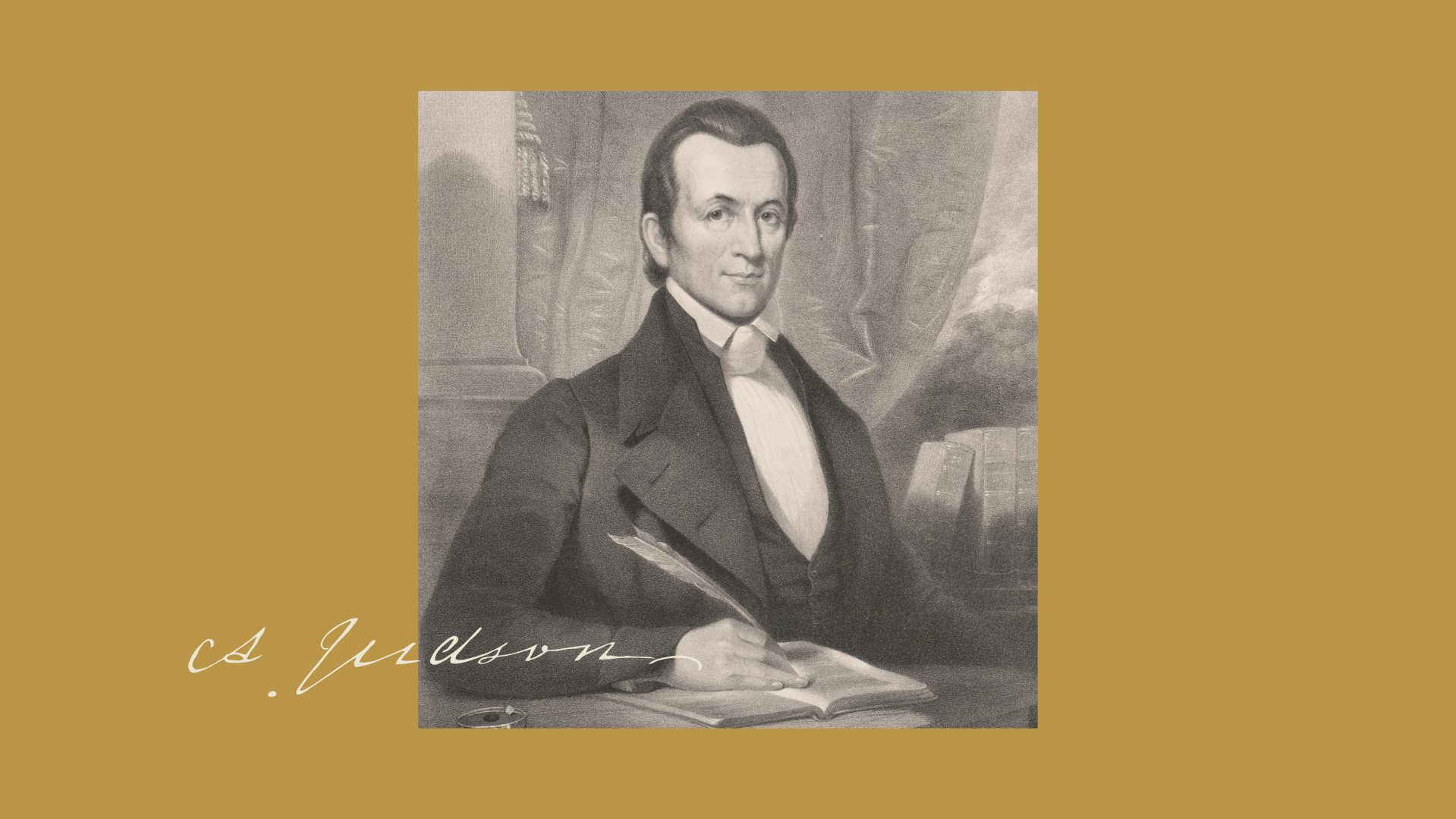
Engraved portrait of pioneer missionary Adoniram Judson seated at a desk with a quill pen, set against a gold background with his cursive signature.
Library of Congress.

Adoniram and Ann Judson were among the first formally commissioned American missionaries. Arriving in Burma (today’s Myanmar) in 1813, the Judsons labored for six years before they saw anyone convert to Christianity. Determined and diligent, they made extraordinary progress in learning native languages. Then, 11 years into their Burmese ministry, the Judsons’ world collapsed.

In 1824, long-simmering tensions between the British Empire and the Burmese king exploded in the First Anglo-Burmese War (1824–1826). The Judsons themselves sometimes had a difficult relationship with British authorities in South Asia. But in 1824, all English speakers in Burma fell under suspicion as possible spies. Judson knew plenty of British diplomats and merchants, but he was no spy.

Burmese authorities did not believe him. On June 8, 1824, police in the royal city of Ava arrested Judson, marched him to a judge, and convicted him without a trial. The Burmese committed him to the “death prison,” a small, dank building with about a hundred prisoners. The death prison had little ventilation and teemed with rats, roaches, and rotten smells.

During the day the prisoners languished in chains, but at night their captors devised additional means of preventing escape. These measures amounted to unremitting torture. Jailers passed a long bamboo stick between Judson’s legs and those of a lineup of prisoners. They chained the prisoners’ legs to the pole and lifted their bodies in the air, while the men’s shoulders remained on the ground. They left them in that excruciating position all night. Ann frantically sought to secure Judson’s release, but he remained in prison for 17 months.

The history of missions is a history of suffering. From the apostle Paul’s dangers, beatings, and imprisonments to the 1956 deaths of Jim Elliot, Nate Saint, and the other “Auca martyrs” in Ecuador, Christians rightly memorialize their best-known missionaries as people called to endure all things for the gospel. The Judsons knew trials lay ahead when they sailed away from Salem, Massachusetts, in 1812. But they never envisioned the horrors of the death prison or the compounding sufferings yet to come.

Familiarity with missions history is one of the best antidotes to the prosperity gospel—the idea that God will surely bless the faithful with health, wealth, and safety. Missionaries have routinely endured terrible hardships as they obeyed God’s call in the Great Commission (Matt. 28:18–20).

The call to missions—and the call to ministry generally—is also a call to resilience. To be sure, many missionaries have chosen to terminate their missions for good reasons, sometimes before the scheduled end of their service. This can happen when God permits circumstances that make it impossible for them to operate without grave threats to themselves or their families’ lives.
Some missionaries, such as the Judsons’ British contemporary William Carey in India, probably stayed longer in the field than godly wisdom would have dictated. Carey watched as his wife, Dorothy, suffered a protracted slide into violent mental illness. She finally died in India in 1807, after more than a decade of delusions and torment.

Any well-prepared missionary anticipates seasons of deprivation, loneliness, and other stresses. Counsel and prayer are required to know whether God is simply allowing his servants to encounter the normal travails of ministry or is definitively closing a door.

The missionary impulse is fundamental to biblical faith, as seen in the Great Commission and the Book of Acts. However, following the Reformation of the early 1500s, Protestants generally trailed Catholics in efforts to evangelize outside North America and Europe. Protestants often thought more about their churches’ survival than evangelistic expansion.

Meanwhile, Catholic powers such as Spain and France mobilized missionary orders such as the Jesuits in imperial endeavors in Asia and South and Central America. Certain Protestants, such as the Puritan John Eliot in the mid-1600s and Jonathan Edwards’s protégé David Brainerd in the 1740s, made evangelistic inroads among Native Americans.

More evangelicals professed their faith and planted churches as they moved, without being sent by any particular church or missions organization. These travelers included the Baptist pastor and former slave George Liele, who was a key leader in Black churches in Georgia and South Carolina before moving to Jamaica in the 1780s. There he became one of the founding fathers of Jamaica’s multiplying Baptist churches. But overall, organized Protestant missions were limited until the 1790s.

A turning point in Protestant missions came with Carey’s Enquiry into the Obligations of Christians to Use Means for the Conversion of the Heathens, published in 1792. Carey was one of the first Protestants to cite Christ’s “commission” (in Mark 16:15) to “go into all the world and preach the gospel to every creature” (NKJV). He insisted that this command applied to contemporary churches and believers. Carey was also instrumental in the founding of England’s Baptist Missionary Society (BMS). Arguably the first formal Protestant missionary organization, the BMS sent Carey and other missionaries to work in Serampore, near Calcutta (now Kolkata).

Carey’s work and writings inspired a generation of evangelicals, including the Judsons, to consider overseas missionary work. In 1806, students from Williams College in Massachusetts held an impromptu prayer meeting in the shelter of a haystack, consecrating themselves to the missionary cause. The Haystack Prayer Meeting led to the creation of a zealous missionary cohort amid the fervent atmosphere of the Second Great Awakening.

Engraved portrait of a young Ann Judson.The National Library of Wales. Engraving by Richard Woodman.

That cohort in 1810 founded the American Board of Commissioners for Foreign Missions (ABCFM), America’s first national missionary organization. The ABCFM was the Judsons’ first sending agency. Meanwhile, Judson himself converted in 1808 after a dalliance with religious skepticism as a student at Brown University. In 1812, the ABCFM sent the newly married Adoniram and Ann to South Asia as part of its first group of overseas missionaries.

The Judsons initially thought they might settle in India. At a minimum, they knew they would meet Carey and other British Baptists there. The problem was that the Judsons were Congregationalists and therefore paedobaptists. With plenty of time for study on the journey to India, the Judsons began to research the scriptural issue of baptism. Not long after arriving, they announced that they had become Baptists. This decision effectively cut them off from the ABCFM, their source of funding. Another Congregationalist turned Baptist missionary, Luther Rice, returned to the US and helped form the Triennial Convention, the first national Baptist organization in America.

Judson may have viewed Burma as a likely sphere of operations when they left America, but he and Ann considered several other destinations once it became clear that officials in British India would not allow them to remain. The ongoing War of 1812 made Americans unwelcome in British India.

The Judsons knew the Burmese were, in Ann’s words, “a people who have never heard the sound of the Gospel, or read, in their own language, of the love of Christ.” The prospect of operating among this unreached people was intriguing but intimidating. Certain Catholic and Protestant workers had already made brief forays into Burma, but overall it was a Buddhist kingdom with virtually no Christian influence.

The Judsons moved to Rangoon (Yangon), the main Burmese seaport. Rangoon was physically dominated by Buddhist shrines such as the great Shwedagon Pagoda. The dazzling pagoda held venerated relics, including several strands of hair claimed to be from Siddhartha Gautama, the Buddha himself.

It is difficult to overstate the resolve required for a young married couple from America to settle in South Asia, halfway around the world from friends and family. In Rangoon, they knew almost no English speakers or Christians of any kind. In the era before electronic communication, correspondence with America was achingly slow. In 1815, they received letters from US supporters for the first time in two years.

Perhaps the most daunting aspect of the work was that they knew nothing about the Burmese language. It uses a writing system called an “abugida,” which to Westerners looks like a jumble of squiggly lines. In addition, Judson needed to learn Pali, a traditional language that profoundly colored the type of Buddhism practiced in the country. Many religious terms a Christian translator in Burma needed to know were rooted in Pali, not Burmese.

Today’s missiologists would regard it as utterly irresponsible to send missionaries into a foreign culture with no knowledge of the country’s language. But that’s exactly what the Judsons faced. There were no courses on Burmese in American colleges, and the Judsons did not set out with the express intention of going to Burma anyway. They were pioneers in the most extreme missiological sense. Some American missionaries who followed the Judsons to Burma made little progress in language study, to Judson’s irritation. But the Judsons were incredibly diligent students of the language, and with the help of Burmese instructors they made phenomenal progress.

What purpose did their study serve? First, the Judsons planned to form Burmese-language churches when God blessed the mission with enough converts. Thus, Judson needed to be able to preach in Burmese.

The longer-term goal of studying Burmese and Pali was that Judson intended to translate the whole Bible into Burmese. Some in the missionary community wanted to focus on English-language instruction for natives, who then would read the Bible and hear sermons in English. But modeling the great Protestant principle of Scripture in the vernacular, Judson insisted that a vibrant Burmese church needed a Bible in its own language.

Sepia-toned illustration of the golden Shwedagon Pagoda rising above palm trees and lush vegetation.Wikimedia, Joseph Moore (engraved by T. Fielding, G. Hunt, H. Pyall)

Because of books such as Courtney Anderson’s classic biography To the Golden Shore: The Life of Adoniram Judson (1956), people familiar with Judson see him as an exemplar of missionary courage. And that he was. But he was also one of the brightest and most disciplined Christian scholars ever. We may miss this fact because he applied his scholarship in a foreign mission instead of in the relative comfort of an American church, college, or seminary.

Judson’s imprisonment and the other dangers he faced are compelling stories for readers. But what he did most days—studying and translating Burmese—is not so exciting. Once the Judsons settled in Rangoon, Judson worked on Burmese and Pali 12 hours a day, six days a week, for years on end. If you stopped by their home, Ann wrote, you would invariably find Judson “bent over his table, covered with Burman books, with his teacher at his side.” This steady labor took a toll on Judson’s eyesight, and headaches constantly tormented him. Language study was almost all the Judsons could report in their early years in Burma. The fact that there were no converts caused concern among impatient supporters back home. But Judson’s diligence resulted in a translation of the Gospel of Matthew by 1817.

Ann was no slouch in languages either. She focused more on conversational Burmese than Judson did, and soon she also began to study “Siamese,” or the Thai language. (Thailand is Myanmar’s neighbor to the southeast.) Judson slowly began to produce tracts and books of the Bible in Burmese, works that Ann and her Siamese teacher then translated into Thai.

Judson began more public-facing ministry in the late 1810s. In 1819, he finally baptized his first Burmese convert, a man named Maung Naw. But there was tremendous cultural and legal pressure for ethnic Burmese people not to abandon Buddhism. Judson approached the emperor in 1820 to request greater latitude for evangelizing the Burmese, but to no avail.

Death constantly shadowed the Judsons’ lives, even before his scourging confinement in prison. Their first child was stillborn and died before they arrived in Burma. In 1815, Ann gave birth to Roger Williams Judson (named for the great American Colonial champion of religious liberty). But little Roger lived only eight months. Parents in the 1800s often lost children to disease, but the Judsons had almost no one except themselves and God with whom they could share their grief.

Despite their constant difficulties, by 1823 Judson had completed a draft of the whole New Testament in Burmese, and the Rangoon church had more than a dozen baptized members. Then in 1824 came the horrors of war, prison, and torture.

In addition to appealing for Judson’s release and bringing whatever supplies she could to the prisoners, Ann cared for their baby Maria, conceived just before Judson went to jail.

In 1826, the Burmese finally released Judson, but the bitterest times of his life were yet to come. Just when the reunited couple thought they might resume their ministry, Ann suddenly died. Judson was not even with her at her death, as he had been called away to negotiate a commercial agreement between the British and Burmese. Little Maria died six months later. Judson buried them both in Amherst, Burma, under a large hopea tree that became a pilgrimage site for Western missionaries and Burmese Christians.

Judson had long practiced ascetic Christian disciplines, but Ann’s and Maria’s deaths sent him into a bitter spiral of self-denial and introspection. Emaciated and ill, he on many days ate only a bit of rice. At one point, he dug his own grave and sat on its edge, contemplating the day when his own body would molder there too.

Though his asceticism seemed extreme to some, it was Judson’s way of spiritually coping with his intense losses and grief. At his new mission headquarters at Moulmein, Burma, he plodded away on the full Bible translation, a draft of which he finished in 1834. The next year he married Sarah Boardman, another American missionary who had lost her own husband to death several years earlier.

Judson was not easily satisfied with his translation work, but in 1840 he published a revised version of the complete Bible. Then he turned his attention to a Burmese–English dictionary. The latter project seemed dull even to the bookish Judson, but he knew it was essential for future Anglo-American missionaries to have a reliable guide.

Death stalked his marriage to Sarah too. In 1845 they left Burma for America in hopes of getting health treatment for her. But en route to the US, Sarah died. Judson went on to America, returning to his homeland for the first time in more than three decades. But he found his native country unpleasant. Judson saw many Christians there complacent and morally compromised. He wanted to return quickly to Burma, but before he left, he married a young Christian writer named Emily Chubbuck, who agreed to give up her burgeoning career to become a missionary.

Back in Burma, he and Emily sought to rejuvenate the church in Rangoon, which had effectively ceased operations during and after the First Anglo-Burmese War. But the country’s authorities remained unfriendly to Christians and especially hostile toward Burmese Buddhists who converted. So the Judsons were forced to retreat to Moulmein, which was under British rule.

Judson thought of going to the royal capital of Ava to appeal for religious liberty again, but the Baptist mission board back in the US couldn’t provide the necessary funds to send him. It pained Judson that after all these years, the Baptists in America weren’t able to cover even the basic expenses of his work.

The long-suffering Judson had already outlived two wives, as well as many colleagues and children. But death finally caught up with him in 1850. Doctors suggested a sea voyage to alleviate symptoms of a lung disease, but he died on the trip and was buried at sea. Although there is a memorial in his hometown of Plymouth, Massachusetts, his admirers and descendants have no grave to visit.

Before he died, he told Emily, “I am not tired of my work, neither am I tired of the world yet when Christ calls me home, I shall go with the gladness of a boy bounding away from his school.” Judson’s long missionary career saw no spectacular ingathering of converts. Most converts in Burma during his lifetime came from the Karen (pronounced Ka-REN) tribe, not the ethnic Burmese majority to whom he devoted the most time.

Judson did receive praise in America for his Bible translation, but of course only the Burmese could read it, so few Americans ever read any of his work. He spent most of his adult life toiling in relative obscurity in Burma and primarily spent the last ten years composing a dictionary. As a missionary, he was not sensational. But he was extraordinarily disciplined and resilient.

And what great fruit his ministry bore! Most obviously, he left a translation of the whole Bible that, for Burmese Christians, was definitive. It remains the default Bible in Burmese churches today. It is not unusual to see portraits of Adoniram and Ann in Burmese churches.

Rarely has a missionary ever become so closely linked with a nation’s churches and Bible as Judson was in Burma. But one obvious disappointment for him was the lack of conversions among the Burmese. This pattern has persisted through to the present day. According to the World Christian Database, less than 1 percent of the ethnic Burmese in Myanmar identify as Christian.

Where the gospel really caught fire was among often-persecuted minority groups, especially the ethnic Karen and Chin. Judson was aware of the surprising conversions among non-Burmese ethnicities, but he didn’t evangelize much among them. Some of his American colleagues did, though, and conversions escalated when native Karen evangelists preached to their own people in the 1830s and ’40s.

Today, about half of the people with a Karen background in Myanmar profess Christian faith. Baptists are the largest Christian denomination in Myanmar, reflecting Judson and his missionary colleagues’ affiliation. Substantial émigré communities from Myanmar have also moved to the US, particularly to Midwestern cities such as Indianapolis and the Twin Cities in Minnesota. Christian immigrants from Myanmar commonly plant churches in America, especially Baptist congregations.

Judson left a profound legacy in Burma, but he did not always see the fruit he initially expected. As one Burmese Christian commented more than 150 years after the publication of Judson’s translation, “Whenever someone mentions the name ‘Judson’ great tears come to our eyes because we know what he and his family suffered for us. . . . Today, there are [millions of] Christians in Myanmar, and every one of us traces our spiritual heritage to one man—the Reverend Adoniram Judson.”

Judson possessed little money at the end of his life. Like the apostle Paul, he poured himself out for the sake of the gospel. More specifically, he endured countless trials to make God’s Word known in a nation with no Bible translation. Judson was not a perfect man. Among other faults, he easily became exasperated with colleagues who didn’t meet his exacting standards for hard work.

But in addition to his brilliance and courage, perhaps his greatest Christian virtues were resilience and hope. He endured profound suffering and spent years on translation work that was the opposite of glamorous. His long years of toil and loss forged a foundation for Burma’s churches, built on the perfect Word of God.

Thomas S. Kidd is research professor of church history at Midwestern Baptist Theological Seminary. He and Midwestern’s provost, Jason Duesing, are writing a biography of Adoniram Judson.

Culture

Can the City of Steel Rise Again?

Gary, Indiana, has struggled for decades. A coalition of Christians is working to bring it back to life.

People walk along a sandy beach at dusk while a smokestack-laden industrial plant looms in the background under a pink, hazy sky in Gary, Indiana.
Getty, Patrick Bennett.

Attendees of a news conference walked past boxes of donated clothes and worn-out leather couches to the back room of a dreary building where homeless men spend their nights. The mayor of Gary, Indiana, Eddie Melton, was there announcing his latest plan to revitalize a city that was once an emblem of America’s industrial might. And local residents, reporters, pastors, and city officials had gathered to hear what he would share. 

Flanked by nearly two dozen empty twin beds, Mike Dotson, a local pastor whose predominantly Black church owns and operates the shelter, opened the conference in prayer. He thanked God that the facility has been used to serve thousands for decades and asked for blessings for its future. In this case, Melton would soon share, its future is that it’s being rebuilt. But Gary has hemorrhaged residents for decades and can’t easily afford this type of major project. The city is using $3 million in federal funds, some of which came through the government’s COVID-19 relief package, to construct a new shelter. 

“We know the Scripture in Genesis 4:9 when the question was asked, ‘Am I my brother’s keeper?’ And today we want to answer that question and say, ‘Yes, we are our brothers’ keeper,’ ” Melton, who came into office about two and a half years ago, said in February. He noted the new facility would essentially double the number of beds in the building to 50. The shelter, however, still needs support from the community—including churches, which are needed to provide furniture, bedding, and other supplies for housing people.

The new shelter is one of many projects underway to beautify and revive downtown Gary, a once-bustling commercial corridor that’s now filled with dilapidated buildings, shuttered businesses, and empty lots. The city, located on the south shore of Lake Michigan just a 45-minute drive from Chicago, is seeking to turn over a new leaf and shed its reputation for poverty and crime. To do so, it needs to permanently reverse its steep population decline, clean up blight, and attract businesses that provide good-paying jobs and serve as a stable source of revenue for the city’s coffers. 

The task is primarily one for Melton. But in this heavily churched area, congregations, pastors, and Christian-run nonprofits are an integral part of the effort. “This is an all-hands-on-deck approach,” the mayor told me during an interview. 

The city can feel churches’ impact in many areas. About two miles north of the men’s shelter, another pastor, Dennis Walton, has spent the past few years renovating an old Salvation Army building and converting it into a community center. Walton, who pastors a dual-location church called Faith Temple of Christ, purchased the building using his own money. He called it Faith Community Center North and offered the space to nonprofits that train residents in construction and trade—including carpentry, roofing, and HVAC systems—and provide mental health counseling to residents battling drug and alcohol addiction. 

Inside the building, his team is developing a gym, and they also plan to create a service that delivers fresh produce to nearby residents. During the holidays, they host a Toys for Tots giveaway, which usually draws enough people to create a ten-block line outside. 

When I toured the building, Walton told me the city gave his organization some funding last year to set up emergency shelters for women with children. His team now runs five homes in the city. In another part of Gary, they work with nonprofits to operate a six-acre community garden, on which they farm honey and grow spinach, cucumbers, tomatoes, squash, and other vegetables they plan to sell and give away.

However, funding for projects is typically bleak, even for Walton, who chairs a city subcommittee on economic vitality. There’s not enough money for everything that needs to be done. But he meets regularly with pastors and business leaders to see what they can do with what they have. “Our goal is to give the city a lift,” he said.

Gary has always been an industry town. The city was established in the early 1900s by U. S. Steel Corporation, a steel manufacturer that became the world’s first billion-dollar company. At the time, the industrial giant controlled more than half of the country’s production of steel. It owned not only massive steel mills but also iron ore mines, coal fields, shipping lines, and railroads. 

By 1905, U. S. Steel was looking to expand, and the Gary area offered major benefits. The land was sparsely populated and conveniently located near Lake Michigan and rail transportation, which made it easier to serve regional customers. The company purchased thousands of acres on the southern shore of the lake and built a massive steel plant, known as Gary Works, on top of swampland and sand dunes. They named the new city after the company’s founding chairman, Elbert Henry Gary. 

Gary was soon promoted as the “Magic City.” Its population boomed as people came to work in the steel plant. The city was filled with white Americans, European immigrants, Mexican laborers, and African Americans, many of whom migrated from the South. 

The jobs were plenty, but discrimination was rampant. Many schools were racially segregated, and Black workers in the steel mills had the most-dangerous and lowest-paying jobs. Immigrant and Black workers lived in overcrowded, dilapidated boarding houses on the south side. 

The Great Depression brought an economic downturn to Gary before wartime efforts helped the steel industry roar back to life. After World War II, Gary’s mills continued to churn out the steel needed for skyscrapers, bridges, dams, and appliances. Pubs, coffee shops, clothing stores, and local theaters lined the city’s vibrant downtown neighborhoods. By 1960, more than 178,000 people lived in the city. 

But like other Rust Belt towns, Gary was too dependent on the steel industry for jobs and tax revenue. What happened next is the familiar story of disastrous industrial decline. Foreign competition and automation wiped out thousands of steel jobs, and Gary went into free fall. But unlike many other towns that suffered a similar fate, race played a significant role in Gary’s story. 

In 1967, Gary’s growing Black population elected Richard Hatcher, a Democrat, as one of the nation’s first Black big-city mayors. At that point, Hatcher was a well-known civil rights figure. When he was on the city council, Hatcher helped pass a local law that ended racially restrictive property covenants and allowed Black residents to live wherever they wanted in Gary. His mayoral victory gave him national recognition. A few years after he won, Gary hosted the National Black Political Convention, which drew figures like Jesse Jackson and Coretta Scott King to the city. 

White residents were already moving to nearby suburbs before Hatcher was elected. But the stream of white flight “became a flood” after his win, The New York Times described in one article published in the early ’90s. In the 1997 documentary The Magic City of Steel, former residents said they left Gary because of growing crime, which coincided with job losses. But the exodus was also tied to changing racial politics. “White fear caused people to leave,” historian James B. Lane bluntly told The Trace, an independent media outlet. 

As residents fled, many stores, banks, and businesses closed up shop and moved to nearby Merrillville, Indiana, a newly incorporated town just south of Gary. As the number of jobs in the city declined, homeowners couldn’t afford to pay their mortgages. Houses were abandoned and boarded up. Schools closed. The city lost tax revenue, leaving it unable to provide the most basic services, such as trash pickup and road repairs. The loss of funds made it challenging to hire new police officers. Drugs and violence increased, and crime soared. 

Different mayors attempted to revive Gary, but the city never turned a corner. Hatcher’s successor, Thomas Barnes, sent thousands of businesses a promotional pamphlet to entice them to set up shop in Gary, all with no luck. In the ’90s, Michael Jackson and his family agreed to a sprawling Jackson-themed amusement park that could attract visitors to their hometown of Gary, but the project failed without the then-mayor’s sign-off. 

Gary suffered another setback when the Indiana state legislature in 1999 allowed U. S. Steel, still a top employer in the city, to self-assess its own property value. That move, coupled with the state’s decision to cap property taxes nearly a decade later, took millions of dollars out of the city’s budget.

Casino gambling and a new baseball stadium were eventually brought in to boost the town. But to this day, Gary depends on external funding to revitalize its neighborhoods. About 67,000 people now live in the city, and roughly three-fourths are Black.

Three years ago, a multiethnic church called Flourish opened in Gary. Multiethnic churches are rare in the area, and Flourish could be unique, Dexter Harris, the lead pastor, told me. The church began as the Gary campus of a predominantly white nondenominational congregation, which purchased an old Boys & Girls Club in the heart of the city’s downtown and planted its third campus there. 

After the Gary site and the mother church butted heads over leadership issues, the third campus split off and became independent. The leaders subsequently named the new church with hope. “We want to see the city of Gary flourish again,” Harris said. 

When Flourish got off the ground, Harris decided to reach out to local nonprofits to try to bring them together. He saw there was already a lot of good work being done, but many organizations were working in silos and didn’t know what others were doing. Harris, a native of nearby Chicago, created a nonprofit hub and invited organizations that mentor girls, offer high school diploma classes, and provide other services in Gary. He hosted dinners and allowed groups to use church space to run health classes or even teach karate. 

Shine Recovery Café, one of the Christian-run nonprofits in the Flourish hub, operates four-hour activity sessions every week for nonviolent offenders on work release. The café aims to help participants overcome substance abuse and to connect them with resources to reorient their lives. Some might need help finding an employer who won’t throw out an application that mentions a criminal record. Others might have been in jail for so long that they don’t know how to use basic technology, like a computer or an email account, and need training. Shine hosts sessions in Gary as well as nearby Griffith. 

Daveed Holmes, a staffer, told me the organization wants to be a place where people feel that they’re more than a case, an approach that informs much of what they do. During a recent event, a few participants trickled into a church lobby, where they did puzzles before a cook prepared dinner. Afterward, they observed a moment of silence and split up to do activities. Some drew portraits. Others drummed on stability balls for cardio. 

Shine Recovery and other nonprofits in the Flourish hub are also trying to support local businesses. One day, 20 people might visit a neighborhood coffee shop to help it stay afloat, and a few days later, they might eat at a nearby restaurant. Last year, some of the organizations partnered with residents to revitalize four lots in the city. A national nonprofit offered funding to put up murals in a new gated park and set up a playground, which the mayor christened. 

Harris oversaw much of that work. After a few years in Gary, the pastor, who is Black, told me he’s built some trust with residents. Flourish tries to worship with six other churches in the area every few weeks. Sometimes, the congregations collaborate on grants that could finance new projects. Flourish also operates resource closets, which contain suitcases, diapers, school supplies, and other materials for foster children, and has spurred more than a dozen other churches to do similar work. 

Soon, Flourish plans to take over a nearby warehouse in Gary and convert it into an indoor playground, gym, and retail space. “Our hope is that this building will be an extension of the hub,” Harris told me. 

U. S. Steel remains a behemoth of an institution, barricaded from intrusions. Last year, Japan’s Nippon Steel took over the company after a prolonged negotiation that was the subject of intense presidential politics. Despite its history of job losses, the plant in Gary is still one of the largest steel mills in North America, drawing in about 4,300 workers from across the region. About 10 to 15 percent of its workers live in Gary, one company representative previously told The New Yorker. The steel plant wants to hire 1,000 new employees for a multiyear project, and it has been advertising its plans downtown. 

When they’re not on the clock, some steel workers come to a retro ’50s-style café across the street from the plant. They walk past the pro-union sign posted on the door of Great Lakes Café and sit at red-and-white booths for a quiet lunch break. 

The owner, Cindy Klidaras, opened the café about 30 years ago and seems to know almost everyone. After she accurately detected me as a first-time visitor, I told her I was a visiting journalist working on a story. She sat across from me, telling me the changes she hoped to see in the city: One, for Gary to embrace tourism. Two, for the city to clean up its downtown area. “I want to see it like Chicago,” she said, mentioning how that city revitalized some of its neighborhoods. 

If you talk to Gary officials, they will tell you the city has a lot going for it. It’s near a major metro area. And if city plans work out, the cheaper cost of living will attract workers who choose to make their home in Gary and commute to Chicago. Gary also has an airport, a lakefront that landlocked cities covet, a national park, and a small affluent neighborhood called Miller Beach, located far from its struggling downtown. With the number of highways and rail lines that go through the city, Melton often says it could be a logistical hub not just for Indiana but also for North America. 

Making that a reality, however, is a long and layered work. It involves the hard task of changing the city and its image. It also requires pushing back against the malaise of pessimism that has crept in over the decades. Melton told me his priority, first and foremost, is to give people hope. “It took Gary 50 to 60 years to get to this point. It’s not going to happen overnight. But you have a mayor that believes in God,” he told a local crowd during his annual address last year, leading to cheers. 

Some of the revitalization efforts—financed through COVID-19 relief dollars—are kindling hope. When Melton came into office, the city hired its first engineer in more than a decade. Afterward, government workers discovered that nearly half of the city’s 2,000 streetlights were broken. The city is using federal funds to fix the lights and some traffic signals in the city that don’t work well, the mayor told me. 

At the same time, abandoned buildings are continually being demolished, some as a result of a local company that’s offered to do it for free. More demolitions means more empty lots, but the city’s goal is to clear the decks for potential investors. 

Then there’s public safety, which Melton told me makes up more than 50 percent of Gary’s budget. Managing crime is a must to attract new residents, but the city is simultaneously attempting to free some of that money for other uses. Case in point: Instead of buying new vehicles for its police department, it’s leasing them with the help of a grant from a local Hard Rock Casino. There has been some good news. In February, Gary’s police department said the city’s homicide rate last year dropped to its lowest level since 1970. 

One report showed that home prices in Gary increased sevenfold between 2014 and 2024—which normally wouldn’t cause celebration, but for Gary, it’s a sign that homebuyers are investing. Last October, FedEx broke ground on a new distribution center that’s expected to create 600 jobs for residents by 2027. A few other companies are also making investments

Charles Hughes, a former city councilman who leads Gary’s Chamber of Commerce, told me a lot of these investments could have happened a long time ago. “But this is God’s chosen moment,” said Hughes, who is also a Christian. 

Gary still faces significant obstacles. By the end of this year, it must complete all projects financed by federal relief funds and look for new sources of revenue for revitalization. And Indiana’s state legislature passed a new law last year that would cut property taxes for homeowners, in turn creating less local revenue for city governments. Then there’s the question of how exactly Gary can thread the needle of attracting new businesses and residents while making sure life in the city remains affordable for those who already live there. 

Almost everyone I spoke with is clear-eyed about the challenges. But the Christians God has placed in the Steel City are seeing sparks of hope as they pray for Gary’s resurrection. Hughes summed up this longing during a conversation in his office: “We just want to come back.” 

Haleluya Hadero is Black church editor at Christianity Today.

Photograph of Paige Lohman
Church Life

I Sold My Body and Couldn’t Quit Heroin. But God Pursued Me.

Some faithful Christian women visited the dressing room at my strip club and showed me the love of Christ.

Photography by Aaron Wojack for Christianity Today

I grew up in Las Vegas, and my mom took me to church a few times a year. She even enrolled me in Sunday school and a Christian high school. But the stories, skits, and sermons never turned into a relationship with God. I didn’t know that was possible—or that he would ever love someone like me.

When I was 8, my mom was diagnosed with breast cancer. My parents tried to hide it, but I could tell something was wrong—the endless doctor visits, her beautiful black hair falling out, her decision to step away from a job she loved. I prayed to this God everyone talked about, bargaining with him: If you make her better, I’ll be the best daughter ever. I’ll get straight A’s. I’ll never talk back. But she didn’t get better. Watching her fade away, I wondered if God was real and, if he was, why he let our family crumble.

When everyone’s attention turned to my mother’s illness, I felt lost in the shadows. I looked to my peers for love and connection I couldn’t find at home. That search led me into the grip of anorexia and bulimia. I’d starve myself, binge, then purge—over and over. Eventually, my aunt and my dad admitted me into an inpatient program. My heart rate dropped so low that I had to be fed through a tube. I’ll never forget the feeling of that tube being shoved down my throat.

While I was still at the facility, my dad walked in one day to tell me that Mom was gone. Something inside me shut off. I didn’t cry. I just felt numb. That was the day my world went silent.

After I lost my mom, I craved escape. My best friend invited me to a party one night. “Sure,” I said. My dad worked nights at a casino, so from 8 p.m. to 4 a.m., I was on my own.

That first party wasn’t what I expected. There were older strangers, along with weed, cocaine, and acid. That’s where I tried OxyContin for the first time. A friend showed me how to smoke it to feel the full effect. 

By 18, I was addicted to black tar heroin. Somehow, I still graduated from high school. After a string of car wrecks and violent outbursts, my family realized I needed help. I went to college, hoping that burying myself in books and goals would fix everything. But you can’t outrun demons. I carried every wound, every trauma, right into that next chapter.

In college, I had moments of sobriety. But every clean streak ended in a relapse worse than the last. It was during one of my sober stretches that I met Katy. She was a senior like me. Katy was smart, mysterious, and a writer for the campus feminist column. She was also addicted to opiates. Looking back, I see how the Enemy set that up. Katy sat down next to me in the library one night as I was studying. She couldn’t stay awake, and I ended up helping her get home. Later, I looked her up on Facebook. Her bio said she was an exotic dancer at a club called the Spice House.

I had grown up in Las Vegas, but I’d never been inside a strip club. My only knowledge of that world came from music videos—the money, the lights, the girls who appeared powerful and adored. They look happy, I thought. That’s what I want. I just want to feel like I matter. So one night, I decided to check it out. I told myself it was just for research, but the moment I got a taste of fast money, I was hooked. Stripping became a gateway to darker forms of exploitation. I started responding to ads promising $1,000 a night. Some were for escort services. Others were covert trafficking schemes. One boundary after another fell until I didn’t recognize myself.

I remember spending a night in a cheap motel room and looking at my reflection in the mirror. I saw a hollow shell of a woman staring back at me. A thought pierced through the haze. What if you die this way? If heaven and hell are real, I wondered, where would my soul go? I decided to take a bath. As the tub filled, I remembered that I had just taken several hits of heroin. Then another thought hit me: Remember how Whitney Houston died? She drowned in the bathtub. It was as if God had whispered, If you don’t change, this is where you’re headed. That night, I had a spiritual awakening. My soul woke up before my body.

A week later, I dragged myself back to the strip club. I went into the locker room, lit up my foil, and took a few puffs. Suddenly, laughter filled the room—not fake, empty laughter but sounds of real joy. It sliced through the darkness like a beam of light in a cave. I peeked around the corner and saw a few older women walking in with bright smiles and plates of warm food.

They sat with the dancers, talking with them like friends. I realized they’d been there before, but I’d never noticed them. They were talking about Jesus. And it wasn’t the judgmental “turn or burn” Christianity I’d heard shouted through megaphones on the Vegas strip. These women came to tell us that we were loved—that God had a plan, even for girls like me. Something shifted. For the first time in years, I felt seen. I felt valued. I felt hope. Those women didn’t wait for me to find my way into a church. They brought church to me. That night, I wrote on one of their prayer cards, “God, help me.”

Those Christian women planted precious seeds that night, but it took time for them to grow. I spent several more years in addiction and abuse. 

Eventually, my dad called with an ultimatum. He said I needed to go to rehab or he would have to step back from being in my life. “I can’t watch you kill yourself,” he told me. “We already lost your mom.”

Something in me finally shifted. I agreed to enter a 30-day treatment program in Florida. There, with a clear mind for the first time in years, I started to picture my life without drugs. What could it look like?

Even though it was a secular rehab program, the staff offered to take us to church on Sundays if we wanted to go. I went every time, and I could sense God tugging at my heart. After the program, I moved into a sober living home in Covina, California. I started going to meetings again and even got accepted into law school.

But I wasn’t free yet. I slipped back once more—this time working for a manipulative escort agent. He was cunning and controlling, and when the shame hit, I couldn’t numb it anymore.

One night, I dropped to my knees in my bedroom and cried out, “God, I know what I’m doing is wrong. Jesus, I know you’re real. Please forgive me.” I felt his presence flood the room. It felt like heat, peace, love, forgiveness. The gospel finally made sense: While we were still sinners, Christ died for us (Rom. 5:8). Even when I was dancing in clubs or getting high, Jesus loved me. He never stopped pursuing me.

I called my agent from a grocery store parking lot and said, “I’m done.” Then I blocked his number. That day, I finally chose freedom. After that, God began rebuilding my life piece by piece. He sent godly women my way—like one I met at an Alcoholics Anonymous meeting who introduced herself not as an alcoholic but as “a child of God.” She invited me to Bible studies and coffee.

Another woman invited me to church, where I nervously walked up to the altar and gave my heart fully to Jesus. I was baptized and joined a discipleship class. After a sermon on purity, I broke down at the altar, repenting and surrendering everything to God. In that moment, God removed my desire to use drugs—and my desire to exploit my body in any way.

Today, I’m free from heroin. I’m married to a man of God, I’m a mother of three and a law school graduate, and I work in the anti-trafficking field. I still go to the strip club, but this time, I’m the one sharing the gospel of Jesus Christ. Over the years, we’ve reached hundreds of women, and many have given their lives to Jesus.

My life is not without trials. In 2020, I was diagnosed with cancer. Recently, I learned that it’s back. I’m battling breast cancer and brain cancer, which has caused temporary partial blindness. But as I walk through treatment again, I’m not alone. My faith is my anchor. The Word of God is my medicine. Romans 5:3–5 says, “We also glory in our sufferings, because we know that suffering produces perseverance; perseverance, character; and character, hope. And hope does not put us to shame, because God’s love has been poured out into our hearts through the Holy Spirit.”

I hold on to that truth every day. The same God who reached me in a strip club dressing room is still with me now. He hasn’t failed me yet, and he never will. 

Paige Lohman is a digital content creator and founder of Girl Redeemed. She lives in California with her husband and three children.

Church Life

Men Should Bear the Brunt of Contraception

Sterilization should never be done carelessly, and it should be the man’s burden.

Abstract collage-style illustration of overlapping silhouetted figures in orange, teal, and pink hues suggesting connection, embrace, or emotional struggle.
Illustration by Shonagh Rae

In this series

I vividly remember crying in the kitchen with my wife, Lauren. I was doing some dishes when Lauren put a pregnancy test on the counter next to me. That moment was totally unlike the others, where there was waiting, joy, and celebration. This one felt like a punishment and a total surprise. We already had three rambunctious boys under the age of 5. What’s more, the pregnancies had been hard on Lauren’s health. Her midwives had recommended against having another pregnancy for a while.

A year later, two things were true. First, we did what many faithful people of God have done before us when faced with unexpected children. We wrestled with God. We fought with each other. We talked with friends. And we changed. We made our peace with God’s plan. That fourth boy is now 7, and we love him with that indescribable love that is the blessing of parenting. He is a gift unlike any other.

The second truth is I got a vasectomy. Lauren scheduled it for me. We didn’t need to talk about it. It never occurred to me to pray about it. I never consulted a friend about it. I did not research it. I just tied off my ability to reproduce. But that way of making such a morally fraught decision was a mistake.

T. S. Eliot called contraception the suicide of civilization. Theodore Roosevelt called it “the one sin for which the penalty is national death.” G. K. Chesterton was even more blunt: “I despise Birth-Control because it is a weak and wobbly and cowardly thing.” Birth control did change the world. Contraception pulled the plug, and American sexual ethics fell swiftly down the drain. The right to privacy emerged from access to contraception; Roe v. Wade and the sexual revolution followed closely behind, including a rampant pornography industry.

When I ran to the doctor to get a vasectomy in my mid-30s, I had no idea I was standing in a world created by such chaos. I was just trying to care for my family. Having now learned much more about the history of sex ethics and a theology of the body, here is what I would recommend as a primer:

First, I have come to believe that Christians should have a strong preference for natural family planning. Even my Catholic brothers and sisters admit and allow for natural family planning through abstinence at certain times of the month. I used to find their arguments cheeky: Don’t ever separate the unitive and procreative aspects of sex (unless you want to separate them by natural family planning, wink, wink). But I give it much greater respect now.

Submitting to the natural rhythms of our bodies is a far healthier—and far less ethically fraught—means of family planning. Natural family planning requires we adjust our lives to our bodies, not our bodies to our lives. A century ago, there was relative consensus in the church that our culture should be very cautious of birth control.

Second, male contraception should be cautiously permissible. While natural family planning seems the wisest and safest choice, I find condoms or vasectomies permissible for a few reasons.

To start, they put the burden on the male and require him to take initiative to control himself and alter his life when it comes to sex. This is healthy for men. When sex is offered to men with no responsibilities or restrictions attached, men, women, and children suffer. When men are required to be responsible for sex, men, women, and children benefit.

Male contraception also helps a man care for his family by allowing good and beautiful intimacy to flourish while stewarding his family’s stage of life. But it should not be encouraged outside marriage, since according to Scripture there is no place for sex outside of marriage. I also believe this should not be used lightly to delay children for a long period of time or to create a culture where children are optional in marriage.

But when you are in a committed marriage with children and having more would create unwise health or mental health issues, I stand by the idea of male contraception as a possibly wise option for a man to care for his wife and family.

These are admittedly narrow circumstances for male contraception to be used discerningly. This is why I believe the church should move from a default posture of “What is wrong with this?” to asking instead, “What is right about this?”

It is not a simple answer. The industry of contraception almost inevitably leads to a culture that is interested in not family planning but untethered sex. So I admit that making exceptions for wise use in marriage is a very difficult ethical dilemma. Evangelicals can and should put much more theological work into these questions.

Third, female contraception should be strongly avoided. It is simply wrong for men to put the burden of family planning on altering more complex female biology. It may even be evil when it is driven largely by a willingness to complicate or damage the female body to simplify and increase the pleasures of the male body.

The world of pill-based birth control and intrauterine devices (IUDs) has created a world where women are almost expected to put their bodies through wild hormonal changes for the sake of sex without consequence.

Of course, some women use birth control for medical, hormonal, and health reasons. But the default assumption that women should be altering their bodies to give men sex with no side effects puts the burden in the wrong place. Men and women are better off when men are held to the very highest responsibility for sex.

Further, some IUDs and birth control pills work as abortifacients, since they don’t allow an already-created embryo to implant and grow. In vitro fertilization, too, often leads to discarded or forgotten embryos. As Christians, we must challenge our consciences and advocate on these personal topics as much as we speak out on abortion.

If I could go back seven years ago, I would make the same choice, but for entirely different reasons. And I would do it in an entirely different way. I would weigh the fact that I would be taking a step of incredible moral and physical significance. I would ask for counsel and prayer. I would read and think. I would act the same, probably, but with sobriety and reverence.

But I did not. I simply got a vasectomy. That puts me in a long line of modern men and women who casually use all kinds of birth control with no serious consideration.


We must reckon with our conscience, with church history, with the devastating impact of sterilization’s common use, and with the hard ethical choices that accompany reproductive technologies. If we cannot find better practical ethics, then we may have to admit the historical church was right.

Justin Whitmel Earley is a lawyer, speaker, and author of numerous best-selling books, including Habits of the Household and, most recently, The Body Teaches the Soul.

Ideas

What the Awkwardness of Sterilization Tells Us

Our instinctive discomfort reveals something about the unnaturalness of these procedures.

Stylized illustration of a lone silhouetted figure standing at the intersection of multiple converging paths in an orange and green landscape.
Illustration by Shonagh Rae

In this series

The day my fourth child was born was the first time I came face to face with the reality that my ability to bear children is temporary. For one full day, at the age of 30, I was precariously close to needing a hysterectomy, as my postpartum hemorrhage simply didn’t want to subside. 

The question of whether hysterectomies are morally permissible is fairly straightforward, since they’re almost always done out of medical necessity to help preserve life or perhaps quality of life. (There is no cure for endometriosis, and the debilitating pain it causes can sometimes be relieved only by hysterectomy.) In these cases, Christians need not debate.

For life-threatening or debilitating medical conditions, then, hysterectomies are licit and, while tragic, can be good: True medicine always seeks to restore the body to its natural function or, when restoration is impossible, preserve it. The procedure renders a woman unable to bear children, but it is not the intended aim. And intention matters.

Like most people, I am not particularly fond of the idea of one of my organs being taken out of my body. The uterus isn’t considered a vital organ like the heart or the lungs since the female body can survive without it. It seems to me that it’s probably there for a reason, though, and perhaps for more reasons than we yet fully understand. The ovaries, for example, are integral to regulating the hormone balances of the entire body, and hormones affect or facilitate many vital bodily functions scientists don’t yet fully appreciate. 

On the other hand, sterilization through tubal ligations (or the male counterpart, vasectomies) is more ethically fraught. These types of permanent elective procedures are done not to preserve health but to prevent life. They involve cutting into an otherwise healthy human body and destroying a natural function, a process that in earlier times might have been called “bodily mutilation.” And they are wildly popular. Ninety-nine percent of evangelicals use some form of contraception: most commonly, sterilization and hormonal methods. 

There are some seemingly good, perhaps even compassionate reasons to pursue sterilization. The best reason I can think of is to preserve the health of a woman or a future child, such as when a woman is terminally ill or on chemotherapy. And examples like these are not the primary reason I hear from couples who say they want to be sterilized. Usually, it’s from a sense that their families “are complete” or that they don’t think they could handle more children. 

I have a strong suspicion, even a conviction, that hormonal methods of birth control, which can cause unintended abortions, and sterilization, which is destructive to the body, are both wrong (though I recognize that position is rather unpopular). 

Despite its popularity, sterilization still seems to make people feel, well, weird. I’ve never met a man, for example, who says with unreserved excitement, “Sign me up for a vasectomy!” Other times, it’s joked about, as if in order to handle our deep discomfort with its strangeness, we simply make light of it. I’ve seen many men visibly recoil when the topic comes up. Yet approximately half a million men undergo the procedure each year in the United States alone (and more women than that undergo tubal ligation). 

Weirdness—repugnance, “ick” as Gen Z would say—isn’t always meaningful, like when my toddler conveys her disgust for the green stuff on her dinner plate. But other times, when things seem weird, it’s because they are. A sense of unease or even disgust might indicate something beneath the surface worth examination. Weirdness should lead to deeper moral reflection. 

Leon Kass, the George W. Bush–appointed chair of the presidential council on bioethics, once wrote that “repugnance is the emotional expression of deep wisdom, beyond reason’s power fully to articulate it.” 

In his essay “The Wisdom of Repugnance,” Kass took seriously the public reactions of disgust to the then-novel cloning of Dolly the sheep. We often speak about “knowing something in our gut.” Kass, a Harvard-educated scientist, asked people to pay attention to that. Feeling deep, perhaps even physical unease about something can be a moral guide, a knowing what reason knows not. 

So what if we channel Kass and examine this sense of weirdness about sterilization as an invitation to consider its morality?

Let’s start first with the most obvious: It is weird that we use medicine as a tool to incapacitate. The purpose of medicine should be to restore the body’s natural function, to help it flourish as God intended. Sterilization intentionally frustrates God’s design for the human body and for sex, which he created for both unity and procreation. Depending on the type of sterilization, tubes are cut, tied, burned, or blocked.

It’s strange that a practice that harms and permanently alters the human body in order to prevent the potential for new human life is as widely practiced and less widely debated than a similarly permanent, much less consequential practice: tattooing.

Next, consider the strangeness of treating children as if they’re a choice or even superfluous to marriage. Reproductive technologies give us an illusion of choice and control, when in reality all life is a pure gift from God. Having children and avoiding them are frustratingly elusive endeavors. Until quite recently, welcoming children into a marriage was not a choice but a God-ordained norm and a biblical command. It is only modern advances in biotechnology—namely, hormonal birth control, abortion, and sterilization—that have let us think about sex apart from procreation, or even marriage apart from procreation. 

Now, our culture sees sex as a right, an inevitability, something we deserve without context and without consequence. And children suffer for it. It’s easier now than ever to treat children like a commodity, just one choice among many, rather than a gift and a natural outflowing of covenantal love. 

Scripture talks about focusing on today since it has enough trouble of its own. Yet we worry about the future and take life-altering actions. I have heard families say after undergoing sterilization that they wanted more children and wished they hadn’t acted so rashly. What if God changes your desire for children in a year? Or three? You cannot know what tomorrow holds, how your family or your desires or your financial situation may change. 

And finally, though certainly not exhaustively, it’s strange that we opt for such a drastic measure when other means of stewarding family size—means that often also produce virtue and augment health—are available. Fertility awareness-based methods work with the body rather than against it. Fertility is a sign of health that can help some doctors diagnose underlying health conditions, like endometriosis or even cancer.

Instead of shutting down a man or woman’s reproductive capacity, these methods help identify a woman’s small fertile window each month so couples can avoid pregnancy if desired. Contrary to popular belief, chastity and self-control are virtues to be had within marriage in addition to before it. A marriage license is not a license for sex on demand. 

Perhaps all matters of sex and bodily function are weird. But God did create us as embodied creatures and took on flesh himself. And that fact alone should substantially raise our consideration of these imperfect, fleshly bodies that will one day die and be remade perfectly by him.

Acknowledging the strangeness of sterilization should prompt us to wonder if it might be wrong, to wonder why we are so deeply uncomfortable with something that is so culturally pervasive. The longer we ignore this sense of weirdness, the more likely we are to be desensitized to it. 

Katelyn Walls Shelton is a visiting fellow at the Ethics and Public Policy Center’s Bioethics and American Democracy Program and a women’s health policy consultant.

Ideas

Christians Need Clearer Thinking About Sterilization

The wide and easy acceptance of vasectomies shows the weakness of our moral and biblical reasoning.

Textured illustration of a family silhouetted on a hillside at sunset, with one small figure running ahead toward distant mountains.
Illustration by Shonagh Rae

In this series

In 2022, pastor Jonathan Moynihan described entering what he called the “ ‘chop chop’ phase of life,” in which he and his buddies were “doing what is necessary to make sure we don’t keep having kids. … AKA, we’re all getting vasectomies.” Moynihan’s transparency is telling, as is his church’s willingness to broadcast his sterilization to the internet.

Vasectomies somehow became thoroughly mainstream inside evangelicalism without anyone either noticing or resisting. Even John Piper’s counsel about permanent sterilization is representative of many evangelicals’ central thesis: After strongly endorsing the goods of marriage and procreation, Piper does little more than caution against a vasectomy because of the future possibilities it cuts off. 

It does not matter for Christian ethics whether one can marshal a Bible verse for or against vasectomies. Christian moral judgments must be shaped by the whole canonical witness; they are practical determinations that arise from a thick description of the reality of God’s creation and its end and goal in Jesus Christ. The advent of new medical and military technologies in the 20th century presented humanity with new moral questions that require more robust, stable answers than “It depends.”

Christian churches must develop those answers by carefully reflecting on the way the entire canonical witness to God’s revelation of his life shapes our understanding of what it means to be human. A Christian response to vasectomies will, in that way, be “biblical,” even if it makes use of no single Bible verse. 

It is striking, in that light, that Piper’s response to vasectomies makes no mention of the body. Piper is by no means alone in this view. Many pastors’ default assumption in addressing vasectomies seems to be that their only distinguishing feature is permanence. There are certainly ways in which the moral questions vasectomies raise—and they do raise moral questions—are generally about contraception.

If nothing else, though, a vasectomy (or tubal ligation) is a more invasive intervention that impedes a healthy reproductive system from functioning. Other forms of contraceptives might do the same, but the surgical character of sterilization and the resulting need to heal makes the intrusion into the body’s organic functioning even more transparent. Effectively, a vasectomy takes what is healthy and breaks it for the sake of some social or communal end, and it does so without any medically indicated reason for the patient. 

It is hard to see what grounds Christians might have for endorsing such a practice. There are, after all, less invasive ways of preventing conception. Evangelicals have long demanded schools teach “abstinence education” and have expressed outrage at the idea of distributing condoms in high schools. Yet when the moral question comes about sex within marriage, they have had few concerns about adopting contraceptives. The good of sexual congress has often been transformed within this context to a “need,” a position that has absolutely no scriptural warrant whatsoever. The only “need” that Scripture knows of regarding sex is the need that undergirds conception. 

Christian medicine historically has been aimed at healing the body and caring for the dying when there was nothing left to be done. Sterilization serves neither of those ends. When pregnancy might threaten a wife’s life, a husband honors her body and nature by remaining abstinent—rather than surgically contravening her body so that they can continue to have the pleasures of sex without its potentially deadly fruits. 

Fundamentally, the Christian imagination on vasectomies bottoms out in whether we think it possible for us to “possess our vessel in sanctification and honor,” to borrow from 1 Thessalonians 4:4 (KJV). There are two paths for the body: One path is that which Paul lays down here, namely, the cultivation of restraint and self-control from within so that our bodies might become a genuine gift in freedom to each other.

Chastity is the freedom that comes from understanding and honoring the body’s intrinsic sexual powers by delighting in their use when the time permits and by cheerfully refraining when the season does not—even if that season is a permanent one for married couples. The path Paul offers involves not being held captive to our sexual passions because we have turned our lives and our bodies over to God. 

The other path parodies this gracious self-possession of our bodies by allowing us to dominate them, turning them into instruments and tools for the gratification and pleasure of ourselves or others. On this path, the body with its organic functioning has no intrinsic authority to which we are responsible. It is instead subject to our modification, manipulation, or what has classically been called “mutilation”—of which sterilization remains a form.

The domination of the body enables us to transcend its immanent ends—not by seeking higher ones but by blocking or preventing certain aspects or dimensions of its lower ends while trying to hold on to the pleasures that accompany them. Vocationally celibate people make no use of their reproductive organs while devoting themselves to serving the church, but they also do not damage them; those who dominate their bodies attempt to have the pleasure without its fitting ends. 

The Christian position on vasectomies is not especially complicated and, from the standpoint of Christian
history—including the Protestant Reformation and into the evangelical revival—not especially controversial. That it has become complicated among evangelicals is indicative of how far we have become detached from standard Christian convictions about the body and its ends and how willing we are to fight to protect the sexual gratification and pleasure we think is “necessary” within our own marriages while denying the same to everyone else.

Perhaps it is time for evangelicals to contemplate anew Paul’s radical and strange exhortation in 1 Corinthians 7:29–31 (ESV) that, in light of the eschaton, those who have wives might “live as though they had none, and those who mourn as though they were not mourning, and those who rejoice as though they were not rejoicing, and those who buy as though they had no goods, and those who deal with the world as though they had no dealings with it. For the present form of this world is passing away.” 

Matthew Lee Anderson is an assistant research professor of ethics and theology at Baylor University’s honors program.

addApple PodcastsDown ArrowDown ArrowDown Arrowarrow_left_altLeft ArrowLeft ArrowRight ArrowRight ArrowRight Arrowarrow_up_altUp ArrowUp ArrowAvailable at Amazoncaret-downCloseCloseellipseEmailEmailExpandExpandExternalExternalFacebookfacebook-squarefolderGiftGiftGooglegoogleGoogle KeephamburgerInstagraminstagram-squareLinkLinklinkedin-squareListenListenListenChristianity TodayCT Creative Studio Logologo_orgMegaphoneMenuMenupausePinterestPlayPlayPocketPodcastprintremoveRSSRSSSaveSavesaveSearchSearchsearchSpotifyStitcherTelegramTable of ContentsTable of Contentstwitter-squareWhatsAppXYouTubeYouTube