39: Other Means of Grace

Baptism and the Lord’s Supper are by Christ’s own appointment means whereby his grace is imparted to the members of his body—the one, relating to entrance through union with Christ in his death and resurrection into newness of life and the fellowship of the church; the other relating to the nourishment of that life through believing participation in the elements of bread and wine as showing forth the Lord’s death till he come. But there are, apart from the two sacraments, other means whereby God’s grace is imparted to men. As Charles Hodge says, “A work of grace is the work of the Holy Spirit; the means of grace are the means by which, or in connection with which, the influence of the Spirit is conveyed or exercised” (Systematic Theology, Vol. II, p. 654). Thus the sacraments or ordinances, although unique in their institution, are not the only agencies through which divine grace is received. For both Scripture and life bear witness to the fact that the Holy Spirit influences men in many different ways.

So manifold are these other means of grace that to discuss them within the compass of a brief essay imposes a problem of selection. But the problem may be solved, in part at least, by considering first those means which, although different from the sacraments or ordinances, are in particular relation to them—namely, the Word of God, prayer, and fellowship (communion of the saints)—and then by considering some of the many means that come through common grace.

Baptism and the Lord’s Supper do not stand in isolation. They are intimately related within the Church to the Word of God. Thus Calvin declared, “Wherever we see the Word of God purely preached and heard, and the sacraments administered according to Christ’s institution, there, it is not to be doubted, a church of God exists” (Institutes, ed. by J. T. McNeill, Vol. II, p. 1023). And, as R. S. Wallace shows (Calvin’s Doctrine of The Word and Sacrament), much of the great Reformer’s thought rests upon this indissoluble relationship of Scripture and sacrament.

The Word of God. Foremost, then, among the other means of grace is the Word of God, not only in its true preaching and faithful hearing but also in its daily use by the individual believer. Church history from apostolic times (1 Cor. 1:17, 21, 23, 24) down through the ages testifies to the preached Word as a means of grace unto the salvation and nourishment of souls. If the first-century Church “continued stedfastly … in breaking of bread” (Acts 2:42), the same text tells us that it did so in conjunction with “the apostles’ doctrine and fellowship” and “in prayers.” Indeed, the book of Acts is in large part a record of the apostolic preaching of the Word (Acts 2:14–35; 3:12–26; 4:31; 7:2–53; 8:4, 35; 10:34–43; 13:16–41; etc.). Following the pattern established in Acts, God has made faithful preaching and obedient hearing of the Word a blessing to his people. Therefore, the integrity of Scripture is crucial for the life of the Church, and to impugn the authority of the Word is to call in question one of God’s chief means of grace.

But it is not just in its public preaching and hearing that Scripture is a means of grace; in its private use the Bible is no less an instrument of the Spirit. Recall the relation of the Word of God to some of the loci classici of Christian experience—Augustine in the garden at Rome, hearing the childish voice repeating, “Tolle, lege,” and going into the house to find deliverance through reading Romans 13:13, 14; Luther in the Black Monastery at Wittenberg, converted through meditation on Romans 1:16, 17; Bunyan finding spiritual peace through 1 Corinthians 1:30. What happened to these men has been paralleled countless times by the experience of Christians in all ages and among all peoples. Moreover, along with this function in God’s gracious work of regeneration (Jas. 1:18; 1 Pet. 1:23), Scripture is also daily food whereby the believer is nourished. The exhortation, “Grow in grace and in the knowledge of our Lord and Saviour Jesus Christ” (2 Pet. 3:18), goes hand in hand with the injunction, “As newborn babes, desire the sincere milk of the word, that ye may grow thereby: if so be that ye have tasted that the Lord is gracious” (1 Pet. 2:2, 3). Daily reading of the Word is beyond question a continuing means of grace for untold multitudes of God’s people.

Fellowship, Prayer, Worship. Turning again to the record in Acts, we observe that fellowship and prayer accompanied teaching and the sacrament: “And they continued stedfastly in the apostles’ doctrine and fellowship, and in breaking of bread and prayer” (Acts 2:42). Surely the most inclusive of the other means of grace is that of fellowship (koinonia). Samuel Rutherford quaintly said, “Many coals make a good fire and this is part of the communion of saints” (Letters, ed. by A. Bonar, #286). The worshiping, serving fellowship of the church is surely among the other means of grace. It is significant that in the new translation of Calvin’s Institutes (ed. by J. T. McNeill) the original title of Book IV, which deals with the church, is for the page headings shortened from “The External Means or Aids by Which God Invites Us Into the Society of Christ and Holds Us Therein” to “Means of Grace: the Holy Catholic Church.” In the comprehensive sense the Church is indeed a chief means for the Spirit’s influence upon men. Proper recognition of this fact is a corrective to the extremes of individualism into which certain forms of evangelicalism may possibly lapse.

Again, prayer, public as well as private, is a means of grace. For while prayer offered, as our Lord instructed, behind the shut door is the most intensely personal of spiritual exercises, no believer anywhere prays only as an individual but always as a member of the body of Christ. Nor does he pray apart from the Word of God. The promises of Scripture constitute the warp and woof of prayer. Feeding the soul on the Bible leads to prayer and prayer leads to the Bible. From the perfect prayer life of our Lord on through the intercessions of the great saints of Scripture, among them Abraham, Moses, David and the other psalmists, Elijah, Isaiah, Jeremiah, Daniel, Jonah, Ezra, Peter, Paul, Scripture is the book of prayer. Nor is it answered prayer alone that is a means of grace but rather the act of praying in the sense of adoration of God, praise to God, communion with God, which also brings blessing to the soul.

At this point, special mention should be made of corporate worship, including as it does the preaching and hearing of the Word of God, and public prayer. For this too is a means of grace, and a great one. In the words of Calvin, “Believers have no greater help than public worship, for by it God raises his own folk upward step by step” (Institutes, Vol. II, p. 1019).

However, to subject these other means of grace to strict analysis is difficult if not impossible. Just as in man the physical, mental, and spiritual components are united, so these agencies of the Spirit’s working are interrelated and interdependent. The Word of God is spiritual seed and spiritual food; prayer is made according to its promises and teaching; the sacraments are administered as it directs; and all this is under Him who is at the center of the Word and who is the great Head of the Church in which believers find gracious fellowship.

Additional Means in Relation to Common Grace. God also confers his benefits to men through common grace, by which is meant the “general influences of the Holy Spirit which to a greater or lesser degree are shared by all men” (L. Boettner, The Reformed Doctrine of Predestination, p. 179; cf. also C. Hodge, Systematic Theology, Vol. II, pp. 654–675; and M. E. Osterhaven, “Common Grace,” CHRISTIANITY TODAY, VI, No. 8 [1962], 374 f.). Included in these influences of the Spirit are not only the blessings of the natural order, epitomized in our Lord’s words in the Sermon on the Mount, “He maketh his sun to rise on the evil and on the good, and sendeth rain on the just and on the unjust” (Matt. 5:45b); but also the talents God bestows upon men, whether artistic as typified by Bezaleel (Exod. 31:2–4) or administrative as in the case of Moses and Joshua and David, or in the many other kinds of human ability. Thus considered, all human progress intellectually and culturally, science not excepted, stems from common grace. In this fact lies the answer to the parochialism of judging a work of literature or art by the life of its human creator, or of relegating scientific advances wholly to the secular realm. For if God gives ability, then the products of that ability, provided that it is used in the integrity of the truth, are to be accepted as gifts of God’s grace. As Justin Martyr put it, “All that has been well said belongs to us Christians” (Second Apology, p. 13). Therefore, music not simply in conjunction with sacred words but in its own right may be, under common grace, an uplifting and ennobling influence. Likewise with the other arts. For the title of C. G. Osgood’s little book, Poetry As a Means of Grace, is more than figurative and points to the spiritual use of culture as a whole.

Nature. But while the arts and sciences are necessarily subject to limitations of opportunity and ability, there are even more spacious areas of common grace that are open to all regardless of education and culture. In the forefront of these are the works of God in nature. To go down to the sea in ships and to behold the wonders of the deep (Ps. 107:23, 24); to lift up one’s eyes unto the hills (Ps. 121:1, 2; Ps. 36:6); to consider the heavens, the moon and the stars which God has ordained (Ps. 8:3)—these and experiences like them are also, in their wordless but eloquent communication of the greatness of the living God, means of grace.

Work and Service. Of great importance among the agencies of common grace is work. Faithful doing of the daily task brings satisfaction gained in no other way, while even the humblest work done for the glory of God may become a pathway to lofty Christian experience, as with Brother Lawrence (cf. The Practice of the Presence of God). But especially work in the form of selfless service for others, done out of love and compassion, is a means of blessing both to doer and recipient. If some forms of present-day evangelicalism lack social concern, the remedy lies in renewed sensitivity to human need. Said our Lord to those who gave food and drink to the hungry and thirsty, sheltered the stranger, clothed the destitute, and visited the sick and imprisoned, “Inasmuch as ye have done it unto one of the least of these my brethren, ye have done it unto me” (Matt. 25:40). And James, the brother of the Lord, wrote, “Pure religion and undefiled before God and the Father is this, To visit the fatherless and widows in their affliction and to keep himself unspotted from the world” (Jas. 1:27). After describing how a group of British officers who, having suffered unspeakable degradation in the notorious Japanese prison camp at Chungkai, shared food and water with destitute Japanese casualties and bound up the wounds of these their enemies, Ernest Gordon declares, “We had experienced a moment of grace.… God had broken through the barriers of our prejudice and had given us the will to obey His command, ‘Thou shalt love’ ” (Through the Valley of the Kwai, p. 222).

Special Human Relationships. Other means of grace include the wide range of human relationships. The sacred union of husband and wife, bearing the precious analogy of the union of Christ with his Church (Eph. 5:22–33), surely conveys a special measure of grace to those who live within it in the fear of the Lord. And additional relationships, such as that of parent and child, friend and friend, employer and employee, doctor and patient, teacher and pupil, citizen and civil authority—all of these may be used by the Spirit to bring blessing to men.

The fact is that the breadth of divine grace is immeasurable. In his sovereignty God is able to make any circumstance a vehicle of good for his children (Rom. 8:28). Even the bitter experiences of life—disappointment and misunderstanding, sorrow and tragedy—may become means of grace through him who is able to sanctify to us our deepest distress. There is no limit to the wideness of God’s mercy. His grace has infinite horizons and the agencies through which it is conveyed are as varied and multiform as life itself.

Use of the Other Means of Grace. A final comment is in order regarding use of the other means of grace. Here the reference, although including the special nonsacramental means, such as the Word of God and prayer, which are no more to be neglected than the sacrament, cannot be restricted to these special means. Clearly there is for Christians the continuing obligation to use talents, to do work, to serve others, to enjoy the beauty and fruits of creation, to live with others, and to experience every contingency of life as unto the Lord. Only by the unremitting practice of Paul’s advice, “Whatsoever ye do in word or deed, do all in the name of the Lord Jesus, giving thanks to God and the Father by him” (Col. 3:17), can believers use as they should the other means of grace.

Bibliography: L. Boettner, The Reformed Doctrine of Predestination; J. Calvin, Institutes; C. Hodge, Systematic Theology, Vol. II; Brother Lawrence, The Practice of the Presence of God; M. E. Osterhaven, “Common Grace,” CHRISTIANITY TODAY, VI (January 19, 1962), 374 f.; R. S. Wallace, Calvin’s Doctrine of the Word and Sacrament.

Headmaster

The Stony Brook School

Stony Brook, L. I., New York.
Brotherly Love

There are times when one is impelled to write with directness and great urgency. This is such a time, for there has been borne in on my soul the tragic need for more love between Christians.

On every hand one comes in contact with frictions, jealousies, back-biting, gossip, and just plain bad manners, on the part of some Christians in their attitudes and dealings with other Christians.

There is not one of us who has not been guilty of this in some measure, so there is no need to point the finger of accusation at others unless we search our own hearts and recognize and confess this great sin ourselves.

An unloving and critical spirit is clear evidence that there is something wrong inside. We see things in others which we do not like. We forget that we are all responsible to the same God and that God is looking into our hearts and seeing there many things grievous in his sight. Lovelessness eats as a canker in our souls, taking away joy, power in witnessing and a sense of the presence of Christ. It grieves his heart and tarnishes our spirits.

Only a few days ago two Christians came to us separately. They live in different cities but have occasion for repeated contacts with each other. From each there came a tale of criticism. They were utterly miserable and did not know why. Each was cherishing a grudge against the other. Each thought he had been wronged. Each was bitter in his criticism of the other.

As we listened we were sick at heart. We know both of these individuals well. They are unquestionably Christians and God has used them, each in his own sphere. But here one sensed a spirit which dishonors the Lord and greatly lessens their influence as Christians. This situation can be duplicated so frequently that it may be considered commonplace within the Christian community. Brethren, these things ought not so to be.

Often there is the clash of personalities. One considers himself better than the other, or, the peculiarities of one individual “get on the nerves” of another and he breaks forth in words of resentment and criticism. How easy it is to magnify the peculiarities of others while at the same time we forget that our own idiosyncracies are often even more offensive!

Again our anger smoulders as we imagine the wrongs someone has done to us! Many times these wrongs are the fruits of our own imagination. Again they may be real and we proceed to forget that forgiveness is a Christian virtue, based on God’s forgiveness to us. Who are we to cherish resentments when God has forgiven us for so much?

Only too often we clash with others because we are determined to have our own way. Willfulness and self-assertiveness are often signs of our own immaturity or of our own ignorance. Many times the writer has been sure of his own judgment and sought to carry it out only to find that some one else had a much wiser solution.

Many times the failure to exhibit Christian love is a case of just plain bad manners. Christians should, of all people, exhibit love and consideration of others but they often fail miserably. A little girl is reported to have prayed: “Oh Lord, make more people Christians, and then make more Christians nice.” There is more than an implied joke in this prayer, for there is great need that more of us Christians shall be “nice.”

That there should be secret scheming by Christians against other Christians seems unthinkable, but if we search our own hearts we know that many of us have been guilty of this sin.

Again, petty revenge ever lurks in the wings, anxious to assert itself in the guise of righteous indignation, or contending for the faith, or any one of a number of pious-sounding but nonetheless hypocritical attitudes.

How many of us love to gossip! We hear a tidbit of scandal, or supposed scandal, or backsliding by a fellow Christian and we can hardly wait to tell someone else. And in the telling the story grows and becomes distorted to the injury of our brother and the scarring of our own souls. Somewhere along the way Satan attached the word “harmless” to gossip. What a trap!

In all of this harshness and lack of Christian love the solution rests with the individual Christian and his Lord. God will give the grace to overcome this sin and he will give us Christian love through his Spirit. But we must practice this grace, and with it comes a wonderful change in attitude to others and peace in one’s heart.

Our Lord spoke of the priority of reconciliation over acts of worship. He tells us to first be reconciled to our brother, then come to him in worship. This is not easy, for it requires the grace of humility, but what peace and joy it brings to the one who is so reconciled!

Basic to such love is a realization of God’s love for us in Christ. He did not come to die for saints, but for sinners such as we are. This love of both the Father and the Son is reflected in our hearts by the indwelling Spirit.

Paul tells us that God will teach us to love others, even the most unlovely (1 Thess. 4:9). In Galatians 5:13, 14 he says: “… but through love be servants of one another. For the whole law is fulfilled in one word, ‘You shall love your neighbor as yourself’ ” (RSV).

The definition of Christian love is one we should study repeatedly. It involves patience, kindness without either jealousy or boastfulness. It does not insist on its own way, is not irritable or resentful. It does not rejoice at wrong but rejoices in the right. Love bears all things, believes all things, hopes all things and endures all things.

How impossible to live in that relationship with others without the presence and power of the indwelling Spirit!

If one will study the realm of Christian relations one will find how far most of us come short of God’s standard in this matter. Unbelievers look at us and scoff. Believers consider and mourn.

Paul, speaking of the works of the flesh numbers far more sins of the spirit than of the body—“enmity, strife, jealousy, anger, selfishness, dissention, party spirit, envy,” 8 of the 15 specific sins mentioned in Galatians 5:20 (RSV) have to do with our personal relationships with others.

The Kingdom of God is being retarded because so many of us who name the name of Christ exhibit so little evidence of Christian love in our hearts.

But where such love is found, how winsome and refreshing! The healing balm of love is desperately needed in a world where Satan tempts us to the very opposite. Faith abides because it is a reaction of man to God’s offer of salvation. Hope is a result of our faith in the saving and keeping power of Christ. But it is love which demonstrates to others that our faith and hope are genuine.

God, enable us to love our brothers for Thy glory!

Inexhaustible Grace

John 1:16

THE PREACHER:

Charles S. Duthie has been since 1944 Principal and Professor of Systematic Theology, Scottish Congregational College, Edinburgh. After a distinguished career at Aberdeen University, where he graduated in Arts and Divinity, he was ordained in 1936. Army chaplain during most of World War II, he is a leading supporter of the Tell Scotland movement and was the First President of the Scottish Pastoral Association. Dr. Duthie has written God in His World, on the theology of evangelism.

THE TEXT:

And of his fulness have all we received, and grace for grace (KJV).

And from his fullness have we all received, grace upon grace (RSV).

THE SERIES

This is the sixth sermon in our 1962 series in which CHRISTIANITY TODAY presents messages from preachers in Great Britain and the Continent. Future issues will include sermons by Dr. A. Skevington Wood, Minister of Southlands Methodist Church, York; the Rev. William R. Mackay, Hospital Chaplain in Scotland; and President Jean Cadier, of the Reformed Faculty at Montpellier, France.

This might be called an old text with a new meaning-thanks to our recent translations of the New Testament. It is true that the rendering of the King James Version can still be made to yield its measure of truth. “Grace for grace” or “grace in exchange for grace” would refer to the fact that the life of the Christian is rooted in God’s grace from its beginning to its end, one grace being exchanged for another as that life continues. But the original word translated “for” can quite legitimately be rendered “upon” or “after” to give this significant alternative: “From his fullness have we all received, grace upon grace, grace after grace—grace succeeding grace, grace heaped on grace, grace without end.” God’s grace is both superabundant and unfailing.

Let us put the thought of the apostle into a simple picture. In summer many of us go to the seaside to find renewal of body and spirit. However active we may be, there are moments when we desire nothing better than to sit or lie still and watch the tide move in upon the shore, magic moments when the rolling waters hold us fast as in a spell. As we gaze, we see the waves thrusting forward to the beach, wave surmounting and succeeding wave, endlessly. So John seems to say, from the boundless ocean fullness of God’s grace in Christ we have all received and we now receive and we shall go on receiving wave after wave of grace. The source from which this grace streams is inexhaustible.

The Wonder Of Grace

Grace is a lovely and indispensable Christian word because it describes something very wonderful. It is a decisive event in any man’s life when he discovers for himself what the word means. I recall being present once at a committee where candidates for the Christian ministry were being examined. One man who had done well in the written work and who was known to be rather shy was making heavy weather of the oral. We put the usual questions to him but he appeared to be confused and overwhelmed by the occasion. Then Dr. J. D. Jones, the celebrated Bournemouth preacher, who was in the chair, leaned forward and said, “My boy, what we really want to know is this: do you know anything about what the New Testament calls the grace of God?” A hush came over the committee. Then the young man lifted up his head, looked Dr. Jones in the eye and said with quiet confidence, “Yes, sir, I do and I know it from my own experience.” We knew then that he had the “root of the matter” in him. He had broken through to the living heart of New Testament faith. He had discovered grace.

What a wealth and world of meaning there is in this word grace! The goodness of God and the power of God and the holiness of God are all in it. And to that we must add the loveliness and the love of God. P. T. Forsyth who has been called “a theologian of grace” puts it like this: “By grace is not here meant either God’s general benignity, or His particular kindness to our failure or pity for our pain. I mean his undeserved and unbought pardon and redemption of us in the face of our sin, in the face of the world-sin, under such moral conditions as are prescribed by His revelation of His holy love in Jesus Christ and Him crucified.” Grace is the free, unmerited, uncalculating, outflowing and overflowing love of God in Christ meeting and matching our indifference and defiance. Grace is the first word in the Christian vocabulary for Christianity in distinction from all other religions is preeminently the religion of grace, with God the great giver and man the humble receiver. This is what makes “the Christian message” a “Gospel,” the power of God issuing in salvation for all who believe. For this reason the Christian is essentially a man who lives by the assurance of grace.

Strange how long it takes some men to grasp the fact that God is the God of grace, giving himself in Christ to the limit, accepting us as we are, pardoning us freely and pouring his love into our hearts by the Holy Spirit! Spurgeon had a favorite story about an old woman who was so poor that she often lay in bed for a large part of the day in order to keep warm. One day her minister called with a gift of money for her. He knocked several times at the door but received no answer. Several days later he met her in the street and told her of his visit. “Ah!” she said, “I was in bed. The door was locked. I did not get up to open the door. You see, I had no money and I thought it was the landlord come to collect his rent.” It is possible to go through life thinking that God is at the other end of a heavy demand that we cannot possibly meet. And indeed God makes the greatest of all demands: He asks for ourselves, because he knows that there can be no enduring satisfaction for us apart from fellowship with him. But he asks everything of us because he has already given everything for us in his Son. The demand presupposes the gift: the gift makes it possible for us to answer the demand. God is indeed the “God of all grace” (1 Pet. 5:10).

Endless Resources

Our text makes the direct suggestion that this astonishing grace of God comes to us from a source which can never be exhausted. That source is God himself whose limitless “fullness” has been made available to us in his beloved Son.

What new dimensions are added to our Christian discipleship when we realize that God’s resources cannot come to an end! One Christian thinker speaks of the “stupendously rich reality of God.” That is but an echo of Paul’s great phrase “the exceeding riches of his grace” (Eph. 2:7). This is a recurring theme of the hymns of the Wesley brothers:

Its streams the whole creation reach

So plenteous is the store

Enough for all, enough for each

Enough for evermore.

In every age Christians bear witness to the fact that when they go to God he never turns them empty away and that however much they may have received, he has still more to give.

Is it possible that our Christian lives are so deficient in power to attract and heal because we do not pause often enough to realize that God’s grace is inexhaustible? As a boy in the twenties I recall vividly the grey days of depression and unemployment. I remember seeing a paragraph in a newspaper describing how an undernourished urchin from the slums was taken into one of our large hospitals. They gave him a big glass of milk to drink. He gazed at it as if he had never seen the like before. Then he turned to the nurse and asked: “How far down may I drink, miss?” The spectre of insufficient supplies still haunted him. This is the kind of fear we never need to entertain with regard to God’s resources. They are always adequate because they are more than adequate. When we are grappling with a temptation that threatens to squeeze the life out of us, when we are faced with a sudden emergency that almost unmans us, when we have to carry for years a burden we did not deserve or when life tumbles in upon us, crushing our hopes into the ground we can open our ears to hear and appropriate the assurance given to Paul—“My grace is sufficient for thee” (2 Cor. 12:9). Here, too, lies the way of hope for the Church. She needs constantly to lift her eyes beyond the paralyzing bigness of the Christian task and the frailty of her own faith to the God whose renewing energies cannot fail. In an age of revolution, war and threatening destruction a Church constrained and made compassionate by grace can tell men everywhere that in God a limitless power to build up the world is available as they repent and return to him, their Heavenly Father.

While our text tells us that the grace of God comes from an inexhaustible source, it implies that this grace is only given to us as we need it, for the day, the hour, the moment. Because God is a God who gives and goes on giving “grace upon grace, grace after grace,” we must go on receiving, again and again and again.

One of the perils of the Christian life is that we may come to think that we have a spiritual capital of our own, from which we can draw at will when we require it. Perhaps our parents started it for us and we have added to it by years of Christian faithfulness. Certainly we do receive from the Christian past and from our own previous Christian experience. If we have genuinely striven to follow Christ throughout the years, recognizing our own weakness and pressing that weakness close to his strength, we stand a better chance of riding out the storm than the man who has only paid lip service to Christ and his Church. But which of us, however long we have been on the Christian road, will dare to say that he has spiritual resources of his own and in himself on which he can fall back? Samuel Rutherford put it vividly in his quaint way in his famous Letters: “Every man thinketh that he is rich enough in grace till he take out his purse and tell his money, and then he findeth his pack but poor and light in the day of a heavy trial. I found I had not (enough) to bear my expenses, and should have fainted if want and penury had not chased me to the storehouse of all.” Samuel Rutherford was right. The spiritual capital is not in us, not even in our acquired Christian wisdom, but in God. We can only draw from that capital by renewing our personal relationship with him through Christ, in trust and dependence. God gives. We must always be ready to receive.

Our openness to God’s grace and our utter dependence upon it is vital in every area of the Christian life. We need God’s grace for the inner life of the spirit. We are such fickle people that we can tell ourselves that because we prayed yesterday and will pray tomorrow we do not require to pray today. We need God’s grace for our personal relationships—at home, in the Church, in our work. We cannot be good parents, good sons or daughters, good employers or workers, good students or teachers without grace. It is grace that prevents us from using others for our own ends and enables us to accept people anew each day with a sense of wonder. We need grace if we are to play our part in the world, if we are to help rather than hinder, heal rather than hurt. The human heart is so perverse that we can make personal faith and the enjoyment of God’s gifts a form of self-preoccupation. We can grow callous to the needs of others, shutting our ears to the cries of the hungry and the dispossessed, avoiding the troublesome, missing the Christ who comes to be served by us in the least of his brothers and sisters. Grace and grace alone can thrust us out from our stagnant backwater to the wide ocean of human need until our deepest concern is for the salvation of a world and not simply for our own.

If we are truly open to this grace, God gives it to us in the fullest measure. The hymn often sung in missions and crusades

Just as I am, without one plea

But that Thy blood was shed for me

applies not only to the beginning of the Christian life. It is valid for that life in its continuance. We live by grace. And living by grace means coming to God again and again just as we are, presenting ourselves to him with our sins, our doubts, our fears and our disloyalties and relying on his willingness to accept us in that condition. The wonder is that he not only accepts us—he unites us with himself by his Spirit, he enters into us, he changes us into the likeness of his Son.

Grace For Every Christian

Let us notice too that this grace which is inexhaustible and which we must humbly receive from God as we need for it is for every Christian without exception.

It is not without reason that John writes: “From his fullness have we all received, grace upon grace.” At the time when these words were written it is probable that a sect was springing up within the Church which distinguished Christians into various classes—the beginners, the more advanced, and the spiritual élite. John goes out of his way to make it clear that all who have received Christ may draw from the fullness of his grace—the rich and the poor, the educated and the illiterate, the freeman and the slave. There may be differing levels of spiritual apprehension, but it is dangerous to think that we are on the higher levels. Every Christian ought to be able to say

It reaches me, it reaches me

Wondrous grace, it reaches me

Pure, exhaustless, ever-flowing

Wondrous grace, it reaches me.

That verse puts the truth of our text in a simple and graphic form. “From his fullness have we all received”—that refers to something that has happened in the past in virtue of which we are Christians now. “Grace upon grace”—that indicates that we are in living touch with God the source of our new life. “It reaches me”—that bears witness to the fact that God’s grand initiative continues, that at this very instant I am linked with the God of grace, that I have the assurance of grace and am depending on grace alone.

But what is the grace of God? It is God himself in his gracious presence in Jesus Christ pardoning, reconciling, renewing, transforming. Grace is inexhaustible because God is inexhaustible. Grace is to be received again and again because God is to be so received. Grace in full measure is for every Christian because God is for every Christian.

“Ye know the grace of our Lord Jesus Christ” wrote Paul to the Corinthians, “that, although he was rich, yet for your sakes he became poor, that ye through his poverty might be rich” (2 Cor. 8:9). As we look at our Lord throughout his whole life spending himself for all sorts of men and women and giving himself supremely on the Cross we know that such self-giving is the costliest thing in the world. The wonder of grace is the wonder of a God who suffers for us and with us.

We cannot die for the world as Christ died; but we can be caught up by him through the Spirit into the passion of his “dying love” and work that love out in saving and serving men. The “power of his resurrection” is not given apart from the “fellowship of his sufferings.” And as we are privileged to enter into this fellowship in the duties and demands of every day, in our work, in our relationships with others and perhaps in some special task which God has assigned to us, God’s grace becomes more real and more wonderful. So may we live “to the praise of the glory of his grace, wherein he hath made us accepted in the beloved” (Eph. 1:6)! Amen.

Evangelical Literature and Radio

English literature is much used in certain evangelical circles on the continent. Publications of the Inter-Varsity Fellowship or of Billy Graham, for example, are often translated or adapted in the different languages.

French literature is very limited. Europe has only two million French-speaking Protestants. Among those available are books on Barthian theology, translations of Barth himself, Brunner and other modern theologians, and reprints of Calvin and Luther. In the evangelical field about 850 titles are obtainable. The Davis Bible Dictionary, considerably revised and enlarged, has now been published in French. We have no one-volume Bible commentary and hardly any conservative biblical or theological text books. Authors are few in many subjects. There is a number of small publishing houses, but their efforts are scattered.

In German literature one finds everywhere the theology of Barth, Brunner and Bultmann. Critical theories have influenced even some independent groups. Excellent positive impact has been made by the Bible Dictionary and other publications issued by R. Brockhaus; Pastor Rienecker’s series of Bible commentaries; Scripture Union literature; and works by Erich Sauer, Dr. H. Bürki and Dr. G. Wasserzug.

In Italian literature the list of evangelical works is very small (there are only 100,000 Protestants in Italy’s population of 50 million). About 30 titles have been published by Biginelli in Rome; others are made available by the Waldensian church, and by the Conservative Baptists in Naples. Books in English and French are utilized by Christian workers.

Spanish and Portuguese literature from Latin America is often used by the tiny evangelical minorities of Spain and Portugal. In Spain it is virtually forbidden to print or import evangelical works; stocks are sometimes seized and the printer prosecuted.

Dutch literature is plentiful and freely available, and is characterized by the orthodox Calvinist teaching found in the works of G. C. Berkouwer and others.

Evangelical literature in Europe needs a series of key books which will present the Gospel powerfully and intelligently. May God send authors, funds, bookstores and colporteurs for this urgent task.

[René Pache is President of Emmaus Institute in Lausanne.]

In a population of over 600 million on the European continent it is estimated that there are 100 million radio receivers. Unhappily for Gospel broadcasting, most of the radio stations are under government control, involving a limited amount of free time more or less proportional to the number of Protestants in the population being granted to the “official” Protestant groups. In France (2 per cent Protestant) a 30-minute religious service is broadcast on Sundays at 8:30 a.m. In Belgium (1 per cent) a 15-minute broadcast is allowed on Monday evenings at 6:30, and a 30-minute morning service four times a year on special occasions such as Christmas. In Italy (0.2 per cent) a 15-minute Sunday service at 7:45 a.m. is broadcast. Spain, Portugal and Greece allow no Protestant broadcasting. Switzerland, roughly 50 per cent Protestant, has a one-hour Sunday service at 10 a.m.

The pioneer evangelical broadcaster in French was Rev. F. Durrleman, founder of “La Cause.” He and his colleagues broadcast once a week on three stations: Radio Luxembourg, Radio Paris, and the “Poste Parisien,” between 1928 and 1939. These were then all commercial stations, but at present the only European stations on which time may be bought for Gospel radio are Radio Luxembourg, Radio Europe No. 1, and Trans World Radio (short wave only).

The first paid French Gospel broadcast after World War II was produced by the writer of this article and European colaborers in 1946, and this has continued on Radio Luxembourg until now. This station carries also a daily French program on its two transmitters, at 5:40 and 6:40 a.m. respectively. Radio Europe No. I also has a daily (except Sunday) Protestant broadcast in French at 5:45 a.m. Unfortunately, certain sects are also using these facilities. Trans World Radio now broadcasts some 44 hours a week in 18 languages, mostly in the late afternoon and evening. Radio Luxembourg II carries 1½ hours of Gospel broadcasting in German each morning from 5:30. In largely Protestant Sweden the government radio gives the various religious groups 30 minutes each morning.

Europe’s greatest need is a strong Christian station, operating in the broadcast band.

[Miner B. Steams is Executive Director of Global Gospel Broadcasts, based in Brussels. He holds degrees in Science and Theology (including the Th.D).]

The Missionary Situation in Europe

Is Europe a mission field? A number of evangelical Christians firmly believe that it is. They point out that the continent which launched the great world missionary movement of the nineteenth century now needs to hear the gospel message from missionaries from other lands. This conviction, though not shared by all, is strong and growing. Consequently a spirit of missionary activity has come to Europe since the Second World War.

Many discerning evangelicals in Europe welcome this new emphasis. Dr. René Pache of Switzerland, a leading Bible expositor and educator in French-speaking Europe, says “Europe needs missionaries and we Europeans will do what we can to help them. I cannot list all the American missions and groups that are successfully working in Europe, but we appreciate them. Missionaries should know the Word of God thoroughly, be able to teach it, and be willing to lose sight of the fact that they are from North America. European Christians will generally accept foreign missionaries on this basis.”

Another European leader who sees his continent in missionary terms is Bishop Hans Lilje of the Evangelical Church of Germany, a former president of the World Lutheran Federation. “The era when Europe was a Christian continent lies behind us,” Lilje says. “Europe cannot remain what it was if the drift away from Christianity continues.” Lilje prophesies that in the future “church membership will become more a matter of personal choice than social custom. It is no longer a question of which church one wishes to belong to, but whether he wants church at all.”

These are strong words coming from a church leader in the land of Luther and of the Bible. He knows that today less than five per cent of the Protestants of Germany attend services regularly, and that in the larger cities average attendance falls as low as two per cent. Further, almost half the people of the Federal Republic now profess to be Catholic. Is there a trend here? Though many would dispute his opinion, Pastor Martin Niemöller candidly prophesies the victory of Rome in free Germany. Already the Catholics are politically dominant, with a much larger youth movement and a high morale.

Robert P. Evans is founder and European Director of the Greater Europe Mission, the largest foreign mission on the Continent. He received a B.A. at Wheaton College and a B.D. at Eastern Baptist Seminary, and was a Navy chaplain in Europe during World War II. Mr. Evans founded the European Bible Institute and has lived in Paris for 14 years.

Conditions such as these convince men like Kenneth Scott Latourette of Yale that the last 50 years have changed the spiritual picture in Europe, where, he says, “The trend is toward the de-Christianization of a predominantly nominal Christian population.”

The return of Roman Catholicism to power and influence in formerly Protestant strongholds is especially significant. Almost half of Holland’s population is now claimed by Rome, which has a political edge here as in Germany. In Switzerland today 41 per cent of the people profess to be Catholic. Taken as a whole, less than a quarter of the inhabitants of free, western Europe now remain actively Protestant.

An Unevangelized Nation

French Protestants, who number hardly two per cent of the population, worry about the shortage of pastors to supply parishes in the 2,000 towns where they are at work. Protestants in France have about the same slim ratio to the population as the Quakers do in America. But what about the 36,000 towns and cities in France which have no Protestant church at all? Second to India, France probably has more unevangelized towns than any single country in the free world.

The challenge of Europe’s unevangelized towns has sobered mission leaders in America and impelled much of the new interest in this continent. Spain’s tiny minority of about 16,000 Protestants makes little impression upon a nation of 30 million. More than 20,000 Spanish towns (5, 000 with no roads leading to them) are still untouched by the Gospel. Italy counts 29,000 such towns, and less than half of one per cent of its people are Protestant. When we add the 10,000 unreached towns in Portugal and Austria and those of Greece, Belgium, Ireland and Protestant Europe we reach an astounding total. The number of churchless towns in free Europe, based on a recent study of Protestant church directories, is now estimated at 250,000.

How has this challenge been met by missionaries during the last 50 years? Of course, some from outside Europe served there with distinction during the nineteenth century, but no real movement in this direction gained momentum. The Edinburgh missionary convention of 1910 did not even refer to Europe as part of the missionary world. Before 1912 some work had been started in Latin Europe, but on a very small basis.

During the interval between the two world wars, which did so much harm to church life, American Christians became more concerned. But in response the churches of North America sent only about 50 missionaries to Europe before World War II.

After the armistice of 1945 the success of grim new enemies of the Gospel led some across the Atlantic to rethink missionary strategy for this continent. Larger denominations decided to supplement their massive post-war programs with some missionary manpower. The Presbyterians called theirs in Portugal “fraternal workers,” tactfully stating that they were there to serve under the national church which had invited them. The Southern Baptists, long at work in Italy and Spain, now opened seminaries in Switzerland and Italy and increased the number of their minority groups in the Latin countries.

The new nondenominational missions, lacking a constituency on the continent, were primarily interested in the masses which had no contact with Protestantism. In early post-war years the emphasis of these societies was on direct evangelism in which the missionary himself played the key role. But many workers came increasingly to realize the importance of trained nationals and spent more time readying potential church members in the Bible classes or launching Bible-teaching institutions.

Since 1945 more than 400 missionaries have gone to Europe—an increase of about 450 per cent since 1939. At least a score of missionary societies and special agencies have been created especially for service in Europe. The achievements of their workers, who constitute less than two per cent of the North American missionary body, have been little recognized.

Some Pioneer Efforts

For one thing they have pioneered gospel broadcasting in Europe. Dr. Miner B. Stearns of Brussels has aired programs regularly since 1946 in French and Spanish on Radio Luxemburg and other stations. The European Evangelistic Crusade and the Greater Europe Mission have had sustaining programs on these large commercial stations in several languages. Such efforts have stirred Swiss and German evangelicals to enter the commercial broadcast field for themselves. Then Trans World Radio transferred its short-wave broadcasting from Tangier to Monaco in 1961, leasing a large transmitter and several antennae owned by Radio Monte Carlo. The main efforts of this organization were directed toward captive eastern Europe. Meanwhile the World Radio Missionary Fellowship continues efforts to establish a medium and long wave station for reaching the masses in free Europe.

In the wake of the many successful Billy Graham crusades in Europe came a new interest in mass evangelism. The American, Eugene Boyer, in France, and the Canadian, Leo Janz, in German-speaking Europe, have consistently outdrawn even national evangelists in their large preaching missions. Through their efforts a multitude have turned to the Saviour. Europeans who have observed the long-term results of all these crusades report much lasting fruit despite the few evangelical churches in which to place converts.

In the training realm much help has come from abroad. Six Bible institutes and two theological seminaries have been founded by missionaries in free Europe since the Second World War. Twelve other such schools, some directed by Europeans, get either permanent or periodic missionary teaching help from foreigners and much financial aid from North America. The Greater Europe Mission has opened three schools. In the first, the European Bible Institute near Paris, students from 21 nations have been trained in two language sections. This mission maintains also the German Bible Institute in Seeheim and the Italian Bible Institute in Rome. In Brussels the Belgian Bible Institute has taught many of the pastors of Belgium. Its sponsor, the Belgian Gospel Mission, is the largest evangelical body in the country. In Portugal the Conservative Baptist Seminary of Leiria is the advanced Protestant training school in the land.

Europe still has fewer foreign missionaries than the city of Hong Kong or the island of Haiti. There is every evidence, though, of quickening concern about this strategic area called the “overlooked continent” by missions at work there.

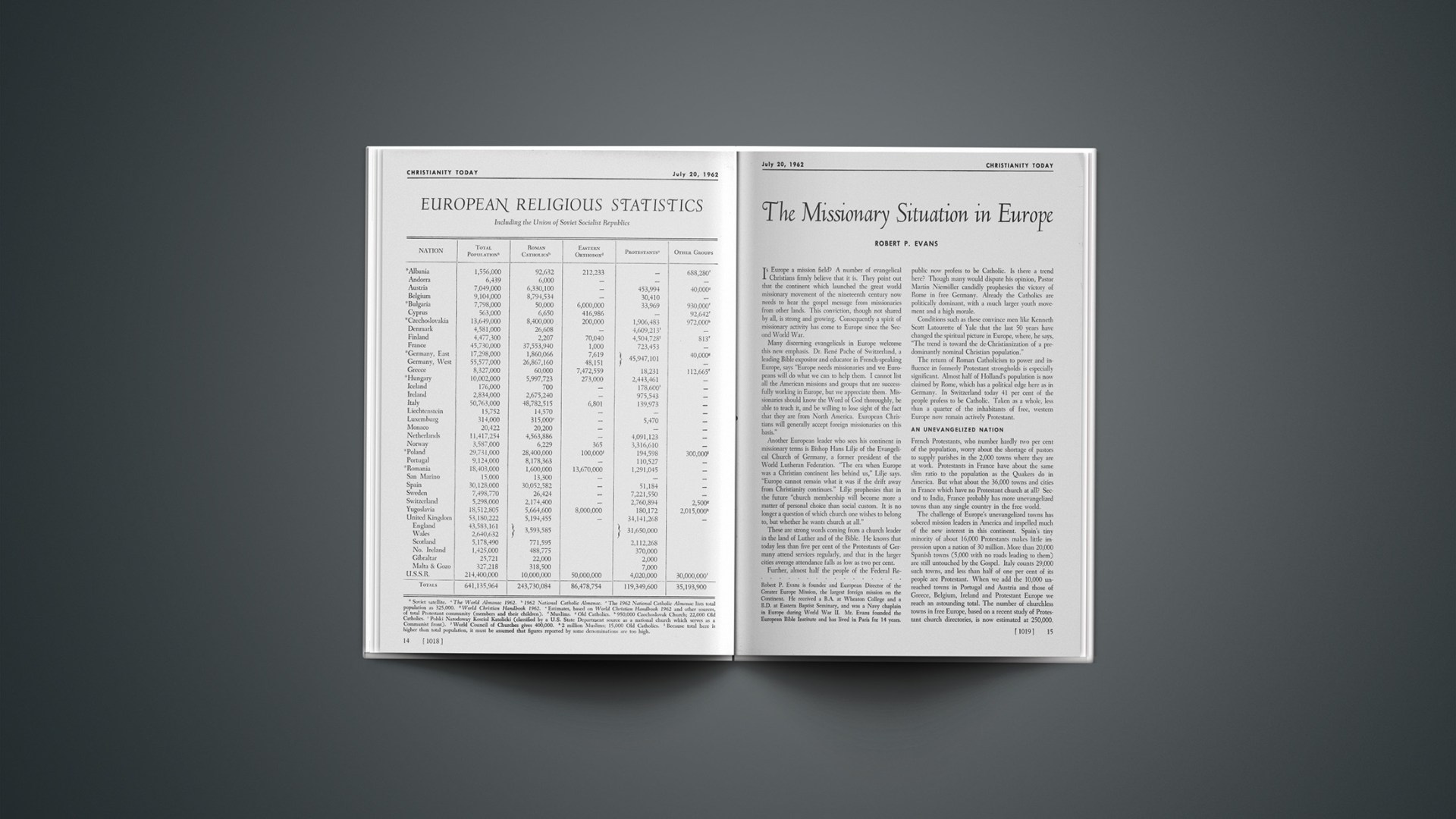
European Religious Statistics

Including the Union of Soviet Socialist Republics

Greece and Eastern Orthodoxy

The past 50 years represent a most important period for Greece. Four wars, the absorption of 1½ million refugees by a small country of poor means, a disastrous enemy occupation and an internecine guerrilla war which followed hard on the heels of World War II, have all contributed to the great changes in the size, the population, the face, and the soul of the country. Signs of these changes are easily seen in the religious outlook of the people, as well as in the new potentialities for the evangelization of the country.

The vast majority of the population belongs nominally to the Greek Orthodox Church, though church attendance, according to the official statistics, does not exceed one and one half per cent on normal Sundays. There is a small Roman Catholic minority which is strongest in the islands of the Aegean Sea—a relic of the Venetian occupation of the country—and there is an even smaller Protestant body, the oldest and largest part of which, the Greek Evangelical Church, is Presbyterian. The whole Protestant community in Greece does not exceed 30,000 out of more than eight million.

One must, however, go beyond dry statistics and try to gauge the influence of Protestant bodies on the Orthodox church. This influence can be detected, for example, in the Sunday school. This was introduced into Greece by the Evangelical church, and for many years the leaders of the Orthodox church fought hard against it. But the Evangelical church persevered, and today statistics show that 2,170 Sunday schools operate within the Greek Orthodox Church.

More important was the matter of the Bible in the vernacular tongue. In November 1901 there was bloodshed in the streets of Athens, leading eventually to the resignation of both the Government and the Archbishop of Athens. This all began when the pious Queen Olga inspired and encouraged the publication of a translation of the New Testament into modern Greek. The fact that the New Testament was originally written in Greek has always filled the leaders of the Established Church with an inordinate national pride, and they have consistently refused to permit a translation of the sacred text into the modern tongue—the only one understood by most Greeks. To mark the complete victory of this reactionary party in 1901, a copy of Queen Olga’s translation was burnt in a ceremony held, fittingly enough, in the square occupied by the ruins of the pagan Olympian Jupiter. The Greek Evangelical Church, however, convinced that the key to the evangelization of the country lay in making the Word of God accessible to the people, maintained consistent efforts to this end. And what a wonderful change has gradually and painfully emerged within the last 50 years! Today, although the constitutional law still prohibits the rendering of the original text of the New Testament into modern Greek, there are hundreds of priests, and a few bishops, of the Established Church who use all their influence to encourage the ever-increasing circulation of the Bible in the tongue of the people.

Preaching is another sphere in which one can recognize the influence of the small church in the life of the big one. For many years there was nothing but the Mass in the Greek service. Pitton de Tournefort, a Frenchman who visited Greece in the sevententh century, said that the pulpit no longer existed in the majority of the churches, not even as a piece of furniture, “for the custom of preaching had been abolished.” This sad state of things prevailed long after Tournefort’s time. It was the Evangelical church which brought the pulpit into its own, and preaching gradually infiltrated into the practice of the national church, some of whose priests now sound a positive evangelical note.

There is also the promise of still greater developments. Besides work done for many decades by the British and Foreign, and the American Bible Societies, special mention should be made of the attractive editions of single Gospels and Scripture booklets issued in large numbers by the Scripture Gift Mission of London. During the first five years of their ministry in Greece (1953–58), the Gideons placed 150,000 Bibles in hotels, prisons, and ships, and now have entrance to many hospitals and schools.

The sowing of the Word in the land which heard Paul preach has been plentiful; there are signs that the imminent harvest will be commensurately rich.

Southwestern Europe

Italy

In Italy’s population of 50 million 98 per cent are nominally Roman Catholics, but only about 25 per cent of these attend Mass. Among lower classes piety often degenerates into superstition; this is true particularly of the south, where religious festivals, pilgrimages and visits to local shrines play a large part in the lives of the peasants. In this world center of Roman Catholicism, one finds increasing agnosticism among the intelligentsia, and a higher proportion of Communists than in any other non-Soviet country in Europe.

Protestants number just over 100,000, with more than a quarter of these belonging to the Waldensian church, the only indigenous Protestant body (others have been founded by missionaries from foreign countries). This church, whose origins are traced back to Peter Waldo in the late twelfth century, has always placed a strong emphasis on biblical and evangelical teaching. It has congregations in many parts of Italy, and a theological college in Rome.

The International Fellowship of Evangelical Students, specially concerned with the country’s 21 universities, finds that students (not surprisingly in a country both ignorant and intolerant of Protestantism) are reluctant to show interest for fear of the priests. Nevertheless, small groups meet here and there for Bible study; others are reached as a result of correspondence courses and through the evangelical magazine Cerpezze, and one or two conversions are reported each year. A reading room has been opened in Rome.

J. D. DOUGLAS

Spain

Progress through persecution is the story of Spanish Protestantism during the past 50 years. The 4,000 evangelicals were greatly restricted but the coming of full religious freedom of the Republic in 1931 was not used to full advantage. Though funds were limited to further expand the work, a few new chapels were added to the already existing 166 churches. Three Bible vans went from town to village selling Scriptures and posting Gospel billboards on walls.

The Civil War years (1936–39) halted all progress and brought great losses to the churches. When General Franco closed almost all places of worship, services were held in private homes. Nevertheless, they were years of revival with many souls saved. Baptismal services were held secretly behind closed doors in the churches. The Spanish Bill of Rights issued in 1945 and Franco’s fear of United Nations repercussions brought the reopening of some 50 churches in 1946. When the Metropolitan bishops complained about this great advancement of Protestantism, some chapels were invaded and property destroyed and in a few instances physical harm done to those attending services by some fanatical Catholics. The government did try, however, to protect from further violence but, being influenced by the anti-Protestant propaganda, refused to give more permits to open new chapels and, in some cases, others were closed.

In spite of continued restrictions in not allowing schools for evangelical children, publishing of Protestant literature, and other public manifestations of the Christian faith, the number of Spanish evangelicals has quadrupled. Today’s 16,470 members of the 225 scattered churches face persecution but not without fearlessly witnessing in the pulpit, by the printed page, and through personal testimony to Spain’s 30 million inhabitants, nominally Catholic but mainly indifferent.

HAROLD J. KREGEL

[Harold J. Kregel is Executive Secretary of Literatura Evaugelica Española (Spanish Evangelical Literature fellowship), and has been a missionary in Spain since 1952 under Worldwide European Fellowship.]

Portugal

The first Protestant church in Catholic Portugal dates from 1839. Severe oppression curtailed growth until the founding of the Republic in 1910. Unfortunately, evangelicals were ill-equipped to capitalize on their new freedom before new restrictions took effect under the present regime, now 30 years old. But there has been progress. In 1935 4,000 church members met in 153 preaching places. Today active membership numbers 15,000 with attendance of 30,000 in 517 places of worship; 500 workers (part and full time), assisted by 36 missionaries, are distributed among 11 groups (Pentecostals, Brethren, Baptists and Presbyterians, being the largest in that order). The church’s needs are: greater unity, less dependence on foreign finances, more leaders spiritually and intellectually prepared.

RUSSELL P. SHEDD

[Dr. Russell P. Shedd is Professor of New Testament in the Seminário Teologico, Baptista de Leiria, Amadora, Portugal.]

The French-Speaking Areas

France

Most French people belong nominally to the Roman church, but the number of practicing Catholics is possibly not more than 15 per cent in a population of 46 million. The strong and sometimes bitter anticlerical movement, which in 1905 led to a total separation of church and state, has cooled down to a large extent, despite the Communist increase. Roman Catholicism is more enlightened in France than it is in Spain or Latin America. Apparent at present is a kind of biblical renewal, and this is coupled with a great interest in the ecumenical movement.

Protestants comprise less than two per cent of the country. The recovery of Alsace-Lorraine in 1918 meant an addition of about 300,000 to the 500,000 who could be counted before World War I. 400,000 Protestants are members of the Reformed Church, 300,000 are Lutherans, and the remaining 100,000 represent Evangelical Reformed, Free churches, Methodists, Baptists, Pentecostalists, Mennonites, Plymouth Brethren, and Salvation Army. There are, however, large areas totally devoid of evangelical ministry.

In 1938 two groups of Reformed churches (except for a minority who remained Evangelical Reformed), many Free churches, and the majority of Methodists joined and created the new Reformed Church of France, with no strictly enforced creed, so that the union displays various theological tendencies. Today there are those who would like to unite the different branches of the Protestant family in one church, but most evangelicals look with some suspicion upon this project. The things most needed today are:

1. A loyal stand for the Gospel, combined with a clear vision of the dangers of compromising with Romanism and modernism.

2. An enthusiastic proclamation of the Gospel. Although, apart from Baptists, Plymouth Brethren and Pentecostalists, no large increase in numbers is to be noted, the French public is ready to listen to the Good News of Jesus Christ, as has been seen in various evangelistic campaigns in recent years.

Fact and Faith Films are now available in France, and through this medium hundreds of people not normally accessible are being reached.

J. M. NICOLE

[Jules Marcel Nicole is currently Associate Director of the Nogent Bible Institute and Professor at the Evangelical Seminary, Aix-en-Province.]

Belgium

Astride the weld uniting Flemish and Walloon Belgians, Brussels is emerging from the struggles of two conflicting cultures as a symbol of the will to unite, and the probable capital of the European Economic Community. In a country it has dominated for centuries, the Roman church is reversing its field in the face of major losses to materialism. If Protestants could hardly hold a job or rent a house in many towns a generation ago, in 1962 a Roman Catholic weekly speaks of them as “separated brethren,” regrets the excesses of the past, and prays for their return to the fold. Evangelicals are uniting on the practical level as never before; nothing like the Hutchings campaign had been seen in Brussels since the Reformation. Participating were a few churches whose ministers 40 years ago repudiated the Gospel. Today evangelicals find ministerial gatherings warm but lacking in discernment. On four occasions recently Protestant ministers told a converted priest what a pity it was he left the Roman church. Since Protestants still do not make up half of one per cent, Belgium’s unbelieving millions rank high, as a wide open mission field.

JOHN C. WINSTON

[John C. Winston is Principal of Brussels Bible Institute and Director of Belgian Gospel Mission.]

Switzerland

With over one million inhabitants French-speaking Switzerland has a slight Protestant majority, most of which are members of the official Presbyterian Church and follow the tradition of the great reformers Calvin and Farel. There are also various other denominations, some very active. Swiss Protestantism has a great influence in all the countries where French is spoken—much greater than would be supposed from the country’s size—international church organizations in Geneva, theological literature, missionary and social action. Rapid expansion in Lausanne and Geneva attract many Roman Catholic Italian and Spanish workers employed in the erection of new buildings. But the church is alive to evangelistic opportunities: Billy Graham and Maurice Ray have led successful crusades here. Many persons lead an intense religious life, but the high living standard requires watchfulness and boldness.

BORIS DECORVET

[Boris Decorvet is a native of Switzerland and holds the B.D. in France and Switzerland (currently in Versoix).]

Germany and Her Neighbors

Germany

In Germay the centuries-old tradition of church government by secular princes survived until 1918, when the individual territorial churches adopted their own constitutions. Before this time, moves towards unity had resulted in the establishment of the Committee of the German Evangelical Churches in 1903, but a closer bond was made in May 1922 with the formation of the Federation of German Evangelical Churches, with a permanent office in Berlin. (“Evangelical” in the German context usually signifies the indigenous non-Roman churches.) The confessional status of the various constituent bodies (Lutheran, Reformed, Union) was untouched, but from this time the Federation represented all of them in common affairs, such as overseas work.

By 1933 the tendency towards unity became stronger, partly under the pressure of the so-called “German Christian” movement and the Nazi government, and this led in that year to the constitution of the German Evangelical Church. The encroachments of the Nazis on the confession of the churches soon resulted, however, in what was described as the Struggle of the Church (Kirchenkampf), in the course of which such fellowship as had been achieved was virtually destroyed.

After the German defeat in 1945 it was found necessary to begin anew, and a conference was called at Treysa, with the aim of reorganizing the whole church which was renamed the Evangelical Church in Germany (Evangelische Kirche in Deutschland=EKD). This is, strictly speaking, a federation of churches rather than a church, and has no confession of its own. It is regarded as the realization of a fellowship between the two Reformation churches (Lutheran and Reformed), not easily expressed in legal terms, but closer than the usual relationship between these two bodies in other parts of the world, and stronger because of the period of trial and persecution during World War II. Theological and ecclesiastical problems still arise, particularly in connection with such subjects as intercommunion and mutual eligibility of ministers, and though it has not solved them, the united church has learned to live with such questions.

On a broader scale EKD is a member of the loosely organized Cooperative Fellowship of Christian Churches in Germany—an organization similar to the ecumenical National Councils. Other members of this body are Baptists, Open Brethren and some Elim churches (which three groups are united in the Federation of Evangelical Free Congregations), the Evangelical Fellowship, The Methodist Church, the Old Catholic Church, the Mennonites and the Moravian Church. EKD is also a member of the World Council of Churches; its member churches belong partly to the Lutheran World Federation, partly to the Presbyterian World Alliance.

According to the census of 1950 (the latest available), in a total population in the Federal Republic of some 48½ million, just over 24½ million were members of the various Evangelical churches or other non-Roman Christian groups; 22¼ million were Roman Catholics; 94,000 professed other religions (including Jews, whose numbers dropped astronomically and tragically under the Nazi regime); and rather more than 1½ million were members of other groups or professed no religious affiliation. To these should be added the respective figures for West Berlin (population over two million): more than 1½ million Evangelical Christians; less than ¼ million Roman Catholics; 8,000 of non-Christian religions; and 327,000 others.

There are danger signs in the Federal Republic, with many reacting strongly against what they regard as an increasingly dictatorial ecclesiastical system characterized by a barren orthodoxy. In some areas the complaint is made that the younger clergy especially are “removed from life” and are failing to speak to the condition of the people, and this is having its inevitable effect. It is estimated that the number of Unitarians has increased alarmingly (to 100,000), particularly in Schleswig-Holstein, and great success is claimed also for the efforts of organized atheism.

Yet true evangelical preaching is meeting with its customary response. In 1954 a single Billy Graham meeting brought out 25,000 in Düsseldorf, 80,000 in Berlin. In 1955 similar meetings in Mannheim, Stuttgart, Nuremberg, Dortmund and Frankfurt had attendances varying from 25,000 to 60,000. In 1960 three one-week crusades in Essen, Hamburg and Berlin were attended by crowds averaging about 25,000 to 30,000 each night for the entire period. The final meeting in Berlin brought an attendance of 100,000. Bishop Otto Dibelius wrote a letter to his entire clergy urging them to participate in these meetings; Bishop Hans Lilje appeared on the platform and spoke most enthusiastically about the whole venture.

In all of these efforts the original invitation to the Graham team came from relatively small evangelical groups, but with growing support from the broader church in Germany. For a return visit in 1963, the Evangelical Alliance is again extending the invitation; this time, however, with the cooperation of the German Conference of Bishops and other church leaders. Meetings will be held for one week each in Stuttgart and Nuremberg, with a two-day visit to Berlin. It is expected that by that time German-language versions of “The Heart is a Rebel” and “Africa on the Bridge” will be available. Dr. Graham has said that he finds the response to the preaching of the Gospel in Germany greater than that in almost any other place in the world.

J. D. DOUGLAS

[Some of the background material for the essay on Germany has been used by permission from Dr. Heinz Burnotte, author of the book Die Evangelische Kirche in Deutschland.]

Austria

In 1952 the Lutheran and Reformed Church of Austria still included those parts of the former monarchy which since 1918 belong to Poland, Romania, Czechoslovakia, Yugoslavia and Italy. In 1945 some of them became part of Russia. 169,208 of the 588,686 church members were geographically within the present Austria. 28 congregations with 37,000 members were added in 1921 when German-speaking Burgenland became part of Austria.

Resistance against political Catholicism and the Catholic marriage laws caused many conversions. By 1938 the number of members had increased to 342,308.

Between 1938 and 1945 41,000 left the church under Nazi pressure. This cleansed and purified the church. After 1945 political ambitions of the church yielded first place to a stronger faith in Christ in Protestant terms. 55,000 refugees from southeastern Europe increased the number of members. 65,000 other people had joined by 1961, while 30,000 dropped out. Today the Protestant Church has 420,000 members, 405,000 of which are Lutherans organized in 160 congregations and six superintendencies, while 15,000 in eight congregations belong to the Reformed Church. 230 ministers and 400 religion teachers serve the 800 preaching stations and 4,500 places of religious instruction. Since 1947 the growing church had to build 78 churches and 56 church centers. The theological department of the University of Vienna and two special schools train the ministers and female church workers. The church administers hospitals; homes for children, youth and old people; nursing and convalescent homes; two university extentions; an academy; a teacher’s college; and three schools.

In 1949 the Church got a new constitution which in 1961 was supplemented by the state “law on the external legal status of the Protestant Church” which grants complete autonomy regarding jurisdiction, direction and management as well as an equal status with the other officially approved churches.

D. GERHARD MAY

[Bishop May is the Bishop of the Evangelical Church Augsburgian Confession (Lutheran Church) in Austria, and President of the Evangelical Executive Church Council Augsburgian and Helvetic Confession in Austria. He has served in this position since September 1944. He is a graduate of Vienna, Halle, and Basel Universities and holds the Th.D. from Heidelberg.]

Netherlands

In 1959 a test census covering 10,000 families out of the country’s total population of some 11 ½ million gave what is considered a reasonably accurate indication of religious affiliation. The statistics showed the Roman Catholic Church with 40 per cent; Dutch Reformed 29 per cent; Free Reformed 9 per cent; other groups 4 per cent; and those with no religious tie 18 per cent.

Still seen among Protestants is the influence of men like Groen van Prinsterer and Abraham Kuyper who were associated last century with the old Calvinist traditions: notably those concerning spiritual theocracy, devotion, emphasis on church order, and confessional loyalty. Thus in the Netherlands the Revival movement was directed along ecclesiastical lines. An opportunity was given to the laity to make their contribution to the spread of the Gospel in Christian organizations within such fields as education, workmen’s unions, newspapers, charitable bodies, academic circles, and (latterly) broadcasting and television.

Since 1940 the Dutch Reformed Church (Nederlandse Hervormde Kerk) has known a significant recovery. Before that time it was primarily an administrative union which gave responsibility for preaching the Word to local congregations. During and after World War II the church, under the influence of Karl Barth and of those elements in the Reformed tradition not associated with Kuyper and his colleagues, revealed itself as a Christ-confession, assuming responsibility for preaching and pastoral care of the people, in obedience to Holy Scripture and in close connection with the historic creeds of the Reformed Church.

In Dutch Christianity generally the following tendencies are at present noticeable: A desire for ecumenicity; a new emphasis on the understanding of the Bible (in 1952 there was a new Protestant Bible translation; in 1961 a new Roman Catholic translation); in theology an attempt to keep the best elements of the dogmatic tradition in a continuing confrontation with responsible exegesis; a liturgical movement which will serve the exercise of devotion. Over all there is a tendency for Christianity to become dogmatic, certainly less rationalistic, and more biblical and personal, and often service-and missionary-minded. Together with all this there is apparent a greater receptivity for that which is experimental.

Smaller churches which are not indigenous have had relatively little influence in the Netherlands; similarly with sects such as Jehovah’s Witnesses and Mormons. One poignant reminder of recent history concerns the number of Jews: 106,409 in 1909, but only 14,346 in 1947. One possible reason for the comparatively small inroads made by “international” churches in the country is that they are not easily oriented into the general pattern of Dutch Protestant Christianity, in which there is always a seeking for harmony between ecclesiastical institutionalism and spiritual power.

R. SCHIPPERS

[R. Schippers is Professor of New Testament in the Free Reformed University of Amsterdam, which awarded him the D.Th. degree in 1938.]

Switzerland

That the German-speaking section of Switzerland could produce the two most influential theologians of their generation is evidence of a vitality in the churches. However, the theology of Karl Barth of the University of Basel, and Emil Brunner of the University of Zürich, has not yet led to a revival of Christian devotion among the people. Church membership for many Protestants means little more than the payment of taxes to support the Reformed Church of their canton. There is little opposition to the church, and it plays an important role in the life of the nation; the problem is lack of widespread personal concern about Christianity, a problem which is inherent in the Volkskirche (people’s church) today.

Some 2,857,600 of Switzerland’s 5,429,100 inhabitants are Protestants. As the Italian-speaking section of the country is almost wholly Roman Catholic, Protestant strength lies in the other areas, though some sections of these also are largely Roman Catholic. In the most populous Swiss canton, Zürich (927,000), 65 per cent are Protestants and 32.4 per cent Catholics. But only 2.6 per cent were Catholics in 1850, 21.7 per cent in 1930, 24.9 per cent in 1950. Part of this growth is attributable to the influx of Italian workmen, but among the Swiss themselves the Catholic proportion has increased from 22.2 per cent in 1950 to 25.8 per cent in 1960. In the Protestant cantons of Switzerland, as indeed in other Protestant countries, Catholicism is gaining strength fast.

Each canton is free to regulate its own religious affairs, except that the federal constitution guarantees religious freedom. In some cantons the Reformed Church receives state support; in others the Catholic Church is the official one; and in still others both are supported financially by the government, or neither is. Free churches are gaining respect, but their membership is small. Baptists, for example, have gained less than 400 new members in 40 years, and now number about 1,500. Methodists and some others are larger. The Reformed Church of Zürich reports that for several years its greatest losses have been to the New Apostolic Church which claims a reestablishment of the apostleship in preparation for the end of time.

Protestantism has contributed much to the character of the Swiss people and the culture of the nation. Through Zwingli, the Anabaptists and other leaders of the past and present, Switzerland has had an influence far out of proportion to its size. Still vigorous but losing ground, Swiss Protestantism faces the challenge of making the Gospel relevant to more than a small minority of the population.

J. D. HUGHEY

[J. D. Hughey is President of the (international) Baptist Theological Seminary of Rüschlikon, Switzerland. He has been a member of the faculty since 1952 and teaches church history. He holds the A.B. degree from Furman University, Th.M. from Southern Baptist Theological Seminary, and M.A. and Ph.D. degrees from Columbia University.]

The Crisis On The Continent

A CRITICAL SITUATION—We see European civilization breaking up into anarchy before our eyes, because the economic, social, and political forces have developed freely without regard for one another. The traditional values of civilization are no longer moulding civilization today; they are no longer taken into account. There is, therefore, a serious lack of balance, and we have reached a definite crisis.—JACQUES ELLUL, professor in the faculty of law, Bordeaux, from the report of the First Assembly of the World Council of Churches.

UPHEAVAL IN HISTORY-Conventional notions of private and public morality have been steadily atrophied in the last ten or fifteen years by the exposure of treason in government, corruption in labor and business, scandals among the mighty.… Orthodox religion’s conception of good and evil seem increasingly inadequate to explain a world of science fiction turned fact, past enemies turned bosom friends, and honorable diplomacy turned brink of war.—J. C. HOLMES, “The Philosophy of the Beat Generation,” Esquire Magazine.

THE TURN IN FRANCE—What is truly new today is that there is a new religion. In a few words, it is the general feeling that no one is really healthy without a fully developed sex life.—Time, quoting from France’s Esprit.

UNCONCERN IN SWITZERLAND—Everywhere too one saw the church existing, but saw no evidence of its existing significantly. Symptoms were most unmistakable in southern Italy, where crime, immorality and human degradation swarmed horribly around a church which seemed blind alike to their presence and their tragic implications. But it was in Switzerland that a loyal churchwoman responded to my disturbance about an instance of abject but removable poverty with an assurance which only increased my perturbation: “You should not feel that way about it. It is not sad at all! These people are not being deprived of what they need. They do not go hungry. They steal.”—Dr. ROY PEARSON, Dean of Andover Newton Theological School, in a report to The Christian Century (June 14, 1961).

DECLINE IN ENGLAND—Prosperity and righteousness do not go hand in hand. As material standards climb ever higher, moral standards are on the decline. Crimes of violence are on the increase; juvenile delinquency, the break up of home life, mental sickness all plague the community and present bewildering problems to the State.… There is no reason to believe that this decline is likely to be halted, unless disaster overtakes us, or revival rescues us.—TALBOT MOHAN, “The Situation in England Today” from The Churchman.

MORAL NEEDS IN SPAIN—There remains a grave need for human and moral reforms. Human relationships are often still poor. Often the economically weak resent a lack of understanding, of human cooperation, of confidence, of interest in family and factory relationships, more than they resent a low wage. Many can—and willingly do—reject any salary, high or low, to show their resentment against incorrect treatment.—Commerce Minister of Spain Ullastres, discussing the miner’s strike at Barcellona, New York Times Magazine (July 1).

SOVIET PRESSURE—The largest Baptist Church in Riga, known as the Hagensburg Church, has been converted by the Soviet Russians into a TV studio and production center.… Already in 1940 when Latvia was annexed by the Soviets this Baptist congregation was compelled to cede the building to the State; but they were permitted to use it until 1961. Only three of the eight Baptist churches in Riga remain open for divine worship, the Alliance says. When the Russians in 1940 occupied Latvia there were 104 Baptist churches with a total membership of 11,000. Although many churches in the meantime have been forced to close, the membership of the Baptist churches during the last years, despite persecution and repression from the Communists, has increased.—The Gospel Call.

addApple PodcastsDown ArrowDown ArrowDown Arrowarrow_left_altLeft ArrowLeft ArrowRight ArrowRight ArrowRight Arrowarrow_up_altUp ArrowUp ArrowAvailable at Amazoncaret-downCloseCloseellipseEmailEmailExpandExpandExternalExternalFacebookfacebook-squarefolderGiftGiftGooglegoogleGoogle KeephamburgerInstagraminstagram-squareLinkLinklinkedin-squareListenListenListenChristianity TodayCT Creative Studio Logologo_orgMegaphoneMenuMenupausePinterestPlayPlayPocketPodcastprintremoveRSSRSSSaveSavesaveSearchSearchsearchSpotifyStitcherTelegramTable of ContentsTable of Contentstwitter-squareWhatsAppXYouTubeYouTube