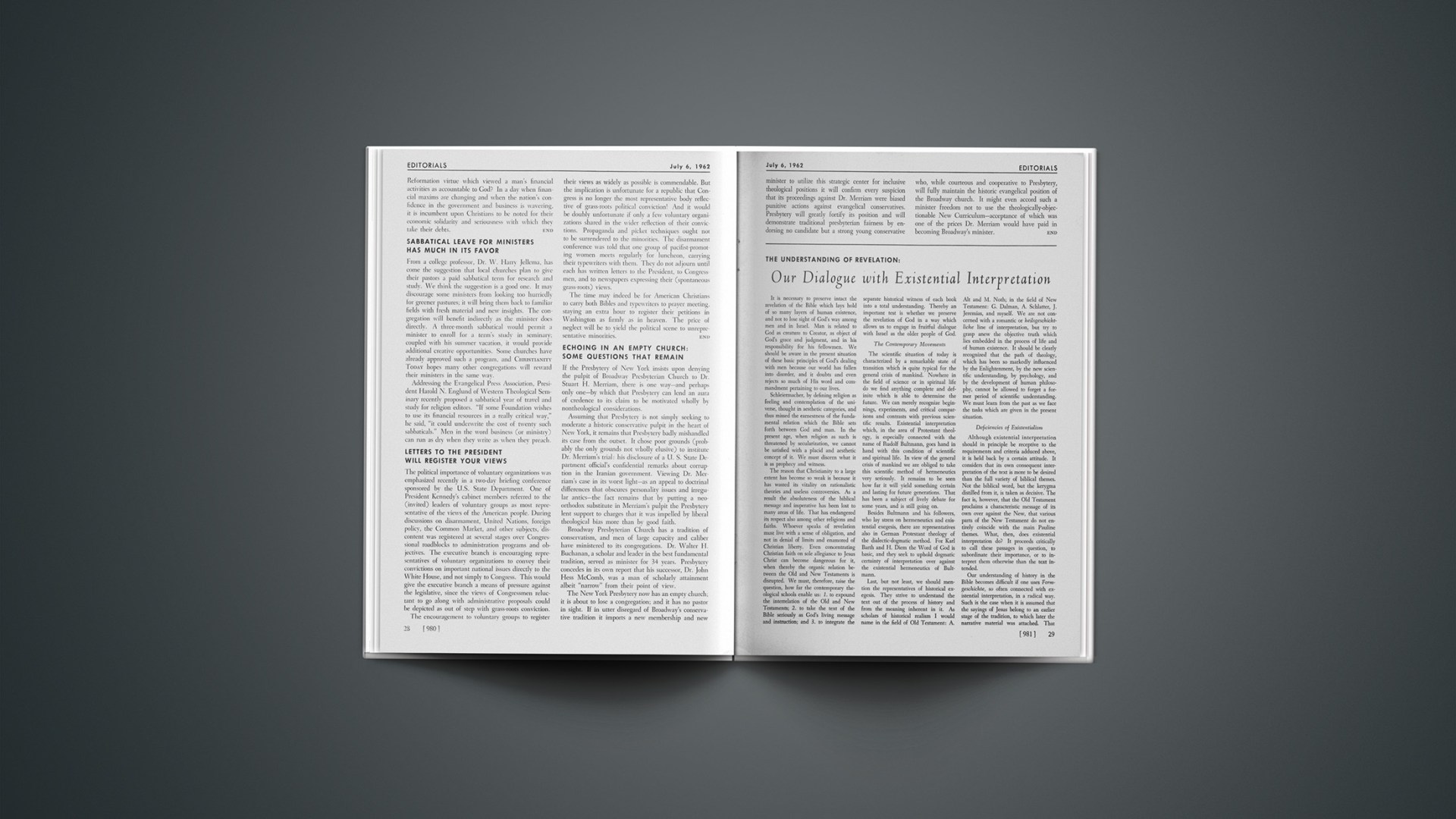
The Understanding of Revelation: Our Dialogue with Existential Interpretation

It is necessary to preserve intact the revelation of the Bible which lays hold of so many layers of human existence, and not to lose sight of God’s way among men and in Israel. Man is related to God as creature to Creator, as object of God’s grace and judgment, and in his responsibility for his fellowmen. We should be aware in the present situation of these basic principles of God’s dealing with men because our world has fallen into disorder, and it doubts and even rejects so much of His word and commandment pertaining to our lives.

Schleiermacher, by defining religion as feeling and contemplation of the universe, thought in aesthetic categories, and thus missed the earnestness of the fundamental relation which the Bible sets forth between God and man. In the present age, when religion as such is threatened by secularization, we cannot be satisfied with a placid and aesthetic concept of it. We must discern what it is as prophecy and witness.

The reason that Christianity to a large extent has become so weak is because it has wasted its vitality on rationalistic theories and useless controversies. As a result the absoluteness of the biblical message and imperative has been lost to many areas of life. That has endangered its respect also among other religions and faiths. Whoever speaks of revelation must live with a sense of obligation, and not in denial of limits and enamored of Christian liberty. Even concentrating Christian faith on sole allegiance to Jesus Christ can become dangerous for it, when thereby the organic relation between the Old and New Testaments is disrupted. We must, therefore, raise the question, how far the contemporary theological schools enable us: 1. to expound the interrelation of the Old and New Testaments; 2. to take the text of the Bible seriously as God’s living message and instruction; and 3. to integrate the separate historical witness of each book into a total understanding. Thereby an important test is whether we preserve the revelation of God in a way which allows us to engage in fruitful dialogue with Israel as the older people of God.

The Contemporary Movements

The scientific situation of today is characterized by a remarkable state of transition which is quite typical for the general crisis of mankind. Nowhere in the field of science or in spiritual life do we find anything complete and definite which is able to determine the future. We can merely recognize beginnings, experiments, and critical comparisons and contrasts with previous scientific results. Existential interpretation which, in the area of Protestant theology, is especially connected with the name of Rudolf Bultmann, goes hand in hand with this condition of scientific and spiritual life. In view of the general crisis of mankind we are obliged to take this scientific method of hermeneutics very seriously. It remains to be seen how far it will yield something certain and lasting for future generations. That has been a subject of lively debate for some years, and is still going on.

Besides Bultmann and his followers, who lay stress on hermeneutics and existential exegesis, there are representatives also in German Protestant theology of the dialectic-dogmatic method. For Karl Barth and H. Diem the Word of God is basic, and they seek to uphold dogmatic certainty of interpretation over against the existential hermeneutics of Bultmann.

Last, but not least, we should mention the representatives of historical exegesis. They strive to understand the text out of the process of history and from the meaning inherent in it. As scholars of historical realism I would name in the field of Old Testament: A. Alt and M. Noth; in the field of New Testament: G. Dalman, A. Schlatter, J. Jeremias, and myself. We are not concerned with a romantic or heilsgeschichtliche line of interpretation, but try to grasp anew the objective truth which lies embedded in the process of life and of human existence. It should be clearly recognized that the path of theology, which has been so markedly influenced by the Enlightenment, by the new scientific understanding, by psychology, and by the development of human philosophy, cannot be allowed to forget a former period of scientific understanding. We must learn from the past as we face the tasks which are given in the present situation.

Deficiencies of Existentialism

Although existential interpretation should in principle be receptive to the requirements and criteria adduced above, it is held back by a certain attitude. It considers that its own consequent interpretation of the text is more to be desired than the full variety of biblical themes. Not the biblical word, but the kerygma distilled from it, is taken as decisive. The fact is, however, that the Old Testament proclaims a characteristic message of its own over against the New, that various parts of the New Testament do not entirely coincide with the main Pauline themes. What, then, does existential interpretation do? It proceeds critically to call these passages in question, to subordinate their importance, or to interpret them otherwise than the text intended.

Our understanding of history in the Bible becomes difficult if one uses Formgeschichte, so often connected with existential interpretation, in a radical way. Such is the case when it is assumed that the sayings of Jesus belong to an earlier stage of the tradition, to which later the narrative material was attached. That leads to a skeptical attitude toward the life of Jesus. Must we, however, give up a realistic picture of Jesus for the sake of the kerygma? If the historical elements, which the Evangelists used, prove to be unreliable, then the message to be proclaimed, the kerygma, would lose its power. The primitive Christian proclamation did more than offer us the grace of God and summon us to a new understanding of ourselves. It showed how the grace of God, offered through Jesus, was accepted, exhibited, and fulfilled in his life. The truth which he lived out was decisive for the offer and summons of the kerygma. There came into being a definite history which was integral to revelation, and cannot be detached from it. This history could pass through stages, be interrupted and concealed, undergo transformation and renewal, but it retained the character of valid and final truth. All the biblical traditions are directed toward the future goal of God. Their history partakes so essentially of it, that none of them can give it up. To be sure the present ever requires decision, but a decision always with reference to the future which includes and transcends it. As biblical history went on, it issued in traditions which became normative for subsequent times, even though subject to continual question and opposition. But they made their way despite invidious effort from within and without to discredit and to invalidate them. Man was never capable of grasping and holding the mystery of God. The entrance of God’s revelation into history always met with forces which sought to suppress it. From that we know that we must ever hear again and understand anew the history of God’s revelation, and upon the basis of our study and understanding be ready at any time to make a fresh start. But we do not thereby put an end to the past. Its traditions help us to distinguish more clearly between truth and error, light and darkness.

Since each biblical tradition converges upon an ultimate goal, we should hesitate to set one over against another, as the Synoptic against the Johannine, or the Jerusalemic against the Hellenistic. Each performs its service as a strand of history mingling with others to reach a single end. It should not be unraveled and exposed to each person’s existential judgment. The radical existential criticism in Germany today, which puts Paul in opposition to James and to Luke, is in the last analysis unhistorical; for it disguises the inner logic of history whose character as revelation is given us in the Old Testament, and is an important heritage of the Christian faith.

Our present crisis in exegesis recalls the controversy of Apostolic preaching with Gnosis. The Gnostics interpreted the message of the Gospel in the light of the hic et nunc, adapted it to the existence of the believer, to his intention and feelings. That thrust out of the picture the historical setting of the Gospel, the objective continuity of revelation in history, and displaced it with anthropological criteria.

So also existential interpretation discounts the understanding of revelation in history which the Old Testament, itself bound up with that history, began to disclose. It disputes the Messianic self-consciousness of Jesus which linked his life with the hope of Israel. It slights the apocalyptic heritage received from Jewish tradition. All that produces a shrinkage in the substance of the kerygma which cannot be made good by recasting it in the mold of existentialism.

The Inroads of Philosophy

Existential interpretation is drawn from Formgeschichte, from the philosophy of Heidegger, and from the theology of the Reformation. The combination of these various elements lends considerable strength to its method, but therein lies also its weakness. What happens if this combination breaks up? The weakest element within it is that of philosophy. In field of faith and theology it is the element least able to bear its weight. While it offers considerations and reflections which are akin to the Christian faith, they must not be confused with it. The concern of Christian faith is to take God seriously, and to conform experience to his Word, not to interpret philosophically the essence of human existence. It is at this point that Bultmann is the most vulnerable. Existential philosophy imbues the believer with a new sense of self-understanding, whereas the believer should recognize the necessity to be cautious and to admit fallibility of judgment. In the midst of the dangers of history the believer must look beyond himself into a future that is more than his present. In his existence before God the believer can only draw partial conclusions as to the true nature of man from the Bible. It is not likely that at the beginning the kerygma had an anthropology. Certainly the chief aim of theology should not be to develop one, so that it can argue anthropologically.

The theology of the Reformation recovered and interpreted anew the truth of the Bible. It did not make place of itself for radical biblical criticism, of the kind that broke out later in the period of the Enlightenment. When we persist in the same sort of criticism, old struggles within the Christian church are kept alive. Basically the question is whether the faith of which E. Fuchs, G. Ebeling, and others speak today comes from the Bible, or rather from a philosophical position which feels itself constrained to establish a connection with the Bible. Further, can the program of “demythologizing,” which may be meaningful as a philosophical method to obtain theoretical understanding, be carried out in the field of religion? What is most important is not to make faith intelligible to our way of thinking, to our philosophical ideas, but rather to let the process of revelation in history speak for itself. The philosophical approach to faith has given rise to a “religion of the intellectual,” far remote from the faith of ordinary members of the church. For years there has been open, sometimes concealed, controversy between them. The “intellectual” side, with its group of theologians, contends that theology requires a new language for the modern mind, and to this end submits the categories of existential thinking. But these ideas meet with resistance on the part of biblical data and concepts which simply do not fit in with them. Here is objective ground which refuses to give way to varied forms of attack, and sets a limit to the introduction of existential categories. For this reason it has not been possible to break down resistance within the Christian church.

Still it is significant that all the problems concerning the “historical Jesus” have become acute again, although one was inclined to suppose from the side of neoorthodoxy that the case was closed. There is good reason, therefore, to keep before us the basic biblical position of A. Schlatter and M. Kähler, coupled with steadfastness, faithfulness, and patience, those primary attributes which go along with biblical faith. We are not thereby acting out of longing for human security, or with lack of courage to face the modern age. We know the way ahead is full of peril. That is a necessary consequence of decisions which have shaped our world in recent years. But we did not get our faith from subjective experience or hermeneutics. It is grounded on the all-embracing, objective order of creation, history, and church.

OTTO MICHEL

Director

Institute of Judaic Studies

University of Tübingen

Ideas

Between Midnight and Four

T. S. Eliot talks of the “twisted things” that come to life on city streets between midnight and four. Bent upon what Reinhold Niebuhr calls “mutable goods,” these “twisted things” use twisted means to fulfill fleeting, sensual, and twisted desires.

Long ago God promised to “make … crooked things straight” (Isa. 42:16). And it was John the Baptizer who recognized that “the crooked shall be made straight” (Luke 3:5) through Christ. By his saying grace Jesus Christ can straighten the souls of “twisted things” that haunt the streets and dark alleys. By his refining Spirit he can also straighten the twisting forces that curl and squiggle into the church. Through the Saviourhood and Lordship of Christ “whosoever will” may grow more and more into the fullness of the measure of the stature of the Son of God.

City streets and late hours have no monopoly on twistedness. It lurks in the pews of churches. Indeed, it visits in pulpits. To be sure, its pew and pulpit demeanor may seem relatively proper. But twistedness is there nonetheless.

When people shake hands with the pastor at the door, for example, is it not twistedness that custom dictates only complimentary comments about his sermon? All week long people live in a world of feigned friendship and back-slapping opportunism. All week long people hear from Washington and London and Moscow, from Wall Street and Main Street, from Hollywood. On Sunday they hope to hear from heaven. They want to discover God’s pertinent word for their hopes, their fears, and their sins. They require something prophetic and apostolic and piercing. If the pastor’s telephones, his car, his organizations, even his tongue, have pre-empted his energies all week long, he may not be able to provide that kind of word. Shall the people simply continue in their hunger, and for politeness’ sake never reveal their spiritual yearnings to their minister? More than this, are they expected to twist the inadequacies of their preaching diet into something praiseworthy? Does the pulpit abet this twisting of honest reaction by not providing people with some avenue of expression, such as a suggestion or comment box?

What about the active even turbulent spirit in which the Church was born and grew? Is it so well suppressed and twisted now that in places the Church appears lethargic compared to other organizations? If someone feels himself God’s lay Luther to stir up the situation, more often than not he is warned to quit rocking the boat. Actually, a good upset is sometimes necessary and refreshing. The same sleepy pew-warmers who insist on an uneventful church atmosphere would never tolerate such a hanger-on and do-nothing spirit in their everyday business affairs. The fact that the Church does not founder and fail more often at human hands attests that its ultimate being, like its Lord, is surely divine.

Twistedness plagues church members in other ways also. Sometimes men on the job have been ruled more by the late Dale Carnegie than by Christ. Or their idea of ultimate security is a fall-out shelter. Or even a snowfall—for all its beauty and spiritual reminders of God—they impatiently disparage as an irksome hindrance to driving speed.

Or take twistedness in the pulpit. The man of God is called to proclaim high and holy things; he himself is to soar and to lift his people into the heavenlies. It belongs to his calling to handle, to be awed by, grace and glory and God. But alas! too often he handles but the earthly things of the material world. What he cannot touch he considers too remote. What he cannot weigh and analyze has too little practical merit. Trivial and clever talk excites him. Gadgets and gimmicks are his favorite concern. How conversant he is about cars and other material things! He exchanges jokes with aplomb and spirit and perhaps even toys with introducing jazz into the worship services. Sometimes he itches to be a rancher instead of just a shepherd. So he keeps one eye on the public press and the other on the Recording Angel. He may broadcast an anti-Communism crusade and here and there tuck in the Gospel where it’s convenient. Such twistedness violates matters of grace and glory, of God’s kingdom and righteousness, of the world to come. There is twistedness in the pulpit when its major concerns are but those of a materialistic, unregenerate world.

Outside the church there is twistedness, too, of course. What about the crooked guardians of the law in Denver and Chicago? What about a metropolis whose corruption may have tipped a presidential election?

Someone has noted that the illusory symbols of modern hope—the Nazi swastika, for example—are twisted crosses. They are man-made images in which the bent and warped character of modern life still shines through. These contemporary symbols—Marx’s hammer and sickle among them—are banners of desperation raised between midnight and four. They are to be judged by the tree of life, a tree of God’s planting whereon a Saviour died. In the daytime turned to darkness between high noon and three he illumined with enduring the twisted things in which a fallen race sinks its spirit in its “midnight to four” struggle for meaning and survival.

Vatican Rejects Protestant View Of Church Unity

A Vatican announcement that its concept of Christian unity views the Roman Catholic Church as “the paternal house” to which all “dissident Christian communities” must return disappoints more observers than it surprises.

Nobody expected Pope John XXIII to cast his vote for Franklin Clark Fry, Eugene Carson Blake, or Bishop James A. Pike in settling the shape of a new era of world Christian amicability. In approaching the Roman Catholic ecumenical council which opens October 11, the Vatican quite properly deplored the current ecumenical tendency to view no presently existing church as “the one true church of Christ” and to work toward a “completely new” church resulting from the union of presently existing groups.

CHRISTIANITY TODAY has said that the effort to overcome the ailments of existing denominations by a process of merger into a giant church need not be viewed as the divine ideal. In fact, merger momentum may simply substitute “ecclesiastical elephantiasis” for Protestant fragmentation, and the leprous-like condition would be no improvement.

But if contemporary Protestant ecumenism unsatisfactorily dilutes the church taken as a body of regenerate believers, the Roman error is fully as perversed, for it compromises the headship of Christ over the church. The lordship of Christ is virtually suppressed in the dogma of papal infallibility and deference to the Pope as his earthly vicegerent. Between “ecclesiastical elephantiasis” and “ecclesiastical encephalitis” the pickings often seem slim for those who search the Scriptures for insights into the nature of the redeemed body that Christ heads. Hence reiteration that only the return of “separated brothers” to the Roman Catholic hierarchy promises an acceptable ecumenical development is frustrating.

Sunday Union Meetings Pose Dilemma For Protestant Workers

The increasing tendency of labor unions to schedule meetings for Sunday morning and to fine those members who place church attendance above union meetings for failure to attend has created a new and significant dilemma for Protestant churchgoers. The fines are frequently high, and many cannot afford to pay them.

The minister often feels unjustified in requesting loyalty to the church when job security may be at stake. It must be noted, however, that the individual’s loyalty in this situation is not to be judged only in respect to the local church but to God the Father who enjoined believers not to forsake the assembling of themselves together.

Our God is a loving God. He does not forsake his children, and he honors our small attempts at obeying him. But Christians have always suffered persecution; and they may suffer more in the years ahead. Yet in joy or in sorrow, in plenty or in want, we serve a God who has promises to supply all our needs according to his riches in glory by Christ Jesus.

Graham Crusade Demonstrates Link Of Evangelism And Ecumenism

Those who make ecumenism the mission of the Church in our time need to take a lesson from the remarkable crusade just concluded by Billy Graham in Chicago. Even leaders of the city’s church federation, which withheld its official support of the campaign, acknowledged that Christians of all denominations who lost themselves in the task of cooperative evangelism gave a display of spirited ecumenical cooperation.

“I was impressed with the ecumenical character of the witness,” said Dr. Edgar H. S. Chandler, executive vice-president of the federation, “in the sense that the evangelist was dealing with the central truths of the faith.”

The way to biblical ecumenism, in fact, is through biblical mission anchored to biblical theology and ethics.

Living Within One’S Means Rejected In Current Fiscal Theory

In recent weeks significant speeches by government officials have given added impetus to the mistaken but increasingly popular notion that living beyond one’s means is virtuous. Living within one’s budget is now regarded as old fashioned, a reversion to outdated labels in an age demanding fresh, dynamic economics.

Purchasing on credit is, of course, essential to a free enterprise economy, in which mass production depends for its market on the increased purchasing power which credit buying supplies. But credit may be abused. It may be abused by pledging away the future in order to gain unnecessary comforts for the present. And it is most abused when, under the captions of “offsetting inflation” and “demonstrating our confidence in the economy,” one is encouraged in the notion that failing to meet his yearly expenses may even be a virtue.

Such an attitude cannot avoid perverting the sense of individual responsibility. What has become of the Reformation virtue which viewed a man’s financial activities as accountable to God? In a day when financial maxims are changing and when the nation’s confidence in the government and business is wavering, it is incumbent upon Christians to be noted for their economic solidarity and seriousness with which they take their debts.

Sabbatical Leave For Ministers Has Much In Its Favor

From a college professor, Dr. W. Harry Jellema, has come the suggestion that local churches plan to give their pastors a paid sabbatical term for research and study. We think the suggestion is a good one. It may discourage some ministers from looking too hurriedly for greener pastures; it will bring them back to familiar fields with fresh material and new insights. The congregation will benefit indirectly as the minister does directly. A three-month sabbatical would permit a minister to enroll for a term’s study in seminary; coupled with his summer vacation, it would provide additional creative opportunities. Some churches have already approved such a program, and CHRISTIANITY TODAY hopes many other congregations will reward their ministers in the same way.

Addressing the Evangelical Press Association, President Harold N. Englund of Western Theological Seminary recently proposed a sabbatical year of travel and study for religion editors. “If some Foundation wishes to use its financial resources in a really critical way,” he said, “it could underwrite the cost of twenty such sabbaticals.” Men in the word business (or ministry) can run as dry when they write as when they preach.

Letters To The President Will Register Your Views

The political importance of voluntary organizations was emphasized recently in a two-day briefing conference sponsored by the U.S. State Department. One of President Kennedy’s cabinet members referred to the (invited) leaders of voluntary groups as most representative of the views of the American people. During discussions on disarmament, United Nations, foreign policy, the Common Market, and other subjects, discontent was registered at several stages over Congressional roadblocks to administration programs and objectives. The executive branch is encouraging representatives of voluntary organizations to convey their convictions on important national issues directly to the White House, and not simply to Congress. This would give the executive branch a means of pressure against the legislative, since the views of Congressmen reluctant to go along with administrative proposals could be depicted as out of step with grass-roots conviction.

The encouragement to voluntary groups to register their views as widely as possible is commendable. But the implication is unfortunate for a republic that Congress is no longer the most representative body reflective of grass-roots political conviction! And it would be doubly unfortunate if only a few voluntary organizations shared in the wider reflection of their convictions. Propaganda and picket techniques ought not to be surrendered to the minorities. The disarmament conference was told that one group of pacifist-promoting women meets regularly for luncheon, carrying their typewriters with them. They do not adjourn until each has written letters to the President, to Congressmen, and to newspapers expressing their (spontaneous grass-roots) views.

The time may indeed be for American Christians to carry both Bibles and typewriters to prayer meeting, staying an extra hour to register their petitions in Washington as firmly as in heaven. The price of neglect will be to yield the political scene to unrepresentative minorities.

Echoing In An Empty Church: Some Questions That Remain

If the Presbytery of New York insists upon denying the pulpit of Broadway Presbyterian Church to Dr. Stuart H. Merriam, there is one way—and perhaps only one—by which that Presbytery can lend an aura of credence to its claim to be motivated wholly by nontheological considerations.

Assuming that Presbytery is not simply seeking to moderate a historic conservative pulpit in the heart of New York, it remains that Presbytery badly mishandled its case from the outset. It chose poor grounds (probably the only grounds not wholly elusive) to institute Dr. Merriam’s trial: his disclosure of a U. S. State Department official’s confidential remarks about corruption in the Iranian government. Viewing Dr. Merriam’s case in its worst light—as an appeal to doctrinal differences that obscures personality issues and irregular antics—the fact remains that by putting a neoorthodox substitute in Merriam’s pulpit the Presbytery lent support to charges that it was impelled by liberal theological bias more than by good faith.

Broadway Presbyterian Church has a tradition of conservatism, and men of large capacity and caliber have ministered to its congregations. Dr. Walter H. Buchanan, a scholar and leader in the best fundamental tradition, served as minister for 34 years. Presbytery concedes in its own report that his successor, Dr. John Hess McComb, was a man of scholarly attainment albeit “narrow” from their point of view.

The New York Presbytery now has an empty church; it is about to lose a congregation; and it has no pastor in sight. If in utter disregard of Broadway’s conservative tradition it imports a new membership and new minister to utilize this strategic center for inclusive theological positions it will confirm every suspicion that its proceedings against Dr. Merriam were biased punitive actions against evangelical conservatives. Presbytery will greatly fortify its position and will demonstrate traditional presbyterian fairness by endorsing no candidate but a strong young conservative who, while courteous and cooperative to Presbytery, will fully maintain the historic evangelical position of the Broadway church. It might even accord such a minister freedom not to use the theologically-objectionable New Curriculum—acceptance of which was one of the prices Dr. Merriam would have paid in becoming Broadway’s minister.

38: Baptism and the Lord’s Supper

Two ritual observances, baptism and the Lord’s Supper, are maintained by members of the Church of Christ irrespective of their denomination or of their personal spiritual maturity. Whether these observances are regarded as possessing only symbolic value, or whether they are sacraments which confer spiritual grace directly, they are central to the worship of all groups. In them the heart of Christian doctrine is enacted in visible form.

Baptism. This is the rite by which a professed believer was inducted into the fellowship of the New Testament church. By submitting to immersion in water, pouring, or sprinkling, he confessed publicly his need of cleansing from sin and his faith in Christ. Peter instructed his audience on the day of Pentecost to “Repent, and be baptized … in the name of Jesus Christ for the remission of sins” (Acts 2:38), and each subsequent stage of the church’s growth was marked by baptism of the believers (Acts 8:12, 38; 9:10; 10:47, 48; 16:33; 18:8).

The concept of baptism is rooted in the Old Testament law which prescribed certain washings for the cleansing of diseased persons (Lev. 14:8). Proselytes entering Judaism were expected to strip themselves of their former clothing, submit to circumcision, and bathe themselves completely, after which they were reckoned members of the Jewish community. The rite was acknowledgment of defilement and of the acceptance of the law as a purifying agent. The baptism of John must have been founded upon current usage, for his hearers were not surprised when he proclaimed it, and the Scriptures take the significance for granted (Mark 1:4, 5). John the Baptist, however, realized that his ministry of baptism was only preparatory, for he expected the advent of another who would baptize “in the Holy Spirit” (Mark 1:8).

Jesus’ personal acceptance of John’s baptism was a public avowal of his consecration to God and of his mission to men. By taking his stand with sinners, although he was sinless, he provided a link between the symbol of repentance and the fuller significance implied in the final commission to his followers. He enjoined them to “… make disciples of all nations, baptizing them into the name of the Father and of the Son and of the Holy Spirit” (Matt. 28:19). By this command he related baptism to the total work of the Trinity in salvation, and prescribed it as the universal practice of the church.

The key passage on baptism is connected with Paul’s argument for holiness in Romans 6:4–6 (ARV): “We were buried therefore with him through baptism into death: that like as Christ was raised from the dead through the glory of the Father, so we also might walk in newness of life.”

Assuming that the Roman Christians were familiar with the ceremony, he explained it in terms of death and resurrection. Since the claims of retributive justice cannot be executed upon a dead person, the union of the Christian with Christ in His death frees him from condemnation, and through the Resurrection he shares in a new life. By the rite of baptism he enacts this experience symbolically and accepts its reality by faith, though his full realization of the truth may develop gradually.

Parallel with the baptism by water is the baptism of the Holy Spirit which insures this progressive experience of union, and which constitutes the Christian an active member of the body of Christ (1 Cor. 12:13). The same term, “baptism,” is used both of the external rite and the internal reality, as if to indicate that they are interdependent and equally necessary. The internal experience necessitates outward confession; the external confession must be supported by inward reality.

The efficacy of baptism lies in the relation of the individual to God rather than in any property of the water. The only passage in the New Testament that connects salvation directly with baptism is 1 Peter 3:20, 21 (ARV): “… wherein few, that is, eight souls, were saved through water: which also after a true likeness doth now save you, even baptism, not the putting away of the filth of the flesh, but the interrogation of a good conscience toward God.…” Although the translation seemingly conveys the idea that baptism saves men, a careful study of the context reveals that “saved through” does not mean “saved by,” but “preserved through.” The baptismal water does not provide the means of our salvation, but is rather representative of the peril through which we are brought into a new life as Noah passed through the waters of the flood to safety. Obviously water cannot save any man; salvation is by the grace of God.

The long dispute over the proper mode of baptism will probably never be settled satisfactorily to all concerned. The Greek verb baptizo, which has been transliterated rather than translated, means fundamentally to dip, plunge, immerse. After making allowance for certain occasional exceptions, such as passages where washing is implied, the etymological meaning indicates that baptism was originally by immersion. Historically this mode has been perpetuated by the Eastern Church, and it prevailed in the West until the Middle Ages. Pouring, or affusion, according to the Teaching of the Twelve Apostles, a second-century document, was permissible if water were scarce, and sprinkling was a later substitution developed in the Middle Ages.

Of greater importance than the mode of baptism is the question of the proper candidates. Where the New Testament speaks clearly, it emphasizes the personal belief of those concerned. Faith must precede commitment; the external act of water baptism will not transform an unbeliever into a Christian. Can infants, incapable of an individual act of faith, rightfully receive baptism? On this question the Scriptures make no direct pronouncement. The mention of the Philippian jailor’s household (Acts 16:33, 34) does not necessarily imply that infants were included, nor is there any other passage that affords an obvious answer. The varying views on baptism are the logical consequences of attempts to interpret the implications of the Scriptures.

At the moment of baptism the Christian makes an irrevocable commitment to Christ, whose death is the means of his redemption and whose life will be the continuing dynamic of his career. He takes a step in spiritual experience which he cannot retrace, and need not, if he is sincere. He enters a new relationship with God and with other members of the redeemed community who constitute the church.

Having accepted baptism and having agreed to all that it means, the Christian is henceforth destined for a life of progress in holiness. He cannot logically revert to the old sins which he has abandoned, but he must rather devote himself to holiness and to conscious spiritual growth. The teaching of Paul in Colossians 2:12, 13, 20–3:2 indicates that the baptized believer is obligated to put away his former loose thinking and conduct, and to adopt the standards of the new fellowship of the regenerate into which he has been inducted. Such a life is not negative aceticism, but is rather the spontaneous response of a renewed conscience to the ethical revelation of God. Baptism, according to the New Testament, is not merely a religious ceremony, but it is also a moral and spiritual pledge of devotion to holiness.

The Lord’s Supper. The second ordinance is the memorial feast instituted by Jesus on the eve of his death. As he celebrated the passover with his disciples, he gave them bread and wine, saying, “… this is my body,” and “This is my blood of the new covenant, which is shed for many” (Mark 14:22, 24). The Pauline record (1 Cor. 11:23–26) shows that the Lord’s Supper had become the focal point of worship in the early church (c. A.D. 50), and that it was observed regularly. Justin Martyr states in his First Apology that Christians met on the first day of the week to worship and to break bread. With few exceptions the sacred meal has been perpetuated in all denominations to the present day.

The primary significance of the Lord’s Supper is its representation of Christ’s death as the seal of the New Covenant between God and man. The breaking of Christ’s body and the shedding of his blood made the sacrifice by which atonement for sin was accomplished, thereby reconciling man to God. As the bread and wine are assimilated into the physical body to contribute to its well-being, so the person of Christ enters spiritually into the life of the communicant. By this impartation the saying power of Christ is constantly appropriated, and his strength becomes the source of the believer’s life.

Although the Lord’s Supper is not a sacrifice offered by a priest, since the death of Christ occurred once for all, its origin implies that it is more than a social meal. The bread and wine were part of the passover feast which was itself symbolic of Israel’s deliverance from Egypt and of the beginning of new life as a redeemed nation. By analogy, “… our passover … hath been sacrificed, even Christ” (1 Cor. 5:7), so that the elements of which we partake imply union in a body of individually redeemed men who are bound together into the church of God.

The bread and wine cannot be fragments of the literal body and blood of Christ, for when he said, “This is my body” and “This is my blood,” he was reclining at the table with his disciples. They would have understood that the bread and wine were only representative of his physical being, as a picture represents the person whose likeness it reproduces. This figure of speech was discussed by Jesus in his discourse on the bread of life, “Except ye eat the flesh of the Son of man and drink his blood, ye have not life in yourselves” (John 6:53). His language created consternation among his hearers, who took it with absolute literality. Jesus provided the initial clue to its meaning by adding: “As the living Father sent me, and I live because of the Father; so he that eateth me, he also shall live because of me” (6:57). The relation between the Father and himself was so close that the same relationship, expressed by the figure of “eating,” should obtain between him and his disciples. When they grumbled at the obscure expression he replied. “It is the spirit that giveth life; the flesh profiteth nothing” (John 6:63). The eating of the material emblems is both a reminder and a pattern of this appropriation of the spiritual essence of Christ.

Jesus also intended by the observance to keep alive his memory and the obligation of his disciples to serve him until he should return. “… ye do shew the Lord’s death till he come” was his final word. Although he did not reveal the details of his purpose at that time, Jesus contemplated a program extending beyond his death and resurrection to the establishment of his kingdom. Knowing that his departure would remove him from visible companionship with his disciples, he gave them this stimulus to hope that they might not become discouraged nor forget the true objective of their calling.

The table of the Lord establishes also a new basis of fellowship. Those who partake of it cannot consistently maintain evil associations; complete severance from all defilement is required. Paul, in reproving the Corinthians for idolatry, says. “… ye cannot partake of the table of the Lord, and of the table of demons” (1 Cor. 10:21). Furthermore, it creates a bond of union between believers, for hatreds, jealousies, and divisions are incompatible with the principle of love which was the very motive for Christ’s sacrifice. Negatively and positively, Christians are bound into one fellowship around the center of his living person.

Participation in the Lord’s Supper was therefore limited to believers who receive the elements in a spirit of thankfulness and honesty. Absolute sinlessness was not a prerequisite, else there would be none to partake; but careless indifference or willful impenitence unfits the spirit for joining others who assemble in humility and sincerity to celebrate the feast. Flagrant sin was adequate cause for exclusion from the Lord’s table—the last and most drastic step in the discipline of the Church.

By these means of grace the life of the believer was initiated and sustained. His public declaration of faith in deliverance from sin and possession of a new life is manifested in baptism; his public avowal of dependence upon Christ and association with others of like faith is maintained in communion.

Dr. G. W. Bromiley, in his work on Sacramental Teaching and Practice in the Reformation Churches (p. 106), has well summarized the value of these rites:

“To know their meaning and purpose is to be helped to their true enjoyment.… But properly to use them … is to do so with a readiness to see Christ Himself and His saying work, and therefore with prayer to the Holy Spirit that He may dispose of the means which He Himself has chosen and of which He Himself is the Lord.”

Bibliography: “Baptism,” Dictionary of Doctrinal and Historical Theology, J. H. Blunt, ed.; K. Barth, The Teaching of the Church Regarding Baptism; A. Carson, Baptism in its Modes and Subjects; O. Cullmann, Baptism in the New Testament, trans. by J. K. S. Reid; W. Flemington, The New Testament Doctrine of Baptism; G. H. W. Lampe, The Seal of the Spirit; J. G. Lawson, Did Jesus Command Immersion? (rev. ed.); J. Warns, Baptism, trans. by G. H. Lang; A. J. B. Higgins, The Lord’s Supper in the New Testament; J. Jeremias, The Eucharistic Words of Jesus; C. L. Wallis, The Table of the Lord.

Dean of the Graduate School

Wheaton College

Wheaton, Illinois

Words with Meaning

There are some words we may permit to lose their significance and implications, but only to our great loss.

In a day of cynicism, disillusionment and existential jargon we do well to remember that truth, honesty, love, faith and faithfulness (to mention but a few) are words with deep abiding meaning.

In the realm of the Christian faith there are also words which still have deep relevance to man and his relationship with God.

We are perfectly aware of the fact that many of these words are no longer popular, having been supplanted by others intelligible only to some who devised them, and only too often devoid of any true spiritual significance.

One wonders why words like conversion, repentance, confession, salvation and faith (again to mention but a few) are no longer popular in certain theological circles. Can it be that their significance has been discarded for new concepts, the fruit of human imagination rather than of divine revelation?

One of the most articulate proponents of this new concept has said: “The Biblical revelation of God shows us a God who acts, who reveals himself in events, rather in the imparting of information about Himself. And so neoorthodoxy (rightly, I believe), has misgivings about ‘plenary verbal inspiration,’ since it always runs the danger of leading us to believe statements about God, rather than in God Himself.”

No one questions that the Bible reveals to us a God who acts. Nor does anyone question that, as the God of all history, God reveals himself in events. But we believe that God has also revealed himself in words and that these words have eternal implications for all men.

There are many interpretations of the phrase, “plenary verbal inspiration,” and those who use it should never do so carelessly. But, believing in the complete integrity and authority of the Bible we have frequently noticed that those who inveigh against the emphasis on words are those most prone to deny doctrines conveyed by words.

Some years ago Dr. Robert Dick Wilson, a man of unquestionable scholarship, affirmed with deep conviction that no new discoveries had invalidated one single doctrine of the Christian faith.

Only a few weeks ago Dr. William F. Albright, one of today’s outstanding scholars, said in speaking of recent discoveries: “Nothing has been found to disturb reasonable faith, and nothing discovered which can disprove a single theological doctrine.”

If doctrines are to have ultimate meaning they must, of course, be translated through faith into action. But this in no way invalidates the fact that truth is expressed in words—and it is to some of the words which have great relevance in the Christian faith that we now write.

Conversion speaks of a spiritual transformation. Not only is it a good word but it describes a transition our Lord declared to be a “must”: “Except ye be converted, and become as little children, ye shall not enter into the kingdom of heaven” (Matt. 18:3).

Conversion is a good word because it speaks of passing from death to life, from self to Christ, from time to eternity. It is a good word because it means that the center of gravity of one’s life is changed, the objective for living transformed, the motive of thought and action to know and do God’s will.

Another good word, a part of the conversion experience, is repentance. Not much is said about repentance today but this silence does not mean this change of mind and heart is not a necessity—it just means that some men think they know a better way.

Repentance involves a recognition of sin for what it is and an admission that we too have sinned and come short of God’s glory. Repentance means that we come to grips with the enormity of sin, its offence to a holy God and that we are sorry for our sinful nature and acts.

An equally good word is confession, for confession of sin is an integral part of repentence and conversion.

Confession involves first of all a recognition and statement of our unworthiness before God. It means coming clean with the God we have offended. It means a recognition of our own helplessness to solve our problem.

Confession is also a positive affirmation of our faith in Christ as the Son of God, an acceptance of his as Saviour and a desire that he should become the Lord of our lives.

The Bible emphasizes the significance, the meaning and the importance of these and other words having to do with God’s saying grace in Christ:

Paul and Barnabas returned to Antioch telling of the conversion of the Gentiles through the preaching of Christ.

David, in Psalm 57, tells of the chain reaction of conversion—repentance and confession followed by forgiveness, and by spiritual power to go out to others: “Then will I teach transgressors thy ways; and sinners shall be converted unto thee” (vs. 13).

Has not God indicated to us here the sequence of events? We become effective witnesses for our Lord only when we have experienced the conversion about which we preach to others.

In Luke 22:32 our Lord speaks to Peter of the conversion experience he was to have (involving a sense of sin, remorse, repentance and confession) after which he would become a spiritual power.

This same Peter, in Acts 3:19, preaching in the power of the Spirit, said to the people: “Repent ye therefore, and be converted, that your sins may be blotted out.”

The Apostle James declares: “Let him know, that he which converteth the sinner from the error of his way shall save a soul from death, and shall hide a multitude of sins” (James 5:20).

The Apostle Paul affirms: “… if thou shalt confess with thy mouth the Lord Jesus, and shalt believe in thine heart that God hath raised him from the dead, thou shalt be saved. For with the heart man believeth unto righteousness; and with the mouth confession is made unto salvation” (Rom. 10:9, 10).

Repentance—the three words, repentance, confession and conversion, cannot be put into separate and unrelated categories—means a complete reversal of direction. In this, as in all phases of man’s conversion, the sovereign work of the Holy Spirit is essential. Where man’s free agency and God’s sovereign grace merge God alone knows. But man’s responsibility before God is a fact, as well as God’s offer of redemption in Christ.

It therefore becomes a matter of the utmost importance, that God requires of men repentance and confession and offers as their reward conversion—a new life in Christ.

Can we exchange these words of such vital import for something else, something which evades the truths they convey?

God forbid!

Eutychus and His Kin: July 6, 1962

Pilgrim’S Analysis

Now I saw in my dream that Christian entered again through a door with a brass plate on which was the name, Sigmund Schlaf, M.D.

Christian: Sir, my anguish of spirit has much abated since leaving the dungeon of the Giant Despair.…

Dr. Schlaf: So you feel you have responded to analysis. Are you able to take a balanced view of your earlier hallucinations?

Chr.: Whether the Giant Despair was but the creature of my sick soul I know not, but the blows of his cudgel were very real.

Dr.: And the Celestial City?

Chr.: I have come to bid you farewell. I must now resume my journey to the City of the Great King.

Dr.: I see. You don’t question the existence of this City?

Chr.: No longer, sir. There was a time in the dungeon when the City seemed a dream, but now I know it stands foursquare about the throne.

Dr.: I should like to refer you to a specialist friend at the Peacehaven Sanatorium. Peacehaven has the facilities for the therapy you should have at this time. If you sign this committal form …

Chr.: You still think me a madman.

Dr.: Not at all. At least not what that term implies. At first I thought you had the common symptoms of the normal modern neurosis, but the persistence of certain delusions.…

Chr.: What malady is this normal neurosis of which you speak?

Dr.: I was referring to existential vacuum. Nearly everyone has it. With the loss of instinctual behavior and the fading of social tradition, life has become aimless and meaningless for modern man.

Chr.: So it was in the City of Destruction. But do you point your patients to the Way of Life that leads from the little wicket gate to the garden of the Prince?

Dr.: Unfortunately mythology no longer serves the interest of adjustment to the real world. Retreat into delusion is the way of mental illness.

Chr.: Sir, think you that the Prince, too, is a phantom?

Dr.: I am a doctor, not a theologian. If you wish further treatment, I recommend Peacehaven. Goodbye, Mr. Christian.

Now I saw in my dream that Christian went forth upon the King’s Highway, singing this lament:

Destruction’s citizens do find

An empty vertigo of mind;

The doctor’s diagnosis

Is vacuum neurosis;

His learned perspicuity

Discerns complete vacuity;

He causes blinded minds to see

The darkness of reality.

O Great Physician, grant him sight,

And speak again, “Let there be light!”

EUTYCHUS

Torquemada’S Reaction

Your editorial in the May 25 issue entitled “Uncle Sam or Big Brother?” has been sent to me by my father. I want to commend you for some clear thinking.…

M. O. ALEXANDER, M.D.

Rockford Memorial Hospital

Rockford, Ill.

Your editorial expresses precisely the same viewpoint of Caiaphas. Just as Calvin put the torch to Servetus, he must have said, “Love, mercy, kindness and goodness are superfluous pieces of sentimentality in government.” I think Torquemada from his front seat in hell must have rejoiced in your Big Brother bit.…

O. CARROLL ARNOLD

First Baptist

Boulder, Colo.

The Legs Seem Flexed

The men who write of the “Free Church” in relation to ecumenism (May 25 issue) appear to be taking a longing look at the “Coming Great Church.” They’re not ready to jump on the bandwagon until certain assurances are made, but all the same, they seem as those whose legs are already flexed to make the hop.

Why? Their analysis of the ecumenical fever of our day is on a purely rational plane. Humanistically speaking, what could better meet the exigencies of the global situation than a “framework of collective influence”? But spiritually speaking, what could more flagrantly contradict the whole tenor of our faith than a man-made organizational unity never even hinted at in the Bible, except as an apostate end-time entity to be judged during the tribulation?

When our Free Church friends conceive of ecumenism in its biblical perspective as nothing more nor less than the existing spiritual oneness of the redeemed, they’ll quit worrying … about the feasibility of getting “Catholic and Reformed and Free Church Christians” on the shaky bandwagon of the “Coming Great Church.”

H. EDWARD ROWE

Church of the Open Door

Los Angeles, Calif.

Anxieties For The Church

“Calvin’s Influence in Church Affairs” by J. Howard Pew (May 11 issue) … expresses the fears and anxieties for our church and state of many laymen. From my observation, the church has lost much of its power because of its failure to believe the Bible to be the Word of God. I have been present in small prayer meetings and seen a young minister completely confused, and having to resort to vague and unsatisfactory answers when questioned by sharp young people present, all because he had no foundation Word of God from which to draw his answers.…

MRS. HARRY B. GAUSS

Washington, D. C.

Does Mr. Pew mean that the Church, including the clergy, must now cease its criticism of the United Nations? Should it be quiet about the Chinese government on Formosa? Can it no longer exalt the virtues of “free enterprise”? Must it be silent about the abuses of the Supreme Court?…

If Mr. Pew means this he is going to put a large number of conservative preachers out of business! These men are meddling with social, economic and political questions as has rarely been seen in the history of the church.

W. WESLEY SHRADER

First Baptist Church

Lewisburg, Pa.

• Mr. Pew’s essay registered no veiled plea for ecclesiastical meddling in behalf of conservative causes. His appeal to Calvin is unqualified: “… the Church should not become involved in outside affairs.… the Church has no scriptural authority to speak outside of the ecclesiastical field.… Meddling in politics is divisive and inimical to the success of the church.”—ED.

Howard Pew does beautifully! He shows the cause and power of the Reformation—in Geneva. And it was not a question of theology.

As it was power-organization then, so it is now. And so it is ever. Organization needs correcting balances. And when the balances fail, and the organization expands in power-application, then the Spirit is crushed. Luther was asked only one thing: “Will you obey the Church?” Right or wrong; creeds, orthodoxy, historical truth, had no part in the thinking and proceeding of the Church against him.

JOHN F. C. GREEN

Evangelical Congregational Church

McKeesport, Pa.

May I humbly suggest that the only error the church has shown … is that its efforts of witness in the social, economic, and political realms have been so weak, short-sighted, and without a Christ-centered aim that they have been far too little and too late, rather than as Mr. Pew suggests (without backing of any figures) an increasingly great involvement.…

RALPH F. HUDSON

Eau Claire, Wise.

Interpreting Genesis

The bulk of Dr. Klotz’s argument (“Evolutionary Theory: Some Theological Implications,” May 11 issue) … is a series of rationalistic conclusions from certain premises. It seems to me that theologically the single issue is this: What is the correct interpretation of the first 11 chapters of Genesis? In my opinion—and many of the professors of the seminary of which Dr. Klotz is a graduate share this view—the answer to this question has nothing to do with the arguments about the inspiration of Scripture. If the first 11 chapters of Genesis constitute a form of literature in Scripture that need not be taken as a straight historical account then there is no difficulty, theologically speaking, in accepting the teachings of science regarding the sequence in which various living forms appeared over long periods of time. To Dr. Klotz the fact that St. Paul refers to Adam and Eve proves that the Genesis account has to be taken as a historical one. It would seem to me that this is an assumption on his part which does not follow directly from Scripture itself.…

It is also stated that the doctrine of evolution is mechanistic and materialistic. There is one form of materialism which is to be condemned: this is the view that only material things are real. Since evolution deals with material things it has to be materialistic, in the same way that the study of the brain in terms of neurophysiology is materialistic. This, however, does not mean that those who study neurophysiology must reject the Christian doctrine of the soul. To reproach biology for being materialistic is just as meaningless as to reproach the astronomers for being materialistic.…

In this day and age when all Christians, and particularly young people, are assailed from all sides by materialism and unbelief it would be a pity to confuse them further by insinuating that their acceptance of certain scientific statements would put them outside the pale of Christianity. We live in a world of dualism—in that by faith we see God’s actions, but through the eyes of science we see connections between created material events. We had better face this because there are many apparent conflicts similar to the one about evolution. Viewed with the eyes of a scientist many events are determined by purely materialistic causes, whereas to a Christian they would appear as expressions of God’s will. It seems to me that if we cannot develop a world view that can embrace both our faith and the findings of science, which in my view are also gifts of God, we are doomed to failure in our communication to twentieth-century people.…

M. GERGELY

Retina Foundation

Boston, Mass.

Thank you for printing “Some Theological Implications” by Professor John W. Klotz. There are still some of us around who do not believe that we are “naive literalists” or “fighting fundies,” but we do believe that science needs to be checked and trimmed by Scripture, and not Scripture by science. We will not “interpret” the Bible to fit the world’s demands.

PAUL H. SEELY

San Francisco, Calif.

Gift Worthy Of The Magi

A Soviet clergyman, frustrated by the appalling shortage of Bibles in the U.S.S.R., challenged me: “Why don’t the visitors who come to our country each bring in and leave a Russian Bible?”

From this challenge evolved the offer of one free Russian Bible to each tourist who plans to visit the U.S.S.R.

Last year, many found this experience of participation meaningful and satisfying. Among them were businessmen, housewives, ministers, scientists, doctors, teachers and students.

If any of your readers plan to visit the U.S.S.R. this summer, each may receive one free Russian Bible by writing to: Box 3456, Grand Central Station, New York 17, N. Y.

STEVE DURASOFF

New York, N. Y.

Anti-Semitism

It was encouraging to read “The Theology of Anti-Semitism” (Apr. 27 issue), since this is a subject too long neglected by the Christian churches.…

One paragraph to which I take special exception, however, is the one that appeals to the sufferings and plight of the Jews as a continuing “object lesson” on the consequences of disobedience. While … we cannot rule out the element of divine judgment in Israel’s history, … God has made clear that he stands in universal judgment on all groups.… For Christians it is more fitting, and more true to the biblical spirit, to perceive the divine judgment that has fallen upon our own groups and institutions in the history of the churches and in present-day events. In a sense, Dr. Stephens comes almost to the point of saying this.… In an oblique way, for example, he seems to be stating a fundamental truth, namely, that sinful men are eager and content to discern judgment on the Jew …, while at the same time blindly resisting any application of the same biblical insights to themselves. The hostile reaction of any man to the Jews, therefore, is a self-blinding to the scriptural message, a running away from God and his demands for love, mercy and justice, and a refusal to confess and repent.… In short, the anti-Semite (devout Christian though he may profess to be), whether he knows it or not, in his rejection of the Jew is denying the validity and efficacy of Christ’s sacrifice on the Cross.…

Christians today, especially in view of the tragic events in Germany, should thus reappraise what it is that God is trying to say to the Church … in preserving the Jews despite the many past attempts of Christians to get rid of them.

BERNHARD E. OLSON

New York, N.Y.

Do you agree that the Christian world owes the Jewish people an eternal apology for persecuting, tormenting and killing them during the last 2,000 years, because of a myth?

LOUIS BERGER

Santa Monica, Calif.

Pacifist Riposte

In the April 27 issue, an article appears entitled “Better Red than Dead?” … The article in question amazes me almost beyond description by saying: “The reasoning that love is the answer is next to preposterous … (Love) is not the whole of Christian morality”! And this in the light of Galatians 5:14 and related passages: “For the whole law is fulfilled in one word, ‘You shall love your neighbor as yourself.’ ” We must understand that the heart of our Lord’s teaching on this subject is admittedly the “non-resistance” and “love-your-enemy” sections in Matthew 5:38–48 and Luke 6:27–36.…

DONALD K. BLACKIE

Calvary Reformed Church

Grand Rapids, Mich.

Certainly the issue presented by the question, “Why wasn’t this pamphlet given widespread coverage when Russia engaged in its recent testing program?” is [irrelevant]. I submit that the only reason for such a question is the highly unethical one of subtly suggesting Communist influence. Actually it is a silly question for the author to ask. If Russia is as thoroughly evil as he suggests, certainly arguments invoking the Christian gospel are not going to change her mind. On the other hand, we still have a certain amount of respect for Christian ideals in the United States, and there might be a little glimmer of hope that we could get our government to act in accord with those principles.

JAMES T. HENDERSON

The Methodist Church

Jeromesville, Ohio

Mr. Scutt asks: “Why wasn’t this pamphlet given widespread coverage when Russia engaged in its recent testing program …?”

The pamphlet was published and distributed toward the end of 1960! Not only was [it] distributed …, but in February, 1961, the journal Worldview, reproduced the pamphlet in full.…

I agree with Mr. Scutt that the … authors have not come to terms with the necessity of force in international affairs, but as between their position and Mr. Scutt’s rather casual dismissal of the suffering and destruction involved in a nuclear war, I would prefer the former.

HERMAN F. REISSIG

Council for Christian Social Action

United Church of Christ

New York, N. Y.

Critic’S Notebook

One violates a taboo among contemporary theologians and social prophets by raising the question whether, when a minister smokes, he is setting a very good example.

The current ideology in connection with this question is well known and well pondered. We are saved by grace, not good works. Legalism should have no place in our Christian admonitions. Will anyone call Spurgeon a second-class Christian, or deny to Jowett or Campbell Morgan the evangelical label? (Fundamentalism, too, is vulnerable here, especially in the South. It can hardly point the scornful finger at tobacco as the handmaiden of theological apostasy!) And time would fail us to tell of Reinhold Niebuhr, Karl Barth, J. B. Phillips and C. S. Lewis who, pipe in mouth, have put to flight armies of aliens, et cetera.

Others, less famous but no less worthy of the praise of their colleagues for perspicacity and piety have reminded us that tobacco helps soothe nerves and aids in weight control, and that it is better to smoke here than hereafter; in other words (to paraphrase a bit loosely the apostolic dictum) that it is better to smolder than to explode. I expect to see many of these good men of moderation-in-all-things-carnal in heaven where, on good evangelical grounds, I can even conceive of myself (beam exchanged for gleam) as passing muster and gaining entrance at the Last Day.

But frankly I wonder often about this whole matter of smoking in its relation to the minister’s self-image and so make timorously bold, behind this veil of anonymity, to voice a few questions. For instance:

1. Why does one almost never come across a minister who has quit smoking? or, as a wholesome preliminary, who confesses humbly that he wishes he had the will power to do so? There are multitudes of laymen who are ready to testify to their deliverance from this admittedly bad habit. “It was tough,” say they with a bit of the martyr glow, “but I did it. Now I can taste food again!” Or if, as yet, the flesh still wavers and retreats from the awful prospect of life without nicotine, one hears the honest layman croak a warning to young men not yet trapped.

My first question, then, is why laymen who smoke do quit it, or advise young people not to start, while in my experience, which is fairly lengthy, I have never known a fellow minister to stop smoking and have never heard one who was a smoker advise young people to avoid beginning. Why this odd aversion to being candid, and calling a bad habit just that? For what lurking fear are we “over-compensating?”

2. Or take the stewardship implications of the question. Some of us eschew the ownership of a Cadillac or a Mercedes-Benz not because we can’t afford to drive a “fine car” but because we suspect that any symbolic lack of frugality would compromise our witness in a world where half the population goes hungry most of the time. And yet the sheer waste of money represented by the annual tobacco bonfire bill must make very strange incense to the nostrils of Jehovah. I recall a church men’s meeting which was being addressed on the subject of the Overseas Mission of the Church by an outstanding Christian layman, executive head of one of our largest merchandising corporations. The room was blue with smoke, and his audience puffed away without blinking while he pointedly talked about the relative amounts we spend in America on tobacco and on foreign missions. One does not need to insist on smoking as a “moral” question to recognize certain spiritual considerations in its use.

3. As for the health factor, this is a rather weak lever on most of us ministers who abuse our bodies with overwork and under-rest and by snatched nourishment at luncheon committee meetings! Yet one wonders whether we ought to be forever bringing up the rear when it comes to living the disciplined life and keeping the temple of the Spirit in good order. A recent AP news clipping informs us that the British government has launched a hard-hitting poster campaign against cigarette smoking.

“The government is using three different posters. Across the top of each is the word ‘Danger!’ ‘The more cigarettes you smoke the greater the risk of death from lung cancer, bronchitis or heart disease,’ one poster continues. The second version: ‘Heavy cigarette smokers are 30 times more likely to die of lung cancer than non-smokers.’ The third: ‘Deaths from lung cancer are nearly five times more than 20 years ago and they are still rising. The more cigarettes you smoke, the greater the risk’.… The director of a big London hospital called on the British Armed Forces to stop supplying troops with cigarettes.”

The fact that we limit our smoking to a pipe or occasional cigars may tend to increase our life expectancy over that of a fellow pastor who must have his pack or two of cigarettes a day. But this distinction is a bit too subtle for youngsters who are encouraged on every hand to discount what the American Cancer Society is trying to tell them in school health classes. “After all, our minister smokes … and our doctor smokes.” What more could a teenager ask who is looking for rationalizations wherever he can find them?

A syndicated newspaper column not long ago deplored the mounting tide of teen and sub-teen smoking. The author, an M.D., concluded with these words:

“For all this, I don’t want to appear as an apologist for these youngsters. But I must say you can hardly blame them when they see their parents, teachers, clergymen [italics mine], favorite actresses, actors and athletes smoking and endorsing cigarettes. And when they hear those of us who oppose smoking being attacked as killjoys, alarmists, fuddy-duddies and the like.”

4. Question four has to do with our sense of courtesy. There are plenty who are allergic to tobacco smoke, and many more, one suspects, who greatly dislike the smell. These “second-hand smokers” usually try to grin and bear it when subjected to third-degree suffocation. Some ministers consciously avoid subjecting others to their atmospheric tastes. Many do not seem to realize that anyone could possibly fail to enjoy their redolent self-advertising. Most smokers, religious or otherwise, settle euphemistically for a “You don’t mind if I smoke, do you?” If the victim were to say “Yes, I do!” I suppose we would put him in our little book as “maladjusted.”

I have an idea that preacher-smokers fall into three main categories:

1. Those who smoke in order to project a cherished self-image.

2. Those who without so intending have developed an addiction which is riding them whether they will it or not.

3. Those who smoke for pure pleasure, without particularly considering the allergies or scruples of others.

Before we all crowd into category three which is likely to look a little more ethical than the other two, let us briefly recall again that there are a lot of our less guarded parishioners who frankly admit being in category two. Like one of my members who has circulatory trouble and has already lost a couple of toes rather than give up smoking.

As for category one, who would admit such a thing! But I’d like at least to sow some seeds of dark suspicion. Are we a bit adolescent at this point? Are we perhaps trying to prove something which could be better proved some other way?

A PRESBYTERIAN MINISTER

The Ranks Grow Thin

THE CHANGING CLIMATE OF FAITH—Burmese Buddhists are sending missionaries to Europe and America. They hope that the Light of the Dhamma (“The Truth”) will lead the “natives” of those “darkened continents” nearer to peace than they believe the Light of the World has done.

What is more, the lights in the west do appear to be “going out.”

A recent survey in England, for instance, reveals that altho 26 million persons are baptized Anglicans, only 2,887,671 are registered on church membership rolls. In Latin America, long considered a Christian stronghold, 88 per cent of the population are baptized Roman Catholics, yet Catholic authorities report that the “vast majority” seldom see the inside of a church. In the United States, nearly two-thirds of the nation call themselves Christians, the much heralded “religious revival” of the 1950s is now regarded as a will-o-the-wisp, and some American theologians are already describing our age as the “post-Christian era”.…

In every corner of the globe today, the historical boundaries of belief are splitting open.… In West Germany, land of Luther and wellspring of Protestantism, there are fewer Protestants than Roman Catholics.… Old religions, long though dormant, are rumbling with the promise of new eruptions. While Buddhism is preparing to “save” the west, Islam is launching an aggressive missionary offensive of its own, and Hinduism is establishing mission bases as far from its home grounds as the United States, reversing for the first time the traditional flow of missionaries from west to east.

And new religions are springing up to confront the old. Some 120 energetic sects have suddenly blossomed in Japan, embracing between 12 and 20 million devotees. Much the same thing is happening in India. In South America, faith-starved thousands are turning to Spiritualism, a shadowy cult whose worshipers practice animal sacrifice. The Black Muslims, a quasi-Moslem sect, now number 200,000 in the United States and they are growing.… Throughout the world, the climate of religion is changing.

For Christianity, the climate is one of wintry discontent. Despite its impressive plurality in the world (883,803,000 adherents) it has become so “diluted” … that it no longer inspires contemporary culture.… Never has Christianity penetrated so many lands (all but three: Tibet, Afghanistan, and Saudi Arabia do not have organized Christian churches).…

These faiths, however, are overshadowed by two other religions—“counter-religions” is a better term—which are spreading east and west with tidal-wave force, ramming headlong into the foundations of established belief and rivaling the classical religions with gospels of their own.

The newer and by far the more aggressive of the two was founded just 44 years ago and now possesses the minds and bodies, if not the souls, of half the world—communism.…

The other “religion” is older, subtler, and harder to pin down, for it has neither organization nor orthodoxy, and its high priests are often unaware of their ordination. Even its name is obscure. Some call it “scientism”; some call it “humanism”; some simply lump it into the catch-all category of “atheism.” But whatever its name, it is winning adherents in increasing numbers, especially among the educated of the world’s urban centers.…

Scientism and communism are powerful rivals of the classic faiths—powerful because their aims are man-centered and unequivocal, powerful because they are at home in the pervasive secularity of the twentieth-century life.…

As science reaches farther into space, the easy notion that God is “out there” become more remote. As science learns new ways to combat disease, famine, and early death, these plagues seem less the will of God than penalties for man’s ignorance. And as science probes deeper into the heart of matter and into the creation of life itself, many men find it more and more difficult to discern the hand of God in the workings of the living world.…

The times are ripe for a true revival of religion. In some areas of the world, it has already begun. But it will not be a soft-footed revival.

Today, almost every man is free to worship or reject whatever gods he pleases, regardless of the faith he happens to be born into, regardless of his nationality or race. Few countries still sanction a state religion, and of those that do, less than a handful still attempt to suppress nonconformity.… For the first time in history, all faiths, ideas, and ideologies are forced to compete with one another in the open marketplace of the human soul.…

With few exceptions, today’s religious thinkers believe that a union of the major faiths is neither desirable nor probable, for it would mean whittling the doctrines of each religion to a common core which would be so vague that no faith could accept it. However, there is increasing interest in promoting unity within the several faiths by bridging the gaps between sect and sect.…

Among Christians, a union movement is gathering momentum.… The immediate issue is how to bring together the disparate Protestant groups, which range from “high church” Anglo-Catholicism to the spare theological independence of the Baptists, with a confusing gamut of persuasions in between.… One more barrier was breached last December when the Third Assembly of the World Council of Churches voted to admit the Russian, Bulgarian, Romanian, and Polish Orthodox churches.… Meanwhile the Vatican has announced its first ecumenical council since 1870.… Some Christian leaders hope that this dialogue will lead to a reunification of all churches, while others hope at best for a “commonwealth” of churches. But no one foresees achievement of unity, even among Protestants, in this generation or in the next.… Yet few churchmen deny the urgent need for all churches, whether united or autonomous, to seek spiritual unity which transcends doctrine and practice.…—GORDON GOULD, “Religion Today,” in the Chicago Sunday Tribune Magazine, June 3, 1962.

FIT FOR THE TASK—Take your share of hardship, like a good soldier of Christ Jesus. A soldier on active service will not let himself be involved in civilian affairs; he must be wholly at his commanding officer’s disposal.… Reflect on what I say, for the Lord will help you to full understanding.—The Apostle Paul to Timothy (2 Timothy 2:3 ff., NEB).

A Plea for Prayer

The men upon whose shoulders rested the initial responsibility of Christianizing the world came to Jesus with one supreme request. They did not say, “Lord, teach us to preach; Lord, teach us to do miracles; or, Lord, teach us to be wise” … but they said, “Lord teach us to pray.”

Where do you suppose the Disciples learned the supreme importance of prayer? They learned it from Jesus. No one has given more encouragement to prayer than did Jesus. The followers of Christ were both encouraged to pray and taught how to pray. They saw constantly the example he set in praying and they noted the direct relationship between Jesus’ unusual ministry and his devout life of prayer.

Jesus considered prayer more important than food, for the Bible says that hours before breakfast, “… in the morning, rising up a great while before day, he went out, and departed into a solitary place, and there prayed” (Mark 1:35).

To the Son of God prayer was more important than the assembling of great throngs. The Bible says, “… and great multitudes came together to hear, and to be healed by him of their infirmities. And he withdrew himself into the wilderness, and prayed” (Luke 5:15–16).

The precious hours of fellowship with his heavenly Father meant much more to our Saviour than sleep, for the Bible says, “And it came to pass in those days, that he went out into a mountain to pray, and continued all night in prayer to God” (Luke 6:12).

He prayed at funerals, and the dead were raised. He prayed over the five loaves and two fishes, and a multitude were fed with a little boy’s lunch. He prayed, “Not my will, but thine,” and provided sinful man access to a Holy God.

It has pleased God to relate his work in the world to the prayers of his people. Noah prayed, and God handed him a blueprint of the ark of deliverance. Moses prayed, and God delivered the Israelites from Egyptian bondage. Gideon prayed, and the host of a formidable enemy fled in fear before his valiant, prayerful three hundred. Daniel prayed, and the mouths of the lions were closed. Elijah prayed, and the fire of God consumed the sacrifice and licked up the water around the altar. David prayed, and he defeated Goliath on the Philistine battleground.

The disciples prayed, and they were filled with the Holy Spirit so that three thousand were added to the Church in one day. Paul prayed, and hundreds of churches were born in Asia Minor and Europe. God does answer prayer.

What a privilege is ours: the privilege of prayer! Christian, examine your heart, reconsecrate your life, yield yourself to God unreservedly, for only those who pray through a clean heart will be heard of Him. The Bible says, “The effectual, fervent prayer of a righteous man availeth much.” Pray in times of adversity, lest we become faithless and unbelieving. Pray in times of prosperity, lest we become vaunted and proud. Pray in times of danger, lest we become fearful and doubting. Pray in times of security, lest we become self-sufficient.

Christians, pray for an outpouring of God’s spirit upon a wilful, evil, unrepentant world. Sinners, pray to a merciful God for forgiveness! Parents, pray that God may crown your home with grace and mercy!

Satan trembles when he sees the weakest saint upon his knees—so pray, Christian, pray!—Evangelist BILLY GRAHAM in a sermon on “Prayer.”

Lord, Teach Us to Pray!

The Reformation reemphasized the birthright of the priesthood of believers. The consequence of this doctrine in the realm of prayer is far-reaching in terms of privilege but also of liabilities. It is concerning the liabilities that we wish to speak. The priesthood of the believer means that the individual is admonished to enter into the presence of the Creator (Heb. 4:14–16) to seek mercy and grace in time of need. This doctrine has given rise to the practice of “free” or spontaneous prayer. Consequently among less liturgical churches—I say less, for most churches have their liturgies, whether they call them that or not—it is common practice for the pastor to ask some layman to lead the congregation in the invocation, in dedication of the offering, or in the benediction. Especially in the Sunday school the layman comes into his own. There he leads the group in corporate prayer in the opening and closing services, as well as in the class session.

The practice of “free prayer” has led to definite problems in the corporate worship of the church, among which a prominent one is the stereotype prayer. This can be predicted even before it is uttered. It generally runs something like this:

Oh, Lord, we just thank thee for this beautiful day. We just thank thee, Lord, for all the blessings of life, Lord. God, we ask, dear Lord, that you would just bless us as we worship today, Lord. We just thank thee, God, for the freedom of worship, dear God. We pray for the pastor, dear Lord, that you would just give him words from on high, dear God. Now we just want you to forgive our many, many sins, dear Lord, and Father, we just ask thee to help us glorify thy name in this day, dear Lord, in Christ’s name, Amen.

This stock prayer, by changing a phrase or two, can be adjusted to meet almost any occasion. The words, “Please bless all those who gave this morning,” make it suitable for the offering. The addition of “Bless all our missionaries around the world” or “Bless those who could not be here, and those who are sick,” adapts the prayer to still other situations.

Although it is embarrassing to admit the fact, many churches are bound to this low calibre of expression. Such prayer is decidedly illiterate, grammatically impoverished, full of tautology and of repetitious phrases that Jesus condemned. Even college students who are brilliant in many areas, often seem unlearned and illiterate in prayer. While a book of prayers is not the solution to the problem, it points to an ingredient our spontaneous prayers often lack—forethought!

Obviously God does not answer prayer on the basis of its literary merit. If a layman leads the congregation in prayer, however, his prayer should express the heartfelt thoughts of the group. To do this demands big and vivid thinking and includes the right choice of words as well as sincerity. Too often prayers become occasions for mental vacations.

Generally speaking, the nature and content of prayer have been of concern to the church. Origen’s Treatise on Prayer in the third century condemned repetitious phrases and attempted to give direction for constructing prayers. And the many subsequent worship manuals and prayer books likewise have stressed the need for instruction in prayer. Several things can be done to improve our present situation.

1. The church must teach its people to pray just as Jesus taught his disciples. Because a man is converted and on speaking terms with God does not automatically give him proficiency in prayer. He does the logical thing—imitate someone else! New church members would find it helpful, therefore, to read a book of prayers for all occasions; one good example is worth far more than any number of poor ones. By analysis and study one soon learns, for example, that an offertory prayer is limited to the dedication of the offering—it need not include everything else in the catalogue of human concerns.

2. Every church member could profitably write out a number of prayers. By recording our thoughts to God—giving thanks for his inexpressible love, casting ourselves upon his unshakable mercy, expressing our needs and requests—we can discover what our prayers ought to be. We are not suggesting that public prayer should be read, although some occasions might very well demand such procedure. By writing out a prayer, however, one is apt to remember key thoughts and will be more adequately prepared for public prayer.

In cooperation with Dr. Henry Eason of the Wayland Drama Department, a number of students were asked to volunteer their cooperation in composing prayers for chapel services at Wayland Baptist College. One obvious result was a marked decrease in the repetition of pet phrases. But in the spontaneous portions of their prayers that incorporated the chapel leader’s prayer requests, students tended to revert to their customary phrases. It was also observed that when students prepared beforehand, their prayers improved grammatically as well as in content. Students also tried to express the same thought in different ways. This experiment definitely succeeded in encouraging students to think before praying.

3. A third essential for improving the quality of prayer must come from the pastor or the leader of a meeting. He must forewarn those who will be requested to pray. Often the endless repetitions in prayer are due to the spur-of-the-moment assignments we make to lead in prayer. Taken by surprise, and perhaps a bit nervous, the assignee can think only of Deacon Repeatem’s customary prayer. So he steals the Deacon’s fire and form.

4. Christian people need to learn that there is nothing wrong with pausing to think in the course of prayer. The fear of silence too often prompts us to throw in our favorite phrases like “dear Lord,” “our dear heavenly Father,” “dear Jesus,” and so on. In a prayer of a minute and a half, we heard one student use the title “dear Lord” 12 times. In conversation with a friend, such repetition would sound ridiculous. Pausing to think may very well eliminate disturbing and pointless repetition of phrases.

5. We need to say fewer but pray more prayers. Stop for a moment and recall the total number of prayers given in the course of an ordinary Sunday’s services. Without exaggeration there could easily be anywhere from 20 to 25 prayers. Unfortunately, most of them are the same. Instead of padding our services with “rote prayers” we need to pray more by repeating less.

Perhaps in no other area of our Christian lives are we so poverty-stricken as in prayer. We know that God will not hear us for our “much repetition of words.” And we know that men will not grow in prayer unless we lead them in meaningful prayer.

Perhaps now, as never before, we need to say, “Lord, teach us to pray.”

The Secret

In his hymn “O Master, Let Me Walk with Thee,” Washington Gladden expresses this request: “Tell me thy secret.” Prayer, I believe, was the secret of the life of Jesus Christ, God’s Son. On one occasion, after he had finished praying, one of his disciples said, “Lord, teach us to pray.” This is the only record we have of a request by the disciples to be taught of Jesus. Scripture nowhere indicates that the disciples asked him for instruction in how to preach or visit, how to organize, or to sing, or to play, or even to cook. But they did ask him to teach them to pray. The disciples knew that Jesus had spiritual power; the secret of that power they believed was his prayer life.

Jesus did not give us many rules about prayer, but he gave us a life that demonstrated the practice and power of prayer. Let me suggest that you read the four Gospels to discover what Jesus’ experiences were in regard to prayer.

Jesus prayed when he was baptized by John the Baptist (Luke 3:21).

Jesus prayed at the Mount of Transfiguration. “And as he prayed,” we read, “the fashion of his countenance was altered …” (Luke 9:29). Hours of prayer do indeed change the fashion of one’s countenance.

Jesus prayed on the occasion when Peter confessed faith in him as “the Christ of God” (Luke 9:18).

Jesus performed his miracles in the power of prayer. One day the Pharisees witnessed a strange thing. They had seen a man sick with palsy brought by some friends to Jesus. Because of the multitude these friends could not enter the house where Jesus was teaching. So they lowered the sick man into the dwelling through the tiliing of the roof. When Jesus saw their faith he healed the man. To those who witnessed the scene this was a strange occurrence. Luke precedes his account of this miracle by giving us this fact about Jesus: “He withdrew himself into the wilderness, and prayed” (Luke 5:16). No wonder unusual things happened. If the Church today prayed in greater power people would see strange things.

Ministry Steeped In Prayer

Early one morning when Simon Peter and others sought Jesus they found him praying in a solitary place (Mark 1:35). “All men seek for thee” (Mark 1:37), they told him. Jesus answered, “Let us go into the next towns, that I may preach there also: for therefore came I forth” (Mark 1:38). The Jesus who prayed in the solitary places went out to bless the multitudes.

In the Garden of Gethsemane he agonized: “O My Father, if it be possible, let this cup pass from me: nevertheless not as I will, but as thou wilt” (Matt. 26:39).

And he prayed as he hung on the cross: “Father, forgive them”; he said, “for they know not what they do” (Luke 23:34).

Christ’s entire ministry was steeped in prayer.

Not Many Rules

Our Master’s rules about prayer were few.

He told us to pray for laborers (Luke 10:2). He himself prayed for Simon Peter. “Simon, Simon,” he said, “behold, Satan hath desired to have you, that he may sift you as wheat: But I have prayed for thee, that thy faith fail not: and when thou art converted, strengthen thy brethren” (Luke 22:31, 32).

In the high-priestly prayer offered on the eve of his crucifixion, Jesus said, “I pray for them: I pray not for the world, but for those whom thou hast given me; for they are thine” (John 17:9, ASV). Jesus knew that his laborers would witness with their very lives in a needy but hostile world.

Jesus also admonished his followers: “… tarry ye in the city of Jerusalem, until ye be endued with power from on high” (Luke 24:49), thereby pointing to an essential factor for effective service. Both laborers and spiritual power come from our prayer-hearing and prayer-answering God.

Jesus tells us the manner in which to pray. He said, “… enter into thy closet, and when thou hast shut thy door, pray to thy Father which is in secret; and thy Father which seeth in secret shall reward thee openly” (Matt. 6:6).

Jesus never prescribed long prayers. In fact, he advised against using vain repetitions, and reminded us, “… your Father knoweth what things ye have need of, before ye ask him” (Matt. 6:8).

The prayer Jesus gave his disciples is recorded in Matthew and Luke. It is a revolutionary prayer. To pray “Thy will be done in earth, as it is in heaven” will change our lives, our homes, and our churches. We say this petition many times a day, but do we really pray it?

Jesus said, “… pray for them which despitefully use you, and persecute you” (Matt. 5:44). Here is a good place to put specific persons in your prayer list. I guarantee that if you pray for them lovingly and sincerely, God will change you. I know this truth by experience.

Jesus said, “If you ask anything in my name I will do it” (John 14:14, NEB). I have discovered that one cannot ask for spiritual power if it is to be for one’s own glory or even for the glory of the Church. If spiritual power will bring glory to Christ, then ask for it in his name.

Jesus illustrated that “… men ought always to pray, and not to faint” (Luke 18:1) by means of a parable. No matter what the difficulty, problem, or trouble may be, we need not be fainthearted nor defeated. We still have the presence of the Holy Spirit to comfort and buoy us. God has sent us the Holy Spirit that he may abide with us forever.

Plea For A Prayer Table

Jesus had a certain place to pray. I know it is possible to pray anywhere at any time. But Jesus had a certain place. As I visit in numerous homes, I often see a certain place for prayer, namely, a table. On this table are a Bible and devotional books, and sometimes a picture of Christ.

In our homes, we have a table for eating, for cooking, for sewing, for games, even for beauty preparations. Why not a prayer table?

Some years ago a Mr. Brown lived in Meridian, Mississippi, who was known as Praying Brother Brown. One day he took me to a closed door in his home. “Brother Harry,” he said, “I do not let many persons go into this room, but I am going to let you enter. This is Peniel.” Jacob, you remember, had given this name to a place where, he said, “… I have seen God face to face” (Gen. 32:30). What a blessed room to have in a home!

“And it came to pass, that, as he [Jesus] was praying in a certain place, when he ceased, one of his disciples said unto him, Lord, teach us to pray, as John also taught his disciples” (Luke 11:1).

The Importance of Private Prayer

We live in a jet-propelled, noisy, and restless age. Split atoms and split personalities characterize our times. Like Paul, the good we would, we do not, and the evil we would not, that we do (Rom. 7:19). Ours is a generation marked by uncertainty and fraught with fear. Personal, national and international tensions have taken their toll. We have lost our moorings, and attempt to cover our anxiety and frustration under a blanket of sound and motion. Speaking to this situation, Editor Norman Cousins of The Saturday Review has said, “Plainly this is not the age of meditative man. It is a squinting, sprinting, shoving age. Substitutes for repose are a million-dollar business. Silence, already the nation’s most critical shortage, is almost a nasty word. Modern man may or may not be obsolete, but he is certainly wired for sound and has ants in his pants.”

Our problem is not new, nor is it without antidote. More than 27 centuries ago Isaiah proclaimed to a restless people, “In quietness and in confidence shall be your strength” (Isa. 30:15). To a troubled land the Psalmist declared, “Be still, and know that I am God” (Ps. 46:10). Christ, speaking to his exhausted disciples, said, “Come away by yourselves to a lonely place, and rest a while” (Mark 6:31); and on the night of his betrayal he commanded them, “Watch and pray, that ye enter not into temptation: the spirit indeed is willing, but the flesh is weak” (Matt. 26:41).

These words suggest the solution to our problem. The importance of private prayer cannot be overestimated. We are busy people living in a hurried age, and find ourselves engaged in countless pursuits which sap our strength, time, and energy. In activism we neglect our prayer life, only to find ourselves lacking the wisdom, direction, and purpose that such a life affords. Until we learn to cultivate this prayer life we will always be at loose ends. Jesus’ words “without me, ye can do nothing” (John 15:5) are pragmatically true.

Private Prayer As A Defense

Private prayer is important because it provides the Christian with a formidable defense against life’s perplexities and difficulties. “Watch and pray, that ye enter not into temptation,” said Jesus to his disciples. The word temptation in the New Testament can mean at least two things—to be lured and enticed to evil or to be tested and tried as by affliction and sorrow. While Christ obviously addressed an immediate circle and situation when he spoke these words, they are nonetheless universally and comprehensively true. Private prayer is a defense against both enticement to sin and the sorrows and afflictions of life. Prayer and watchfulness mean vital contact with God; they are our defense, for in their practice we see life in proper perspective and discover the meaning of Isaiah’s assurance, “… they that wait upon the Lord shall renew their strength” (Isa. 40:31).

There is no stronger weapon against the power of evil in our lives than private prayer. This is why the Scriptures so frequently enjoin us to pray, and why at the same time the powers of evil constantly buffet us to keep us from prayer. It is no coincidence that the giants of Christendom have been men of prayer who were frequently called to endure hardship and suffering. We must not forget that the prelude to Jesus’ ministry was a period of solitude in the wilderness and that he constantly sought the quiet place to commune in prayer with the Father. The account in the Book of Acts concerning the establishment of the church notes that “… they continued stedfastly in the apostles’ doctrine and fellowship, and in breaking of bread, and in prayers” (Acts 2:42). And in studying the life of Paul we are impressed by the place of prayer and solitude in his preparation and ministry. He had his Arabia at the outset, and throughout his years of service a continuing fellowship with Christ in prayer.

While addressed to ministers, John Henry Jowett’s words are true for all believers:

I am profoundly convinced that one of the greatest perils which beset the … [Christians] … of this country is a restless scattering of energies over an amazing multiplicity of interests, which leaves no margin of time or strength for receptive and absorbing communion with God. We are tempted to be always on the run,’ and to measure our fruitfulness by our pace.… We are not always doing the most business when we seem to be most busy. We may think we are truly busy when we are really only restless, and a little studied retirement would greatly enrich our returns. We are great only as we are God possessed; and scrupulous appointments in the upper room with the Master will prepare us for the toil and hardships of the most strenuous campaign” (The Preacher: His Life and Work, New York, Harper, 1912, pp. 62–63).

It is the presence of Christ realized in private prayer that is our defense against the inroads of evil and the strain of trial. It was this truth that occasioned Paul’s words, “I can do all things through Christ which strengtheneth me” (Phil. 4:13), and John’s assurance “… greater is he that is in you, than he that is in the world” (1 John 4:4).

Private Prayer As A Discipline

Private prayer is also a discipline. Perhaps failure to learn this discipline of prayer explains why many Christians have not discovered the defense that prayer provides against temptation and evil. Christ told his disciples to ‘watch and pray.” Prayer is not some perfunctory ritual; it is work and involves time and effort. Our emphasis on group dynamics and “togetherness” has frequently overlooked this truth. While being sensitive to the voices of the crowd, we have not realized that the crowd is a fearful thing, that its standards of success are unreliable and a menace to valid self-evaluation. The street needs our expressions of activity and faith, but he who has learned the discipline of prayer will be the strongest spiritually and the most fruitful in Christ’s service among men.

But what is our usual experience? Noise—motion—throngs—rarely the secret place. Radios lull us to sleep at night and awaken us in the morning. We have music while we work, while we shop, and while we study. Television has telescoped world events, sports, and plays into our homes. From morning until night the continuing noise and activity externalize and secularize our life, luring our interest to peripheral things and constantly draining our emotions and nerves of vitality. As T. S. Eliot describes the situation:

Where is the knowledge we have lost in information?

Endless invention, endless experiment,

Brings knowledge of motion, but not of stillness;

Knowledge of speech, but not of silence;

Knowledge of words, and ignorance of the Word—

Where is the life we have lost in living?

Where is the wisdom we have lost in knowing?

We shall never search out the riches of God nor even begin to know ourselves until we establish the discipline of private prayer. Only thus can we maintain our fidelity to Christ and the integrity of our own soul. With its noise and false standards the crowd gives a distorted view of life. We see the text but not the context, facts but not relationships. The discipline of prayer provides perspective.

There are many avenues of service, but we can not fulfill them until we are prepared. Peter learned this. His potential was great, and once prepared, there was little he could not do. But when Christ said, “watch and pray,” Peter slept. Although full of good intentions, and even of confident boasts, Peter was not qualified for service until he learned the discipline of prayer.

Prayer requires time and determination and it taxes our strength. But it is essential to Christian fruitfulness. In the sermon he preached at his mother’s funeral, Clarence Macartney gives a telling picture of her disciplined prayer life.

She taught me to pray!… not merely by precept and commandment, but by example. She … realized that she had brought into the world immortal souls with an infinite capacity for joy and happiness. She travailed in prayer that she might discharge with the utmost fidelity the high and holy office of motherhood.… She paid the price of spiritual power by continually waiting upon God. The beneficient river of her life was fed by an unfailing fountain of communion with God. She endured as seeing Him who is invisible. She was not content with morning and evening worship which was held daily in this home, but had her own time and place of intercession. Well do I remember the room and the hour when we all knew that mother was not to be disturbed, for she was on her knees praying for her children. Then to our childish hearts it seemed a small thing, but now, looking backward across the years, we begin through our tears to discern its significance” (“A Son’s Tribute to His Mother” in Hurlbut’s Great Sermons by Great Preachers, Philadelphia, Winston, 1927, p. 620).

Private Prayer As A Declaration

Besides being a defense and a discipline, private prayer is also a declaration, a testimony. By cultivating and practicing the devotional life we give witness to our faith and loyalty to Christ, for the extent and quality of our prayer life will invariably be in direct proportion to our commitment to him. Our busyness in Christian activity may delude both us and others as to our piety, but the time spent in the quiet place is what really tells the tale.

Thomas Hooker, a Puritan divine of more than three centuries ago, admonished New Englanders in this regard.

Labour to give attendance daily to the promise of grace and Christ, drive all other suitors away from the soule, and let nothing come between the promise and it, and forbid all other banes.… Let not thy heart onely see the promise once in a week, but shut out all others, and keep company onely with that, and see what beauty and strength, and grace there is in the same. (Douglas Horton, The Meaning of Worship, New York, Harper, 1959, p. 78).

If Christ is Lord of our lives communion in prayer will be the reasonable response of a loving heart. If Christ is truly loved, our devotional life will be transformed from a duty to a delight and from a mere form to a spiritual force.

Closely related to our love for Christ is our commitment to him, as implied by Jesus’ words, “If ye keep my commandments, ye shall abide in my love; even as I have kept my Father’s commandments, and abide in his love” (John 15:10). Private prayer declares this commitment, for here we bare our souls to God. Withholding nothing, we seek his pardon, his wisdom, and the knowledge of his will. In private prayer our total being is transformed and renewed, for “if any man be in Christ, he is a new creature” (2 Cor. 5:17). As Archbishop Trench exclaimed:

Lord, what a change within us one short hour

Spent in thy presence will avail to make!

In other words, our transformed lives will be a visible declaration of our commitment. This transformation is wrought largely in prayer.

Christian maturity is impossible without private prayer. For it is private prayer that waters the seed of faith and encourages spiritual fruitfulness. As a defense against the enticements of evil and the tests of affliction; as a discipline to strength and character; and as a declaration of our love and commitment, private prayer is absolutely essential to Christian growth. Because our spirit may be willing, but our flesh weak, we must “watch and pray.”

addApple PodcastsDown ArrowDown ArrowDown Arrowarrow_left_altLeft ArrowLeft ArrowRight ArrowRight ArrowRight Arrowarrow_up_altUp ArrowUp ArrowAvailable at Amazoncaret-downCloseCloseellipseEmailEmailExpandExpandExternalExternalFacebookfacebook-squarefolderGiftGiftGooglegoogleGoogle KeephamburgerInstagraminstagram-squareLinkLinklinkedin-squareListenListenListenChristianity TodayCT Creative Studio Logologo_orgMegaphoneMenuMenupausePinterestPlayPlayPocketPodcastprintremoveRSSRSSSaveSavesaveSearchSearchsearchSpotifyStitcherTelegramTable of ContentsTable of Contentstwitter-squareWhatsAppXYouTubeYouTube