Ideas

I Took My Birthright Citizenship for Granted

Contributor

Heavenly citizenship doesn’t mean abdicating our earthly citizenship, especially when it comes to speaking on behalf of the most vulnerable.

A stroller made of the American flag
Christianity Today July 17, 2025
Illustration by Mallory Rentsch Tlapek / Source Images: Unsplash

On a recent trip back from South Africa, I was warmly greeted in the Chicago airport by a US customs official with the words “welcome home.” He didn’t know the weight of those words for me, an American citizen by birthright who has had a complicated relationship with my nationality—complications made freshly relevant in light of President Donald Trump’s efforts to undo citizenships like mine.

Last week, federal judge Joseph LaPlante continued the judicial branch’s struggle with the Trump administration when he blocked the executive order that would have denied citizenship to children born to immigrant parents in the US. In a hearing before his ruling, Judge LaPlante declared that such citizenship is “the greatest privilege that exists in the world.”

While I acknowledge the nobility of such a statement, I confess that the benefits of that privilege didn’t always feel so apparent to me as a child growing up in Midwest America.

I was a US citizen on paper, yet people repeatedly assumed that I’d just immigrated from another country. I would sing, “I’m proud to be an American,” during school choir, and then hours later in a McDonald’s parking lot, a white man would drive by with a roar of his engine and yell at me and my family, “Go back to China!”

When I moved school districts in 7th grade, I was automatically placed in ESL class based on my Korean name. Reading and writing (in English) had always been my strongest subjects. Why did that need explaining? At the same time, Korean-born acquaintances called me a Twinkie: yellow on the outside, white on the inside.

Unable to fully identify as either Korean or American, I instantly connected with Paul’s words in Philippians 3 the first time I read them: “Our citizenship is in heaven” (v. 20). Paul, a Hebrew of Hebrews, a Benjamite, a Pharisee, a Roman citizen—who could claim every kind of national belonging to his favor—chose to forsake it all in view of his heavenward call.

It seemed like the perfect way to avoid my own identity angst, so for many years, I took my birthright citizenship for granted. I didn’t care to read the news, snored through American history, and when I turned 18, quietly decided not to vote alongside my peers. What was earthly citizenship, anyway? I counted it all as dross and pressed hard into my identity as a Christian.

But I was wrong. History and the Bible have since taught me that citizenship is nothing to scoff at. Like all other gifts in life, it is to be used to help us obey the call to love God and neighbor. Neglecting to do so comes at a cost to the most vulnerable.

The displacement I felt as a child was not just personal. Beneath today’s birthright citizenship battles in the US is an old undercurrent: how to determine, in a nation made up almost entirely of immigrants, which immigrants belong and which do not.

Birthright citizenship is not the norm around the world. Most countries grant citizenship based on ethnicity and ancestry—by “the law of blood,” or jus sanguinis. You’re a citizen if your parents are—and in many ways, things are simpler that way. Among the 20 most developed countries, only Canada and the US grant citizenship through jus soli, or “the law of soil.”

Jus soli in the US originated from the colonial era, when European settlers born in colonies were considered “natural born” subjects of England’s king. This practice influenced how an independent America later conferred citizenship to most Europeans born in the US. Non-European immigrants (and Indigenous people) were excluded from this privilege.

That changed in 1894, when Wong Kim Ark, who was born in America and had lived most of his life there, returned to California after visiting China. He was denied reentry on grounds that his Chinese parents were ineligible for US citizenship under the Chinese Exclusion Act that throttled Asian immigration to America at the time.

In response, Wong claimed his status as a US citizen under the 14th Amendment, which had brought equal citizenship to formerly enslaved Black people. In United States v. Wong Kim Ark, the court ruled in Wong’s favor, affirming that all persons born in the US were, regardless of race, entitled to the rights of citizenship.

Wong’s case was the beginning of birthright citizenship as we know it today. Still, it was contested from the very beginning, and for many years after, did little to prevent continued discrimination against Chinese and other Asian Americans. The path to naturalized citizenship for those who were not “common-sense white” or Black did not open until 1923.

The US “has always wrestled with two strains of nationalism,” explains Gary Gerstle, a historian at the University of Cambridge. “On the one hand, ‘civic nationalism’ imagines America as a country open to everyone, regardless of faith, color or creed,” while “racial nationalism” imagines America as a place where nonwhite people “could never be accepted as full-fledged members.”

The Wong verdict was a step away from racial nationalism toward civic nationalism. Over the decades since Wong’s case, the US pivoted, however slowly, to become a multiracial democracy. “The absorption of millions of immigrants was part of what made the new superpower unique, then and now,” says Marcela Valdes in The New York Times.

Yet racial nationalism never fully went away. Birthright citizenship has been debated since long before Trump’s first presidency. It’s raised difficult questions, like what to do with “birth tourism” or children born to parents who are in the US illegally. Above all, it’s concerned with a key question: In a diverse democracy, who is truly a citizen and who is an “alien”?

Christians of all nationalities know we are both heavenly citizens and earthly exiles. “Live out your time as foreigners here in reverent fear,” writes the apostle Peter (1 Pet. 1:17), and the writer of Hebrews calls people of faith “foreigners and strangers on earth” who are “looking for a country of their own” (11:13, 14). It would be easy to conclude, then, that our earthly citizenship doesn’t matter. But a closer look at Paul’s relationship with his Hebrew and Roman identities shows a more complicated picture.

Paul denounces his elite Hebrew status in Philippians 3, but in Romans 9, he expresses “great sorrow and unceasing anguish” (v. 2) over the unbelief of his people, “those of my own race” (v. 3). His citizenship is in heaven, but he unabashedly exercises his Roman rights when he and Silas are unjustly imprisoned (Acts 16:37–39). In Acts 22, when Paul is stretched out to be flogged, he turns to the centurion and says, “Is it legal for you to flog a Roman citizen who hasn’t even been found guilty?” (v. 25). The commander and his guards withdraw; the law of Rome rises to protect Paul.

Rather than letting his love for Rome or Israel take precedence in his identity, Paul uses these earthly nationalities in service to the kingdom. He repeatedly pushes the limits of his Roman citizenship to shield his colleagues and preach before audiences as diverse as the Sanhedrin and sailors (Acts 23; 27). His example challenges me to likewise use my rights as an American citizen to voice concern on behalf of the most vulnerable.

The US Conference of Catholic Bishops recently wrote in a statement that the repeal of birthright citizenship “would render innocent children stateless, depriving them of the ability to thrive in their communities and reach their full potential.” The repeal of birthright citizenship would “create a permanent underclass in U.S. society, contravening U.S. democratic tradition,” the statement continues, “undermining the human dignity of innocent children who would be punished though they did nothing wrong.”

What’s most concerning today is that even those who did everything right are not safe. The Trump administration’s focus on ridding the country of illegal immigrants has also targeted legal refugees and asylum seekers, professionals, and students (as my parents once were). Immigrants in America today are truly in danger of becoming stateless, punished without doing anything wrong. Many being deported are Christians, some fleeing persecution from countries like Iran.

Those of us who are Christian—and who wish to see our nation guided by our faith—should be especially concerned about all this, especially when many of our fellow citizens now see diversity as a danger to American culture.

A primary arc of Scripture is that our heavenly citizenship extends to people from every nation, tribe, tongue, and class (Rev. 7:9; Gal. 3:28). “Christianity has been a multicultural, multiracial, multiethnic movement since its inception,” writes Rebecca McLaughlin. One cannot read the Bible without seeing that God cares deeply about injustice toward the foreigner, the poor, and the oppressed (Isa. 58:6–7; Matt. 25:35–40). American Christians who disagree with this kind of vision may be sorely disappointed if the country were to become a truly Christian nation.

“The promise of Christ’s return does not demand quietism or political escapism,” writes Kaitlyn Schiess. “Rather, it should prompt faithful political work that can resist the impulse toward violence and injustice.” When our earthly citizenship is rightly lived out in service to our heavenly one, we can live more fully into our calling to love God and neighbor. It’s a calling that others have lived out for me.

I, as an American Christian, can thus harness the protection of the First Amendment to speak out against the troubling turn toward racial nationalism of late—the confirmation of all my worst suspicions as a child. As what was spoken in United States v. Wong Kim Ark is being undone, my prayers may look like weeping, my love like joining a march with arms linked. But all this would be an expression of what it means to be both a faithful citizen of the US and a faithful citizen of the kingdom to come.

Birthright citizenship did not wholly take away my feelings of statelessness or lift me from being perceived as somehow less than American. But I grew up in a time when all these feelings and experiences fell to shambles at the hard, legal truth of my passport. Though there was always anxiety each time my parents applied for a new visa, we weren’t separated or deported. We didn’t fear them being snatched off the streets by immigration officers in plain clothes.

America wasn’t perfect then, and it isn’t perfect now. But in my day-to-day life, I had friends who rallied around me, who loved me for my whole person, and who spoke up on my behalf. I had mentors and teachers who prayed with me, encouraged me, and enfolded me with a sense of belonging.

I know there are still Christians like this in America. I’m blessed to call them my friends. Both my earthly and my heavenly citizenships demand that I now be that kind of person for others too.

Sara Kyoungah White is an editor at Christianity Today.

Culture
Review

‘Testament’ Imagines Acts Happening Now

From the blood of the martyrs to swimming pool baptisms, the new TV series stages the biblical drama with intelligence and creativity.

Charlie Beaven as Stephen (center) in Testament.

Charlie Beaven as Stephen (center) in Testament.

Christianity Today July 17, 2025
© 2025 by Angel Studios, All Rights Reserved

Filmmakers tackling the Gospels or the Book of Acts often look for ways to make the story of Jesus and his followers relatable to modern audiences.

Sometimes they set the plot to modern music. Sometimes, as in The Chosen, they use modern idioms in the dialogue, impose modern establishments like hair salons on the first-century setting, or focus on the emotional relationships between characters.

And sometimes they go in the opposite direction, moving the first-century story to the present day. That is more or less what Testament, a new series based on the Book of Acts, has done, and the results are fascinating, illuminating, and at times profoundly moving. (The first seven episodes are currently streaming on the Angel Studios platform; the first-season finale arrives July 21.)

Directed by Paul Syrstad, who wrote the series with his wife, Faith, and her brother Kenneth Omole (who also plays the apostle John), Testament puts the Book of Acts in a setting that resembles modern Britain but is known as “the District of Salem.” Salem is under the occupation of a political entity known as “the Imperium,” and the Imperium has been ruling the district with the help of local ministers—a word that neatly hints at both the political and the religious roles played by the priests in Jesus’ day.

The series begins at Pentecost—identified here by its Hebrew name Shavuot—as the Holy Spirit descends on the apostles in their “upper apartment” and they step outside to find a crowd waiting to hear them preach. Swimming-pool baptisms follow while the disciples prepare small study groups and preach in the “temple” courts.

The setting is at once familiar and yet slightly off. The characters drive cars and take rides in trains, but there doesn’t appear to be much, if any, digital technology, and money takes the form of small bars rather than coins or paper. The soldiers wear red armor and opaque visors like something out of a dystopian sci-fi movie, and some of them wield electrified spears.

The music, too, has a contemporary, even secular feel; the hymns sung by the Christians at their gatherings are basically modern praise songs, and when the apostles come home unscathed from their first hearing before the ministers, they’re chanting like sports fans who’ve just watched a great game at the pub.

While the mix of ancient and modern details sometimes feels a little odd—we hear that Jesus was crucified, but we get no hint of what that particular form of execution would have even looked like in this modern urban setting—the fact that the series isn’t trying to be historically accurate allows the filmmakers to dig into the emotional truth of a scene without worrying about whether all the details feel correct.

It also allows them to give full rein to their imaginations, to fill in the gaps in the biblical narrative while also adding new story lines that tie the story to modern forms of ministry.

Some of the connections they make are fairly standard. The biblical Saul (Eben Figueiredo), who started out as a persecutor of the church, was also a student of Gamaliel (Stewart Scudamore), an esteemed rabbi who told his peers to leave the Christians alone. While the Book of Acts never puts these two men in the same scene at the same time, Testament—like nearly every other film about Paul—imagines what their relationship was like and milks it for dramatic conflict, pitting the intolerance of one against the tolerance of the other.
Other subplots look at the story from fresh angles. Chief minister Caiaphas (Gary Oliver), for example, responds to the public preaching and miracle working of the apostles by complaining that he thought the Jesus issue had been put to rest over a month ago. I can’t think of any other film or series that has made me aware of how much time passed between the Resurrection and Pentecost and how frustrating it must have been from the priests’ perspective to be dragged back into this controversy.

The series also pays attention to small details that most other films miss. The biblical Saul had a sister and a nephew, the latter of whom helped foil an assassination plot against him (Acts 23:16–22), but very, very few films about Paul have depicted those characters. (I can think of a few old and rather obscure films that depict the nephew, but none that depict the sister.)

Testament—the first season of which ends while Saul is still persecuting the church—obviously can’t get into that story yet, but it lays the groundwork for it by devoting a few key scenes to Saul’s relationship with his sister, who is here named Eliza (Nisha Aaliya), and her son Asher (Tanay Joshi).

But if there is any one plot that gives the first season its arc, it’s the story of Stephen (Charles Beaven), an early convert to the faith who—spoiler alert for those who have never read Acts— ends up becoming the church’s first martyr.

When we first see Stephen, he’s reading the Book of Ruth with his mother, Esther (Lizzie Hopley), at Shavuot. He is soon drawn outside by the gust of wind that announces the coming of the Spirit, and before long, he hears the first sermon delivered by Peter (Tom Simper) and is baptized along with many, many others.

Stephen is very aware of the fact that he has never met Jesus himself, and this becomes a recurring theme throughout the season: How can he believe in someone he has never met? And how can he ask other people to join him in following someone he has never met at the potential cost of their freedom, maybe even their lives?

Stephen’s regret at never meeting the Messiah is nicely contrasted with the apostles, who did know Jesus personally but now find themselves adjusting to the facts that he isn’t with them physically anymore and that it might be a long, long time before they get to see him again.

In one episode, John steals away to pray in Gethsemane, and he tells Jesus how much he misses him. When an angel appears to the apostles in prison, Peter asks if she has come to take them back to Jesus. Nope, she says; instead, they’re sent back out into the world, where they get the authorities’ attention all over again, with even harsher results.

Eventually it all comes back to Stephen—and to his relationships with those outside the community who don’t know what to make of his faith.

Early on, Stephen takes a lame beggar named Caleb (Steve Furst) to hear the apostles preach, and he is excited when Peter and John actually heal Caleb (as per Acts 3). But then the story takes an unexpected turn as Caleb and the apostles are dragged before the Sanhedrin and Caleb realizes he never asked to be put in the cross hairs. Caleb’s resistance to becoming a Christian—even after he has been healed—gives Stephen pause about his own faith.

And then there is Stephen’s mother, Esther. She practically disowns Stephen when she learns about his conversion. Of course, she clearly still loves him, and in episode 7 (which started streaming last Monday, July 14 on the Angel Studios platform) her reaction to her son’s martyrdom is quietly but powerfully devastating.

Not everything translates to the modern setting as well as it could.

The series, which depicts the followers of Jesus as a multiethnic community from the get-go, obscures the narrative trajectory of Acts, which is all about how the church became more diverse, expanding from Hebraic Jews to Hellenistic Jews (Acts 6), Jewish-adjacent groups like the Samaritans (Acts 8), and then finally the Gentiles (Acts 10).

When the series gets to the story of the Hellenistic Jews—who are depicted here as foreigners speaking Ladino, an obscure Judeo-Spanish dialect—it depicts Stephen as one of the insiders who ministers to this outside group. But the biblical Stephen, like all the other deacons who ministered to non-Hebraic Jews, was actually a Hellenist himself. (Note their Greek names.)

Still, there’s a lot to like here, from the competitive politics between some of the ministers to the thoughtful way the series integrates even the most troubling of stories, like the deaths of Ananias (Edward Baker-Duly) and Sapphira (Ony Uhiara), struck down by God for lying about their gift to the church (Acts 5). In spite of those interludes, this narrative is mostly about the joy found within the early Christian community.

There are plenty of little Easter eggs, too, for those who know their Bible. A female temple guard named Mara (Yasmin Paige) goes undercover as “Naomi”—an inversion of how the biblical Naomi asked her friends to call her Mara, which means “bitter” (Ruth 1:20). And when the Sadducees tease Gamaliel, a Pharisee, by asking if he’s planning to join their sect, he replies, “Maybe in the next life”: a subtle, humorous nod to the fact that the Pharisees believed in the Resurrection and the Sadducees didn’t (Acts 23:6–8).

Intelligent, creative, and deeply pastoral, Testament is one of the best “faith-based” projects to come along in some time. Here’s hoping it gets a second season.

The first seven episodes of Testament are currently available on the Angel Studios platform; the season finale comes out July 21. The producers are also making each episode available for 24 hours on their YouTube channel and Facebook page one week after they debut on Angel; episode 7 goes live on YouTube and Facebook July 21, and episode 8 on July 28.

Peter T. Chattaway is a film critic with a special interest in Bible movies.

Inkwell

The Social Media Navel Gaze

Self-reflection in small doses is an elixir. Too much is a poison to our well-being.

Inkwell July 17, 2025
"Two women in a grove" (1886) by Eugeniusz Wrzeszcz

The term navel gazer comes from the Greek word omphaloskepsis, and it didn’t enter the English vernacular until the 20th century. But omphalopsychoi (people having their souls in their navels) was initially a pejorative name given to the Hesychasts, a monastic faction of Eastern Christianity in the 14th century.

Central to Hesychasm was a practice of contemplative prayer, where the attention was fixed on the middle of the body. The idea was to connect to one’s breath by literally gazing at one’s navel. Rather than just self-reflection, this practice was a way to find the quietness necessary to commune with God.

In the centuries since the Hesychasts gazed at their belly buttons, belief in the transcendent has eroded. Navel-gazing as we know it is no longer a way to commune with the divine but to seek deeper communion with ourselves. And you, as it turns out, make both a fascinating and a disturbing subject of study.

Documenting this phenomenon, I recently did a social experiment on my Instagram account. The self-obsessed “hot girls” on the platform were driving me mental—the ones defined less by their physical attractiveness and more by their incessant, vapid posting about themselves. So I decided to try posting like one. My goal was to get to the root of my own annoyance.

For two weeks, I posted only self-aggrandizing photos of myself: “fit check” videos, self-timer photos, selfies in bed. I kept a record of how it was making me feel and how other people responded to my posts. And then I wrote a whole essay about it.

In essence, I was doing some navel-gazing. 

G. K. Chesterton, in his essay “A Much Repeated Repetition,” writes: “Of a mechanical thing we have a full knowledge. Of a living thing we have a divine ignorance.” We are complicated, living beings, ignorant of even ourselves most of the time. Some amount of self-observation is necessary if we want to pursue wisdom and even love. But self-reflection is a kind of Goldilocks game. Just enough of it is immensely helpful. Too little or too much can warp us in unintended ways of being.

And then social media enters the chat—an addictive platform defined by the currency of attention. It’s become a kind of marketplace where we are rewarded for navel-gazing and then encouraged to do even more of it. Find your perfect color palette, discover your metabolic rate, unearth your trauma through this new therapy technique, figure out your attachment style. All of these are invitations to look at ourselves and attempt to heal the wounds within us—a frantic scramble to look better, to be better and to do it in front of each other online.

This content is packaged with the underlying assumption that you can fix yourself only if you put in enough effort. But just because you know something doesn’t mean you actually have the capacity to change it or yourself. Thus the apostle Paul says at his most relatable, “For I do not do the good I want to do, but the evil I do not want to do—this I keep on doing” (Rom. 7:19). 

During my own social media experiment, I learned a lot of things, both about the way that others reacted to my posts and what it did to me as I engaged in it. Put simply, the posts that were directly and unabashedly about me got more attention. That feedback loop was addictive. Yet it also tormented me. Why didn’t more people respond? Why did that person respond, but that person didn’t?

I also started to notice how the act of taking photos of myself and posting them was making my lens of the world even more self-focused. On one particular walk in the woods with my mom, I caught myself thinking, That patch of sunlight would be the perfect place for a photo of me.

Thankfully, I capped my experiment at two weeks. The attention-grabbing made me feel gross inside, and I wanted to go walking in the woods again, unencumbered by the narrative of my own psychodrama.

Ironically, navel-gazing about my own navel-gazing helped me to disengage from it. Yet I was still left with the palpable feeling that those things at the root of my irritation with the hot girls, as well as of my tendency to get caught up in other people’s attention, were buried so deeply in my heart that I couldn’t reach them all by myself.

Arthur C. Brooks, Harvard professor and social scientist, in one of his recent columns for The Atlantic, writes:

The rate of depression in the United States has risen to its highest level on record. Behavioral science offers a compelling thesis that may explain what we’re seeing, as a result of what has been termed the “self-reflection paradox.” An intense focus on self is an evolved trait, scientists suggest, because it confers competitive advantages in mating and survival. But research has also shown that to be so focused on self can be a primary source of unhappiness and maladjustment. So what appears to be happening is that we have developed culture and technology that together supercharge this primal drive of self-reflection—to such an unhealthy and unnatural extent that it has the paradoxical effect of ruining our lives.

It seems that a small dose of self-reflection is some kind of evolutionary elixir, but too much and it becomes a poison to our well-being. 

The Hesychasts were criticized for their navel-gazing, but there may be something in their practice we could learn from—both their search for quietness and their hunger to commune with Someone other than themselves. I think of the psalmist’s words: “Search me, God, and know my heart; test me and know my anxious thoughts” (Ps. 139:23). We could keep gazing at ourselves with our critical, fallacy-prone human eyes. Or we could invite the perfect gaze of God.

I quoted G. K. Chesterton above. But I withheld the last part of that quote because I wanted to save the best for last. Chesterton finishes with this: “Of a living thing we have a divine ignorance; and a divine ignorance may be called the definition of romance” (emphasis mine).

Could it be that our inability to truly know or fix ourselves is a kind of beckoning portal to divine communion—a prompt to invite the divine gaze that always looks with unflinching honesty and kindness? The gaze that knows the way out of the quagmire of your brokenness. The only gaze with the power to truly heal you.

Maybe this secure affection could allow you to participate in the adventure, the romance that is your life; to let yourself be revealed over a lifetime and not scrutinized, dissected, overanalyzed like a thing. You are a person, a story within a story. And you cannot only be studied, you must be known, treasured, loved into becoming who you are. 

A young man struggling with excessive self-awareness once wrote C. S. Lewis asking for advice. Lewis responded with a beautiful letter, at the end of which he writes, “I sometimes pray, ‘Lord, give me no more and no less self-knowledge than I can at this moment make a good use of.’ Remember He is the artist, and you are only the picture. You can’t see it.”

As an Enneagram Four, a hopeless romantic, and a highly sensitive, navel-gazing prone woman, that prayer from Lewis brings me relief. While I may have stopped posting vapid selfies, I still scroll Instagram too much. Sometimes I see reels of therapist interviews and am tempted to diagnose myself with the latest trending mental health problem, like a hypochondriac reading too many WebMD articles and convincing myself I have cancer.

I come back to Lewis’s prayer often, whispering the words to myself, asking God for my daily bread of self-awareness and nothing more.

Sarah Jane Souther is a graphic designer and the founder of Unfortunately, i Love You, a poetry collective centered around the theme of unrequited love. Her writing has been published online at Fathom and Woman Alive. She currently resides in Manhattan and writes about culture, literature, and faith on her Substack, The Other Darlings.

Theology

Why We Want to See the Epstein Files 

Columnist

All of us can agree that we want wrongs to be righted and evil to be avenged.

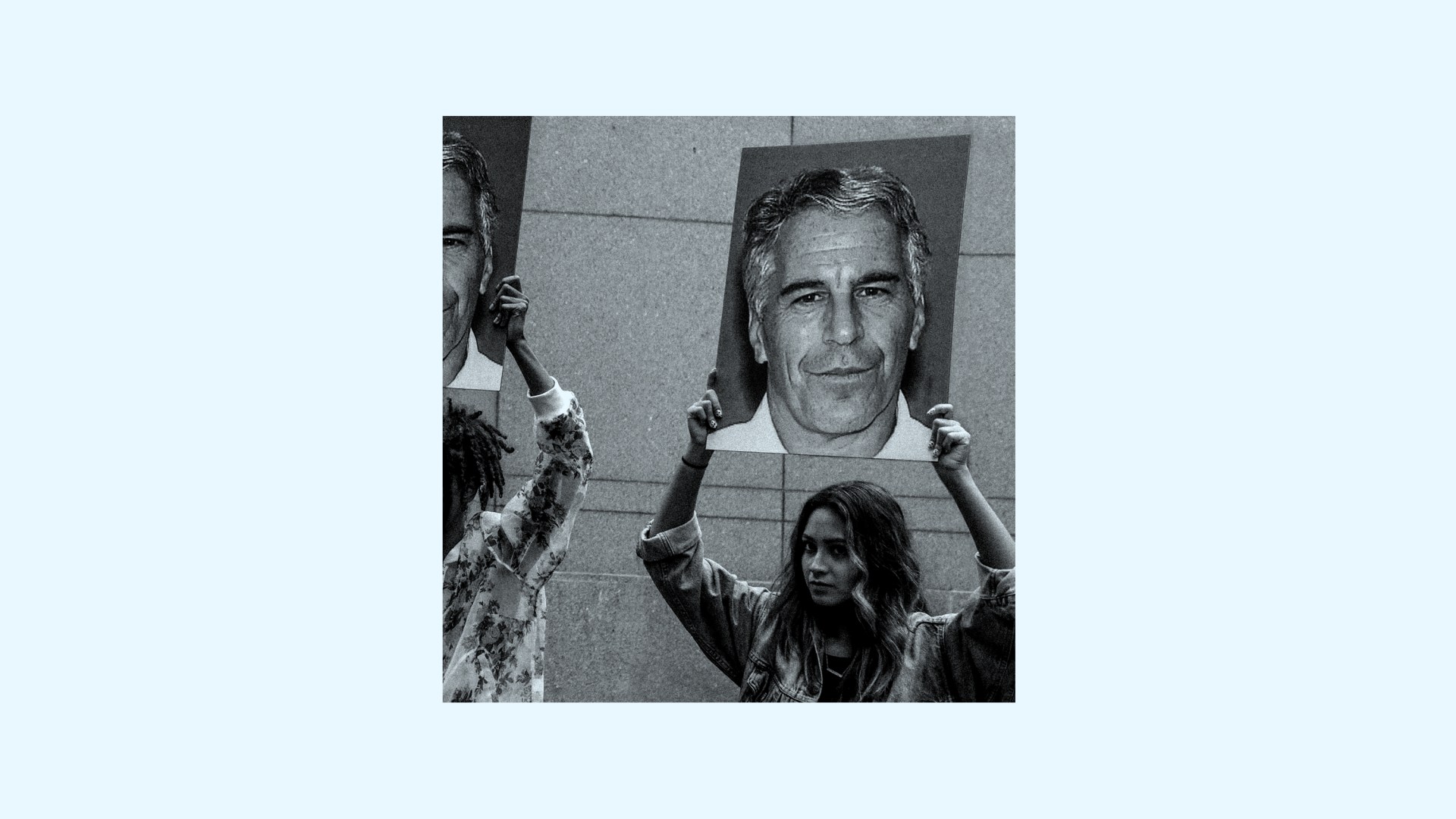
A protest group holds up signs of Jeffrey Epstein
Christianity Today July 16, 2025
Illustration by Christianity Today / Source Images: Getty

This piece was adapted from Russell Moore’s newsletter. Subscribe here. Want to listen instead? Russell Moore reads the piece aloud on his podcast.

Sometime last winter, I was jarred by a picture on social media of a Christmas ornament: a figure of a smiling Jeffrey Epstein attached to the tree by a noose around his neck. The caption on the post read: “This ornament didn’t hang itself.”

The reference to the popular notion that the alleged sex trafficker’s suicide in prison was perhaps murder didn’t strike me as resonant with holiday cheer. I couldn’t have imagined that, come summer, Epstein would be the most inflammatory conversation topic in the country.

The controversy was ignited by Attorney General Pam Bondi’s refusal to release the files from the Epstein case, including the “client list” of those involved in Epstein’s ring of powerful friends alleged to have assaulted multiple girls and young women.

At first, the attorney general said the files were on her desk and she would release them later. Then she said there were no such files, just Epstein’s own videos of abuse. Then President Donald Trump implied that there were files but that they had been faked by some of his political opponents who somehow had access to the levers of justice long after they left office.

The president then told people to stop talking about Epstein. But people have not stopped talking about Epstein. Those enraged by all this include some of Trump’s most enthusiastic backers—Tucker Carlson, Laura Ingraham, Glenn Beck, Alex Jones, and, of course, Elon Musk, who suggested on his social media platform several weeks ago that the files are not released because Trump is named in them.

To see why this moment matters, we might look backward to another time. Before Richard Nixon went to China, he went to Disney World. There at the Orlando resort, in the fall of 1973, the president told newspaper journalists that he welcomed questions about the Watergate scandal because “people have got to know whether or not their president is a crook.” His next statement defined an era: “Well, I’m not a crook.”

If you made it through your high school American history class, you know that Nixon did not, in fact, welcome questions into Watergate. And you know that—whatever else one might think of Nixon—the “I’m not a crook” statement was answered on tape, in Nixon’s own words. The American people heard what came to be known as the “smoking gun” recording, in which the whole country heard Nixon ordering what he said he never did. Some felt betrayed. Some felt vindicated. The country decided to move on.

I’m not sure that “Stop talking about Epstein” will be taught to high schoolers in 2065 in the same way that “I’m not a crook” is. We are unlikely to ever see the files. We are also likely to be in the middle of another all-consuming national conversation in a matter of days, maybe even by the time you are reading this.

Even so, we should ask ourselves what this moment means. Why do we want to see the Epstein files?

The most obvious reason is that we want justice done. We want to believe that our institutions—even in the present crises of credibility that most are going through—are not wholly corrupt. Most people don’t want the kind of country in which a poor person is behind bars for drug possession while some of the wealthiest and most powerful men in the world rape women on a Caribbean island with no penalty whatsoever.

This impulse is a good one. In fact, it is more than just a moral instinct. It is written on the heart. “You shall do no injustice in court,” God said through Moses. “You shall not be partial to the poor or defer to the great, but in righteousness shall you judge your neighbor” (Lev. 19:15, ESV throughout). That principle is repeated in various ways throughout both the Old and New Testaments.

Behind this moral foundation, though, there might be something else more specific to this moment in American history. The Epstein files might be a parable, a stand-in for a definitive settling of what has ripped America apart: a way to see, in real time and without dispute, who are the good guys and who are the bad guys.

The pro-Trump media ecosystem spent years talking about the files and the fishy circumstances around Epstein’s death because it was part of a larger story: about how Trump was standing up to a “deep state” cabal that was, among other things, trafficking children. For these people, the Epstein files were meant to show that, like the Hunter Biden laptop, there really was a story there that the people they mistrust didn’t want to talk about.

Those of us who don’t support the president, on the other hand, are no less pulled toward the story of a conclusion to the moral divide of this time. The Epstein files suppressed by a president who was friends with the dead villain would finally cause our neighbors and friends to walk away from the kind of character that’s been celebrated over the last decade.

But that’s not going to happen—no matter what happens with the Epstein files. The revelation that Nixon had lied about Watergate wasn’t a shocking reversal of image to the degree that it would have been if, for instance, Mother Teresa had been discovered to have a private jet or if Gerald Ford had been seen coming out of a strip club. For years, Nixon had carried the nickname “Tricky Dick.” Still, many of his supporters were stunned when Nixon—as songwriter Merle Haggard put it—“lied to us all on TV.”

I’m not sure we are in an era where a shared morality would trump tribal identity. After all, we all heard the Access Hollywood recordings. We all saw January 6. None of these things ultimately mattered, if by “mattered” we mean resolved the political divide. But they will matter in history. Those who come after us will be horrified that our generation looked away from these matters of character—or they will approve of such things as good.

With the Epstein files, part of what we want is—at long last—unity, agreement that there is something on which we, as a matter of moral principle, can agree is wrong. We also want justice: the right prosecution of those who have ruined lives. I doubt we will get either, but it’s possible.

Behind all that, however, we want something even bigger. We cry out for wrongs to be righted and evil to be avenged in a more ultimate sense than any Department of Justice can grant. Regardless of what happens here, for that, we will have to wait.

We should pursue justice as far as we can while recognizing that even when it is not done, no one will get away with it. Jesus said, “So have no fear of them, for nothing is covered that will not be revealed, or hidden that will not be known” (Matt. 10:26).

Whoever the victims are, they will be heard. Whoever those who harmed them are, they will be found out. The Epstein files may never be opened on earth, but do not be deceived; they are open in heaven.

Russell Moore is the editor in chief at Christianity Today and leads its Public Theology Project.

News

Christian Groups Perplexed, Wary After Korea Bible Incident

South Korea detained six Americans trying to send rice and Bibles by sea to North Korea.

Activists in South Korea throw bottles full of rice, a Christian message, and USB drives into the ocean in hopes that North Korean residents would pick them up.

Activists in South Korea throw bottles full of rice, a Christian message, and USB drives into the ocean in hopes that North Korean residents would pick them up.

Christianity Today July 16, 2025
Jean Chung / Stringer / Getty

When Eric Foley heard that police had detained six Americans in late June for doing a “rice-bottle launch” in South Korea, he felt a dull wave of dread pass through his body.

The group had attempted to throw 1,600 plastic bottles filled with Bibles, rice, $1 bills, and USB sticks in the sea off the shore of Ganghwa Island, which lies close to the southern part of North Korea, in hopes that they would float toward the North. Police investigated the Americans for allegedly violating a law on the management of safety and disasters.

Foley immediately recalled June 2020, when South Korean police charged him and his organization, Voice of the Martyrs Korea (VOMK), for using balloons to send Bibles to North Korea. After an investigation, police ultimately decided not to pursue the charges against him.

“None of this dampened my resolve to keep my promise to underground Christians to get more Bibles into North Korea,” Foley said.

Information on who the six Americans are has not been released. A US State Department spokesperson told CT they are aware of media reports of US citizens detained in South Korea and are monitoring the situation but could not provide further comment due to citizens’ privacy.

Meanwhile, Foley said he fielded inquiries from both Korean and American authorities about the group that was detained. Yet he and other groups working to reach North Koreans have no clue who these individuals are.

“We have no connection to this group at all and no awareness of their activities,” Foley said. He feels troubled by how they had come to South Korea to “try to do this work that looks so simple but for which so many have paid such a high price.”

Christian nonprofits and groups in South Korea that have served North Korea for decades worry that the incident will hamper efforts to reach the reclusive country. Officially known as the Democratic People’s Republic of Korea (DPRK), North Korea ranks on the World Watch List as the world’s most dangerous place to be a Christian—being found with a Bible can lead to imprisonment in a labor camp or even execution.

Depending on the party in power, the South Korean government has held different views on sending information into North Korea, whether by bottles, balloons, or loudspeakers. Under the Moon administration, which sought reconciliation with the North, the government passed a bill prohibiting acts that violate an inter-Korean agreement, such as disseminating leaflets by balloon to North Korea.

But under the conservative Yoon administration, the Unification Ministry, a government body responsible for inter-Korean relations, reversed its stance. And in 2023, South Korea’s Constitutional Court scrapped the law, saying that it curbed free speech excessively. Local police, however, continue to monitor balloon activity along the border to protect citizens from reprisals from North Korea.

The recently elected president Lee Jae-myung has pledged to rekindle dialogue and reopen communication channels with the North.

In a two-hour press conference on July 3 marking his first month in office, Lee vowed to improve relations with the North. “It’s foolish to completely cut off dialogue,” he said. “We should listen to them even if we hate them.”

In June, as a means of reducing tensions between the two Koreas, Lee ordered the South Korean military to stop broadcasting anti–North Korea propaganda along the border, and the Unification Ministry called for activists to stop sending anti–North Korea leaflets.

Yet the Virginia-based Defense Forum Foundation believes that rice-bottle and balloon launches are needed. For years, it has partnered with North Korean defectors who engage in exactly the activities the six Americans are accused of—throwing bottles filled with items like rice, $1 bills, USBs, and small Bibles off the coast of South Korea—to get information into the North.

But Suzanne Scholte, the group’s president, doesn’t know who the detained Americans are. The entire “Operation Truth” team had recently returned from a trip to Europe for North Korea Freedom Week when they heard about the arrests. Beyond bottle launches, the group also helps send information into North Korea by launching helium balloons, floating giant plastic bags on ocean currents, and broadcasting a radio program.

Scholte even questioned whether the arrest was a fake story to intimidate groups like hers.

“I just do not find it plausible that six Americans would be doing something like that, because it’s North Korean defectors that are doing it,” she said. “[They] are the most effective at carrying these projects out because they’re the ones that develop these methods, because they know how to get stuff in.”

She notes that defectors often point to receiving information from the outside world, including from leaflets or short-wave radio, as the catalyst leading them to escape. So despite pushback from the current administration and fears of arrests, the group plans to continue its work quietly. “We’ll just be more careful, and we’ll have to develop new routes,” she said.

Balloons launched by different groups—both religious and political—have carried items like a leaflet dispenser, tiny battery-powered loudspeakers, USB sticks containing K-pop music and Korean dramas, and abridged versions of the Bible.

In response, North Korea sent more than 7,000 balloons filled with trash like toilet paper, soil, and batteries into the South last year to retaliate against what it considered the “frequent scattering of leaflets and other rubbish” by groups in South Korea.

Foley prayed that God would prevent other foreign groups from copycat launch efforts. He fears their actions may lead to larger, unintended consequences. Although the six Americans can leave South Korea, this incident may lead to greater scrutiny from government officials and greater public concern over the work that groups like VOMK do to serve North Korea, Foley said.

Jongho Kim, chairman of the Northeast Asia Reconciliation Initiative (NARI), agreed. The nonprofit brings believers from East Asia and the US together to discuss what healing and engagement look like in a region fraught with political tension.

In Kim’s view, the Americans’ detention is not an issue of religious persecution but a legal matter based on the South Korean government’s laws on engagement with the North.

“Actions that are not coordinated with or permitted by the South Korean government can easily be viewed as provocations, undermining the fragile new mood of dialogue,” he said.

North Korea closed its borders when the COVID-19 pandemic struck in 2020, and it has largely remained closed since then. After opening up the northeastern city of Rason to Western tourists in March, North Korea abruptly stopped more visitors from entering without citing a reason.

These ongoing border closures have also affected how Christian nonprofits serve there, a CT report noted last year.

Kim feels deeply concerned by how the incident may hamper NARI’s efforts to foster dialogue and build relationships through forums that encourage discussion on healing divides. “The work of reconciliation and engagement with North Korea is incredibly delicate and built on years of patient trust-building,” he said.

But he looks to the parable of the sower for guidance. The long-term work of reconciliation is like patiently cultivating good soil so that, at the right time, a seed can produce a lasting harvest, he said. “Actions that are perceived as reckless, however well-intentioned, risk hardening that soil for everyone.”

Foley agrees that patience is key when it comes to serving the North. But he also urges Christians not to keep thinking that North Korea is “closed” to the gospel.

It is illegal to send Bibles into North Korea from South Korea, China, or Russia, Foley said. Despite this, VOMK delivers an average of 40,000 Bibles into the DPRK each year, although for security reasons, Foley can’t say how. The nonprofit sends one or two Bibles at a time, and it may take Foley and his team a year to get a Bible to a difficult location. He noted that they play the long game, often planning years in advance and coming up with multiple backup plans so that their distribution isn’t interrupted.

As a result of their and other Christians’ work, the number of North Koreans who have seen a Bible has increased by 4 percent each year since 2000, according to the 2020 White Paper on Religious Freedom by the North Korean Human Rights Database.

“More North Koreans inside North Korea are seeing Bibles than at any other point in history, including the time of the Great Pyongyang Revival in the early 1900s,” Foley said.

Foley continues to pray for underground Christians in North Korea. In his view, the first thing people should do before undertaking any activity to serve North Korea is to take the time to ask believers there, “What would be helpful to you?” 

Additional reporting by Angela Lu Fulton.

Church Life

Pray Hard and Prosper?

My encounter with a false health-and-wealth gospel in Nigeria.

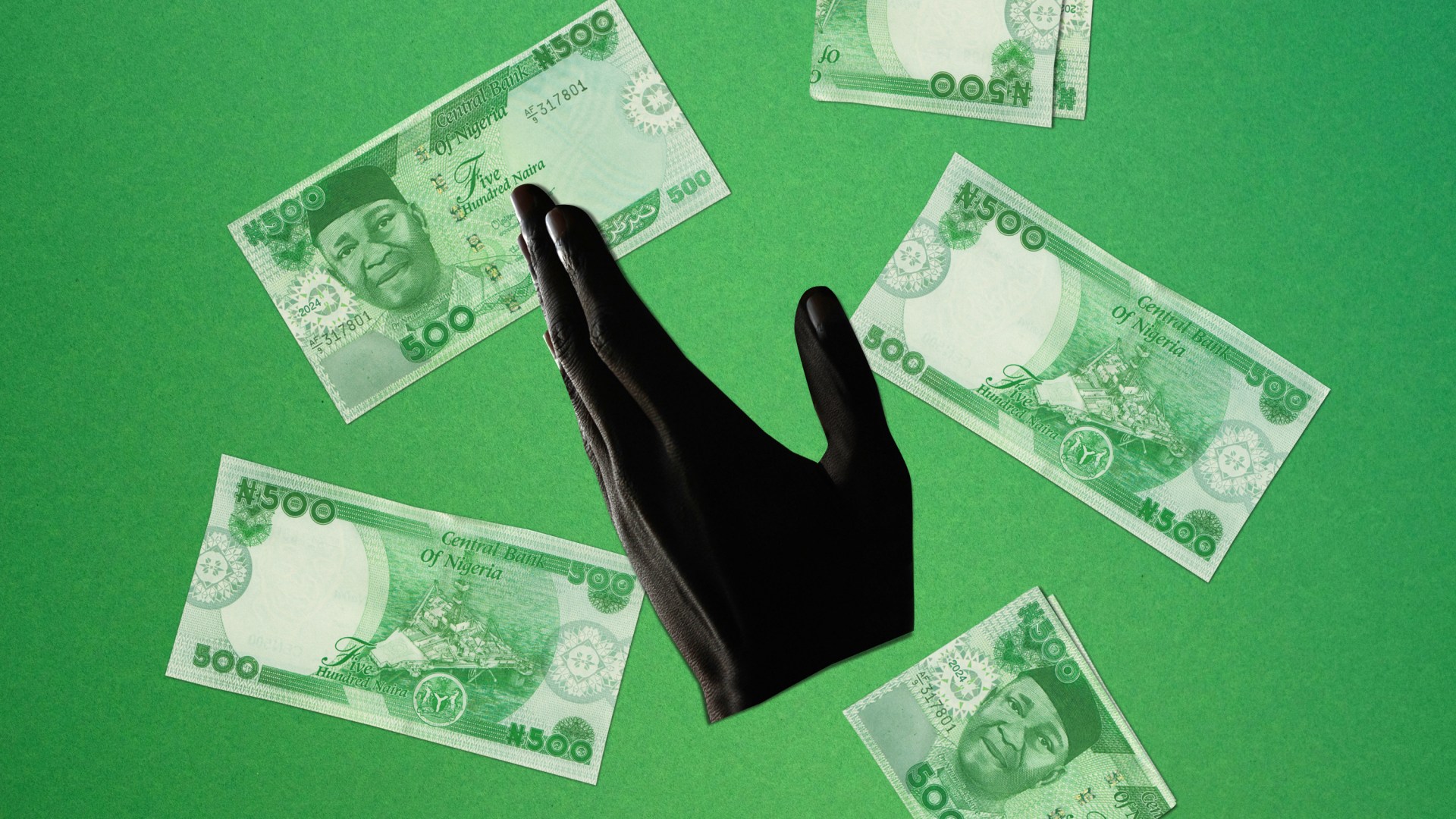
Hand raised with Nigerian currency behind it
Christianity Today July 16, 2025
Illustration by Christianity Today / Source Images: Getty, Unsplash

On a warm summer evening in Girne, Cyprus, the harbor buzzed with cheerful chatter under the fading evening light. Families, tourists, and locals—mostly non-English speakers—gathered near the water to escape the day’s scorching heat. The shouts of children playing tag and the faint melody of a distant guitarist surrounded the harbor. As I settled under the shade of a tree, my heart set on a mission: I had come to tell people about the gospel. I prayed silently, asking God for an English speaker to cross my path.

Just a few minutes after I arrived, a man approached me, holding a flyer. He introduced himself as Caleb, a Nigerian student who had recently moved to the city. “I will like to invite you to this livestream,” he said, handing me the flyer. “You don’t want to miss it.”

The flyer’s bold text promised healing, financial breakthrough, and divine favor. It was the classic prosperity gospel message: Come to Jesus and get all you want.

“My friend once told me that Nigerians travel the world with two things: our food and our church [religion],” I remarked.

“That’s true. God is important to us,” he replied with a smile. He explained that his faith had been shaped by various miracles. God had answered his numerous prayers at the regular livestream services. Now he was eager to share the livestream with others. All you need is a mobile device, an internet connection, and faith, he said.

Nigeria is Africa’s most populous country and also one of the most religious in the world. A 2018 Pew study revealed that 89 percent of Christian adults in Nigeria attend weekly worship services, the highest recorded global rate. However, the church in Nigeria is heavily influenced by the prosperity gospel.

Pentecostalism in Nigeria often emphasizes miracles, healing, and material prosperity. The movement draws thousands to megachurches and boasts of influential pastors—David Oyedepo of Living Faith Church (also known as Winners Chapel), Enoch Adeboye of the Redeemed Christian Church of God, and Chris Oyakhilome of Christ Embassy. Their sermons, streamed worldwide, resonate with those struggling economically in Nigeria. Fifty-six percent of the population lives below the poverty line, according to a 2024 World Bank report.

In 2011, a friend invited me to a three-day service hosted by our university’s Joint Christian Body. The event took a surprising turn when the guest preacher urged us to sow a substantial offering to secure God’s blessings. He claimed that donating 50,000 naira (equivalent to $320 USD at the time) would unlock abundant rewards. For students like me, this amount—thousands of naira above my monthly allowance—was nearly impossible to afford.

As the sermon continued, the pastor incrementally lowered his request, dropping from 50,000 naira to 30,000, then 10,000, then 5,000. Despite the reductions, I still couldn’t contribute. I felt excluded from these promised blessings. This was the closest I had come to the prosperity gospel. I loathed it.  

That memory lingered as I conversed with Caleb. Curious about his perspective, I asked, “What if I don’t receive what I want from this service?” Without hesitation he replied, “That would be your fault.” I was stunned.

For him, faith was a force to attract material wealth, health, and happiness to the Christian. The stronger your faith, the more blessings you attract. The weaker your faith, the fewer blessings you attract. Each person has the power to make positive confessions and ward off suffering. It won’t happen unless you believe, he said.

Oyakhilome taught his members to make declarative statements such as “Debt has no hold over me! I operate in financial liberty, owing no man anything except love. I have more than enough to fund my dreams, support my family, and be a blessing to others.” Caleb argued that this strong belief leads to victory.

The prosperity gospel capitalizes on half-truths: Yes, we must believe in God to be blessed by him. But the Bible never tells us that the strength of our faith will magically procure all our needs.

Biblical faith is a deep trust in God. We trust him because of his character and promises, no matter what happens—good or bad, riches or poverty. We know that God is faithful and works all things for our good (Rom. 8:28). But the prosperity gospel creates a transactional relationship with God. As with a slot machine, you hope to get what you want. The prosperity gospel creates a God who serves our purposes rather than recognizing the true God, who created us for himself. True faith is focused on God, not on self.

Caleb further argued from Matthew 6:33 (“Seek first his kingdom and his righteousness, and all these things will be given to you as well”) that Jesus promised to give us anything we ask. Because of this, he said, the gospel promises material riches. Yet the context doesn’t teach this. Yes, Jesus promises that God provides “all these things”—food, shelter, clothing (v. 25). He calls us to trust that God provides for us just as he provides for the birds and clothes the flowers (vv. 26–30). Struggling to meet these needs causes ungodly anxiety, as with the Gentiles who don’t know God (v. 32). Jesus seeks to shield us from the worries of the world. He encourages us to seek and trust our Father daily.

The Bible warns against various forms of idolatry, including the love of money (1 Tim. 6:10). It calls us to fix our eyes on eternal rewards, not on earthly possessions (Matt. 6:19–20), “for where your treasure is, there your heart will be also” (v. 21).

The battle is between trusting God and trusting in riches, between faith in Christ and faith in faith. The true gospel wars against a false gospel. Although Caleb had begun to understand, he still had another obstacle to overcome.

Nigeria has an honor culture. Congregants often revere pastors as “men of God,” and their words are rarely questioned. In early April, another influential pastor in Nigeria, David Ibiyeomie of Salvation Ministries, faced criticism for a sermon where he said Jesus “hates people who are poor.” He argued that Jesus only visited rich people like Zacchaeus and Lazarus. “That means he hates poverty,” he said.

Ibiyeomie doubled down after receiving intense criticism online for distorting the gospel. “For them to listen to me means I’m very important,” he said in another sermon at the end of April. The congregation greeted his remarks with applause.

Many avoid disagreeing with their pastors, even when confronted with their mistakes. Caleb faces a similar challenge: Will he disagree with his well-respected pastor?

That evening, our conversation began with Caleb inviting me to a livestream. It ended with me inviting Caleb to make Christ the object of his faith.

News

New CEO Trying to Save Barnabas Aid

Colin Bloom believes the scandal-wracked ministry serving persecuted Christians should have a future, starting with corporate repentance.

Barnabas Aid CEO Colin Bloom
Christianity Today July 16, 2025
Barnabas Aid / edits by CT

On Colin Bloom’s first day as head of Barnabas Aid International in April 2024, he gathered his team together and gave them a simple message. 

“We as an organization have done wrong,” he said. “We have to own our mistakes and corporately repent.” 

Not the typical first-day pep talk from a new CEO. But then nothing is normal these days at Barnabas Aid, the evangelical, UK-based charity that serves the persecuted church. 

Bloom, a former Conservative Party politician with a background in business, recently described it like this: Imagine you’re in the cockpit of a crippled Boeing 747. The plane is going down. It’s plunging into the side of a mountain. You have to somehow fix the plane so it can keep flying, and you have to fix it in midair. 

And one more thing, Bloom said with a grim smile: “The previous captain is still trying to kick the door in.”

Even in an era rocked by scandals, the scandal of Barnabas Aid has proved especially tumultuous. Many British evangelicals still ask themselves, What happened? Now they are also asking another question: Can one part of this ministry recover? Will some tough leadership, clear commitment to doing the right thing, honesty, and transparency be enough to repair the damage?

Not everyone is convinced, but it’s starting to look like the answer might be yes. 

Bloom is at the head of Barnabas Aid because the board of trustees forced out founder Patrick Sookhdeo and three top officials in 2024. 

Sookhdeo, a Christian convert from Islam, founded Barnabas Aid in 1993 and named the organization after Barnabas from the Book of Acts, whose name means “son of encouragement.” The ministry quickly grew into one of the largest organizations in the world serving the persecuted church, with annual spending in the tens of millions of dollars. 

Today, it is a family of international charities with branches in the United States, Australia, South Africa, and beyond. Sookhdeo came to be recognized as an evangelical leader in Great Britain and also achieved some fame as a critic of Islam. 

Then, in 2014, he was arrested. A member of Sookhdeo’s staff accused him of calling her into his office and touching her inappropriately. The charity quickly closed ranks. There was a cursory internal investigation, and Sookhdeo was exonerated. Barnabas Aid said the accusations were not only untrue but also malicious—an outrageous attempt to destroy Sookhdeo and the ministry.

Mark Woods, a Baptist minister and journalist who investigated Sookhdeo, said Barnabas Aid leaders were quick to deploy the “textbook” defense of any Christian leader caught in wrongdoing. They said his critics were just hostile to the work he was doing and, ultimately, to the gospel itself.

“He was on the side of the angels,” Woods said. “To lose faith in him was, in a sense, to lose faith in the cause.”

The argument was persuasive to many of Barnabas Aid’s faithful donors, who believed passionately in the importance of helping the persecuted church. 

The British legal system was not so easy to manipulate. Sookhdeo was put on trial and convicted of sexual assault and two further charges of intimidating witnesses after he was caught pressuring Barnabas Aid staff not to cooperate with the police. The court sentenced him to community service.

Around the same time, someone inside Barnabas Aid leaked financial records to the media. They showed lax financial controls—in some places nonexistent. Barnabas funds were going to a network of interconnected charities, all controlled by Sookhdeo and close associates.

There were more assault charges in 2015, with allegations he had touched a woman inappropriately in 1977. Barnabas Aid trustees sprang to his defense, publishing a 36-page document defending the founder and attacking his accuser and a handful of major evangelical organizations in Great Britain. Sookhdeo was the real victim, they claimed, suffering “sustained attacks” and “destructive opposition, seemingly aimed at breaking individuals and crippling organizations.” 

In 2018, a jury concluded there was not enough evidence to convict Sookhdeo of a 41-year-old crime. By then many evangelical leaders had distanced themselves from Barnabas Aid. 

Sookhdeo did not respond to CT’s request for comment on this story.

Despite the many scandals, Sookhdeo still has many staunch evangelical supporters. Christian leaders who work in international missions told CT they have been appalled at how hard it has been to convince people in the pews not to believe what Sookhdeo says.

Jos Strengholt, a Dutch missionary who works in Egypt and was once a major recipient of Barnabas funds, said many faithful British Christians just swallow Sookhdeo’s stories whole. Strengholt came to see Sookhdeo as a charismatic fabulist who would tell any story to create the reality he wanted. He cultivated a sense that Christians were under siege, Strengholt said, and people believed every overblown persecution narrative.

Many evangelical donors only found out something was amiss inside Barnabas Aid when they started to get contradictory emails. A group of staffers started revolting against Sookhdeo’s leadership and filed more than 100 whistleblower complaints about mismanagement and financial misconduct with the board in April last year.

The whistleblowers claimed that Sookhdeo was an authoritarian who brooked no dissent and made financial decisions on a whim, Bloom told CT. 

“There was no rigor,” Bloom said. “It was like a Roman emperor—thumbs up or thumbs down.” 

Staff claimed the ministry was pervaded by a culture of fear and anyone who spoke out was punished. Retribution was swift and brutal. 

The board took action, suspending Sookhdeo and his top allies and bringing in a law firm to investigate. The report came back a few months later. Investigators said Barnabas Aid was a “toxic work environment” and they found “serious and repeated contraventions of internal policies.” 

They also found fraud: The report said Noel Frost, the head of international operations, had siphoned £130,000 (about $176,000) into his bank accounts. The Barnabas Aid board reported the allegations to authorities, and soon police and the British charity regulators were doing their own investigation. 

Authorities put strict controls in place while investigating Barnabas Aid for fraud. The organization is not allowed to spend more than £4,000 (about $5,400) without government approval. The investigation is ongoing, and authorities declined to comment for this article.

The board replaced Sookhdeo with Bloom, and one of Bloom’s first jobs was to email the financial supporters of the ministry and explain what was happening. But just as he did, donors also started receiving messages from Sookhdeo claiming he was the victim of a coup. Working under the auspices of a subsidiary charity, Sookhdeo also said he was still in charge of the real Barnabas Aid, even though the international board had ousted him.

“It was chaotic,” Bloom said.

Bloom told CT he expected some “rough-and-tumble” when he accepted the job of leading Barnabas Aid. But the vituperative attacks still surprised him. He has been smeared online, and he said Sookhdeo’s supporters have also showed up at his home and photographed his family. 

Longtime donors heard rumors that Bloom was ushering in New Age practices at Barnabas Aid. He previously served as the Conservative Party’s senior faith adviser, and before that he ran a network of Christian care homes, but panicked donors believed Bloom was dropping the charity’s commitment to Christian belief.

It wasn’t true, Bloom said. 

“Utter codswallop,” he told CT. “Everyone we have recruited is a Bible-believing follower of Jesus who can sign … our statement of faith.”

One option, in the midst of the conflict and ongoing tumult, might have been to shut the ministry down. Bloom was resolute that Barnabas Aid had a future.

“The correct thing to do is to own our mistakes and be transparent,” he said. 

He believed there was still a need for the work Barnabas Aid was doing, especially when the ministry gave funds directly to Christians facing oppression. Barnabas Aid still has deep pockets and lots of goodwill, and Bloom said he believes that if they can repair the plane in midair, the ministry will become an example of second chances, encouraging Christians around the world. 

“If we do the right thing,” he said, “then the Lord will honor that and will bless us as we try to bless others.”

A big part of that effort, for the new CEO, involves rebuilding trust and demonstrating continued commitment to the mission combined with a new commitment to transparency. Today, every penny is accounted for, according to Bloom, and he holds regular town-hall-style meetings with donors to show them where all the money is going. 

He tells them how the staff is now making spending decisions based on evidence and data, not the whims of the founder. Team leaders who used to just get told what Sookhdeo wanted them to do now travel overseas themselves to assess local projects and help make decisions.

The charity is sending more funds than ever to the persecuted church, even with the ongoing regulation requiring all expenditures over £4,000 get preapproved. While spending remains high, donations have fallen as donors learned about the chaos. Bloom said this is why he was working so hard to reassure supporters it is safe to resume giving. 

Objections and counterarguments about the “real” Barnabas Aid have died down a bit since November, when Sookhdeo and his top deputy were arrested on charges of fraud and money laundering. 

Bloom said he’s also made sure the staff overseeing the finances are all properly qualified, and he’s installed a vigilant human resources team. Staff members told CT the changes from Sookhdeo’s leadership to Bloom’s are “night and day” and they are excited about the ways the ministry is becoming more effective.

The longtime Barnabas Aid staffers have been through a lot, but Bloom encourages them to focus on the people they’re helping. This spring, during the 15-minute staff Bible study, he talked about the body of Christ and how Paul said, “If one part suffers, every part suffers with it” (1 Cor. 12:26). The same verse is printed on a poster in Bloom’s office beneath a striking image of one of the persecuted Christians supported by the charity. 

“Her life is a thousand times worse than everyone in this office,” Bloom said.

The mission remains urgent. That hasn’t changed. 

“What has changed,” Bloom told CT, “is our resolute commitment to acting with integrity.”

Will it be enough? It is hard to tell.

The journalist Mark Woods, for one, is skeptical that a good CEO will be able to repair the charity and pick up the pieces that Sookhdeo left behind. 

“I don’t use this sort of language lightly, but there is a quality of evil about the way [Sookhdeo] behaved and the damage that he has done,” Woods said. But “if anyone can save Barnabas, it will be somebody like Colin Bloom, who is a very experienced and very tough-minded Christian leader.”

Ideas

Yes to Politics in the Pulpit. No to Endorsements.

The IRS says churches can endorse candidates. But the Black church has shown we can accomplish great change without doing so.

An American flag waving over a church
Christianity Today July 15, 2025
Edits by CT / Source Images: Getty

As a faith-engagement staffer for politicians, I’ve spent many Sundays in the back seats of black Suburbans. I was typically there with a driver and a candidate making a campaign stop at a church. It was my job to work with pastors or their teams and set up these events. Sometimes, a church leader supported the candidate. Other times, leaders were just feeling the person out. But regardless of how they felt, two questions always came up: “How do we do this without compromising the church’s moral and spiritual authority?” and “How do we make sure we protect the church’s tax-exempt status?”

Last week, the IRS seemed to take the second question off the table. In a court filing, the agency declared that political speech at a church or “through its usual channels of communication on matters of faith” does not run afoul of the Johnson Amendment, a provision of the tax code that bars tax-exempt organizations from engaging in political campaigns. The filing was made in a legal case brought by two evangelical churches and broadcasters who argued the provision violated their First Amendment rights. The IRS didn’t ask for a full repeal of the Johnson Amendment, which it rarely enforces against houses of worship. But the agency has essentially green-lighted church leaders who want to endorse candidates without worrying an officer will come knocking on their doors. 

The shift has sparked fervent debate. Some celebrated it as a triumph for religious liberty or an opportunity for more active social justice work, while others fear it will embroil churches deeper into partisan politics. If we as the church can explicitly endorse politicians, the question becomes – should we?

Personally, I am proud to have done most of my work with Black churches in my hometown of Chicago, a city that’s known to be politically active. The type of work I did extends beyond Black churches and blue cities, but I believe the rich legacy of political engagement inside the Black church can be a good model for us to follow in this new moment.

At its best, the Black church has shown that churches wield significant power not by directly backing candidates but by shaping local communities and the nation’s consciousness. When segregation and racial discrimination prevented Black people from expressing their political views through rotary clubs or the local chambers of commerce, the Black church stepped forward to fill the role of mediating Black political power. This political engagement was formed at a time when the wider society largely commended faith, family, and Christian sexual ethics. But because of rampant racism, the church served as a central hub for advocacy focused on securing civil rights.

The mission transcended politics and was rooted instead in the biblical mandate to pursue justice and love mercy. Over time, the issues the Black church advocated for—equal justice, expanded voting rights, secure housing and health care—–came to be championed more by one political party, leading most congregants to affiliate with the Democratic Party. Lately, however, the political dynamics have slowly begun to shift. Cultural topics, such as LGBTQ issues and the role of faith in society, are now dominant in political debates. And the consensus around which major political party represents the best hope for Black material prosperity is beginning to fray

The history of the Black church shows that when civil laws unjustly muzzle our voices, some convictions compel us to speak anyway. However, when it comes to unwise alliances that can diminish our eternal message, I know as a pastor that it’s best to practice restraint. While some on the left and the right have reacted to the IRS news as an opportunity to rush into partisan advocacy, churches should instead discern how to speak courageously on issues while keeping our ultimate allegiance not to candidates or parties but to the kingdom of God.

Church occupies a unique position of power, as every candidate and activist knows. As a faith-engagement staffer, I knew it was unlikely that I would hear a pastor say, “Hey, everybody, go vote for candidate X,” but I still wanted and worked with leaders to discuss my candidates and issues. Some might see this delicate dance as confusing and simply want churches to pick a side. But even though navigating these nuances can sometimes seem silly, it’s good for churches to keep these boundaries intact. While we can engage with politics and make moral evaluations, we don’t have to align ourselves with earthly political kingdoms.

Some Christian civic organizations can offer help in this area. The And Campaign, for example, recommends presenting all candidates who want to speak in churches with a questionnaire focused on key moral and political issues, intentionally designed to avoid partisan bias. Like the angel of the Lord whom Joshua encountered before the battle of Jericho, we can demonstrate that the proper question is never “Whose side is God on?” but rather “Who is on God’s side?”

As a church leader, I’m convinced that if pastors begin backing candidates from the pulpit (something we have already seen both on the right and on the left), we not only lose credibility but also hinder our congregants from building relationships with believers who may vote differently from them. Congregants will filter our words on matters of public importance through the lens of partisan politics and its constricting loyalties. And the price of political pragmatism will be the loss of prophetic witness. Choosing candidates in elections is incredibly important work. And yet it is not the church’s role. The body of Christ is called to embody a moral clarity that transcends any political candidate or party. Elections can be zero-sum games, and while there are often “better” choices, there is rarely, if ever, a perfect choice.

The church’s true mandate is to form disciples whose faith shapes every aspect of their lives, including their political engagement. It’s the same principle our high school math teachers taught us when they told us to “show our work” on assignments. They understood that the process by which we arrive at answers often matters more than the answers themselves.

If there is a silver lining to the IRS’s recent filing, it may be that churches no longer have an easy escape route from tough conversations. For too long, many pastors and congregations hid behind the Johnson Amendment, using it as a reason to explain why they couldn’t address important issues. But the church ought to have something to say about justice, righteousness, poverty, racism, and the dignity of human life. Too often our silence has spoken louder—and more harmfully—than our public voice ever could, signaling that the church is either unconcerned about the public good or unprepared to meaningfully contribute to it.

The responsibility for our witness lies squarely on our own shoulders. With the IRS’s new stance, politically passionate congregants or people in a black Suburban might push—or plead—for candidate endorsements. I would caution them to refrain from doing so. But if they don’t, pastors should be prepared to remind them of what Jesus said to the political officials of his day: The kingdom we serve, ultimately, “is not of this world” (John 18:36).

Chris Butler is a pastor in Chicago and the director of Christian civic formation at the Center for Christianity & Public Life. He is also the co-author of  Compassion & Conviction: The And Campaign’s Guide to Faithful Civic Engagement.

News
Wire Story

At Doug Wilson’s DC Church Plant, ‘Worship Is Warfare’

Pete Hegseth and other Capitol conservatives join Christ Church’s new location.

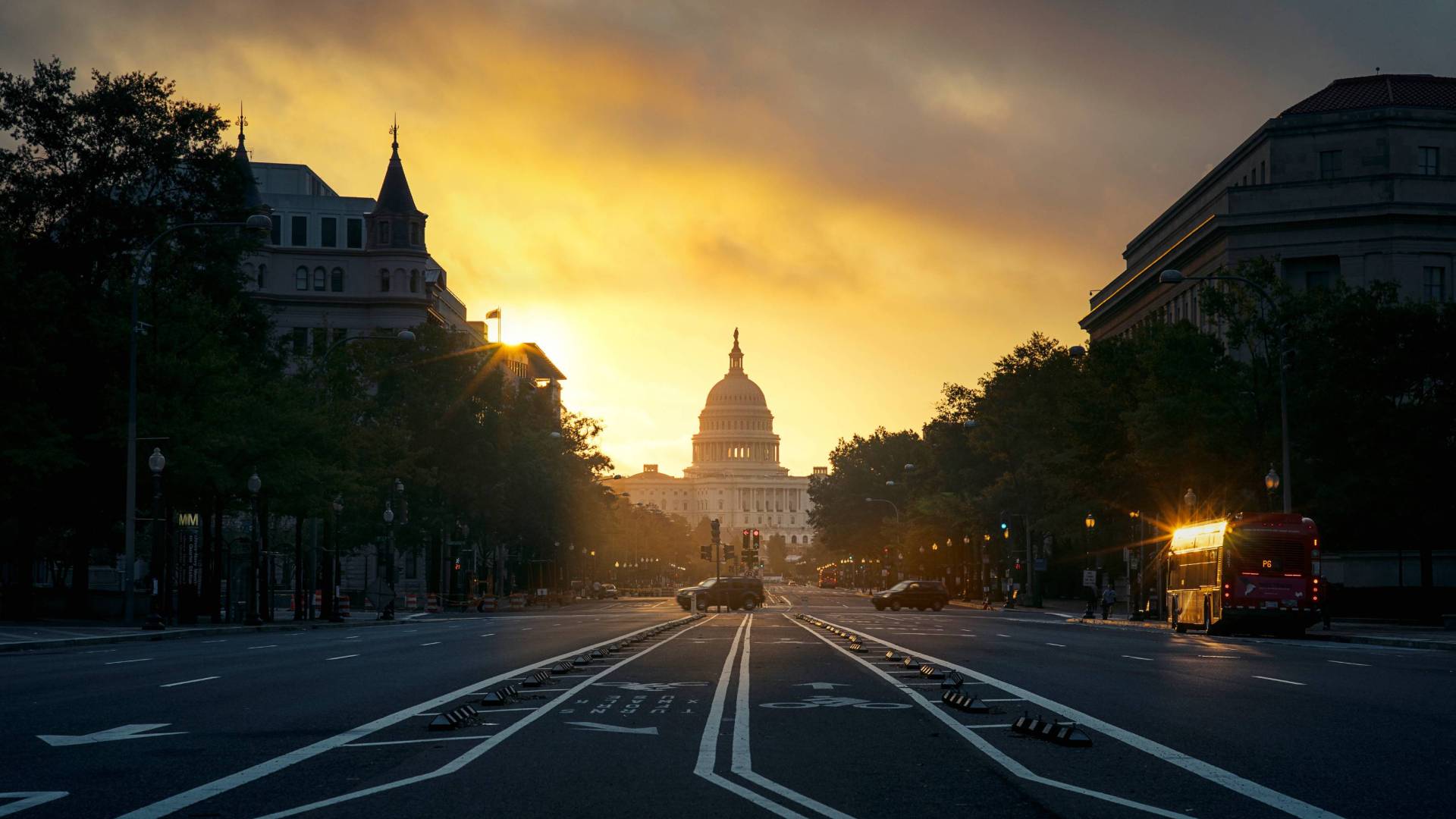
Looking along Pennsylvania Avenue towards the Capitol Building at sunrise in DC
Christianity Today July 15, 2025
Doug Armand / Getty Images

Pastor Jared Longshore isn’t exactly a holy roller preacher. Bearded and bespectacled, his sermon before the Washington, DC, plant of Christ Kirk church on Sunday was delivered in the subdued, heady style typical of the often buttoned-up Reformed Christian tradition.

But as Longshore stood underneath an American flag suspended just above his head, its stars and stripes facing toward the floor, the pastor made clear that the new congregation—an outpost of an Idaho church run by a self-described Christian nationalist—wanted to make some noise.

“We understand that worship is warfare,” Longshore said, leaning over the lectern. He paused for a moment, then added: “We mean that.”

Many in the roughly 120-strong congregation nodded in agreement, a few fanning themselves with church bulletins as they sat packed together in the small, non-air-conditioned room just a few blocks from the US Capitol.

And the message appeared to resonate with the most notable attendee among the crowd of worshippers: US Secretary of Defense Pete Hegseth. Children in the pews whispered excitedly when Hegseth entered, and the defense secretary was mobbed by supporters as he left the church.

While the service itself followed the traditional rhythms of Reformed Protestant liturgy—confessions of faith, Scripture readings and hymns sung in harmonies that emphasize fourths and fifths—Longshore’s sermon was full of political references. He lauded the Department of Government Efficiency and argued that liberty and equality are concepts that only make sense if they are attached to conservative Christianity.

“If you get rid of God, you lose all sense of what equality is,” Longshore said.

The church plant is the latest example of pastor Doug Wilson’s growing sphere of influence among a cadre of conservatives sometimes described as the “New Right.” Having founded Christ Kirk (also known as Christ Church) in Moscow, Idaho, decades ago, Wilson has since helped establish a small denomination—the Communion of Reformed Evangelical Churches—while also creating a Christian school, college, seminary, and printing press. Along the way, the stridently conservative pastor has sparked a number of controversies, from his blatant use of anti-LGBTQ slurs to his comments downplaying the atrocities of American slavery.

But Wilson’s political rise is more recent, tied mostly to his congregation’s headline-grabbing protests against pandemic restrictions and the pastor’s fervent, unapologetic embrace of Christian nationalism on his various YouTube channels. The result has been a flurry of prominent politically themed speaking engagements in the past two years, such as speaking alongside Russell Vought (who would go on to be the director of the Office of Management and Budget) at an event hosted in a US Senate office building; addressing the crowd at a Turning Point USA conference; or speaking on a panel at the National Conservatism Conference.

Hegseth, who has praised Wilson’s books, said he moved to Tennessee specifically to enroll his children in a school associated with the Christian education movement popularized by Wilson. He also became a member of a local CREC church in the area. In May, Hegseth had his pastor, Brooks Potteiger, lead a prayer service at the Pentagon.

In an interview with Religion News Service, the Idaho-based Longshore—who is one of many pastors associated with Christ Kirk and the CREC slated to preach to the DC startup until it installs its own pastor—dismissed the idea that the church was part of an effort to influence DC politics in an explicit sense. He echoed Wilson, who has said the nation’s capital is now home to many members of the CREC denomination and denied that Hegseth had any role in bringing the church to Washington.

But Wilson has also stated publicly that establishing the church is part of an effort to capitalize on “strategic opportunities with numerous evangelicals who will be present both in and around the Trump administration,” and Longshore acknowledged the effort is designed to be an indirect form of politicking.

“We do believe that culture is religion externalized, always, whatever the religion,” said Longshore, who serves as an associate pastor at Christ Kirk Moscow. “And politics is downstream from culture, and culture is downstream from worship.”

Photographs were prohibited as a condition of being able to observe the service, but political symbols filled the worship space. Old newspaper articles praising Ronald Reagan dotted the walls, as did multiple American flags.

Some ensigns were associated with the political right, such as the Revolutionary-era “Don’t Tread on Me” flag popularized among conservatives by the Tea Party movement. An “Appeal to Heaven” flag—another Revolutionary-era banner that has become associated with Christian nationalism and the January 6, 2021, attack on the US Capitol—was draped on the wall nearby.

Streetfronts in DCCourtesy of Google Maps / Religion News Service
Christ Kirk DC met in a building, center, on Pennsylvania Avenue owned by Conservative Partnership Institute in Washington.

Granted, the room wasn’t decorated by the church itself, but rather, the flags were likely an artifact of the church’s political ties. The building, situated along Pennsylvania Avenue just southeast of the Capitol, is one of several owned by a far-right think tank known as the Conservative Partnership Institute.

CPI is deeply connected to the MAGA movement: led by former US Senator and Heritage Foundation head Jim DeMint and President Donald Trump’s onetime chief of staff Mark Meadows, the group’s partner organizations include the Center for Renewing America, which was created by Vought, and America First Legal, an operation co-founded by current White House Deputy Chief of Staff Stephen Miller.

Christ Kirk’s own ties to the group appeared to extend to the pews: Spotted among the parishioners on Sunday was Nick Solheim, head of American Moment, an organization founded with the backing of then-senator JD Vance. The group is also listed among CPI’s partners.

Wilson’s various projects appear to be geared toward building a base of power distinct from others that have rallied behind Trump, such as Charismatic and Pentecostal evangelicals that surrounded the president during his first term.

Wilson and his allies were openly critical of the president’s decision to install Pastor Paula White as head of his White House Faith Office, challenging her appointment in part because of their opposition to women’s ordination.

And he has also shown a willingness to exert influence on other powerful, far-right religious institutions: Shortly after announcing Christ Kirk in DC, Wilson unveiled a similar effort at Hillsdale College.

Christian nationalism is a mainstay of Wilson’s projects, a trend that continued on Sunday. Longshore stressed he believes “Christendom” has “marked this land from its founding.” He made a similar argument during his sermon, in which he also suggested that the US has become a “fallen” or “lapsed” nation because it has drifted from its Christian roots.

It’s a common argument among purveyors of Christian nationalism. But it’s also a heavily disputed idea and one unlikely to sit well with DC’s deeply liberal population. Outside the building on Sunday, a pair of protesters stood jeering worshippers as they entered, with one holding a sign that read “Christ Church Is not Welcome.”

One of the protesters, who identified themself only as Jay, told RNS that Christ Kirk espouses values that are “fundamentally un-American” and “un-Christian.”

“But most fundamentally, they’re contrary to my deeply held values, and what I know are the deeply held values of DC,” Jay said.

The frustration was shared by at least one person inside the church. Nathan Krauss, who lives just outside DC and works in the federal government, said he attended the service as part of an ongoing personal effort to learn more about Christian nationalism.

A United Methodist, Krauss said the service was fascinating in part because he found much of it unoffensive. But he argued there was a clear disconnect between Scripture read by worship leaders and their support for Christian nationalism.

“I just really want to know: Is the creation of this church going to create more liberty for the oppressed or less liberty for the oppressed? Because from everything that I see that they’re about, it seems to be that there’s going to be less liberty for people, not more,” Krauss said.

Longshore, for his part, said the hope is for Christ Kirk DC to evolve from a “service” of Christ Kirk Moscow to a mission church and, eventually, a “particularized church” with its own established local leadership.

Asked about the protesters, Longshore quipped, “We love it,” noting that Christ Kirk is sometimes protested in Moscow as well. Washington, DC, of course, is a very different animal than Idaho. But Longshore argued that as a church leader preparing for “spiritual warfare,” he relished the challenge.

“What feels like crazy to you is actually normal stuff,” he said, referring to the protesters. “It’s like normal stuff from the land of the free, in the home of the brave. It’s what we used to be as American society, and what we still are, in large part, outside of the secular bubble.”

Theology

Beyond Buddhist Exceptionalism

Serenity in war undermines wishfulness about “Baseball Zen.”

Buddhist warrior monk and a temple on Mount Hiei

A Buddhist warrior monk from Japan and a Buddhist temple on Mount Hiei.

Christianity Today July 15, 2025
Illustration by Christianity Today / Source Images: Getty, WikiMedia Commons

In this series

(For previous articles in this series, see here, here, and here.)

Philosophy professor Evan Thompson, who defines himself as “a good friend to Buddhism,” is also a critic of “Buddhist exceptionalism”: “the belief that Buddhism is superior to other religions in being inherently rational and empirical … a kind of ‘mind science’” that’s “based on meditation.”

Buddhism, particularly in its Zen variation, has gotten a great amount of press as a way of experientially finding one’s “true self,” with a typical article stating, “Meditation Is No Fad. It Could Make Your Career.” Major League Baseball’s television network between innings shows clips of sweet plays under the heading “Baseball Zen.”

And yet Methodist-turned-Buddhist Brian Victoria shows how Zen Buddhist priests during World War II taught Japan’s military leaders to be serene about killing others and, if necessary, themselves. As samurai warriors in previous centuries found Zen’s mind control useful in developing combat consciousness, so kamikaze pilots visited Zen monasteries for spiritual preparation before their last flights.

Some Buddhists taught that life is unreal, so we should not be attached to it. D. T. Suzuki, who taught at Columbia University in the 1950s and became the prime spreader in America of Zen’s mystique, stated in 1938 that Zen’s “ascetic tendency” helped the Japanese soldier to learn that “to go straight forward in order to crush the enemy is all that is necessary for him.”

This was the latest curve in a long history. Japanese Buddhists built a power center on Mount Hiei, which overlooks Kyoto, Japan’s capital from 794 to 1868. Buddhist armies based on the mountain became known for overthrowing emperors at will. Nine hundred years ago Emperor Shirakawa listed the “three things which I cannot bring under obedience: dice, the waters of a rushing river, and the priests on Mt. Hiei.”

One historian of Kyoto, Gouverneur Mosher, noted that “Buddhism did not retard war but rather promoted it.” Brian Victoria and others do not say that Buddhism leads to violence, but they also say it does not necessarily curtail it. Buddhists can be unattached to war, but they can also be unattached to peace.

For example, in the 15th century two Buddhist armies of about 100,000 men each fought for 10 years with Kyoto as the battleground. The city was destroyed. Then came more civil wars that culminated in 1571 when the armies of Japanese strongman Oda Nobunaga burned 300 Tendai temples and killed thousands of those priests.

Nonattachment can cut both ways.

That’s particularly true because Buddhism is exceptional in one way: Buddhists typically do not pray as Jews, Christians, or Muslims pray, because they turn their devotional meditations inward rather than outward. A leader at one Buddhist meditation center I visited said, “Take your glasses off.” I was not to read but to look within.

On Mount Hiei overlooking Kyoto, where Buddhist armies once ruled, monks I met there were trying to achieve nonattachment through Jogyo-do (constant walking). They also meditated for long stretches while fasting, drinking only a little water, and trying hard not to fall asleep. As one monk explained, “If we can remove the desire for food or sleep, we can get closer to the goal of leaving behind all desire.”

Mount Hiei was also the home of elite monks supposed to walk for at least 18 miles a day for 100 days up and down the mountain’s steep slopes. Others, wearing straw sandals, tried to do 1,000 days of walking 50 miles a day. (The monks I asked were vague on how often this was done over the centuries.)

Four short articles on Buddhism only scratch the surface. When I traveled to Japan, the country with the fourth-highest number of Buddhists, Buddhism changed for me from a strange religion with millions of adherents to one interwoven with the lives of particular faces in the crowd. One was a Japanese woman in her 40s with a mottled face, freckles, and some bruising under one eye.

She and others at a Buddhist temple on Mount Koyasan told me how her parents divorced when she was young and how neither wanted to take care of her. She was the fifth and youngest child, with grown-up brothers and sisters who had also abandoned her. Sent around to the homes of various relatives as half maid, half slave, she tried to have herself committed to an orphanage, but those who mistreated her would not allow an action that would bring public shame.

Hurt further by a hard marriage, she and her son, a toddler, began coming to the temple on a beautiful hill in central Japan about a two-hour drive from the crowded streets of Osaka. She believed she could find relief from her pain on a cool Saturday evening by entering a frigid river, her hands clasped before her. She wore a white robe, indicating purity, and threw handfuls of salt into the water as another purifying gesture.

She began chanting names of Buddha, fast, loud, seemingly without stopping for breath. She let out a scream (“VEE-AYE!”) and stood chanting for ten minutes. She later said that during that time she felt Buddha enter her body. She was numbing herself physically and hoped to numb herself emotionally. Seeking nirvana means seeking the elimination of individuality, but it also means hoping to attain a state where there will be no more pain.

One reason Buddhism gets a great press is because its adherents say it’s a nonreligious religion. But as Evan Thompson notes, the question of faith is inescapable in all belief systems, including Buddhism: “Buddhist faith is trust or confidence in the teachings of the Buddha, and trust or confidence in the possibility of awakening (bodhi) and liberation (nirvāṇa).” The Buddhist bottom line is that we don’t need a savior: If we work at it enough, we can save ourselves. 

Readers seeking further enlightenment might turn to CT’s 2023 “Engaging Buddhism” series. In it, Angela Lu Fulton observed, “While Westerners view Buddhism as a philosophy, Paul De Neui, a former missionary to Thailand and professor of missiology at North Park Theological Seminary, noted that this concept isn’t embraced by Buddhists in the East, who see Buddhism as a cultural identity. This means they are Buddhists because their parents are Buddhist.”

She also noted, “When Buddhism entered different countries, the religion’s elasticity allowed it to integrate with local religions. Because it rarely challenged local norms, many could easily accept Buddhism alongside their existing faiths. This practice of syncretism led the religion to look quite different depending on the country. In China, Buddhism was mixed with Daoism and traditional ancestor worship. In Cambodia, its cosmology includes ghosts and spirits, ancestors and Brahma deities.”

Bottom line: “By combining with local religions, Buddhism created a strong bond with people’s nationalities. Often when trying to minister to Buddhists, Christians find that the greatest barrier to evangelism is the mindset that ‘to be Thai (or another nationality) is to be Buddhist.’”

addApple PodcastsDown ArrowDown ArrowDown Arrowarrow_left_altLeft ArrowLeft ArrowRight ArrowRight ArrowRight Arrowarrow_up_altUp ArrowUp ArrowAvailable at Amazoncaret-downCloseCloseellipseEmailEmailExpandExpandExternalExternalFacebookfacebook-squarefolderGiftGiftGooglegoogleGoogle KeephamburgerInstagraminstagram-squareLinkLinklinkedin-squareListenListenListenChristianity TodayCT Creative Studio Logologo_orgMegaphoneMenuMenupausePinterestPlayPlayPocketPodcastprintremoveRSSRSSSaveSavesaveSearchSearchsearchSpotifyStitcherTelegramTable of ContentsTable of Contentstwitter-squareWhatsAppXYouTubeYouTube