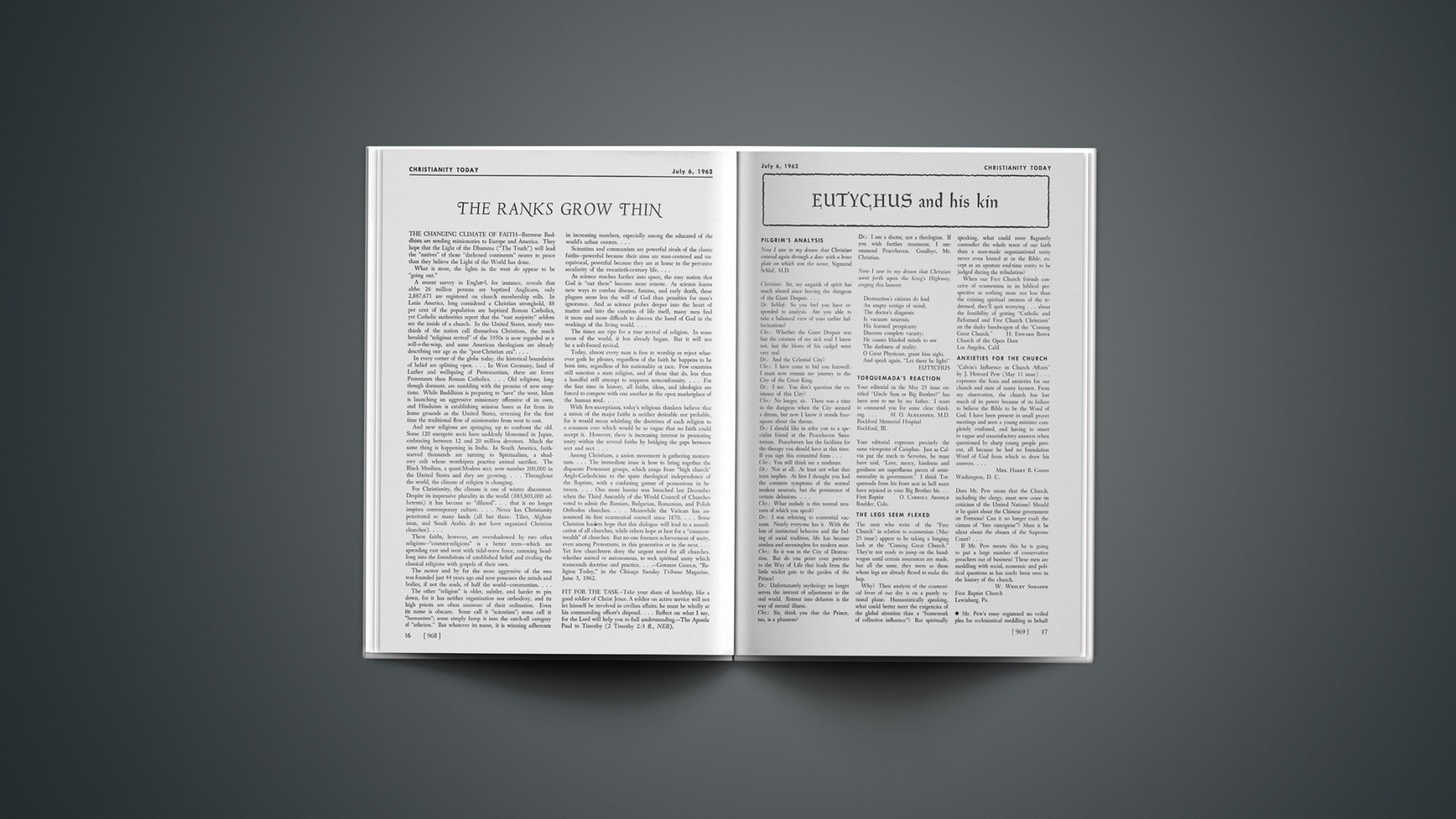
Eutychus and His Kin: July 6, 1962

Pilgrim’S Analysis

Now I saw in my dream that Christian entered again through a door with a brass plate on which was the name, Sigmund Schlaf, M.D.

Christian: Sir, my anguish of spirit has much abated since leaving the dungeon of the Giant Despair.…

Dr. Schlaf: So you feel you have responded to analysis. Are you able to take a balanced view of your earlier hallucinations?

Chr.: Whether the Giant Despair was but the creature of my sick soul I know not, but the blows of his cudgel were very real.

Dr.: And the Celestial City?

Chr.: I have come to bid you farewell. I must now resume my journey to the City of the Great King.

Dr.: I see. You don’t question the existence of this City?

Chr.: No longer, sir. There was a time in the dungeon when the City seemed a dream, but now I know it stands foursquare about the throne.

Dr.: I should like to refer you to a specialist friend at the Peacehaven Sanatorium. Peacehaven has the facilities for the therapy you should have at this time. If you sign this committal form …

Chr.: You still think me a madman.

Dr.: Not at all. At least not what that term implies. At first I thought you had the common symptoms of the normal modern neurosis, but the persistence of certain delusions.…

Chr.: What malady is this normal neurosis of which you speak?

Dr.: I was referring to existential vacuum. Nearly everyone has it. With the loss of instinctual behavior and the fading of social tradition, life has become aimless and meaningless for modern man.

Chr.: So it was in the City of Destruction. But do you point your patients to the Way of Life that leads from the little wicket gate to the garden of the Prince?

Dr.: Unfortunately mythology no longer serves the interest of adjustment to the real world. Retreat into delusion is the way of mental illness.

Chr.: Sir, think you that the Prince, too, is a phantom?

Dr.: I am a doctor, not a theologian. If you wish further treatment, I recommend Peacehaven. Goodbye, Mr. Christian.

Now I saw in my dream that Christian went forth upon the King’s Highway, singing this lament:

Destruction’s citizens do find

An empty vertigo of mind;

The doctor’s diagnosis

Is vacuum neurosis;

His learned perspicuity

Discerns complete vacuity;

He causes blinded minds to see

The darkness of reality.

O Great Physician, grant him sight,

And speak again, “Let there be light!”

EUTYCHUS

Torquemada’S Reaction

Your editorial in the May 25 issue entitled “Uncle Sam or Big Brother?” has been sent to me by my father. I want to commend you for some clear thinking.…

M. O. ALEXANDER, M.D.

Rockford Memorial Hospital

Rockford, Ill.

Your editorial expresses precisely the same viewpoint of Caiaphas. Just as Calvin put the torch to Servetus, he must have said, “Love, mercy, kindness and goodness are superfluous pieces of sentimentality in government.” I think Torquemada from his front seat in hell must have rejoiced in your Big Brother bit.…

O. CARROLL ARNOLD

First Baptist

Boulder, Colo.

The Legs Seem Flexed

The men who write of the “Free Church” in relation to ecumenism (May 25 issue) appear to be taking a longing look at the “Coming Great Church.” They’re not ready to jump on the bandwagon until certain assurances are made, but all the same, they seem as those whose legs are already flexed to make the hop.

Why? Their analysis of the ecumenical fever of our day is on a purely rational plane. Humanistically speaking, what could better meet the exigencies of the global situation than a “framework of collective influence”? But spiritually speaking, what could more flagrantly contradict the whole tenor of our faith than a man-made organizational unity never even hinted at in the Bible, except as an apostate end-time entity to be judged during the tribulation?

When our Free Church friends conceive of ecumenism in its biblical perspective as nothing more nor less than the existing spiritual oneness of the redeemed, they’ll quit worrying … about the feasibility of getting “Catholic and Reformed and Free Church Christians” on the shaky bandwagon of the “Coming Great Church.”

H. EDWARD ROWE

Church of the Open Door

Los Angeles, Calif.

Anxieties For The Church

“Calvin’s Influence in Church Affairs” by J. Howard Pew (May 11 issue) … expresses the fears and anxieties for our church and state of many laymen. From my observation, the church has lost much of its power because of its failure to believe the Bible to be the Word of God. I have been present in small prayer meetings and seen a young minister completely confused, and having to resort to vague and unsatisfactory answers when questioned by sharp young people present, all because he had no foundation Word of God from which to draw his answers.…

MRS. HARRY B. GAUSS

Washington, D. C.

Does Mr. Pew mean that the Church, including the clergy, must now cease its criticism of the United Nations? Should it be quiet about the Chinese government on Formosa? Can it no longer exalt the virtues of “free enterprise”? Must it be silent about the abuses of the Supreme Court?…

If Mr. Pew means this he is going to put a large number of conservative preachers out of business! These men are meddling with social, economic and political questions as has rarely been seen in the history of the church.

W. WESLEY SHRADER

First Baptist Church

Lewisburg, Pa.

• Mr. Pew’s essay registered no veiled plea for ecclesiastical meddling in behalf of conservative causes. His appeal to Calvin is unqualified: “… the Church should not become involved in outside affairs.… the Church has no scriptural authority to speak outside of the ecclesiastical field.… Meddling in politics is divisive and inimical to the success of the church.”—ED.

Howard Pew does beautifully! He shows the cause and power of the Reformation—in Geneva. And it was not a question of theology.

As it was power-organization then, so it is now. And so it is ever. Organization needs correcting balances. And when the balances fail, and the organization expands in power-application, then the Spirit is crushed. Luther was asked only one thing: “Will you obey the Church?” Right or wrong; creeds, orthodoxy, historical truth, had no part in the thinking and proceeding of the Church against him.

JOHN F. C. GREEN

Evangelical Congregational Church

McKeesport, Pa.

May I humbly suggest that the only error the church has shown … is that its efforts of witness in the social, economic, and political realms have been so weak, short-sighted, and without a Christ-centered aim that they have been far too little and too late, rather than as Mr. Pew suggests (without backing of any figures) an increasingly great involvement.…

RALPH F. HUDSON

Eau Claire, Wise.

Interpreting Genesis

The bulk of Dr. Klotz’s argument (“Evolutionary Theory: Some Theological Implications,” May 11 issue) … is a series of rationalistic conclusions from certain premises. It seems to me that theologically the single issue is this: What is the correct interpretation of the first 11 chapters of Genesis? In my opinion—and many of the professors of the seminary of which Dr. Klotz is a graduate share this view—the answer to this question has nothing to do with the arguments about the inspiration of Scripture. If the first 11 chapters of Genesis constitute a form of literature in Scripture that need not be taken as a straight historical account then there is no difficulty, theologically speaking, in accepting the teachings of science regarding the sequence in which various living forms appeared over long periods of time. To Dr. Klotz the fact that St. Paul refers to Adam and Eve proves that the Genesis account has to be taken as a historical one. It would seem to me that this is an assumption on his part which does not follow directly from Scripture itself.…

It is also stated that the doctrine of evolution is mechanistic and materialistic. There is one form of materialism which is to be condemned: this is the view that only material things are real. Since evolution deals with material things it has to be materialistic, in the same way that the study of the brain in terms of neurophysiology is materialistic. This, however, does not mean that those who study neurophysiology must reject the Christian doctrine of the soul. To reproach biology for being materialistic is just as meaningless as to reproach the astronomers for being materialistic.…

In this day and age when all Christians, and particularly young people, are assailed from all sides by materialism and unbelief it would be a pity to confuse them further by insinuating that their acceptance of certain scientific statements would put them outside the pale of Christianity. We live in a world of dualism—in that by faith we see God’s actions, but through the eyes of science we see connections between created material events. We had better face this because there are many apparent conflicts similar to the one about evolution. Viewed with the eyes of a scientist many events are determined by purely materialistic causes, whereas to a Christian they would appear as expressions of God’s will. It seems to me that if we cannot develop a world view that can embrace both our faith and the findings of science, which in my view are also gifts of God, we are doomed to failure in our communication to twentieth-century people.…

M. GERGELY

Retina Foundation

Boston, Mass.

Thank you for printing “Some Theological Implications” by Professor John W. Klotz. There are still some of us around who do not believe that we are “naive literalists” or “fighting fundies,” but we do believe that science needs to be checked and trimmed by Scripture, and not Scripture by science. We will not “interpret” the Bible to fit the world’s demands.

PAUL H. SEELY

San Francisco, Calif.

Gift Worthy Of The Magi

A Soviet clergyman, frustrated by the appalling shortage of Bibles in the U.S.S.R., challenged me: “Why don’t the visitors who come to our country each bring in and leave a Russian Bible?”

From this challenge evolved the offer of one free Russian Bible to each tourist who plans to visit the U.S.S.R.

Last year, many found this experience of participation meaningful and satisfying. Among them were businessmen, housewives, ministers, scientists, doctors, teachers and students.

If any of your readers plan to visit the U.S.S.R. this summer, each may receive one free Russian Bible by writing to: Box 3456, Grand Central Station, New York 17, N. Y.

STEVE DURASOFF

New York, N. Y.

Anti-Semitism

It was encouraging to read “The Theology of Anti-Semitism” (Apr. 27 issue), since this is a subject too long neglected by the Christian churches.…

One paragraph to which I take special exception, however, is the one that appeals to the sufferings and plight of the Jews as a continuing “object lesson” on the consequences of disobedience. While … we cannot rule out the element of divine judgment in Israel’s history, … God has made clear that he stands in universal judgment on all groups.… For Christians it is more fitting, and more true to the biblical spirit, to perceive the divine judgment that has fallen upon our own groups and institutions in the history of the churches and in present-day events. In a sense, Dr. Stephens comes almost to the point of saying this.… In an oblique way, for example, he seems to be stating a fundamental truth, namely, that sinful men are eager and content to discern judgment on the Jew …, while at the same time blindly resisting any application of the same biblical insights to themselves. The hostile reaction of any man to the Jews, therefore, is a self-blinding to the scriptural message, a running away from God and his demands for love, mercy and justice, and a refusal to confess and repent.… In short, the anti-Semite (devout Christian though he may profess to be), whether he knows it or not, in his rejection of the Jew is denying the validity and efficacy of Christ’s sacrifice on the Cross.…

Christians today, especially in view of the tragic events in Germany, should thus reappraise what it is that God is trying to say to the Church … in preserving the Jews despite the many past attempts of Christians to get rid of them.

BERNHARD E. OLSON

New York, N.Y.

Do you agree that the Christian world owes the Jewish people an eternal apology for persecuting, tormenting and killing them during the last 2,000 years, because of a myth?

LOUIS BERGER

Santa Monica, Calif.

Pacifist Riposte

In the April 27 issue, an article appears entitled “Better Red than Dead?” … The article in question amazes me almost beyond description by saying: “The reasoning that love is the answer is next to preposterous … (Love) is not the whole of Christian morality”! And this in the light of Galatians 5:14 and related passages: “For the whole law is fulfilled in one word, ‘You shall love your neighbor as yourself.’ ” We must understand that the heart of our Lord’s teaching on this subject is admittedly the “non-resistance” and “love-your-enemy” sections in Matthew 5:38–48 and Luke 6:27–36.…

DONALD K. BLACKIE

Calvary Reformed Church

Grand Rapids, Mich.

Certainly the issue presented by the question, “Why wasn’t this pamphlet given widespread coverage when Russia engaged in its recent testing program?” is [irrelevant]. I submit that the only reason for such a question is the highly unethical one of subtly suggesting Communist influence. Actually it is a silly question for the author to ask. If Russia is as thoroughly evil as he suggests, certainly arguments invoking the Christian gospel are not going to change her mind. On the other hand, we still have a certain amount of respect for Christian ideals in the United States, and there might be a little glimmer of hope that we could get our government to act in accord with those principles.

JAMES T. HENDERSON

The Methodist Church

Jeromesville, Ohio

Mr. Scutt asks: “Why wasn’t this pamphlet given widespread coverage when Russia engaged in its recent testing program …?”

The pamphlet was published and distributed toward the end of 1960! Not only was [it] distributed …, but in February, 1961, the journal Worldview, reproduced the pamphlet in full.…

I agree with Mr. Scutt that the … authors have not come to terms with the necessity of force in international affairs, but as between their position and Mr. Scutt’s rather casual dismissal of the suffering and destruction involved in a nuclear war, I would prefer the former.

HERMAN F. REISSIG

Council for Christian Social Action

United Church of Christ

New York, N. Y.

Critic’S Notebook

One violates a taboo among contemporary theologians and social prophets by raising the question whether, when a minister smokes, he is setting a very good example.

The current ideology in connection with this question is well known and well pondered. We are saved by grace, not good works. Legalism should have no place in our Christian admonitions. Will anyone call Spurgeon a second-class Christian, or deny to Jowett or Campbell Morgan the evangelical label? (Fundamentalism, too, is vulnerable here, especially in the South. It can hardly point the scornful finger at tobacco as the handmaiden of theological apostasy!) And time would fail us to tell of Reinhold Niebuhr, Karl Barth, J. B. Phillips and C. S. Lewis who, pipe in mouth, have put to flight armies of aliens, et cetera.

Others, less famous but no less worthy of the praise of their colleagues for perspicacity and piety have reminded us that tobacco helps soothe nerves and aids in weight control, and that it is better to smoke here than hereafter; in other words (to paraphrase a bit loosely the apostolic dictum) that it is better to smolder than to explode. I expect to see many of these good men of moderation-in-all-things-carnal in heaven where, on good evangelical grounds, I can even conceive of myself (beam exchanged for gleam) as passing muster and gaining entrance at the Last Day.

But frankly I wonder often about this whole matter of smoking in its relation to the minister’s self-image and so make timorously bold, behind this veil of anonymity, to voice a few questions. For instance:

1. Why does one almost never come across a minister who has quit smoking? or, as a wholesome preliminary, who confesses humbly that he wishes he had the will power to do so? There are multitudes of laymen who are ready to testify to their deliverance from this admittedly bad habit. “It was tough,” say they with a bit of the martyr glow, “but I did it. Now I can taste food again!” Or if, as yet, the flesh still wavers and retreats from the awful prospect of life without nicotine, one hears the honest layman croak a warning to young men not yet trapped.

My first question, then, is why laymen who smoke do quit it, or advise young people not to start, while in my experience, which is fairly lengthy, I have never known a fellow minister to stop smoking and have never heard one who was a smoker advise young people to avoid beginning. Why this odd aversion to being candid, and calling a bad habit just that? For what lurking fear are we “over-compensating?”

2. Or take the stewardship implications of the question. Some of us eschew the ownership of a Cadillac or a Mercedes-Benz not because we can’t afford to drive a “fine car” but because we suspect that any symbolic lack of frugality would compromise our witness in a world where half the population goes hungry most of the time. And yet the sheer waste of money represented by the annual tobacco bonfire bill must make very strange incense to the nostrils of Jehovah. I recall a church men’s meeting which was being addressed on the subject of the Overseas Mission of the Church by an outstanding Christian layman, executive head of one of our largest merchandising corporations. The room was blue with smoke, and his audience puffed away without blinking while he pointedly talked about the relative amounts we spend in America on tobacco and on foreign missions. One does not need to insist on smoking as a “moral” question to recognize certain spiritual considerations in its use.

3. As for the health factor, this is a rather weak lever on most of us ministers who abuse our bodies with overwork and under-rest and by snatched nourishment at luncheon committee meetings! Yet one wonders whether we ought to be forever bringing up the rear when it comes to living the disciplined life and keeping the temple of the Spirit in good order. A recent AP news clipping informs us that the British government has launched a hard-hitting poster campaign against cigarette smoking.

“The government is using three different posters. Across the top of each is the word ‘Danger!’ ‘The more cigarettes you smoke the greater the risk of death from lung cancer, bronchitis or heart disease,’ one poster continues. The second version: ‘Heavy cigarette smokers are 30 times more likely to die of lung cancer than non-smokers.’ The third: ‘Deaths from lung cancer are nearly five times more than 20 years ago and they are still rising. The more cigarettes you smoke, the greater the risk’.… The director of a big London hospital called on the British Armed Forces to stop supplying troops with cigarettes.”

The fact that we limit our smoking to a pipe or occasional cigars may tend to increase our life expectancy over that of a fellow pastor who must have his pack or two of cigarettes a day. But this distinction is a bit too subtle for youngsters who are encouraged on every hand to discount what the American Cancer Society is trying to tell them in school health classes. “After all, our minister smokes … and our doctor smokes.” What more could a teenager ask who is looking for rationalizations wherever he can find them?

A syndicated newspaper column not long ago deplored the mounting tide of teen and sub-teen smoking. The author, an M.D., concluded with these words:

“For all this, I don’t want to appear as an apologist for these youngsters. But I must say you can hardly blame them when they see their parents, teachers, clergymen [italics mine], favorite actresses, actors and athletes smoking and endorsing cigarettes. And when they hear those of us who oppose smoking being attacked as killjoys, alarmists, fuddy-duddies and the like.”

4. Question four has to do with our sense of courtesy. There are plenty who are allergic to tobacco smoke, and many more, one suspects, who greatly dislike the smell. These “second-hand smokers” usually try to grin and bear it when subjected to third-degree suffocation. Some ministers consciously avoid subjecting others to their atmospheric tastes. Many do not seem to realize that anyone could possibly fail to enjoy their redolent self-advertising. Most smokers, religious or otherwise, settle euphemistically for a “You don’t mind if I smoke, do you?” If the victim were to say “Yes, I do!” I suppose we would put him in our little book as “maladjusted.”

I have an idea that preacher-smokers fall into three main categories:

1. Those who smoke in order to project a cherished self-image.

2. Those who without so intending have developed an addiction which is riding them whether they will it or not.

3. Those who smoke for pure pleasure, without particularly considering the allergies or scruples of others.

Before we all crowd into category three which is likely to look a little more ethical than the other two, let us briefly recall again that there are a lot of our less guarded parishioners who frankly admit being in category two. Like one of my members who has circulatory trouble and has already lost a couple of toes rather than give up smoking.

As for category one, who would admit such a thing! But I’d like at least to sow some seeds of dark suspicion. Are we a bit adolescent at this point? Are we perhaps trying to prove something which could be better proved some other way?

A PRESBYTERIAN MINISTER
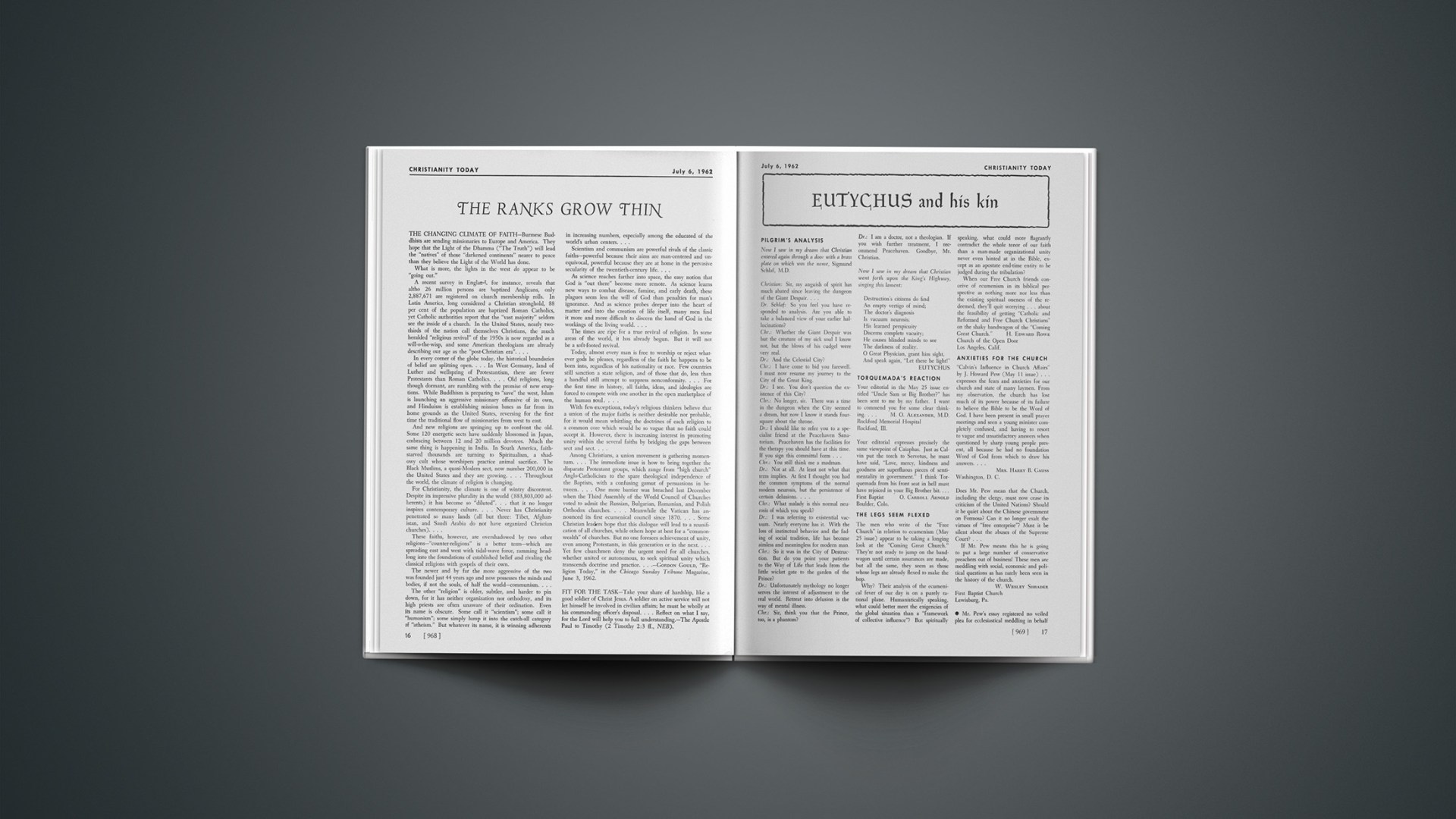
The Ranks Grow Thin

THE CHANGING CLIMATE OF FAITH—Burmese Buddhists are sending missionaries to Europe and America. They hope that the Light of the Dhamma (“The Truth”) will lead the “natives” of those “darkened continents” nearer to peace than they believe the Light of the World has done.

What is more, the lights in the west do appear to be “going out.”

A recent survey in England, for instance, reveals that altho 26 million persons are baptized Anglicans, only 2,887,671 are registered on church membership rolls. In Latin America, long considered a Christian stronghold, 88 per cent of the population are baptized Roman Catholics, yet Catholic authorities report that the “vast majority” seldom see the inside of a church. In the United States, nearly two-thirds of the nation call themselves Christians, the much heralded “religious revival” of the 1950s is now regarded as a will-o-the-wisp, and some American theologians are already describing our age as the “post-Christian era”.…

In every corner of the globe today, the historical boundaries of belief are splitting open.… In West Germany, land of Luther and wellspring of Protestantism, there are fewer Protestants than Roman Catholics.… Old religions, long though dormant, are rumbling with the promise of new eruptions. While Buddhism is preparing to “save” the west, Islam is launching an aggressive missionary offensive of its own, and Hinduism is establishing mission bases as far from its home grounds as the United States, reversing for the first time the traditional flow of missionaries from west to east.

And new religions are springing up to confront the old. Some 120 energetic sects have suddenly blossomed in Japan, embracing between 12 and 20 million devotees. Much the same thing is happening in India. In South America, faith-starved thousands are turning to Spiritualism, a shadowy cult whose worshipers practice animal sacrifice. The Black Muslims, a quasi-Moslem sect, now number 200,000 in the United States and they are growing.… Throughout the world, the climate of religion is changing.

For Christianity, the climate is one of wintry discontent. Despite its impressive plurality in the world (883,803,000 adherents) it has become so “diluted” … that it no longer inspires contemporary culture.… Never has Christianity penetrated so many lands (all but three: Tibet, Afghanistan, and Saudi Arabia do not have organized Christian churches).…

These faiths, however, are overshadowed by two other religions—“counter-religions” is a better term—which are spreading east and west with tidal-wave force, ramming headlong into the foundations of established belief and rivaling the classical religions with gospels of their own.

The newer and by far the more aggressive of the two was founded just 44 years ago and now possesses the minds and bodies, if not the souls, of half the world—communism.…

The other “religion” is older, subtler, and harder to pin down, for it has neither organization nor orthodoxy, and its high priests are often unaware of their ordination. Even its name is obscure. Some call it “scientism”; some call it “humanism”; some simply lump it into the catch-all category of “atheism.” But whatever its name, it is winning adherents in increasing numbers, especially among the educated of the world’s urban centers.…

Scientism and communism are powerful rivals of the classic faiths—powerful because their aims are man-centered and unequivocal, powerful because they are at home in the pervasive secularity of the twentieth-century life.…

As science reaches farther into space, the easy notion that God is “out there” become more remote. As science learns new ways to combat disease, famine, and early death, these plagues seem less the will of God than penalties for man’s ignorance. And as science probes deeper into the heart of matter and into the creation of life itself, many men find it more and more difficult to discern the hand of God in the workings of the living world.…

The times are ripe for a true revival of religion. In some areas of the world, it has already begun. But it will not be a soft-footed revival.

Today, almost every man is free to worship or reject whatever gods he pleases, regardless of the faith he happens to be born into, regardless of his nationality or race. Few countries still sanction a state religion, and of those that do, less than a handful still attempt to suppress nonconformity.… For the first time in history, all faiths, ideas, and ideologies are forced to compete with one another in the open marketplace of the human soul.…

With few exceptions, today’s religious thinkers believe that a union of the major faiths is neither desirable nor probable, for it would mean whittling the doctrines of each religion to a common core which would be so vague that no faith could accept it. However, there is increasing interest in promoting unity within the several faiths by bridging the gaps between sect and sect.…

Among Christians, a union movement is gathering momentum.… The immediate issue is how to bring together the disparate Protestant groups, which range from “high church” Anglo-Catholicism to the spare theological independence of the Baptists, with a confusing gamut of persuasions in between.… One more barrier was breached last December when the Third Assembly of the World Council of Churches voted to admit the Russian, Bulgarian, Romanian, and Polish Orthodox churches.… Meanwhile the Vatican has announced its first ecumenical council since 1870.… Some Christian leaders hope that this dialogue will lead to a reunification of all churches, while others hope at best for a “commonwealth” of churches. But no one foresees achievement of unity, even among Protestants, in this generation or in the next.… Yet few churchmen deny the urgent need for all churches, whether united or autonomous, to seek spiritual unity which transcends doctrine and practice.…—GORDON GOULD, “Religion Today,” in the Chicago Sunday Tribune Magazine, June 3, 1962.

FIT FOR THE TASK—Take your share of hardship, like a good soldier of Christ Jesus. A soldier on active service will not let himself be involved in civilian affairs; he must be wholly at his commanding officer’s disposal.… Reflect on what I say, for the Lord will help you to full understanding.—The Apostle Paul to Timothy (2 Timothy 2:3 ff., NEB).

A Plea for Prayer

The men upon whose shoulders rested the initial responsibility of Christianizing the world came to Jesus with one supreme request. They did not say, “Lord, teach us to preach; Lord, teach us to do miracles; or, Lord, teach us to be wise” … but they said, “Lord teach us to pray.”

Where do you suppose the Disciples learned the supreme importance of prayer? They learned it from Jesus. No one has given more encouragement to prayer than did Jesus. The followers of Christ were both encouraged to pray and taught how to pray. They saw constantly the example he set in praying and they noted the direct relationship between Jesus’ unusual ministry and his devout life of prayer.

Jesus considered prayer more important than food, for the Bible says that hours before breakfast, “… in the morning, rising up a great while before day, he went out, and departed into a solitary place, and there prayed” (Mark 1:35).

To the Son of God prayer was more important than the assembling of great throngs. The Bible says, “… and great multitudes came together to hear, and to be healed by him of their infirmities. And he withdrew himself into the wilderness, and prayed” (Luke 5:15–16).

The precious hours of fellowship with his heavenly Father meant much more to our Saviour than sleep, for the Bible says, “And it came to pass in those days, that he went out into a mountain to pray, and continued all night in prayer to God” (Luke 6:12).

He prayed at funerals, and the dead were raised. He prayed over the five loaves and two fishes, and a multitude were fed with a little boy’s lunch. He prayed, “Not my will, but thine,” and provided sinful man access to a Holy God.

It has pleased God to relate his work in the world to the prayers of his people. Noah prayed, and God handed him a blueprint of the ark of deliverance. Moses prayed, and God delivered the Israelites from Egyptian bondage. Gideon prayed, and the host of a formidable enemy fled in fear before his valiant, prayerful three hundred. Daniel prayed, and the mouths of the lions were closed. Elijah prayed, and the fire of God consumed the sacrifice and licked up the water around the altar. David prayed, and he defeated Goliath on the Philistine battleground.

The disciples prayed, and they were filled with the Holy Spirit so that three thousand were added to the Church in one day. Paul prayed, and hundreds of churches were born in Asia Minor and Europe. God does answer prayer.

What a privilege is ours: the privilege of prayer! Christian, examine your heart, reconsecrate your life, yield yourself to God unreservedly, for only those who pray through a clean heart will be heard of Him. The Bible says, “The effectual, fervent prayer of a righteous man availeth much.” Pray in times of adversity, lest we become faithless and unbelieving. Pray in times of prosperity, lest we become vaunted and proud. Pray in times of danger, lest we become fearful and doubting. Pray in times of security, lest we become self-sufficient.

Christians, pray for an outpouring of God’s spirit upon a wilful, evil, unrepentant world. Sinners, pray to a merciful God for forgiveness! Parents, pray that God may crown your home with grace and mercy!

Satan trembles when he sees the weakest saint upon his knees—so pray, Christian, pray!—Evangelist BILLY GRAHAM in a sermon on “Prayer.”

Lord, Teach Us to Pray!

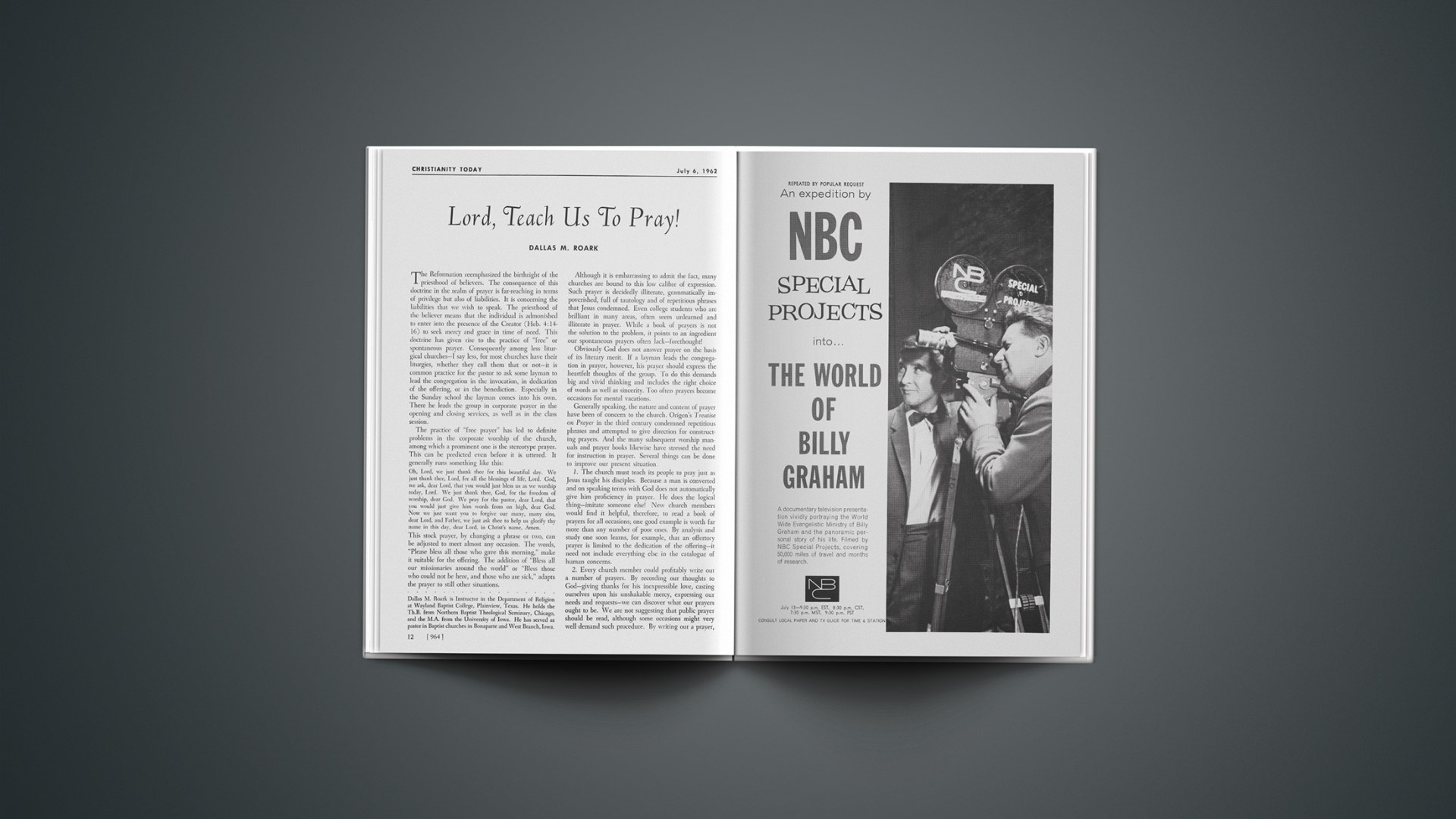
The Reformation reemphasized the birthright of the priesthood of believers. The consequence of this doctrine in the realm of prayer is far-reaching in terms of privilege but also of liabilities. It is concerning the liabilities that we wish to speak. The priesthood of the believer means that the individual is admonished to enter into the presence of the Creator (Heb. 4:14–16) to seek mercy and grace in time of need. This doctrine has given rise to the practice of “free” or spontaneous prayer. Consequently among less liturgical churches—I say less, for most churches have their liturgies, whether they call them that or not—it is common practice for the pastor to ask some layman to lead the congregation in the invocation, in dedication of the offering, or in the benediction. Especially in the Sunday school the layman comes into his own. There he leads the group in corporate prayer in the opening and closing services, as well as in the class session.

The practice of “free prayer” has led to definite problems in the corporate worship of the church, among which a prominent one is the stereotype prayer. This can be predicted even before it is uttered. It generally runs something like this:

Oh, Lord, we just thank thee for this beautiful day. We just thank thee, Lord, for all the blessings of life, Lord. God, we ask, dear Lord, that you would just bless us as we worship today, Lord. We just thank thee, God, for the freedom of worship, dear God. We pray for the pastor, dear Lord, that you would just give him words from on high, dear God. Now we just want you to forgive our many, many sins, dear Lord, and Father, we just ask thee to help us glorify thy name in this day, dear Lord, in Christ’s name, Amen.

This stock prayer, by changing a phrase or two, can be adjusted to meet almost any occasion. The words, “Please bless all those who gave this morning,” make it suitable for the offering. The addition of “Bless all our missionaries around the world” or “Bless those who could not be here, and those who are sick,” adapts the prayer to still other situations.

Although it is embarrassing to admit the fact, many churches are bound to this low calibre of expression. Such prayer is decidedly illiterate, grammatically impoverished, full of tautology and of repetitious phrases that Jesus condemned. Even college students who are brilliant in many areas, often seem unlearned and illiterate in prayer. While a book of prayers is not the solution to the problem, it points to an ingredient our spontaneous prayers often lack—forethought!

Obviously God does not answer prayer on the basis of its literary merit. If a layman leads the congregation in prayer, however, his prayer should express the heartfelt thoughts of the group. To do this demands big and vivid thinking and includes the right choice of words as well as sincerity. Too often prayers become occasions for mental vacations.

Generally speaking, the nature and content of prayer have been of concern to the church. Origen’s Treatise on Prayer in the third century condemned repetitious phrases and attempted to give direction for constructing prayers. And the many subsequent worship manuals and prayer books likewise have stressed the need for instruction in prayer. Several things can be done to improve our present situation.

1. The church must teach its people to pray just as Jesus taught his disciples. Because a man is converted and on speaking terms with God does not automatically give him proficiency in prayer. He does the logical thing—imitate someone else! New church members would find it helpful, therefore, to read a book of prayers for all occasions; one good example is worth far more than any number of poor ones. By analysis and study one soon learns, for example, that an offertory prayer is limited to the dedication of the offering—it need not include everything else in the catalogue of human concerns.

2. Every church member could profitably write out a number of prayers. By recording our thoughts to God—giving thanks for his inexpressible love, casting ourselves upon his unshakable mercy, expressing our needs and requests—we can discover what our prayers ought to be. We are not suggesting that public prayer should be read, although some occasions might very well demand such procedure. By writing out a prayer, however, one is apt to remember key thoughts and will be more adequately prepared for public prayer.

In cooperation with Dr. Henry Eason of the Wayland Drama Department, a number of students were asked to volunteer their cooperation in composing prayers for chapel services at Wayland Baptist College. One obvious result was a marked decrease in the repetition of pet phrases. But in the spontaneous portions of their prayers that incorporated the chapel leader’s prayer requests, students tended to revert to their customary phrases. It was also observed that when students prepared beforehand, their prayers improved grammatically as well as in content. Students also tried to express the same thought in different ways. This experiment definitely succeeded in encouraging students to think before praying.

3. A third essential for improving the quality of prayer must come from the pastor or the leader of a meeting. He must forewarn those who will be requested to pray. Often the endless repetitions in prayer are due to the spur-of-the-moment assignments we make to lead in prayer. Taken by surprise, and perhaps a bit nervous, the assignee can think only of Deacon Repeatem’s customary prayer. So he steals the Deacon’s fire and form.

4. Christian people need to learn that there is nothing wrong with pausing to think in the course of prayer. The fear of silence too often prompts us to throw in our favorite phrases like “dear Lord,” “our dear heavenly Father,” “dear Jesus,” and so on. In a prayer of a minute and a half, we heard one student use the title “dear Lord” 12 times. In conversation with a friend, such repetition would sound ridiculous. Pausing to think may very well eliminate disturbing and pointless repetition of phrases.

5. We need to say fewer but pray more prayers. Stop for a moment and recall the total number of prayers given in the course of an ordinary Sunday’s services. Without exaggeration there could easily be anywhere from 20 to 25 prayers. Unfortunately, most of them are the same. Instead of padding our services with “rote prayers” we need to pray more by repeating less.

Perhaps in no other area of our Christian lives are we so poverty-stricken as in prayer. We know that God will not hear us for our “much repetition of words.” And we know that men will not grow in prayer unless we lead them in meaningful prayer.

Perhaps now, as never before, we need to say, “Lord, teach us to pray.”

The Secret

In his hymn “O Master, Let Me Walk with Thee,” Washington Gladden expresses this request: “Tell me thy secret.” Prayer, I believe, was the secret of the life of Jesus Christ, God’s Son. On one occasion, after he had finished praying, one of his disciples said, “Lord, teach us to pray.” This is the only record we have of a request by the disciples to be taught of Jesus. Scripture nowhere indicates that the disciples asked him for instruction in how to preach or visit, how to organize, or to sing, or to play, or even to cook. But they did ask him to teach them to pray. The disciples knew that Jesus had spiritual power; the secret of that power they believed was his prayer life.

Jesus did not give us many rules about prayer, but he gave us a life that demonstrated the practice and power of prayer. Let me suggest that you read the four Gospels to discover what Jesus’ experiences were in regard to prayer.

Jesus prayed when he was baptized by John the Baptist (Luke 3:21).

Jesus prayed at the Mount of Transfiguration. “And as he prayed,” we read, “the fashion of his countenance was altered …” (Luke 9:29). Hours of prayer do indeed change the fashion of one’s countenance.

Jesus prayed on the occasion when Peter confessed faith in him as “the Christ of God” (Luke 9:18).

Jesus performed his miracles in the power of prayer. One day the Pharisees witnessed a strange thing. They had seen a man sick with palsy brought by some friends to Jesus. Because of the multitude these friends could not enter the house where Jesus was teaching. So they lowered the sick man into the dwelling through the tiliing of the roof. When Jesus saw their faith he healed the man. To those who witnessed the scene this was a strange occurrence. Luke precedes his account of this miracle by giving us this fact about Jesus: “He withdrew himself into the wilderness, and prayed” (Luke 5:16). No wonder unusual things happened. If the Church today prayed in greater power people would see strange things.

Ministry Steeped In Prayer

Early one morning when Simon Peter and others sought Jesus they found him praying in a solitary place (Mark 1:35). “All men seek for thee” (Mark 1:37), they told him. Jesus answered, “Let us go into the next towns, that I may preach there also: for therefore came I forth” (Mark 1:38). The Jesus who prayed in the solitary places went out to bless the multitudes.

In the Garden of Gethsemane he agonized: “O My Father, if it be possible, let this cup pass from me: nevertheless not as I will, but as thou wilt” (Matt. 26:39).

And he prayed as he hung on the cross: “Father, forgive them”; he said, “for they know not what they do” (Luke 23:34).

Christ’s entire ministry was steeped in prayer.

Not Many Rules

Our Master’s rules about prayer were few.

He told us to pray for laborers (Luke 10:2). He himself prayed for Simon Peter. “Simon, Simon,” he said, “behold, Satan hath desired to have you, that he may sift you as wheat: But I have prayed for thee, that thy faith fail not: and when thou art converted, strengthen thy brethren” (Luke 22:31, 32).

In the high-priestly prayer offered on the eve of his crucifixion, Jesus said, “I pray for them: I pray not for the world, but for those whom thou hast given me; for they are thine” (John 17:9, ASV). Jesus knew that his laborers would witness with their very lives in a needy but hostile world.

Jesus also admonished his followers: “… tarry ye in the city of Jerusalem, until ye be endued with power from on high” (Luke 24:49), thereby pointing to an essential factor for effective service. Both laborers and spiritual power come from our prayer-hearing and prayer-answering God.

Jesus tells us the manner in which to pray. He said, “… enter into thy closet, and when thou hast shut thy door, pray to thy Father which is in secret; and thy Father which seeth in secret shall reward thee openly” (Matt. 6:6).

Jesus never prescribed long prayers. In fact, he advised against using vain repetitions, and reminded us, “… your Father knoweth what things ye have need of, before ye ask him” (Matt. 6:8).

The prayer Jesus gave his disciples is recorded in Matthew and Luke. It is a revolutionary prayer. To pray “Thy will be done in earth, as it is in heaven” will change our lives, our homes, and our churches. We say this petition many times a day, but do we really pray it?

Jesus said, “… pray for them which despitefully use you, and persecute you” (Matt. 5:44). Here is a good place to put specific persons in your prayer list. I guarantee that if you pray for them lovingly and sincerely, God will change you. I know this truth by experience.

Jesus said, “If you ask anything in my name I will do it” (John 14:14, NEB). I have discovered that one cannot ask for spiritual power if it is to be for one’s own glory or even for the glory of the Church. If spiritual power will bring glory to Christ, then ask for it in his name.

Jesus illustrated that “… men ought always to pray, and not to faint” (Luke 18:1) by means of a parable. No matter what the difficulty, problem, or trouble may be, we need not be fainthearted nor defeated. We still have the presence of the Holy Spirit to comfort and buoy us. God has sent us the Holy Spirit that he may abide with us forever.

Plea For A Prayer Table

Jesus had a certain place to pray. I know it is possible to pray anywhere at any time. But Jesus had a certain place. As I visit in numerous homes, I often see a certain place for prayer, namely, a table. On this table are a Bible and devotional books, and sometimes a picture of Christ.

In our homes, we have a table for eating, for cooking, for sewing, for games, even for beauty preparations. Why not a prayer table?

Some years ago a Mr. Brown lived in Meridian, Mississippi, who was known as Praying Brother Brown. One day he took me to a closed door in his home. “Brother Harry,” he said, “I do not let many persons go into this room, but I am going to let you enter. This is Peniel.” Jacob, you remember, had given this name to a place where, he said, “… I have seen God face to face” (Gen. 32:30). What a blessed room to have in a home!

“And it came to pass, that, as he [Jesus] was praying in a certain place, when he ceased, one of his disciples said unto him, Lord, teach us to pray, as John also taught his disciples” (Luke 11:1).

The Importance of Private Prayer

We live in a jet-propelled, noisy, and restless age. Split atoms and split personalities characterize our times. Like Paul, the good we would, we do not, and the evil we would not, that we do (Rom. 7:19). Ours is a generation marked by uncertainty and fraught with fear. Personal, national and international tensions have taken their toll. We have lost our moorings, and attempt to cover our anxiety and frustration under a blanket of sound and motion. Speaking to this situation, Editor Norman Cousins of The Saturday Review has said, “Plainly this is not the age of meditative man. It is a squinting, sprinting, shoving age. Substitutes for repose are a million-dollar business. Silence, already the nation’s most critical shortage, is almost a nasty word. Modern man may or may not be obsolete, but he is certainly wired for sound and has ants in his pants.”

Our problem is not new, nor is it without antidote. More than 27 centuries ago Isaiah proclaimed to a restless people, “In quietness and in confidence shall be your strength” (Isa. 30:15). To a troubled land the Psalmist declared, “Be still, and know that I am God” (Ps. 46:10). Christ, speaking to his exhausted disciples, said, “Come away by yourselves to a lonely place, and rest a while” (Mark 6:31); and on the night of his betrayal he commanded them, “Watch and pray, that ye enter not into temptation: the spirit indeed is willing, but the flesh is weak” (Matt. 26:41).

These words suggest the solution to our problem. The importance of private prayer cannot be overestimated. We are busy people living in a hurried age, and find ourselves engaged in countless pursuits which sap our strength, time, and energy. In activism we neglect our prayer life, only to find ourselves lacking the wisdom, direction, and purpose that such a life affords. Until we learn to cultivate this prayer life we will always be at loose ends. Jesus’ words “without me, ye can do nothing” (John 15:5) are pragmatically true.

Private Prayer As A Defense

Private prayer is important because it provides the Christian with a formidable defense against life’s perplexities and difficulties. “Watch and pray, that ye enter not into temptation,” said Jesus to his disciples. The word temptation in the New Testament can mean at least two things—to be lured and enticed to evil or to be tested and tried as by affliction and sorrow. While Christ obviously addressed an immediate circle and situation when he spoke these words, they are nonetheless universally and comprehensively true. Private prayer is a defense against both enticement to sin and the sorrows and afflictions of life. Prayer and watchfulness mean vital contact with God; they are our defense, for in their practice we see life in proper perspective and discover the meaning of Isaiah’s assurance, “… they that wait upon the Lord shall renew their strength” (Isa. 40:31).

There is no stronger weapon against the power of evil in our lives than private prayer. This is why the Scriptures so frequently enjoin us to pray, and why at the same time the powers of evil constantly buffet us to keep us from prayer. It is no coincidence that the giants of Christendom have been men of prayer who were frequently called to endure hardship and suffering. We must not forget that the prelude to Jesus’ ministry was a period of solitude in the wilderness and that he constantly sought the quiet place to commune in prayer with the Father. The account in the Book of Acts concerning the establishment of the church notes that “… they continued stedfastly in the apostles’ doctrine and fellowship, and in breaking of bread, and in prayers” (Acts 2:42). And in studying the life of Paul we are impressed by the place of prayer and solitude in his preparation and ministry. He had his Arabia at the outset, and throughout his years of service a continuing fellowship with Christ in prayer.

While addressed to ministers, John Henry Jowett’s words are true for all believers:

I am profoundly convinced that one of the greatest perils which beset the … [Christians] … of this country is a restless scattering of energies over an amazing multiplicity of interests, which leaves no margin of time or strength for receptive and absorbing communion with God. We are tempted to be always on the run,’ and to measure our fruitfulness by our pace.… We are not always doing the most business when we seem to be most busy. We may think we are truly busy when we are really only restless, and a little studied retirement would greatly enrich our returns. We are great only as we are God possessed; and scrupulous appointments in the upper room with the Master will prepare us for the toil and hardships of the most strenuous campaign” (The Preacher: His Life and Work, New York, Harper, 1912, pp. 62–63).

It is the presence of Christ realized in private prayer that is our defense against the inroads of evil and the strain of trial. It was this truth that occasioned Paul’s words, “I can do all things through Christ which strengtheneth me” (Phil. 4:13), and John’s assurance “… greater is he that is in you, than he that is in the world” (1 John 4:4).

Private Prayer As A Discipline

Private prayer is also a discipline. Perhaps failure to learn this discipline of prayer explains why many Christians have not discovered the defense that prayer provides against temptation and evil. Christ told his disciples to ‘watch and pray.” Prayer is not some perfunctory ritual; it is work and involves time and effort. Our emphasis on group dynamics and “togetherness” has frequently overlooked this truth. While being sensitive to the voices of the crowd, we have not realized that the crowd is a fearful thing, that its standards of success are unreliable and a menace to valid self-evaluation. The street needs our expressions of activity and faith, but he who has learned the discipline of prayer will be the strongest spiritually and the most fruitful in Christ’s service among men.

But what is our usual experience? Noise—motion—throngs—rarely the secret place. Radios lull us to sleep at night and awaken us in the morning. We have music while we work, while we shop, and while we study. Television has telescoped world events, sports, and plays into our homes. From morning until night the continuing noise and activity externalize and secularize our life, luring our interest to peripheral things and constantly draining our emotions and nerves of vitality. As T. S. Eliot describes the situation:

Where is the knowledge we have lost in information?

Endless invention, endless experiment,

Brings knowledge of motion, but not of stillness;

Knowledge of speech, but not of silence;

Knowledge of words, and ignorance of the Word—

Where is the life we have lost in living?

Where is the wisdom we have lost in knowing?

We shall never search out the riches of God nor even begin to know ourselves until we establish the discipline of private prayer. Only thus can we maintain our fidelity to Christ and the integrity of our own soul. With its noise and false standards the crowd gives a distorted view of life. We see the text but not the context, facts but not relationships. The discipline of prayer provides perspective.

There are many avenues of service, but we can not fulfill them until we are prepared. Peter learned this. His potential was great, and once prepared, there was little he could not do. But when Christ said, “watch and pray,” Peter slept. Although full of good intentions, and even of confident boasts, Peter was not qualified for service until he learned the discipline of prayer.

Prayer requires time and determination and it taxes our strength. But it is essential to Christian fruitfulness. In the sermon he preached at his mother’s funeral, Clarence Macartney gives a telling picture of her disciplined prayer life.

She taught me to pray!… not merely by precept and commandment, but by example. She … realized that she had brought into the world immortal souls with an infinite capacity for joy and happiness. She travailed in prayer that she might discharge with the utmost fidelity the high and holy office of motherhood.… She paid the price of spiritual power by continually waiting upon God. The beneficient river of her life was fed by an unfailing fountain of communion with God. She endured as seeing Him who is invisible. She was not content with morning and evening worship which was held daily in this home, but had her own time and place of intercession. Well do I remember the room and the hour when we all knew that mother was not to be disturbed, for she was on her knees praying for her children. Then to our childish hearts it seemed a small thing, but now, looking backward across the years, we begin through our tears to discern its significance” (“A Son’s Tribute to His Mother” in Hurlbut’s Great Sermons by Great Preachers, Philadelphia, Winston, 1927, p. 620).

Private Prayer As A Declaration

Besides being a defense and a discipline, private prayer is also a declaration, a testimony. By cultivating and practicing the devotional life we give witness to our faith and loyalty to Christ, for the extent and quality of our prayer life will invariably be in direct proportion to our commitment to him. Our busyness in Christian activity may delude both us and others as to our piety, but the time spent in the quiet place is what really tells the tale.

Thomas Hooker, a Puritan divine of more than three centuries ago, admonished New Englanders in this regard.

Labour to give attendance daily to the promise of grace and Christ, drive all other suitors away from the soule, and let nothing come between the promise and it, and forbid all other banes.… Let not thy heart onely see the promise once in a week, but shut out all others, and keep company onely with that, and see what beauty and strength, and grace there is in the same. (Douglas Horton, The Meaning of Worship, New York, Harper, 1959, p. 78).

If Christ is Lord of our lives communion in prayer will be the reasonable response of a loving heart. If Christ is truly loved, our devotional life will be transformed from a duty to a delight and from a mere form to a spiritual force.

Closely related to our love for Christ is our commitment to him, as implied by Jesus’ words, “If ye keep my commandments, ye shall abide in my love; even as I have kept my Father’s commandments, and abide in his love” (John 15:10). Private prayer declares this commitment, for here we bare our souls to God. Withholding nothing, we seek his pardon, his wisdom, and the knowledge of his will. In private prayer our total being is transformed and renewed, for “if any man be in Christ, he is a new creature” (2 Cor. 5:17). As Archbishop Trench exclaimed:

Lord, what a change within us one short hour

Spent in thy presence will avail to make!

In other words, our transformed lives will be a visible declaration of our commitment. This transformation is wrought largely in prayer.

Christian maturity is impossible without private prayer. For it is private prayer that waters the seed of faith and encourages spiritual fruitfulness. As a defense against the enticements of evil and the tests of affliction; as a discipline to strength and character; and as a declaration of our love and commitment, private prayer is absolutely essential to Christian growth. Because our spirit may be willing, but our flesh weak, we must “watch and pray.”

Anxiety and Peace

These things have I spoken unto you, that in me ye might have peace. In the world ye shall have tribulation: but be of good cheer; I have overcome the world” (John 16:33). Here at one and the same time Christ our God promises us two seemingly opposite experiences. Can peace and tribulation be compatible?

Today’s world is so desperate for peace it will even wage war if necessary to preserve what it considers peace. The West seeks a personal peace, especially a peace of mind for which it is felt the various freedoms of democracy are required—freedom of worship, freedom of press, and so on. As Christians we, too, are caught up in this kind of thinking, so that it permeates our desires. Another, far more subtle influence on us is psychiatric philosophy which stresses peace of mind through freedom from anxiety. According to the popular concept, things are bad not because of their essential nature, but rather if and to the degree that they create anxiety-producing conflicts. Adultery as such is not evil according to this belief, but the conflicts in the wish-defense system resulting from a puritanical upbringing are. We can avoid such tension, we are told, by adjusting to the realities of society, an adjustment that often involves relinquishing what is termed our “unrealistic morals.” Obviously Christians often find themselves in the dilemma, then, of not wanting anxiety but of not wanting to adjust to a sick society either.

Why do people so dislike anxiety? (Often the term mental anxiety is used in the same sense as physical pain.) Basically fear of the unknown, and conditions of uncertainty upset us. The great American psychoanalyst, Harry S. Sullivan, has said that any remembered or anticipated event that tends to lower one’s self-esteem among others brings about anxiety. He claims that while we spend many waking hours simply avoiding anxiety, no adequate behavior pattern exists for relieving anxiety. Besides the pain of anxiety people fear what anxiety and its causes will do to their personalities and to their chances of success. Mankind dislikes anxiety because it reveals the presence of some unmet “need.” It represents the tension of some unsatisfied “drive.” We might very well ask, however, does pain have any value? Is it harmful not to know for sure? Are the needs we experience real, are these drives innate and therefore necessary?

1. Christians pay a high price to avoid anxiety. The high price to be paid to avoid this anxiety is having to adjust to the norm of an essentially sick society. If we wish to avoid the embarrassment of being called a “square” we must conform to the standard behavior of our immediate society whether this be the apparent righteousness of the good middle class or the apparent nonconforming of the beatniks. In our society, to be unpopular shows something is wrong with a person. It is very difficult to resist the unstated but very real and strong pressures of close-living society and of mass media. Let’s face it—to be popular you must be similar to those of that group. To a great extent, our feeling of worth comes from how much others praise us. We hate to lose face, and our feeling of importance; we don’t want our ego punctured, we don’t want to be corrected. We would rather be dishonest than considered a “sucker” for returning incorrect change. Even on Sunday we rush around like the rest of the world to allay our anxiety with recreation.

2. To avoid anxiety Christians often push aside the responsibility of making decisions. Or we hurry them through without proper thought, simply to get them out of the way. Just look at the stupendous sale of how-to books of advice—how to bring up children, how to make friends and influence people, how to eat to be healthy, how and what to read, how to live comfortably on only $50,000 a year! Such books are more numerous and popular than any other kind. Men want some “father image” to guide them in what to think or do, be it Kennedy or Khrushchev, and usually conform unless some uncomfortable situation will result. This tendency to shirk decision-making is seen among Christians who claim, and appear to be, seeking God’s guidance but who act primarily on the basis of circumstances. By the easier course of following the dictates of closing and opening doors, they become the victims of circumstance rather than responsible determiners of policy and practice.

3. To avoid anxiety and mental anguish, men seek comfort in a variety of escapes. They travel to get away from their troubles, sleep to forget their labors, entertain to erase their sorrows and drink to banish their fears. They try desperately hard to be happy. This mood even touches churches where jokes and happy, snappy songs enliven the congregation. Such procedure often avoids the pain of God’s probing light of truth. On the other hand, those are no better who, afflicting themselves through neurotic introspection, evade the anxieties of real problems by seeing only the evil they wish to see.

From the time we begin earning money we save for a radio, some gadget or a trip and offer many reasons for our action. Basically, however, these things are supposedly the answer to whatever troubles us. And all of us seem to be troubled. Why do we need a big, roomy house and car, why do we need a hobby, why do we need recreation and travel? Why? So we won’t become overworked, overanxious and sick! This is the modern, popular American philosophy of life. Reared in this atmosphere we Christians tend to accept this pattern, too. But, you say, this is natural, this is to be expected. Unfortunately, humanly speaking, I am inclined to agree with you. But just how much of this is really natural? Just how far can the Christian go in his natural pursuit of natural things to allay anxiety? Is there possibly some other way? For someone who wants to avoid anxiety the logical conclusion is simply to do nothing. But is this natural? Or is it another of desperate humanity’s vain attempts to be happy, when physical and mental pain are ubiquitous and inevitable, and when the fear of possibly soon, sudden death is being continually forced into awareness?

We have peace! “… my peace I give unto you!” said Christ, “not as the world giveth, give I unto you” (John 14:27). This peace is distinctly different. It is not freedom from anxiety, nor the peace of comfort, nor the peace of peace treaties. Rather, in the peace of Jesus Christ: (1) We have freedom from enslaving sin and from oppressing guilt. We can rest fully in Christ’s finished work for us. (2) We have a fully satisfying purpose for living, namely, God’s glory. We have love as the all-encompassing motivation. We have Christ in us as the strength to live this life. (3) We have the promise of personal safety and knowledge of our future, gifts that no human system can provide. “I will both lay me down in peace, and sleep! for thou, LORD, only makest me dwell in safety” (Ps. 4:8). We have no fear of uselessness and of eventual oblivion. The Christian knows that so long as God can use him here, he will be kept for service and in the state that God thinks best. These and other assurances support the believer. Why then should we be anxious?

Anxiety—that fearful anticipation of some future unpleasantness—is inevitable. Anyone who attempts to make the right decision, anyone who wants to do what is right, experiences anxiety. Because he has a special desire to live righteously, the Christian, therefore, in many respects has greater than usual anxiety. What are some of the uniquely Christian anxieties?

1. A Christian is commanded to love his neighbor as himself. Whenever he makes a personal decision, therefore, he must consider his neighbor’s welfare as well. Shall I buy a new car or should I use the money to help an alcoholic’s needy wife and family? Even in the use of our time we must choose perhaps between spending it for our own spiritual refreshing, listening to a fine preacher or serving an embryo church. Bearing one another’s burdens involves concern. For such things the world shows no real concern; the Christian must.

2. A Christian has been converted: he is a born-again, new creation and thus basically different from others. While his physical form has not changed, his manner of life shows changes because he no longer seeks his own, but God’s glory. Such God-ward living involves a suffering which the world does not know. Christ, however, has given us the reason and the pattern for this experience: “For even hereunto were ye called: because Christ also suffered for us, leaving us an example, that ye should follow his steps” (1 Pet. 2:21). This was more than just physical suffering. As he prayed and anticipated the awfulness of the world’s sin to be borne by his holy person, Christ sweated “as it were great drops of blood.” As Christians we are essentially different and tend to live differently; therefore we are basically not popular. If we are living as Christians and people elect us to public office, they do so because of our ability and integrity rather than for our affability. Should we first of all seek to be well liked, it would mean hiding or demeaning our basic differentness. No worldly person likes to have his essentially selfish nature revealed by contrast. In any group, different people disturb the desired complacent uniformity of that group and therefore tend to be extruded and made to be scapegoats. While the world fears loneliness, Christians should not be disturbed at being without friends in the popular sense. In their seeming aloneness they have opportunity to experience more fully the fellowship of Christ.

Because he seeks God’s glory the Christian must discipline his body and mind. The earthly nature rebels against attempts to check its “needs,” and the Christian, like others, recognizes the presence of desires, for example, to enjoy free expression of libidinal drives. Christians also experience anxiety about witnessing because this activity really marks us as being different. Yet we must remember that when we withhold the message of salvation from someone in order to avoid personal embarrassment, we may be denying a sincere seeker his only route to true peace.

3. When he seeks fellowship with God, a Christian often experiences the opposition of Satanic forces. He encounters interference with his determination to study the Bible and pray for growth and strength. To face these difficulties honestly, however, is far better than to yield to proffered short cuts. There are no Ten Easy Steps to Study the Gospels, or to spiritual maturity, for that matter. There is at times the anxiety of doubt, especially during intensive learning. “How do we know, can we prove there is a God? Am I really a depraved creature or suffering from some kind of a complex? Why should God allow suffering and tragedy?” If we honestly commit our entire beings to God we are bound to experience some apprehension. “Will his way be hard, will it be one of suffering?” we ask. Even the strong in faith may have qualms over some new missionary venture.

4. Despite the fact that we are admonished to confess our faults one to another, a Christian still tends to fear being seen as he really is. Thus the Christian must face the anxieties of making right decisions, being different in the world’s groups, committing himself to God who is sometimes not easily seen, and exposing himself to God’s searching truth.

These are some of the most common anxieties and anxiety-producing situations that confront every courageous Christian. Actually the absence of anxiety may often be the happy delusion of Satan!

Anxiety has genuine value. Like pain in the body it warns of further discomfort or trouble. Anxiety may occur when conflict arises between the new spiritually oriented and the old physically oriented natures about satisfying some innate drive. Or it may occur when some directive of God disturbs our present comfortable state. In any case we should face and examine the anxiety to determine its cause and implications. When a conflict involves us we usually discover it develops from our dislike of accepting or deciding on something that will make us uncomfortable.

We usually interpret affliction in the Bible as meaning physical suffering. Actually, however, the word also involves the concept of fear. In fact, Job and David more often mention suffering in terms of mental anguish than of actual physical hurt. Often God uses affliction to remind us of our inadequacies and failures, of our need for his forgiveness and enabling. Anxiety often stimulates as well as reveals spiritual growth. It helps us dissociate ourselves from the physical mind and body and to live “in the Spirit.”

But there is also a type of chronic or neurotic anxiety that is not only useless but unchristian as well. It is neurotic when it is absurd in terms of reality when it is based on unreal fears or fantasy. Instead of being an aid to learning and growth it becomes instead a destructive and vicious enemy. It is true that many anxiety-producing conflicts are repressed, that is, unconsciously pushed out of awareness. For many Christians, however, the causes of conflict are quite apparent, especially when examined in the light of God’s Word. Yet they prefer to dabble in the usual anxieties of society instead of dealing with their problems realistically because to do so might impinge on the amount of comfort they have allowed themselves. This kind of conflict explains how in our country a big car is considered a necessity while in many cold places of the world shoes are a luxury. Yet we are aware of Christ’s command to love our neighbor, the man whose need we see and know, as ourselves. Are spiritual values real? If so, we ought to discard the confining neurotic fear of what people think or will think and do our duty in the firm assurance that it is God who “fighteth our battles.” Let us not hide under the neurotic comfort of society’s conformity but openly face the real conflicts of spiritual warfare.

The man who excels physically is the man who can hear the discomforts of rigorous training. Anxiety tolerance is a similar discipline. I have often seen the young, apparently healthy, male college student work far into the night to pack shining new gear and necessities against hunger and cold for his first mountain climbing expedition. In the early morning his companion waits impatiently while our hero fortifies himself with a hearty breakfast. The friend’s worn boots, frayed jacket, battered ice axe and other equipment are evidence of perhaps extensive experience in this rugged sport. At the base of the mountain our hero enthusiastically strides ahead. In less than 500 feet he must rest his aching feet, ease the unnecessarily heavy load from his aching back and quench his terrible thirst at a nearby stream. He grumbles about the heat, the mosquitoes and the underbrush. He never notices his companion’s preoccupation with a delicately fashioned wildflower. When they finally reach the alpine lake where they will camp, our hero collapses onto the damp grass, shuts his eyes and groans, stirring only to swat at the insects. His friend meanwhile, having spread his sleeping bag in the shadow of a rock, wanders across the flowered meadow, marvels at the grandeur of the encircling peaks and mentally picks tomorrow’s route. During the night our hero jumps in fear at every crack of a twig; his friend, after gazing into the depths of a star-strewn eternity, commits himself to the safe keeping of his Creator-God and falls asleep.

Toiling on the rocks and ice the next day our hero in the same puffs loudly bemoans his full stomach and questions the charting of the route. He sees another gully that is far less steep. What he doesn’t see are the falling rocks that periodically funnel into it. As the ridge narrows he becomes frightened; he shuts his eyes, thereby hindering his sense of balance. Taking his leader’s proffered hand, he is nevertheless afraid to rest his weight on it, trusting rather the crumbling rock under his own hand. He wants to untie the rope and quit the climb but the leader restrains him from this dangerous folly. Oh, if only he had never left the comforts of home! At the summit his agony is so acute he can think of nothing but the pain and danger of the descent and completely misses the panorama of glaciers and mountains.

You may say the men differed in physical stamina and in courage. Yes, they probably did. At the same time the leader of the party also experienced the discomfort of sore feet, and so on, and fear of the steep ridge. In fact, he saw far more of the real dangers and had the worry of his friend’s safety besides. The real difference between the men is that the leader, engrossed in the far greater significance of the surrounding beauty and of sharing the climb with his friend, overlooked his discomforts. Furthermore, each successive encounter with the rigors of mountain climbing developed greater confidence in the God who enabled him to overcome his anxieties.

I do not consider peace and anxiety incompatible. Personal peace of course will be perfect and complete only when at last we reach the Land that is fairer than day. Meantime, however, while still subject to temptations and infirmities, we jeopardize our power and peace by trying to avoid anxiety. God knows our limitations. Why not let him undertake for us instead of trying to protect our comfort. “Casting all your care upon him; for he careth for you” (1 Pet. 5:7). Despite our desire to do so we fail to accept his invitation. We fear greater anxieties await us, if we fully yield ourselves to His care and leading.

Perhaps we’re cowards. Although we’re in a hot war we want to play ostrich like everyone else and pretend all is well. To avoid conflict spells defeat. On the other hand, victory may be ours from the very outset of our conflict through Christ. He promises us victory because he has already conquered and is still conquering in our behalf. We ought to seek peace but not the spiritually corrupting coexistence the Israelites tolerated in their promised land. While it may seem paradoxical, to cast off society’s enslaving worries about physical and mental ease and to accept instead the rigorous anxieties of spiritual warfare will bring true peace of which Christ is the Prince. “Take my yoke upon you, and learn of me; for I am meek and lowly in heart: and ye shall find rest unto your souls” (Matt. 11:29).

God Made Me to Laugh

Once upon a time many churchgoers suspected anything funny was subversive. Yesterday’s pilgrim didn’t dare to clown and Plymouth squeezed itself into a poker face. We’re always photographed saying “cheese,” but a Winthrop wouldn’t unlace a smile even for his heirloom portrait. Those old sobersides really scrambled goodness with solemnity. They weren’t as dreadful as we are determined to make them for they knew where frivolity leads. But the Calvinist was so afraid of fun’s consequences that he tried, at his fanatic worst, to wipe off every smile, put a stop to dancing, and turn off the organ music. He wouldn’t let artists play with color on canvas or in stained glass any more, so that the apostles looked as dead pan as Cigarstore Indians.

Critics unjustly trace to Jesus the depressing graveyard atmosphere that sometimes haunts the Church. The men who really killed joy wore pointed three-cornered hats and buckled shoes. “The parsonical voice, the thin damp smell of stone,” as British architect Hugh Casson calls it, were flung like a pall over the faith by some of Cromwell’s men. Frankly, this grinning generation doesn’t respect its forefathers enough, but those grim graybeards do deserve the blame for taking the fun out of religion.

Christ was simply not cut from black cloth no matter how the Pharisees dressed him down. The Gospels give us a warm friend, full of life, laughter, and such good news it showered radiance on the heads of saints and sinners alike.

It was the Pharisees—long-faced, fasting, frowning—who always appeared to be in perpetual mourning. Christ’s men behaved like a feasting bridal party. “How,” he asked those who scorned his merrymaking, “how can men fast when the bridegroom is still with them?” There is much more to Christianity than skipping along blithely, but neither can it keep always in marked military step. Men may only stand up for the Hallelujah Chorus, but it makes hearts skip with excitement. Christ was born in a burst of angelic “Joy to the World.” And when he came back triumphant from the fight with death there was such heavenly light, such overwhelming evidence of his resurrection life shining about him, men trembled in ecstasy.

Certainly life was not too sweet to Christ. She Hew at him in a tantrum, flung suffering in his face, and hung him up to die. We do not keep back the tears. But he took life and taught it a thing or two. Nothing could destroy Christ’s good humor, for life tried everything. Past master death at last had lost a man—that called for a celebration! The last meal of the condemned man was not taken smiling bravely through his tears, but as a victory banquet. In fact, there is so much Christmas cheer in his achievement, we have never stopped celebrating and never will stop “as long as ye eat this bread and drink this cup.”

Everyone knows that death did something terrible to Christ, but not everyone knows he did something wonderful to death. Men keep missing the whole point of the old, old story. No one knows how he did it. But the deed was mighty enough to dry Mary Magdalene’s tears, transport desolate disciples into an upper room of unspeakable joy, and send them out stammering with faith in jail and out, living or dying. After five terrible beatings and two horrible stonings, Christianity’s most jubilant apostle got up and dusted off the opposition with a shout, “Rejoice, and again I say unto you, rejoice!” After wading through inquisition, torture, blood, and hell, the Book ends with a great host no man could number singing “Hallelujah!” As Dr. Fosdick has said, “There is … enough tragedy in the New Testament to make it the saddest book in the world and instead it is the joyfullest.”

There was something to laugh about before Christ’s time, of course, but doomed men did not, do not, feel much like laughing. However high we rate the world’s other religions, none scores very high in joy. Buddhism recommends the equivalent of slow suicide for life. Hinduism is too shy and Islam too fierce and militant to find anything amusing. But even Calvin’s catechism claims “the chief end of man is to glorify God and enjoy Him forever.” Humor happens in the happiness that grows out of the “good news.” The insecure, the rejected child cannot smile much. To produce laughter in gales and peals takes more than bread enough to go around, it takes trust in a loving father. If we believe we will feel like singing something. And we will feel and be free enough from the curse of guilt and grief to see the humorous side of life.

We’ll see, too, that humor is built right into the whole Creation. Mother Nature can be a scream. Jungle life can act up like an ape, sass us like a parrot. Disney didn’t create the heavens and the earth. That was done by the same One who did Disney’s sense of humor. The model skunk was not drawn without a smile. “No somber God could ever have made a bullfrog or a giraffe.” Dr. Buttrick believes “a row of penguins looks for all the world like a speaker’s table.” Who can keep a straight face, watching little lambs scampering about stiff-legged; or baboons itching? Hearts are breaking all around us. God knows, for he gets blamed. But sides are splitting, too. Someone has been up to something even on the deathbed. Phyllis McGinley quotes Oscar Wilde as saying, “I am dying as I lived, beyond my means.” Remember Sir Thomas More’s parting remark to his hangman? “Assist me up, if you please. Coming down I can shift for myself.” Even when we are at the bottom of our morale someone spoils the misery. Some ramrod usher spills the offering on the marble chancel floor or some pious cleric solemnly folds his hands and intones “Let us play, er—pray.” Life doubles us up in laughter as in pain, and in pain Christians remember how the Lord said: “Blessed are ye who weep now, for ye shall laugh.”

Our faith makes a man laugh at something more—at himself. We are all tempted to take ourselves too seriously. If taken in the right way Christianity brings relief from this wearisome self-inflation. Someone who feels safe and sure in the hands of God and likes to see his neighbor have a good time will come down from his pedestal and enjoy the joke he is. A Christian is not afraid to have a little fun at his own expense. Robert Frost said: “Forgive, O Lord, my little jokes on Thee and I’ll forgive Thy great big one on me.”

Christian joy is not complete, however, until men surrender unconditionally to God. Christian joy is not passed out with the Sunday bulletins; it blooms from the dedicated life. The sweets of the faith, God’s friendship and forgiveness, the only fun that’s any good and clean, lie around lifeless and dormant until we are sworn in. It was not until St. Francis gave himself up to God, silver and soul, that he started singing and dancing in the streets. Why don’t we have strength to carry a tune? Could it be that nothing ever broke our ego’s ice to make us burst with music? A new birth, Christ said. And until that old native stone of self is pried up, laughter will be but the leftover residue from swapping old jokes, the slimy scum that congeals on dirty stories. It is the decision to do the will of God that gives us wings to meet and embrace the joy coming down from heaven. That’s what unclenches the Zacchean fist; that’s what makes us cut and serve our little piece of property with irrepressible generosity. The report of our change will go up like a cheer from all the King’s men.

But what really brings down the Christian house is not the arrival of the righteous but the homecoming of the damned. The greatest happiness comes for a Christian not when he himself enters the Kingdom, but when it happens to someone unexpected. A man who is alive can laugh, but laughter is a love story that dotes on another’s rescue best of all. The Good Shepherd gets more excited over finding one stray lamb than bringing in the ninety-nine. The father did not celebrate the boy who stayed behind. The thing that made him shout for joy was to see the lad he’d given up for lost coming toward him over the horizon.

Nothing makes heaven half so happy as these surprise come-backs. This life’s mortal storm is frightening. But could the thunder perhaps be the crashing of God’s cymbals to herald a man come out from the mouth of hell? The world is full of “sound and fury” signifying something—deafening applause by the numberless multitude for some one who made it in the midst of temptation. And when the sun seems blotted out, could it be covered with caps tossed high in triumph by “the great host of witness” who herald someone’s victory against great adds below? “I tell you there is more joy in heaven over one sinner who repents.”

Christianity In Free Europe

Within the past two years, CHRISTIANITY TODAY has devoted complete issues to the question of the world missionary situation and, more particularly, to a survey of the spiritual state of Great Britain. Facts and figures were charted and analyzed, and their significance competently assessed. The response has been so remarkable that our next issue (July 20) will feature a parallel survey—Christianity in Free Europe, with special reference to the period 1912–1962. These 50 years have seen the growth of a materialism which, it has been suggested by a former President of the United Nations General Assembly, is doubtfully worth more than the dialectical materialism of Communism. At our invitation, residents of various European countries will tell how God is nonetheless working through faithful servants, how the Gospel is still being preached, and how men and women are still being won for the Saviour in every land and in every walk of life.

Review of Current Religious Thought: June 22, 1962

IT SEEMED kind of inevitable that I should get around eventually to the writings of J. D. Salinger what with his Franny and Zooey leading the best-seller lists week after week and, along with the fetching title, The Catcher in the Rye, giving me all kinds of curiosity. Then there was the parade of reviews, and it wasn’t just that some reviewers thought Salinger clever (which he is), and funny (which he can be), and very much the fad right now (which gets me into the picture, I guess), but the big boys among the reviewers thought he was of great importance. So I read The Catcher in the Rye which I maybe read too rapidly because I read while I was on a trip, in bits and snatches; and I felt after the rapid reading, which is unfair for judgment, that I came out just about where I went in: there was this poor, touching, adolescent boy who had to leave school and didn’t like to face his parents, and he had enough money in his pockets to have a few days on the town, and we get the impression he has a nice heart and that he is kind and compassionate in a kind of rebellious sort of way, and that he’s a mixed-up kid, and that maybe with a little direction or motivation he might just turn out all right although it is hard inside this little story to figure out just what being “all right” would include. The scenes are vivid and the characters are clear, but the total effect of the book for me was just about the same as seeing that adolescent with his baseball cap on backwards—sort of silly, especially if he knows any better. Only catchers should wear their caps backwards and any kid, adolescent or otherwise, knows that, but it is sort of the unbuttonness of the boy and the unbuttonness of the book that this boy wears his cap backwards all the time—but then, on the other hand he is a catcher, a catcher in the rye, by jove. And like that.

Then comes Franny and Zooey. The names sound like people with their baseball caps on backwards again, but it turns out that the characters in this book are grown up, or adult, or mature. I used to think that John O’Hara was the best writer of conversation of the day, and I think he still is, in exchange and repartee; line upon line, sentence upon sentence, the conversation just pours out all over you. And it’s real good, too. It must take endless patience as well as a good ear to write conversation the way O’Hara does. But you should read this Salinger; his characters talk with all the conviction of O’Hara, but they talk in paragraphs. You are carried along splendidly because this man Salinger can write, but with Salinger you get yourself inundated. The effect is overwhelming. And just to make matters worse Salinger makes practically the whole Glass family to be made up of grown people who used to be youngsters on a quiz show who lasted weeks on end, and Zooey, especially, was the one who had to hold himself back on a Whiz-Kid program because he was so far out in front of the other ever-so-bright youngsters. By the time you spend about 200 pages amidst the paragraph conversations of Mrs. Glass and her two bright now adult youngsters you feel a little choked up, or should I say, you are just about gagging. But the book just races along, the characters are clear, all subjects are dealt with authoritatively by the bright ones of the story (if it is a story), and there you are. At the end of the tale Franny, who has just about had herself a nervous breakdown, is sleeping peacefully—she has been talked out of it by Zooey—and for the life of me I just couldn’t quite get what it was that made her so peaceful, except that she believed what Zooey told her, but then that seems simple enough: “only believe” has been a message for a long time and has rested many nervous spirits.

Franny and Zooey is almost a religious book and is almost a Christian book. Franny’s problem certainly lies along the edge of a neurosis growing out of her religious “kick,” and I very much like Salinger’s attitude toward people who are tortured with religious seeking. But nothing is ventured and nothing is gained and we seem to end up again with nothing accomplished except a brilliant exhibition of Salinger’s ability as a writer. Maybe this is what makes it a best seller—it keeps its existential integrity and settles nothing. Maybe there is nothing to settle. Maybe there is nothing.

One of our most brilliant students here maneuvered me into a conversation at the Snack bar the other evening. He led me around to his main thesis: “I’m really bugged.” I think I know what this means, to be really bugged, but it makes me nervous to interpret language like that at my age. The lad reads a lot, he sees a lot of movies and arty ones at that, he has been reading a lot of philosophy lately, he thinks religion is “real interesting” to talk about, he can win arguments in most of his classes by taking either side of the issue because something can always be said for both sides, and that goes for Christianity too, and Jesus Christ too. If you will pardon a “square” expression, my bright friend is “lost” in a most amazing and complete and subtle an intellectual way and the sad, sad mark of our day is that these wonderfully bright young people are under the spell of Salingers and Russells, and Sartres—just how do we make the Gospel break into all that worldly conditioning? I’m bugged too!

Book Briefs: June 22, 1962

Marx: Weighed And Found Wanting

Communism and Christian Faith, by Lester De Koster (Eerdmans, 1962, 158 pp., $3.50), is reviewed by C. Gregg Singer, Professor of History, Catawba College, Salisbury, North Carolina.

The continuing crisis involving not only the United States and Russia, but the whole world, has brought a seemingly endless flood of literature dealing with the problem of communism. Too much of this material fails to present the basic issues of the conflict in which the West is engaged, and falls far short of the goal in its effort to present an adequate defense of the Western concept of freedom and life. Not a little of this literature actually relies upon some of the presuppositions of the very liberalism out of which Marxism arose, in its efforts to give a satisfactory answer to the challenge of communism. This reviewer believes that it were far better that some of these books were never written for they weaken rather than strengthen the case of the West.

It is, therefore, a privilege and a pleasure to turn to the work of Professor De Koster. He writes with a penetrating insight into the very nature of the communist movement. He evaluates it in the light of its internal deficiencies, and yet treats the movement with an historical accuracy which is all too often lacking in much of the propaganda let loose against communism in an uninformed and sometimes irresponsible manner. He travels far beyond the hackneyed criticisms of Marx to those that are not so well recognized. Particularly valuable are his insights into the detachment which the communist philosophy and practice must bring between the worker and property. De Koster hurls back at Marx the very charge which Marx had leveled against the capitalism of his day, and shows that, in a communist state where the worker “owns all,” he actually owns nothing. Equally devastating is De Koster’s indictment of Marx and Marxism for the estrangement from the very processes of history which Marx claimed in behalf of his own system, both as a defense for it, and a vehicle in which it would ride to ultimate triumph.

The second great value of this work lies in the fact that De Koster does not stop with a thorough and well-nigh unanswerable indictment of communism, but continues with a defense of free enterprise in which he does not shrink from the charges which Marx hurled against the capitalism of his own day. He bravely points out that a free enterprise which finds its root in the philosophy of Adam Smith and his school of economic thought, ultimately has no defense against Marx, for the roots of his own system, in part at least, are to be found in this very philosophy. Laissez-faire philosophy then is no answer to the challenge of Marx.

What then is the answer? For De Koster there is only one—that world and life view which is found in the Scriptures and in the Reformed theology. De Koster does not insist that the pulpit should become the fountainhead of economic and political thought, but he does take a strong stand that the individual Christian must consciously reflect this biblical concept of economic life in his own activities.

This reviewer wishes that the author might have done something more with the philosophical roots of the Marxian philosophy. Such a foundation would throw greater light on some of his statements made in the later chapters, which are true, but which lack a proper orientation in this work. Neither can we share the feeling of the author that the social and economic programs of the New Deal and succeeding administrations, reflect the Christian world and life view found in the Reformed theology. These minor flaws in no way detract from the great value of this book; it should be in every church library, and in the hands of every Christian college student. Its indictments against communism and secularism will stand any test brought against them.

C. GREGG SINGER

The Cross Is The End

A Thousand Years and a Day, by Claus Westermann (SCM, 1962, 280 pp., 21s.), is reviewed by John C. J. Waite, Principal, South Wales Bible College, Barry, Wales.

This book owes its title and much of its contents to the author’s conviction that the 1,000 years of Old Testament history find their consummation and fulfillment in the day that Jesus died on the Cross. It is yet another contribution to the ever-growing body of literature which for the last two decades has been seeking to rehabilitate the historical and spiritual value of the Old Testament.

Westermann is a professor at Heidelberg and thus firmly wedded to the critical standpoint. His adherence to the broad outline of the “documentary hypothesis” reveals itself from the first and colors the whole book. Yet he is a moderate critic and seeks, shackled as he is by critical presuppositions, to present positively the meaning of the Old Testament. In his view of the Conquest, as in much else, he follows Albrecht Alt, and accordingly has a low estimate of the historical value of Joshua.

His survey of the monarchy is not without value, but the most useful part of the book is the long chapter on the Prophets, though Ezekiel is barely mentioned. There are a few errors, e.g., Sennacherib’s seige of Jerusalem is placed in 714 (p. 167), but later on (p. 222) it is ascribed to 701 B.C. For those wanting a nontechnical and clear exposition of the moderate critical approach to the Old Testament today this book is not without value.

JOHN C. J. WAITE

Christ’S Return

The Imminent Appearing of Christ, by J. Barton Payne (Eerdmans, 1962, 191 pp., $3.75), is reviewed by George Eldon Ladd, Professor of Biblical Theology, Fuller Seminary, Pasadena, California.

Professor Payne here tries to recover what he considers to be the biblical middle way between the unbiblical any-moment pretribulation return of Christ of dispensationalism and the equally unbiblical modern form of posttribulation eschatology which has lost the biblical teaching of imminency. Payne tries to structure a single posttribulation return of Christ which is also an “imminent” event, i.e., (in Payne’s definition) an event capable of happening at any moment. This he does by rejecting a futuristic interpretation of many prophecies in favor of the historical interpretation, and by interpreting the Great Tribulation and the appearance of the Antichrist to involve such a short period of time as to be practically coincidental with the return of Christ.

This effort cannot be pronounced successful. Any New Testament doctrine of the imminence of Christ’s return which is valid must by definition be valid for the entire Church throughout its lay history. Payne sees the return of at least some Jews to Palestine with some sort of Jewish organization as a necessary antecedent to the imminent appearing of Christ (pp. 112, 122). If this is true, then it was impossible for Christ to return during the centuries when the Turks ruled Palestine and Jews were excluded. Payne’s view seems to propose a doctrine of imminence for the twentieth-century church, not for the church at large.

GEORGE ELDON LADD

One Never Knows

God’s New Age, by Nels F. S. Ferré (Harper, 1962, 160 pp., $3), is reviewed by M. Eugene Osterhaven, Professor of Systematic Theology, Western Theological Seminary, Holland, Michigan.

Nels F. S. Ferré is one of the more interesting thinkers on the American theological scene. Moreover, he is an honest one; witness the candor with which he writes in Searchlights on Contemporary Theology, published the year before the present volume. This observer is also of the opinion that Ferré has moved closer to the center of the Christian tradition within the last decade. If this is true, it means that he has the ability to learn from the criticism of others. His close, critical study of Tillich may have contributed negatively to his appreciation of biblical categories of thought and his determination to take them seriously. That he does not accept the Word of God written as normative, however, is still evident here and there in his writings.

The sermons that are gathered in the volume before us were preached to diverse audiences and reveal the author’s fertile mind, imagination and ability to write interestingly. They range from treatments of biblical themes, usually developed topically, to one entitled “A Charge to Your City” in which all differences, even those between Christian and pagan, are transcended. In another sermon, which “aims to pull together, within the power of the Bible, the three strongest drives in modern theology,” 1 John 5:8 is handled allegorically. The witness of the Spirit stands for the claim by neoorthodoxy that revelation is self-authenticating; the witness of the water means God’s presence in history and nature; the blood represents neoevangelicalism’s stress on the grace of God through Christ our Lord.”

One never knows quite what to expect theologically when he picks up something written by Ferré. He may find something that reminds him of the faith once-for-all delivered; then again, he may not. He can be sure, however, that the experience will be stimulating and suggestive of the relevance of the theologian’s task for all of life.

M. EUGENE OSTERHAVEN

Reading for Perspective

CHRISTIANITY TODAY’S REVIEW EDITORS CALL ATTENTION TO THESE NEW TITLES:

* Question 7, by Robert E. A. Lee (Eerdmans, $2.95). An exciting novel of conflict and cruelty in Communist East Germany; adapted and illustrated from the powerful, award-winning motion picture Question 7.

* Frontiers of the Christian World Mission, edited by Wilbur C. Harr (Harper, $5). An up-to-date report on development and changes in the missionary situation since World War II in key areas of Asia, Africa, and the Pacific.

* The Treasury of Religious Verse, compiled by Donald T. Kauffman (Revell, $4.95). An unusually fine collection of 600 religious poems by many poets, ranging from Charles Wesley to T. S. Eliot, Fanny Crosby to Francis Thompson, John Donne to Carl Sandburg.

Double-Barreled Shotgun?

A Manual For Survival (The Church League of America, Wheaton, Illinois, 1961, 218 pp., $3), is reviewed by Carl F. H. Henry, Editor, CHRISTIANITY TODAY.

Subtitled “A Counter-Subversive Study Course,” this paper-covered manual compiled and published by The Church League of America has much to commend it as an analysis of Communist techniques. Unfortunately, nine-tenths of the manual is devoted to what the Communists do, and one-tenth to what the anti-Communists can do. Much of the manual is highly useful and informative, although it contains some generalizations that create a false impression. We are told, for example, that “the leaders” of the National Council of Churches “are among the most blatant deniers of the Christian Faith. They seem to pride themselves in promoting one another to high positions within the Council on the basis of unbelief.… To them, Jesus Christ was not and is not the divine Son of God. They deny that he was conceived of the Holy Spirit and born of the Virgin Mary without a human father” (p. 124). The reader can scarcely avoid the impression that what is announced as an anti-Communist manual is made simultaneously to do service as an anti-National Council polemic which deserts principle for bias.

CARL F. H. HENRY

Message Comes Through

The Epistle to the Ephesians, by F. F. Bruce (Revell, 1962, 140 pp., $3), is reviewed by John R. Richardson, Pastor, Westminster Presbyterian Church, Atlanta, Georgia.

Dr. F. F. Bruce is one of the most respected New Testament scholars of our day. He excels in the field of early church history and also in the masterly exposition of New Testament literature.

This work is intended for the general Christian leader who is interested in serious Bible study. While not ignoring textual, linguistic and other critical questions, the author’s main aim has been to bring out the meaning and message of the epistle.

Dr. Bruce presents convincing arguments as to the Pauline authorship of Ephesians. He observes that if the Epistle were not written by Paul but, as some of the critics claim, by one of the disciples in the apostle’s name, “then its author was the greatest Paulinest of all time—a disciple who assimilated his master’s thought more thoroughly than anyone else ever did. The man who could write Ephesians must have been the apostle’s equal if not his superior in mental stature and spiritual insight.”

This verse-by-verse exposition will appeal to both students and laymen who are interested in practical Bible study. All will be grateful to Dr. Bruce for pointing out so clearly that the Christian church is God’s masterpiece of reconciliation and also his instrument for bringing about the cosmic reconciliation which is God’s ultimate purpose.

JOHN R. RICHARDSON

Remarkable Discovery

Come Out the Wilderness, by Bruce Kenrick (Harper, 1962, 221 pp., $3.95), is reviewed by Tunis Romein, Professor of Philosophy, Erskine College, Due West, South Carolina.

New York City’s outstanding exhibition of human misery is East Harlem, sometimes called “The Hell of Manhattan.” Come Out the Wilderness is the story of a unique kind of parish ministry, reminiscent of the vibrant social gospel overtones which characterized Walter Rauschenbush’s response to New York’s nineteenth century “Hell’s Kitchen.” This contemporary response to East Harlem was pioneered in the main by the students and graduates of nearby Union Theological Seminary and was encouraged financially by the National Council of Churches.

If any revision of the Creed should sometime evolve from the impact of this missionary endeavor, it may well be: I believe in the “communication” of the saints …, for without doubt a striking feature of ministry is “communication” in a city jungle where traditional churches stand out as monuments of non-communication and irrelevance.

This new kind of ministry links the contemporary problem of communication with identification. The members of this enterprise must freely submit themselves and their families to the rigors and frustrations of East Harlem, joining hands at the lowest levels with addicts, drunks, and the friendless, and even with thieves, in order to find a way out of seemingly hopeless dilemmas.

For pharisees and certain other respectable people, the reading of this story of the East Harlem project is likely to be a disagreeable chore, partly because of the sickening picture of a “seething mass of social outcasts,” and partly because of the unorthodox views and procedures of this Group Ministry (usually referred to as the Group and always with a capital G).

In this case, however, let neither the pharisee nor the respectable and skeptic put down the book half read. The story takes unexpected twists and turns: surprising, bewildering, possibly even inspiring to the stanchest traditionalist. For example, an uncommon development takes place after the Ministry has completed some seven or eight years of service in East Harlem. The Group at this point comes to the conclusion that it has been too much “activist” and not sufficiently “contemplative.” Prayer and Bible study have been too much subordinated to social activity. Christ had said, “Without me ye can do nothing,” and now the Group see that even identification, participation and desperate striving to bear East Harlem’s burdens, “could result in precisely nothing.” In the final analysis what the Group needed, and “What East Harlem needed was Christ.” Prayer, Bible study, repentance, confession, obedience to Christ—this is the real life of the ministering Church.

This kind of testimony may be ultramodern, but surely it is also very ancient, accenting and reverberating the witness of a Great Company of the faithful of all ages.

TUNIS ROMEIN

Cut On The Bias

Frontiers of the Church, by H. G. Herklots (Benn, 1961, 293 pp., 35s.) and Anglicanism in History and Today, by J. W. C. Wand (Weidenfeld & Nicholson, 1961, 265 pp., 42s.; Thomas Nelson, 1962, $7.50), are reviewed by Gervase E. Duffield, member of The National Assembly of the Church of England.

Canon Herklots of Peterborough concentrates on the Anglican Communion; Bishop Wand on the Church of England. The canon has a flowing style and shows an immense range of reading. He tells in popular form the story of Anglican expansion across the seas. He begins with the first Anglican service in America in the sixteenth century. Then we read of Bishop Selwyn setting up his diocesan synod in New Zealand, the important dispute in South Africa between the modernist, Bishop Colenso, and the Tractarian, Bishop Gray. Both men were a bit cantankerous, but the issues of authority—Crown versus Archbishop—were of crucial importance. Such disputes, together with Tractarian theology, led to the current Anglican obsession with episcopacy. The canon is usually very fair, apart from a bias against the State. It is a bias, for he never argues his case but merely prejudges the issue with loaded words like “Erastianism.”

The bishop is concerned with interpretation rather than the story. The section on devotion will explain for American readers British reserve, conservatism, and suspicion of extremes, whether “Methodist enthusiasm,” High Church ritualism, or modern revivalism. The book is a classic example of the Anglican image which officialdom is trying desperately hard to project. The image? Episcopacy lies at the centre, precise doctrinal statements are frowned on and replaced by all embracing comprehensiveness. Anglicanism is made synonymous with moderate Anglo-Catholicism. Cranmer would have winced at some of this. For him episcopacy was of minor importance. He advocated comprehensiveness, but within a definite doctrinal limit, later known as the Thirty-Nine Articles. He preferred to separate truth from error rather than blur distinctions into matters of emphasis. Somehow the book is epitomized in a page headed “The Life of the Church Today.” It has two pictures—a bishop grandly robed, and a group of bishops and Orthodox patriarchs. Is our life really summed up in a bishop, and our solidarity with the Orthodox rather than the Reformed churches?

Dr. Wand has some fine sections on the various Anglican societies, and he recognizes the Pelagian tendencies of the “decent Christian gentlemen” cult. But as a whole the book has too many biased and erroneous statements for the content to match the magnificent production; e.g., odd remarks about the Articles (p. 21), an unfair account of the Colenso dispute (p. 40), dismissal of Conservative Evangelicals as zealous extremists (p. 62), some quaint comments on Barth (p. 74), and the extraordinary statement that Erasmus is typical of Anglican theology (p. 103). In fact, Erasmus hated theology, preferring literary pursuits. When he tried it, Luther routed him. He never tried again. We fear Erasmus is only too typical of modern Anglicanism, not of those past giants: Cranmer, Jewel and Hooker.

G. E. DUFFIELD

Christ’S Prophetic Office

Church Dogmatics: Volume IV: The Doctrine of Reconciliation: Part 3, First & Second Halves, by Karl Barth (T. & T. Clark, 1961, 963 pp. in all, 50s. each) are reviewed by Colin Brown, Tutor, Tyndale Hall, Bristol, England.

Being introduced to Barth’s Church Dogmatics is like seeing a Picasso for the first time. The first thing that strikes you is the strange idiom in which Barth works. When you have mastered this and are beginning to find your feet, you are confronted with Barth’s peculiar perspectives. If you have the time, the patience and the energy to assimilate these, you will be rewarded with a number of red herrings of various shapes and sizes and a wealth of penetrating insights.

All this is particularly true of Barth’s doctrine of reconciliation. His starting point is the doctrine of the three offices of Christ as prophet, priest and king which first came to prominence in Calvin. But whereas in Calvin the offices describe three separate activities and receive only brief treatment, in Barth they constitute three angles from which he views the one work of reconciliation in Christ. The traditional perspective is further modified by Barth’s view of the covenant: that God by the union of divine and human nature in the person of Jesus Christ has taken mankind into union with himself. Hence, the priestly office now describes the downward movement of God in Christ effecting atonement for all. The kingly office depicts the upward movement of mankind in Christ in which man is elevated as the partner of God. The present volume is concerned with the prophetic office. Unfortunately Barth’s treatment of this office is so vast that it has proved necessary to print it in two halves.

As our prophet Christ does much more than teach truths about God and man. Rather the prophetic office is Christ’s entire reconciling work regarded from the point of view of revelation, for with Barth revelation and reconciliation are virtually synonyms, denoting different ways of looking at the same thing. Reconciliation looks at the atonement from the point of view of what is accomplished. Revelation looks at the same event in so far as it unveils the truth about God and man and describes its impact on the world. The prophetic is concerned with the revelation of the atonement, the outworking in the world of Christ’s work as Priest and King.

After outlining this conception of the prophetic work of Christ the first half-part-volume closes with an account of sin. As in the two earlier volumes on reconciliation Barth again expounds sin as reaction against grace. This time sin appears as man’s opposition to revelation. The second tome deals with man’s vocation and the work of the Holy Spirit in the light of Christ’s prophetic office. To that extent it is an answer to those who say that Barth is so preoccupied with Christology that he leaves no room for the Holy Spirit.

There can be no doubt that Barth’s Church Dogmatics is the great theological tour de force of our time. Yet the question remains: Is Barth’s Christ the living Christ of Scripture, or is he merely a Christ-idea, the product of a brilliant human imagination? The question is no mere academic nicety. What think ye of Christ? The answer we give affects (or should affect) everything that we do in our churches.

COLIN BROWN

As A Man Is …

Act and Being, by Dietrich Bonhoeffer (Harper, 1961, 192 pp., $3), is reviewed by Gordon H. Clark, Professor of Philosophy, Butler University, Indianapolis, Indiana.

The main concern of contemporary theology, according to this author, is the problem of act and being, a legacy from Kant and idealism. Act is wholly alien to being. The former has outward reference, infinite extensity, existentiality, and discontinuity; the latter comprises strict self-confinement, infinite intensity, and continuity. All theology depends on which of these two receives the stress.

The solution of the theological problem is found only in transcendentalism; that is, the assertion of an unknowable Ding-an-sich to which thought refers. Thus questions of being are foreign to transcendentalism. The opposing view is idealism; and only a bad man can be an idealist because, as Fichte said, a man’s philosophy depends on what sort of man he is.

For a satisfactory solution, however, transcendentalism needs radical transformation and completion. The author accomplishes this by beginning with Kant, adding something of Fichte, plus a good amount of Sören Kierkegaard, along with a contribution from Martin Heidegger.

All that is needed from the Bible is a couple of phrases divested of their biblical meaning. To be “in Adam” is to be in sin. “Sin is the narcissism of the human will, which is to say, ‘essence’ ” (p. 162). “I myself am Adam, am I and humanity together; in me falls humanity” (p. 165). To be “in Christ” is salvation. Salvation is the release of the Da in Dasein “from oppression by the Wie of Wiesein, while conversely the Wie rediscovers itself in the divinely appointed Da” (p. 183). “In Adam” and “in Christ” are thus both existentialized; there is no clear hint in the book that Christ was an historical person. Sometimes the living person of Christ is referred to as “it.”

The style of the book is pontifical and oracular. Seldom are reasons given for the crucial assertions. The reader apparently is expected to get the same unintelligible mystic experience that moved the author, a “revelation” that reveals nothing definite. No doubt this is essential to a transcendentalism that bases itself on the unknowable. A man’s philosophy depends on what sort of man he is.

GORDON H. CLARK

Christ Or Caesar?

Schools Weighed in the Balance, staff study of St. Thomas School, Houston, Texas, for the Association for Christian Schools, Houston, Texas (St. Thomas Press, Houston, 1962, 63 pp., $1.95), is reviewed by John F. Blanchard, Jr., Headmaster, Culter Academy, Los Angeles, California.

This well-documented little volume contains a concise review of the development in American education from colonial times to the present. The power structure of modern education is graphically described. Who controls the education of your child, “Christ or Caesar”?

The volume continues by reporting recent developments in the private day-school movement where significant progress has been made by Christian day schools and it is pointed out that a considerable weight of evidence supports the private school movement. Historically, ideologically and functionally the private school has a special place and right to exist.

All Christians who would defend freedom and faith should have the information presented in this volume.

JOHN F. BLANCHARD, JR.

CRIME AND PUNISHMENT—The death on the gallows of a man named Adolf Eichmann can be no atonement for the mass murder of 6,000,000 Jews. Adequate expiation for such a monstrous deed is an impossibility. In this case there is no punishment to fit the crime.… Justice demanded for him a fair trial—and this he unquestionably received. Justice demanded … the ultimate penalty. Clemancy for this defiant, unrepentant less-than human homicide was clearly out of place.… His execution will not wipe out the bitter chapter in history but it can stand forever as a reminder that justice usually triumphs in the end over the most wicked adversary.—The Philadelphia Inquirer.

LEAVE HIM TO HEAVEN—Many Nazis took part, either directly or indirectly, in the perpetration of this horror, but Eichmann bore an especially heavy share of the responsibility for it. That is why the Israelis, brushing aside the technicalities of international law, kidnapped him in Argentina, placed him on trial … and then finally … hanged him. Their main purpose was (1) to document before the whole world, and for ages to come, the hideous facts of the crime; (2) to mete out justice in the name of the Jewish people; and (3) to impress upon the conscience of mankind the awful nature of genocide, and thus perhaps to make its recurrence less likely in the future.… Now let us leave him to heaven for whatever further judgment may be his lot.—The Evening Star, Washington, D.C.

EYEWITNESS ACCOUNT—Eichmann’s face was ashen, but I could detect a defiant expression on it as he spoke to us his very last words in German. He said he was a “gottesgläubiger”—a believer in God—which was the Nazi expression for Christians who had left the church under the directive of the party, but still professed to believe in God—ARYE WALLENSTEIN for Reuters wire service.

A TWOFOLD HOPE—The world must hope that the calculations of the Israel authorities will prove correct—that the long, grim process … will have given Israelis a sense of atonement which they needed, and that the course of history will never again require a symbol of anti-Semitism to appear in a dock.—The Times, London, England.

A JOYLESS DUTY—This is not a day of joy for us. We have done our duty, a duty which it would have been a crime to evade. There is no joy for us today when a life has been taken of a man who was responsible for the terrible sufferings and slaughter of millions of our brethren. And today we shall remember them with renewed pain and renewed understanding, for never will there be atonement for what was done to them.—Davar, Tel Aviv, Israel.

OF SOME HELP—It has been said that Eichmann’s death will heal no wounds. That insofar as the history of his apprehension, trial and execution helped to restore the feeling that justice may be delayed but that ultimately evil will be punished, it has helped to wipe out a little of the sodden regression into barbarousness brought into our times by the Nazis. And it is certainly historic justice that this task should have been taken up and completed by Israel, whose people were the chief sufferers of the Nazi aberrations.—Jerusalem Post.

NEVER BEFORE—An execution had never before been carried out in Israel, which reserves the death penalty for crimes against the Jewish people.—New York Herald Tribune.

REMINDER OF EARLIER TRIAL ON SAME SOIL—Pilate therefore, willing to release Jesus, spake again to them. But they cried, saying, Crucify him, crucify him. And he said unto them the third time, Why, what evil hath he done? I have found no cause of death in him: I will therefore chastise him and let him go. And they were instant with loud voices, requiring that he might be crucified. And the voices of them and of the chief priests prevailed. And Pilate gave sentence that it should be as they required. And he released unto them him that for sedition and murder was cast into prison, whom they had desired; but he delivered Jesus to their will.… (Then answered all the people, and said, His blood be on us, and on our children.—Matthew 27:25).… And when they were come to the place, which is called Calvary, there they crucified him.… Then said Jesus, Father, forgive them for they know not what they do.—Luke 23:20–25, 33, 34.

FRENCH RESPONSE—In France, Eichmann’s hanging went almost unnoticed. Paris newspapers published the bare fact without comment.—New York Post.

KREMLIN RESPONSE—Justice has been done—the justice which all honest people on earth have been demanding for a long time.… No, the trial of Nazism is not over. The hangmen must not escape just retribution no matter where they are hiding.—Commentator VIKTOR BABKIN, Radio Moscow, June 1.

SCOPE AND REMEDY—Was pre-war Germany the only country in which this murderous emotion was allowed full play? No. In different forms it was encouraged in Russia and other Communist countries. It was stimulated in Spain, where it put a dictator in power. It is a deadly disease everywhere where races are in conflict. What of our own country, where the power of the Federal Government has had to be invoked to secure equal justice for a racial minority?… The statesmanship that might help us today is found in several of the great religions. It is known to many of us as the Sermon on the Mount.—The New York Times.

PAST AND FUTURE—Eichmann’s death neither cancels his guilt nor relieves us of the guilt we have to carry. Our responsibility remains never to forget this and to make sure with all our might that it never be repeated—Hannoversche Presse, Hannover, Germany.

ANCIENT PROPHECY—How goodly are thy tents, O Jacob, and thy tabernacles, O Israel!… Blessed is he that blesseth thee, and cursed is he that curseth thee.—Numbers 24:5, 9.

addApple PodcastsDown ArrowDown ArrowDown Arrowarrow_left_altLeft ArrowLeft ArrowRight ArrowRight ArrowRight Arrowarrow_up_altUp ArrowUp ArrowAvailable at Amazoncaret-downCloseCloseellipseEmailEmailExpandExpandExternalExternalFacebookfacebook-squarefolderGiftGiftGooglegoogleGoogle KeephamburgerInstagraminstagram-squareLinkLinklinkedin-squareListenListenListenChristianity TodayCT Creative Studio Logologo_orgMegaphoneMenuMenupausePinterestPlayPlayPocketPodcastprintremoveRSSRSSSaveSavesaveSearchSearchsearchSpotifyStitcherTelegramTable of ContentsTable of Contentstwitter-squareWhatsAppXYouTubeYouTube