Ideas

I Was Once an Immigrant. Then I Forgot.

When the world’s exiled inconvenience the world’s established.

A blurry image of a woman carrying a suitcase.
Christianity Today February 10, 2025
Havva Yilmaz / Unsplash / Edits by CT

I am an immigrant from Venezuela, a recent Canadian citizen, and a member of the kingdom of God. These three identities collided with each other one recent afternoon when my husband and I went to our local pharmacy to get our seasonal flu shots.

After checking in for our appointments, made weeks prior, my husband Gustavo and I squeezed past numerous coats, jackets, purses, and backpacks as we navigated the cramped waiting area of our local pharmacy. With fewer than ten chairs and twice as many people waiting their turn, we eventually found standing room space that curved out into the store’s aisle of antihistamines.

As we waited for the nurse to call our names, I wondered how a routine appointment had packed out the waiting room. Slowly it dawned on me that the staff was squeezing in people without appointments between those who had them. Judging by the languages that these patients were speaking, it seemed that many were immigrants. 

At one point, I took a freed-up seat next to a white-haired gentleman. Visibly inconvenienced, he muttered something about there being an orderly way of doing things, that they should make an appointment like everyone else. His accent gave him away; he was very much a local. I quietly agreed with clenched teeth, sharing this Canadian grandfather’s irritation.  

When the nurse walked over to him to let him know it was his turn, I caught my last name on the nurse’s clipboard right after his. But instead of her reading my name aloud, she called out two more people, a middle-aged woman followed by a young college-aged student. 

I rolled my eyes, looked at my watch, and tapped my foot. I looked over where my husband was still standing. He threw a “Don’t worry about it” look, mouthing in Spanish that our turn would come eventually.  

The next time the door opened, I was ready to storm in, roll up my sleeve, and give the nurse my arm. But instead of calling a name, she looked straight past the row of chairs where I was sitting, pointing toward a couple with a young boy standing in the crowd, and beckoned the family in.

The party of three crammed inside the tiny office, a space not much larger than a bathroom stall. Behind the closed door we could hear the couple speaking in a foreign language, trying to calm their frantic son, who was terrified about getting a shot. After ten minutes of the grade schooler wailing—both before and after receiving the vaccine—everyone in the family had gotten a dose. When the mother walked past me as I switched places with her, she avoided eye contact, an embarrassed smile on her face. 

We left the pharmacy after 35 minutes. I felt indignant. So much of my time had been taken away from me for no reason other than by the selfishness of families who were asking the system to accommodate them, rather than following the procedures of a free health care system. In my own anger, I saw myself only as a Canadian citizen, not someone who had been a newcomer to the country at her own point in life. I forgot anything about my own faith and how that might provoke me to consider my fellow vaccine patients. 

I grew up privileged, educated in both Switzerland and the United States. My husband and I hold university degrees from the UK and the US, respectively. But these credentials didn’t afford us job security when Venezuela’s economy began declining in 2010. They also didn’t give us automatic residency nor work authorization in any Western country. 

After several months of research, we learned we could qualify for Canada’s immigration program for permanent residency and began the application process, a journey which included my husband learning French. 

The process felt like running through an obstacle course in slow motion. We needed the Venezuelan government to provide numerous original documents, leaving us at the mercy of government officials trained to intimidate would-be emigrators. 

We also knew that we were among tens of thousands of applicants petitioning the Canadian government for this change in status. After two years, thousands of dollars invested in language learning, bureaucratic fees, background checks, and academic records from three different countries, in late March 2012, we left 72-degree Caracas and landed in Montreal at an icy 14 degrees Fahrenheit. 

Although linguistic difficulty or economic poverty didn’t hinder our integration into Canadian society, starting over in my 40s was humbling. We could fit our whole Montreal apartment in the space of our old home’s common areas. We went from two cars to monthly bus passes. 

Looking for work while learning our way in a new city, using a language I hadn’t spoken since adolescence (though at least I hadn’t had to learn it from scratch like Gustavo), and navigating life without an in-person support system left me lonely and disoriented. 

So much of who I thought I had been was no longer evident, relevant, or recognized. In one airplane flight, I went from being someone—someone’s child, friend, neighbor, a known member of a community—to a number on a government form, a name difficult to pronounce. 

Yet there I was last fall, 15 years on the other side, a grateful Canadian citizen—and an irritated neighbor. Reflecting on my own frustration in the pharmacy has helped me understand the growing negativity toward immigrants. The number of immigrants in Canada has nearly doubled in the last ten years since we landed in 2012, and the government has struggled to provide sufficient affordable housing and quality health care. In 2023, the number of immigrants living in the United States increased by 1.6 million, and the migrant situation overwhelmed the border and cities with inadequate shelter and language resources, and strained many existing social support systems. 

The pattern seen in North America echoes a global trend, as the number of forcibly displaced persons worldwide doubled over the past decade, reaching “114 million in 2023, the highest since the beginning of the century.”  

The world’s exiled people present a huge inconvenience for the world’s established. For the poor and marginalized, watching the government distribute resources they’ve asked about for years can feel demoralizing and infuriating. The intense emotions present in the pharmacy’s standing room–only waiting area offer a jarring microcosm of a global reality. 

Peter’s words to first-century Christians provide a timely reminder: “Once you were not a people, but now you are the people of God; once you had not received mercy, but now you have received mercy” (1 Peter 2:10).

As Peter notes, God’s transformative work in our lives hinges on mercy. We cannot change without receiving this grace. We also cannot be recipients of mercy if we have not wronged or inconvenienced someone else. And according to Peter, that is all of us. Yet the New Testament consistently reminds us that this does not stop God from wanting to make us family.  

James continues this thought: “Judgment without mercy will be shown to anyone who has not been merciful” (James 2:13). We are called to “speak and act as those who are going to be judged by the law that gives freedom” (v. 12). Yes, God’s mercy defines our lives. But so does our own outward expression of mercy. 

While politicians debate our immigration systems, our faith calls us to extend grace to the people who challenge us. 

After we finally left the pharmacy, my husband remarked on the nurse’s gentleness—and exhaustion. He told me that she had excused herself for not greeting him properly, that she barely remembered what day of the week it was, and that she’d been on her feet for the past seven hours. Hearing her posture shamed me. I regretted my reaction and confessed it to my husband on our walk back home.

I later wondered if perhaps she was one of the quarter of nurses who are also Canadian immigrants. Perhaps she believed that the costs of a recently-arrived family getting sick would be worse (both for the family and their community) than making the rest of us wait a little longer. Maybe she knew their language and felt a personal connection with them. Or maybe the nurse felt compassion for individuals trying to navigate an overwhelming environment. Regardless, she did far better than me, a professing Christian. 

During these 12 years in Canada, our nationality, last name, or other factors have sometimes caused others to misjudge, misunderstand, and alienate my husband and me. People have also welcomed us into their homes and treated us as neighbours and respected colleagues, and we have cultivated meaningful friendships. Now with Gustavo and me in our 50s, our relocated life continues to reposition my knees to the ground. 

Whether we are part of the world’s exiled or the world’s established, our citizenship in the kingdom compels us to care for immigrants and refugees because of who we are in Christ—a people who received mercy and whose God identifies with the lowly, the stranger, and the needy. Apart from Christ, that’s our true condition as well.

Paola Barrera is a writer born in Venezuela, educated between Europe and the US, and Canadian through the gift of immigration. Her work focuses on how faith and theology inform everyday life. You can find more of her work at https://paolabarrera.com/

Ideas

Southern Border Gothic

Contributor

ICE agents arrested a Honduran man at his church in Georgia. As Augustine chronicled after the sack of Rome, even the Visigoths never stooped to that.

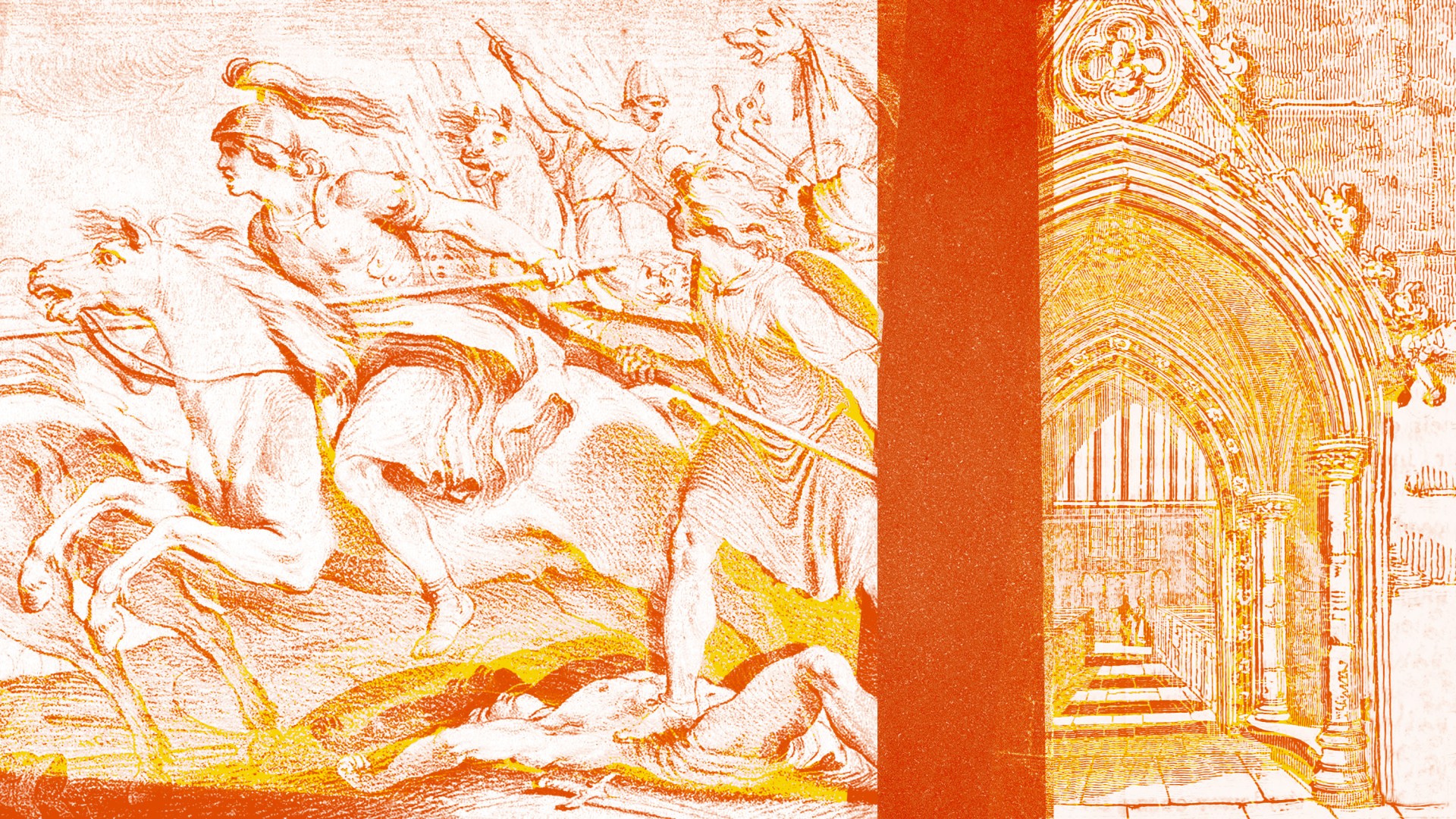
The Visigoths attacking the Romans next to a church door that is untouched
Christianity Today February 10, 2025
Illustration by Mallory Rentsch Tlapek / Source Images: WikiMedia Commons

Rome was sacked in AD 410. It was the greatest tragedy in the empire’s living memory: the former seat of the empire’s power conquered by Visigoths and their vicious leader, Alaric. 

The suffering of Romans who experienced the sack was brutal. Cruel, greedy, and savage—Augustine would call the invaders “barbarians” in City of God—the Visigoths inflicted every horror imaginable upon the civilians they encountered. They perpetrated mass rape on Rome’s women and girls, tortured people of all ages (often trying to force those who appeared wealthy to give up their valuables), and murdered random people in the streets.

But there was one place, and one place alone, the Visigoths dared not enter: church. For all their cruelty, the Visigoths were Christians, albeit of the Arian heresy. And while their faith didn’t otherwise translate into their conduct of war, it did lead them to respect Christian houses of worship. Though Augustine doesn’t comment on this, if any of the Visigoths had wanted to attend church on a Sunday during the sack, they might have worshiped in Roman churches themselves. Indeed, toward the end of the fifth century, the Visigoths accepted the Nicene Creed. Could their adoption of Trinitarian theology have begun here?

I thought about this history of respect for churches as sanctuaries while reading CT’s recent report on US officers from Immigration and Customs Enforcement (ICE) going to an Atlanta church to arrest a Honduran man, Wilson Velásquez—on a Sunday, no less. 

The man was in the US with his family, waiting for their asylum application to be adjudicated. As CT’s Andy Olsen reported, he “had made all his required check-ins at an Atlanta ICE office. He had the government’s permission to work and had an appointment on a court docket. He was deported once nearly 20 years ago—a significant strike on an immigrant’s record—but otherwise had no criminal record.” He had helped found the church where he was arrested.

But my aim here isn’t to litigate this one man’s case. Nor am I trying to say how to reform America’s policies toward immigrants (of whom I am one, as well as a naturalized citizen for nearly 17 years now). I am simply asking what it says about this administration that it is willing to thus disrespect spaces set apart for God—that it has no regard for the centuries-old tradition of sanctuary.

What does this arrest say about churches? What message does it send when state agents use Christians’ obedience to the biblical command to meet together (Heb. 10:25) to make a political point? Why would US officers conduct this arrest during the Sunday service? Even the Visigoths balked at that.

There are seven days in the week, and people who wear a GPS-tracking ankle bracelet, as Velásquez did, are very easy to find. Even if we all were to agree this arrest was legitimate and necessary, it could have been planned for any other time and place. Church was a choice. And why? Why choose to arrest a man at church?

When Augustine wrote in City of God of the horrors of the sack of Rome, he saw the Visigoths’ respect for sanctuary as a remarkable witness of God’s provision for Christians and non-Christians alike. Vicious to everyone and disrespectful of every other space, the Visigoths at least understood that churches were unique, a space set apart for God. 

The result, Augustine said, was nothing short of a miracle. Christians and pagans alike took shelter in churches throughout Rome and were spared. What “was novel,” Augustine states in City of God, “was that savage barbarians showed themselves in so gentle a guise, that the largest churches were chosen and set apart for the purpose of being filled with the people to whom quarter was given, and that in them none were slain, from them none forcibly dragged; that into them many were led by their relenting enemies to be set at liberty, and that from them none were led into slavery by merciless foes.”

This was utterly unlike city conquests known to the pagan world. Pagans did not respect even their own gods’ temples when sacking cities, Augustine duly observed, citing the mythical sack of Troy as described in Rome’s national epic, Virgil’s Aeneid. There, Troy’s aged king, Priam, seeks refuge at the altar of Jupiter, king of the gods. But a Greek warrior slaughters him anyway, and the altar flows with royal blood, a sort of perverse sacrifice. 

Virgil indicates his disapproval of this impiety, but he isn’t shocked. This story was nothing unusual in the ancient world. People often sought sanctuary, and they were often dragged from their refuge to be killed or enslaved. 

Arresting Wilson Velásquez may have been defensible on legal and political grounds, though I have strong doubts. And an arrest by ICE is not a horror on the scale of an ancient city conquest. Still, the choice to arrest Velásquez during Sunday worship at church was downright pagan. It implies church buildings are nothing special—no different from any store or office. It is an act of disdain for the worship of God.

When Augustine reflected on the meaning of the Visigoths’ respect for sanctuary, he saw in this miracle an opportunity to preach the gospel to those still skeptical of the good of Christianity. God’s mercy is so great we can see it even in the merciless Visigoths, Augustine argued; Christ’s power is so great that even corrupt earthly powers may respect it. 

And though the city of God is a spiritual realm, physical spaces matter too, Augustine said, especially if they point people to God. Churches are set apart as no other buildings are. They should be respected as sanctuaries not in the name of a polite fiction but because they are devoted to God. 

Augustine’s reflections on the sack of Rome remind us that churches have a long history of offering temporary respite to the powerless, weak, and suffering. That is a history American congregations should continue. 

Most of us are not called to figure out US immigration policy, to determine who may be justly arrested or deported. We are called to minister to those in our midst (Matt. 25:34–40). And because the vast majority of immigrants and refugees who arrive in the US are Christians of some sort, it is churches specifically to which they are likely to turn when in need.

Such works of mercy are not political but theological, and it is the church’s prerogative to ask immigration enforcement officials to do their work in mercy, too. Specifically, it is the church’s prerogative to ask ICE to make arrests without interrupting Christian worship and ministry. It is not too much to ask for the long tradition of sanctuary to be respected.

“The Most High does not live in houses made by human hands” (Acts 7:48), and it is not any building but Christians as God’s people who are his home (Heb. 3:6; 1 Pet. 2:5). But our church buildings are given to God, too. They are sacred places of refuge and provision for souls, places where mercy flourishes for anyone within. ICE agents are always welcome there—if they have come to worship.

Nadya Williams is the author of Cultural Christians in the Early Church and Mothers, Children, and the Body Politic: Ancient Christianity and the Recovery of Human Dignity (IVP Academic, 2024).

News

The Prisoner Who Planted a Church on Death Row

As Trump pushes states to resume executions, Kevin Burns in Tennessee tries to keep his congregation alive.

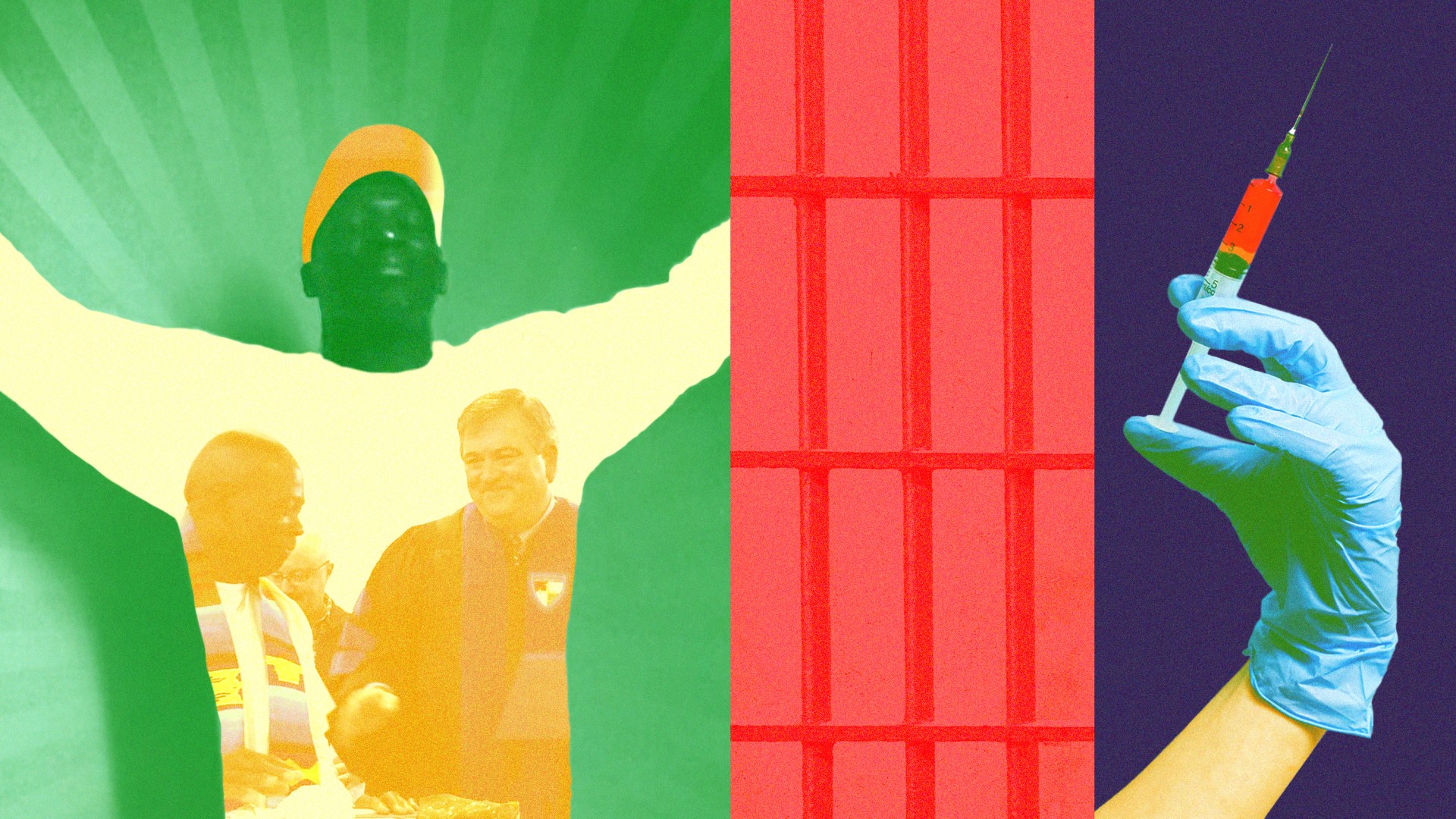
A collaged image of photos of Kevin Burns in prison.
Christianity Today February 10, 2025
Illustration by Elizabeth Kaye / Source Images: Kevin Riggs, Getty, Unsplash

Every week, behind a half dozen security doors that lead to Unit 2—Tennessee’s death row—Kevin Burns holds a worship service. He leads Communion, prayer, liturgy, and a sermon with men who share his sentence.

Burns, 55, has been on death row at Riverbend Maximum Security Institution in Nashville for 30 years, convicted of felony murder in two young men’s deaths in 1992. A group that included Burns robbed another group and shot Damond Dawson, 17, and Tracey Johnson, 20. This particular murder charge, felony murder, applies to those present during an inherently dangerous crime even if they did not kill. Burns maintains his innocence in their killing.

For years, Burns has led Bible studies and prayed with other men on death row, going on to become an ordained minister in 2018 and start The Church of Life within prison walls.

“It is so wonderful what God is doing here,” Burns said in a phone interview. “I never, never could have imagined being on death row and having an actual church service. It’s a church for us, led by us.”

Franklin Community Church pastor Kevin Riggs, whose church ordained Burns and helped plant the Church of Life, thinks this is the only church in the US led by people on death row. Texas has a program to allow prisoners to take seminary classes and become de facto prison chaplains, but death row prisoners there are in solitary confinement most of the day.

Burns is in the part of death row that holds about two dozen other men with good disciplinary records and time accumulated, and they have more mobility in the day. The rest of the men on death row must remain in their cells 23 hours a day.

A church on death row struggles with membership. The church has about five regular members out of the 45 men on death row in Tennessee. Another ten or so come sporadically.

In Burns’s time behind bars, Tennessee has executed 13 men in Unit 2. Burns can name them all. He prayed with nine of the men before their executions and has led memorial services for them afterward.

He prays he’s not next.

President Donald Trump is pushing states to carry out more executions. In his first term, Trump oversaw 13 executions, the most by any president in 120 years. But this time, former president Joe Biden commuted the sentences of 37 out of 40 people on federal death row before leaving office—they are now serving life sentences without parole. The three remaining prisoners on federal death row all still have the ability to file more appeals.

Trump is left with the state prisoners. In one of his first executive orders, Trump directed the Justice Department to help states acquire a supply of drugs for lethal injection, a key holdup for states trying to carry out the death penalty.

The companies that make the drugs won’t sell them to prisons for executions, and they say they have distribution controls in place to prevent that. Execution drugs are typically among the tightest-controlled substances, so they’re not easily obtainable.

But some states have performed executions with lethal drugs of unknown origins. Alabama has executed two people with nitrogen gas, but states use lethal injection for the vast majority of executions. Texas executed a man by lethal injection last week.

Opponents of the death penalty believe the federal supply of pentobarbital is exhausted, so the US government would not have access to the drug. It’s unclear how the federal government could get any lethal drugs to states.

Tennessee paused executions in 2022, after a scheduled execution was halted over an unknown problem with the drug protocol. The governor ordered a review of the state’s three-drug protocol, and at the end of 2024, the state announced it would now be using a single-drug protocol, pentobarbital. Now the state could resume issuing execution dates anytime if it can acquire the drug.

Church of Life’s lone deacon, Pervis Payne, was scheduled to be executed in 2020, but COVID-19 gave him a reprieve.

Then the Innocence Project took on Payne’s case. Shortly after, Tennessee passed a law in line with Supreme Court precedent blocking the execution of those with intellectual disabilities—which includes Payne. Since then, a Tennessee court reduced Payne’s sentence to two life sentences, served concurrently, which means he could be up for parole in a few years.

Burns didn’t lose his deacon to execution, but now he could lose him to parole—which would be a welcome development for Payne. But it underscores the complexity of maintaining a death row church.

The church meets in an empty section of cells on death row, where some cages are available for prisoners under tighter security to sit and hear the services.

Burns remembered one man, Robert Glen Coe, refused to leave his cell and remained there 24 hours a day. Leading up to Coe’s execution in 2000, Burns went to talk to him and looked through the slit in the door. He noticed that the man had worn a path in the concrete from the door to the small window in his cell from walking back and forth. Burns couldn’t help but cry.

“We are human beings,” Burns said. “We’re not animals. When Cain killed Abel, it didn’t mean that he stopped feeling. It didn’t mean that he stopped being a human being. We see his emotion. We saw his feelings. When God pronounced his punishment, he said, ‘Lord, my punishment is more than I can bear.’ And we saw the mercy that God had on him.”

Burns grew up in the Church of God in Christ, the son of a pastor. He regrets joining a group of friends on the day of the murders in 1992. Though Burns was only convicted of being present for the murders, which he acknowledges, at the sentencing phase prosecutors brought evidence that he shot one of the victims—Dawson. The jury gave him the death penalty based on that evidence.

He admitted he and the others in the group had guns, but he said he didn’t shoot anyone. He didn’t know the young men in the other group and had no motive for attacking them. No one else out of the six in that attacking group received the death sentence.

The US Supreme Court denied his final appeal in April 2023, but with a dissent from justices Sonia Sotomayor, Elena Kagan, and Ketanji Brown Jackson. Sotomayor wrote for the dissenters that Burns’s attorneys failed to introduce “evidence that Burns did not shoot Dawson” at his sentencing.

“Burns now faces execution despite a very robust possibility that he did not shoot Dawson but that the jurors, acting on incomplete information, sentenced him to death because they thought he had,” she wrote, adding that “the indefensible decision below will be the last for Burns.”

Burns’s only hope now is for a commutation or pardon from the Tennessee governor. He does not have an execution date while executions are paused, and he ministers in the meantime.

After his arrest in 1992 and incarceration at “the 201,” a notorious county jail in Memphis, he started leading Bible studies in his cell. People have called him KB since he was a kid, but at the 201, one of the prisoners told him that nickname meant “Know the Bible.” Burns remembered he joined a choir started by a prison captain, where they would sing Kirk Franklin’s “He’s Able.”

In Nashville, he’s been the chaplain’s assistant on state death row since 2015.

Ordination took years. Riggs, who had been visiting Burns on death row, talked to his elders about the idea in 2016. They were behind it, but they didn’t want it to be an empty gesture. They wanted Burns to go through a legitimate ordination process.

Burns doesn’t have a seminary degree, but he has done his own studies for years. Riggs brought him books, and the church administered an exam asking questions about his faith, his calling to be a minister, theology, and social issues.

To the question about his faith, Burns wrote in part, “How do I know I’m saved? … The Lord says in Scripture, ‘For if our heart condemns us, God is greater than our heart, and knowest all things.’”

He was able to have an ordination service on death row in 2018, with his parents and sister from Arkansas present along with Riggs and others. Riverbend, he said, bent over backward to make the service happen. Everyone sang hymns and prayed. Riggs gave an ordination charge, and then Burns preached and served Communion.

“Ordination is not man approving a person,” Riggs said in his charge. “Rather, ordination is a public confirmation, or affirmation, of the Holy Spirit’s calling on an individual’s life.”

Burns said it was the most moving day of his life, but he also has a mantra that every day is “the best day of my life.” 

Now Burns leads The Church of Life worship services with a taped-together Bible he has had since his first days in lockup in the early ’90s, a gift from a pastor-mentor in a different correctional facility.

Prison policies require volunteers at the death row church services, and a few Franklin Community Church members attend every week—Riggs’s church in Franklin, Tennessee, is a short drive from the maximum-security facility in Nashville.

But the prisoners run the service. The Franklin volunteers go to keep the church prisoner-led and to keep it from being taken over by other well-meaning charitable programs—or, as Burns dreaded, becoming another small group.

The church inside the prison has influenced its parent church, Franklin Community Church. Before Riggs preaches to his congregation, he sometimes shares that he visited death row that week and the men need prayer over tension in the unit or anxiety about the drug protocol. Sometimes, Franklin Community can arrange for Burns to call in from Riverbend to preach.

Riggs noted with a laugh that his congregation likes when Burns preaches; they know it’ll be limited to 30 minutes because that’s how much time Burns has on the phone before it cuts off. Riggs sometimes talks a little longer.

Church members visiting death row have been transformed by it too, in seeing how the men live their faith in such a context.

The prisoners helped change the diapers of another prisoner dying of cancer and helped another with intellectual disabilities, Riggs recalled. Burns ministered to Riggs and his wife after their son was killed in a car crash in 2023.

One member, Eric Boucher, who consistently visits death row as a volunteer and has become friends with Burns, said he supported the death penalty before visiting the men there.

Boucher said he had thought, They’re animals. They did something; they’ve had all their appeals. … If they die, that’s just. But now that he’s been in proximity to the “systemic issues with the death penalty,” he believes it is impossible to carry out justly.

Most Americans still support capital punishment, although that support is declining. But in surveys, white evangelicals have had the highest level of support for the death penalty.

When the pandemic prevented all volunteers from coming into the prison for 15 months, Church of Life could keep holding services—although they weren’t allowed to sing to prevent viral spread. They’re back to singing now. 

One member of Church of Life, Donny, whose last name is withheld because of sensitivity around his case, wrote about what it meant to him: “I have been incarcerated for 38 years. All of which has been without family or friends. What Church of Life means to me is that while those that I called family have written me off, God has not. It means that in this place of darkness there is a light of hope. There is a way beyond the path I have walked.”

Burns said it’s meaningful to have a prisoner as a pastor to other prisoners because he knows what it’s like to be in lockdown, to have his cell shaken down, to not be able to touch grass.

“Some would consider us to be the worst of the worst,” he said. “If God can be all that he is in me and I’m one of you, then God can do it for you. … They can’t say to me, ‘You go home to your family.’ I’m here with you.”

A handwritten prayer by Kevin Burns from death row 

Recorded in the book he cowrote with Kevin Riggs: Today! The Best Day of My Life:

O Lord God, even the God and Father of our Lord and Savior Jesus, the Christ.

Lord God, you are holy and righteous; Gracious and altogether true.

Your mercies are everlasting, and they are renewed every morning.

O Lord God, unto thee do I lift up my soul.

And unto thee do I cry in despair.

Have mercy on me, Lord, I pray, and deliver me.

Deliver me from those who are too strong for me: And deliver me from certain death.

You said in your word, that you looked down from the height of your sanctuary;

From heaven you beheld the earth; to hear the groaning of the prisoners;

To loose those that are appointed to death.

Behold, I am in prison, and they have appointed my soul for death.

But unto you O Lord my God, do I make my appeal.

For you are that God that took me from my mother’s bosom,

And declared your love for me, and made your covenant with me,

And told me that you will never leave me nor forsake me.

But that you will be with me always, even until the end of the world:

And caused me to hope in you.

And now, O Lord my God, in thee do I put my trust.

Let me not be brought to shame.

Neither let any that trust in your holy name be brought to shame.

But bring me out of this prison swiftly, I pray;

And deliver me by a strong hand, O lover of my soul.

In the name of Jesus, I pray, amen and amen!

Inkwell

The Millennial Dream Dash

Listen to the clues of your life

Inkwell February 9, 2025
In the Woods by George Inness

“It is, I think, that we are all so alone in what lies deepest in our souls, so unable to find the words and perhaps the courage to speak with unlocked hearts, that we do not know at all that it is the same with others.”
— Sheldon Vanauken, A Severe Mercy.

I’M A VORACIOUS DREAMER, and I’ve come to realize that this means the object of my longings will never come to full fruition.

In my early 30s, most of my dreams still burned bright. They layered like pearls on a string, each one distinct yet bound together by a shared vision: the dream to write, move to Nashville, meet a good guy, develop a retreat center or some other community third space, and host people in a home of my own—one filled with music and conversation, good meals, an herb garden in the backyard, bookshelves everywhere, and friends gathered from all walks of life. I called it my “George Bailey lassos the moon” dream. Exhilarating, yet always just out of reach.

This idea of warmth and home was a refuge against the deep unrest that permeated my body daily. Most months, my time and money went toward things like functional medicine and bodywork, capsules of things I couldn’t pronounce, therapy, lab tests, and memory foam pillows to support the vertebrae in my neck while I slept.

Along with chronic pain from a family car accident when I was 17 (and two since), I also had PMDD, which is a severe mood disorder caused by brain sensitivity to hormone fluctuations. It wreaked havoc on my emotional health, along with every close relationship, to the point where I only felt sane and secure maybe one or two weeks out of the month. I also had a host of undiagnosed symptoms including digestive pain, brain fog, food allergies, nausea, and fatigue. I overturned every stone in sight and didn’t know where else to go or what to do. I was desperate to be well.

After years of prayer and oil fingerprints pressed onto my forehead in the shape of a cross, my heart broke when I realized the healing must not be coming. Psalm 34:10 promises that “those who trust in the Lord will lack no good thing,” yet day after day, I circled back to the same question: Is God withholding good from me? Just as my favorite book heroines had left the places they knew, I suspected that I too would have to leave the comfort of home one day to confront my longings.


AS A MILLENNIAL, I belong to a generation well-acquainted with disillusionment. The Pew Research Center describes how most of us came of age and entered the workforce at the peak of an economic recession, uniquely shaping our conception of the future. I know many friends who feel a bit forgotten—like they blinked and missed the boat. “The long-term effects of this ‘slow start’ for Millennials will be a factor in American society for decades,” says Pew. Of course, we’re not the only ones to feel the ache of unmet longing. It is universal.

Today, our homes, degree programs, doctors’ offices, and counseling rooms are filled with people yearning for the delayed fulfillment of childhood dreams. Many are still unmarried in their 30s and 40s, do not own a home, have moved back in with family or other single adults, are approaching the age when having kids is unlikely, and are dealing with a mental or chronic health condition. This is a lot to carry, especially when disillusionment also runs deep within the Church—a place where we long for hope and rest but often find false promises. We live in an era hungry for something as big as a miracle or as simple as an understanding friend who will listen.

Unmet longings can feel more like withheld love when they persist for longer than we think we can bear. Although disillusionment is not a bad thing, it’s fed in unhelpful ways by a culture that values the pursuit of passion more than perseverance.

Dr. Alicia Britt Chole is a leadership mentor who believes disillusionment is necessary for healthy spiritual formation. It’s a well-traveled path by believers, not the evidence of failure or abandonment. In her book, The Night Is Normal (a fabulous read!)Chole says, “In disillusionment, God invites us to reframe questions as companions, to see that our senses neither create nor negate his presence and to experience the fellowship of Jesus’s suffering. In disillusionment, shiny (yet sometimes shallow) ideals are lost, as deeper (yet initially duller) reality is gained.” As painful as it can be, disillusionment offers us the gift of deepening our trust in God and walking by faith. “Answers do not carry us through the night,” she writes. “Love does.”


IN THE SPRING of 2019, a new friend hosted a songwriting retreat at his home in Nashville, Tennessee. Gluten-free brownies bubbled away in the oven while incense trailed up to the ceiling, giving the room a musky aroma mingled with chocolatey sweetness. Our group gathered on the living room floor. I was the only non-songwriter in the house but was excited to make friends with people who shared both my faith and creative wiring. By now, this dream had taken time to settle into me the way rain settles into the earth after a good storm. Four years in the making, the move from California to Tennessee was a huge step of trust. Beneath all the questions was a quiet, faith-filled knowing. I just had to go. And God would be with me.

Our host rolled up the sleeves of his button-down shirt and invited us to close our eyes while he read a blessing by the Irish poet, John O’Donohue. It was an apt invocation called “For a Friend on the Arrival of Illness”:

May you find in yourself a courageous hospitality
toward what is difficult, painful, and unknown.
May you learn to use this illness as a lantern
to illuminate the new qualities that will emerge in you.
May you find the wisdom to listen to your illness.
Ask it why it came. Why it chose your friendship.
Where it wants to take you.
What it wants you to know.

The words gripped me.

Despite my longing for a space to practice hospitality, it had never crossed my mind to show this same welcoming spirit to the unwanted parts of my life. The parts, like illness, that God in his divine mystery allowed to persist. Wasn’t this a sign of resignation? A white flag?

Sunlight warmed my skin as it glowed through the dual-paned window. I laid my journal aside, listening while the rest of the house came alive for the next few hours with the sounds of guitar strums and pencil scratches, confessional moments and laughter, along with the aroma of vegetable soup. In many ways, it was the “George Bailey lassos the moon” dream now sprung to life. But did I belong in it? So much lay outside my control, but the words to that blessing gave me something solid to hold onto. Maybe this alone was why I was here. God knew that on a Saturday in springtime, a writer from California would need to know that she was seen and not forgotten.


I LIVED IN Nashville for two and a half years. The first year was a string of delights, a season of fulfillment. The next one brought shattered hopes as I watched nearly every dream I carried out with me unravel like a ball of yarn. Perhaps craziest of all was a deadly tornado that hit the city in the middle of the night just before the lockdowns—a natural disaster that, devastating as it was, got buried almost overnight by national headlines.

By the spring of 2021, I sensed a need to return home and recommit to my physical health. I packed my belongings with that pesky question still rumbling around in my heart: Is God withholding good from me? Moving into my little brother’s childhood bedroom was humbling at my age, but there was peace in being near family again. Mom made up the guest bed and prayed with me nightly. We baked and watched Gilmore Girls. I found a full-time copywriting job that allowed me to work from home. Two months later, I was hospitalized after a thyroid episode and diagnosed with Graves’ disease.


ULTIMATELY, OUR DESIRES point to Christ. They stir in us a deep yearning for the wholeness of eternity—a wholeness we catch glimpses, tastes, and whispers of in this life. Come, they say. There is something true and beautiful that lies beyond. Paying attention to the desires that drive us, and being willing to name them, invites God into those tender places where he longs to meet us with his love.

By following my dream of moving to Nashville, I experienced God’s goodness in ways I never would have if I had stayed home. He spoke to me through bluegrass, summer thunderstorms, the fragrance of honeysuckle, opportunities to sharpen my writing craft, grilled catfish, landscapes so beautiful they take your breath away, and long walks filled with conversations I will carry with me for the rest of my life.

Instead of constantly forever trying to make meaning from the chaos of life, we can rest in the unknowing. We can rest in the arms of Love. “Now we see things imperfectly, like puzzling reflections in a mirror, but then we will see everything with perfect clarity,” says 1 Corinthians 13:12 in the New Living Translation. “All that I know now is partial and incomplete, but then I will know everything completely, just as God now knows me completely.”


THE GOLDEN HOUR backlit our table with the glow of an orangey-pink California sunset. I clasped the hand of the man next to me. It was the evening of our wedding, and he wore a burnt orange suit that matched his personality. Pink Lady apples lay strewn across the tables, and a wine barrel supported a cake infused with honey, rosemary, buttercream, and fresh blackberries. I sighed with gratitude.

After moving back home, I met the man who became my husband. He was a young, blue-eyed veteran named Noah who had served four years as an Army medic before also returning home from out of state. Most surprising was our age gap. He was ten years younger, a detail I had to warm up to. But the man also had premature graying hair (thank God!) and patience in spades. While preparing for his honorable discharge, he got the call from home that his mom was dying of pneumonia, instigating an early return before she passed. We met shortly after, both navigating our unique griefs as we worked to rebuild our lives.

My illness did not go away once I was in a committed relationship, but Noah’s love became a resting place. Knowing that his name means rest in Hebrew is not lost on me. Instead of healing my body as I prayed, God brought a skilled endocrinologist who put me on high-dose thyroid medication and the Autoimmune Protocol (AIP) diet. This led to remission, yet I still have daily symptoms that vary from mild to debilitating. Instead of removing my PMDD, God brought a partner who honored that part of my story and who willingly chooses my particular set of problems every single day. I don’t fully know how to receive this kind of love yet, but I am learning.


“LISTEN TO YOUR LIFE,” wrote Frederick Buechner, an American writer and minister. “See it for the fathomless mystery it is.” This quote has been an anchoring thought and a healthy challenge amidst life’s highs and lows. Just because a dream ends doesn’t mean it fails. Maybe we’ll outgrow our early dreams. Or maybe, in their endings, they’ll become a bridge to what’s next. Similarly, just because our desire remains, it doesn’t mean God withholds good from us. I believe this now, though the ache remains. Instead, as pain points have become constellations illuminated against the night sky, I’ve learned to trace God’s faithful presence in the midst of my suffering from point to point, illuminating the cosmos of care that we live in as those who live and walk in his marvelous light.

Bailey is a writer from Northern California. After a career in higher education and publishing, she now hosts a podcast called Listen to Your Life and cares deeply about helping millennials walk in hope and well-being. Besides writing, she enjoys road trips to the coast, good stories, farmers markets, and cooking. Bailey regularly contributes to other publications and has written on art, women’s health, and spiritual formation for IAPMD Global, She Reads Truth, The Rabbit Room, and Jessup University. You can follow her on Instagram @baileylgillespie and find her on Substack at baileygillespie.substack.com.

News

How a TikToker Found a Ministry Opportunity in RedNote

With thousands of Americans migrating to the Chinese app, one user made a connection with a struggling Chinese believer.

An image of the RedNote app on a smartphone.
Christianity Today February 7, 2025
Anna Kurth / Contributor / Getty

The week before the TikTok ban in the US came into effect, Desteny Flerillien, a 25-year-old Christian TikTok influencer, followed thousands of other users in downloading the Chinese app Xiaohongshu, also known as RedNote.

At first, she scrolled through the videos learning about Chinese food, culture, fashion, and traditional medicine. On January 14, she posted a short introduction with a picture of herself and the caption “Hello from America.” She started posting about her skin-care routine, hair tutorials, and enthusiasm for the app, but didn’t mention her Christian faith, as she was unsure if the app would censor religious posts. By the end of 10 days, she had gained 500 followers.

One of the followers was a 22-year-old Chinese man named Jing Shijie who messaged her with the help of a translation app. He welcomed her to the app, offered to answer any questions she had, and asked her to add him on the Chinese messaging app WeChat. They started discussing cultural differences between Chinese and Americans. 

In one message, Flerillien mentioned that she made YouTube videos about her faith.

“What religion do you follow?” Jing asked. When she shared that she was a Christian, Jing surprised Flerillien by responding that he was also a Christian. He began to ask Flerillien questions about the faith, as “a lot of people in our church are saying things that aren’t true, so I have been longing to know the real Christ.”

That led to a deep conversation with a believer on the other side of the world that would never have happened if not for the TikTok ban and the ensuing migration to RedNote. 

The TikTok ban lasted only 12 hours before President Donald Trump announced he would delay enforcement of the law banning the app and TikTok flicked back to life. Still, many “TikTok refugees” had already created accounts on RedNote, a popular Chinese social media app for sharing videos, photos, and conversation topics. With the internet in China behind the Great Firewall—which blocks access to international social media networks like Facebook, Instagram, X, and even TikTok—the migration created a unique space for people in the US and China to interact.

Yet cybersecurity experts raised concerns that the app is subject to the same Chinese data laws as TikTok, “which may grant government authorities access to user data without the privacy protections expected in the US,” according to Adrianus Warmenhoven at NordVPN. Back in 2023, a former executive in ByteDance, the Chinese company that owns TikTok, said in a legal filing that the Chinese government had used data from TikTok to identify and locate protesters in Hong Kong and has access to US user data.

Many Americans seemed unphased by those concerns as they downloaded RedNote, making it the No. 1 app in the Apple store the week of the ban. American and Chinese users shared cat photos, compared working hours, and gave each other names in their respective languages.

When Courtney Alexandra Laliberte first downloaded the app, she was intrigued by the images of the “beautiful people and places, just things that we as Americans were not really privy to.”

But the 29-year-old Christian content creator from Melbourne, Florida, also felt uneasy. Knowing how the Chinese government has control over Christian practices in China, “I did get a sense of being watched,” she said. “Like a feeling of someone looking over my shoulder and everything I was doing.”

After two days, she felt strongly convicted that she needed to delete it. She noted that if RedNote is not a place where she can freely share the gospel, “then that is just not a place where God wants us.”

Laliberte posted a video on TikTok as a pinned post with the caption “Christians pray before you download RedNote” and shared her thoughts.

 “Good to see China is not as bad as they make it seem,” one commenter pushed back. “You are allowed to be a Christian over there.”

But others told her they felt the same urge to delete the app, as their religious posts had been placed under review then deemed illegal.

Flerillien saw the app as an opportunity for evangelism, noting that she felt safer talking to Chinese people about faith than Americans because they seemed more curious and willing to listen. Besides Jing, she has also been talking with another Chinese woman who mentioned it felt like “God’s plan” that they met through RedNote. Now that they’ve built a friendship, she plans to eventually start having deeper faith conversations.

“Ultimately, I just see it as an opportunity for more people to learn about Jesus, even if [only] seeds were planted,” she said.

Flerillien, who lives in Orlando, Florida, started posting Christian content on her YouTube page five years ago after a 40-minute video of her testimony coming out of New Age spirituality went viral. The video was viewed nearly 50,000 times, including by her mother, who renounced her own New Age practices after watching it.

Then, in 2021, Flerillien “got hooked” on TikTok after a friend introduced her to a TikTok dance. Seeing the Christian community on the app, Flerillien started to post her own inspirational Christian videos with captions like “Scriptures for when your faith is low” and “Mood after spending time with God.” Today she has more than 14,500 followers.

An image of Destiny Flerillien from her social media.Image courtesy of Desteny Flerillien
Desteny Flerillien, a 25-year-old Christian TikTok influencer.

“It’s always a mission,” Flerillien said. “It’s always an assignment.”

Although she knew the app was owned by a Chinese company, Flerillien saw TikTok as “just another social media platform.” Yet as the deadline for the ban drew near, she began to feel distraught, as TikTok had become a place for her to laugh, learn, and engage with others. So she decided to move to RedNote. (Since the ban has been reversed, Flerillien still posts on TikTok.)

Meanwhile, Jing, a 22-year-old in Jinan, China, heard about the foreigners flooding to RedNote and created an account, as he was interested in international e-commerce. That’s when he met Flerillien.

Jing told CT that he had been raised by his grandmother, who became a Christian after Jing’s father was miraculously healed from brain inflammation. She took Jing with her to the government-sanctioned Three-Self church where she worshiped, but she never forced Christianity on him.

Jing said that Christianity became real to him two years ago when his grandmother was diagnosed with a pancreatic tumor. For the first time in his life, he prayed on his knees for hours as his uncle took her to the biggest hospitals in the province for multiple opinions on whether the tumor was malignant. He begged God to save her.

“I was completely overwhelmed at that time, feeling helpless, and that’s when I turned to God,” he said.

When the family learned the tumor was benign and his grandmother recovered quickly, Jing said his faith in God began to take root.

Yet challenges persisted. His startup furniture business was struggling, as customers were few. A leader from his grandma’s church urged him to quit his business and find a factory job, claiming that continuing “would be going against God’s will.” Jing said he felt that the leader was calling his desire to run a business a sin, yet Jing had wanted to make money to provide for his family and contribute to his grandmother’s church, which rented its meeting space from a worn-down school building.

Then his roommate, whom he had hired at his business and lent money to, began to lash out at him and accuse him unfairly. In despair, Jing spiraled into severe depression. Several months later, Jing gave up on his business and returned home to work as a food delivery driver.

An image of Jing Shijie on his phone.Image courtesy of Jing Shijie
Jing Shijie, a 22-year-old RedNote user in China.

As he started talking about faith with Flerillien over WeChat, he asked her about some of the questionable teachings he had received from his church, including whether it was a sin to try to earn more money and whether Christians were allowed to go the hospital when they were sick instead of waiting for God to heal them. She responded by pointing him to different Bible verses and speaking from her own experiences.

Once Jing used his Chinese Bible—a gift from a church summer camp—to look up a verse Flerillien had shared, and he was excited to see that God’s Word remained the same across languages.

He then opened up to Flerillien about his rage against his roommate who had wronged him, which weighed down on his heart like “an unbearable lock.” He noted that when he sought advice from the leader of his grandmother’s church, he was told that Christians should be “weak” and that he should swallow his anger and endure.

“Bitterness and unforgiveness doesn’t have an impact on the person who did us wrong,” Flerillien wrote in her message. “It only hurts us.”

When she pointed to Jesus’ ultimate forgiveness and reminded him that vengeance belongs to the Lord, Jing said he realized that forgiveness wasn’t a sign of weakness; rather, it took strength to let evil done to him go.

After that conversation, Jing said he finally felt his heart was free from anger: “It was full of light, [in] one switch of a moment.” He began to find a purpose behind his failed business and the criticism from his church when Flerillien explained that God uses suffering to build up the character of believers so they can do work for the Lord. She encouraged him to not give up on his business.

“Do you think it’s a coincidence that you met me on Red note?” Flerillien asked. “God is still calling you.”

“It must be God’s plan for us to know each other and become good friends!” Jing said.

Ideas

Super Bowl Fans Don’t Want Faith Sidelined

A new survey shows that many of today’s viewers see sports and Christianity in collaboration rather than in competition.

Patrick Mahomes and Jalen Hurts praying and playing football
Christianity Today February 7, 2025
Illustration by Mallory Rentsch Tlapek / Source Images: Getty

On the American sports calendar, there is no bigger day than Super Bowl Sunday.

Nothing else garners the same level of attention, drawing in both serious and casual fans. In the United States, 19 of the 20 highest-rated scheduled television programs of all time are Super Bowls. It is one of our few remaining common cultural touchpoints, an event everyoneknows about.

And for Christians who bring their faith onto the field, the Super Bowl represents a supersized platform.

On the Kansas City Chiefs—who have played in four of the past five Super Bowls—owner Clark Hunt has spoken frequently about his faith and how he prioritizes spiritual development on the team. Chaplain Marcellus Casey provides spiritual support and care, while players like cornerback Trent McDuffie describe faith as “the biggest thing in my life.”

The Chiefs also have kicker Harrison Butker, a conservative Catholic who leans more into political activism and made waves earlier in the year for his controversial remarks at Benedictine College.

On the other side of the field, the Philadelphia Eagles also hold a legacy of outspoken Christian athletes, with the team’s faithful players receiving so much attention in 2017 that an entire book about them was published.

Chaplain Ted Winsley served on that team, and he continues to work with and disciple the Eagles today, including Christian wide receiver A. J. Brown. During the playoffs, Brown went viral for opening up and reading Jim Murphy’s Inner Excellence on the sidelinesin the middle of a game—a book written by a Christian and strongly shaped by a faith-based perspective.

So what do football fans think of all this God talk? A new survey out this week from Sports Spectrum and Pinkston found that most sports fans tuning in on Sunday—the majority of whom are Christian themselves—will be happy to hear players and coaches display their faith.

Sports Spectrum, the closest thing to a “journal of record” for the evangelical Christian subculture in sports, has focused mostly on sharing and amplifying stories of faith from athletes. With this survey, Sports Spectrum moves in a new and intriguing direction—seeking to actively drive and shape public conversation and enhance our understanding of the culture of sports.

Christians used to be concerned about America’s growing obsession with sports. It was seen as a rival for influence and authority in American life, a competitor for devotion and loyalty. To watch a game on Sunday, Christian leaders warned, was either a sin or a sign of lukewarm faith.

Some scholars today continue to stress the conflict between religion and sports. They argue that sporting events have replaced the role that religion used to play in society. Yet this survey, which targeted people who watch games at least a few times a month, suggests sports fans might actually be more religious than others.

Compared to the American population, which has slightly more women than men, the survey respondents skewed male: 57 percent to 43 percent. And respondents also expressed deeper religious commitments: 73 percent identified as Christian compared to around 67 percent of Americans overall, with more than half saying faith is extremely or very important to them. Just 19 percent indicated no religious faith, compared to around 30 percent of the general population.

These results suggest fascinating possibilities for further exploration. Rather than replacing organized religion in American life, perhaps sports has become a cultural space that is more open to religion—a means through which traditional religious identities can be affirmed and expressed.

And perhaps this is true not just of athletes and coaches (an argument I make in my book), but also of the fans who cheer them on.

Growing up in the evangelical subculture, I was taught to see popular culture as a hostile place, with an American public that did not want to hear about Jesus. When I saw Christian athletes and coaches speaking about their faith after games, it seemed subversive, as if they were sneaking in something that the media did not want to promote or share.

In this survey, however, fans have shown broad support for athletes like McDuffie and Brown who use their platforms to talk about their faith: 56 percent are supportive, while only 12 percent oppose.

It’s a result that makes sense, given that the survey respondents tended to place a high value on faith. But it also makes sense in a cultural climate that encourages the expression of personal identities and values, especially for public figures. Few identities are more important to a person than religious affiliations and beliefs.

For Christian athletes, this should provide encouragement to be open and honest about the significance of faith in their lives.

Yet, it is easy to support expressions of faith with which you agree. It’s a different story when an expression of faith doesn’t align with your views.

While three-fourths of respondents (74%) said they support athletes using their platforms to talk about nonprofit causes, only a third (34%) said they support athletes talking about causes they oppose. 

This should not diminish the desire by Christian athletes to speak about their faith. But it should remind them that faith is not some generic common denominator; it takes shape in particular ways, and it makes claims about truth and goodness that not everyone will agree with. Navigating public witness well requires a blend of courage, wisdom, and discernment.

Certainly, Christians should be encouraged that so many athletes, coaches, and sports fans find faith meaningful to their lives. But does the culture of sports shape Christians more than the other way around?

The survey also examined the rapid rise and spread of sports gambling and found that Christians were as likely as Americans overall to back the trend.

When asked how they felt about online sports betting, 43 percent of respondents were in favor, 35 percent neutral, and 23 percent opposed. Among Christians, 42 percent were supportive, 35 percent neutral, and 22 percent opposed. 

While gambling has always been associated with sports, in the past it was done in the shadows, limiting its reach. Now, gambling is front and center, literally funding sports leagues and the media companies that cover them—all the while teaching a new generation of fans to view gambling as a central part of the sports experience.

Christians should be concerned for many reasons: the way gambling can lead to a dehumanizing and transactional view of athletes, the way it encourages addictive and self-destructive behavior in young men, the way it subverts and undermines the constructive possibilities of moral formation through sports.

Yet while some Christian leaders have raised the alarm, there is little organized resistance. Nor, it seems, do church leaders take sports betting seriously as a matter of discipleship.

Whether Christian fans have money on the game, friendly pools for Super Bowl squares, or just favorite teams they are pulling for in their prayers, they may ask whether God cares who wins.

Most fans seem to agree that God doesn’t pick sides: 78 percent of Christian, Jewish, and Muslim respondents said that God does not have a preferred outcome or influence the results.

This is the right perspective. We can’t discern God’s will when it comes to why one team wins and the other loses. If we try, we can easily fall into the transactional frame of the prosperity gospel: If players perform religion in the right way, if they have enough faith, then God will bless them with success.

At the same time, we can acknowledge a sense in which victory does come from God. When fans watch athletes or coaches thank Jesus after a game, they should see it as a recognition of human dependence on a higher power. The skills and talents used on the field have a source, and it is not us.

We should also affirm that God cares about sports. He may not pick winners and losers, but he is not indifferent. He cares about athletic competition because he cares about human beings and the cultural activities we create and engage with.

As we watch the Super Bowl again this year, we should care about sports not just because it provides a platform for Christian athletes to talk about Jesus, but also because sports are a gift that can be enjoyed. And as the survey results remind us, it’s also a formative space for meaning, connection, and community in our culture.

News

USAID Freeze Leaves Ukrainians Out in the Cold

Ministry and nonprofit leaders warn funding pause will hurt the most vulnerable.

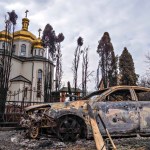
Cold Ukrainians in front of a house destroyed during the war with Russia.
Christianity Today February 6, 2025
Ivan Antypenko/Suspilne Ukraine/JSC "UA:PBC"/Global Images Ukraine via Getty Images

It’s a lot of money: more than $30 billion

Ukraine is by far the top recipient of US Agency for International Development (USAID) funding since 2022. And that’s not even counting the billions that have gone to weapons, munitions, and military equipment. 

But Yuriy Boyechko, president of Hope for Ukraine, a nonprofit that serves the country’s poorest communities, thinks about the firewood. 

Some of that $30 billion went toward keeping older people warm and giving them fuel to cook their food. President Donald Trump’s sweeping “stop work” order on American aid in January shut down humanitarian programs. One of the paused projects, headed by a Hope for Ukraine partner organization, provided people with wood. 

“These people rely on firewood to keep warm in the winter and to cook food,” Boyechko told Christianity Today.

In the war-ravaged regions of Sumy, Dnipro, and Donetsk, many of the people who could not flee Russia’s full-scale assault now live in shelters that look like “barns with the doors open all the time.” Most of the remaining residents are elderly. The temperature likely won’t climb above freezing until the end of February or maybe March. 

“They’ve been living without electricity,” Boyechko said, “some of them for two-plus years.”

Hope for Ukraine, Mission to the World, and Mission Eurasia leaders told CT that the Trump administration’s funding freeze hasn’t affected their programs. But the order has impacted many of their partners, and Christians working in the region are concerned about the devastation that could result from even a 90-day pause.

Military aid has not changed. Affected programs include refugee shelters, remote learning (a necessity for the majority of children in frontline regions), health care for internally displaced people, military veteran rehabilitation, and salaries for first responders. 

“I totally understand that they want to audit, but I think to completely cut funding in the middle of winter is a little bit too harsh,” Boyechko said. “This particular freeze is going to impact the most vulnerable people on the ground, and it’s coming at the worst time.”

Elon Musk, who leads the new Department of Government Efficiency, has framed the freeze on USAID as a battle against corruption. And there’s no question there is corruption. 

Ukraine ranks low on Transparency International’s corruption index—104 out of 180 countries. Some of the aid that has been paused was, in fact, going to anti-corruption initiatives. The country has made some progress in the last 11 years, especially through reforms to the justice system that increased the independence of the judiciary. Ukraine has improved by six points on Transparency International’s scale since Volodymyr Zelensky became president.

The US Congress also built anti-corruption measures into Ukraine’s USAID funding, including third-party, in-person monitoring and the use of separate, fully auditable accounts. The Office of Inspector General must assess the safeguards and report to the legislature every 45 days. The World Bank also monitors the funding.

Christian ministries in Ukraine say they wouldn’t object to more oversight. But concerns about corruption don’t justify a funding freeze, and they worry about Ukrainians who are going to suffer because of it. 

“Even a temporary disruption in aid could further exacerbate the crisis for displaced and refugee communities,” Mission Eurasia president Sergey Rakhuba said.

The disruption could also put the country in a worse position to negotiate a possible settlement with Russia. Experts expect the next six months to be critical. The situation doesn’t look great for Ukraine. Zelensky has called for four-way peace talks between Ukraine, Russia, the US, and the European Union, But Russian leaders deny he’s the legitimate leader of Ukraine. Russia has also stepped up executions of Ukrainian soldiers, continued to barrage Ukraine with airstrikes, and pushed for more territory.

“This is a very critical time for a country that’s barely standing,” Boyechko told CT. 

But as a Christian, his main focus is not the conflict or the politics of foreign aid and government efficiency. 

“When I see innocent suffering needlessly, that’s where my compassion and my faith in Jesus supersedes my political views,” Boyechko said. “Jesus gave bread and fish to everyone.”

Theology

Worship Starts with a Pierced God

Practitioners of Thaipusam show devotion to encounter their gods. Our God came to us first.

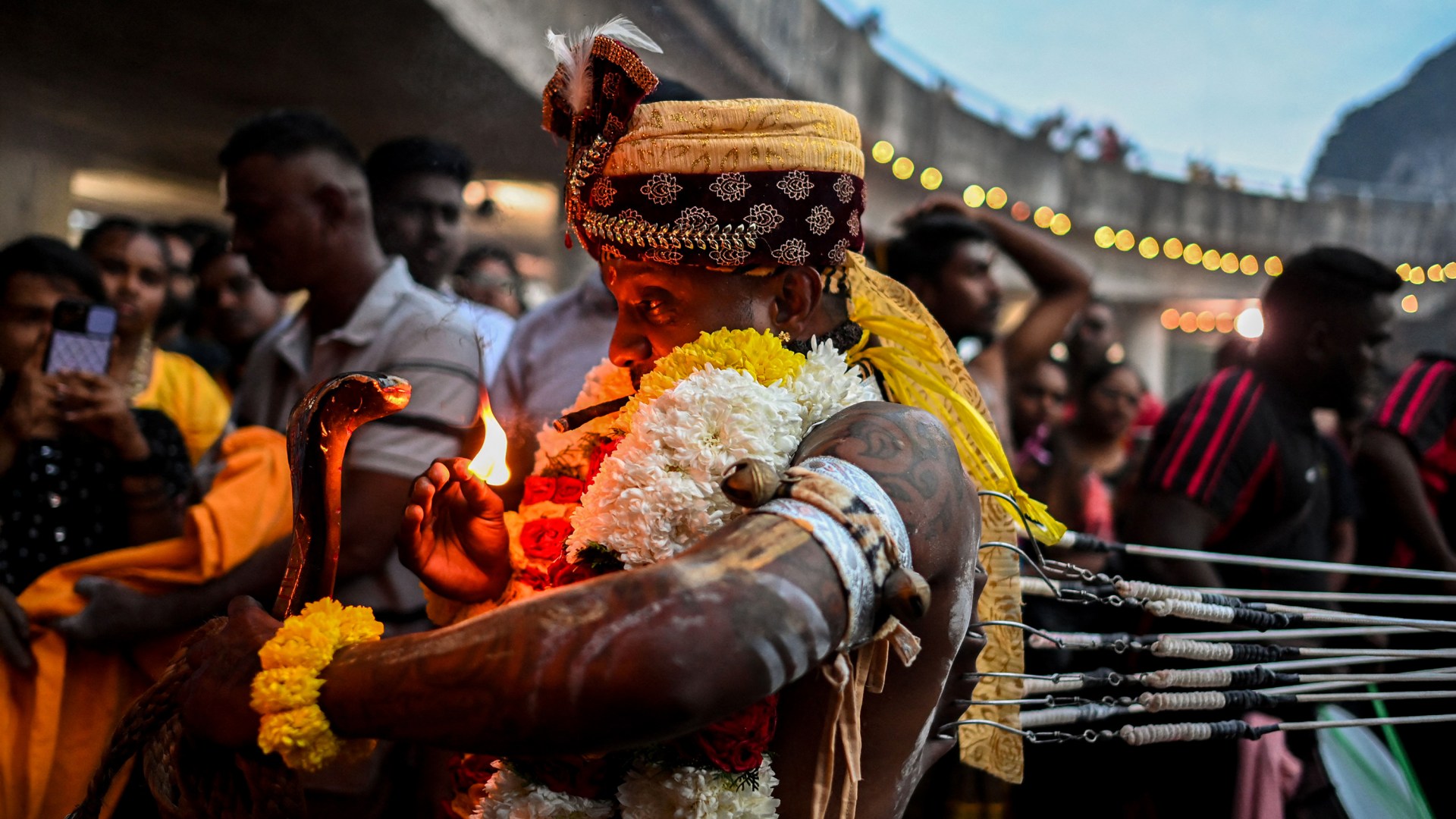
A Malaysian Hindu devotee with his back pierced with hooks makes his way towards the Batu Caves temple to make offerings during the Thaipusam festival.

Christianity Today February 6, 2025
Mohd Rasfan / Getty

As a new resident of Malaysia, the first time I saw the festival of Thaipusam in 2022, I was horrified. Metal hooks weighed down with milk pots skewered the flesh of men’s backs as tridents pierced their cheeks and tongues. Devotees pulled shrines on wheels with ropes and chains hooked to their backs. 

Later in the year during the Hungry Ghost Festival and the Nine Emperor God Festival, I saw my Chinese neighbors display devotion to their gods and spirits by piercing their cheeks with long hooks and walking over hot coals.

As a Christian who grew up mostly in the United States, I was shocked by these extreme religious practices in my new home of Penang, a multicultural, multireligious state in Malaysia. In Penang, around 45 percent of the population practices Islam, 37 percent Buddhism, 8 percent Hinduism, and 4 percent Christianity.

As I got to know my neighbors of different faiths, I learned the deeper spiritual significance behind these religious rituals. For the most part, the piercings were expressions of penance, devotion, or yearning for blessings. These actions expressed the lengths to which devotees would go to connect with their gods or spirits.

At the same time, I noticed that some of my Christian neighbors desired to strive—perhaps not through piercings but through acts of deep devotion—to similarly initiate encounters with God.

It made sense. All around Penang, there are little shrines with deity statuettes on the streets and in stores. Every day, people burn incense and bow their heads with folded hands, asking for a blessing. How could my Christian neighbors not be influenced by this ubiquitous posture toward worship?

Yet the more I thought about the worship of other religions, the more I realized the strangeness—and beauty—of Christianity.

Before we adored him, God pursued us and saved us through Jesus’ suffering and death on the cross. Unlike the piercings of other religions, those on Christ’s hands and feet revealed the sacrifice God made to bring us to him.

Painful acts of devotion

The Tamil Hindu festival of Thaipusam, which this year falls on February 11, commemorates the day the Hindu goddess Parvati gave the Vel (a divine spear) to her son Murugan so he could conquer the demonic Surapadman.

Devotees put kavadi (burdens) on themselves to seek help from Murugan. These semicircular pieces of wood or steel—which can weigh up to 66 pounds—are often decorated with peacock feathers, flowers, and images of deities and balanced on the devotees’ shoulders.

“Carrying a kavadi involves some kind of body piercing to secure it,” said Jeffrey Oh, professor of world religions at Malaysia Baptist Theological Seminary. “This ritual of self-sacrifice is intended to defeat inner demons and gain Lord Murugan’s blessings.”

Many kavadi bearers say the process puts them in a trance, so they don’t feel the pain. The festival comes at the end of a 48-day period of preparation, which includes special diets, rituals, and prayer.

These piercings are also an act of penance to cleanse devotees of their sins, Oh noted. Hindus must perform acts pleasing to the deities so their gods will help them in this life and the next, with a goal of either being reborn into a higher caste or achieving moksha, liberation from the cycle of rebirth.

Meanwhile, for the Buddhists, Daoists, and adherents of Chinese folk religion who observe the Hungry Ghost Festival, the purpose of body piercing is to mark that a person is possessed by a spirit so that the medium can bless the devotees. Chinese people believe the gates of hell open during the festival, which falls in August or September, allowing spirits to roam the earth.

To appease the spirits and prevent them from harming loved ones, people make food offerings, burn paper money and incense, and entertain the spirits with Chinese opera performances. It’s also a time to pray for blessings and good fortune.

Those involved in the body-piercing ritual go through rigorous preparation beforehand, including fasting or maintaining a vegetarian diet to allow the spirit to manifest in themselves and for the devotees to receive blessings.

While body piercing for Thaipusam is for “penitence, repentance, or a vow,” in Chinese festivals, the focus is on “blessings to either be good, successful, or to be able to right a wrong,” said Mark Tan, a Malaysian pastor who formerly practiced Buddhism and Hinduism.

Piercings also play a role in another Chinese holiday, the Daoist Nine Emperor God Festival, in September or October. The objects piercing devotees include not only skewers and swords but also more unconventional items such as banners, table lamps, bikes, and other household items. Similar to Hungry Ghost Festival, body piercings mark people who are possessed by spirits to bless others. But in addition, “some devotees would pierce themselves as a sign of their devotion and penance, because they believe the Nine Emperor Gods could bestow wealth and longevity on them,” Oh said.

I discussed this with my husband, Tony, a missiologist who recently wrote a book about Christianity and Chinese folk religion in Taiwan. He noted that “for Christians, the starting place is God, who he is, and how we ought to worship him. The starting point for Chinese folk religion is humanity, what we need, and how we go about fulfilling those needs.”

He stressed that their main question is not “Are these deities real?” but rather “Are they really good at doing what I need?”

Influence on Christianity

For many Christians—not only those who come from Chinese folk religion or Hindu backgrounds—beliefs about the need to show our devotion to God to secure his blessings permeate our worship. Some believers think that long, strenuous prayers or sacrificial offerings lead to a higher likelihood that God would respond to their petitions.

“Today many Christians’ understanding of worship differs little from that of pagans, except perhaps that God is singular and the forms of worship come from traditions more or less rooted in the Scripture,” wrote Daniel I. Block in For the Glory of God. “Largely divorced from life, such worship represents a pattern of religious activities driven by a deep-seated sense of obligation to God and a concern to win his favor.”

Sometimes the influence from these beliefs is more subtle. As a pastor and a professor of worship, I often encounter the misconception that worship begins with people seeking God, to which God then responds. This is evident in the language many worship leaders use as they start services or in worship song lyrics like Hillsong’s “You’ll Come.” (“You’ll come. / Let your glory fall as you respond to us.”) These words can incorrectly teach the church that the gathered people initiate the encounter with God.

Although it is true that our God accepts offerings given by faith (Heb. 11:4) and answers to our calls and cries (Ps. 118:5), these devotional acts are not prerequisites for Christian worship. God does not withhold his goodness and love until we bring him our offerings. Unlike the Hindu gods and Chinese folk religion’s gods and spirits, our God doesn’t wait for us to show devotion first before he saves us.

In 1 John 4:10, John writes, “This is love: not that we loved God, but that he loved us and sent his Son as an atoning sacrifice for our sins.” God was the initiator of our salvific relationship. He loved us when we did not love him. He sought us when we were not seeking him. This is a continuous pattern we see in salvation, his covenantal relationship with Israel, and worship.

“God invites us to worship,” wrote Constance Cherry in her book The Worship Architect. “We don’t create worship; we don’t manufacture services. Rather, we respond to a person. … Worship happens when we learn to say yes in ever-increasing ways to God’s invitation to encounter him.”

Thus, our worship flows out of what God has done for us and who he is. God is the one who created us and redeemed us, and therefore we adore him. When we deserved to be pierced and punished for our wrongdoings, God chose to pierce his Son instead. Jesus took up our pain, bore our suffering, and was pierced for our transgressions (Isa. 53:4–5). He wasn’t in a trance: Jesus experienced intense physical pain, thirst, and abandonment by God. Therefore, our acts of devotion—prayers, singing, thanksgiving, and offerings—are responses to God’s sacrificial love.

This is what distinguishes Christian worship from worship in other religions: It is not driven by our needs, but it is our response to a good and loving God, the one who first reached out to us.

“In Hinduism and Buddhism, worship was burdensome, tedious, and uncertain as to the result. There was always a need for an offering for appeasement,” Tan said, looking back at his experience. But he added, “Worship to Jesus is always in thanksgiving because he has given us everything we need to be right with God forever.”

Esther Shin Chuang, who holds a doctorate in worship studies, is an award-winning concert pianist, worship leader, and faculty at six seminaries throughout Southeast Asia. She and her husband are pastors at Georgetown Baptist Church in Penang, Malaysia.

Theology

When Obeying God Means Resisting Rulers

What we can learn from the Hebrew midwives of Exodus who defied a tyrant to protect the vulnerable.

Pharaoh and the midwives
Christianity Today February 6, 2025
Illustration by Mallory Rentsch Tlapek / Source Images: WikiMedia Commons

Biblical teaching generally pushes Christians to advocate for submission to authorities, whether in politics or in the church. Paul’s words are often quoted: “Let everyone be subject to the governing authorities, for there is no authority except that which God has established” (Rom. 13:1)

Yet other Scriptures suggest that our loyalty to those in power should be understood in relation to our ultimate allegiance to God.

Famous examples in the Old Testament include Shadrach, Meshach, and Abednego, who were sentenced to death for refusing to bow to King Nebuchadnezzar’s golden image (Dan. 3:16–18), and Daniel, who was convicted for defying the king’s decree against praying to God instead of him. In the New Testament, when Peter and John were thrown into prison for refusing to comply with the authority’s command to stop preaching in Jesus’ name, they stood firm, saying, “We must obey God rather than human beings” (Acts 5:29; see John 19:11).

But one often-overlooked story is found in Exodus, where two minor characters were deemed so important to Israelite history that their names—unlike the unnamed mighty kings of Egypt—were preserved for posterity: Shiphrah and Puah.

When faced with the threat of destructive power, these two women demonstrated courage and inner freedom that can inspire the way we as Christians work and serve in a fallen world today. Their audacity to defy Pharoah shows us what it means to serve and fear the Lord in the face of evil.

The Book of Exodus continues the story that began in Genesis. From a small family clan, Israel became a whole people: “The Israelites were exceedingly fruitful; they multiplied greatly, increased in numbers and became so numerous that the land was filled with them” (Ex. 1:7). This growing foreign population made the Egyptian powers uncomfortable.

A new pharaoh arose and created fear in his fellow native Egyptians, convincing them that the Hebrew people were an imminent threat to the safety and well-being of their nation. In his mind, the presence of a population group which had not assimilated into the society’s dominant culture created an us-and-them dynamic: “‘Look,’ he said to his people, ‘the Israelites have become far too numerous for us. Come, we must deal shrewdly with them’” (Ex. 1:9–10).

Pharaoh began by putting the Israelites to work, oppressing them with forced labor. But the building tasks he imposed on the Hebrew people were not enough to keep them from multiplying. So, Pharaoh’s desire for control then turned to a tactic of terrible cruelty.

Pharaoh wanted to attack the flourishing of the Israelites, but he didn’t dare risk the revolt of his workforce by assaulting adults. Instead, he opted for a cowardly yet foolproof method of destabilizing and demoralizing the population. He summoned two Hebrew midwives, Shiphrah and Puah, and told them to kill all the baby boys born to the women of their people.

Imagine for a moment the horrific task Pharaoh was forcing upon these women: smothering a newborn baby, or perhaps breaking its neck, discreetly, right next to the baby’s mother, who had just given birth. In the monstrosity of his thoughts, Pharaoh wanted to make monsters of the midwives and make them directly complicit in crimes against their humanity.

But then the story shifted: “The midwives, however, feared God and did not do what the king of Egypt had told them to do; they let the boys live” (Ex. 1:17).

The midwives’ actions were not merely an act of obedience to rules (this was, after all, before Moses and the Ten Commandments) but also acts of faithfulness to their vision of what is righteous, just, and good, grounded in their fear of God. They didn’t hide behind a command from their earthly ruler but instead reckoned with the divine consequences of their actions.

When Pharaoh summoned the midwives to account for the failure of his plan, their response was simple: “Hebrew women are not like Egyptian women. They are vigorous and give birth before the midwives arrive” (Ex. 1:19).

What are we to make of this lie, which Scripture—unlike some commentators—hardly seems to hold against them? That’s another question their story raises.

First, it’s important to note that the exception does not make the rule. The Bible’s clear and consistent concern for truth rules out using this case as general permission for deception. But this was a case of great necessity. Shiphrah and Puah were trying not just to save their own heads, careers, or reputations but also to protect a whole community from very real and immediate peril.

Ethically, their choice to resort to the evil of verbal lies seems far preferable to the gruesome lie of treating human life as negligible.

German theologian Dietrich Bonhoeffer came to a similar conclusion in his unfinished essay “What Does It Mean to Tell the Truth?” Well known for his opposition to the Nazi regime, the pastor warns against a “formal, cynical notion of truth” of the philosophical (Kantian) sort, which does not take into account the reality of a situation or relationship at hand.

While he sees the risks of the formula, Bonhoeffer calls for a “living truth.”

“Lying is the negation, denial, and deliberate and willful destruction of reality as it is created by God and exists in God to the extent that it takes place through words and silence,” he argues. According to this definition, there is far more falsehood found in Pharaoh’s demands than in Shiphrah and Puah’s response. In fact, the midwives’ united audacity ultimately tells the truth about the inescapable failure of the Egyptian king’s plans to defy the will of Israel’s God for his people.

Shiphrah and Puah refused to be cogs in a violent political machine. In response, God entered the scene at the end of their story—not only to spare them from the wrath of the Egyptian king, but also to show them kindness and bless their families for their act of defiance (v. 20).

But this ancient king of Egypt was certainly not the first or the last to entertain such horrors. In a significant biblical parallel, the story of Advent begins with a citywide genocidal massacre of baby boys, ordered by King Herod—another powerful man seized with paranoia and insecurity amid rumors of a child who was said to have been “born king of the Jews” (Matt. 2:2).

In both cases, tyrannical rulers either directly or indirectly dehumanized a vulnerable population, seeing each group as nothing more than a political or demographic problem to be solved in order to preserve their own power and control.

In an act of civil disobedience similar to that of the Hebrew midwives, the Magi defied Herod’s order to return and report on the child’s whereabouts, choosing instead to protect Jesus’ life. And just as Pharoah ended up finding other willing participants to carry out his evil orders, Herod did the same.

Every oppressive political system relies on individuals who obey instinctively, without regard to the moral impact of their actions on themselves and others. Throughout history, the big fish have often left their dirty work to smaller ones. But the worldly hierarchies of our day do not allow people to offload their responsibilities before God and toward the rest of humanity.

To follow evil orders like Pharoah’s and Herod’s, you have to become less than human—to act like a robot and carry out orders without independent thought. You have to focus on fulfilling your civic duty regardless of the brutality it calls for. You have to prioritize man’s favor over God’s values and desensitize yourself to the negative human impact of your actions.

Whenever we demean or dismiss the equal humanity of others, we damage and threaten our own humanity in the process. Not only that, but if certain people—whoever they may be—can be viewed and treated as just a number, a statistic, or a sociopolitical problem to solve today, who’s to say we won’t be treated the same way for a similar reason tomorrow?

Many historical examples, including the tragic fate of Bonhoeffer himself, prove that resistance to evil is not without risk. Yet the midwives and the Magi remind us that God is the main character of history and that our accountability and allegiance ultimately belong to him.

Whatever the scale, every generation of believers will face abusive leaders who devalue what God cherishes and damage what God created. But in every age, we are called to align with God’s living truth over the destructive lies of earthly powers.

This is why I believe the biblical authors preserved the names of minor characters like Shiphrah and Puah—to help us as God’s people to persevere in fearing him when the world calls upon us to join in its evil.

Léo Lehmann is CT’s French language coordinator as well as publications director for the Network of Evangelical Missiology for French-speaking Europe (REMEEF). He lives in Belgium.

Theology

Tech Broligarchs Want Jesus Out of the Way

Columnist

When the Living Word speaks, the ambitions of every would-be “master of the universe” stand exposed.

Elon Musk putting on sunglasses
Christianity Today February 5, 2025
Illustration by Christianity Today / Source Images: Getty

This piece was adapted from Russell Moore’s newsletter. Subscribe here.

It’s been a long, strange trip from George Washington to Elon Musk—and maybe we should ask if that has anything to do with Jesus.

For many years, some of us have warned that this moment’s technological platforms would lead us to the point of constitutional crisis. Most of us, though, meant that this would happen indirectly—through the erosion of social capital and the heightening of polarization by social media.

Few of us foresaw the crisis happening as directly as it has: with Elon Musk, the world’s richest man, and a small group of 20-something employees having virtually unilateral veto power over the funds appropriated and the legislation passed by the United States Congress.

There are, of course, massive constitutional, social, economic, and foreign policy implications to this time, implications that will no doubt reverberate through the decades and perhaps even the centuries. But what if there are theological causes and effects too?

Nicholas Carr was one of the early Paul Reveres warning of what digital technology would do to human attention spans. He writes in his new book Superbloom: How Technologies of Connection Tear Us Apart about what the most techno-utopian, “move fast and break things” Silicon Valley barons of industry have told us all along: that behind their project was not just a way to make money (although it’s certainly that) but also a particular view of human nature.

Meta founder Mark Zuckerberg’s statements, for example, would speak of the social network as a “graph”—which is, Carr notes, “a term of art borrowed from the mathematical discipline of network theory.”

“Underpinning Zuckerberg’s manifesto was a conception of society as a technological system with a structure analogous to that of the internet,” Carr writes. “Just as the net is a network of networks, so society, in the technocrat’s mind, is a community of communities.”

Carr argues that Zuckerberg had long held to “a mechanistic view of society,” observing that “one of the curiosities of the early twenty-first century is the way so much power over social relations came into the hands of young men with more interest in numbers than in people.”

The mechanistic view of society is widespread—almost unanimous, though manifesting itself in different forms—among the architects of the social media–artificial intelligence–virtual reality industrial complex. For example, OpenAI CEO Sam Altman created disturbance across the world last week when he suggested that the type of generative artificial intelligence he sees around the bend will result in changes being “required to the social contract, given how powerful we expect this technology to be,” noting, “the whole structure of society itself will be up for some degree of debate and reconfiguration.”

This mechanistic view is not just of society, writ large, but of the human person. For years, comedians have laughed at the “creepy” tech venture capitalists who would, for instance, allegedly seek blood transfusions from younger donors to maintain their own youth and vitality. People would wave away as fringe those like tech leader Ray Kurzweil, who would speak of uploading his consciousness to a computerized cloud in order to live forever. Few paid enough attention to such figures to hear the chilling echoes of Genesis 3 in the answer Kurzweil gave to the question of whether God exists: “Not yet.”

In the past few weeks, my colleague Kara Bettis Carvalho examined tech entrepreneur Bryan Johnson’s claims in the Netflix documentary Don’t Die that he could engineer his body to escape mortality. Once again, few seem to hear the reverberations of Genesis 3: “You shall not surely die” (v. 4, ESV throughout).

All of this is easy enough to chalk up to “creepy” people with fringe positions and an endless supply of money. But this ideology is now not only inhabiting an entire technological ecosystem—to which we are all entwined—but also is the driving factor behind decisions about whether children in Africa get the funds allocated to save them from starvation or AIDS, and whether the constitutional checks and balances of power among equal branches dies in front of our eyes.

And that’s what brings us to the question of God.

Several years ago, Elon Musk told Axios journalists Mike Allen and Jim VandeHei that human beings “must merge with machines to overcome the ‘existential threat’ of artificial intelligence.” When pressed about what this means for our sense of reality, Musk said that we should question whether reality is itself real. “We are most likely in a simulation,” he said, elsewhere noting that the likelihood that we’re not living in a simulated world is only one in billions. The implication is clear—maybe on the other side of the veil of the universe around us is a cosmic Elon Musk.

Seeing humanity and the rest of the “real” world through the metaphor of machine has consequences. Seeing humanity and the rest of the world through the metaphor of data is more dangerous still. Once one interprets the universe through a grid of mechanistic mastery—believing what counts is what’s quantifiable and measurable—the end result is a disrespect of the sanctity of a human nature that cannot be understood that way. And once one sees all limits as arbitrary and “analog,” why would one stop at the limits of norms and traditions and laws and constitutional orders, the things that make up a society?

Ultimately, the “cold” illusion of mastery and the “hot” eruption of chaos prove not to be opposites but two aspects of the same horror. The mindset that sees humanity and society as data to be manipulated naturally gives way to the will-to-power that sees no limits to the appetite and the libido. Elon Musk named one of his children “X Æ A-12” (before having to remove the Arabic numerals for the sake of California law), a “name” reminiscent of a QR code or a serial number, while also fathering children with multiple women. Why would fidelity matter if the world is just data? What are the consequences if the world is a simulation that could be rebooted?

“God” is no problem in this view of reality. After all, the word God can be made abstract and even algebraic. Albert Einstein suggesting that “God does not play dice with the universe” implicated an impersonal structure, a logic, not the living God of Abraham, Isaac, and Jacob. Spinoza’s “God” will never summon a person before a judgment seat. The words God or religion can be used as stand-ins for the very sort of self-deification the tech-bro ideology and all its successors demand.

Jesus, on the other hand, is not easily dismissed. Once he is heard—not as a theoretical avatar giving authority to some ideology, but for the actual words he spoke, the actual gospel he delivered—the ambitions of every would-be “master of the universe” stand exposed.

Dostoevsky’s Grand Inquisitor in The Brothers Karamazov said he wanted Jesus silenced because the Jesus of the Bible didn’t “understand” human nature: that what people really want is the filling of appetites and the spectacles of distraction. Against the Inquisitor’s diatribe, though, Jesus, as with Pilate, simply stands there, with a look that pierces through all the manipulations of a mechanistic view of the universe.

The digital view of humanity cannot fit with the vision of James Madison and the framers of the American constitutional order. Utopian revolutionaries have always offered some version of “One must break a few eggs to make some omelets,” regardless of the price of actual eggs at the moment. But behind that utopianism is always a theology—and the theology can co-opt almost everything. Christianity can be co-opted by a digital utopianism, but only by silencing Jesus.

Yet Jesus is not easily silenced. The universe is no simulation. It is created and held together not by an algorithm but by a Word. And this Word is no abstraction to be decoded but a person, one who “became flesh and dwelt among us” (John 1:14).

A million different Babels lie in the ruins of history, and behind them a million different Nimrods, all of whom would storm the limits of mortality and of accountability to create simulations of themselves and of their rule. They are all gone, and they cannot be rebooted.

The tech-bros have inherited the earth, for now. That’s not their fault. It’s ours. We have believed what they told us about ourselves: that we are ultimately just data and algorithms to be decoded, appetites to be appeased. And because of that, we’ve looked for programmers and coders to keep our simulation going—what previous generations would have called “gods.”

In his inaugural sermon at Nazareth, Jesus read from the scroll of Isaiah the prophet, recounting the “good news to the poor” that comes with “the year of the Lord’s favor” (Isa. 61:1–2; Luke 4:18–19). That same prophetic book taught us to pray, “O Lord our God, other lords besides you have ruled over us, but your name alone we bring to remembrance” (Isa. 26:13).

After all the promises of the tech-bros are gone, Jesus abides.

Russell Moore is the editor in chief at Christianity Today and leads its Public Theology Project.

addApple PodcastsDown ArrowDown ArrowDown Arrowarrow_left_altLeft ArrowLeft ArrowRight ArrowRight ArrowRight Arrowarrow_up_altUp ArrowUp ArrowAvailable at Amazoncaret-downCloseCloseellipseEmailEmailExpandExpandExternalExternalFacebookfacebook-squarefolderGiftGiftGooglegoogleGoogle KeephamburgerInstagraminstagram-squareLinkLinklinkedin-squareListenListenListenChristianity TodayCT Creative Studio Logologo_orgMegaphoneMenuMenupausePinterestPlayPlayPocketPodcastprintremoveRSSRSSSaveSavesaveSearchSearchsearchSpotifyStitcherTelegramTable of ContentsTable of Contentstwitter-squareWhatsAppXYouTubeYouTube