Five Indian Christians Who Fought for India’s Freedom

Following Jesus’ example, many lived simply, humbly, and selflessly to uplift the poor and marginalized, and their faith in God nurtured their hopes for liberation.

Christianity Today January 24, 2024
Illustration by Elizabeth Kaye / Source Images: Wikimedia Commons

This year, India celebrates its 75th Republic Day, a holiday commemorating the nation’s constitution coming into effect in 1950. While the efforts of towering figures like reformers Mahatma Gandhi and Jawaharlal Nehru are widely celebrated, the courageous participation of Indian Christians in the freedom struggle often goes unrecognized.

Following Jesus’ example, many lived simply, humbly, and selflessly to uplift the poor and marginalized of India, and their faith in God nurtured their hopes for Swaraj, or self-rule. From sheltering dissidents to mobilizing women, educating youth to building institutions, these Christian stalwarts contributed in diverse ways. Their work dispels the myth that the Indian independence struggle was solely a Hindu-Muslim endeavor.

Below are five Christian leaders who dedicated themselves to the cause of Indian nationalism and of overcoming British colonial rule. From Kerala in the south to the Punjab in the north, these men and women of faith were driven by a deep patriotism and a desire to see their motherland free.

1. Sushil Kumar Rudra (1861–1925)

When Kasturba “Ba” Gandhi, otherwise known as the wife of Mohandas “Mahatma” Gandhi, returned to India from South Africa in 1915, she and her children were welcomed by Sushil Kumar Rudra, a second-generation Bengali Christian and the first Indian principal of the prestigious St. Stephen’s College in Delhi.

Rudra had traveled to Bombay (now known as Mumbai) specifically to receive the Gandhi family, and he hosted them in Delhi while they awaited Mahatma Gandhi’s arrival from London. He had also been the man largely responsible for convincing Gandhi to return to India.

As principal, Rudra encouraged nationalism among the students. He had long supported the Indian independence movement, even before he risked his relationship with the British by sheltering the Gandhi family in his Delhi home in 1915. Gandhi referred to Rudra as a “silent servant” for his quiet acts of resistance, which included helping Lala Har Dayal, Rudra’s former student and the leader of the Ghadar movement, leave the country in 1911 to avoid being arrested by the British. When Gandhi himself returned to India from South Africa, he stayed in Rudra’s house, where he wrote important letters and documents related to civil disobedience and Hindu-Muslim relations.

Sushil Kumar RudraWikimedia Commons
Sushil Kumar Rudra

Rudra was born to parents who had converted to Christianity under the influence of Scottish missionary Alexander Duff. Rudra graduated from Calcutta University and left for the Punjab, where he joined the staff of St. Stephen’s College in 1886. He married Priyobala Singh in 1889, who tragically passed away due to typhoid in 1897. The couple had three sons, and the youngest, Ajit Anil Rudra, rose to prominence, becoming one of the first Indian major generals in the Indian Army.

After several years as a teacher, Rudra was appointed principal, becoming the first Indian to head a missionary institution during the colonial era. Under his leadership, the college grew in size and reputation, shifting toward a more residential model. Rudra helped draft a new constitution for the college that increased Indian control by reducing the influence of the British founders. He also instituted equal pay regardless of race. As documented by Daniel O’Connor in Gospel, Raj and Swaraj, Rudra observed the Englishmen’s inclination to impose their views and convert others, a stance he resisted.

Rudra is considered to be one of the first to promote the idea of a Christian ashram, mentioning the idea in an article in 1910. (Up to that point, ashrams were Hindu communities where students educated themselves under the tutelage of a guru. In the 1930s, American missionary E. Stanley Jones began a Christian ashram, though it is unclear whether his idea was inspired by Rudra.) He was close to Sadhu Sundar Singh, better known as “the apostle with the bleeding feet,” having met Singh long before he met Gandhi or Tagore.

Charles Freer Andrews, a missionary, educator, and very close confidant and collaborator of Rudra, credited his friend’s prayer life with teaching him to love God with all his heart, mind, and soul:

I learnt from my friend to understand what Christ is to the heart of men in new and living ways. I found that the new thoughts and visions of Christ were not strange or unfamiliar to India, but intimately one with India’s own higher spiritual life. This transformation of my Christian faith into a more living reality I regard as the greatest gift which Sushil Rudra’s friendship brought into my own character and nature.

Upon concluding his tenure at St. Stephen’s College, Rudra established his residence in the Himalayan foothills, where he died in 1925 at the age of 64. Gandhi, in an obituary featured in his English publication Young India, characterized Rudra as a quiet but deeply interested spectator in the events of the national struggle.

2. Accamma Cherian (1909–1982)

Accamma Cherian was a pioneering advocate for women’s rights and a courageous freedom fighter from the Christian community in Kerala, then known as Travancore, who overcame immense odds to play an important role in India’s independence struggle.

Cherian was born in 1909 into a prosperous Syrian Catholic farming family. Despite living in a traditional society, her forward-thinking parents supported their daughters’ education. Cherian took full advantage of these opportunities and graduated with her teaching credentials by age 24 and soon became the headmistress of a reputable school in the town of Edakkara.

However, by the 1930s, Cherian had renounced her prestigious teaching career to actively join India’s independence movement. The Indian National Congress (or Congress Party), the political party under Mahatma Gandhi’s leadership, recognized Cherian’s bravery and organizational skills, entrusting her with establishing the Desasevika Sangh, or Female Volunteer Corps, across India. Cherian ultimately recruited and trained thousands of women volunteers, giving them a voice and a means to participate in the male-dominated freedom struggle.

In 1938, Cherian’s courage was tested when she was thrust into leadership in the Travancore State Congress Party (TSC), a chapter of the INC, after the authorities ruthlessly suppressed protests and imprisoned party leaders there. Before his own arrest, the TSC president nominated Cherian to lead in his place.

“I was aware of the seriousness of the assignment and knew what the consequences could be, yet I volunteered to do the job,” she later wrote in her autobiography.

Accamma CherianWikimedia Commons
Accamma Cherian

Defying a ban, Cherian fearlessly organized a rally of 20,000 people demanding the government revoke its ban on the TSC, free political prisoners, and expel the region’s corrupt leader. Facing armed British police ordered to shoot protesters, she dared them to shoot her first. Her bold stand forced the police to withdraw without firing on the crowd.

For her valor in the face of grave danger, Cherian was arrested multiple times. But her courage earned praise from Mahatma Gandhi, who hailed her as the “Jhansi Rani of Travancore,” comparing her to the brave Queen Lakshmibai who rebelled against British rule in 1857. Inspired by their sister’s example, Cherian’s siblings Rosamma and K. C. Varkey also joined the independence struggle.

After India gained independence, Cherian was elected to the Travancore legislative assembly in 1948, becoming one of the first women to hold political office in the state. However, she soon faced challenges from the male-dominated Congress Party. Disillusioned, she resigned from the party in 1952 and accused it of being taken over by opportunists.

In November 1952, at age 43, Cherian married V. V. Varkey Mannamplackal, a seasoned Congress activist from her hometown. After leaving the assembly, she attempted to restart her political career by contesting the 1953 elections as an independent candidate while pregnant. Facing attacks on her character as well as significant opposition due to jealousy and her sister’s Communist affiliation, she lost the election.

After this defeat, Cherian retreated from politics for over a decade to focus on managing the family’s rubber plantation and raising her son. She made one final attempt to revive her political career in 1967 but met defeat again, ending her aspirations.

“Shakespeare has said that the world is a stage and that all the men and women are merely players; but to me, this life is a long protest,” she later wrote in her autobiography. “Protest against conservatism, meaningless rituals, societal injustice, gender discrimination against anything that is dishonest, unjust. When I see anything like this, I turn blind, I even forget who I am fighting.”

In the 1970s, Cherian and her family relocated to Trivandrum so she could oversee her son’s engineering education. She lived out her final years quietly there until her passing in 1982 at age 73.

3. Harendra Coomar Mookerjee (1877–1956)

Harendra Coomar Mookerjee was an Indian academic and public figure who contributed to India’s independence movement and the founding of the free country. He was vice president of the Constituent Assembly of India.

Mookerjee was born into a Brahmin Bengali Christian family in Calcutta in 1877. The family had converted to Christianity after his grandfather, Bhairabchandra Mookerjee, embraced the faith after receiving kind treatment from Serampore missionaries following an accident. He was possibly their first Brahmin convert, and his decision cost him his ancestral property. His death at a young age orphaned his son (and Mookerjee’s father), Lalchand Mookerjee, and left him reliant on the missionaries for his education. Nevertheless, he excelled in studies and ultimately became self-sufficient.

Mookerjee also found academic success and became the first Indian to receive a doctor of philosophy degree from the University of Calcutta. Mookerjee’s doctorate was in English literature, and he went on to work in academia and public service. As he continued to progress in his career, he was forced to work through the loss of his son, who died from typhoid fever at age 17, and several months later, the death of his wife, Chipmoyee Goswami.

In 1937, Mookerjee ran for a seat in the Bengali legislative assembly as a representative of the Christian community. He also served as president of the All India Conference of Indian Christians, an association for Christians connected with the freedom struggle, and was an active member of the Indian National Congress.

Mookerjee played a key role in drafting India’s constitution. The Constituent Assembly, which drafted and adopted the constitution of India, unanimously nominated him and another politician from Jaipur to serve as vice presidents of the body.

A devoted patriot, Mookerjee also deeply cherished his Christian faith, expressing profound reverence for “my Master” and “my Lord.” As evidenced in his speeches, his love for Christ enabled him to transcend communal divides and see everyone as brothers. Firm in his beliefs, he made the case that Indian Christians should be allowed to evangelize.

“We believe that the faith we follow has a deep significance in religious life, bringing about a positive change in a person’s character more effectively than other prevailing religions,” said Mookerjee in one speech. “This belief is our only justification for sharing our perspective with our non-Christian brethren. As Christians, we assert the same right to share our faith, a right enjoyed by Muslims, Sikhs, Arya Samaj, and advocates of the Sangathan and Shuddhi movements.”

Throughout his life, Mookerjee wrote extensively on Indian politics and society, and in a speech, he detailed how he had transitioned from being a “Christian communalist” to a “Christian Indian nationalist.”

After the constitution was approved, the president appointed Mookerjee as governor of West Bengal in 1951, a position he served in until his death from a heart attack in 1956.

4. Titusji (1905–1980)

India’s old 500-rupee note depicts a sculpture in Delhi that portrays Mahatma Gandhi leading ten followers at the Salt March, a historic civil disobedience protest. One of those ten is Titusji, the only Christian among the 78 people who accompanied Gandhi during the iconic 1930 event.

Freedom fighter and social reformer Titus Theverthundiyil was born in 1905 to a Mar Thoma Syrian Christian family in Maramon, Kerala. Gandhi later dubbed him Titusji as a term of affection and respect. Raised on a farm, Titusji attended school and later became a teacher before studying dairy management. His son Thomas later noted that his father had become an “expert at pasteurising and chilling milk and at making curds, buttermilk, butter, ghee and different varieties of cheese (then consumed by the Westerners only).”

In 1929, Titusji began applying his dairy expertise at Gandhi’s ashram in Sabarmati, where his expenses were provided for but he received no salary. (Gandhi did send five rupees monthly to Titusji’s family to support his aged father.) As a community member, Titusji was asked to observe celibacy, clean the latrines, and wash his clothes in the river.

In 1930, as the statue later depicted, Titusji joined Gandhi in a 24-day, 239-mile march from the ashram to the coastal town of Dandi, protesting British salt taxes. Marchers of all faith backgrounds walked 10 miles daily while spinning handwoven clothes and praying. At the Salt March’s end, Titusji was beaten, arrested, and jailed. After his release from prison, he went back to the ashram.

In 1933, Titusji married Annamma, who was also from Kerala. Gandhi allowed the new couple to live in Titusji’s room temporarily, but life in the community was hard for Annamma, who, against her will, was forced to relinquish her gold jewelry and clean the latrines at the request of Gandhi and her husband. The couple ultimately had seven children, and when Gandhi dissolved the ashram, the family traveled around the country working on dairy farms. To make ends meet, Titusji ultimately sold their family car and property in Kerala.

In 1970, Titusji published The Bharat of My Dreams, expressing his hopeful vision for a nation where everyone was considered equal. He passed away at the age of 75 in 1980. Unlike his fellow freedom fighters, he never received any medals or pension.

Titusji is remembered as a devout Christian who believed in the dignity of every individual. In Bhopal, he played a key role in establishing a Christian church and its missions ministry.

5. Amrit Kaur (1887–1964)

Rajkumari Dame Bibiji Amrit Kaur was an Indian freedom fighter and independent India’s first health minister. Born into Punjabi royalty, she was the youngest of ten children. Her father Raja Harnam Singh was a Christian convert and prince of Kapurthala (Punjab) who married a Bengali missionary’s daughter. Raised Protestant Christian, Kaur entered India’s independence movement after the 1919 Jallianwala Bagh massacre, joining Mahatma Gandhi’s Congress Party.

Kaur’s father, Singh, is remembered as a dedicated Christian who had many learned and patriotic Indian friends who exposed his children to nationalist ideas through their conversations at the family’s house. Among these friends was Gopal Krishna Gokhale, a social reformer whom Gandhi considered his political guru. “The flames of my passionate desire to see India free from foreign domination were fanned by [Gokhale],” Kaur later wrote.

An advocate of women’s rights, Kaur campaigned against temple slavery, child marriage, and cultural norms that forced women out of public spaces. In 1927, she founded the All India Women’s Conference and was jailed for joining Gandhi’s Salt March (via Bombay).

In 1934, she moved to Gandhi’s ashram, adopting its simple lifestyle. Along with economist J. C. Kumarappa, Kaur became one of Gandhi’s few Christian confidants, functioning as his secretary for nearly 17 years.

Rajkumari Amrit KaurWikimedia Commons
Rajkumari Amrit Kaur

In 1937, Kaur was jailed again, this time on charges of sedition, during a goodwill mission in present-day Pakistan, and then again for 20 months in 1942 for the Quit India Movement, for which she organized several demonstrations and marches against British rule. The toll on her health was evident after she endured a brutal baton charge. Eventually, she was released from jail and put under house arrest in a city in the foothills of the Himalayas.

As independence neared, she championed universal suffrage and chaired the All India Women’s Education Fund Association. TIME magazine declared her 1947’s “Woman of the Year.”

Post-independence, Kaur was elected to parliament and served as the minister of health for ten years. She spearheaded public health campaigns against malaria and tuberculosis, and founded the All India Institute of Medical Sciences.

In 1950, she became the first female and Asian president of the World Health Assembly and tirelessly advanced women’s rights, child welfare, and public health. She was a founder and chair of many significant social organizations that persist to this day and she played key roles in international health organizations. She also founded Lady Irwin College in Delhi.

Kaur was also a personal friend of American evangelist Billy Graham. She presided over his crusade in Delhi in 1956, later saying of him: “Billy Graham is one of those rare jewels who tread this earth periodically and draw, by their lives and teaching, millions of others closer to God.”

Kaur is remembered as someone who followed the doctrine of equal respect for all religions. In Gandhi’s ashram, she was a regular participant in prayers featuring scriptures from all religions.

Throughout her life, Amrit Kaur consistently fought for India’s independence and its people’s welfare, laying aside her privileged roots as a princess to exemplify selfless service. As she was described when receiving an honorary doctorate from Princeton University in 1956:

A Princess in her nation’s service. She has gone among the poor and the weak, the mothers and the children, the sick and the starving, not only with messages of hope and faith but also with substantial and highly effective programmes of action. … She stands thus as a living image of faith, hope and love— believing like St. Paul that the greatest of these is love.

News

Iranians Gain 12 New Ways to Read the Bible

Marginalized minority groups receive New Testament translations. “If Jesus delays his return, they will say: Christians preserved our culture.”

Unveiling 12 new Iranian minority language New Testaments.

Unveiling 12 new Iranian minority language New Testaments.

Christianity Today January 24, 2024
Courtesy of Korpu

Home to the world’s fastest-growing church, with up to an estimated 1 million Christians, Iran has many underground fellowships that had previously worshiped in the Farsi language. But according to a 1991 survey of new mothers in Iran, only 46 percent reported Farsi as their mother tongue.

Minority Gilaki, Mazandarani, and other citizens can now read the New Testament in their own language, thanks to the publication of 12 new Bible translations. Far from a Persian monolith, Iran has 62 distinct languages, according to the Korpu translating agency, 9 of which number more than 1 million speakers.

And God’s concern for Iran goes beyond their individual souls.

“Translating the Bible is God’s way not simply to save people,” said Yashgin, a Korpu exegete-in-training, “but to return glory to humiliated minority peoples.”

Now living in Turkey and a Christian since 2007, Yashgin requested anonymity to protect her believing family back in Shiraz, 525 miles south of Tehran. A member of the Qashqai Turkic minority of Iran, she fled the country after two brief detentions in jail for her faith, connecting with Korpu in 2017.

Seven years later, she helped birth the first Qashqai New Testament.

Yashgin said she was mocked as a child over her accent and Turkish name. (Minority Rights Group (MRG) states that Iran represses its minority languages, mandating Farsi alone in education and civil affairs.) But studying the Bible, she learned that God called Israel as a minority people (Deut. 7:7), and translation, she said, proves the truth of John 3:16.

God loves the world, not just the majority.

“No one cares for us more than our mother,” Yashgin said. “God showed us he cares also, by speaking her language.”

Language and ethnicity figures are contested in Iran, whose 88 million people reside in a territory roughly the size of Alaska. Slightly more than half speak a variant of Persian, with Azeris and Kurds as the largest minority ethnic groups.

Local Armenian and Assyrian Christians have long had their own Scriptures. The first Kurdish Bible was published in 1872, and an Azeri Bible was published in 1891. While the first reference to a Persian translation dates back to the fourth century with archbishop of Constantinople John Chrysostom, fifth-century manuscript evidence was found in a Nestorian monastery in Chinese Tajikistan.

Missionary Henry Martyn led the first modern version, completed in 1846.

But while missionaries were exceptional in their geographic reach, said Lazarus Yeghnazar, founder of Transform Iran, they established Farsi-speaking congregations even in regional capitals. His church planting organization has congregations in over 50 Iranian cities, he said, and seeks to reverse this ethnic neglect.

Working with unfoldingWord’s Open Bible Stories, Transform Iran has used regional accents to orally translate key biblical episodes in 22 minority languages, set to a background of local folk instrumentation. Few minority Iranians can read their mother tongue, he said, many of which experts fear are at risk of disappearing.

“When they hear their music, it touches their soul,” said Yeghnazar, an ethnic Armenian. “If Jesus delays his return, they will say: Christians preserved our culture.”

An ethnic Azeri agrees—while recognizing the political implications.

Feridoon Mokhof, director of Korpu, said that Iran wrongly sees the spirit of nationalism behind ethnic desires to use their native speech. The logic goes like this: A language implies a people, a people implies a nation, a nation implies land, and a land implies separatism. MRG states that language activists in Iran have been imprisoned or exiled.

When Korpu translators are arrested, Mokhof said, it is often due to their being seen as a threat to national security. Adding Arabic as an official religious language after its 1979 revolution, the Islamic Republic has largely continued the earlier government policy to suppress ethnic identities. But they have also disturbed relations that had previously been cordial and historical.

The Bible speaks of the Persian King Xerxes’ 127 satraps, with central authority in Susa—where the Lak people live today. And King Cyrus governed biblical Elam—where the Lur people reside. Both these languages now have a New Testament—possession of which, Mokhof said, is a basic human right.

“The Lur don’t need their own country, but their language and culture should be preserved in their own community,” he said. “The Bible is the only literature that can keep it.”

Mokhof became a Christian in 1974 as a university student and began his linguistic career in 1990, translating the Bible into his native southern Azeri. Five years later, the Azerbaijan Bible Society was founded across Iran’s northwestern border in Baku to work on the northern Azeri translation, while he founded Korpu—which means “bridge” in Azeri.

It was always his goal that the Bible would connect peoples.

In 1998, Mokhof began translating the New Testament into Gilaki, with Mazandarani and Luri following a few years later. But much of this work was put on hold until the southern Azeri Scriptures were finished in 2014. Thereafter, Korpu began work in Talysh, Tati, Ahwazi Arabic, and others, with the finished 12 New Testaments dedicated in a London presentation last weekend.

Six more translations are scheduled to be published in June.

Working with United Bible Societies (UBS), Seed Company, Operation Mobilization, and the Southern Baptist Convention’s International Mission Board, Korpu employs 73 staff including 58 translators, two-thirds of whom work from inside Iran. Mokhof is also the assistant superintendent of the Hamgaam Council of United Iranian Churches, which oversees 850 house churches in Iran. Several are located in minority areas.

Where security permits, translators check their work with friends and relatives in Iran. This can open opportunities for evangelism, and Yashgin said one friend of hers believed after hearing the gospel in Qashqai, having rejected it years earlier in Farsi.

“When you speak of Christianity in Iran, their first thought is that it is a Western religion,” she said. “Hearing the Bible in one’s mother tongue proves this is a false idea.”

But until now, Mokhof said that house churches—which largely match the ethnic composition of the nation—relied on Farsi Scriptures. Following the Islamic Revolution, Christianity exploded first in Tehran, the Farsi-dominated cosmopolitan and culturally open capital. It then took about 10–15 years for satellite television to widen the revival to the ethnic peripheries.

Prior to persecution dividing believers into smaller family-based units for safety, Yashgin’s congregation was originally mixed Farsi-Qashqai. Although her believing grandmother understood the national language, she would translate the Bible orally to help it resonate better. But as people from across Iran have fled into Turkey, church is once again a multiethnic assembly—with Farsi central.

As it is for scattered Iranians everywhere.

“We don’t use labels, which helps our national unity,” said Nahid Sepehri, executive director of the Iranian Bible Society in Diaspora (IBSD), referring to the Iranian Church in London and similarly named churches elsewhere. “But if other ethnicities want to worship in their own language also, why not?”

She has not heard of any diaspora congregation that is ethnically unique, but the IBSD will partner with Korpu to get these translations to any who need it. They currently distribute 300,000 Scripture copies a year, cooperating with national Bible societies aware of the Iranian diaspora. Elsewhere they ship literature to less-developed countries, or hand carry it to less-friendly regimes.

The IBSD was founded in 2015, growing out of a UBS-sponsored project to translate Today’s Persian Version into contemporary Farsi. Finished in 2007, a revised edition was finalized last year. And with the completion of 12 new ethnic New Testaments, Korpu will discern the local desire for the entire Bible. Under current resource commitment, Qashqai speakers and others will have the whole counsel of God within three years.

Should freedom come to Iran, which language will they choose for church? Yashgin said while both models are good, monocultural service yields more intimacy while mixed groups nurture wider fellowship. She hopes that Iran will permit local language education, yet she recognizes the need for a uniting identity.

“Translation fulfills Colossians 3:11—‘Here there is no Gentile or Jew … but Christ is all, and is in all,’” Yashgin said. “But I am also an Iranian, and the only difference is my language.”

Editor’s note: Consider sharing this article on Telegram, where more than 10,500 readers (with 3/4 outside North America) now follow CT.

Books
Review

One Underrated Way to Enrich Your Christian Political Witness: Be a Better Christian

Personal discipleship and spiritual formation are hardly irrelevant to the rough-and-tumble of public debate.

Christianity Today January 24, 2024
Illustration by Elizabeth Kaye / Source Images: Wikimedia Commons

As another election year begins and Americans brace for what will undoubtedly be another contentious presidential race, Michael Wear’s new book, The Spirit of Our Politics: Spiritual Formation and the Renovation of Public Life, has an important message for us: If politics is causing you to stumble, care less about it.

The Spirit of Our Politics: Spiritual Formation and the Renovation of Public Life

The Spirit of Our Politics: Spiritual Formation and the Renovation of Public Life

HarperCollins Children's Books

256 pages

$9.19

It’s an intriguing message from a political consultant who now runs The Center for Christianity and Public Life, a nonprofit dedicated to bringing more robust Christian presence and resources to political life in America. After all, politics has defined Wear’s career, beginning when he somehow managed to finish his undergraduate degree while working for President Barack Obama (first as an intern on his presidential campaign, then in the White House Office of Faith-based and Neighborhood Partnerships).

You might expect, in an election year, to hear calls to whip ourselves into a greater fervor because the stakes are so high. But Wear has written a book that urges the exact opposite. If there’s ever a conflict between political victory and moral faithfulness, he argues, we ought to choose faithfulness every time.

Rejecting silence and subservience

Indeed, the central contention of The Spirit of Our Politics is that undisciplined political fervor and a desire to defeat our political enemies is poisonous for our spiritual health. We must first seek the kingdom of God before aspiring to participate in political action.

Wear is deeply concerned that the toxicity and rancor of American politics are seeping into American churches, leading to the use and abuse of Christianity as a blunt instrument in political discourse and furthering a mass epidemic of shallow faith defined less by trust in God and more in political affiliation. At the same time, there is a strong countercurrent of opinion that wants to dismiss the role of Christian teaching and faith in politics, denying Christians a political voice as Christians.

The theme that unites these dangerous developments is the idea that politics is a realm in which Christian discipleship and personal moral development do not apply. Wear describes this as “a fatal choice between a Christian silence in politics and a Christian subservience to political programs, ideologies, and aspirations.”

Some Christians argue that politics is a rough-and-tumble world of brute force and power plays, so trying to apply the principles of the Sermon on the Mount is like trying to enforce tea party etiquette during a rugby match. Other Christians, like many non-Christians, see the moral strictures of Christianity as irrelevant to politics because faith is merely a personal choice akin to one’s opinion on the color of the carpet on the Senate floor.

Both perspectives entail divorcing spiritual formation from political life; Wear’s argument is that good spiritual formation will make us better participants in political life and that America’s political life needs well-formed Christians more than ever.

Wear draws heavily from the work of Dallas Willard, author of many books on spiritual formation and philosophy, to make these intertwined arguments. Willard wrote about what he calls “the disappearance of moral knowledge,” that is, the cultural transformation of moral truths into a set of personalized beliefs that have no grounding beyond the faith of the individual who asserts them. This has made politics an arena in which Christian teaching is felt to be irrelevant or even harmful.

Politicians nowadays make statements about separating their “personal beliefs” from their political actions, as if there is some neutral, impersonal body of knowledge that will guide them apart from religious commitments. Life without moral knowledge is impossible, though, and Wear sees a natural hunger for moral knowledge experiencing the kind of resurgence that opens new avenues for Christian influence.

Willard was also highly critical of what he called “the gospel of sin management,” which leads Christians to think of their faith as merely a set of beliefs that get them out of hell and into heaven. In this view, Jesus is a “fixer” who deals with our “sin problem,” a point of view that tends to produce a weak sense of discipleship.

While Willard certainly seems accurate in this assessment, Wear’s attempt at bringing it into politics seems a bit muddled and hard to follow. He argues that Christians often look at Christian faith and politics with a “fixer” mentality, but his primary examples are Christians who absolutize political principles as tests for Christian faithfulness.

I struggled to see the connection between these two points, but the examples were disturbing enough on their own. Take, for instance, a progressive preacher leading his congregation to shout, “Filibuster is a sin!” Or a conservative minister telling his followers that if “they do not vote, or they vote wrongly, they are unfaithful.”

Both admonitions struck me as simultaneously absurd and disheartening. Wear describes this approach as spiritually corrupting, claiming that it is “a form of blasphemy to flippantly ascribe to our preferred policy instruments and political judgments the weight of religious dogma.” What Wear recommends instead is making political commitments informed by our faith rather than allowing our faith to be driven by political commitments.

A good chunk of the book is spent simply on biblical reflections about developing the kind of character we want, which is, of course, relevant to much more than politics. Drawing on Willard’s The Allure of Gentleness to describe an ideal of loving service and an emphasis on “vision, intention, and means” as the pathway to achieving our spiritual vision, Wear wants us to see that a healthy relationship to politics in a Christian’s life should naturally result from a strong relationship with God.

If we think that God’s moral commands apply in all arenas of life, we won’t treat politics as a place where those commands can be waived off in favor of fear, anger, vulgarity, and false confidence. If we’re confident in God’s power to bring about the kingdom he has promised us, then we won’t treat every election as an apocalyptic spectacle. If we’re grounded in a theological conviction about the nature of our relationship with God, we won’t anathematize our fellow believers over voting choices.

Besides the more obvious habits of prayer, reading Scripture, fasting, and worship that should characterize every believer’s life (and, let’s face it, these are probably some of the first things we neglect when we instinctively reach for our phones each morning), Wear suggests other spiritual disciplines that are key to political engagement.

He recommends service to others rather than “othering” people, relating a story about a pastor who changed his political views after spending time ministering to people he had only known through news reports and op-eds. He advises us to critique those we support and affirm those we oppose, practices that keep our minds from being warped by polarization.

He asks a critical question about solitude and silence: “Different noises make us feel fun, productive, in control, alive. What do we hear in the silence? Who are we there?”

Something worth saying

Wear concludes with a word to parents and pastors, who in many ways have borne the brunt of political polarization. He gives pastors permission to ignore political concerns in just about every aspect of their church’s liturgy except for prayer, and he exhorts them to use any political topics that do come up to connect congregants with the love of God for them and for all people. As important as politics may be, what comes first is leading people to worship God and letting any political applications flow out of that.

For parents, Wear wants them to make sure their faith and their political judgments avoid hypocrisy. And he encourages parents who are concerned about their kids’ political development to get them involved in some kind of real-life activism rather than leaving them to merely absorb information through a screen.

Wear’s first book, Reclaiming Hope: Lessons Learned in the Obama White House About the Future of Faith in America, was an honest look at what politics can and cannot accomplish, informed by his successes and failures at the White House. In many ways, his new book offers a natural continuation of those stories by describing politics as an important part of life but not as the primary or most critical means of effecting change.

If you or someone you love has gotten locked into a world that thinks only in terms of political activism, even to the point of destroying relationships, this book is a helpful antidote. I suspect, however, that some have gone so far down that path that they will dismiss what Wear has to say. Still, for people who have been turned off by politics in recent years, Wear’s vision of a political life grounded in Christian discipleship can give valuable hope and a compelling reason to engage in a process that seems hopelessly corrupt.

Even though we won’t be casting our final votes for nearly a year to come, I’m already seeing friends on social media venting their anxieties and hatreds. The Spirit of Our Politics isn’t just a much-needed corrective to those tendencies; it’s a strong argument for a much healthier way of life.

Dallas Willard’s work is worth revisiting these days, even if Wear’s reading of Willard doesn’t always map well onto what he wants to say about politics. Honestly, it’s refreshing just to read a book about politics and faith that only mentions Donald Trump in passing, doesn’t play on vague tropes about “the common good” or “moral values,” and isn’t obsessed with Christian nationalism (while still speaking to the questions it raises).

Wear wants Christians to have a closer walk with Jesus so that when we engage in politics, we’ll have something worth saying. In 2024, we need to practice what he’s preaching more than ever.

Matthew Loftus lives with his family in Kenya, where he teaches and practices family medicine. You can learn more about his work and writing at matthewandmaggie.org.

News

After New Hampshire, Evangelicals Brace for Another Trump Nomination

Is the church ready for a repeat?

Donald Trump on the campaign trail in New Hampshire.

Donald Trump on the campaign trail in New Hampshire.

Christianity Today January 24, 2024
Chip Somodevilla / Getty Images

After former president Donald Trump bested former South Carolina governor Nikki Haley in New Hampshire on Tuesday, the GOP primary outcome that many have expected all along may soon be here.

“This race consolidated faster than any race I can remember,” Dan Darling, director of the Southwestern Baptist Theological Seminary’s Land Center for Cultural Engagement, told Christianity Today. “It’s feeling a little bit like an incumbent candidacy.”

Haley outlasted a large field of presidential hopefuls, but after a second-place finish in the Granite State, her underdog campaign may soon run out of road, political analysts say.

“New Hampshire has a much more moderate and much less religious electorate than South Carolina, and she still could not win,” said Kyle Kondik, an elections analyst with the University of Virginia Center for Politics. “The bottom line is that I think she needed to do better in New Hampshire to demonstrate wider appeal among the base Republican electorate.”

In New Hampshire, she also performed well with college graduates and self-identifying moderate and independent voters. But nearly 9 in 10 of New Hampshire voters who considered themselves “very conservative” supported Trump, The Washington Post’s exit polling found. And white evangelical Christians—about 20 percent of voters in the contest—went for Trump by 70 percent.

Trump won support from a strong majority of white evangelical voters in the 2016 and 2020 presidential elections, but his popularity also heightened ideological divisions within churches.

“Christians should be preparing now for a really divisive and contentious campaign season,” Daniel Bennett, a political science professor at John Brown University, told CT.

Darling sees more fatigue among the faithful when it comes to politics. In the year ahead, he anticipates that there will be less back-and-forth from Christians arguing over support for Trump, and more conversations “about how to conduct ourselves and do this well and love our fellow Christians, even if we disagree on how to go forward and the election.”

After 2020, a solid minority of evangelicals (43%) said they believed evangelicals’ embrace of Trump had hurt the church’s credibility and a third said it made it harder to witness to others.

“I am deeply concerned about what the re-election of Trump would appear to some to vindicate and justify,” Michael Wear, a former faith adviser to the Obama administration and president of the Center for Christianity and Public Life, told CT. “He is running for the highest office in the land, and if he wins, it will have significant consequences for our nation and for the world.”

Bennett also thinks that most evangelicals have made up their mind about Trump: “At this point, you’re either with him or you’re not. I doubt we’ll see a lot of faith leaders ‘fall in line’ if he wraps up the nomination; they may vote for him, but I wouldn’t expect there to be a deluge of enthusiasm from currently quiet corners of American evangelicalism.”

Even with their appeals to faith, the rest of the Republican field struggled to outperform the former president. Former vice president Mike Pence and South Carolina Sen. Tim Scott quoted Bible verses and adopted a pastoral tone—both failed to gain steam. Florida Gov. Ron DeSantis sought to run to Trump’s right—he fizzled after his narrow second place in Iowa. Former New Jersey governor Chris Christie made a moral case against Trump—he didn’t make it till Iowa.

The Methodist Haley, meanwhile, often remained tepid in her criticism of Trump, in hopes of not alienating supporters of her rival. So far, the strategy has kept her in the race, but not enough to threaten Trump’s front-runner status.

“This race is far from over,” Haley said Tuesday night, pledging to focus on South Carolina’s upcoming primary in February. “There are dozens of states left to go. And the next one is my sweet state of South Carolina.”

But Trump is projected to win there too. “Just a little note to Nikki,” he said Tuesday, “she’s not going to win.”

High name recognition and a loyal GOP base are qualities that have helped him in the primary, though some see Trump’s weakness with moderates and independent-leaning voters as a problem for his campaign in the general election.

“If you think of him as an incumbent, you have to be a little bit worried,” Darling said, noting that Trump polled only around 50 percent in Iowa. “In a general election, Republicans are going to need every Republican and then some. You're going to need all the Republican votes from all sides of the party. Plus, you’re gonna need some independents.”

Still, with Joe Biden’s approval ratings lagging, several recent polls put Trump ahead of him in the general election.

Wear hopes Christians can engage in this political cycle in ways that are countercultural. His latest book, The Spirit of Our Politics, urges Christians to prioritize spiritual growth over political gains.

“We must address the choices immediately in front of us, but we also need to say things and act in ways that are true and lasting beyond a presidential election cycle,” he said. “We can actively refuse to follow the logic of our toxic politics, which runs on fear, anger and insecurity, but instead contribute what we have to offer with joyful confidence.”

News
Wire Story

Paul Pressler’s Case Haunts Southern Baptist Abuse Reform

The downfall of a prominent leader of the Conservative Resurgence—a “dangerous predator” whose behavior was hidden for decades—symbolizes a wider failure to deal with sex abuse and coverup.

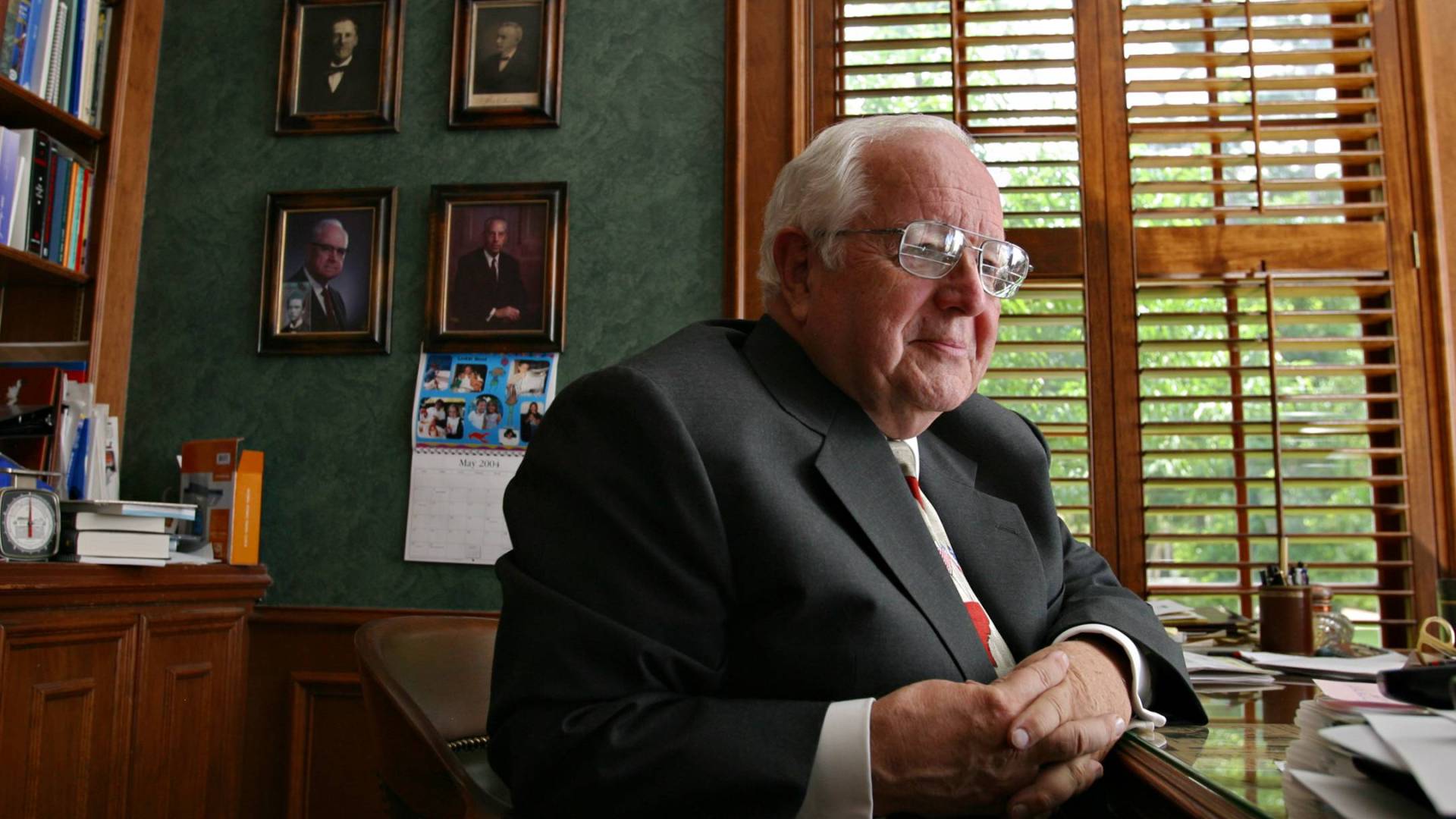
Paul Pressler in 2004

Paul Pressler in 2004

Christianity Today January 23, 2024
Michael Stravato / AP

Paul Pressler has long been an eminent Texas Republican, having served as a state representative and judge in Houston. He also once served as the first vice president of the Southern Baptist Convention, but the title doesn’t capture his true place in the firmament of the SBC.

As one of the architects of the Conservative Resurgence that reshaped the largest US Protestant denomination beginning in the 1970s, he has been hailed for decades as a hero who helped rid SBC churches of a creeping liberalism.

But recently, Gene Besen, a lawyer for the SBC, called Pressler, 93, a “monster” and “a dangerous predator” who leveraged his “power and false piety” to sexually abuse young men even as he was building his reputation as a conservative reformer.

“The man’s actions are of the devil,” Besen said, clarifying that he spoke in his personal capacity and not as a representative of the denomination. “That is clear.”

What makes Pressler’s case so enraging to many Southern Baptists, however, is that his abuse has been detailed for years. A lawsuit, filed by a former Pressler assistant named Gareld Duane Rollins Jr. claiming the older man abused him for decades, has been making its way through the courts since 2017. (The suit, which named Pressler, the SBC, and other Baptist entities, was settled in December.)

In 2004, the year Pressler was first elected vice president, his home church warned in a letter about his habit of naked hot-tubbing with young men after a college student complained that Pressler had allegedly groped him, according to the Texas Tribune. That same year, Pressler agreed to pay $450,000 to settle Rollins’ earlier claim that Pressler had assaulted him in a hotel room. When Pressler stopped making the agreed payments, Rollins sued again, this time alleging sexual abuse.

Pressler’s downfall also symbolizes a wider failure to deal with sex abuse in the SBC.

In recent years, leaks from the denomination’s headquarters in Nashville and legal filings have shown leaders stonewalling survivors and attempting to force the denomination to face the scope of abuse happening in member churches. The thousands of local church representatives, known as messengers, who make up the SBC’s governing body, meeting once a year at an annual meeting, have voted for measures to identify abusers and keep them from being employed as pastors.

They did so after learning the SBC’s Executive Committee, which runs the organization day to day, had long acted to shield the SBC—and particularly its assets—from liability, a strategy that led the leaders and their attorneys to defend things that were “indefensible,” said Marshall Blalock, a South Carolina pastor and former chair of a task force appointed to address the scandal.

The leaders in Nashville have relied in part on the decentralized structure of the SBC, which they have repeatedly claimed makes reforms impossible to implement. The 47,000 churches of the denomination are independent entities held together by a statement of their beliefs—the Baptist Faith and Message—and their contributions to the Cooperative Fund, established in the 1920s.

The SBC’s more than 13 million members donate nearly $10 billion dollars annually to their churches, nearly half a billion of which goes each year to fund cooperative ministries in the United States and abroad, including six major seminaries and a world missionary force.

While the SBC has no top-down authority, its churches and ministries are deeply interwoven, tied together by a network of state conventions, local associations, and “weak ties”— friendships between pastors, leaders, and lay people. Its institutions are overseen by volunteer trustees and a handful of staffers in the national office.

The only authority the SBC holds over its constituent churches, according to its leaders, is to kick out those considered no longer in “friendly cooperation” with its doctrine.

As a result, Southern Baptist leaders boast of their power to spread the gospel but take little responsibility when things go wrong. And local congregations have little power to fix things that are broken on a national level.

“The beauty of SBC is that we’re local and autonomous,” said Adam Wyatt, a Mississippi pastor and member of the SBC Executive Committee, recently. “The challenge is, we’re local and autonomous.”

The lawsuits against Pressler have provided a window into just how SBC leaders have evaded accountability. In a 2012 email revealed in court documents, an SBC attorney crowed over a 2008 decision not to create a database of abusive pastors that the SBC’s annual meeting had asked for. The lack of action on abuse enabled the leadership to avoid being sued after a church hired a music minister who was also a two-time abuser.

“This defendant was convicted and is serving a 10-year sentence in one case involving a very young girl,” the email read. “He was the music minister and had molested before, twice. The church knew and hired him anyway.”

In another email, an SBC vice president complained that the denomination’s insurance company had made a small payment in another abuse case. “Our insurer agreed to pay $5000 of a $67,500 settlement figure,” wrote the vice president. “Made me mad that ANYTHING was paid on our account, but we are not in control of that decision, the insurance company is, and for them it is not about principle, it is about cutting their expenses.”

In 2021, delegates to the annual meeting, known as messengers, commissioned an investigation—which leaders made concerted efforts to derail—by the third-party firm Guidepost Solutions. Its 2022 report showed the lengths SBC leaders had gone to mistreat abuse survivors and stonewall any possibility of taking national action to address abuse. In response, the SBC annual meeting called for a series of reforms.

Josh Wester, chair of the SBC’s abuse reform implementation task force, said that real reform is coming. Work continues on the long-anticipated database of abusers, known as Ministry Check, even though no names have been added to it yet. Wester said the task force is also looking for permanent funding to make the reforms stick—something that remains uncertain.

“We are trying to find a system that would work in accordance with Southern Baptist polity,” he said. Wester said that he has seen change at the local level and in state conventions but that changing the SBC on a national level remains a difficult task.

“We are working aggressively on all of the … things necessary to help our churches be safer places and to help keep dangerous people away from the vulnerable,” he said.

But Christa Brown, an abuse survivor and longtime advocate for reform, said that she sees no path to real reform. Brown recently called on members of the SBC task force charged with implementing reforms to resign, saying that while they have good intentions, the institution itself is untrustworthy.

“I believe they’re simply lending credibility to a process that is wholly polluted,” said Brown, author of a forthcoming book titled Baptistland.

Brown tracks the problem back to the conservative takeover of the SBC Pressler set in motion, to which all of the current leaders owe their rise. It explains why few have criticized him publicly, she said, even after details of his abuse became known, and why few have empathized with Pressler’s victims, including Rollins.

“None of them seem to have an ounce of respect for Duane, who brought truth to the table,” she said.

Attorney and abuse advocate Rachael Denhollander, an abuse survivor whose testimony helped convict former USA Gymnastics doctor and serial abuser Larry Nasser, said that documents from Pressler’s trial show that the SBC’s lawyers knew all along the abuse allegations were true and that SBC leaders should have known as well.

“Scripture tells us that when a leader falls, you are to rebuke him in the face of all so that he will become a warning,” she said. “The principle behind that is, as far as his reach has gone, that’s as far as the rebuke goes. If you have helped spread his platform, you have a responsibility to undo what you did.”

After the Rollins lawsuit was settled in December, Danny Akin, the longtime president of Southeastern Baptist Theological Seminary, told RNS, “We can’t deny the reality of the accusations. You’ve got too many people stacked up that were ready to testify.”

But Akin said he still believes in the ideals of the resurgence. He said that Southern Baptists will need to acknowledge their sins and abuse when teaching about the Conservative Resurgence.

Some younger Southern Baptist leaders have also denounced Pressler, including Wyatt, who said Southern Baptists can appreciate the accomplishments of the Conservative Resurgence and still repudiate the wrongdoing of its leaders.

Wyatt, who declined to comment on the committee’s settlement in the Rollins lawsuit, said he has been more concerned about what SBC leaders knew about Pressler’s past misconduct. “How could you know and not say something?” he said.

He hopes that Southern Baptists will be more concerned about the character of their leaders than they have been in the past. “I just hope that we’ve learned enough to know that we don’t need to platform people we don’t trust. It seems like a no-brainer to me.”

One Southern Baptist voice that has been notably silent about Pressler is Albert Mohler, the longtime president of Southern Baptist Theological Seminary and perhaps the most prominent theologian in SBC circles. A spokesman for Mohler did not respond to requests for comment.

Karen Swallow Prior, a professor of English who has taught in evangelical Christian schools for decades, said the SBC can’t escape the failings of the Conservative Resurgence. She said she became a Southern Baptist because she believed the resurgence was about the Bible. Now she suspects that it was about power.

“It’s the convenient myth that the SBC has told us for the past several decades,” she said.

Prior said that those who raised questions about abusive leaders in the SBC were eventually told they were not welcome—while figures like Paige Patterson and Pressler were allowed to remain.

She worries the abuse reforms will fail, and that that failure will break the SBC.

“My best guess is that this is the hill they will die on. And how long that will take, only God knows.”

Culture

Evil Is as Evil Does

The Zone of Interest, nominated for Oscars including best picture, is a Holocaust horror movie about the corruption of the human heart.

The Zone of Interest starring Sandra Hüller in theaters February 2.

The Zone of Interest starring Sandra Hüller in theaters February 2.

Christianity Today January 23, 2024
Courtesy of A24

The verdant and blooming garden outside the family home in The Zone of Interest, nominated for 2024 Academy Awards including best picture and best director, could appear in some celebrity’s home tour on YouTube. In the yard, the mother swoops her baby down close to sniff various flowers. “This one is phlox,” she says.

But all is not lovely here. Audiences might have a hint from the two minutes of complete darkness that begin this razor-sharp film that something is wrong in this Eden. The family dog sprints anxiously through most of the immaculate shots, grabbing food off the sumptuously set tables and knocking things over. Just over the garden hedge, you can see the puffs of smoke from a train going by. At night, there is a strange red glow on the bedroom walls, and no one seems to be able to sleep.

This is 1944, and the Höss family live in their beautiful home next to the gate of Auschwitz concentration camp, of which Rudolf Höss is the commandant. This part of the story is historical fact: Höss was the real commandant of Auschwitz, responsible for creating an efficient machine for destroying human lives. He later confessed he’d overseen the killing of 3 million people.

But The Zone of Interest, an antiseptic term Nazis used to describe the area around Auschwitz, doesn’t include that kind of historical detail about World War II or the Holocaust. Director Jonathan Glazer, who spent ten years on this project and shot it on location at Auschwitz, knows audiences have seen many such movies and may, by now, be numb to their presentation of those horrors. Instead, he drops the audience straight into the Höss family life as they swim and eat birthday cake. Only slowly do we absorb the darkness behind the “life we’ve always dreamed of,” as Höss’s wife, Hedwig, describes it.

This is a horror movie, not a historical epic. The film shows no violence, which makes it all the more disturbing and unforgettable. It’s important to watch with a high-fidelity audio setup because the family’s picnics and play are peppered with distant gunshots and screams. Like many films about the Holocaust, Zone is an examination of evil and the corruption of human hearts—but in an unusual way for our cultural moment.

The last few years have seen an explosion of stories exploring how a villain became evil—think Cruella, Joker, or the Star Wars prequels. The true crime genre, too, is often more fascinated with the backstory of serial killers than with the stories of their victims. We have become accustomed to watching evil deeds explained, contextualized, maybe even justified.

Zone is radical in its total disinterest in Höss’s backstory. It doesn’t explain his evil with a difficult childhood or a life-changing trauma. Evil deeds themselves seem to turn this family evil—and it is the entire family that’s corrupted, even the children. As Ecclesiastes 7:7 (ESV) notes, “Surely oppression drives the wise into madness, and a bribe corrupts the heart.”

As the story progresses, we start to see the many ways the family’s wrongdoing has deranged them, down to the way the children play together. The murders in the camp are unseen but wreaking havoc everywhere. I was reminded of a passage from Frederick Douglass’s autobiography, Narrative of the Life of Frederick Douglass, in which the former slave, abolitionist icon, and preacher was not preoccupied with the psychology or backstory of slaveholders. Instead, he examines how slavery not only brought evil into his life but corrupted the hearts of his masters too.

When Douglass is sold to a new mistress who had never owned a slave before, he recalls that when he met her, she was “a woman of the kindest heart and finest feelings.” “But alas!” he continued:

This kind heart had but a short time to remain such. The fatal poison of irresponsible power was already in her hands, and soon commenced its infernal work. That cheerful eye, under the influence of slavery, soon became red with rage; that voice, made all of sweet accord, changed to one of harsh and horrid discord; and that angelic face gave place to that of a demon.

The inverse of this heavy tale is Terrence Malick’s A Hidden Life, which tells the true story of an Austrian farmer who refused to fight for Nazi Germany. A Hidden Life also begins with a family in a kind of Eden. But where the family in Zone gains the world and loses their souls, the family of A Hidden Life sees their world fall apart, while their souls remain free. “Darkness is not dark to you,” the Christian farmer prays as he is beaten in a jail cell.

Zone’s darkness is very dark. It is an accurate depiction of its moment, when most Germans did not resist Adolf Hitler, but it also offers a glimpse of an alternative virtuous life via two night-vision sequences that are based on the true story of a 12-year-old who was part of the Polish resistance. These portions of the horror film are fleeting and too short—can’t we see more of that?

But that is not what the characters themselves seek: “They have all turned aside; together they have become corrupt” (Psalm 14:3, ESV). In The Zone of Interest, virtue is as rare as those glimpses in the night.

Emily Belz is a staff writer at Christianity Today.

Culture

‘Past Lives’ Is the Anti-‘Notebook’

We’ve romanticized stories of destiny-driven love—even at the expense of fidelity. This Oscar-nominated drama shows the beauty of limits.

Past Lives starring Teo Yoo, Greta Lee, and John Magaro.

Past Lives starring Teo Yoo, Greta Lee, and John Magaro.

Christianity Today January 23, 2024
Courtesy of A24

Last year, I watched The Notebook for the first time. For nearly 25 years, it has epitomized Hollywood romance, with stills of Allie (Rachel McAdams) cupping Noah’s (Ryan Gosling) face as they passionately kiss in the rain serving as a pop culture shorthand for love and destiny.

The Notebook is also a story of infidelity. The story toggles between the present, where an elderly Noah comforts an Alzheimer’s-afflicted Allie, and the 1940s, where Allie cheats on and ultimately leaves her fiancé to reunite with Noah after years apart. In the modern scenes, Noah models faithfulness despite its difficulty, but in the earlier part of their timeline, Allie’s unfaithfulness is presented as the peak of romance.

The 2023 film Past Lives, which was nominated for five Golden Globes and Academy Awards including best picture, subversively shows the extent to which that impermanent perspective has permeated our thinking about life and love. Nora (Greta Lee) lies in bed with her husband Arthur (John Magaro), who is processing his feelings about an upcoming visit from his wife’s former love interest, Hae Sung (Teo Yoo):

Arthur: I was just thinking a lot about what a good story this is.

Nora: The story of Hae Sung and me?

Arthur: Yeah, I just can’t compete.

Nora: What do you mean?

Arthur: Childhood sweethearts who reconnect 20 years later only to realize they were meant for each other.

Nora: We’re not meant for each other.

Arthur: In the story I would be the evil white American husband standing in the way of destiny.

“I’m the guy you’re leaving,” Arthur reiterates later, “when your ex-lover comes to take you away.”

Arthur’s confession surely echoes the inner narrative of many of the film’s viewers: We’ve been conditioned to expect the rejection of limits modeled in The Notebook. We meet characters with settled lives, then watch approvingly as they break commitments to expand their own possibilities and find peace, enlightenment, or even personal destiny. When our heroes’ relationships become collateral damage along their journeys, we might find it painful but accept it as necessary.

Past Lives doesn’t accept that damage. It asks if a more meaningful and beautiful life might be made by accepting our finitude, keeping commitments, and paring down possibilities. For Christians, of course, the answer is yes.

Like all of us, Nora lives a life shaped by a combination of choices made by others and those she has made herself. As a middle-schooler growing up in Seoul, she shared a sweet, mutual crush on her classmate Hae Sung. But when her family immigrated to Canada, the relationship came to an abrupt halt.

Nora first reconnects with Hae Sung as a young adult pursuing her lifelong dream of making it as a writer in New York. While aspects of their dynamic seemingly delight Nora, she eventually calls for a break. She wants to pursue her New York life, and it’s evident that this phone and video call relationship is a distraction. Though she assures Hae Sung the pause won’t last forever, Nora soon moves on, falling for and marrying Arthur.

Years later, when Hae Sung announces his visit to New York, Nora has built a successful career as a playwright and remains happily married. But as Arthur unravels—and Past Lives portrays Hae Sung sympathetically enough that we may begin to expect the pattern of The Notebook to repeat—Nora doesn’t waver.

“This is my life,” she assures Arthur, “and I’m living it with you.” She seems to intuitively understand what behavioral scientists have documented: that limiting your choices can give you a more satisfying life.

Nora’s countercultural embrace of limits and self-denial is also reminiscent of a biblical motif that begins in the creation account with God’s instructions to Adam and Eve about the tree of the knowledge of good and evil (Gen. 2–3). Immediately after violating God’s one mandate for them, we see the first humans begin to struggle with their own identities, losing their intimacy with God. They gained options, yes, but at far too high a cost.

That pattern of bucking God’s limits—and coming to regret it—repeats throughout the Old Testament, from the Israelites’ pleading with God for a king (1 Sam. 8) to Israelite men taking foreign wives (Ezra 10). Those who don’t follow this pattern flourish, like when Daniel, Shadrach, Meshach, and Abednego set themselves apart by foregoing the rich royal diet of Babylon (Dan. 1).

Refusal to stray beyond good limits in our lives is not something that happens by chance. “If you’re not gonna get taken in to the ways of Babylon, you have to have resolve not to do it,” Beth Moore has taught. She goes on to say:

Resolve means a decision that is made in advance, that you’ve already answered it, that you don’t make that decision … at the moment of decision. That decision was already made. That’s resolved. I already know in advance I’m not going to do it. … There are so many things, so many temptations, that come to us that are in the heat of that moment, and we cry out to God, and he says he’s promised to always give us a way of escape. But resolve is when we go, “There are certain things, I’ve just already made my mind up in advance.”

“This is where we ended up. This is where I’m supposed to be,” Nora tells her spiraling husband. She has already resolved to be faithful, to abide by the limits of the marriage she has chosen. Perhaps for Nora, her marriage to Arthur is never in question. But those of us raised on mottoes like What If and Follow Your Heart tend to question our loyalty to the choices we’ve made.

One of Past Lives’ most significant elements, then, is how it gives viewers a word for resolve cloaked in destiny. In Nora’s first meeting with Arthur, she tells him about the Korean concept of inyeon. It’s like providence or fate, she explains, which comes from supposed connections in past lives.

At that point, Nora jokes that the concept is just a Korean seduction device and goes on to kiss Arthur. But she later uses it to gently rebuff Hae Sung. As they banter in animated Korean at a bar, shortly before he leaves New York, the camera’s close shot on their profiles, the dim lighting, and the way they lean toward each other suggest they may yet follow The Notebook’s infidelity.

But Nora is not leaving her husband here; she is rejecting her childhood crush. She uses inyeon, appropriating and inverting the language of destiny, to say that though Hae Sung may feel a beautiful connection, pursuing the relationship is not for her.

Past Lives describes inyeon as a Buddhist concept, which may limit its application for Christians. Yet there is something worthwhile in Nora’s use of it to acknowledge that her connection to Hae Sung doesn’t abrogate her commitment to Arthur. For Christians, it can be a reminder that our resolve to reject faithlessness is part of a bigger story—not of destiny but of God, the author of our lives.

Morgan Lee is the global managing editor at Christianity Today.

Theology

Wrestling with Awkward Stories in the Old Testament

Cringeworthy passages can derail our yearly Bible reading plans. How do we interpret them?

Jacob Wrestling with the Angel by Giulio Benso

Jacob Wrestling with the Angel by Giulio Benso

Christianity Today January 22, 2024
Wikimedia Commons

On a recent trip to Egypt, the chefs at our hotel put out a remarkable buffet of culinary delights presented with both excellent taste and exquisite aesthetics.

One of our group members served onto his plate a beautiful spread: a cucumber disc topped with a triangle of cheese, a baby tomato, and a swirl of what looked like a dessert mousse. Sitting back at our table, he took a bite, and his eyes went wide as he grimaced. “What is this?!” he cried. That sweet mousse turned out to be liver pâté—not at all what he was expecting!

It’s the time of the year when many Christians embark on a new Bible reading plan. Reading through the Bible from cover to cover is a wonderful practice that exposes us to its less-familiar passages. We may discover new treasures along the way, tucked between the stories we know.

But we may also encounter passages we’d rather spit out of our mouths, like my friend’s liver pâté. Expecting inspiration, we may instead find hard words, troubling scenes, or confusing episodes. Especially if we hoped for an endorphin-generating Bible study—a “feel-good” devotional to carry us through our day—we can often find ourselves disillusioned.

As a Bible scholar, I’ve devoted my life to reading and understanding the Scriptures. I’ve watched the pages of the Bible come alive over and over again. Even so, I still encounter passages that trouble me. But I keep in mind something another Bible scholar and friend of mine, Esau McCaulley, once said—which is that we should engage with such difficult passages in the same way Jacob interacted with the angel in Genesis 32.

After a lengthy absence, Jacob was heading home to Canaan. He was nervous about running into his brother, Esau. When he left, things had been tense, and Jacob wasn’t sure how Esau would receive him when he returned. The night before their encounter, an angel surprised Jacob, and the two of them wrestled until daybreak—at which time the angel asked Jacob to let go of him. That’s when Jacob replied, “I will not let you go until you bless me” (v. 26).

Jacob knew he was encountering a heavenly being from the divine realm, and he didn’t want to miss an opportunity to receive a blessing from the Lord. And at that particular moment, he knew he would need it to have the courage to face his brother the very next day.

What if we treated the Bible like this? What if, whenever we wrestled with a troubling biblical passage, we adopted the same approach as Jacob? Understanding that the Scripture is divinely inspired and God-breathed, what if we said, I will not let go of this until it blesses me?

It’s far easier to throw up our hands and walk away from the text, but if we persist, we may find richer inspiration than we ever expected.

Three Keys to Wrestling with the Old Testament

In my experience, even the most difficult passages (maybe especially those passages) can be a source of blessing when we persist in trying to understand them. The problem is that many people struggle to understand the Bible because they were never really taught how to engage with it. So, with that, I’d like to share three keys to go about interpreting these tricky passages:

1. Consider the historical and cultural context. Like it or not, the Bible was not written to us or about us. Yes, it is God’s word for us, but the events it describes took place far from the time and place most of us call home. Even for those living in “Bible lands” today, thousands of years stand between us and the Bible.

That means reading the Bible is not only a cross-cultural experience; it also involves time travel. That’s why it helps when we know something about the history of this region. If we take the time to consider the daily lives of ordinary men and women—their concerns and challenges, their hopes and values—then we can enter into their stories more easily. Some modern readers are concerned that if they focus on history, the Bible will become less devotionally inspiring. Yet, time and again, I’ve found the opposite to be true. When I better understand the gritty realities of ancient times, I can see how much we have in common with ancient people. God still meets us in our mess today, just like he met them in theirs.

One way to learn the historical and cultural contexts of the Bible is through resources like the NIV Cultural Backgrounds Study Bible or the Zondervan Illustrated Bible Backgrounds Commentary series. Both contain rich, full-color images and are loaded with information to help you make sense of what is happening in the world behind the text.

2. Pay attention to the literary design of the passage. To focus on the scripture as literature does not mean we dismiss its historicity—it simply means we recognize that the Bible is an expertly crafted literary text. Scripture presents an inspired interpretation of history in a deliberate format designed to highlight its key themes.

As you read, take note of how the author describes people and places. Notice whether the narrative unfolds chronologically, and which scenes are placed side-by-side. Resources like videos from the Bible Project, freely available online, can help alert you to how a book is crafted.

In other words, read not just for the facts, but also to appreciate the artistry of the biblical authors. Carried along by the Holy Spirit, these writers are creating a stunning work of art that has stood the test of time.

3. Read with a diverse community. Some passages may strike us as odd, or even objectionable, because of our cultural context or life experience. When we read with others, we can pool our knowledge, our ideas, and even our questions to help us tackle difficult texts. Over the years, I have learned from other teachers and pastors and even from student questions and observations when I’m teaching a class.

In recent years, I’ve made a concerted effort to read the insights of the global church. It’s a gift to learn alongside men and women from different contexts, because their cultural vantage points allow them to see things that I miss and to explain matters that are unfamiliar to me.

A few resources I’m grateful for are Langham Global Library, the searchable database at Every Voice, and the Translation Insights and Perspectives website. These have significantly broadened my perspective by helping me read the Bible with others from around the world.

Why Would God Try to Kill Moses?

One passage that has baffled me is tucked away in Exodus 4. It’s not the sort of passage that comes up in sermons or Sunday school lessons, and I doubt you’ve read a devotional on it. In fact, it’s such a short story that if your mind wanders a bit while you’re reading, you might even miss it. But if you’re paying attention, this one is a bit shocking.

To set the stage, God has already met Moses at Mount Sinai in the burning bush and commissioned him to go to Egypt to bring his people out of slavery. Moses takes leave of his wife’s Midianite family and begins the journey back to Egypt with his wife and sons. That’s when the unexpected happens:

At a lodging place on the way, the Lord met Moses and was about to kill him. But Zipporah took a flint knife, cut off her son’s foreskin and touched Moses’ feet with it. “Surely you are a bridegroom of blood to me,” she said. So the Lord let him alone. (At that time she said “bridegroom of blood,” referring to circumcision.) (v. 24–26)

Why did God try to kill Moses while he’s in the middle of obeying? How did Zipporah know exactly what to do? Why did this circumcision change God’s mind? Why isn’t Moses’ son already circumcised? Why is this strange story important enough to include in this Book?

These were only some my questions. Based on past experience, I expected to find inspiration—if I dug deeply and wrestled with the text like Jacob with the angel—and indeed, I did!

Applying the Three Keys to the Zipporah Story

First, I considered the historical and cultural background of the story. Zipporah is the daughter of a Midianite priest. She has grown up around rituals. Circumcision was practiced by the Hebrews as well as by the Egyptians—but not in the same way or at the same time, and certainly not with the same meaning.

While God instructed the Hebrews to circumcise infants when they were just eight days old (Gen. 17:12), the Egyptians circumcised at puberty—and the rite did not appear to have a religious significance to them. For reasons unknown to us, it appears Moses had neglected to circumcise his own sons, which put his family on the outside of God’s covenant with Abraham.

Second, I learned the phrase “bridegroom of blood” may have a broader meaning. The Hebrew word hatan (“bridegroom” in NIV) can refer to any male relative by marriage, not just the groom.

Although the NIV specifies the pronouns, the Hebrew text is more ambiguous. When it says that she touched “Moses’” feet with the foreskin, the Hebrew is unclear as to whose feet it refers: her son’s feet, Moses’, or the Lord’s? But since her son was her relative by birth, rather than marriage, she was most likely speaking either to Moses or to his God, Yahweh, with whom she had entered into a relationship by marriage.

Not only that, but Zipporah’s statement, “Surely you are a bridegroom of blood to me,” had ritual significance, like the one wedding officiants today use when saying, “I now pronounce you husband and wife!” Likewise, Zipporah was declaring that her family belonged to Yahweh.

Third, and most importantly, as I spent time in the literary context of this odd passage, I found many connections that helped me make sense of it.

Before this scene, God had just told Moses to tell Pharaoh, “This is what the Lord says: ‘Israel is my firstborn son, and I told you, “Let my son go, so he may worship me.” But you refused to let him go; so I will kill your firstborn son’” (Ex. 4:22–23).

Moses was born a Hebrew but adopted by the daughter of Pharaoh. We don’t know whether she had other children, but if not, Moses may have occupied the role of her firstborn son. As Moses grew into adulthood, he seemed uncertain about his identity. He was not accepted by the Hebrews or by the Egyptians—and when he arrived in Midian, he did not introduce himself. It was only in his encounter with Yahweh at the burning bush that his identity was clarified.

However, if Moses did not circumcise his sons, then he had failed to take the only necessary step to identify himself and his family as Hebrews. Moses could not afford to return to Egypt with an uncertain identity—and so he would not be exempt from God’s ultimatum to Pharaoh.

Later, Moses would instruct the Hebrews regarding the Passover ceremony that would protect their firstborn sons when the angel of the Lord struck. Recall that to participate in the Passover, all the males in the family had to be circumcised (Ex. 12:48). So, Moses was about to command others to do what he had not done himself.

So back in the desert, Yahweh confronted Moses to ensure his full identification with the Hebrews. Zipporah, like the midwives and the other women in Moses’ infancy narrative, stepped in to rescue him from danger (Ex. 1:17; 2:1–10). As a woman who saved Moses, Zipporah is the bookend to the Moses saga. After this, the narrative then pivots to Yahweh’s rescue of Israel.

Learning to Eat Liver

Liver is an acquired taste with certain health benefits. If my friend on my study tour to Egypt had been adequately prepared, he may have been able to appreciate it. The Bible is an acquired taste too. Reading it well requires certain skills, experience, and commitment. My best advice whenever you come to a difficult passage is this: Determine not to let it go until it blesses you.

Carmen Joy Imes is associate professor of Old Testament at Biola University and author of Bearing God’s Name and Being God’s Image. She releases weekly “Torah Tuesday” videos on YouTube.

Nicaragua’s Relentless Crackdown on the Church Continues

Even with the recent release of imprisoned priests, Ortega’s regime continues to target Christian organizations with an “absolute intolerance for dissent.”

Nicaraguans hold a demonstration in front of San Jose’s Cathedral in Costa Rica to protest the detention of Nicaraguan bishop Rolando Alvarez in 2022.

Nicaraguans hold a demonstration in front of San Jose’s Cathedral in Costa Rica to protest the detention of Nicaraguan bishop Rolando Alvarez in 2022.

Christianity Today January 22, 2024
Ezequiel Becerra / Getty Images

Bad news has been the norm for Catholics in Nicaragua, where clergy and church groups have been frequent targets of a wide-ranging crackdown for years. But on January 14, 2024, they received a happy surprise: The government unexpectedly released two bishops, 15 priests and two seminary students from prison and expelled them to the Vatican.

Those released included Bishop Rolando Álvarez, a high-profile political prisoner who was detained in 2022 for criticizing the government and then sentenced to 26 years in prison for alleged treason.

They also included priests detained by President Daniel Ortega’s government in late December 2023 for expressing solidarity with Álvarez and other political prisoners. Days later, Pope Francis criticized the regime in his New Year’s message and then called for “respectful diplomatic dialogue.”

Nearly six years after mass protests erupted against Ortega and then were brutally repressed, these prisoner releases offer some hope to Nicaragua’s opposition. As my research has shown, however, the Ortega regime is unrelenting in trying to retain power, which suggests this is not necessarily a turning point. In fact, the government reportedly took yet another priest into custody on January 16.

Why target the church?

Ortega first led Nicaragua from 1979 to 1990, after his left-wing revolutionary organization, the Sandinista National Liberation Front, or FSLN, spearheaded the overthrow of dictator Anastasio Somoza Debayle. In the 1980s, the FSLN clashed with the Vatican and church hierarchy over the group’s socialist politics, even as many poorer Nicaraguan Catholics embraced them.

When Ortega took office again in 2007, however, he did so with the blessing of Christian leaders. During the 2006 elections, he had turned to alliances with Catholic and Protestant elites to return to power in exchange for adopting conservative social policies like banning abortion.

Over the next decade, Ortega remained popular, presiding over economic growth in collaboration with business leaders and developing new public infrastructure and services.

Yet he and the FSLN party he controlled were also consolidating power and governing in an increasingly authoritarian manner. Ortega won reelection in 2011 and then retained power in fraudulent elections in 2016. Opposition candidates were disqualified, and Ortega’s running mate was his wife, Rosario Murillo.

Unexpectedly, Ortega’s popularity and his relationship with the church came crashing down in April 2018, when the government announced cutbacks in social security benefits for retirees. Nicaraguans from all backgrounds took to the streets, and Ortega and Murillo responded with a furious crackdown, unleashing police and pro-government paramilitaries armed with military-grade weapons.

Cathedrals and churches tried to offer refuge to protesters, but over 300 people were killed. Church leaders facilitated a national dialogue between the government and an opposition coalition, but withdrew as repression continued.

When popular Catholic leaders criticized violence against protesters, the regime began viewing the church as a rival threatening Ortega’s waning legitimacy. Police, paramilitaries and FSLN supporters started harassing and attacking clergy and Catholic institutions.

In 2019, the pope recalled Silvio Báez, the auxiliary bishop of Managua and a prominent critic of Ortega, from Nicaragua. Yet other bishops and priests still found themselves in the regime’s crosshairs.

Some fled into exile or were blocked from entering Nicaragua if they traveled abroad. Others who stayed were kept under surveillance. Priests who expressed support for political prisoners or continued to criticize the regime, even in vague terms, could be arrested or beaten.

The government expelled 12 formerly detained priests to the Vatican in October 2023 after what the regime called “fruitful conversations.” But Álvarez, the highest-profile political prisoner, was still held by the government and was stripped of his citizenship after refusing to go into exile in February 2023.

Broader patterns of repression

Attacks on the church are a symptom of the Ortega regime’s absolute intolerance for dissent.

With over 3,000 nongovernmental organizations shut down since 2018, the church has become Nicaragua’s only major nonstate institution with nationwide reach.

[Editor’s note from CT: This year, Nicaragua saw the sharpest rise on Open Doors’ World Watch List due to restrictions on religious freedom, seizure of church and ministry properties, and the arrest or exile of Christian leaders.

The Nicaraguan government has shut down at least 256 evangelical organizations in the past two years. While over a third of Nicaraguans identify as evangelical, experts say the persecution of evangelicals has been “more silent” because some of their leaders still support Ortega’s government and critics don’t speak out for fear of retribution.]

In a country where over 40 percent of the people identify as Catholic, many normally turn to the church in times of need. Suppressing Catholic institutions means Nicaraguans must turn to the state for aid, which monitors citizens and has been accused of denying services for perceived disloyalty.

At least 27 Catholic and secular universities have also been closed or seized by the government, as have more than 50 media outlets.

The government’s decision to expel clergy on January 14 is also in line with its tendency to either block opponents’ reentry into Nicaragua or force them into exile. In many cases, Nicaragua has then revoked critics’ citizenship, as when it expelled 222 political prisoners in February 2023 to the United States.

When imprisonment or threats have not shaken critics’ resolve, Ortega and Murillo appear to have decided that keeping them abroad is best. Not only does this reduce the risks of anti-regime action in Nicaragua, but it may diminish international scrutiny of political prisoners’ mistreatment.

Cautious criticism

Since 2018, repression in Nicaragua has come in waves, with the brutal violence that repressed the protests shifting toward an environment of constant surveillance, legal actions against independent institutions and opponents, and periodic arrests. Moments of seeming calm, however, have often been followed by harsh crackdowns, such as a slew of arrests ahead of the 2021 elections.

Even as repression has mounted, the Vatican has been cautious about criticizing Ortega and Murillo, and some Nicaraguans and Catholics abroad have urged the pope to do more. Yet the Vatican’s restraint has not appeared to decrease threats against clergy or limits on activities like religious processions.

In January 2024, however, Francis pointedly called attention to the crisis during two speeches, days after a dozen priests were arrested. One week later came the release of Álvarez and his colleagues – free to leave Nicaragua, but not to come back.

Catholic leaders remain Nicaragua’s most popular figures, according to independent polling. This makes them a continued threat to Ortega and Murillo’s quest for total control. Ezequiel Buenfil Batún, the priest detained January 16, belonged to a religious order whose legal status was revoked that same day, along with several other nongovernment organizations.

As many Nicaraguans lose hope of conditions improving and dozens of political prisoners remain jailed, any positive news like the priests’ release is welcome. But it holds no guarantees of broader change ahead.

Kai M. Thaler is assistant professor of global studies at the University of California, Santa Barbara. This article originally appeared at The Conversation.

News

Indonesian Christians Divided Over Choosing Country’s Next Leader

As a once-beloved president ends his term in controversy, church leaders don’t see a clear front-runner in February’s elections.

Billboard of two pairs of candidates and other legislative candidates running in Indonesia's upcoming general election. 

Billboard of two pairs of candidates and other legislative candidates running in Indonesia's upcoming general election. 

Christianity Today January 19, 2024
Juni Kriswanto / Contributor / Getty

Last October, the reputation of Indonesia’s widely respected president took a fateful hit.

Led by President Joko “Jokowi” Widodo’s brother-in-law, the Constitutional Court of Indonesia dropped the age limit for presidential and vice-presidential candidates if they previously held elected regional office. Conveniently, this paved the way for Jokowi’s son, Gibran Rakabuming Raka, 36, to run as vice president for front-runner Prabowo Subianto in the February 14 presidential elections.

“That is the worst thing to happen to our democracy,” said Yonky Karman, a lecturer at Jakarta Theological Seminary. “This [upcoming] election is orchestrated by the incumbent to offer his preferred candidate, and the worst thing is that he made a way for his eldest son to run as vice president by changing the election law.”

Five years ago, 97 percent of non-Muslims voted for Jokowi. This time, Christians are divided in their support.

In the world’s third-largest democracy, Muslims make up 87 percent of the population while Christians make up 10 percent. For Christians, the most important issue when voting in an election is maintaining their rights as a minority religion. Because of this, they largely supported Jokowi in the past two elections.

Yet this time, the decision is trickier. Ex-general Prabowo is a former longtime rival of Jokowi, who later joined the president’s coalition and served as defense minister. Christians worry that, in the past two elections, he had the backing of radical Muslim groups.

Prabowo is running against Anies Baswedan and Ganjar Pranowo, both former governors. Anies is no stranger to the headlines either, after accepting support from radical Muslims who strongly opposed his rival, ethnic Chinese Christian Basuki “Ahok” Tjahaja Purnama, in the 2017 Jakarta gubernatorial election. Meanwhile, some are concerned about how much Ganjar, who has the support of moderate Muslims, will be influenced by former president Megawati Sukarnoputri.

Currently, Prabowo commands a large lead in the polls with 47 percent of the vote, compared to Ganjar at 25 percent and Anies at 21 percent, according to a December poll.

However, if none of the candidates receive more than 50 percent of the votes and wins at least 20 percent of the votes in half of Indonesia’s provinces, a second runoff election will be scheduled in June.

Respondents mentioned that, while the Christian vote is split, Jokowi’s push for “dynasty politics” is dominating conversations among Christians.

Franz Magnis-Suseno, a Jesuit priest and professor who has authored several books on political philosophy, noted that Indonesia is in a “really dangerous situation.”

“For many of us, it is the question of how will Indonesian democracy go on?” Magnis-Suseno said. “Under Jokowi, democracy is going down … the drain.”

A ‘humble, down-to-earth president’

Five years ago, it seemed unthinkable that such a popular figure like Jokowi would cause so much controversy .

“[Jokowi] was known to be very democratic and he … exhorted the plurality of culture and religion in Indonesia,” said Andrew Kristanto, pastor of an Indonesian church in New Zealand. Kristanto is one of more than 1.7 million overseas voters in the 2024 election, and while he has lived abroad for the last eight years, he said he follows Indonesian politics closely.

He described Jokowi as a “humble, down-to-earth president [whom] everyone loved.” Kristanto believed Indonesia became “a rising power in Asia, if not the world” while Jokowi was president and pointed to his achievements, such as recognition from world leaders, infrastructure growth, and the minimization of Islamic radicalism.

“He truly cares for the minority, for the lowly,” he said.

Andreas Hauw, a lecturer at Southeast Asia Bible Seminary and the founder of a political education nonprofit in Malang, Indonesia, agreed. He noted that Christians and the wider community approved of Jokowi’s performance in the last nine years.

During his administration, the government improved health care and education and standardized fuel prices in various regions, he said.

“Although there are still acts of radicalism such as the banning of churches, they occur sporadically,” said Hauw. “In general, Christians enjoy great freedom of worship.”

Jokowi catapulted into the country’s top post in the 2014 elections, which saw conservative Muslims squaring off against moderate Muslims and minority groups. Polls found that moderate Muslims and 97 percent of non-Muslim voters backed Jokowi and his running mate Ma’ruf Amin in the 2019 elections. Meanwhile, his rival Prabowo won the hearts of conservative Muslims.

To Kristanto, the decision between Prabowo and Jokowi in those two elections was “black and white.”

When asked about Jokowi’s actions at the end of his tenure, Kristanto paused before answering. “I’m a bit conflicted on this issue because, yes … I’m disappointed in how Jokowi toys with the constitution and he seems to [be using] any means to accomplish his goal,” he said.

“What Jokowi has done with the constitution leaves a bad legacy.”

Prabowo a ‘problematic’ figure

Does this mean the popular president has alienated his Christian supporters in just five years?

“Some are happy with Jokowi’s policies,” said Karman. “But people like me are concerned with the future of democracy and the future of good governance.”

He pointed to the Corruption Perceptions Index, which saw Indonesia’s score drop to the same level as the score in 2014, when Jokowi first came into power.

Others question whether they would vote for Prabowo, even if he has Jokowi’s support in this election.

“For some Christians, the figure of Prabowo is problematic, especially when you see 2014 and 2019, he was supported by radical Islamic groups,” said Kristanto. “If Prabowo really becomes president, will he still listen to Jokowi? Will Jokowi’s son be a powerful envoy?”

So far in this campaign, radical Muslim groups have stayed silent about who they will be throwing their weight behind, and Prabowo himself has tried to appear moderate, said Magnis-Suseno, who is German-born but has lived in Indonesia since the ’60s. Unlike in Prabowo’s previous campaigns, religion has not played a big role because the candidate wants the support of pro-Jokowi Indonesians, he said.

“Prabowo wants to avoid the questions of religious camps. … It would make it more difficult for him if he appeared as the champion of hard-line Muslim groups,” said Magnis-Suseno.

Moderate Muslim leaders agree that the current presidential election has focused less on voters’ religious identities. “People have even started to feel ashamed if they use issues related to ethnicity, religion, race, or intergroup relations in political campaigns because the public has become more discerning," said Inayah Rohmaniyah, an Islamic studies scholar.

But history is not easily forgotten. In the past two elections, Muslim hard-liners like Amien Rais (co-founder of the conservative National Mandate Party) were embedded in Prabowo’s camp. In 2014, Rais viewed the election in stark terms: “the party of Allah” against “the devil’s party.”

Magnis-Suseno believes that referring to political parties in this way is “evil” in a democracy. “Prabowo accepted this, and in 2019 he also accepted support from the 212 group.”

The rally called Alumni 212 emerged during the 2016 campaign for the Jakarta gubernatorial election in opposition against Ahok. Ahok was accused of blasphemy after referring to the Quran and sentenced to two years in prison. In the wave of that backlash, Ahok lost the bid in 2017 to Anies Baswedan, who is also running for president this time around.

But Magnis-Suseno said one of the biggest threats to democracy posed by Prabowo was his allegations of “widespread cheating” after Jokowi declared victory in the last election. Mass protests against Jokowi’s win turned violent and left eight people dead and hundreds injured. Prabowo was also a military leader during the May 1998 riots leading up to former leader Suharto’s downfall, during which 1,200 people burned to death and more than 90 ethnic Chinese women were raped.

“I do not believe in his democratic convictions at all,” Magnis-Suseno said of Prabowo. “I am afraid that democracy will be in big danger if he becomes president.”

Similarly, Martin Lukito Sinaga, founder of the Society of Interreligious Dialogue and a lecturer at Jakarta Theological Seminary, suggested that because of the way the law was changed for Gibran to run in the election, if Prabowo won, Indonesia would face “a setback in democracy,” and an “autocratic government” would likely develop.

A divided Christian vote

All of this has left Indonesian Christians without an obvious choice.

Magnis-Suseno recalled an encounter with a parish priest in East Jakarta. “He told me, ‘Our churches could be built after Anies gave permission, so part of my community will vote for Anies,’” Magnis-Suseno said. “Then in his parish, [there is] a good Catholic activist who is one of the close co-workers of Prabowo; thus, many of his community will vote for Prabowo, and the rest will vote for Ganjar.”

Karman also noted that Protestants were divided as well. He said he’d be happy with either Anies or Ganjar as the country’s next president.

“Ganjar does have another positive point, which is that his vice president candidate is Mahfud MD,” Karman said. “Mahfud is a professor in law and the former head of Mahkamah Konstitusi (the Constitutional Court). He knows many things about laws and is consistently against corruption.”

Sinaga believed the church would have more of a chance to minister effectively under Ganjar’s leadership because he appeared more open to plurality. He said that Ganjar also seemed focused on addressing the gap between the rich and poor, which worsened in 2022.

On the other hand, he believed democracy would flourish under Anies but may potentially lean more toward Islamic interests because he would need the support of more hard-line Muslim groups to garner the votes needed for the presidency. “Churches may need more energy to deal with religious legislations proposed by Islamic political power,” he said.

Hauw believes most Christians would not vote for Anies because he benefited from the strong opposition to Ahok in the 2017 election.

As for Ganjar and Prabowo, Hauw is wary about who is pulling the strings behind them. Former president Sukarnoputri, who chairs the Indonesian Democratic Party of Struggle, selected Ganjar as the party’s candidate. (Jokowi also rose to power through the same party, but in recent years his relationship with Megawati had grown increasingly estranged.) On the other hand, Prabowo is seemingly controlled by Jokowi through his son as a proxy.

“My main concern in this presidential election is that there is not one qualified candidate to vote for,” he said. Looking at the top two candidates, “One side likes the puppet but not the puppeteer. On the other side, the puppeteer is liked but not the puppet. Practically speaking, Ganjar is liked but the puppeteer isn’t, while on Prabowo’s side the puppeteer is liked.”

Kristanto also raised concerns about whether Ganjar would be an independent president, as it was uncertain how much influence Megawati had on Ganjar: “That has been a concern for some people as well because they’re afraid that Ganjar and Megawati don’t really get the visions of the great Indonesia Jokowi has been imagining.”

Kristanto said he would be voting for a candidate based on whether they have been aligned with radical Muslim groups in the past, how far they have tried to distance themselves with those groups, and whether they use them for their own political popularity.

While he didn’t share who he plans to vote for next month, he noted, “I would choose the candidate with the cleanest track record in terms of how he exhorts plurality.”

Apple PodcastsDown ArrowDown ArrowDown Arrowarrow_left_altLeft ArrowLeft ArrowRight ArrowRight ArrowRight Arrowarrow_up_altUp ArrowUp ArrowAvailable at Amazoncaret-downCloseCloseEmailEmailExpandExpandExternalExternalFacebookfacebook-squareGiftGiftGooglegoogleGoogle KeephamburgerInstagraminstagram-squareLinkLinklinkedin-squareListenListenListenChristianity TodayCT Creative Studio Logologo_orgMegaphoneMenuMenupausePinterestPlayPlayPocketPodcastRSSRSSSaveSaveSaveSearchSearchsearchSpotifyStitcherTelegramTable of ContentsTable of Contentstwitter-squareWhatsAppXYouTubeYouTube