News

Indian State Moves to Criminalize Praying for the Sick

A proposed ban on “magical healing” is the latest government initiative targeting Christian practice and evangelism in Assam.

An interdenominational prayer service held in the wake of the attacks on the passing of the Healing (Magical) Bill.

An interdenominational prayer service held in the wake of the attacks on the passing of the Healing (Magical) Bill.

Christianity Today March 11, 2024
Courtesy of Assam Christian Forum

State lawmakers in India are seeking to curtail evangelism with a ban on “magical healing” that could penalize Christians who offer prayer or any “non-scientific” practices to comfort people who are sick.

Last month, the northeastern state of Assam introduced the bill, which Christian leaders say unfairly targets their community’s custom of praying for the sick. Though church healing meetings in India have drawn people to Christ, local Christians insist that prayer is a legitimate, universal spiritual practice and not an unethical tool for conversion, as Hindu nationalists claimed.

The proposed ban, which passed the 126-member state assembly on February 26, states that:

No person shall take any part in healing practices and magical healing propagation for treatment of any diseases, any disorder or any condition relating to the health of a person (relating to human body) directly or indirectly giving a false impression of treatment to cure diseases, pain or trouble to the human health.

Any first-time offender can face one to three years in prison, a fine of 50,000 rupees (about $600 USD), or both. A subsequent conviction may result in up to five years’ imprisonment and/or a fine of 100,000 rupees (about $1,200 USD).

The bill must be ratified by the president of India to become an act. Assembly leaders in Assam say that the healing ban does not target any particular religion, but they were clear about their aims to restrict evangelism and conversion.

“We want to curb evangelism in Assam, so in that direction, the banning of healing … will be a very, very important milestone,” said Himanta Biswa Sarma, the chief minister of Assam. The state is governed by the Hindu nationalist Bharatiya Janata Party (BJP), the national ruling party of Prime Minister Narendra Modi.

“Healing is a very, very dicey subject, which is used to convert tribal people,” said Sarma. “We are going to pilot [this bill], because we believe that religious status quo is very important. Whoever is Muslim, let them be Muslims; whoever is Christian, let them be Christians; whoever is Hindu, let them be Hindus, so there can be a proper balance in our state.”

The bill has drawn flak from the Christian community and the opposition party.

The Assam Christian Forum (ACF), an umbrella body of all Christian churches in Assam, has spoken out against the ban as a violation of religious freedom and against lawmakers’ characterization of prayer as “magical healing.”

“Prayer is a universal practice across religions, used to invoke divine healing,” the forum stated. “Labeling it as magical healing oversimplifies the profound spiritual dimensions of faith and life.”

ACF clarified that Christian prayers for healing are acts of compassion, not conversion. According to the forum’s spokesman Allen Brooks, leaders are concerned that any prayer that may follow healing could be perceived as “a motive to convert the other person to Christianity,” in which case “everybody will go to jail.”

In the neighboring state of Nagaland, the Chakhesang Baptist Church Council criticized the Assam bill as wrongly banning Christian practices in a secular country. The council praised its own state for upholding the right to freedom of religion.

The council’s executive secretary, C. Cho-o, also objected to the term “magical healing” as dismissive of supernatural intervention. “Healing is the work of God, not the work of Christians,” he said. “So, when divine healing takes place, Christians cannot claim responsibility, nor can they be blamed for it!”

Officially called the Assam Healing (Prevention of Evil) Practices Bill, 2024, the proposed law would criminalize any “non-scientific healing practices with ulterior motives for exploiting the innocent people.”

Besides the punitive provisions, the bill empowers police “to enter and inspect any practices within the local limit of jurisdiction of such person where he has reason to believe that an offence under this Act has been or is likely to be committed.” It gives officers a free hand to seize any advertisement, record, or document as evidence.

Healing meetings are common in India and have drawn many people to Christ after they have personally experienced healing or have watched their loved ones recover. Local Christians can recount testimonies around the power of healing for the church. (They shared responses anonymously with CT out of security concerns.)

One leader saw how healings can be an entry point for the gospel, attracting people looking for an answer for their physical suffering.

“Signs and wonders abound, and many people come to know Jesus as healer first, and then as they walk with him as their Lord and Savior,” he said. “But to call this a conspiracy or magic would be belittling it. It definitely is not evil, but the grace of God.”

A convert shared how transformative healing ministries were for her in the three years since she began attending church.

“My family was surrounded with bouts of sicknesses and illnesses. Since I have begun to follow Christ and my family has joined me, we have gotten rid of the bondage of illness,” she told CT.

Hindu right-wing groups have for years alleged that Christian groups are engaging in unethical conversion tactics under the guise of “healing crusades” in India. They have accused Christians of promoting superstitious beliefs, making false claims about miraculous healings, and using deception to convert people, especially from economically disadvantaged communities, to Christianity.

The Organizer, a weekly publication associated with the BJP, ran a special report expressing that the Assam bill will thwart Christian missionaries from luring “villagers with magical healing” and will prevent them from converting tribals.

The Assam Tribal Christian Coordination Committee (ATCCC) has appealed to the government to review the bill, expressing concerns that its current wording could be misused to target the Christian community.

Like other local Christians, the ATCCC stated that the bill should not link “magic healing” with proselytization or conversion, as the Christian church aims to share Jesus’ teachings of love and peace.

The committee urged the chief minister to ensure the bill’s integrity and to maintain the secular principles of the country’s constitution while passing it, fearing that its current form could lead to more harm than good.

The Angami Baptist Church Council (ABCC) from Nagaland condemned the Assam bill as an attempt to target Christian humanitarian work by misleadingly equating divine healing with “magic” used for conversions. It stated Christian healing combines science and prayer, not magic.

The council urged the “sister states” of northeast India to promote peaceful coexistence instead of sowing division through such discriminatory laws.

A pastor in Guwahati, Assam’s largest city, believes that even if the ban is brought into action, it will not stand for long.

“In Assam, we have both tribals and non-tribals who will not obey the law that is being imposed in the state,” said Kamleshwar Baglary of Harvest Baptist Church.

He believes that migrants from other states are responsible for the recent political mayhem in Assam.

“Most of the people used by the Hindu fundamentalist organizations are paid workers to execute their plan in the state,” Baglary said. “They cannot rule in Assam with their ideologies.”

While responding to the bill, the ACF also expressed concern over demands by pro-Hindu, right-wing groups like Sanmilito Sanatan Samaj and Kutumba Surakshya Parishad, which have demanded that schools remove Christian symbols like statues of Jesus and Mary, alleging that the institutions are being used for religious conversion activities.

The situation has escalated with anti-Christian posters being pasted on the walls of several Christian schools, including Don Bosco School, St. Mary’s School, and Carmel School. These posters serve as an ultimatum to remove religious symbols within a specific timeframe. The Assam healing legislation has only added fuel to the fire.

Brooks, the ACF spokesman, has defended the schools as providing equal opportunities beyond caste, creed, and gender, and has clarified that ACF’s healing prayer services are not intended for conversion.

He argued that the new law unfairly targets the Christian community’s practices and undermines their long-standing service to the society of Assam. Christian missions have helped preserve the Assamese language and have established educational institutions that have produced many notable figures, including former chief ministers and chief justices.

“Our destiny as a nation lies in our diversity, while respecting each other’s individuality,” he said.

Inkwell

Variations on The Planets

Inkwell March 10, 2024
Photography by Martin Penot

How do you contain a small explosion?
Just behind the eyes. It has to beat, beat
against the skin –

so if the stars, if they
have taught us anything, surely it is
that creation is not vacuumed. Not ours.
Begun before we had eyes and tongues and
telescopes and hours of our own. Begun
in fire – productive fire – and with a Word
(not Ours). If we need anything, down here,
self-important and soggy and afraid –
if we down here need anything, it’s to
be told we’re smaller than we think but not
alone – not thrown like whittled dice into
this pitch arena.

No, shadowed instead
by bodies bigger than us. And like poor
misguided parents we name them! Oh! the
audacity of naming time! All those
ancient rocks lined up for what? To mark a
thousand solstices that the builders would
never see? You named today a planet
thirteen thousand years into our past – you
named it after a man you love, perhaps
– or who loves you. And now you think you have
immortalised him. And so now he is
past immortal – before he was born his
planet bears his name and now he lives is
it still spinning? Still hurtling? Is that how
this works? Or has the quick time up there won
out again, its pace never quite in step
with our dull turning?

This is why, of course –
we find stars in ice and all the things that
we don’t think are quite eternal enough:
flowers and fireworks and babies’ eyes – all
as if to hold in stasis something of
light, to hold in our hands the echoes of
what was trapped and freed in fairy-tale terms:
long ago and far.

So, in all their bright
and silent hiddenness, these distant golds
become oil-work in our inherited
hunt – the yelp of every human life since
time remembered – for some ever-distant,
never found and fraught vanishing point where
we’ll find grounded everything we’ve questions
for:

how did the atoms come together?
And when? And will we forgive them one day
for doing it without us? How many
moons? Stars? Ages? How many ways can a
child forgive its parents? How far are we
prepared to go? For the men we love? The
women who made us? The children we did
not mean to make? So, because these old and
moulded galaxies are hidden, we find
we cannot stop chasing them, because in
them we see and cite the corners of all
our mundane mysteries – those old, glittering
things that garment us, fragment us, name us
in their own namelessness –

which is why, of
course, we sift on through the dark and draw our
lines between the stars to make animals
and omens, webbing around that trig point
in the black – which is where, of course, we find
that all those things that made it worth seeking
were beside us down here all along, that
every reason we ever had to search
is grounded in a pinnacle in time,
a moment, a sigh, and it is finished.
And it is only just beginning.
And

it was over long before we knew to
look. And we keep looking, keep finding the
same old impressive reasons to find and
name some never forgotten corner of
a long-awake world, just to be told it
was never ours to keep – only to name.
And names change, and the constellations are,
it seems, different across the equator.
And I only knew that when I crossed the
equator,

so maybe we have to cross
the dark to see that when it was finished
it was very good, see that when it was
finished, this was left in place: that every
etched steppe of light was named, was ours to name.

Ruby Dunn’s poetry has been published by the North American Anglican, Stanchion, and Hyacinth Press journals, amongst others. Her academic work has been published by the University of St Andrews Arts and Divinity Faculty Journal, and she currently lives and works in Oxford. You can read more of her work at rubydunnwrites.wordpress.com

Inkwell

This Small Thing

Inkwell March 9, 2024
Photography by Rob Potter

It greets me again on some cold November evening
Crested with cherry and yellow hearted
A most magnificent leaf on the ground by the train station

Tuesday morning and the windows are foggy
My room is cold and my bed is warm
And it sings it’s bright hello in crisp morning sunlight

On the 9:36 to Euston I find it in a stranger
who can’t hold in his laugh, hand over mouth
Chuckling through his nose. He is wonderful.

Three old ladies outside a bistro chattering
Canyon laugh lines and bright lipstick
When they dimple at me, I return my biggest smile

And on Saturday I do the dishes at my sister’s house
Through the kitchen window the tall grass
On the mountainside dances in the amber evening

Something soft blooms in my chest in answer
To the cobweb glistening with dew, dragonflies,
The little yellow boat at Portnoo pier, darling and weathered

To mist below the hill and the first sip of a good cup of tea
My niece’s laugh and my father’s teaspoon collection
And that silk moth I saw sunsoaking on a hot afternoon and I know

It cannot all be luck. My days are threaded with joy
So small and featherlight, a breath against the wind.
Woven together in defiant splendour

These small things
And Your glory therein.

Mary Clement is a debuting poet and student at St Mary’s University, Twickenham, where she is the president of the Creative Writing Society. She studies and works in Creative Media, though her first love is poetry. 

Inkwell

I Closed the Infinite Door

Inkwell March 9, 2024
Photography by Gabriella Clare Marino

I closed the infinite door for the weekend
and followed my weightless heart to a coffee shop
to read fiction like I’m fourteen
and reconnect with the deep magic.

My good wolf finds me here,
pokes his muzzle under my book
and puts a paw in my hand.
He carries scars of self-defence all over his thin body.

I meet his eye and embrace him,
draw him into deep armchair,
his muzzle in my shoulder.
We will repair each other.

I want to throw him a feast, he deserves one,
but you must feed the starving slowly back to themselves.
Then I must follow him into new country,
where I am at long last safe in myself.

Here, I’ll feed up the right wolf,
on full presence and companionship, 
on baths, real rest and undistracted work, 
on sheer play and grateful prayers.

This is the jubilee year of grace and peace,
it is his year and he knows it.
I follow him to Richmond Park,
to plant self-destruct buttons and grow pomegranate trees,
to sharpen screens into black glass arrowheads.

There are many perfect days ahead,
we can taste them.

Taking in the view, 
I scratch his ear and let him know,
‘I have decided to live myself to death.’

Isaac Withers is the Creative Director of Peter’s House Ltd, a Catholic Creative Agency and is currently training as a counsellor.

News

Fear, Grief, then Supernatural Peace: Myanmar Christians Process Draft

While many young people feel helpless over the news of the conscription law, believers see an opening for ministry.

Military officers marching in Myanmar.

Military officers marching in Myanmar.

Christianity Today March 8, 2024
Aung Shine Oo / AP Images

When Kyaw Sone, a 27-year-old seminary student in Yangon, Myanmar, heard the news last month that the government was conscripting young men and women amid the country’s civil war, he felt “very, very sad.”

“These are our oppressors and now we have to fight for them,” he said of the military junta that overthrew the elected government in a coup three years ago. Since then, civilians—including many of Kyaw Sone’s Christian friends—have fled to the jungles to join resistance groups fighting the Tatmadaw, Myanmar’s military. “In my flesh, I [also] want to fight them,” Kyaw Sone added. (CT has agreed to pseudonyms for the Christians in Myanmar interviewed, for security.)

Kyaw Sone, who is part of the small Christian community in Rakhine State, has witnessed the brutality of the Tatmadaw firsthand. In 2017, the junta forcibly evicted the Muslim Rohingya people in Rakhine, killing thousands and forcing 700,000 to flee to Bangladesh. Since the coup, fighting between the well-funded military and an alliance of ethnic armed groups and pro-democracy forces has intensified, with the military bombing churches and destroying entire villages. The junta also cut off aid to Rakhine after Cyclone Mocha last year, leading to an unknown number of deaths.

Over and over Kyaw Sone prayed, “God, what should I do?” until he felt God touch his heart. “He has chosen me for ministry and the church,” he said. “While I am angry and I want to fight, through prayer I see God is using me for his kingdom, so I will stay and serve.”

News of the conscription law—which affects men ages 18 to 35 and women ages 18 to 27—has sent shock waves through the country. The government announced that it would draft 60,000 people a year, with the first batch of 5,000 to be called in April.

Some young people are seeking to flee the country. Others have decided to join the resistance. Still others feel paralyzed without any good options. Yet several Christians CT interviewed said they found a peace beyond all understanding that motivates them to continue their ministries, which are seeing unprecedented fruit. At the same time, Christian groups across the border in Thailand are doing what they can to help young people seeking refuge.

Desperation and fear

The conscription law reveals the desperation of the Tatmadaw, which in recent months has faced its worst military defeat since its coup sparked the current civil war three years ago. Starting in late October, ethnic armed groups have gained control of a large swath of territory in northeastern Myanmar. Resistance groups in other parts of the country have also launched their own attacks, including the Arakan Army in Rakhine State.

Since the coup, the Myanmar military has suffered from mass defections and has had difficulty recruiting soldiers. Recently, the military has reportedly resorted to kidnapping young men and forcibly enlisting them. To date, more than 4,600 people have been killed and 26,200 arrested, according to the Assistance Association for Political Prisoners.

The nationwide anger against the junta explains the overwhelming distraught response to the conscription. Joel, a technical advisor for an international nonprofit that supports Burmese organizations, noted that “the intensity of emotion and fear was as if the coup had happened all over again.”

“Our team in Mandalay’s first reaction was one of, I don’t want to die at the hands of the [military] while being under their control. I’d rather die fighting for the resistance. And, if I don’t dare to do that, then I am going to go to Thailand,” he recalled.

Joel spent several years in Myanmar with his family, including during the time of the coup and the ensuing protests. After half a year of sleepless nights as soldiers raided neighborhoods, shot people in their homes, and carted civilians off to prison, his family made the difficult decision to leave. They realized their foreigner status put their team and their friends at higher risk.

After news of the conscription broke, Joel was tasked with interviewing young people across Myanmar so his organization could know how best to build capacity within the national staff and target their resources to the most-needed areas. Even though the interviewees came from different ethnic groups, religions, and professional backgrounds, the overall feeling was the same.

“I think the intended consequence of this [conscription law] is to put fear into those who are the backbone of the resistance and people giving aid,” he said. “If they flee, then their families might be targeted or at least not have enough money to survive.”

Gospel opportunities in the chaos

Lydia, director of the Waystation, a Christian nonprofit serving marginalized communities in central Myanmar, was alone in her room at night when she heard the news of the conscription.

“I was so surprised that [the conscription law] included young women as well,” said the 27-year-old. (Maj. Gen. Zaw Min Tun later said the government did not yet have plans to call women into military service.) “My first thought was, Where can I go? I wanted to run away and hide somewhere. I felt so afraid to sleep on my own.”

For several months before the news, Lydia had stopped letting male staff go out into the communities they served because the police and military presence was so strong there. She feared that the young men would be snatched away and enlisted.

“I quickly prayed, but the first three days felt like my whole life was broken,” she said. “I had no hope and was very fearful.”

The next day at work, she gathered her staff and felt like crying. “As the leader, I looked at all of them who are young, and I was so afraid for them,” Lydia explained.

Many of her staff began to plan to leave the country, and she wanted to go as well. But then she read Matthew 7:24–29, about the wise man who built his house on the rock and the foolish man who built his house on the sand. “My foundation is Jesus, but where is my faith?” she asked herself. “The storm is coming; where is my faith? Am I building my house as a wise man or a foolish man?”

She then came upon 1 Corinthians 3:10–13, which encouraged her and even brought her joy: “Jesus is our foundation. Even though my whole life can fall, my foundation is God.”

After that, she shared these verses to strengthen others.

Lydia, who is from the Kachin ethnic group, comes from a long line of Christians. Her extended family moved to the Mandalay region long before the coup, as their home had become a war zone after decades of persecution at the hands of the Tatmadaw.

While her father initially looked for ways to keep her from conscription, her cousins seemed bold and unafraid. Her youngest cousin, who is of conscription age and whose wife just had a baby, still goes out to evangelize every day. He told her, “Lydia, God has a ministry for you here. … Everything is in God’s hands. Even though the situation is bad for God’s people, we have God’s protection.” Lydia noted that her cousin’s strong faith helped settle her own fears. She and other members of her community now sleep on the floor of his church, as they find safety in numbers. The church has grown from a few families to 100 people since the coup. Nearly all the members are new followers of Christ.

She’s seen other gospel opportunities. One nearby village the Waystation has been trying to reach had long been averse to any Christian support or witness. Yet recently, they’ve seen a change. “The villages are open to the gospel now in a way they have not been,” she said. “I’m dreaming of what God has for us there.”

Meanwhile, Kyaw Sone said God is speaking to him through the story of Caleb. As Numbers 13 relates, when Moses sent 12 spies to Canaan, 10 of them came back fearful of the powerful people, but Caleb and Joshua believed they could conquer the land.

“Sometimes we are faced with problems in Myanmar,” Kyaw Sone said. “It is so bad and it seems impossible that we can pass [through them]. Yet Joshua and Caleb knew it was possible with God. I read this story again and again. It’s very fitting for my life right now.”

The difficulties are ever present. Kyaw Sone’s parents are still in Rakhine, which is facing a food shortage as all entrances and exits are blocked by the junta forces due to the fighting between the military and the Arakan Army. Last month, the Tatmadaw detained and arrested two flights of civilians returning to Rakhine, accusing them of coming back to join resistance forces. Many have not been heard from since their arrest. Their families fear they will be used as human shields and porters for the military.

Kyaw Sone said his parents are safe for now but sad that their children can’t return home anytime soon. Despite the hardships, his face lit up as he shared that he recently led four people to Christ in Yangon. One woman, who converted on her deathbed, has passed away, but he now has three new disciples.

Preparing for an influx

Across the Myanmar-Thai border, the Charis Project has been serving refugees and migrants from Myanmar in the border town of Mae Sot for the past 15 years. The Christian organization also supports internally displaced peoples (IDPs) on the Myanmar side of the border. Before the coup, most of the fighting had been between the Tatmadaw and ethnic groups seeking greater autonomy.

The Charis Project trains and coaches parents who have experienced deep trauma to build healthy families within the chaos and insecurity they are currently living in, said CEO Aaron Blue. The project’s long-term vision looks 30 to 40 years into the future, seeking to raise children to become wise and compassionate adults who seek peace and make a better world around them.

“Family, by God’s design, is the single most powerful resource in the development of a human,” Blue said.

Their mission has not changed since the coup or the announcement of the conscription, yet Blue believes they are in a unique position to help the influx of people fleeing into Thailand.

The conscription laws impact an estimated 12 to 17 million people, and Thailand cannot accommodate such a large number leaving Myanmar, Blue noted. Since the Charis Project has relationships with ethnic resistance organizations (EROs)—which include ethnic armed groups but also people providing aid, building political foundations, and establishing safe corridors—they can work “upstream” to stem the flow of people into Thailand by helping displaced people find safety within ERO-liberated areas of Myanmar.

“Internally, the EROs do not have the capacity or funding to deal with the amount of IDPs fleeing to the territory they control,” Blue said. “But they are people with the logistics who can get aid to where it is needed. We work to build funding and support for the IDPs; this includes food, medical supplies, [and] hygiene products.”

The Charis Project partners only with EROs that are working for peace: While ethnic armed groups share a common enemy in the Tatmadaw, they do not all agree on tactics and ethics. “There are people on the other side [in Myanmar], people with authority and influence [that] are fighting for peace and the future,” Blue said. “They are Christians seeking peace in the structure of conflict. They are serving out of a commitment to the kingdom of God and their future.”

Blue and his team watched as the conscription law brought fresh fear and desperation. But they also saw a new determination among the youth to stand up. He noted that the conscription news has yet to result in an influx of refugees entering Thailand, but they anticipate it will happen soon and are preparing aid and necessary support.

“People with power are destroying their nation, and the people [of Myanmar] just want to live,” Blue said with tears in his eyes. “They want peace, they want this to stop. They just want to go to the market without being shot. To live without their kids being kidnapped. They want to go through a year without being terrified.”

How the global church can help

CT asked the interviewees how the global church could pray for their brothers and sisters in Myanmar. Here are their answers:

-Pray for the people of Myanmar to hear God’s voice and reassurance amid the trials.

-Pray for the military to lay down their weapons and for the fighting to end in Myanmar.

-Pray for Christians in Myanmar to be wise as serpents and innocent as doves.

If Christians wish to make financial donations, the interviewees urged not to give to the UN or UNICEF, as they work with the Tatmadaw and don’t have the best access to the people’s needs. The Charis Project and the Waystation are two Christian groups working directly with young people in need.

Elizabeth Francis is a pseudonym, as the writer continues to live and travel in sensitive areas.

Ideas

Why John MacArthur Is Wrong About MLK

Contributor

The prominent pastor’s claim that Martin Luther King Jr. was “not a Christian” is not only ahistorical. It misses God’s heart for justice.

Christianity Today March 8, 2024
Illustration by Elizabeth Kaye / Source Images: Wikimedia Commons

When my grandfather died, a portrait of Martin Luther King Jr. was hanging over his deathbed. His name was Bishop Thomas Lee Cooper, and he was part of the Black church’s now-fading civil rights generation, which King defined.

It’s no great mystery why he and millions of other Americans held King in such high regard. This confessing Christian leader literally sacrificed his life to exemplify love of neighbor. His prophetic dream was a clear application of the gospel, which gave his people reason to “keep on keeping on” while suffering under the sword of oppression. He modeled a tenacity and grace that challenged America’s wicked racial caste system without reciprocating the hatred or belligerence of those lynching his people. And King always pointed Black Americans’ hope toward Jesus Christ, not himself. It’s impossible to honestly honor him without acknowledging the role his Christian faith played in his social action.

Contrarily, in February comments more widely circulated this month, California pastor and theologian John MacArthur called King “not a Christian at all,” “a nonbeliever who misrepresented everything about Christ and the gospel.” He also called The Gospel Coalition (TGC) “woke” for honoring King in its MLK50 conference in 2018, implying this signaled the end of TGC’s faithfulness and orthodoxy.

MacArthur cast these condemnations casually, with an apparent air of self-righteousness that suggests his theological expertise is paired with an infantile understanding of neighborly love (Heb. 5:11–13). Deep knowledge of systematic theology, unfortunately, can exist alongside a desperate need for remedial instruction on the greatest commandments (Matt. 22:37–39) and a failure “to distinguish good from evil” (Heb. 5:14), including King’s good work of peace and justice informed by Scripture and motivated by the gospel.

I spoke at MLK50, and I don’t recall seeing any speakers who weren’t unambiguously orthodox. MacArthur’s accusations aren’t only too lightly made. They are plainly slanderous.

MacArthur may take issue with some of King’s early theological work, which did question Christian doctrine. However, as Mika Edmondson—himself a pastor and systematic theologian—insightfully explained, “King’s early seminary papers don’t reflect his final fully formed theology.” Not unlike Abraham Kuyper and Dietrich Bonhoeffer, King wrestled with theological liberalism but later seemed to “shift back toward the faith of his conservative Black Baptist upbringing.”

And notice, as Edmondson also mentioned, that Kuyper’s and Bonhoeffer’s salvation is never questioned. “They are given the benefit of the doubt.” Why is King held to a different standard? Even theologians who were slaveholders receive less scrutiny than King in some Christian circles.

But let’s be honest: The details of King’s theological journey have never been the principal concern of his detractors. J. Edgar Hoover and Bull Connor didn’t hate King because of his theology or even his indiscretions. They hated his audacity and how he called out America’s sins and exposed its fictional storylines. They hated that he didn’t know “his place” and was undermining their authority.

In Acts 5, the apostle Paul’s teacher, Gamaliel, warns fellow religious leaders against trying to kill the apostles based on their inconvenient testimony about Jesus. After reciting a brief history of past leaders and upheavals, he says: “Therefore, in the present case I advise you: Leave these men alone! Let them go! For if their purpose or activity is of human origin, it will fail. But if it is from God, you will not be able to stop these men; you will only find yourselves fighting against God” (vv. 38–39).

The leaders to whom Gamaliel spoke had rejected the Messiah and had helped bring about his death, just as Peter and the apostles charged (vv. 29–32). Yet they were unwilling to accept the truth and repent. They thought they were close to God, but their behavior was at odds with his purposes.

To their detriment, many evangelical leaders (and others) rejected King’s righteous indictment of America’s injustices just as the religious leaders rejected the message of the apostles. God sent America a messenger, and some in the American church are still unable to reckon with his message. They remain too focused on justifying themselves to accept verifiable historical facts. They may find themselves fighting against the very thing they claim to uphold.

As for MacArthur, he might genuinely believe he’s defending the faith, but he’s actually defending a false narrative that has weakened the church’s credibility. People are walking away from the church in part because they can’t reconcile the double-mindedness of this type of evangelicalism. One cannot worship the Prince of Peace and refuse to be a peacemaker in the social context.

That said, though MacArthur’s concerns about the ideological Left’s impact on the church are often exaggerated, they are not completely unfounded. The far Left has distorted social justice and disfigured its redemptive form. It’s become more about individual autonomy and self-indulgence than equality under the law and social order. I too lament when Christian leaders imitate secular activists and academics in the public square and fawn for their validation.

But rejecting King is no solution to this problem; he is the model of the unabashedly, unmistakably Christian activism we need—the exact kind of public, Christian faithfulness that the dysfunctional corners of the Left have eschewed. Condemning King and evangelical groups who are trying to show contrition and repentance is a move toward “bitterness, rage and anger, brawling and slander” (Eph. 4:31), not redemption.

Ironically, those who are obsessed with political power and cultural domination are often the same as those who question King’s representation of the gospel. It’s telling that he’s known for self-sacrifice, and they’re known for resentment and self-interest. They pick up a cross and awkwardly try to use it as a sword, but King knew “the cross is something you bear and ultimately that you die on.” Their assessment of King is wrong.

And disparaging King is not enough to discredit the Christian social justice movement more broadly, as MacArthur has sought to do. To accomplish that, MacArthur would have to do more than smear King’s legacy and deny his faith. He’d have to tear the Spirit-filled prophecies of Isaiah, Jeremiah, and Amos out of Scripture. He’d have to retroactively undo the eschatological motive behind God’s deliverance of the Hebrews. He’d have to go back and rip the heart of Jesus out of the chests of Christian abolitionists.

He will fail in that effort. Social justice, as practiced by Amelia Boynton Robinson and Fred Shuttlesworth, is the fruit of the gospel and is found wherever God reigns. And King’s vision and self-sacrifice rightly made him a symbol of the church’s call “to set the oppressed free” (Luke 4:16–21).

Ultimately, the justice imperative comes from God, who sits on the throne of justice and righteousness, not from any person or organization. And inasmuch as MacArthur or any others reject or even obstruct the American church’s efforts to repent of injustice, imitate Christ, and heal our country’s racism, sexism, and economic inequalities, they will only find themselves fighting against God.

Justin Giboney is an ordained minister, attorney, and the president of AND Campaign, a Christian civic organization. He's the co-author of Compassion (&) Conviction: The AND Campaign's Guide to Faithful Civic Engagement.

God, Music & Meaning

Charlie Peacock, Grammy Award–winning music producer and host of CT’s “Music & Meaning” podcast, shares how God has worked through his life and career.

God, Music & Meaning
Jeremy Cowart

In an interview with CT, Peacock reflected on his career in music and gave some behind-the-scenes information about his new podcast with CT, Music & Meaning.

When did you become a Christian?

I’ve lived a God-haunted life since I was a child and held a biblical belief in Jesus early on. But I had a ten-year period of living as if I wasn’t following Christ—call it “the decade I learned what sin is.” After that, I like to think God sent me a saxophonist/gospel messenger to strip away my immature ideas about Christianity and replace them with one basic fact—I was a broken man in need of a savior. Because of this, I mark that moment of saying yes to this truth, believing Jesus was and is that savior, as when I “became a Christian.”

How did you decide to go into music?

I never decided to go into music; it’s more like music decided to get into me. I see this as divine appropriation for all that was to come. I could’ve been a poet or a writer, and in many ways I am, but music was always in me. I can’t remember a time when I wasn’t humming, singing, or whistling a song or beat. Other people noticed this, and I was invited into a community of musicians.

How has your faith shaped your work over the years?

Succinctly, there is no work for me without faith in Jesus as teacher, redeemer, and overall provider of direction and resourcing. I had the same talent before and after my conversion experience, but stepping into the Jesus story as a participant? Oh man, that changed everything.

I saw a new way to be human, an artist, father, husband, citizen, you name it. The last four decades plus have been about discovering this incrementally—in the measure that I could process and implement, given my brokenness. Everything I try to do is about loving God and neighbor through creative works. That’s directly from Jesus and his summary of the law.

Can you tell me how you came up with the title Music & Meaning and what it means to you?

My producer and the head of CT Media, Mike Cosper, and I came up with the title as a succinct description of both my calling as a musician and what we hoped the podcast would be. He likens the podcast to being with me inside my creative space—in the room, if you will—as I interact with music, people, places, and the tools I’ve used to make music.

I’ve never been the kind of musician who just does a gig. I’ve always needed to know why I’m doing the gig—what is the meaning behind it. Now, later in life, I’ve practiced this way of being for so long that it’s second nature to see into the multiplicity of relationships between music and its use and enjoyment in the world.

Plus, I’m enough of a pop music historian (at least for my era) and have had just enough seminary education in cultural apologetics to ferret out the effect of Jesus on unlikely people and circumstances.

In episode 1 of Music & Meaning, you mention “the role of risk in cooperating with redemption.” What are the biggest risks you’ve taken?

Sadly, or maybe predictably, most of the big risks I’ve taken have been in going against the status quo of parts of the American evangelical church. In cooperating with redemption, there is only one authority—Jesus. If you’re doing a particular work that you think represents Jesus faithfully and other followers disagree, it’s wise and respectful to hear their argument. If you’re not persuaded after consulting the Authority via prayer, reflection, and wise voices and your conscience is clear, you carry on. And you take the hit if it comes to that.

In my line of work, music, most of my risks have been related to the issue of freedom, integrity, and mission. For example, I don’t call myself a Christian musician. I don’t have any issue with identifying with Christ or his church. I just don’t want to be solely identified with Christian music as a genre. To do so is to limit my freedom and mission. The risk of being misunderstood or angering people is one I’m willing to take for the sake of the redemptive, musical work I’m involved in—that is, music that doesn’t fit neatly under the Christian genre category, such as my improvisational music.

Describe a few recent episodes of Music & Meaning for us.

We began in episode 1 by telling the story of me signing the rock band Switchfoot and bringing them into the twin challenges of pop music and Christian music.

Since then, we’ve begun a conversation on AI and music and had Augustine as an imaginary guest, where he and I listened in to today’s Top 40 songs, analyzed the lyrics, and wondered if artistic confessions had changed much at all since his time, 1,600 years ago.

We also took a deep dive into the use of Jesus’ name in popular music over the last 70 years or so. And most recently we celebrated history-maker Sister Rosetta Tharpe as the inventor of gospel rock.

Coming up next is “God Gave Rock and Roll To You,” my interview with author Leah Payne on the history of contemporary Christian music.

What has CT recently done that moved you?

Many things, but most importantly, it reinvented itself—which is incredibly difficult for an institution to do. For me, it began with The Rise and Fall of Mars Hill podcast, then new leadership, Tim Dalrymple, and CT’s willingness to level intellectually serious criticisms against Trumpism and Christian nationalism. CT has done this without making sweeping and unfounded claims about all evangelicals, which is key. Then, more recently, with Russell Moore coming to CT as editor in chief and having gone through his own “risk for the sake of redemption” story, I was moved and intrigued.

Additionally, there was a conscious effort, one of design, to bring more and more diverse voices into the mix—especially women in leadership. All in all, CT has become a bigger tent, one that listens better. I especially like hearing the substantive reporting on the global church. And though of course I’m involved in it, but I have to say, CT’s podcast game is clutch and getting stronger all the time.

How do you see CT making an impact today?

I see Christianity Today making an impact through three channels: CT Magazine, ChristianityToday.com, and all their forms of media (especially podcasts). There are many initiatives underway from listening to and understanding a younger audience to larger film projects. This is a very imaginative and hopeful time for all things Christianity Today.

For me, I still get the magazine and just like I used to read the books of Carl F. H. Henry, CT’s first editor in chief, I’m reading the thoughts of its current editor in chief. Recently, I was very grateful for the article, “The Ideology That Drives Hamas“, excellent reporting and writing from Mike Cosper. I also loved the Randy Loubier contribution, “Christians Made Me Rethink My Hatred of Christians,” a role we can all hope to play in someone’s life. And, as a big reader, the book reviews that CT provides are essential.

In addition to your work as senior music editor at CT and creator of the podcast, what else are you up to?

Mostly I try to be the best husband, father, and grandfather I can be. That’s my main vocational concentration, and I mean that seriously. I’m also fortunate to have a new book coming out soon, coauthored with my wife, Andi Ashworth, titled Why Everything That Doesn’t Matter, Matters So Much: The Way of Love in a World of Hurt. The book drops March 12, 2024.

I’m also working on a film titled Stage Left, about the importance of small venues to the American music canon, featuring a large cast of musicians, including Vince Gill, Molly Tuttle, Jason Isbell, Peter Frampton, my son Sam Ashworth, and daughter-in-law Ruby Amanfu. And there’s always new music to be made.

Any other last thoughts?

Ah, my favorite question. Yes, a word about hope. I am hopeful for myself and my family, for my neighbors, for CT, for the marginalized, the hungry, the unhoused, and the victims of war—and so much more. I have what I believe is a well-placed hope in the personification of the Hopeful One, Jesus himself.

I’ve lived too long following this teacher to not bear this witness. In short, I’ve seen too much not to believe there is good which replicates again and again. So much so, that love is actually seen, heard, and felt—even when things go terribly wrong and even when our best efforts are proximate in effect.

Theology

Fasting for God’s Kingdom

How the Muslim month of Ramadan transformed my understanding of fasting, prayer, and Lent.

Christianity Today March 7, 2024
Illustration by Mallory Rentsch Tlapek / Source Images: Unsplash / Getty

The sun was setting on a sweltering late Friday afternoon in Amman, Jordan. Sun filtered through the dust in the air, glazing the buildings and streets below, as the smell of petrol wafted through my open window.

I had just returned from a lengthy day of study and prayer at the Qasid Arabic Institute and was preparing to host my Muslim friends for dinner. The previous night, they had shown me overwhelming hospitality while serving dinner in their own home, and I wasn’t sure I’d be able to match their level of love and sincerity—or meet the culinary standards instilled in me by my Mexican mother. More than anything, I wanted whatever meal I cooked to convey the fullness of my mutual affection for and genuine fraternity with them.

After all, this was the month of Ramadan—a holy month for Muslims, where they fast from dawn to dusk to engender hospitality, prayer, and spiritual purification. How could I infuse my deep appreciation for what I had learned about fasting and prayer from my Muslim friends with the fragrant love of Christ? “God, please bless these chicken fajitas after a day of fasting and enliven good conversation after a time of prayer,” I prayed silently.

By the grace of God, my homemade chicken fajitas were well-received, and our group sat around the table to enjoy hours of good conversation—about the gospel, prayer, and what it is like to have sincere faith in a world that seems to be careening into secularism.

The short three months I spent in Jordan fundamentally transformed my understanding of God in numerous ways. And in this holy season of Lent, I have begun to rethink what it means to fast and pray as a Christian in light of my experience reading the Gospels in a Muslim-majority context.

Growing up in a Catholic family, I used to think fasting was about not eating certain foods and lauding those people who dedicated themselves to strict dietary regimes. After embracing Protestantism in high school, I began to think of fasting as something that misguided people did to try and earn their salvation—and I, Reformed Christian Alex, clearly knew better than they did. Instead, I would “fast” by giving up something I enjoyed to show God how serious I was about this fasting thing. In turn, my prayers for repentance would be that God would invade my interior life and make me more holy. I believed in the sovereignty of God so much that I expected God to do all the work.

Looking back, I realize I’d misunderstood the significance and the purpose of spiritual practices like fasting and prayer—both as a Catholic and as a Protestant. Fasting is not about food; it is not about appearing emaciated like St. Jerome. And it is also not about the act of giving up something to demonstrate my holiness. What I have come to understand is that true fasting and prayer, as outlined in Scripture, is a rebellious act against our desires and a disposition for action.

In Matthew chapter 6, just after listing the Beatitudes, Jesus teaches his disciples to not look somber while fasting—a mark of hypocrisy. Rather, he says, “when you fast, put oil on your head and wash your face, so that it will not be obvious to others that you are fasting, but only to your Father, who is unseen; and your Father, who sees what is done in secret, will reward you” (Matt. 6:17–18).

Fasting is not for the sake of other people or even for our own sake. Jesus seems to be telling us that fasting is for the sake of God. Those who look somber and who mark their faces with ash desire the attention of others. Their religiosity is on display. Their quest for holiness is motivated by self-satisfaction and the attention they get from others. They believe they are spiritually satiated because they feel full of religious vigor and commitment. But this is not the kind of religiosity that God wants.

The prophet Isaiah critiqued Israel for seeking God’s blessings while oppressing others in Isaiah 58, declaring “on the day of your fasting, you do as you please and exploit all your workers” (v. 3). He describes how Israel cries out for God to recognize their fasting because they have bowed their heads “like a reed” and laid in “sackcloth and ashes” (v. 5).

Yet Isaiah responds, “You cannot fast as you do today and expect your voice to be heard on high” (v. 4). Instead, the fasting God desires is “to loosen the chains of injustice and untie the cords of the yoke, to set the oppressed free and break every yoke.” He further instructs his audience “to share your food with the hungry and to provide the poor wanderer with shelter” (vv. 6–7). This fast will result in Israel’s righteousness shining “like the dawn” and “healing will quickly appear” (v. 8). Only this fast of justice will bring glory to God and invoke his blessing, Isaiah says.

Isaiah is critical of those whose stomachs are full of holy vigor because they perform the outward actions of fasting and expect God and society to recognize their piety. Their fast has become indifferent to God’s desires. Self-deprivation, whether through fasting or even through giving to the poor, has becomes a means to advance their own agendas, leading to injustice.

The fast God calls for in Isaiah is one that not only attends to the oppressed, but also ends the systematic exploitation (v. 3c) and violence (v. 4) that perpetuates oppression. Instead of merely giving to the poor, Isaiah calls Israel to “loosen the chains of injustice” (v. 6a)—by addressing the unjust systems keeping them poor.

The Lord desires a fast that rebels against systemic brokenness in the world—a fast that overturns injustice, liberates the oppressed, feeds the hungry, and clothes the naked. The goal of fasting is not a hungry stomach—but one must hunger. It is not strictly a form of self-denial, but the self must be denied. Fasting is a rebellious act, saying no to the things we desire to create a deep sense of hunger within us for the perfect justice and righteousness of God.

In our age, we are constantly assaulted with demands for our attention, distracted by entertainment, and concerned with our self-image online. When we starve the idols of our desire, we feel hungry, tense, and unsettled. And so, I believe the fasting God desires is a fast that unsettles us to the core of our being, where we cannot truly find rest until we are united with the object of our desires: God. Put simply, fasting allows our souls to experience an unsatiated hunger that only God can truly satisfy. The fasted soul, united with God, does not desire the praise of others. What is the praise of others when one is filled with God?

Fasting involves a rebellion against our capitalist consumerism that tells us that, to be happy, we need to consume more. The soul in God does not feel overly burdened by feeding the poor, liberating the oppressed, and countering injustice. Instead, the fasted soul feels a compulsion from God to do these things. The soul that is in God cannot help but desire God’s kingdom here on earth.

It is this desire for God’s kingdom of justice and freedom here on earth that impels the fasted soul to prayer. This compulsion to prayer is the result of tension the fasted soul attains between dwelling in the presence of God and living in a broken world. One the one hand, the fasted soul dwelling with God has a vision for the potential glory of creation as it should be in God’s kingdom. One the other hand, in this life we cannot dwell in the presence of God forever. We must engage creation as it is and not escape into a holy shelter away from the oppressed and poor.

Indeed, we see this in the transfiguration when Peter desires to “put up three shelters” for Jesus, Moses, and Elijah hinting that he wants to remain in this state forever (Matt. 17:4). Yet Jesus leads them off the mountain of glory and immediately heals a demon-possessed boy (Matt. 17:14-20). Jesus shows his disciples that although it is good to see the glory of the Lord it is not sufficient to dwell in this state forever while the world needs healing.

In this season of Lent, we should consider how the fasted soul moves the believer from desire to prayer inspired action. When we fast, we train our souls to focus on its true desire—God. Starved of idols, the fasted soul yearns for God. Yet faced with the tremendous need in the world, our first recourse is to call out in prayer. Like fasting, prayer is not for the praise of others. Jesus taught his disciples to “be careful not to practice your righteousness in front of others” because they will “have no reward” from God (Matt. 6:1).

Instead, he instructs his followers to pray in seclusion and with intention, because God already knows what is best before we even speak (Matt. 6:5–8). This sets up an interesting tension. On the one hand, humans need words to pray, because without words we struggle to communicate. Yet when we use words, we can fall into assuming that God operates according to our norms, constraining God to the concepts that our words communicate. When we pray for “the good,” for example, we are constrained to the English language and our cultural context. A Christian praying for Ḥasan in Arabic is praying for something good, excellent, or favorable.

On the other hand, Jesus tells us that God knows what is best even before we speak. In this sense, God is beyond the constraints of human language. God both accommodates the intentions in our words and is beyond the limited language concepts embedded in our words. Our notion of what is “good” cannot contain God, who is ineffable, beyond our human minds. The fasted soul understands this because the believer has given up her or his intellectual idols and is open to God acting in ways that are beyond our understanding. Indeed, God is greater than our limited conception of goodness. And praise be to God!

The joint practice of fasting and prayer cultivates the soul’s yearning to commune with God and seek his kingdom through tangible actions in this world. The fasting soul confesses, “Thy kingdom come, thy will be done, on earth as it is in heaven.” Such fasting awakens a desire to loosen the bonds of injustice, to break the yoke of oppression, to feed the hungry, to open homes to the homeless, and to clothe the naked. Prayer arising out of a fasted soul often leads to tangible action. As rabbi Abraham Heschel said when he returned from Selma with Martin Luther King Jr. and was asked if he found time to pray, “I prayed with my feet.”

As I sat in my apartment on that late June evening listening to the waning sounds of prayer echoing from the mosque next door, I was hungry. I had not eaten all day. It was Ramadan and I was fasting with my Muslim friends as an example of my Christian faith. Having fasted for several days, eating only before sun-up and after sun-down, I had become accustomed to the feeling of physical hunger.

However, I discovered a different, deeper hunger during that month—a spiritual hunger for God’s kingdom to be made manifest in the lives of myself and the people around me. I wanted to see the gospel for the poor and oppressed in action: for the man with his donkey-pulled cart of fuel tanks to be freed from his poverty, for my refugee friends to find a safe and permanent home, and for the city where I lived to flourish. I yearned for the universe to attain the harmony found in its Creator.

And although we ate, I left hungry. Although we talked late into the night, I felt discontented. Fasting had awakened a new perspective, one that was not satisfied with knowledge or material gain. Having fasted during Ramadan, I began to realize the holy discontent that one feels when confronted by a world that is suffering, in need of people radically transformed by God.

I have long since left Jordan. I have a wonderful family, work that is fulfilling and meaningful, and could not ask for more. Yet in the quiet moments of the day, I find my soul restlessly yearning for a fast. In this time of Lent and Ramadan, let us fast to clarify our soul’s yearning for God. Let this clarity compel you to pray. And let these prayers excite you to action.

Alexander Massad is assistant professor of world religions at Wheaton College.

Remembering Canadian Politician Brian Mulroney, Who Opened Doors for Evangelicals

The late prime minister welcomed our engagement at a crucial time—and changed my mind about public witness.

Former Prime Minister Brian Mulroney at the House of Commons on Parliament Hill in Ottawa.

Former Prime Minister Brian Mulroney at the House of Commons on Parliament Hill in Ottawa.

Christianity Today March 7, 2024
Sean Kilpatrick / The Canadian Press via AP

Brian Mulroney, prime minister of Canada from 1984 to 1993, passed away last week at age 84.

Mulroney was known as a leader capable of pushing big ideas. But he also opened doors for evangelicals in Canada to engage with the government on major issues. His encouragement was very important, coming at a time when Canadian evangelicals were wrestling with how to present a gospel witness to civil society.

One year before Mulroney became prime minister, I was invited to lead the Evangelical Fellowship of Canada (EFC), the Canadian affiliate of the World Evangelical Alliance. Prior to my arrival, the EFC had been relatively inactive. It was largely a collection of files accompanied by an occasional public meeting.

I had grown up as the son of a Pentecostal pastor on the Saskatchewan prairies. For us, politics was considered outside the orbit of Christian concern. However, two provincial premiers, both Baptists, saw things otherwise, and their actions provided fodder for earnest conversations as to what Jesus meant when he said, Give to Caesar what is Caesar’s and to God what is God’s.

On one hand, Tommy Douglas, a pastor with socialist leanings who became premier of Saskatchewan, introduced the first universal health care system in North America. Meanwhile, in the neighboring province of Alberta, E. C. Manning was a free-enterprise capitalist who also preached every Sunday on the radio.

Despite their influence, our church had no interest in public engagement, apart from bringing people to Christ and preparing them for eternity.

However, as the EFC president, I perceived that the evangelical community could not stay out of issues boiling within our political spheres. Abortion was becoming a major topic of debate, one that we could not ignore.

Eventually, in 1988, the Supreme Court of Canada ruled that provisions in the Criminal Code requiring the involvement of a hospital in an abortion were contrary to the Canadian Charter of Rights and Freedoms. This decision left Canada in a vacuum, as the only country in the West with no laws restricting abortion. The EFC could hardly be silent in such a situation.

Up to this point, the only Canadian churches that had significant contact with the government were Roman Catholics and mainline Protestants. Evangelicals were simply unknown. Moreover, in the 1980s, we were victims of what I called “the Jerry Falwell effect,” meaning that our reputation was being harmed by how the Canadian media portrayed US evangelicals as angry “fundamentalists” and assumed that Canadian evangelicals were the same.

Our task was obvious in Canada: to dismiss that myth, establish a public understanding of who we were and what we believed, and then figure out how we might make useful contributions to our country.

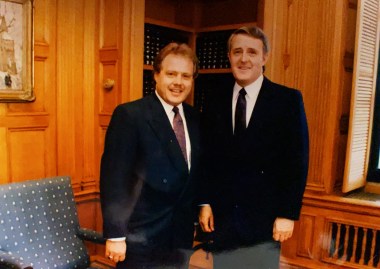
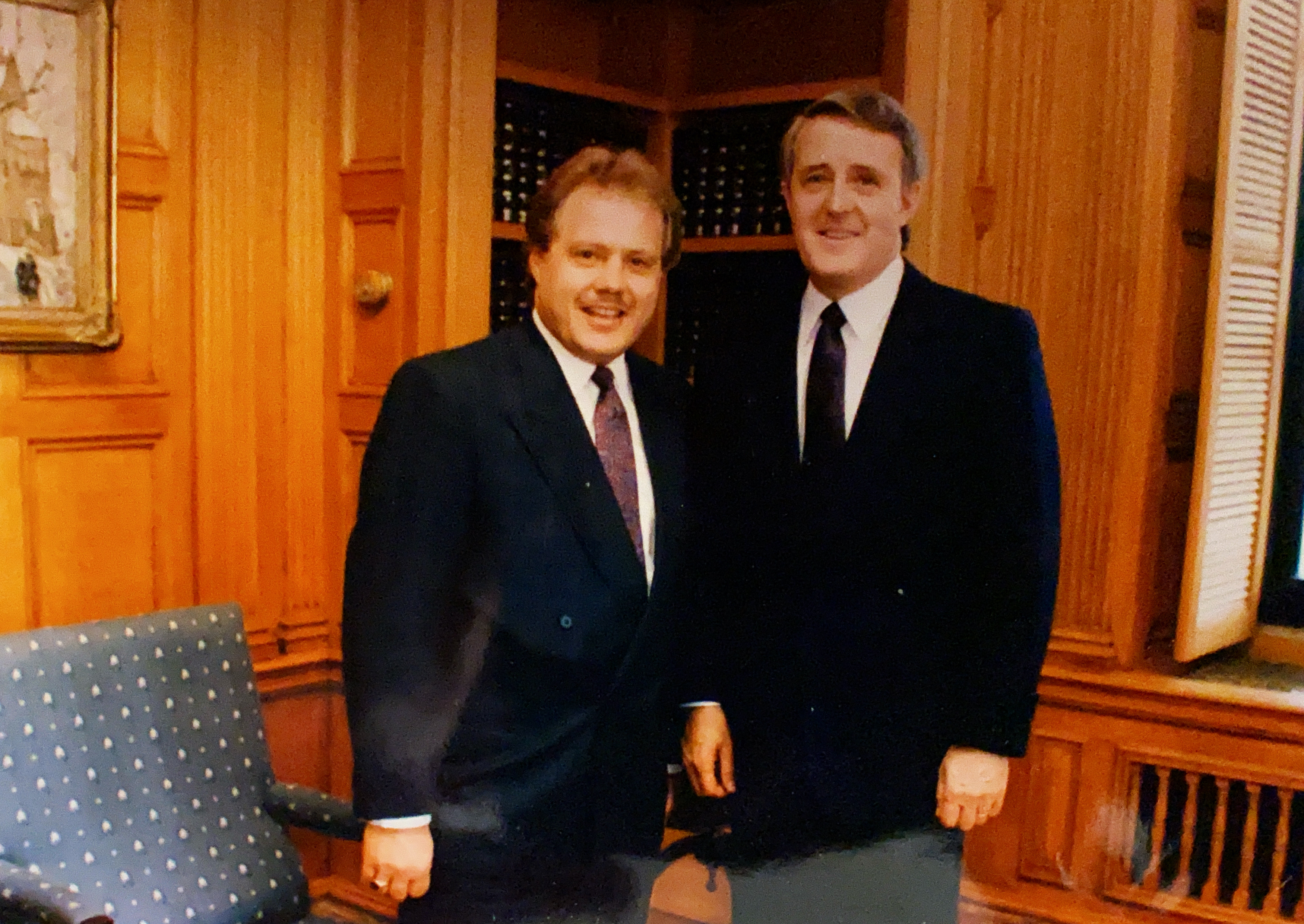
Brian C. Stiller of the Evangelical Fellowship of Canada pictured with then-prime minister Brian MulroneyCourtesy of Brian C. Stiller
Brian C. Stiller of the Evangelical Fellowship of Canada pictured with then-prime minister Brian Mulroney

What I didn’t know was that the new prime minister would be open to engaging with evangelicals. When Mulroney formed his government in 1984, a number of evangelicals were included: Jake Epp became minister of national health and welfare, Len Gustafson was parliamentary secretary, and Mennonite John Reimer, along with other evangelicals, entered parliament as members of Mulroney’s Progressive Conservative Party.

Epp, highly regarded by both his party and those in opposition, helped us understand not only how we might speak to the government—especially on the issue of abortion—but how to build credibility.

For one of my one-on-one meetings with the prime minister, I arrived with an agenda that our senior staff had worked on. While waiting for Mulroney to call me in, I mulled over my early-morning Bible reading of Daniel chapter 11: “And in the first year of Darius the Mede, I took my stand to support and protect him” (v. 1).

It seemed to me that I should put aside my planned agenda and instead offer words of encouragement. A few minutes later, I was invited into his office, and after some pleasantries, was asked about my agenda. My response was simply, “Mr. Prime Minister, I have no agenda today but to encourage you.” We spent a few minutes with some Bible verses and prayed, and, after the customary photograph, I left.

The next week while I was boarding a plane, the minister of justice, Ray Hnatyshyn, invited me to sit with him for a minute. He promptly asked, “Brian, what happened with you and the prime minister last week?” My heart sank. Had I gone too far? I wondered. “Minister, was there something wrong?” I asked with trepidation.

He smiled and said, “No, not at all,” and then proceeded to tell me that the prime minister had extended his time with me, delaying his meeting with the Cabinet members waiting for him in the next room. After joining the Cabinet meeting, Mulroney told them of my visit and our conversation and prayer.

As Hnatyshyn recalled, “The PM said, ‘If we as the government misunderstand or ignore the evangelical community, the country and this government will be the losers.’”

That simple meeting opened more doors for important and substantive conversations with people at all levels of the government, giving us opportunities to understand how to relate in a God-honoring manner to “Caesar,” than many protests or editorials might have accomplished.

When I heard about Mulroney’s untimely death, I was reminded of the lessons I had learned from him in seeking to understand how our public witness fits within the agenda of Christ and his kingdom.

In my global travels, this question is often among the first that Christians ask me, as they seek to understand how our commitment to Jesus as king should shape our interaction with government.

Brian Mulroney opened the door for us to flesh out our mandate and to embody what the apostle Paul instructed: “For the one in authority is God’s servant for your good … Give to everyone what you owe them: If you owe taxes, pay taxes; if revenue, then revenue; if respect, then respect; if honor, then honor” (Rom. 13:4, 7).

Brian C. Stiller is global ambassador for the World Evangelical Alliance and the founder and former editor in chief of the Canadian magazine Faith Today.

News

SBC Executive Committee Says No Charges Following Federal Investigation

Without offering details on the nature of the Justice Department inquiry, the denomination’s administrative entity says it’s “grateful” that “no further action” will be taken around its response to abuse.

Christianity Today March 6, 2024
Jae C. Hong / AP

An 18-month-long federal investigation into the Southern Baptist Convention (SBC) Executive Committee has concluded without any charges or action against it, the Executive Committee said on Wednesday.

The country’s largest Protestant denomination has been the subject of a Justice Department probe following a 2022 report that showed SBC leaders refused to respond to allegations of abuse due to legal liability and failed to enact policies to protect its members from predatory pastors.

The Executive Committee—with staff at its Nashville headquarters and dozens of elected trustees from across the country—oversees everyday business for the SBC. The entity said it was informed last Thursday that its part of the investigation had concluded “with no further action to be taken.”

A spokesperson for the US Attorney’s Office for the Southern District of New York declined to confirm or comment on the status of the inquiry when contacted by CT.

The Justice Department has not publicly acknowledged or commented on the SBC investigation since it began. Federal grand jury subpoenas and proceedings—for better or worse—are shrouded in secrecy. To protect the accused and the integrity of the investigation, the government often doesn’t disclose who had been involved.

According to the Executive Committee, the investigation was expected to look into multiple entities. Presidents of each of its seminaries and agencies had signed a letter in 2022 agreeing to participate and saying, “Our commitment to cooperating with the Department of Justice is born from our demonstrated commitment to transparently address the scourge of sexual abuse.”

Jonathan Howe, the interim president of the Executive Committee, said in a statement Wednesday that the investigation into his entity had ended. He did not comment on the status of other SBC entities that could be involved.

“While we are grateful for closure on this particular matter, we recognize that sexual abuse reform efforts must continue to be implemented across the Convention,” he said. “We remain steadfast in our commitment to assist churches in preventing and responding well to sexual abuse in the SBC.”
Multiple advocates for abuse victims—including SBC abuse survivors Megan Lively and Tiffany Thigpen as well as attorney Rachael Denhollander, who has advised the SBC task forces charged with abuse reform—say they were told by officials that the case is still open and ongoing.

https://twitter.com/R_Denhollander/status/1765476930705391985

Christa Brown, a survivor who has led the charge calling for reforms, including a database of abusive leaders, responded on X.

“This does not lessen SBC’s moral responsibility for grievous harms. Nor does it alter the reality that, in countless SBC churches, leaders violated state laws and standards,” she said.

From the outside, it was never clear what federal statute Southern Baptists might have violated or how federal prosecutors might make their case, several experts told CT.

There’s a lot still unknown. Neither the SBC nor Justice Department officials have publicly specified the scope or focus of the inquiry, which dated back to August 2022. At the time, the Executive Committee’s general counsel said the entity had received a subpoena but no individuals had been subpoenaed yet.

The Justice Department website says that child sexual abuse is “generally handled by local and state authorities, and not by the federal government.” It’s unusual for federal investigators to get involved in clergy abuse, though they have examined abuse and cover-up by Catholic priests in Pennsylvania, New York, and New Orleans, starting in 2018.

So far, none have been charged under federal laws, such as those that restrict racketeering (RICO) or interstate trafficking (the Mann Act). Any possible federal penalty for Southern Baptist entities as part of the probe into abuse response would be the first of its kind.

Besides the Executive Committee, no other SBC entity—such as the denomination’s six seminaries and its missions agencies—has publicly acknowledged any involvement in the investigation.

A spokesperson for the Ethics and Religious Liberty Commission (ERLC), the SBC’s public policy arm, said it had not been subpoenaed or asked for information from federal investigators.

In a response to CT, ERLC president Brent Leatherwood stated:

We have a responsibility to combat abuse by ensuring predators do not have the ability to prey on our churches, and equipping pastors with the tools to do so. The Gospel demands it and messengers have consistently called for such action. Carrying out that objective in a cooperative way remains the goal.

The ERLC continues to offer resources around abuse response and prevention. It was part of the SBC’s initial abuse response following the landmark 2019 investigation by the Houston Chronicle that compiled 700 cases of abuse in Southern Baptist churches.

The issue of abuse has dominated the SBC ever since. There were claims of former seminary president Paige Patterson mishandling abuse at two schools; a lawsuit involving Conservative Resurgence leader Paul Pressler, accused of abusing young men for decades; conflicting factions over whether abuse was really a big problem for the denomination; limited mechanisms for expelling churches who employed abusive pastors; and a massive third-party investigation authorized by convention messengers.

The SBC is also currently facing lawsuits from victims of abuse as well as from leaders named in abuse reports.

The Tennessean reported that legal expenses cost the Executive Committee $2.8 million in the previous fiscal year and that the entity underwent layoffs in part due to the cost of the abuse response.

Last month, the volunteer task force overseeing abuse reform in the SBC announced plans to launch an independent nonprofit to manage the programs, including a database of abusive pastors.

This is a breaking news story and has been updated.

addApple PodcastsDown ArrowDown ArrowDown Arrowarrow_left_altLeft ArrowLeft ArrowRight ArrowRight ArrowRight Arrowarrow_up_altUp ArrowUp ArrowAvailable at Amazoncaret-downCloseCloseellipseEmailEmailExpandExpandExternalExternalFacebookfacebook-squarefolderGiftGiftGooglegoogleGoogle KeephamburgerInstagraminstagram-squareLinkLinklinkedin-squareListenListenListenChristianity TodayCT Creative Studio Logologo_orgMegaphoneMenuMenupausePinterestPlayPlayPocketPodcastprintremoveRSSRSSSaveSavesaveSearchSearchsearchSpotifyStitcherTelegramTable of ContentsTable of Contentstwitter-squareWhatsAppXYouTubeYouTube