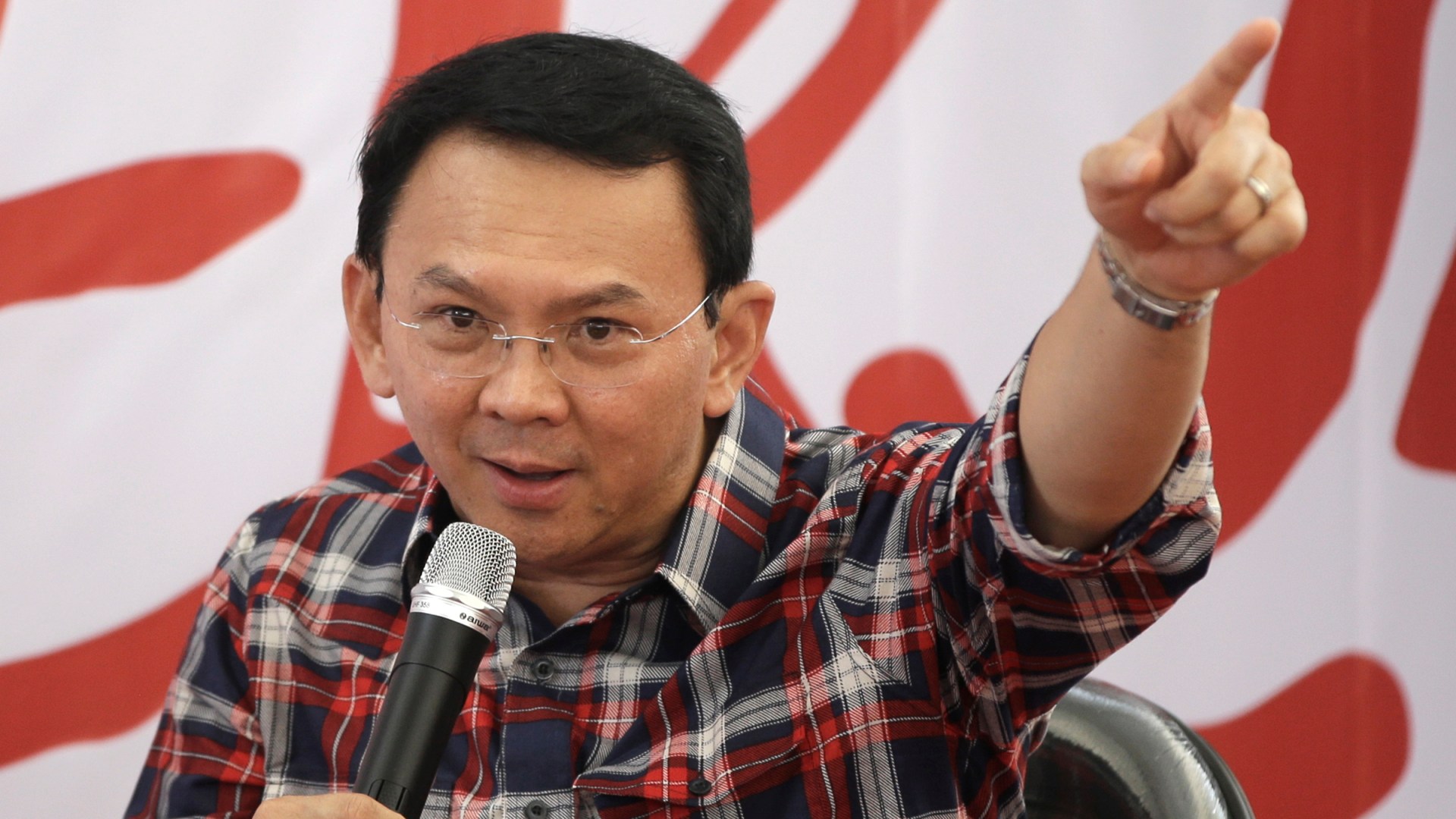
Thousands of Indonesians protested this week after police named the Christian governor of the nation’s capital, Jakarta, as a suspect in a blasphemy investigation.
Basuki Tjahaja Purnama, popularly known as “Ahok,” was appointed in 2014 after his ally and predecessor, Joko Widodo, was elected president. A key presidential ally, Ahok is running for re-election in February.
At issue is the way he used a verse in the Koran when speaking to a group of fishermen in September. “Do not believe everything that people say,” he is reported to have said, “because often you are deceived by using 51st of Surah Al Maidah (the fifth chapter of the Qur‘an).”
The verse warns Muslims not to take Jews and Christians as allies; some read it to mean that Muslims are not to vote for those of other faiths.
Buni Yani, the man who uploaded part of the speech to his Facebook page where it went viral, did not include the word “using” in his transcript, which made the remarks more incendiary. (More than 100,000 people signed a petition calling for legal action against Yani for stirring up public unrest.)
Ahok apologized for his words, saying he “never intended to insult Islam or the Qur‘an.” But thousands of hardline Muslims marched in protest anyway, eventually clashing with police and lighting vehicles on fire.
One of the groups that opposed his governorship—the radical Islamic Defenders Front—was also behind the protests, Reuters reported. Ahok, who is generally trusted and seen as one who fights corruption, is favored over his two rivals for office, though his numbers have slipped since the blasphemy case. He takes a hard line on religious freedom, previously stating that the city schools could not force female students to wear Islamic head scarves and standing up for Ahmadi Muslims that were attacked by Islamist fundamentalists.
The reaction was also likely influenced by Ahok’s Chinese background—he’s the first ethnic Chinese to be governor of Jakarta. Indonesians have discriminated against and attacked ethnic Chinese for hundreds of years, most notably in 1998, when more than 1,000 people were killed and hundreds were raped in anti-Chinese riots across the country.
About 1 percent of Indonesia’s 250 million people are ethnic Chinese, while less than 9 percent are Christian.
President Widodo postponed his visit to Australia but did not meet with the protest leaders. (The khaki bomber jacket he wore to call for calm and blame “political actors” incited a rush on stores afterward.)
Indonesia’s largest Islamic organization, Nahdlatul Ulama, told its members not to take part in the protests. The group, which boasts 40 million members, denounced Islamist extremism earlier this year.
“This could be dangerous,” Ahmad Ishomuddin, a senior official at Nahdlatul Ulama, told Reuters. He told Muslims to stay calm and to forgive. “Ahok, whose tongue slipped, has apologized.”
Indonesia is No. 43 on Open Doors’ list of the 50 hardest places to be a Christian, and the United States Commission on International Religious Freedom has placed it on the second tier of countries of particular concern since 2003.
The country has long been considered a model of tolerance, but religious tensions in the past few years—including the demolition of 20 churches, protests over attacks on Christians by Islamist extremists, and a law requiring minority religious groups to collect signatures from local majority groups before building churches—highlight the country’s increasing struggles to maintain harmony between its religious groups.
Correction: An earlier version of this blog incorrectly stated that Ahok was Indonesia’s first Christian governor. CT regrets the error.