Stories of Hope: John Onwuchekwa

CT Director of Leadership Resources John Onwuchekwa shares a story that gave him hope in the midst of brokenness this year.

At Christianity Today, we tell the stories and ideas of the kingdom of God because when our world seems dark, we need to hear the stories of the light shining in the darkness. We invite you to partner with CT to help shine the light in the darkness. Give now.

See more Stories of Hope: Daniel SillimanSophia LeeMike CosperRussell Moore.

Stories of Hope: Mike Cosper

Director of CT Media Mike Cosper shares a story that gave him hope in the midst of brokenness this year.

At Christianity Today, we tell the stories and ideas of the kingdom of God because when our world seems dark, we need to hear the stories of the light shining in the darkness. We invite you to partner with CT to help shine the light in the darkness. Give now.

See more Stories of Hope: Daniel SillimanSophia LeeJohn OnwuchekwaRussell Moore.
Theology

We Believe in Miracles, So Why Not Aliens?

Christians may be more likely to accept the possibility of extraterrestrial life given our prior assumptions.

Christianity Today December 4, 2023
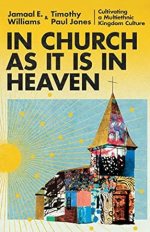
Illustration by Christianity Today / Source Images: WikiMedia Commons

Stories about unexplained aerial phenomena (or UAP—which is what we’re now supposed to call UFOs) used to be reserved for the more garish or sensationalist parts of the internet or the tabloids lining the bottom rung of magazine racks. Not so today, when stories pointing to the evidence for extraterrestrial life are now turning up in every major news outlet.

Prominent, as ever, is a headline that won’t go away: that the US government recovered crashed spacecraft with “nonhuman biologics.” There’s even a newly released book detailing, as the headline of a recent Time article suggests, “The Government’s Search for Aliens and Why They Probably Exist.”

Perhaps now is an ideal time for Christians to start asking some serious what-if questions, like “What if the front page of tomorrow’s newspaper carries news of evidence of life on another planet?” This question has led me into some of the most fascinating theological territory I’ve ever considered—some of which I explore in my recent book, Astrobiology and Christian Doctrine: Exploring the Implications of Life in the Universe.

I was also one of two dozen theologians invited to participate in the NASA-funded research project on the societal implications of astrobiology at Princeton’s Center of Theological Inquiry. And in my research, I was surprised to discover that Christian thinkers have been pondering life beyond Earth for a long time. Why? One reason is that the Christian worldview has a unique set of prior assumptions that may make us more willing (not less willing, as some might assume) to believe in the likelihood of extraterrestrial life.

Let’s look, for example, at the reactions to one UAP in particular, which leading scientists seem most excited about. ‘Oumuamua (Hawaiian for “a messenger from afar arriving first”) entered our solar system and passed quite close to the sun (and not that far from Earth) on September 9, 2017, traveling at almost 200,000 miles per hour. This was the first “interstellar object” observed in our solar system—that is, an object that has traveled between stars, in contrast with a comet, for instance, which is bound by the sway of our sun’s gravity.

That’s notable enough, but ‘Oumuamua had some other unusual properties. We can’t be exactly sure about its shape, but it seems to have been either an oddly long and thin object, like a stretched cigar, or perhaps a disk (or even a saucer, as familiar from so many science-fiction films). It also took an unusual trajectory when it got near the sun.

What are we to make of this? Might those unusual properties suggest that it wasn’t any old object but rather an artifact from another civilization?

For Harvard astrophysicist Avi Loeb, ‘Oumuamua is so odd that seeing it as an alien artifact makes the most sense. On the other hand, the philosopher Christopher Cowie has argued that even if there is other life in the galaxy, extraterrestrial artifacts would be too rare to be a plausible explanation for ‘Oumuamua.

What distinguishes Loeb and his critics is not whether ‘Oumuamua is odd—on that they agree—but whether that counts as evidence of other civilizations. Loeb’s critics think such civilizations are so unlikely that it makes better sense to say that while it’s odd for a natural object, it’s natural nonetheless. In contrast, Loeb thinks that such civilizations are probably widespread, so it’s more likely that ‘Oumuamua is alien workmanship than some freakish natural object.

Astrophysicist Charles H. Lineweaver examined ‘Oumuamua using Bayes’ theorem: what makes for a plausible explanation for evidence depends on our prior assumptions. That is, whether it’s credible to believe this was an alien spacecraft relies on what else we take for granted—such as how likely we think the existence of extraterrestrial civilizations might be.

The progenitor of Bayesian logic is Thomas Bayes, an English Presbyterian minister from the 1700s whose ground-breaking work was likely provoked by the attack on miracles by philosopher David Hume (in An Enquiry Concerning Human Understanding). Hume argued that we shouldn’t accept stories about miracles since—as he saw it—there will always be a more likely, nonmiraculous explanation for any extraordinary event. Our interpretation depends on our assumptions, and his assumptions did not stretch far in the direction of God.

And while we don’t know for sure whether Bayes was, in fact, inspired by Hume’s book, his friend Richard Price made this connection. Price was a doctor of divinity and brought Bayes’ work on statistics to public attention following his death. His treatise against Hume’s skeptical take on miracles (On the Importance of Christianity, the Nature of Historical Evidence, and Miracles) followed a few years later. Bayes realised that we interpret events as likely or unlikely depending on our presuppositions, and Price applied that logic to miracles—in the very first application of “Bayesian” thinking, as far as we know.

As a confirmed agnostic, Hume was skeptical about God. So, he considered a miraculous explanation of an unexpected event to be less likely than some natural explanation, even if he didn’t know what that might be. But a Christian, like Bayes or Price, comes at the same story from a different perspective. If you believe in God and in Jesus as God incarnate, it doesn’t seem at all far-fetched to suppose that Christ could turn water into wine or calm a storm.

Or, in this case, we may be more likely to believe in the possibility of life beyond Earth.

Turning from the 18th century to the 20th, there’s a common (but wrong) assumption that religions are unimaginative compared to science and that they need scientific discoveries to provoke them into thinking about life beyond Earth. Carl Sagan, a renowned astronomer, leveled this very charge when he asked:

How is it that hardly any major religion has looked at science and concluded, “This is better than we thought! The Universe is much bigger than our prophets said, grander, more subtle, more elegant. God must be even greater than we dreamed”? Instead they say, “No, no, no! My god is a little god, and I want him to stay that way.” A religion, old or new, that stressed the magnificence of the Universe as revealed by modern science might be able to draw forth reserves of reverence and awe hardly tapped by the conventional faiths.

Yet Christian theologians have been thinking about life beyond Earth continuously since the middle of the 15th century (and Jewish and Islamic theologians for even longer). If there’s anything frustrating about how Christian sources address this topic, it’s that they don’t tend to be very long—the author mentions the prospect cheerfully and then moves on. It seems these thinkers just weren’t worried enough to write a great deal on the subject.

In the 15th century, we have a Franciscan friar, Guillaume de Vaurouillon, and Nicholas of Cusa, perhaps the greatest theologian of his age. In the 17th, there’s the Dominican Tommaso Campanella (writing in defense of Galileo). We could add English Puritan theologian Richard Baxter and Anglican John Ray, who wrote of the possibility of other solar systems with planets that were “in all likelihood furnished with as great variety of corporeal creatures, animate and inanimate, as the earth is, and all as different in nature as they are in place from the terrestrial, and from each other.”

Nineteenth-century preacher Charles Spurgeon spoke of all creation as a “grand orchestra” with “the inhabitants of the divers worlds, which are perhaps countless in multitude, taking their places in the one harmonious song.” He believed there “may be tens of thousands of races of creatures all subject to him, and governed by the same law of immutable right and justice.”

In the 20th century, C. S. Lewis was fascinated with outer space, writing an essay (“Religion and Rocketry”) and three novels (the Cosmic Trilogy) on the topic. Lewis did not believe the discovery of life on other planets would challenge Christianity, although it would certainly raise some intriguing theological questions for us to consider.

One prominent writer, John Wilkins (Bishop of Chester and a founder of the Royal Society, England’s most prestigious scientific organization), thought he had evidence of life on the moon, but most theologians were speculating without evidence. That said, it’s striking how many theologians believed with strong conviction that there is life beyond Earth on theological grounds—those who took this as a certainty, not just a possibility.

As before, what you think is plausible depends on your prior assumptions. Many Christian theologians have operated with the assumption that God would create habitable places only so that they could be inhabited. And so, far from rejecting the idea that the universe may contain other life, we find theologians arguing that life beyond Earth is widespread. Indeed, they assumed that there will be life pretty much everywhere it could possibly survive.

If your assumption is that life is what matters, especially to God—and therefore that habitability is for the sake of habitation—you’ll find it implausible for habitable places to remain bare. Historically, then, Christian theologians have often likely overestimated how m uch life there might be in the universe. That followed plausibly from the assumption that God populates places and that places are valuable if they host living things.

I’m very open to the universe being full of life, but I’d say that some of the assumptions mentioned in the previous paragraph are faulty. There is a splendor in all sorts of different kinds of places in the universe, all bearing witness to the glory of God in their own way, whether they are inhabited or not.

The 20th-century French Roman Catholic theologian Jean Guitton wrote that a vast universe, uninhabited other than Earth, was implausible because that would essentially make “the pedestal too big for the sculpture.” In other words, the universe would be like a picture frame so big that it overwhelmed the painting at its center.

I think that’s wrong twice over. First, even if the universe contained life only on Earth, an unimaginably large universe would not be too splendid a setting, frame, or pedestal for the glory of life on Earth—especially for human life, with its self-awareness and relation to God.

But second, is it even helpful to think about the rest of the universe as merely the stage for life? The universe has a glory and dignity of its own that isn’t to be judged merely in relation to us. After all, we’re not the only creatures with a vocation to praise God; the heavens do too (Ps. 148:3–6). The heavens themselves are alien and inscrutable—so much so that God brings them up when he puts Job in his place for questioning his sovereignty (Job 38:31–33).

When it comes to the place and prevalence of life in the universe, I’ll let the science inform me, as and when the data comes in. I won’t be perturbed whether we find a lot or none at all.

That said, I’ll be surprised if Earth’s is the only life. After all, we didn’t know until the end of the 20th century whether there are planets around other stars—and it turns out they’re everywhere. Finding evidence of extraterrestrial life might be quite a feat. Yet our ability to detect signs of life around other planets has taken a massive leap forward with the 2021 launch of the James Webb Space Telescope: It senses infrared light, which is ideal for measuring the balance of gases in the atmosphere of other planets and thus ascertaining some of the telltale signs of life.

Christian theologians have thought a good deal about what makes something alive and what counts as a living thing. For instance, angelic beings are an example of life beyond Earth mentioned in the Bible and featured in the Christian imagination—however different they might be from other biological life.

Does it matter that there’s no mention of extraterrestrial life in the universe in the Bible? I wouldn’t say so, especially as we consider what the Scriptures are for and what they’re not for.

In the Bible, God speaks to us in a human way. Does that make our understanding of God so human-shaped that other creatures wouldn’t think about God like we do? Plenty of theologians, such as Calvin, talked about divine “accommodation”—the fact that God speaks to creatures in a way they can understand. Knowledge of God and revelation from God would surely be “accommodated” differently for different creatures so that they could understand it, but it would be the same God who is revealed and known.

Then there’s the idea that human beings are made in the image of God. Is this premise undermined if there are other creatures that can also know and love and be made friends of God? I don’t think so. We would be no less wonderfully created and no less loved by God just because other things are also loved and wonderful—and probably wonderful in a different way from us. The more the merrier, I should think.

But what of sin and salvation? If there’s other sentient life, is a fall inevitable? And what about the Incarnation and redemption? Could Christ’s death and resurrection redeem the whole cosmos? Undoubtably, but would God limit himself to one Incarnation? That’s perhaps the most hotly contested question in the field. As Aaron Earls pointed out for CT, even C. S. Lewis thought it was at least worth considering the possibility that Jesus could have “been incarnate in other worlds than earth and so saved other races than ours.”

As for me, I believe one Incarnation is “enough,” but who says God must do what’s minimally necessary? In Jesus, we see God face to face as a human being. But I could see the beauty in other creatures also knowing God in their own flesh and blood.

In the early 20th century, English poet Alice Meynell wrote that only we know our story and that what God has done elsewhere remains elsewhere:

No planet knows that this
Our wayside planet, carrying land and wave,
Love and life multiplied, and pain and bliss,
Bears, as chief treasure, one forsaken grave.

Nor, in our little day,
May His devices with the heavens be guessed,
His pilgrimage to thread the Milky Way
Or His bestowals there be manifest.

But she ended that poem, entitled “Christ in the Universe,” with the tantalizing idea that we can look forward to knowing the rest of the story of the cosmos in the life of the world to come:

O, be prepared, my soul!
To read the inconceivable, to scan
The myriad forms of God those stars unroll
When, in our turn, we show to them a Man.

Ultimately, whatever lies beyond Earth, of this we can be sure: God will be gracious, and God will do something glorious.

Andrew Davison is the author of Astrobiology and Christian Doctrine: Exploring the Implications of Life in the Universe. He is grateful to Cat Gillen at Durham University for discussing ‘Oumuamua from a Bayesian point of view.

Stories of Hope: Russell Moore

Editor in Chief Russell Moore shares a story that gave him hope in the midst of brokenness this year.

At Christianity Today, we tell the stories and ideas of the kingdom of God because when our world seems dark, we need to hear the stories of the light shining in the darkness. We invite you to partner with CT to help shine the light in the darkness. Give now.

See more Stories of Hope: Daniel SillimanSophia LeeJohn OnwuchekwaMike Cosper.

Books
Excerpt

God Thwarted the Tower of Babel. But Its Spirit Lives On.

From the builders of Genesis 11 to the architects of the modern world, we’ve forgotten who makes our name great.

Illustration by Miriam Martincic

An excerpt from CT’s Book of the Year. Learn about CT’s 2024 Book Awards here.

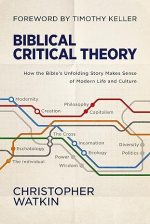
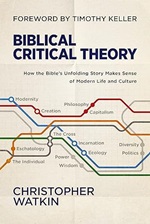
Biblical Critical Theory: How the Bible's Unfolding Story Makes Sense of Modern Life and Culture

Biblical Critical Theory: How the Bible's Unfolding Story Makes Sense of Modern Life and Culture

HarperCollins Children's Books

672 pages

$31.99

The tale of the Tower of Babel is a story of judgment and a story of autonomy. The events are presented in two acts: the people’s provocation and God’s response.

The curtain lifts for the first act on the scene of a communal building project:

Now the whole world had one language and a common speech. As people moved eastward, they found a plain in Shinar and settled there. They said to each other, “Come, let’s make bricks and bake them thoroughly.” They used brick instead of stone, and tar for mortar. Then they said, “Come, let us build ourselves a city, with a tower that reaches to the heavens, so that we may make a name for ourselves; otherwise we will be scattered over the face of the whole earth.” (Gen. 11:1–4)

So what is the problem here? Is it not sensible to live together in cities, with all the benefits of security and the division of labor that urban life brings? Yet there are clues that the main intention is something other than establishing a stable society.

The first humans were commanded by God in Genesis 1:28 to “fill the earth,” but the builders of Babel want to construct a single city, lest they are “scattered over the face of the whole earth.” They want to assert their own autonomous identity, captured in the language of “so that we may make a name for ourselves.” In biblical thinking, to name something is to have authority over it. In Genesis 1, God systematically names the elements of creation as he makes them. To seek to make a name for oneself is to assert one’s independence, ignoring the one who gives you “life and breath and everything” (Acts 17:25).

Also, the builders want to make a name for themselves by building “a tower that reaches to the heavens.” There are two ways of interpreting this architectural undertaking. One is that the tower, as biblical scholar John Walton put it, is “a bridge or portal between heavens and earth” that was “designed to make it convenient for the god to come down to his temple, receive worship, and bless his people.” The second interpretation sees the tower as a beachhead for launching an assault on God’s throne room: a proud assertion of autonomous technological capability on the part of a culture that has turned its back on God. Either way, the people’s desire to make a name for themselves is in diametric contrast to God’s promise to Abraham that “I will make your name great” (Gen. 12:2).

In narrative terms, rather than playing a role in God’s story (filling the earth and subduing it), these people want God to play a supporting role in their story, as the heavenly antagonist who is ultimately beholden to, or vanquished through, their heroic self-aggrandizement. They are not looking forward to what God has planned for them or to the fulfillment of his promises; they are looking forward to the day when they can enjoy all his good gifts as their own while he lies slain at their feet.

Moving to the chapter’s second act, the initiative switches to God. It begins with a heavy irony: “But the Lord came down to see the city and the tower the people were building” (11:5). God, of course, does not need to come down to see the tower. He is quite capable of perceiving what the people are doing without repositioning himself. The motif of descent is intended to parody the heaven-storming aspirations of humanity. God, rather than feeling threatened by the tower or needing it for his descent, stoops down so that he can get a better look at its thimble-like grandeur.

God then pronounces his judgment:

The Lord said, “If as one people speaking the same language they have begun to do this, then nothing they plan to do will be impossible for them. Come, let us go down and confuse their language so they will not understand each other.” (vv. 6–7)

This has sometimes been wrongly understood as a spiteful move to keep humans divided and dumb, but in fact it is a form of mercy. God halts their progress to limit the damage that it will cause. He does not slaughter the rebels but confuses their languages, giving them time to repent as he disperses them over the face of the earth.

The builders of Babel chose to make a name for themselves in opposition to God rather than embrace the name that God gave them. They sought to define their own reality, their own understanding of success.

But Babel is not an isolated event, and its spirit continues in our own day. In contemporary society, we see how the usurpation of the Creator’s right to define the meaning of life can be experienced as a burden. Success in life is now seen as the individual’s responsibility alone, and the only thing stopping us from following our dreams is our lack of desire. In a world that catechizes us into the dream that “you can be anything you want to be,” we face the responsibility of first choosing what to be and then becoming what we have chosen.

To make matters worse, it is not sufficient to be successful only in our own eyes. The ultimate justification provided by God’s judgment has been replaced by the validation of social, broadcast, and print media.

The Babelian quest to make a name for ourselves condemns us to a punishing regime of ever-inadequate performance, ever more forced and filtered self-presentation, and the ever-provisional, ever-changeable verdict of social media. How much sweeter and more peace-bringing to receive a name from God: child, image, and beloved.

The architects and tradespeople of Genesis 11 did not simply build a city but placed a great tower at its center. They sought not just to coexist but to make a statement, to erect a signature building that would broadcast their renown far and wide. People would know who they were when they saw what they built, and the tower would be a spectacular symbol of their power.

Augustine picked up on this theme of “spectacle” in The City of God, primarily in relation to the Roman society in which he lived. According to philosopher Jennifer Herdt, Augustine’s definition included “athletic competitions, executions in the arena and amphitheater, gladiatorial contexts, military reenactments, and comedies, tragedies, and mimes in the theater.” What all these spectacles had in common—and Babel was no exception—was that they demonstrated the might, authority, and greatness (in short, the “name”) of some earthly regime.

Such performances of civic name-making have existed in every age. But the theme of mediating our identity through displays of greatness might characterize our age more than any other. In his 1967 book The Society of the Spectacle, French philosopher Guy Debord defines such a society as one in which relations between people are mediated by images. In other words, we don’t engage with life directly but live through a series of representations, the most obvious and prevalent ones coming from mass media. We live our dreams, desires, and fantasies via advertisements, films, and television programs, and we rely on them to make a name for us.

It would be wrong—and dangerous—to shrug our shoulders and reply that images are not reality. Images can shape people’s lives as effectively as prison bars or schools. But these images deaden people to the reality beyond them.

So what should we do? Debord belonged to an intellectual movement known as the Situationists, who proposed the idea of “counterspectacles” to break the hypnosis of the image. One of their main weapons was a French word, détournement. It has no direct English translation, which is a pity because it is a useful and revealing concept. Détournement means taking something that already exists, some part of the society of the spectacle, and playfully poking fun at the message it conveys, as when the Situationists added speech bubbles to posters in the Paris metro: the handsome sunglasses model saying, “I shop, therefore I am” or the cute baby on the milk advertisement saying, “I do not want to become a machine.”

The concept of détournement is helpful for understanding the Bible’s own counterspectacle. In Genesis 11 we witness a delicious subversion of the tower builders’ self-aggrandizing pretentions. They name their city Bab-el, Akkadian for “gate of the gods,” but God makes their ambition a byword for babel: a near homonym for the Hebrew word meaning “confusion.” The subversion is brilliant: Every time the term Gate of the Gods is evoked in lofty tones, someone can be heard in the background whispering under their breath, “More like Bait for the Clods.”

It is tempting for a would-be autonomous humanity to imagine that there is no final accounting, no divine judgment on human actions. However, what is seen by some as a blessed freedom is received by others as an existential crisis. If it disrupts tranquility to live under the gaze of divine judgment, it provides little comfort to exist in a life subject to no transcendent standard or final verdict at all.

The God of Babel is a God who sees and judges. Whatever else this narrative teaches, it affirms that every human action has a witness and that this witness is also the judge of every human action. We do not live in a meaningless or inconsequential universe where what counts is not what we do but whether we get caught. Such a universe privileges the rich over the poor, the cunning over the honest, those who can evade capture over those who respect justice. It is not the sort of world we want to live in, or to cut a little closer to the bone, it is not the sort of world we want everyone around us to live in, although we might secretly enjoy the prospect ourselves.

We are always already caught, as the Psalmist well recognizes:

O Lord, you have searched me and known me! You know when I sit down and when I rise up; you discern my thoughts from afar. You search out my path and my lying down and are acquainted with all my ways. Even before a word is on my tongue, behold, O Lord, you know it altogether. You hem me in, behind and before, and lay your hand upon me.” (Ps. 139:1–5, ESV)

As these verses indicate, God is not simply the witness of our observable deeds, much less only of those deeds we would want him to know about. He is, as Augustine says in book 3 of the Confessions, “interior intimo meo et superior summo meo” (“more inward than my most inward part and higher than the highest element within me”).

This is a counsel of despair for those who have set themselves up in opposition to God. But for Christians, who no longer fear God’s judgment, the truth of God’s witnessing carries an additional meaning. All our daily actions, not just those spectacular moments of public display, become charged with significance. This brings liberation from the Babelian urge to “make a name for ourselves” in a public way.

God can be served in any circumstance because all things can be done for him, and he sees all things. We all tend to plot our actions along a hierarchy of significance, placing certain deeds at the top (getting that promotion or visiting a sick friend in the hospital) and relegating others to also-ran status (praying the prayer no one will ever thank you for or sweeping the floor).

I have often wondered whether the front-page splash on heaven’s newspaper, so to speak, will be the anonymous elderly lady who, perhaps unbeknown to her church friends, persisted for years in private prayer for God’s world, never having preached a sermon, never mind led a revival. She is the unspectacular spectacle of God’s glory.

To live and die by the dynamics of “making a name for ourselves” is to submit to a court of a public opinion that allows only certain achievements to count, with value ascribed to our words and deeds according to the fickle tastes of the crowd. God’s judgment, by contrast, cuts across these perverse and changeable hierarchies of importance, “for the Lord sees not as man sees: man looks on the outward appearance, but the Lord looks on the heart” (1 Sam. 16:7, ESV). There are no meaningless actions, meaningless words, or meaningless thoughts, for our witness is also our judge.

Christopher Watkin is a senior lecturer at Monash University in Melbourne. This article is taken from Biblical Critical Theory: How the Bible’s Unfolding Story Makes Sense of Modern Life and Culture, by Christopher Watkin. Copyright © 2022 by Zondervan. Used by permission of Zondervan. www.zondervan.com.

Cover Story

Christianity Today’s 2024 Book Awards

Our picks for the books most likely to shape evangelical life, thought, and culture.

Illustration by Miriam Martincic

Think of something big and important happening in the world—some cultural trend, political movement, or social craze. Chances are that someone, somewhere, has proposed giving it a distinctly “Christian” or “biblical” framing. Some of these efforts, aimed at glorifying God in all things, supply helpful correctives to secular errors. Others, smacking more of anxious attempts at hopping aboard a moving train, add little beyond a thin spiritual gloss.

Thankfully, CT’s book of the year, Christopher Watkin’s Biblical Critical Theory: How the Bible’s Unfolding Story Makes Sense of Modern Life and Culture, belongs to the first category. Some might wince at the mention of critical theory, with its perceived reputation for nonsense jargon or radical politics. Critical theory comes in many flavors, of course, some guiltier than others of cramming messy human particulars into ideological straitjackets. But the late Tim Keller, in his foreword, suggests another view, observing that a good theory “make[s] visible the deep structures of a culture in order to expose and change them.”

As Watkin contends, Scripture does this better than anything else. Other critical theories—derived from deep analyses of race, gender, psychology, language, and law—might apply useful lenses to reality. But all are clouded or cracked to some degree, requiring a higher wisdom and a truer story to polish off the smudges and patch together the broken shards. God’s Word, in this sense, does more than explain God to the world. In unsurpassed fashion, it explains the world to itself.

Like Biblical Critical Theory, all of our award winners contain insight and beauty on their own. And like all good books, they are made complete in the greatest Book of all. —Matt Reynolds, senior books editor

Apologetics/Evangelism

The mountains of Appalachia have many faces. One face, shown mostly to vacationers, is picturesque mountain people sewing quilts and playing dulcimers by wood-burning stoves. A different face reveals how Appalachia’s hills and hollows have been left scarred and denuded by overdevelopment. And yet another face exposes how rural families have been hurt for generations by alcoholism, violence, and depression.A true portrait of Appalachia, perhaps, blends together all these differing images, telling a story with more sadness than triumph, with more sorrow than joy.Three-fourths of the poor in the United States are white people living in rural areas. The greatest concentration of those poor people is in Appalachia, which is home to 22 million people. Illiteracy stands at 35 percent in the 397 counties of the region, and 15 percent of the homes still have no telephones.“What we have here,” says Karen Main, deputy director of the University of Kentucky’s Center for Rural Health, “is extensive grain-alcohol abuse, family violence, homicide, accidents, substance abuse, and depression.”The economy of Appalachia has collapsed. Coalmining jobs, light manufacturing, and federal assistance have largely dried up. Today, most of Appalachia’s people work at the marginal jobs that remain. The average annual income for a family of four in West Virginia is , 000.“I’ve been in ministry for 30 years and have never seen more poor people,” says Mary Lee Daugherty, executive director of the Appalachian Ministries Educational Resource Center, based in Berea, Kentucky.Daugherty knows hard times from the inside. Daugherty and her brother, Jim—both brown-eyed and red-headed—grew up in the home of a West Virginia miner and factory worker. Their mother died in their early teen years. Their father drowned his grief in alcohol.Drawn close through adversity, the children found hope in their hometown church. Daugherty came to Christ through the influence of the Sunday school. Jimbo went forward in a tent meeting at age 15. Within two years, his life completely turned around; soon he was directing a local Youth for Christ group.The twosome ministered together in small-scale revival services. He preached; she played the piano or sang, and the determined duo earned their way through college. Afterwards, she went on to seminary, and Jim moved into national ministry with Youth for Christ. Daugherty set her sights on missionary work, thinking there she might find more freedom to use her gifts.Arriving in Brazil, she was struck by the pervasive poverty and quickly became involved with the women of struggling families. Their plight closely paralleled her Appalachian experience. Chuck, a son of American missionaries to Brazil, was one of Daugherty’s fellow teachers. They were married and gave birth to a daughter and son, and eventually returned to the States.Back in Charleston, West Virginia, Daugherty cared for children during the daytime, yet found spare time to teach religion courses at a local college. She quickly discovered that many pastors coming into the region were unprepared for the culture shock that comes from ministry to the rural poor. Working with local church leaders, Daugherty set up an orientation program for new pastors. But she had to abandon the classes when her college dropped its commitment to religious studies. Then, 11 years ago, the Commission on Religion in Appalachia (CORA) asked Daugherty to start a training program for individuals planning to minister in Appalachia. In 1985, the Appalachian Ministries Educational Resource Center (AMERC) in Berea was born. AMERC is a trio of hands-on experiences designed to give pastors the skills they will need to work among the chronically poor:• The January Travel Seminar, an intensive session taking students to family farms, strip-mine sites, and cooperative parish ministries.• On-site rural internships, in which students work directly in parishes.• Summer Term, a six-week program taught at Berea College, where students spend much of their time living in a community.A major reason that AMERC succeeds is Daugherty herself. Out in public, she is persuasively direct, talking about poverty without playing up sentimentality. Daugherty’s unassuming intensity is relieved by a distinctive laugh. She will, says a staffer, “rare back and let out a belly laugh” at herself and the bizarre situations that shoe-string operations frequently find themselves in. That humor helps her staff to “run but not faint.”AMERC’s mission is to strengthen church leadership in Appalachia by recruiting and training clergy and lay professionals for long-term service. Students may learn how to strengthen the churches by working with local people, how to teach in a low-literacy environment, cultivate a garden, or do canning in the church kitchen.The old Pearson Farm, donated anonymously last October, has given AMERC a campus. The farmhouse has been remodeled and its garage has been converted into a library. Typical of Daugherty’s unstinting hospitality, this winter she housed volunteer workers in her own apartment and prepared meals.In February, friends gathered to dedicate the library. The library fund is named in memory of Daugherty’s brother, who died of cancer last year.Daugherty is equally gracious and comfortable with feminists and fundamentalists. As a result, AMERC is thoroughly ecumenical—including Protestants, Roman Catholics, and the Orthodox. J. Steven Rhodes, AMERC’s associate director for academic affairs, says he treasures the memory of a monk, an IBM executive, and a snake handler washing each other’s feet at the service that ended a recent summer term.Daugherty believes the high level of cooperation has been achieved in Appalachia “because we’ve been poor longer, long enough to no longer look to big government or big business, long enough to be asking, instead, ‘How are we going to help ourselves?’ ”Governed by CORA, Berea College, and 45 sponsoring theological institutions, AMERC is now the largest cooperative alignment of seminaries in America. AMERC has trained 439 seminary grads from 37 denominations.Daugherty points out that since there are not enough big-steeple churches to go around, more than half of all seminary graduates will end up in small-town and rural pastorates. Her goal is to train them to cope so that she can successfully appeal to each to give 15 years in service among the rural poor.By then, she figures, the new influx of resources into the mountains will be under way. Meanwhile, don’t underestimate this spunky angel for Appalachia.By Harry Genet.

Biblical Critical Theory: How the Bible’s Unfolding Story Makes Sense of Modern Life and Culture

Christopher Watkin (Zondervan Academic)

Biblical Critical Theory is an outstanding example of careful scholarship employed for the life of the church. Watkin leads the reader through a comprehensive account of the biblical narrative. At each scene in this narrative, he shows how complex biblical truths are often divided into false dichotomies or watered-down compromises. He argues, in contrast, that biblical teaching cuts across these divides and subverts cultural expectations. Watkin travels with ease from biblical exegesis to intellectual history to contemporary philosophy. Scholars, teachers, and pastors will all benefit from this work. I cannot recommend it highly enough. — Gregory E. Ganssle, professor of philosophy, Biola University

(Read an excerpt from Biblical Critical Theory, as well as an interview with the author.)

Award of Merit

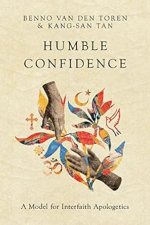
Humble Confidence: A Model for Interfaith Apologetics

Benno van den Toren and Kang-San Tan (IVP Academic)

Humble Confidence offers a fresh integration of evangelism, missiology, and apologetics. With uncommon clarity and grace, the authors bring these insights to bear on the complexities of the modern world, particularly the many religious viewpoints and expressions embedded in innumerable cultural contexts. Crucially, they retain a commitment to rational defense of the Christian faith while resisting the power struggles, logic chopping, and depersonalization that often accompany apologetic efforts. What results is a holistic model of interfaith engagement that honors and respects the bodies, minds, hearts, and souls of all involved. — Marybeth Baggett, professor of English and cultural apologetics, Houston Christian University

Finalists

The Augustine Way: Retrieving a Vision for the Church’s Apologetic Witness

Joshua D. Chatraw and Mark D. Allen (Baker Academic)

The Surprising Rebirth of Belief in God: Why New Atheism Grew Old and Secular Thinkers Are Considering Christianity Again

Justin Brierley (Tyndale Elevate)

(Read CT’s review of The Surprising Rebirth of Belief in God.)

Bible and Devotional

Catholics And Evangelicals In The TrenchesA recent document spells out new ways to share a foxhole in the culture wars.In 1534, Abbot Paul Bachmann published a virulent anti-Protestant booklet entitled “A Punch in the Mouth for the Lutheran Lying Wide-Gaping Throats.” Not to be outdone, the Protestant court chaplain, Jerome Rauscher, responded with a treatise of his own, entitled “One Hundred Select, Great, Shameless, Fat, Well-Swilled, Stinking, Papistical Lies.”Such was the tenor of theological discourse among many of the formative shapers of classical Protestantism and resurgent Roman Catholicism in the sixteenth century. How surprised those feisty forebears would be to learn that their “conservative” heirs, removed by five centuries and an ocean, could find so much on which to agree in the historic document released last month, “Evangelicals and Catholics Together: The Christian Mission in the Third Millennium.” Convened by evangelical leader Charles Colson of Prison Fellowship and Roman Catholic thinker Richard John Neuhaus of the Institute on Religion and Public Life (and a former Lutheran clergyman), a group of some 30 evangelical and Catholic representatives have proposed ways to deepen cooperation and lessen conflict between these two major faith communities. Marked by civility, candor, and conviction, their statement reflects the changing pattern of American church life over the past generation. Traditional Catholics and conservative Protestants, once bitter rivals, have become wary allies in the culture wars that so sharply divide the American people in general.For more than 30 years, a select group of American Catholics and evangelicals has stood side by side in support for parental choice in education, advocacy of the traditional values of chastity, family, and community, opposition to abortion on demand, and repudiation of pornography—all derived from deeply held religious conviction.Born of the trenchesHere is an ecumenism of the trenches born out of a common moral struggle to proclaim and embody the gospel of Jesus Christ to a culture in disarray. This is not merely a case of politics making strange bedfellows. It is more like Abraham bargaining with God for the minimal number of righteous witnesses required to spare the sinful city of Sodom.For too long, ecumenism has been left to Left-leaning Catholics and mainline Protestants. For that reason alone, evangelicals should applaud this effort and rejoice in the progress it represents. However, lest anyone be carried away by the ecumenical euphoria of the moment, it needs to be stated clearly that the Reformation was not a mistake.Both the formal and material principles of the Reformation—that is, the infallibility of Holy Scripture and justification by faith—are duly affirmed in this statement. But how these principles relate to a host of other issues such as church authority, sacramental efficacy, and authentic ministry are acknowledged points of difference. The fact that evangelicals share more in common with born-again Catholics than with liberal Protestants—on theological as well as social grounds—should not blind us to the fact that substantial and persistent differences remain between us. The framers of this document have not dodged these issues, but they must pursue them further on the basis of the commonly confessed Trinitarian and Christological consensus. Only in communities of faith where heresy is a possibility and truth has not been reduced to mere opinion can genuine theological debate take place.A time to sew, not to rendThe document’s call for universal religious liberty and world evangelization can be warmly embraced, but the plea to refrain from “proselytizing” can be affirmed only if it is understood that nominal church membership (whether Catholic or Protestant) makes no one a Christian. Personal faith in Jesus Christ as sole and sufficient Savior for all people everywhere is the message we proclaim, and no Christian can relinquish the responsibility to bear witness to that good news to anyone anywhere.For faithful evangelicals and believing Roman Catholics, this is a time to sew, not a time to rend. In expressing our common convictions about Christian faith and mission, we can do no better than to heed the words of John Calvin: “That we acknowledge no unity except in Christ; no charity of which he is not the bond, and that, therefore, the chief point in preserving charity is to maintain faith sacred and entire.”By senior editor Timothy George, dean of Beeson Divinity School, Samford University, Birmingham, Alabama.What China Doesn’T NeedWhen Secretary of State Warren Christopher tried earlier this year to nudge China to ease up on its dissidents, he tried using its Most Favored Nation trade status as a bargaining chip. “No thanks,” said the Chinese. “We don’t see the connection.” They do see a connection, however, between foreigners invading their country in the name of religion, and their right to persecute the church—a connection that may have inspired last winter’s crackdown. Once again, Western Christians would do well to rethink their role in China’s Christian community.Western idealists, including church and mission leaders, somehow find it hard to believe that other countries do not accept our democratic ideals as the best deal for everyone, East or West. China’s current lapse on human rights offers fresh reminders that although they may never measure up to our ideals, God’s work in his Chinese church does not depend on the Chinese possessing something like the U.S. Bill of Rights.Whatever this latest crackdown means for China’s Christians, such decrees are just as futile as all previous attempts by Chinese Communists to rub out religion. Perhaps no other generation has seen anything like the growth of the church in China in the past quarter of a century. When the Communists took power over 45 years ago, China had about 5 million Christians (2 million Protestants and 3 million Catholics). According to current estimates, the numbers now stand at 75 million—63 million Protestants and 12 million Catholics. God gave this growth without sending foreign missionaries.At the high tide of mission work in China, before this astonishing growth, some 8,500 missionaries worked there. In one sense, the current ingathering can be attributed to the seed sown during the 140 years of missionary work. The government tried every conceivable diabolical scheme to obliterate any vestige of religion brought in by foreign missionary “devils.” Millions of Christians were among the 20 million Chinese who perished in the Cultural Revolution (1966–76). But the gospel clung to Chinese soil.Having been purified by fire, however, China’s Christians emerged with their own distinctive witness and worship. In the process, they shed the hated, shameful opprobrium that theirs was a Western religion, propped up by “subversives” from America and elsewhere. They also shed a lot of the Western scaffolding (church organizational structures, methods, and institutions, as well as buildings) that had been erected prior to 1949, scaffolding that missionaries sometimes find too painful to dismantle. God sometimes uses other kinds of pain to bring forth a more culturally legitimate expression of his church.No one expects the current government to resume its campaign to eliminate religion from China. But while scholars try to figure out what is behind the new restrictions, it would not be too far off the mark to think that one goal is to hold another missionary invasion at bay. If that is true, perhaps the government is doing the church in China a huge favor. Already we hear about consultations among missionaries on how to save China from being engulfed by the same kind of freewheeling, culturally insensitive, do-it-yourself missionary work that has stampeded into the former Soviet empire.Does a church that has grown from 2 million to 75 million need foreign missionaries? If so, what kind, how many, and what should they do? These are tough questions, especially for those of us who have allowed our missions conquests to give us something of a Messiah complex. But too much is at stake if we barrel ahead with yet another onslaught of well-meaning missionary candidates challenged to take the gospel to a country that has done a pretty good job with it themselves. Certainly China still needs some historically astute, culturally mature missionaries, but not an avalanche of aggressive greenhorns from hundreds of Western agencies.My hunch is that the future of Christian missions lies with people like the Chinese physician I met recently. He had gone to a West African nation to offer medical assistance. There he met an American surgeon who told him about Jesus. The surgeon also arranged for the Chinese doctor to come to the United States as a medical observer in a nearby hospital. Now he has been studying English at a community college so he can later study missions at a Christian college. “I want to go back to China as a missionary,” he told me.Rather than crash the gates, it is better to reflect on how God has arranged to put another Chinese missionary back in his own country through a “chance” meeting with a Christian doctor in rural Africa. No agency can come up with a better plan than that.By advisiory editor Jim Reapsome, editor of Evangelical Missions Quarterly and World Pulse Newsletter, in which parts of this editorial appeared.

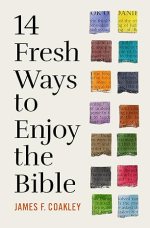
14 Fresh Ways to Enjoy the Bible

James F. Coakley (Moody)

It’s easy to get stuck in our approaches to the Bible—reading it from a certain perspective, asking the same questions of each text, defaulting to familiar ways of interpreting it, or even just getting bored with our old routines. This book offers 14 ways to look at Scripture with fresh eyes, not only revealing meanings and emphases we may have missed but also illuminating the artistry and ingenuity of biblical authors and the Spirit who inspired them. Coakley’s explanations of each concept, as well as examples from biblical and nonbiblical works, will help readers deepen their understanding of Scripture and appreciate its literary beauty. — Chris Tiegreen, author of numerous devotional books and Bible study guides

Award of Merit

What is your definition of discrimination? These days it may depend on how steady your nerves are.At George Mason Univeristy, a guide for students defines discrimination as “jumping when a homosexual touches you on the arm.” It also includes “keeping a physical distance from someone because they are a known gay or lesbian.” Imagine campus administrators scurrying around with tape measures, unmasking the guilty who jump too high or stand too far away.Most people dismiss stories like this as the latest campus silliness—no different from the goldfish-swallowing competitions of the thirties. Others chalk it up to overly sensitive campus officials fearful of offending anyone.But political correctness is much more than sensitivity. It is a manifestation of a deep-rooted philosophical struggle, which Christians critically need to understand. Just as storms are moved by hidden upper-air currents, so cultures are steered by powerful, invisible philosophical currents. And a new current sweeping over our nation right now may alter the very character of American life.PHILOSOPHICAL FACE-OFFCollege campuses are caught in a face-off between modern Enlightenment rationalism and postmodern relativism. The Enlightenment philosophers wanted all the benefits of Christianity without belief in God. By human rationality alone they hoped to discover universal truth and universal morality.But no sooner were these ideas launched than they were shattered on the rocks of history. Each philosopher staked out his own vision of the True and the Good—only to have his stakes pulled up by succeeding philosophers offering competing visions. Finally, suspicion was cast on the very notion of rationality.Gradually it became clear that no mere mortal can stand above his limited niche in time and space to gain a completely objective, “godlike” perspective. Today the vision of human reason discovering ultimate truth on its own is dismissed as Enlightenment arrogance.But postmodernists reel to the other extreme: They deny the existence of any universal truth or morality. Postmodernism holds that individuals are merely constructs of social forces—race, gender, and ethnic background. Every cultural group has its own “truth.”Ideas are no longer judged by a standard of truth but by whether they advance a particular racial, gender, or ethnic group. African-Americans who teach that Plato and Alexander the Great were black often seem less interested in historical fact than in fostering black students’ self-esteem. Radical feminists who preach goddess worship do not seem to care whether a goddess objectively exists, they just want to “empower” women.When people stop believing in a transcendent truth, however, debates about ideas degenerate into power struggles. After all, if there is no truth, then we cannot persuade one another by rational arguments. All that is left is power: Whatever group has the most power imposes its opinions on everyone else.Lest you think I’m being alarmist, let me assure you that this is exactly what postmodernists themselves say. Stanley Fish at Duke University recently wrote There’s No Such Thing As Free Speech, supporting strict campus speech codes. Why not? Fish argues. After all, public discourse is merely a battle to protect our own preferences while restricting everyone else’s. He writes: “Someone is always going to be restricted next, and it is your job to make sure that the someone is not you.”This is frightening stuff. It’s the perfect philosophy to justify tyranny. As Wheaton College professor Roger Lundin explains in The Culture of Interpretation, in postmodernism “all principles are preferences—and only preferences.” As a result, “they are nothing but masks for the will to power.” Postmodernists even recast the Enlightenment’s sacred cows of reason and science as tools of oppression. So, feminist scholar Sandra Harding complains, science embodies a male-centered view that is “culturally coercive.”These ideas assault the very foundations of social and intellectual life. No society can survive without some shared principles, some shared vision of what moral philosophers call the Good Life. But if all principles are merely preferences imposed by force, society degenerates into a war of all against all. Campus codes prescribing how high you may jump or what words you may use are harbingers of the coercion we may soon face at all levels of society.You and I need to be aware that postmodernism is not just one more “ism” on the intellectual horizon. It has become a powerful force changing our culture. The ground rules for engaging our culture must therefore shift dramatically as well. Until recently, Christian apologetics has defended the faith against Enlightenment attacks in the name of scientific rationalism; but at least both sides were debating objective, universal truth. Postmodernism, however, has tossed out the very notion of universal truth. Today we can no longer simply defend our faith as the Truth; we must first defend the very concept of transcendent, universal truth.Christians are called to stand against the spirit of the age. But first we must identify that spirit as it changes from generation to generation. We must “understand the times,” as Paul says in Romans 13. In our own times, the good news is that the arrogance of Enlightenment rationalism is deflated. The bad news is that postmodernism retreats into an irrationalism deadly to our communal life.The PC wars are not just campus silliness. They are reflections of a battle over fundamental principles of truth and social morality, which go to the very heart and soul of our common life.

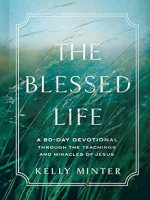
The Blessed Life: A 90-Day Devotional through the Teachings and Miracles of Jesus

Kelly Minter (B&H)

Minter provides a contemplative exploration of a short period in Jesus’ earthly life. Readers walk alongside Christ’s disciples, encountering crowds, misfits, and sufferers while hanging on to the Messiah’s every word. With gracefully short and profound chapters, The Blessed Life illustrates the ongoing relevance of Jesus’ teachings and miracles for building and sustaining faith in today’s world. Minter’s powerful writing helps us receive Jesus’ words the way his original audience did—as new, fresh, and brimming with hope. — Eryn Lynum, Bible teacher, author of Rooted in Wonder

Finalists

Hearing the Message of Ecclesiastes: Questioning Faith in a Baffling World

Christopher J. H. Wright (Zondervan)

Lent: The Season of Repentance and Renewal

Esau McCaulley (InterVarsity Press)

(Read an excerpt from Lent.)

Biblical Studies

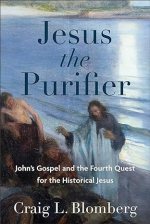
Jesus the Purifier: John’s Gospel and the Fourth Quest for the Historical Jesus

Craig L. Blomberg (Baker Academic)

Blomberg, a prominent New Testament scholar, gives a thorough account of the scholarship that has characterized four distinct “quests” to understand Jesus as a historical figure. As he highlights significant themes and trajectories, he illustrates why the Gospel of John should play a larger role in this research. Blomberg’s argument centers on the motif of Jesus as purifier, showing how—in both John and the other Gospels—he moves beyond a focus on ritual purity to speak of being cleansed and sanctified by the Holy Spirit. John’s gospel has obvious theological value; Jesus the Purifier helps us appreciate its historical value as well. — May Young, associate professor of biblical studies, Taylor University

Award of Merit

When each edition of CHRISTIANITY TODAY arrives in your mailbox, your level of interest is determined in part by the cover art: Does the image draw you in, making it hard for you to toss it aside? Our hope and goal is for you to answer yes.For the past 12 years, the person who designed those covers, who commissioned the art, called the photographers, positioned the type, has been Joan Nickerson. And her graphic signature did not end with the cover; her imprint can be seen on nearly every editorial page. Through her diligent efforts, the design of CT has remained fresh, contemporary, dignified—much like the art director herself.Despite having one of the most youthful spirits on our staff, Joan has decided to retire. This is the last issue for which she is responsible.Saying thank you does not begin to do justice to her contributions. One of the joys of working at CTi is to brush up against those who love our Lord and have been touched by him to do a mighty work. I count Joan among them. While continually raising the standards of excellence for Christian publishing, Joan has gone the extra mile by mentoring and encouraging a whole generation of Christian graphic artists. At a time when the arts were often ignored by the church, she has helped to keep the artistic flame burning.Next month the magazine in your mailbox will look a little different, as a new personality will begin to make his mark on our pages. Like Joan before him, Tom Moraitis comes to us from our sister publication CAMPUS LIFE. His goal, our hope, is to continue Joan’s vision—a high ambition.MICHAEL G. MAUDLIN, Managing Editor

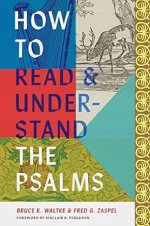
How to Read and Understand the Psalms

Bruce K. Waltke and Fred G. Zaspel (Crossway)

When it comes to works of biblical studies, my ideal is high-level scholarship that connects to pulpits and pews. How to Read and Understand the Psalms is a masterful example, and it now qualifies as my go-to introduction for this section of Scripture. Other introductions are often dry and remote, and even when they accurately dissect specific parts of the Psalms, they can miss the larger point, which is guiding the people of God in speaking to and worshiping God. I have spent a good bit of time working on and thinking about the Psalms, and while reading this book, I was instructed, corrected, and stirred to devotion. — Ray Van Neste, professor of biblical studies, Union University

Finalists

Nobody’s Mother: Artemis of the Ephesians in Antiquity and the New Testament

Sandra Glahn (IVP Academic)

Isaiah

J. Gordon McConville (Baker Academic)

Children

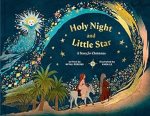
Holy Night and Little Star: A Story for Christmas

Mitali Perkins (WaterBrook)

This original Christmas story is told from the viewpoint of Little Star, a shy yet courageous member of the galaxy, who discovers her purpose in obedience to Maker. On Holy Night, when all the greater stars and planets join with the heavenly host in announcing the Savior’s birth, Little Star learns she has a special part to play as well. Illustrated in muted jewel tones, the brief but lyrical text reads almost like a lullaby. And when Little Star recognizes Maker in the manger, the young reader also learns that “everything was different now, but Maker was the same. Today, tomorrow, forever.” — Pamela Kennedy, children’s author, cocreator of the Otter B series

Award of Merit

Jacques Ellul, who contributed a legacy of social analysis and prophetic theology matched by few in the twentieth century, died May 19 at his home in Pessac, France. Ellul, troubled by heart problems and other ailments in recent years, died near the University of Bordeaux, where he served as professor of the History and Sociology of Institutions in the Faculty of Law and Economic Sciences from 1946 to 1980.He is best known for his critical analysis of the impact of technology on modern life—not just by the introduction of various machines but, more profoundly, by subtly changing methods of thinking and values. In a technical milieu, rationality, measurable effectiveness, quantification, and standardization are replacing God, goodness, tradition, eccentricity, and the like at a great human and spiritual cost. This social analysis unfolded in more than 30 volumes, the best known of which is The Technological Society, which passed the 100,000 mark in sales.Ellul, 82, also had been an active lay theologian in the Reformed Church of France. He wrote on biblical topics, Christian ethics, and the relationship of the church to the world. His books include The Presence of the Kingdom, The Meaning of the City and The Ethics of Freedom. Ellul’s work drew on the Bible, Kierkegaard, and Barth, and challenged Christendom, which he viewed as being too conformed to this world.Ellul’s legacy is impressive for its sheer size, scope, depth, and breadth. He engaged the political Left and Right, Marxists and capitalists, religious and nonreligious, theological liberals and conservatives.The theologian’s life was distinguished by its combination of activism and thought. He was fired from his first university post for protesting the Nazi occupation of Vichy France. He worked in the French Resistance and helped Jews escape the Nazis during World War II. His positions on the technological threat, political inutility, strategic anarchism, and theological universalism caused some to summarily reject his work. Others, however, found his work a brilliant challenge to rethink some of their major assumptions and conclusions, even if they did not agree with all his proposals.By David W. Gill.

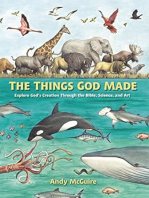
The Things God Made: Explore God’s Creation through the Bible, Science, and Art

Andy McGuire (Zonderkidz)

The story of creation is ubiquitous enough that one might wonder if we need yet another children’s book on the topic. But wonder was, in fact, the word that came to mind as I read The Things God Made. Complemented beautifully by breathtaking artwork, the book has captured the staggering awe that the story of our fascinatingly intricate creation deserves. If we have lost our sense of wonder, McGuire aims to rekindle it. Brilliantly infusing expertise with humility, scientific fact with childlike joy, The Things God Made is a delight. I suspect it will lead readers—children and adults alike—one step beyond wonder and straight into worship. — Hannah C. Hall, children’s writer, author of God Bless You and Good Night

Finalists

Good Night, Body: Finding Calm from Head to Toe

Brittany Winn Lee (Tommy Nelson)

Marvel at the Moon: 90 Devotions

Levi Lusko (Tommy Nelson)

Young Adults

This Seat’s Saved

Heather Holleman (Moody)

This Seat’s Saved captures the longing of every teenager in America: belonging. Elita, like so many girls her age, finds herself in a state of friendship adversity. Suddenly, she is excluded from the lunch table by her best friend with the painful statement “This seat’s saved.” Feeling abandoned, she battles fear and loneliness. But in a world that screams at her to fit in, Elita learns that lasting joy comes not from earning the best seat at the lunch table but from receiving the seat God has freely given her next to Christ. — Reese Carlson, youth pastor, author of Church Doesn’t End With Z

Award of Merit


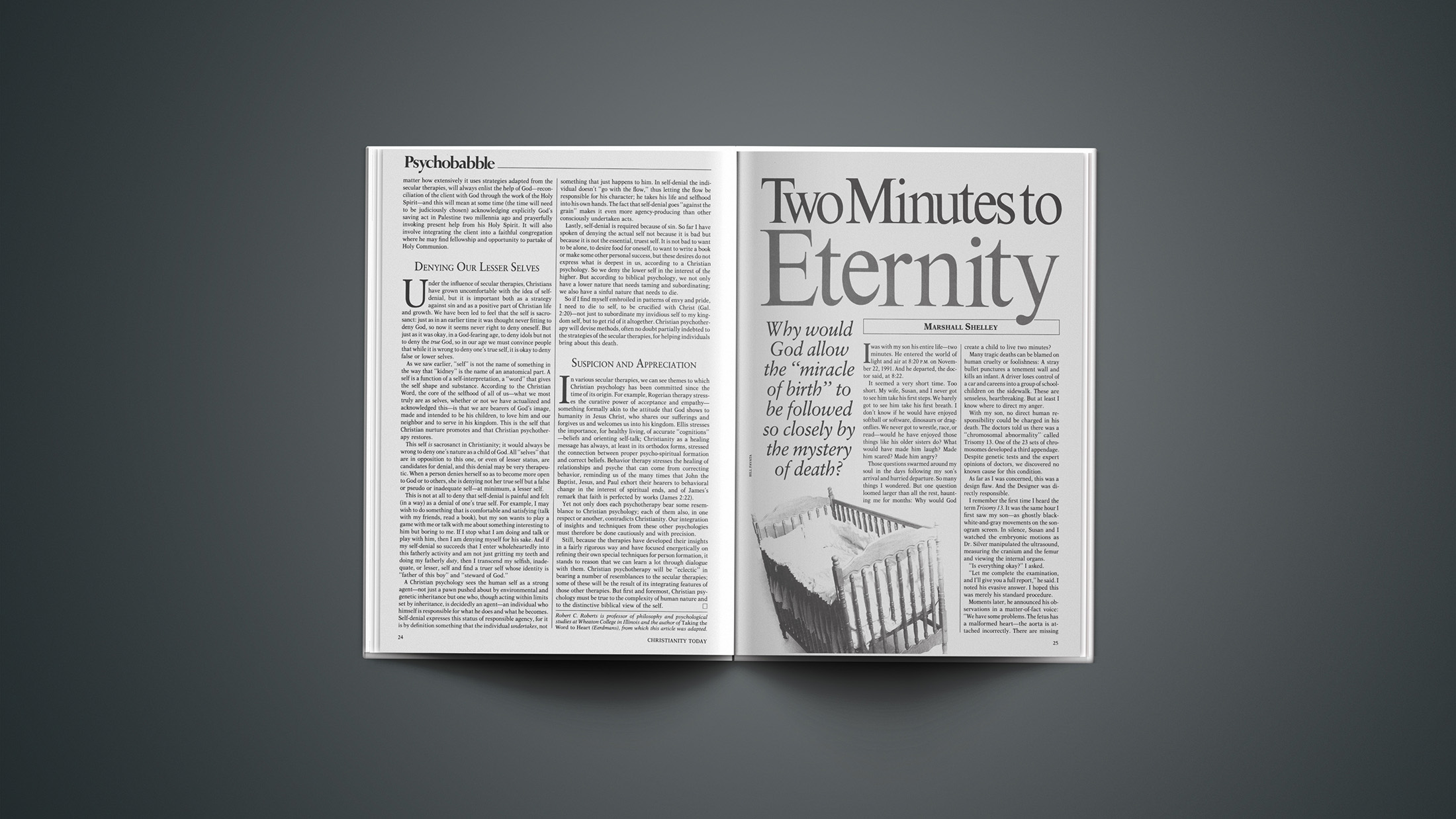
I was with my son his entire life. Two minutes.

He entered the world of light and air at 8:20 p.m. on November 22, 1991. And he departed, the doctor said, at 8:22.

It seemed a very short time. Too short. My wife, Susan, and I never got to see him take his first steps. We barely got to see him take his first breath.

I don't know if he would have enjoyed softball or software, dinosaurs or dragonflies, machines or math. We never got to wrestle, race, or read—would he have enjoyed those things like his older sisters do? What would have made him laugh? Made him scared? Made him angry?

Those questions swarmed around my soul in the days following my son's arrival and all-too-hurried departure. So many things I wondered. But one question loomed larger than all the rest, haunting me for months: Why would God create a child to live two minutes?

Many tragic deaths can be blamed on human cruelty or foolishness. A stray bullet punctures a tenement wall and kills an infant. A driver loses control of a car and careens into a group of schoolchildren on the sidewalk. Senseless. Heartbreaking. But at least I know where to direct my anger.

With my son, no direct human responsibility could be charged in his death. It was a "chromosomal abnormality" called Trisomy 13. One of the 23 sets of chromosomes developed a third appendage. Despite genetic tests and the expert opinions of doctors, we discovered no known cause for this condition.

As far as I was concerned, this was a design flaw. And the Designer was directly responsible.

I remember the first time I heard the term "Trisomy 13." It was the same hour I first saw my son—as ghostly black-white-and-gray movements on the sonogram screen. In silence, Susan and I watched the embryonic motions as Dr. Silver manipulated the ultrasound, measuring the cranium and the femur and viewing the internal organs.

"Is everything okay?" I asked.

"Let me complete the examination, and I'll give you a full report," he said. I noted his evasive answer and hoped this was merely his standard procedure.

Moments later, he announced his observations in a matter-of-fact voice: "We have some problems. The fetus has a malformed heart—the aorta is attached incorrectly. There are missing portions of the cerebellum. A club foot. A cleft palate and perhaps a cleft lip. Possibly spina bifida. This is probably a case of Trisomy 13 or Trisomy 18. In either case, it is a condition incompatible with life."

Neither Susan nor I could say anything. So Dr. Silver continued.

"It's likely the fetus will spontaneously miscarry. If the child is born, it will not survive long outside the womb. You need to decide if you want to try to carry this pregnancy to term."

We both knew what he was asking. I was speechless. Susan found her voice first. Though shaken by the news, she said softly but clearly, "We believe God is the giver and taker of life. If the only opportunity I have to know this child is in my womb, I don't want to cut that time short. If the only world he is to know is the womb, I want that world to be as safe as I can make it."

We left the medical center that July afternoon stunned and saddened.

"Pregnancy is hard enough when you know you're going to leave the hospital with a baby," Susan said. "I don't know how I can go through the pain of childbirth knowing I won't have a child to hold."

Signs of the Pneuma

Summer turned to fall, and we were praying that our son would be healed. And if a long life were not God's intention for him, we prayed that he could at least experience the breath of life. We longed see that reminder of God's Spirit, the Pneuma, flow through him like a gentle wind.

Even that request seemed in jeopardy as labor began November 22. As the contractions got more severe, signs of fetal distress caused the nurses to ask, "Should we try to deliver the baby alive?"

"Yes, if at all possible, short of surgery," Susan replied.

They kept repositioning Susan and gave her oxygen, and the fetal distress eased.

And then suddenly the baby was out. The doctor cut the cord and gently placed him on Susan's chest. He was a healthy pink, and we saw his chest rise and fall. The breath of life. Thank you, God.

Then, almost immediately, he began to turn blue. We stroked his face and whispered words of welcome, of love, of farewell. And all too soon the doctor said, "He's gone."

Within minutes, our pastor, our parents, and our children came into the room. Together we wept, held one another, and took turns holding our son. My chest ached from heaviness. Death is enormous, immense, unstoppable.

The loss was crushing, but mingled with the tears and the terrible pain was something else. I'm not sure I can describe it.

At the births of my three older daughters, I'd felt "the miracle of birth," that sacred moment when a new life enters the world of light and air. The pneuma, the breath of life, fills the lungs for the first time. Now this moment was doubly intense because the miracle of birth was followed so quickly by the mystery of death. The pneuma was here and now gone.

"It feels like eternity just intersected earth" was all I could say to our pastor. The pain of grief was diminished not at all, but it blended with the weight of overwhelming wonder at the irresistible movement from time to eternity.

"Do you have a name for the baby?" asked one of the nurses.

"Toby," Susan said. "It's short for a biblical name, Tobiah, which means 'God is good.' "

We had long thought about the name for this child. We didn't particularly feel God's goodness at that moment. The name was what we believed, not what we felt. It was what we wanted to feel again someday.

The words of C.S. Lewis, describing the lion Aslan, kept coming to mind: "He's not a tame lion. But he's good." We clung to that image of untamed and fearsome goodness, even as we continued to struggle with the question: Why would God create a child to live two minutes?

Everything Has an Inside

Shortly before we discovered Toby's condition, I read a book by Christopher de Vinck, The Power of the Powerless, in which he describes what he learned from his severely and profoundly retarded brother, Oliver.

I was interested because our third daughter, Mandy, was also severely retarded, unable to respond to her environment. And just three months after Toby's birth and death, Mandy also entered eternity. She was two weeks shy of her second birthday. One of the points de Vinck made about Oliver helped me with the God-directed questions I had after Toby's birth and death.

One of the greatest discoveries that a child or an adult can make, writes de Vinck, is that "everything has an inside. In our house, we split apples to look at the core, we crack walnuts to see the meat inside, we press a toy stethoscope to our chests to listen to the heartbeat."

The point: you can't always guess what's on the inside by looking at the outside.

The Bible says that "Man looks on the outward appearance, but God looks on the heart." That was true then. It's true now. We're so outer focused. We're taught to judge people by the stylishness of their clothing labels. Political campaigns are crafted by scriptwriters, TV directors, and pollsters. Educational policies are based on appearances of political correctness. We're tempted to believe that image is everything, that outward appearances are most important. We ignore the inside, the heart, the spirit.

Each of my children also has an inside. With my two older girls, I get occasional glimpses of their interior life. Their words and actions give me clues about their inner worlds. With Mandy, the glass was darker. And with Toby, we never had a chance to see inside.

But Mandy and Toby both had insides. Despite the damage to the outer frame, the inside is to be treasured.

Our Unearthly Calling

Not long after we buried Toby and Mandy, our seven-year-old daughter, Stacey, told us she heard God's voice in the middle of the night telling her that "Mandy and Toby are very busy. They are building our house, and they are guarding his throne."

Not knowing how to respond to a child who had never offered a claim like that before, I found myself reading the Bible with renewed interest in descriptions of heavenly activities. Was this message consistent with Scripture? Our family discussions usually focused on heaven.

We saw that heaven is a place of activity, not just leisure or ease. God is preparing a city for the faithful (Heb. 11:16), where all will be made perfect and complete (Heb. 11:40). The Bible contains many descriptions of heavenly worship as active and intense.

And since Jesus said that in his Father's house are "many mansions" and he was going to prepare a place for us (John 14), we could easily envision part of our heavenly activity being to help prepare for those yet to arrive.

I must admit, however, that I was more intrigued by the image of guarding Christ's throne. Was this an honor guard? A ceremonial assemblage of children, whom Christ on earth had invited to be near him? Or perhaps seats of honor for those Christ had in mind when he said, "The last shall be first"? I can't think of many more "last" than Mandy and Toby.

But what if guarding the throne isn't ceremonial but actual? Daniel 10 describes the angel Michael in conflict with a spiritual foe. Ephesians 6:12 describes a struggle "against the spiritual forces of evil in the heavenly realms." Could it be that among the spiritual warriors in this conflict is one named Toby?

The Book of Revelation records battles involving heavenly armies (Rev. 19:19). Could it be that along with countless others of us, Toby will serve among the heavenly hosts in that final great war?

All of this, of course, is conjecture. But what is clear is that heaven will be a place of active duty.

And when the ultimate spiritual battle is over, our responsibilities continue.

The apostle John's vision of eternity suggests what's in store for all the saints: "The throne of God and of the Lamb will be in the city, and his servants will serve him. They will see his face, and his name will be on their foreheads …. And they will reign forever and ever" (Rev. 22:3-5).

I don't know exactly what our service in that city will involve, nor can I be specific about how we will assist in reigning. But those tasks sound like they may have a bit more significance than most careers we pursue in our current lifetime.

Could it be that when I finally start the most significant service of my life, I'll find that this is what I was truly created for? I may find that the reason I was created was not for anything I accomplish on earth, but the role I'm to fulfill forever.

I realized that my earlier question had been answered.

Why did God create a child to live two minutes?

He didn't.

He didn't create Toby to live two minutes or Mandy to live two years. He didn't create me to live 40 years (or whatever number he may choose to extend my days in this world).

God created Toby for eternity. He created each of us for eternity, where we may be surprised to find our true calling, which always seemed just out of reach here on earth.

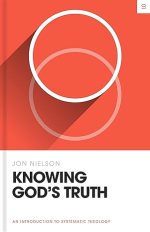
Knowing God’s Truth: An Introduction to Systematic Theology

Jon Nielson (Crossway)

It’s a huge challenge to write a systematic theology book for teens in language they can understand. But Nielson succeeds at this task, helping students grasp deep concepts like eschatology and soteriology. Each chapter contains a Scripture passage that students are encouraged to memorize, as well as pauses where they are invited to pray and reflect on how theological truths can transform their hearts and lives. Nielson does a fine job explaining differing positions on topics like baptism and the end times while leaving space for students to think for themselves. — Jennifer M. Kvamme, student ministries catalyst at Centennial Evangelical Free Church in Forest Lake, Minnesota, author of More to the Story: Deep Answers to Real Questions on Attraction, Identity, and Relationships

Finalists

Do Not Be True to Yourself: Countercultural Advice for the Rest of Your Life

Kevin DeYoung (Crossway)

Hotel Oscar Mike Echo: A Novel

Linda MacKillop (B&H Kids)

Christian Living/Spiritual Formation

The mountains of Appalachia have many faces. One face, shown mostly to vacationers, is picturesque mountain people sewing quilts and playing dulcimers by wood-burning stoves. A different face reveals how Appalachia’s hills and hollows have been left scarred and denuded by overdevelopment. And yet another face exposes how rural families have been hurt for generations by alcoholism, violence, and depression.A true portrait of Appalachia, perhaps, blends together all these differing images, telling a story with more sadness than triumph, with more sorrow than joy.Three-fourths of the poor in the United States are white people living in rural areas. The greatest concentration of those poor people is in Appalachia, which is home to 22 million people. Illiteracy stands at 35 percent in the 397 counties of the region, and 15 percent of the homes still have no telephones.“What we have here,” says Karen Main, deputy director of the University of Kentucky’s Center for Rural Health, “is extensive grain-alcohol abuse, family violence, homicide, accidents, substance abuse, and depression.”The economy of Appalachia has collapsed. Coalmining jobs, light manufacturing, and federal assistance have largely dried up. Today, most of Appalachia’s people work at the marginal jobs that remain. The average annual income for a family of four in West Virginia is , 000.“I’ve been in ministry for 30 years and have never seen more poor people,” says Mary Lee Daugherty, executive director of the Appalachian Ministries Educational Resource Center, based in Berea, Kentucky.Daugherty knows hard times from the inside. Daugherty and her brother, Jim—both brown-eyed and red-headed—grew up in the home of a West Virginia miner and factory worker. Their mother died in their early teen years. Their father drowned his grief in alcohol.Drawn close through adversity, the children found hope in their hometown church. Daugherty came to Christ through the influence of the Sunday school. Jimbo went forward in a tent meeting at age 15. Within two years, his life completely turned around; soon he was directing a local Youth for Christ group.The twosome ministered together in small-scale revival services. He preached; she played the piano or sang, and the determined duo earned their way through college. Afterwards, she went on to seminary, and Jim moved into national ministry with Youth for Christ. Daugherty set her sights on missionary work, thinking there she might find more freedom to use her gifts.Arriving in Brazil, she was struck by the pervasive poverty and quickly became involved with the women of struggling families. Their plight closely paralleled her Appalachian experience. Chuck, a son of American missionaries to Brazil, was one of Daugherty’s fellow teachers. They were married and gave birth to a daughter and son, and eventually returned to the States.Back in Charleston, West Virginia, Daugherty cared for children during the daytime, yet found spare time to teach religion courses at a local college. She quickly discovered that many pastors coming into the region were unprepared for the culture shock that comes from ministry to the rural poor. Working with local church leaders, Daugherty set up an orientation program for new pastors. But she had to abandon the classes when her college dropped its commitment to religious studies. Then, 11 years ago, the Commission on Religion in Appalachia (CORA) asked Daugherty to start a training program for individuals planning to minister in Appalachia. In 1985, the Appalachian Ministries Educational Resource Center (AMERC) in Berea was born. AMERC is a trio of hands-on experiences designed to give pastors the skills they will need to work among the chronically poor:• The January Travel Seminar, an intensive session taking students to family farms, strip-mine sites, and cooperative parish ministries.• On-site rural internships, in which students work directly in parishes.• Summer Term, a six-week program taught at Berea College, where students spend much of their time living in a community.A major reason that AMERC succeeds is Daugherty herself. Out in public, she is persuasively direct, talking about poverty without playing up sentimentality. Daugherty’s unassuming intensity is relieved by a distinctive laugh. She will, says a staffer, “rare back and let out a belly laugh” at herself and the bizarre situations that shoe-string operations frequently find themselves in. That humor helps her staff to “run but not faint.”AMERC’s mission is to strengthen church leadership in Appalachia by recruiting and training clergy and lay professionals for long-term service. Students may learn how to strengthen the churches by working with local people, how to teach in a low-literacy environment, cultivate a garden, or do canning in the church kitchen.The old Pearson Farm, donated anonymously last October, has given AMERC a campus. The farmhouse has been remodeled and its garage has been converted into a library. Typical of Daugherty’s unstinting hospitality, this winter she housed volunteer workers in her own apartment and prepared meals.In February, friends gathered to dedicate the library. The library fund is named in memory of Daugherty’s brother, who died of cancer last year.Daugherty is equally gracious and comfortable with feminists and fundamentalists. As a result, AMERC is thoroughly ecumenical—including Protestants, Roman Catholics, and the Orthodox. J. Steven Rhodes, AMERC’s associate director for academic affairs, says he treasures the memory of a monk, an IBM executive, and a snake handler washing each other’s feet at the service that ended a recent summer term.Daugherty believes the high level of cooperation has been achieved in Appalachia “because we’ve been poor longer, long enough to no longer look to big government or big business, long enough to be asking, instead, ‘How are we going to help ourselves?’ ”Governed by CORA, Berea College, and 45 sponsoring theological institutions, AMERC is now the largest cooperative alignment of seminaries in America. AMERC has trained 439 seminary grads from 37 denominations.Daugherty points out that since there are not enough big-steeple churches to go around, more than half of all seminary graduates will end up in small-town and rural pastorates. Her goal is to train them to cope so that she can successfully appeal to each to give 15 years in service among the rural poor.By then, she figures, the new influx of resources into the mountains will be under way. Meanwhile, don’t underestimate this spunky angel for Appalachia.By Harry Genet.

A Quiet Mind to Suffer With: Mental Illness, Trauma, and the Death of Christ

John Andrew Bryant (Lexham Press)

I’ve sat for hours with friends with severe mental illnesses, not understanding in the slightest how they feel or what’s going on inside them. This book gave me a small glimpse into their world and the hope that exists in the life and death of Jesus. It is profound and deeply troubling, lovely and heart-wrenching. I’m both grieved and grateful when I think of the suffering Bryant endured to give us something so wise, true, and beautiful. This book sheds conventional genres, somehow combining memoir, poetry, lecture, sermon, and essay all in one. I left wanting to know more of the patient, quiet trust in Jesus that Bryant found in the halls of the psychiatric ward. — Shar Walker, author and speaker, contributor to His Testimonies, My Heritage

Award of Merit


Interviewing a couple she calls Tom and Laura Brett, Maggie Scarf asked Tom what attracted him about Laura. He said that in addition to being pretty, smart, and funny, she was a challenge.


“A challenge because of her sincerity, I suppose, and her honesty, too. It’s all there,” he added, with a small shrug, “in her language.”

“Her language?” I gazed at him quizzically. He, however, was exchanging a knowing, fond look with his wife. “Church language,” he explained, running a quick hand through his curly brown hair. “Listening to Laura talk to her friends, you hear certain terms come up again and again. Things like ‘letting yourself be vulnerable’ and ‘investing yourself in a decision.’” (Intimate Partners)


Given that church language was the clue to Laura’s challenging ethics, we might have expected Tom to mention terms like sin, repentance, redemption. But to Tom, “church language” consists of what some of us fondly call psychobabble, the language of popular psychology.

Across the ages, the church has been haunted—hindered and helped—by alien spirits. Time was when the ghosts skulking behind pulpits and visiting in the choir stalls were mostly philosophers: Plato, Aristotle, Kant; and more recently, Hegel, Marx, Whitehead, Heidegger. In the best cases, their conversation stimulated Christian thinking and threw light on aspects of our life and calling that we might otherwise have missed. But sometimes the philosophers affected the pulpit more than the gospel of Jesus did; it was their spirit, rather than the Holy Spirit, that became the spirit of the community; it was their words, and not the Word of Life, that were taken to heart by the congregation.

Recently psychologists have largely displaced the philosophers. Seminars in Rational Christian Living teach believers how to avoid depression, anxiety, unproductive anger, and overeating through rational self-management. In Episcopal congregations, the air is often thick with the mysterious breath of Carl Jung. Small-group Bible studies have a distinctly encounter-group air about them, what with all the sharing of feelings and “needs” that goes on there. We hear about “sensitivity” and “openness” and “being in touch with our feelings.” We learn to accept ourselves and to get in touch with our unconscious or the child within. We class ourselves as introverted or extroverted, feelers or thinkers, sensers or intuitives.

Why does psychology tend to weave itself into sermons, prayers, Bible studies, pastoral care, retreats, spiritual self-reflection, and vestry meetings? Why does the church’s language not get equally infused with the latest developments in fiber optics or subatomic particle physics or genetic engineering? The answer is obvious: The church is not in the business of physics or genetics, but from its earliest days it has been in the person business—transforming people from being damaged, poorly functioning, unfulfilled, hostile, and anxious, to being whole, well-functioning, fulfilled, loving, and at peace. In other words, the church has always dealt in practical psychology.

What It Is to Be a Self

Christian spirituality (or psychology, if you will) has resources for explaining (diagnosing) what goes wrong with people psychologically. The ancient Christian lists of sins, along with the analysis of how the sins do their dirty work—for example, the “seven deadly sins” of pride, envy, sloth, greed, anger, lust, and gluttony—provide a kind of diagnostic scheme. The lists of Christian virtues, again with analysis of their psychological profile—for example, faith, hope, love, humility, compassion, contrition, gratitude, patience, perseverance, self-control—provide a psychological character-ideal, a notion of what the fully functioning person is like. The Christian disciplines of worship, prayer, meditation on God’s Word, meditation on special exemplars of human excellence (saints), service to others, gift-giving (especially to the poor), and fellowship with other Christians are ways of pursuing this proper personal life and shaping our characters as mirrors of God and sisters and brothers of one another. They are, as it were, the basic “therapeutic interventions” of Christian psychotherapy.

To draw the connection in the other direction, we could say that the psychologies of Carl Rogers, Albert Ellis, Carl Jung, Heinz Kohut, and others are really alternative spiritualities: like Christianity, they are ways of conceptualizing what it is to be a person, along with diagnostic schemes and sets of disciplines by which to arrive at better “health”—that is, to grow toward true personhood or away from various forms of failure to be proper persons. These psychologies are, of course, in various ways unlike Christianity in what they take persons to be, so I call them alternative spiritualities. That is why Christians, who insist that persons be formed as children of God, must understand these psychologists’ spiritualities and know just where the continuities and discontinuities with Christianity lie.

The danger is that these psychologies may, to one degree or another, replace Christianity without most people even noticing that any substitution has taken place. In some instances, the influence of the therapies—even from within the church—may be so strong that our character and relationships are no longer Christian but are now family-systemic or Jungian. Our love may be Rogerian empathy, our courage the updated Stoicism of Ellis’s Rational-Emotive Therapy, our forgiveness motivated by our therapeutic “right to be free from hate.” In short, the language we assimilate and the disciplines to which we submit may make our souls therapeutic rather than Christian.

The Christian will agree with Charles Taylor when he says that having a self is quite a different thing from having a kidney. You can have a kidney without having any ideas about kidneys, says Taylor, but to have a self necessarily involves having some ideas about what it is to be a person, about what is important in life, about what the goal of life is, and about what persons can do. We are “self-interpreting animals.” As selves, we do not live by bread alone but by the “words” in terms of which we interpret ourselves, whether these proceed from the mouth of God or the mouth of our Jungian analyst or our Marxian political science professor or Carl Sagan or the pop Darwinians who write for Time. All these thoughts, these words, these understandings are out there floating around in our social environment, inside and outside the church, and they constitute, in significant part, a kind of spiritual junk food. They tell us what it is to be a person, what it is to be fulfilled, what kind of world we live in, what truth is, and how we are to think if we are to be rational.

We are what we eat, according to the biblical psychology. Since we are verbivorous beings, the words we chew, swallow, and digest will determine how we see the world, what we take to be important, how our behavior, our character, and our very life are shaped.

Since persons are verbivores, those who seriously interpret themselves in Christian terms will tend to have Christian selves; those who seriously interpret themselves in Rogerian or Jungian terms will tend to have Rogerian or Jungian selves. The various psychotherapies and personality theories that are influential today are not just neutral medical technologies or scientific theories; they are philosophies of life that endorse particular virtues, character traits, or features of personality. These are the traits a person would have if her therapist succeeded in making her into a fully functioning and mature person—mature, that is, by that therapist’s reckoning. And they are traits the therapy is designed to foster.

These therapeutic virtues are often similar to the Christian virtues, and this is perhaps one reason Christians are attracted to the psychologies and feel comfortable with them. But the therapeutic virtues are not only similar to the Christian ones; they are also, in important ways, quite different from them—even incompatible with them.

Becoming a Double Lover

Many of the secular psychologies identify some basic “need” or “drive” that sets the most fundamental agenda for a human life. Freud, for example, says that we are driven by a need for sexual fulfillment that we cannot properly satisfy in direct ways. The fundamental task, then, is to find socially acceptable ways of satisfying our instinctual needs.

Christian psychology can be read as having the same pattern of positing a basic need or potential or drive, and then seeing human troubles and maladjustment as forms of failure to achieve what our basic nature requires. Our basic need is identified in the double commandment: You shall love the Lord your God with all your heart, and your neighbor as yourself (Matt. 22:37—40). This state of proper attachment to God and neighbor is what we were made for; it is this toward which our hearts most basically incline, despite all appearances to the contrary. We are “nothing” without love, according to the apostle Paul (1 Cor. 13:2). As Saint Augustine comments, we were created with a (suppressed and often hidden) drive to praise and honor God, and our hearts are “restless” until we “rest” in God.

Any Christian psychology that is developed with the help of concepts from the secular psychologies will have to remain faithful to this premise: we are made to love God and will find complete “mental health” only when we do so.

Diagnosing Sin

Sin is without any doubt the chief diagnostic category of biblical psychology. In the New Testament, sin is not just a set of misdeeds but a perverse state of the person and thus a psychological state, a state of the soul. It is a “nature” that one has put on, an orientation, a matter of perverse motives (Eph. 4:22; Gal. 5:16-21; 1 John 2:16). Insofar as Christianity is a word about the overcoming of sin, it is, in the most literal sense of the word, a psychotherapy—a cure for sick souls. But as a concept of psychic dysfunction, sin has three features that non-Christian concepts of dysfunction lack: sin is offense against God, is the result of responsible human agency, and is incurable by merely human effort. Let us look at the last two of these.

Responsibility. The dominant tone of many therapies is that the client is a victim of his society, his unjust upbringing, his early self objects, poor training, or ignorance. Some therapies give the impression that the very idea that a person is responsible for his dysfunction is antitherapeutic. (“Don't make the client feel guilty.”) However, one of the chief therapeutic strategies of Christianity is forgiveness—God’s forgiveness of sinners offered in Jesus Christ, and each sinner’s forgiveness of others. And forgiveness implies guilt; it applies only to someone who is dysfunctional by his own responsibility. Nor can he properly receive forgiveness unless he feels his guilt and repents of his sin. Thus the biblical psychology stresses the therapeutic importance of contrition, that emotion in which the individual regrets his state and dissociates himself from it while taking responsibility for it (Luke 3:7—9; 7:36—50; 18:8—14; 2 Cor. 7:8—10).

A worry that seems to lie behind therapists’ shyness about ascribing responsibility to the client is that being “judgmental” will merely raise the client’s defenses and preempt the development of therapeutic trust. Christian psychology is as much opposed as any other psychology to judgmentalism (Matt. 7: 1—5) if we think of the judgmental attitude as a kind of contempt by one person, who sees herself as “righteous,” of another whom she regards as inferior to herself because of the other’s sinful condition.

This is an alienating and untherapeutic attitude, to be sure, but the remedy need not exclude ascribing responsibility. What is pernicious about judgmentalism is not the judgment being made, but the contempt that alienates one human being from another. The Christian doctrine of sin is that “there is no distinction” between therapist and client in this regard, “since all have sinned and fall short of the glory of God” (Rom. 3:23).

It is a requirement of proper Christian maturity that each one of us recognize emotionally his own sinfulness and dependency on God’s grace. A pervasive attitude of contrition is a mark of Christian holiness, and surely will be a mark of the Christian therapist. Rogers and Kohut stress therapist empathy and require it not to be an artificial attitude or mere “technique,” but to make itself felt to the client out of the depths of the therapist’s personality. Christian psychology agrees with this, but adds that contrition is an equally important virtue for the therapist to possess. Contrition is the attitude that will prevent judgmentalism as the therapist discusses the client’s sins with her.

Incurability by merely human effort. Besides being a misrelationship with God, and a kind of dysfunction for which the sufferer is to some extent responsible, sin is a condition for which there is no cure by merely human effort. As the New Testament declares, sinners are “dead [in their] trespasses and sins” (Eph. 2:1) and need to be “born again” (John 3:1—15). Sin is by definition a condition from which one must be rescued by God. The central story of Christianity is about that rescue operation. So we have two tightly related psychotherapeutic acts of God: the incarnation, ministry, death, and resurrection of God’s son, two thousand years ago in Palestine, and the healing work of the Holy Spirit in individuals and congregations throughout the ages and down to the present day.

This means that distinctively Christian psychotherapy, no matter how extensively it uses strategies adapted from the secular therapies, will always enlist the help of God—reconciliation of the client with God through the work of the Holy Spirit—and this will mean at some time (the time will need to be judiciously chosen) acknowledging explicitly God’s saving act in Palestine two millennia ago and prayerfully invoking present help from his Holy Spirit. It will also involve integrating the client into a faithful congregation where he may find fellowship and opportunity to partake of Holy Communion.

Denying Our Lesser Selves

Under the influence of secular therapies, Christians have grown uncomfortable with the idea of self-denial, but it is important both as a strategy against sin and as a positive part of Christian life and growth. We have been led to feel that the self is sacrosanct: just as in an earlier time it was thought never fitting to deny God, so now it seems never right to deny oneself. But just as it was okay, in a God-fearing age, to deny idols but not to deny the true God, so in our age we must convince people that while it is wrong to deny one’s true self, it is okay to deny false or lower selves.

As we saw earlier, “self” is not the name of something in the way that “kidney” is the name of an anatomical part. A self is a function of a self-interpretation, a “word” that gives the self shape and substance. According to the Christian Word, the core of the selfhood of all of us—what we most truly are as selves, whether or not we have actualized and acknowledged this—is that we are bearers of God’s image, made and intended to be his children, to love him and our neighbor and to serve in his kingdom. This is the self that Christian nurture promotes and that Christian psychotherapy restores.

This self is sacrosanct in Christianity; it would always be wrong to deny one’s nature as a child of God. All “selves” that are in opposition to this one, or even of lesser status, are candidates for denial, and this denial may be very therapeutic. When a person denies herself so as to become more open to God or to others, she is denying not her true self but a false or pseudo or inadequate self—at minimum, a lesser self.

This is not at all to deny that self-denial is painful and felt (in a way) as a denial of one’s true self. For example, I may wish to do something that is comfortable and satisfying (talk with my friends, read a book), but my son wants to play a game with me or talk with me about something interesting to him but boring to me. If I stop what I am doing and talk or play with him, then I am denying myself for his sake. And if my self-denial so succeeds that I enter wholeheartedly into this fatherly activity and am not just gritting my teeth and doing my fatherly duty, then I transcend my selfish, inadequate, or lesser, self and find a truer self whose identity is “father of this boy” and “steward of God.”

A Christian psychology sees the human self as a strong agent—not just a pawn pushed about by environmental and genetic inheritance but one who, though acting within limits set by inheritance, is decidedly an agent—an individual who himself is responsible for what he does and what he becomes. Self-denial expresses this status of responsible agency, for it is by definition something that the individual undertakes, not something that just happens to him. In self-denial the individual doesn’t “go with the flow,” thus letting the flow be responsible for his character; he takes his life and selfhood into his own hands. The fact that self-denial goes “against the grain” makes it even more agency-producing than other consciously undertaken acts.

Lastly, self-denial is required because of sin. So far I have spoken of denying the actual self not because it is bad but because it is not the essential, truest self. It is not bad to want to be alone, to desire food for oneself, to want to write a book or make some other personal success, but these desires do not express what is deepest in us, according to a Christian psychology. So we deny the lower self in the interest of the higher. But according to biblical psychology, we not only have a lower nature that needs taming and subordinating; we also have a sinful nature that needs to die.

So if I find myself embroiled in patterns of envy and pride, I need to die to self, to be crucified with Christ (Gal. 2:20)—not just to subordinate my invidious self to my kingdom self, but to get rid of it altogether. Christian psychotherapy will devise methods, often no doubt partially indebted to the strategies of the secular therapies, for helping individuals bring about this death.

Suspicion and Appreciation

In various secular therapies, we can see themes to which Christian psychology has been committed since the time of its origin. For example, Rogerian therapy stresses the curative power of acceptance and empathy—something formally akin to the attitude that God shows to humanity in Jesus Christ, who shares our sufferings and forgives us and welcomes us into his kingdom. Ellis stresses the importance, for healthy living, of accurate “cognitions”—beliefs and orienting self-talk; Christianity as a healing message has always, at least in its orthodox forms, stressed the connection between proper psycho-spiritual formation and correct beliefs. Behavior therapy stresses the healing of relationships and psyche that can come from correcting behavior, reminding us of the many times that John the Baptist, Jesus, and Paul exhort their hearers to behavioral change in the interest of spiritual ends, and of James’s remark that faith is perfected by works (James 2:22).

Yet not only does each psychotherapy bear some resemblance to Christian psychology; each of them also, in one respect or another, contradicts Christianity. Our integration of insights and techniques from these other psychologies must therefore be done cautiously and with precision.

Still, because the therapies have developed their insights in a fairly rigorous way and have focused energetically on refining their own special techniques for person formation, it stands to reason that we can learn a lot through dialogue with them. Christian psychotherapy will be “eclectic” in bearing a number of resemblances to the secular therapies; some of these will be the result of its integrating features of those other therapies. But first and foremost, Christian psychology must be true to the complexity of human nature and to the distinctive biblical view of the self.

Robert C. Roberts is professor of philosophy and psychological studies at Wheaton College in Illinois and the author of Taking the Word to Heart (Eerdmans), from which this article was adapted.

On Getting Out of Bed: The Burden and Gift of Living

Alan Noble (InterVarsity Press)

Noble is unwilling to let us believe the lie that everyone else has it good. Instead, in this short, straightforward book, he affirms that life is hard and full of suffering and that you can’t rely on some technique to fix whatever you’re going through on this side of heaven. To some, such words can feel like a mean, cold shower. But they have the advantage of being refreshingly honest, and they can get the monkey of blame off our backs. Noble encourages readers who struggle to brave each day, reminding them to trust Jesus’ voice above their own emotions. I’m grateful for his reminder that even if we don’t feel right, we have been given the grace to act right. — James Choung, vice president of strategy and innovation, InterVarsity Christian Fellowship USA

(Read Alan Noble’s CT article, “Getting Out of Bed Is an Act of Worship.”)

Finalists

A Longing to Belong: Reflections on Faith, Identity, and Race

Michelle Lee-Barnewall (Zondervan)

(Read CT’s review of A Longing to Belong.)

Made for People: Why We Drift into Loneliness and How to Fight for a Life of Friendship

Justin Whitmel Earley (Zondervan)

(Read CT’s interview with Justin Whitmel Earley.)

Church/Pastoral Leadership

“Peace on earth, good will to men,” is the familiar Christmas message of the angels, based on the King James Version’s text of Luke 2:14. But where and when, one may ask, has this promise been fulfilled? Indeed, every week brings new reports of spiraling violence, occurring in and spreading out of the Holy Land and the regions around it.Violence accompanied the establishment of the State of Israel in 1948, and it has been the fruit of the Palestinian refugee dispersion since then. In 1973 I visited numerous Middle Eastern countries, including Lebanon, a country that was soon to be torn apart by civil war, when the amicable relations between Maronite Christians and Muslims were rent apart by the external pressures of Palestinian refugees, Israeli intervention, and Islamic “fundamentalism.”In the following year, I had the privilege of attending the Second International Congress of Mithraic Studies in Teheran, Iran. The dozen or so American scholars there were invited to a luncheon at the American Embassy—yes, the same embassy that was later seized by the Iranians. We scholars were unaware that a revolution against the Shah was brewing. It was small consolation to read later that our American ambassador, Richard Helms, former director of the CIA, had no inkling either of the power of Ayatollah Khomeini to overthrow the government.The repercussions of the Iranian revolution of 1979 continue to unsettle governments in the Islamic world from Morocco to Egypt, and from Syria to Iraq. They affect indirectly and sometimes directly Americans—as we discovered from the World Trade Center explosion. The February massacre of Muslims at prayer in the building erected by Herod the Great to commemorate the burial of Sarah at Hebron, just south of Bethlehem, underscored the painful saga of violence begetting further violence. This slaughter occurred, ironically, during the Jewish festival of Purim, which celebrates the deliverance of the Jews from genocide in the reign of the Persian king Xerxes.The difference a letter makesWhere, then, is the truth in the angelic promise of universal peace, which has proven to be so illusory? First, we must remember that our Christmas celebrations conveniently ignore the massacre of the infants at Bethlehem by the paranoid Herod (Matt. 2:16). Second, although the translation of the King James Version is accurate, the Greek text it used is not.That Greek text, known as the Textus Receptus, was based on the first printed Greek New Testament issued by Erasmus in 1516. Working in haste, Erasmus was able to use but seven inferior and late manuscripts available at Basel. Today, on the basis of hundreds of earlier manuscripts, we now have a Greek text that is far more accurate. In the vast majority of cases, the improvements are minor and make little difference, but in some cases, the sense is dramatically altered. One of those cases is Luke 2:14, where the difference of a single letter changes entirely the meaning of the text.The Textus Receptus has en anthrōpois eudokia, whereas the best manuscripts read en anthrōpois eudokias. In the first case, the word eudokia (good will) may be taken as a parallel to peace as a subject. In the second case, eudokias qualifies anthrōpois (men or people). That is to say, peace was not promised to all men in general, but only to “men of [God’s] good will.”The Greek parallels a Hebrew phrase found in the Dead Sea Scrolls, bnei retsono, “sons of His [i.e., God’s] will.” Hence, the RSV renders the line “and on earth peace among men with whom he is pleased,” and the NIV has “and on earth peace to men on whom his favor rests.”Peaceable kingdomHow then can we have peace? By being people of God’s good will. How can we become people of God’s good will? By turning from our selfish and violent ways, and by accepting the Prince of Peace, who promised, “Peace; I leave with you; my peace I give you. I do not give to you as the world gives” (John 14:27, NIV).This is a peace that garrisoned Paul’s heart in the midst of persecution and imprisonment. This is the true personal peace that was promised, not a universal peace on earth. It is a peace that is still available even in these violent times, but only to those who truly become people of God’s good will.EDWIN M. YAMAUCHI

Bully Pulpit: Confronting the Problem of Spiritual Abuse in the Church

Michael J. Kruger (Zondervan)

I lament the need for this book, but its timeliness cannot be overstated. The conversation about spiritual abuse in the church is difficult to navigate because it is challenging to define and diagnose. Kruger gives a clear, biblical definition shaped by humility and pastoral wisdom. He raises his voice for wounded sheep and equips those who advocate for them. He also challenges abusive pastors and the leadership cultures that allow them to flourish. He exhorts churches to identify, repent of, and root out the abusive tactics that are tolerated and affirmed in their midst. This book deserves to be read humbly and prayerfully and applied courageously for the sake of Christ’s flock and the glory of his name. — Brian Key, professor of urban ministry, Grimké Seminary

(Read CT’s review of Bully Pulpit.)

Award of Merit


I was with my son his entire life. Two minutes.

He entered the world of light and air at 8:20 p.m. on November 22, 1991. And he departed, the doctor said, at 8:22.

It seemed a very short time. Too short. My wife, Susan, and I never got to see him take his first steps. We barely got to see him take his first breath.

I don't know if he would have enjoyed softball or software, dinosaurs or dragonflies, machines or math. We never got to wrestle, race, or read—would he have enjoyed those things like his older sisters do? What would have made him laugh? Made him scared? Made him angry?

Those questions swarmed around my soul in the days following my son's arrival and all-too-hurried departure. So many things I wondered. But one question loomed larger than all the rest, haunting me for months: Why would God create a child to live two minutes?

Many tragic deaths can be blamed on human cruelty or foolishness. A stray bullet punctures a tenement wall and kills an infant. A driver loses control of a car and careens into a group of schoolchildren on the sidewalk. Senseless. Heartbreaking. But at least I know where to direct my anger.

With my son, no direct human responsibility could be charged in his death. It was a "chromosomal abnormality" called Trisomy 13. One of the 23 sets of chromosomes developed a third appendage. Despite genetic tests and the expert opinions of doctors, we discovered no known cause for this condition.

As far as I was concerned, this was a design flaw. And the Designer was directly responsible.

I remember the first time I heard the term "Trisomy 13." It was the same hour I first saw my son—as ghostly black-white-and-gray movements on the sonogram screen. In silence, Susan and I watched the embryonic motions as Dr. Silver manipulated the ultrasound, measuring the cranium and the femur and viewing the internal organs.

"Is everything okay?" I asked.

"Let me complete the examination, and I'll give you a full report," he said. I noted his evasive answer and hoped this was merely his standard procedure.

Moments later, he announced his observations in a matter-of-fact voice: "We have some problems. The fetus has a malformed heart—the aorta is attached incorrectly. There are missing portions of the cerebellum. A club foot. A cleft palate and perhaps a cleft lip. Possibly spina bifida. This is probably a case of Trisomy 13 or Trisomy 18. In either case, it is a condition incompatible with life."

Neither Susan nor I could say anything. So Dr. Silver continued.

"It's likely the fetus will spontaneously miscarry. If the child is born, it will not survive long outside the womb. You need to decide if you want to try to carry this pregnancy to term."

We both knew what he was asking. I was speechless. Susan found her voice first. Though shaken by the news, she said softly but clearly, "We believe God is the giver and taker of life. If the only opportunity I have to know this child is in my womb, I don't want to cut that time short. If the only world he is to know is the womb, I want that world to be as safe as I can make it."

We left the medical center that July afternoon stunned and saddened.

"Pregnancy is hard enough when you know you're going to leave the hospital with a baby," Susan said. "I don't know how I can go through the pain of childbirth knowing I won't have a child to hold."

Signs of the Pneuma

Summer turned to fall, and we were praying that our son would be healed. And if a long life were not God's intention for him, we prayed that he could at least experience the breath of life. We longed see that reminder of God's Spirit, the Pneuma, flow through him like a gentle wind.

Even that request seemed in jeopardy as labor began November 22. As the contractions got more severe, signs of fetal distress caused the nurses to ask, "Should we try to deliver the baby alive?"

"Yes, if at all possible, short of surgery," Susan replied.

They kept repositioning Susan and gave her oxygen, and the fetal distress eased.

And then suddenly the baby was out. The doctor cut the cord and gently placed him on Susan's chest. He was a healthy pink, and we saw his chest rise and fall. The breath of life. Thank you, God.

Then, almost immediately, he began to turn blue. We stroked his face and whispered words of welcome, of love, of farewell. And all too soon the doctor said, "He's gone."

Within minutes, our pastor, our parents, and our children came into the room. Together we wept, held one another, and took turns holding our son. My chest ached from heaviness. Death is enormous, immense, unstoppable.

The loss was crushing, but mingled with the tears and the terrible pain was something else. I'm not sure I can describe it.

At the births of my three older daughters, I'd felt "the miracle of birth," that sacred moment when a new life enters the world of light and air. The pneuma, the breath of life, fills the lungs for the first time. Now this moment was doubly intense because the miracle of birth was followed so quickly by the mystery of death. The pneuma was here and now gone.

"It feels like eternity just intersected earth" was all I could say to our pastor. The pain of grief was diminished not at all, but it blended with the weight of overwhelming wonder at the irresistible movement from time to eternity.

"Do you have a name for the baby?" asked one of the nurses.

"Toby," Susan said. "It's short for a biblical name, Tobiah, which means 'God is good.' "

We had long thought about the name for this child. We didn't particularly feel God's goodness at that moment. The name was what we believed, not what we felt. It was what we wanted to feel again someday.

The words of C.S. Lewis, describing the lion Aslan, kept coming to mind: "He's not a tame lion. But he's good." We clung to that image of untamed and fearsome goodness, even as we continued to struggle with the question: Why would God create a child to live two minutes?

Everything Has an Inside

Shortly before we discovered Toby's condition, I read a book by Christopher de Vinck, The Power of the Powerless, in which he describes what he learned from his severely and profoundly retarded brother, Oliver.

I was interested because our third daughter, Mandy, was also severely retarded, unable to respond to her environment. And just three months after Toby's birth and death, Mandy also entered eternity. She was two weeks shy of her second birthday. One of the points de Vinck made about Oliver helped me with the God-directed questions I had after Toby's birth and death.

One of the greatest discoveries that a child or an adult can make, writes de Vinck, is that "everything has an inside. In our house, we split apples to look at the core, we crack walnuts to see the meat inside, we press a toy stethoscope to our chests to listen to the heartbeat."

The point: you can't always guess what's on the inside by looking at the outside.

The Bible says that "Man looks on the outward appearance, but God looks on the heart." That was true then. It's true now. We're so outer focused. We're taught to judge people by the stylishness of their clothing labels. Political campaigns are crafted by scriptwriters, TV directors, and pollsters. Educational policies are based on appearances of political correctness. We're tempted to believe that image is everything, that outward appearances are most important. We ignore the inside, the heart, the spirit.

Each of my children also has an inside. With my two older girls, I get occasional glimpses of their interior life. Their words and actions give me clues about their inner worlds. With Mandy, the glass was darker. And with Toby, we never had a chance to see inside.

But Mandy and Toby both had insides. Despite the damage to the outer frame, the inside is to be treasured.

Our Unearthly Calling

Not long after we buried Toby and Mandy, our seven-year-old daughter, Stacey, told us she heard God's voice in the middle of the night telling her that "Mandy and Toby are very busy. They are building our house, and they are guarding his throne."

Not knowing how to respond to a child who had never offered a claim like that before, I found myself reading the Bible with renewed interest in descriptions of heavenly activities. Was this message consistent with Scripture? Our family discussions usually focused on heaven.

We saw that heaven is a place of activity, not just leisure or ease. God is preparing a city for the faithful (Heb. 11:16), where all will be made perfect and complete (Heb. 11:40). The Bible contains many descriptions of heavenly worship as active and intense.

And since Jesus said that in his Father's house are "many mansions" and he was going to prepare a place for us (John 14), we could easily envision part of our heavenly activity being to help prepare for those yet to arrive.

I must admit, however, that I was more intrigued by the image of guarding Christ's throne. Was this an honor guard? A ceremonial assemblage of children, whom Christ on earth had invited to be near him? Or perhaps seats of honor for those Christ had in mind when he said, "The last shall be first"? I can't think of many more "last" than Mandy and Toby.

But what if guarding the throne isn't ceremonial but actual? Daniel 10 describes the angel Michael in conflict with a spiritual foe. Ephesians 6:12 describes a struggle "against the spiritual forces of evil in the heavenly realms." Could it be that among the spiritual warriors in this conflict is one named Toby?

The Book of Revelation records battles involving heavenly armies (Rev. 19:19). Could it be that along with countless others of us, Toby will serve among the heavenly hosts in that final great war?

All of this, of course, is conjecture. But what is clear is that heaven will be a place of active duty.

And when the ultimate spiritual battle is over, our responsibilities continue.

The apostle John's vision of eternity suggests what's in store for all the saints: "The throne of God and of the Lamb will be in the city, and his servants will serve him. They will see his face, and his name will be on their foreheads …. And they will reign forever and ever" (Rev. 22:3-5).

I don't know exactly what our service in that city will involve, nor can I be specific about how we will assist in reigning. But those tasks sound like they may have a bit more significance than most careers we pursue in our current lifetime.

Could it be that when I finally start the most significant service of my life, I'll find that this is what I was truly created for? I may find that the reason I was created was not for anything I accomplish on earth, but the role I'm to fulfill forever.

I realized that my earlier question had been answered.

Why did God create a child to live two minutes?

He didn't.

He didn't create Toby to live two minutes or Mandy to live two years. He didn't create me to live 40 years (or whatever number he may choose to extend my days in this world).

God created Toby for eternity. He created each of us for eternity, where we may be surprised to find our true calling, which always seemed just out of reach here on earth.

In Church as It Is in Heaven: Cultivating a Multiethnic Kingdom Culture

Jamaal E. Williams and Timothy Paul Jones (InterVarsity Press)

It would be easy to dismiss In Church as It Is in Heaven as just another book on Christianity and race. But its charitable tone and wise counsel make it a must-read for pastors and church leaders. Many books on multiethnic ministry call for repentance, but few provide practical steps to restoration. Williams and Jones augment biblical instruction with personal stories of triumph and failure in a way that is convicting and encouraging. They have guided their own church toward embracing a multiethnic kingdom culture, and their experience provides a blueprint for other churches to follow. — Josh Wredberg, lead pastor at Redeemer Community Church in Fuquay-Varina, North Carolina

(Read an excerpt from In Church as It Is in Heaven.)

Finalists

Pastor, Jesus Is Enough: Hope for the Weary, the Burned Out, and the Broken

Jeremy Writebol (Lexham Press)

The Great Dechurching: Who’s Leaving, Why Are They Going, and What Will It Take to Bring Them Back?

Jim Davis and Michael Graham (Zondervan)

Culture and the Arts

 |

Digital Liturgies: Rediscovering Christian Wisdom in an Online Age

Samuel D. James (Crossway)

James offers a fresh and compelling understanding of how digital media have given rise to various “liturgies” that form its users in underappreciated ways. His book is commendably accessible and engaging for general readers while being firmly grounded in an impressive array of scholarship on social, spiritual, and technological practices. Echoing Marshall McLuhan’s dictum that “the medium is the message,” James argues that the core danger of digital media isn’t objectionable content but its power to inculcate values and habits that run against our eternal calling to glorify God in our hearts and lives. — Rachel Smith, professor of art, Taylor University

(Read CT’s review of Digital Liturgies.)

Award of Merit
 |

Redeeming Vision: A Christian Guide to Looking at and Learning from Art

Elissa Yukiko Weichbrodt (Baker Academic)

Our Christian faith should inform and affect how we see the world around us. That includes the art we look at, whether in a museum, on a computer screen, or with our smartphone. With engaging prose, Redeeming Vision begins by equipping its readers with some basic analytical principles and vocabulary. The rest of the book—divided into two sections: “Love the Lord Your God” and “Love Your Neighbor as Yourself”—encourages us to respond to art not with a detached disinterest but with a readiness to love God and neighbor, a willingness to analyze, and an openness to be changed by what we see. — Cap Stewart, writer at Unpop Culture

Finalists

The Evangelical Imagination: How Stories, Images, and Metaphors Created a Culture in Crisis

Karen Swallow Prior (Brazos Press)

(Read CT’s review of The Evangelical Imagination.)

People of the Screen: How Evangelicals Created the Digital Bible and How It Shapes Their Reading of Scripture

John Dyer (Oxford University Press)

(Read an excerpt from People of the Screen.)

Fiction

 |

Double the Lies

Patricia Raybon (Tyndale)

The mid-1920s conjure images of flappers, jazz, and speakeasies. For some, however, it was a time of suppression, racial injustice, and undiluted bigotry, a time when the KKK could pull the strings of local police departments and threaten Jews, Catholics, and especially African Americans without consequence. This is the setting for Double the Lies, the second novel in a series revolving around Annalee Spain, a determined Black woman with a knack for solving crimes. She sets out to solve the murder of a man she first saw in the local library, which is complicated by the unexplained disappearance of her boyfriend, a local Black pastor. Raybon weaves a well-paced, gripping story tailor-made for mystery lovers. — Alton Gansky, novelist, writing mentor

Award of Merit
 |

I, Julian: The Fictional Autobiography of Julian of Norwich

Claire Gilbert (Hodder Faith)

If a faith journey can ever be described as a “slow burn,” then the term might apply to this fictional autobiography of the medieval mystic Julian of Norwich. At first, as a reader with few leisure-reading hours in my day, I wondered if I could endure the slow unfolding. But I’m so glad I did. Gilbert knew what she was doing in her deliberate pacing, which works both to preserve historical accuracy and to dramatize the knothole of Julian’s passage to faith. I felt her hunger, both physical and spiritual, and I could believe I was living her experience, so different from my own. I, Julian is a wonderful reminder that part of the mystery of fiction is its capacity to lighten the heart, give an adrenaline kick, and strip away preconceptions. — Cynthia Ruchti, novelist, speaker, literary agent

Finalists

When in Rome

Liam Callanan (Dutton)

The All-American

Susie Finkbeiner (Revell)

History/Biography

 |

Elisabeth Elliot: A Life

Lucy S. R. Austen (Crossway)

Elisabeth Elliot was one of the most revered and influential American Christians in the second half of the 20th century and one of the most famous women in modern missionary history. In this intimate account, Austen has delivered a brilliant rendering of her life. Her compassionate but clear-eyed biography pulls back the curtain on evangelical hero-making, shedding light on the habits and beliefs of an entire subculture. Richly laced with primary sources, the book inspires Christian devotion while also showing the human frailties of those desperately trying to serve Christ amid adversity and suffering. Austen’s book deserves a wide readership both within and outside of North American evangelicalism. — Darin D. Lenz, professor of history, Biola University

(Read CT’s review of Elisabeth Elliot: A Life.)

Award of Merit
 |

We Will Be Free: The Life and Faith of Sojourner Truth

Nancy Koester (Eerdmans)

At times heartbreaking and heartwarming, We Will Be Free examines afresh the life and times of Isabella Baumfree, the liberated slave who took the name Sojourner Truth after her dramatic conversion to Christian faith. The book combines careful historical research with adept storytelling, vividly portraying her remarkable impact as an abolitionist and campaigner for women’s equality. Koester makes skillful use of the available source material, painstakingly recreating the life of a woman who never learned to read or write. Her book offers a wonderful example of how faith and social justice can join hands to change society. — Rachel Ciano, lecturer in Christianity in history, Sydney Missionary & Bible College

(Read CT’s review of We Will Be Free.)

Finalists

Timothy Keller: His Spiritual and Intellectual Formation

Collin Hansen (Zondervan)

(Read CT’s joint review of Timothy Keller and Beth Moore’s All My Knotted-Up Life.)

Age of the Spirit: Charismatic Renewal, the Anglo-World, and Global Christianity, 1945–1980

John Maiden (Oxford University Press)

Marriage and Family

 |

The Grace Marriage: How the Gospel and Intentionality Transform Your Relationship

Brad and Marilyn Rhoads (Moody)

This is a fantastic book. It is thoroughly grounded in Scripture, informed by and consistent with the best research on what builds satisfying and lasting marriages. Though it directs couples with serious problems to counseling, as appropriate, it focuses on the pathway from ordinary to excellent marriages, rooted in relationships drenched in grace. As someone who has researched and taught on marriage for decades, I would choose this book in a heartbeat for a marriage enrichment experience in my church. — David Ayers, professor of sociology, Grove City College, author of Christian Marriage: A Comprehensive Introduction

Award of Merit
 |

The Worry-Free Parent: Living in Confidence So Your Kids Can Too

Sissy Goff (Bethany House)

Parenting and anxiety go together like ice cream and chocolate chips. Given the amount that can go wrong, it’s amazing any parent manages to stay sane. Goff’s wealth of clinical experience paired with a Christian worldview provides realistic and helpful advice for harried and worried parents. She walks through major errors parents can make as they seek to raise their kids in a positive, healthy manner. — Nate Brooks, associate professor of counseling, Southeastern Baptist Theological Seminary

Finalists

How to Stay Married: The Most Insane Love Story Ever Told

Harrison Scott Key (Simon & Schuster)

(Read CT’s review of How to Stay Married.)

Talking to Kids about Gender Identity: A Roadmap for Christian Compassion, Civility, and Conviction

Mark Yarhouse (Bethany House)

Missions/Global Church

 |

The Great Story and the Great Commission: Participating in the Biblical Drama of Mission

Christopher J. H. Wright (Baker Academic)

As believers, we are part of God’s grand eternal story, and we have a job to do for his glory. Wright encourages us to read the Bible in this light, asking, “What does it mean to realize that we are ‘in the Bible,’ in the sense that we actually participate in the story it tells and the plan it unfolds, in the era between the resurrection and the return of Christ?” Each chapter presents a careful examination of various facets of mission, prompting healthy engagement with Scripture and leading us to remember that, since Jesus is Lord of all, we must continually cast our own “alls” at his feet. — David Hosaflook, executive director of the Institute for Albanian and Protestant Studies

Award of Merit
 |

Why Evangelical Theology Needs the Global Church

Stephen T. Pardue (Baker Academic)

Pardue has written a unique volume that significantly advances the discussion of global theology among evangelicals. Respectfully acknowledging the hesitations of Western evangelicals, Pardue carefully, thoughtfully, and convincingly argues that the global church is a gift from God. We need each other, and the cultural and historical diversity of the global church across the ages brings God greater glory. — Susan Maxwell Booth, professor of evangelism and missions, Canadian Baptist Theological Seminary and College

(Read CT’s interview with Stephen Pardue.)

Finalists

Faithful Disobedience: Writings on Church and State from a Chinese House Church Movement

Edited by Hannah Nation and J. D. Tseng (IVP Academic)

(Read an excerpt from Faithful Disobedience.)

Before You Go: Wisdom from Ten Women Who Served Internationally

Edited by Emily Bennett (B&H)

(Read a Top 5 Books list from Emily Bennett.)

Politics and Public Life

 |

Baptist Political Theology

Edited by Thomas S. Kidd, Paul D. Miller, and Andrew T. Walker (B&H Academic)

Baptists have often been misunderstood as being one-dimensional, lacking a developed body of thought in political theology. The editors of Baptist Political Thought have assembled a group of scholars who demonstrate the vitality and diversity of Baptist thought on politics and religion, dealing insightfully with the tradition’s successes and failures alike. Some contributors tackle broad historical topics like the relationship between Baptists and the Reformation or the American Revolution, as well as early interdenominational debates on religious liberty, slavery, and social justice. Others take on contemporary challenges like sexuality and gender, environmentalism, and just war theory. — John Wilsey, associate professor and chair of the department of history, Southern Baptist Theological Seminary

Award of Merit
 |

Religious Liberty in a Polarized Age

Thomas C. Berg (Eerdmans)

Religious liberty is a fundamental part of the American political order. But in many current conversations, it has taken on a controversial edge, often functioning as a flash point in our culture wars. In this thorough book, Berg argues that religious liberty, rather than being a prescription of uniformity, is both a remedy for divisiveness and an essential safeguard for genuine pluralism and cultural diversity. Religious Liberty in a Polarized Age is a must-read for all who find themselves engaging in the public square, and it gives valuable insight into the current legal and ideological landscape. — Katie Frugé, director of the Center for Cultural Engagement at Texas Baptists

(Read Thomas Berg’s CT op-ed, “Religious Liberty Doesn’t Have to Make Polarization Worse.”)

Finalists

Just Discipleship: Biblical Justice in an Unjust World

Michael J. Rhodes (IVP Academic)

(Read CT’s review of Just Discipleship.)

The Ballot and the Bible: How Scripture Has Been Used and Abused in American Politics and Where We Go from Here

Kaitlyn Schiess (Brazos Press)

Theology (popular)

 |

Why the Gospel? Living the Good News of King Jesus with Purpose

Matthew W. Bates (Eerdmans)

I live in a heavily forested area, and my children are accustomed to tromping through the woods. When we visited a national forest recently, they recited a pledge to become Junior Rangers and had badges pinned to their chests. I’ve spent most of my life as a follower of Jesus, studying the Word and sharing my faith with countless people. After reading this book, though, I felt as though my heart had been pinned with a “King Jesus” badge. I’ve understood the “what” of the Good News, but after delving more fully into the “why,” I’ve discovered even greater depths to biblical messages of salvation, glory, and divine kingship. For new and mature believers alike, Bates’s book can rekindle a living allegiance to King Jesus. — Rachel Lynn Lawrence, founder of Momma Theologians

(Read Matthew Bates’s CT article, “‘Conscious Uncouping’ from the Church Is the New Temptation.”)

Award of Merit

Hope for God’s Creation: Stewardship in an Age of Futility

Andrew J. Spencer (B&H Academic)

 |

In Hope for God’s Creation, Spencer lays out a compelling argument that orthodox evangelical theology establishes the foundation for an ethic of creation care. Scripture begins with the declaration that God is the Creator and what he made is good. Creation reveals the character of the Creator (Rom. 1), and Scripture calls us to be good stewards of that creation. The church’s primary mission is evangelism, but evangelism cannot be separated from the call to righteous living. Caring for creation is an act of obedience to God, and it makes life on this planet—while we await the new creation—better for all living things. — Glenn R. Kreider, professor of theological studies, Dallas Theological Seminary

Finalists

Ordinary Splendor: Living in God’s Creation

Lydia Jaeger (Lexham Press)

God, Gift, and Guide: Knowing the Holy Spirit

Gregg R. Allison (B&H)

Theology (academic)

 |

The Doctrine of Good Works: Reclaiming a Neglected Protestant Teaching

Thomas H. McCall, Caleb T. Friedeman, and Matt T. Friedeman (Baker Academic)

The authors of this book make the case that more attention should be given to Christians doing good works or, to use John Wesley’s term, “works of mercy.” Alongside a variety of Protestant theologians and confessions, they draw on key Old and New Testament teachings. The book demonstrates that, historically, many Protestants have noted the significance and necessity of good works, even if today the doctrine is often neglected in discussions of salvation or buried under a one-sided concern for salvation by faith alone. Later chapters apply these teachings to local congregations, highlighting churches that make the corporate practice of good works a major ministry focus. — Adam Harwood, professor of theology, New Orleans Baptist Theological Seminary

(Read CT’s review of The Doctrine of Good Works.)

Award of Merit
 |

The Substance of Our Faith: Foundations for the History of Christian Doctrine

Douglas A. Sweeney (Baker Academic)

This book offers an excellent introduction to Christian theology that is rooted in both classic Christian tradition and key contemporary theological and missiological trends. The content is both accessible and detailed, making the book an ideal text for both graduate and undergraduate students of theology. — Jennifer Rosner, affiliate associate professor of systematic theology, Fuller Theological Seminary, author of Finding Messiah

Finalists

The Trinity in the Canon: A Biblical, Theological, Historical, and Practical Proposal

Edited by Brandon D. Smith (B&H Academic)

Beyond Immanence: The Theological Vision of Kierkegaard and Barth

Alan J. Torrance and Andrew B. Torrance (Eerdmans)

Book of the Year

 |

Biblical Critical Theory: How the Bible’s Unfolding Story Makes Sense of Modern Life and Culture

Christopher Watkin (Zondervan Academic)

Written in the spirit of Augustine’s City of God, Biblical Critical Theory has the potential to carve out new conversations and areas of inquiry regarding how Christian teaching on creation, anthropology, sin, society, redemption, and consummation ought to guide and govern our understanding of contemporary life. It is a significant piece of scholarship that capably interacts with an array of disciplines from philosophy and social theory to theology, ethics, and biblical studies. While the book is demanding given its length and density at many points, it will certainly have a significant downstream effect on how Christians approach cultural witness. It is a foundational work that will, in time, provide the basis for many fruitful projects in Christian social theory. While I have notable philosophical disagreements with certain points of application, I think the book successfully demonstrates the enduring relevance of the Christian story as a lens through which we can make sense of our world. — Ross D. Inman, associate professor of philosophy, Southeastern Baptist Theological Seminary

Despite its daunting size and scope, Biblical Critical Theory poses a simple question: “So what if the Bible is true?” What difference would its story make for our understanding of and engagement with contemporary society and culture? With that question in view, Watkin sets out on a recovery mission, drawing together an impressive range of insights from culture, intellectual history, and Scripture to paint a remarkably coherent and compelling picture of life inside the biblical narrative. In so doing, he turns modern critical theory on its head and models how Scripture can simultaneously critique our culture and offer a rich and satisfying alternative. — Marybeth Baggett, professor of English and cultural apologetics, Houston Christian University

(Read an excerpt from Biblical Critical Theory, as well as an interview with the author.)

Our Book Awards Process

How do we choose the winners of the CT Book Awards? The process, in a nutshell, works like this: Publishers (and individual authors) can nominate as many books as they wish, in as many categories as they wish, provided (this time around) that they were published between November 2022 and October 2023. Various CT editors then sort through the resulting pool of nominees and determine the four finalists in each category. From there, the finalist books go to category-specific panels of four or five judges—pastors, theologians, scholars, writers, and the like—who assess both their overall quality and their worthiness for evangelical readers.

Theology

Prophesying a Perfect Ruler

Startling promises on the perfection of power

Phil Schorr

“The days are coming,” declares the Lord,
“when I will raise up for David a righteous Branch,
a King who will reign wisely
and do what is just and right in the land.
In his days Judah will be saved
and Israel will live in safety.
This is the name by which he will be called:
The Lord Our Righteous Savior.

— Jeremiah 23:5-6

Jeremiah was a prophet to people who were experiencing political turmoil. For years, Judah had been ruled by evil kings, men whose reigns were characterized by greed, idolatry, and injustice. Instead of caring for the people, they oppressed them. Jeremiah invited them to remember the covenant and shepherd God’s people. Instead of imitating the nations around them, he called the kings to be different, to show the nations how to worship the one true God. But they ignored Jeremiah’s warnings. Again and again, the kings chose their sin over God, and the people suffered.

Amid this season of chaos, God was not silent. Through Jeremiah, he called out the inadequacy and failure of Judah’s leadership. His words lobbed incriminating charges against those whose authority was not final but merely derived from the Sovereign One. The kings had forgotten they were stewards, appointed to care for a people who belonged to God.

Then, in Jeremiah 23:5–6, the prophet shared a startling promise. God was not going to do away with Judah’s theocracy. He was going to perfect it. From David’s family line, God would raise up a “righteous Branch,” a rightful heir to the throne. This king would do what Judah’s kings could not do—lead in a way that perfectly reflected God’s justice and righteousness. Under his rule, the people would thrive and God would be worshiped. This king would save the people from their oppression.

But this king would not be another human king. This king would be God the Son, Jesus.

With words full of hope, the prophet reminded the people that God had not forgotten them. He had not turned a blind eye to their suffering. Rather, he was preparing the way for their suffering to end. Out of love, God the Father would send God the Son into the world to save it from the root issue that plagued both Judah and its kings—sin. Under the reign of Jesus, sin will be no more. He will right what is wrong, punish evil, and bring about equality for all. Humanity will be treated with justice and will reflect the righteousness of God. Jesus will restore the shalom that sin has disrupted and tries to destroy.
Across the world, many people know the weight of political turmoil as they are ruled by leaders who choose greed, idolatry, and injustice over caring for God’s creation. Yet in the same way God saw Judah’s pain, he sees ours, and the hope of the promised Messiah is our hope too. As we celebrate Jesus’ first coming, we eagerly await his return. We need “the Lord Our Righteousness” to reign. We need Jesus.

Reflection Questions:


1. Reflecting on the failures of the human kings in Judah, what does it reveal about the importance of leadership that reflects God's justice and righteousness? In what ways can we apply this principle in our own lives and spheres of influence?

2. How does the reign of Jesus as the "righteous Branch" bring about the restoration of shalom and the defeat of sin?

Elizabeth Woodson is a Bible teacher, theologian, author, and the Founder of The Woodson Institute, an organization that equips believers to understand and grow in their Christian faith.

This article is part of The Eternal King Arrives, a 4-week devotional to help individuals, small groups, and families journey through the 2023 Advent season . Learn more about this special issue that can be used Advent, or any time of year at http://orderct.com/advent.

Theology

The Humble Character of Our King

Bold proclamations of a great leader

Phil Schorr

“But you, Bethlehem Ephrathah,
though you are small among the clans of Judah,
out of you will come for me
one who will be ruler over Israel,
whose origins are from of old,
from ancient times.”

Therefore Israel will be abandoned
until the time when she who is in labor bears a son,
and the rest of his brothers return
to join the Israelites.

He will stand and shepherd his flock
in the strength of the Lord,
in the majesty of the name of the Lord his God.
And they will live securely, for then his greatness
will reach to the ends of the earth.

— Micah 5:2-4

As we read through the Old Testament prophecies of Scripture, we are reminded that it has always been set in stone that an everlasting ruler would emerge from Bethlehem. Micah 5:2 proclaims, as if announcing from the rooftops to reach the ears of the city, “Out of you will come for me one who will be ruler over Israel, whose origins are from of old, from ancient times.”

With this bold proclamation, it’s clear that God designed the news of this birth not to be kept a secret but to be spread throughout the land with confidence. Yes, the Anointed One, told to be trickling down from the Davidic line, was indeed coming, to save Israel from what they could not bear themselves. Imagine what waiting felt like during the prophets’ times—the Ancient of Days was on his way, after all. Curious believers and dreamers alike must have lived with great anticipation. What will this King be like? What wisdom, they might have wondered, will he bless us with to then carry us out of exile? How would this King make himself known when he finally did come?

In keeping with his nature, Jesus takes on the mantle of a chief shepherd who graces his sheep with the sweet presence of strength and safety. There is something deeply calming about having a Savior who guides me like a shepherd does sheep—in the way I should go instead of the way I imagine best. We are all “prone to wander” from the safe path and away from his heart, as the hymn "Come Thou Fount of Every Blessing" puts it so vulnerably.

The Shepherd would cover Israel with his disposition of majesty and honor in the Father’s name. He would stand steadfast as the ultimate overseer of their lives, ushering them bravely and boldly into everlasting pastures. This was something God’s people not only longed for but desperately needed—a safe haven that would provide them rest. Micah 5:4 reassures us of the holy safeguard Christ will bring: “And they will live securely, for then his greatness will reach to the ends of the earth.”

As his sheep, we have been given a bountiful lot of prosperity and protection. What’s more, inhabitants of this land will find that the Chief Shepherd “will be our peace” (v. 5). What does this look like? We might imagine a herd of docile sheep resting freely under a shady tree as he stands with staff in hand, ensuring total serenity in his care. His peace ushers eternal shalom into every avenue of life. Not even Israel’s opposing forces of Assyria on all fronts would be able to penetrate the gate (v. 5). Truly, there is no safer place than to be wrapped up in the loving ownership of our Creator to flourish in fields, unthreatened forever.
Reflection Questions:


1. How does the humble character of our King challenge our understanding of God's mysterious plans?

2. In what ways does embracing Jesus as our Chief Shepherd transform our daily lives and relationships?

Alexis Ragan is a creative writer and ESL instructor, passionate about global missions.

This article is part of The Eternal King Arrives, a 4-week devotional to help individuals, small groups, and families journey through the 2023 Advent season . Learn more about this special issue that can be used Advent, or any time of year at http://orderct.com/advent.

Books

My Top 5 Books for Christians on Confucianism

These books can help Christians gain a better understanding of Confucianism and do better in our evangelism.

Christianity Today December 1, 2023
Illustration by Elizabeth Kaye / Source Images: Lightstock and Wikimedia Commons

The following books are selected by I’Ching Thomas, a writer and speaker specializing in the relevance of the Christian faith in Eastern cultural contexts, and author of Jesus: The Path to Human Flourishing: The Gospel for the Cultural Chinese.

Confucianism is a belief system rather than a religion, a system of ethics rather than a story of the divine. As the former state religion of ancient China, Confucianism serves as the foundation for Chinese culture, shaping its worldview, forming its traditional values, and offering a structure for relationships and the challenges of everyday life.

Many of God’s truths, which Chinese people have observed and applied from general revelation, can be understood through Confucianism and acknowledged when Christians share the gospel with people of Chinese descent. For example, both recognize the corruption of humanity.

But while the Bible finds the root of depravity in sin, Confucius blames it on a bad environment and doesn’t offer an account of what makes this context bad to begin with. Understanding these similarities and differences can help us in our apologetics, evangelism, and ministry to Chinese people.

Below are five books about Confucianism that I recommend:

An Introduction to Confucianism, by Xinzhong Yao

This is a balanced and concise textbook on Confucianism. Unlike many books that offer a linear account of Confucian intellectual history and influence, this title presents Confucianism as a system of thought with many dimensions and as an ancient tradition that still holds contemporary appeal. As we witness the growing interest in Confucian studies around the world today, this book gives us a glimpse of why this revival is taking place.

Confucius and the Chinese Way, by H. G. Creel

What are some of the images or impressions that come to mind when we think of Kongzi (Confucius, 孔子) or Confucianism? It may surprise us today that the traditional Chinese depiction of Kongzi is not what we would expect for a sage who’s reputed to have had such a deep and wide imprint on East Asian worldviews and cultures. It is this inconsistency that led Creel to explore whether or not tradition has failed to accurately portray the Kongzi who lived 2,600 years ago. Though extensively researched, the book is fully accessible to the general reader. If you want to understand what makes the largest ethnic group in the world tick, start with this book.

Confucianism and Christianity: A Comparative Study, by Julia Ching

Confucianism and Christianity: Isn’t that like comparing apples and oranges? Is Confucianism a religion or a philosophy? These questions have not been adequately answered for at least 300 years (since the arrival of early missionaries in China) and it’s not Ching’s intention to attempt this. Rather, in placing the biblical faith side by side with the Confucian heritage, she hopes to provoke further thinking on whether Christianity and Confucianism are compatible.

Today this reflection is ever more urgent as missiologists emphasize the need for cultural contextualization in Christian evangelism and discipleship. This book may not sufficiently persuade you one way or the other, but this dialogue ought to be revived.

To Acquire Wisdom: The Way of Wang Yang-ming, by Julia Ching

Wang Yang-ming was an accomplished soldier, statesman, and Confucian philosopher during the Ming dynasty whose writings profoundly influenced the political and intellectual development of China, Japan, and Korea. He was fascinated by questions wrestling with the meaning of life but also spent much of his life attempting to rescue Confucianism from the “vulgarized form” he believed it had morphed into. Ching’s work on the thinker opens with a general discussion of truth and ideology before seamlessly moving into analysis of Wang’s philosophy, concluding with a selection of his poems—their first appearance in English.

The Religions of China: Confucianism and Taoism Described and Compared with Christianity 1880, by James Legge

In this classic by James Legge, 19th-century missionary to China, the Scotsman argues that Confucianism, while not purely a religion, does allude to the existence of a monotheistic God. Along this line of thinking, he contends that in order for the Chinese to readily accept Jesus Christ and not perceive Christianity as a foreign religion, missionaries must contextualize the term used to refer to God from shen (神) to shangdi (上帝). While he received strong criticisms and was disregarded for his work by his peers then, I suspect he would be very much commended today.

Editor’s note: CT now offers more than 500 articles in Simplified Chinese and Traditional Chinese.

Curated lists in this religious literacy series for Christians include the best books for better understanding Islam (in five regions), Hinduism, Buddhism, Sikhism, the Druze, Daoism, Confucianism, and the sinicization of Christianity in China.

CT also offers a top 5 books list on Orthodox Christianity, among scores of subjects.

News

‘Jesus’ Is Getting Animated

The Cru film ministry is working on a next-generation remake of the iconic 1979 movie seen by millions.

Artist details for the depiction of Jesus in the forthcoming animation.

Artist details for the depiction of Jesus in the forthcoming animation.

Christianity Today December 1, 2023
Jesus Film Project

Hair isn’t the biggest problem. But it is a problem when you’re trying to animate Jesus and the 12 disciples plus the Pharisees, Sadducees, Zealots, and all the people in the crowds in the gospel story.

“Maybe we could make them all bald!” joked Dominic Carola, director of forthcoming animated remake of the iconic 1979 Cru film, Jesus.

“It’d be so much easier if these were clean-shaven people,” he said. “But we can’t do it! That’s not how it was, and we’re leaning into historical accuracy.”

Carola and his team at Premise Entertainment have, in fact, spent so much time on the historical details of the biblical story that their animation studio in Orlando, Florida, has sometimes looked like the world’s nerdiest Bible study.

They’ve done research on the difference between the second floors of first-century homes in Jerusalem and Capernaum. They’ve looked at the exact hue of the colors of the noonday shadows in the Holy Land, the ethnic diversity in the area at the time, and the way the layers of period-accurate clothing would fall on a person’s body.

Not to mention beards and mustaches.

And, of course, getting the look right is just the start for an animated film production.

“We could be on the phone for a week if I were to go through all the challenges this movie presents,” Carola said in an interview with CT. “You’re telling the greatest story ever told. And you have 90 minutes to tell it in.”

Plans for the new film were announced Thursday night at the Museum of the Bible in Washington, DC, and at two simultaneous events in Seoul, South Korea, and Kampala, Uganda. The animated Jesus is scheduled for release in time for Christmas 2025. It will be initially shown in 31 countries and then translated into thousands of languages. The 1979 film currently holds the Guinness World Record for most-translated movie and has been seen by millions.

“Even in 2023, we’re sharing the gospel in new languages and new ways,” said Josh Newell, executive director of the Jesus Film Project, a Cru ministry. “The telling of the story of Jesus has evolved throughout history, from the ‘Romans Road’ to the Gutenberg press and right up to the present day through the medium of animated film.”

John Eshleman, the son of the late evangelism strategist behind the promotion of the original film, said on Thursday that the animated version is “building on that desire that so many share that people would know Christ … and that perhaps there are some new and creative ways that we communicate the good news of his life.”

The 1979 film was conceived by Cru founder Bill Bright. He had a vision for a movie of the life of Jesus based strictly on scriptural text—no added dialogue—that could show in theaters in America and to people around the world who’d never even seen a screen. The campus ministry partnered with the Hollywood studio Warner Bros. and produced Jesus, starring Brian Deacon, a little-known British actor.

After a short theatrical run in 1980, Cru took over distribution and Paul Eshleman started translating the movie in dozens of different languages—then hundreds, and then hundreds more. Today, the film has been translated 2,100 times. The most recent is into Waorani, a language spoken by about 3,000 people indigenous to the Amazon.

Jesus has been shown at evangelistic events around the world. There is no reliable count of how many people have converted to Christianity after watching the film. The Jesus Film Project’s website says, simply, “millions.”

On Thursday, Southern Baptist pastor and former International Mission Board president David Platt urged Christians to sieze every opportunity for global evangelism.

“Do you realize that there are more people in the world today who have little to no knowledge of Jesus than ever before in history? That’s happening on our watch,” he said. “What an opportunity we have to use a medium that God has ordained to reach … the next generation with the gospel.”

The animated film aims to further extend the reach of the message—and update the movie.

The 2025 Jesus will use some of the audio from the existing translations but will not be a shot-for-shot remake. In a scene where Jesus raises a girl from the dead, for example, he will still say, “She is not dead but asleep,” as recorded in Luke 8:52. In the animation, however, viewers will see the girl’s toes wiggle and then see the screen linger on the reactions of those witnessing the resurrection.

“Animation allows you to tell the story between the words with greater effectiveness,” Newell said.

Those involved in the remake are also thinking very carefully about how to depict Jesus, according to Newell. Cru leaders have sought feedback from Christians around the globe about Jesus’ skin color, the shape of his nose, and the texture of his hair.

The animation team has gone deep into historical research and brought in biblical scholars and archaeological consultants to help. They’ve also looked at different Christian artistic traditions.

Newell, who has been with Cru since 2005, said there have been discussions about an animated film for about 20 years. The art form is exciting and adaptable, appeals to younger generations, and is easily viewed on a big screen or an iPad.

But he was persuaded by the research on the art history of Jesus.

A test image for the animation of ‘Jesus.’

“There was this packet they put together that sold me on the initiative,” he told CT. “It was about all the art depicting Jesus around the globe going back generations: Ethiopian art to Renaissance art, Nestorian art in India to Persian art to modern film. It’s always contextualized. Jesus is relevant to every culture, every time period, and you can see that lived out in the art.”

Carola, the director, said this is more intense and more involved than the typical process for the major studio projects he’s worked on, including The Lion King, Mulan, Pocahontas, and Lilo & Stitch. But for him, that challenge promises great reward.

“The goal of our studio was always to embrace projects that are maybe off the beaten path but really have impact on people’s lives,” he said. “The return on investment really attracts me, because it’s not about the money it makes. It’s about the people it reaches.”

The people involved in the film are also talking about how the animated Jesus could be a preparatory step toward potential developments in entertainment. The work animators are doing now could serve as the basis for a virtual reality retelling of the gospel. Or perhaps interactive augmented-reality encounters with Jesus in the metaverse. The way people consume entertainment and the technology used is changing rapidly.

But for now, they have to think about things like animating clothes and hair.

“We’re climbing Mount Hermon,” Carola said.

In the ongoing research and Bible study at his studio, Carola learned that Mount Hermon is the highest peak in Israel and probably the site of Jesus’ transfiguration. Now it is also a metaphor for all the work they have to do to produce Jesus in the next two years.

“For us, Mount Hermon is technology. Mount Hermon is show complexity. It’s deadlines, for sure, and staying focused on his agenda—no personal agendas, his agenda.”

Apple PodcastsDown ArrowDown ArrowDown Arrowarrow_left_altLeft ArrowLeft ArrowRight ArrowRight ArrowRight Arrowarrow_up_altUp ArrowUp ArrowAvailable at Amazoncaret-downCloseCloseEmailEmailExpandExpandExternalExternalFacebookfacebook-squareGiftGiftGooglegoogleGoogle KeephamburgerInstagraminstagram-squareLinkLinklinkedin-squareListenListenListenChristianity TodayCT Creative Studio Logologo_orgMegaphoneMenuMenupausePinterestPlayPlayPocketPodcastRSSRSSSaveSaveSaveSearchSearchsearchSpotifyStitcherTelegramTable of ContentsTable of Contentstwitter-squareWhatsAppXYouTubeYouTube