Inkwell

I am not their wildest dreams

Inkwell February 5, 2024
Photography by Alexandra Leru

I don’t think my ancestors dreamt
of sleeping in ‘til noon on a Monday
or of student debt and credit cards,
of a working car and just enough
cash to fill the tank. I don’t think
they dreamt of a small apartment in
the city with monstera on the windowsill,
of cats sleeping lazily in dappled sunspots
sprinkled across hardwood floors.

How could they when they were dreaming of
nights of sleep without waking, of safety and
simple things like peace and goodness and
tomorrow?

How could they when they were dreaming of
rest and kind words, of soft hands, of cruelty
withering like chaff in the wind?

How could they when they were dreaming of
Jesus leaning down and parting the rows of
cotton like a million frothing seas,
of being led to freedom, even freedom
through a wasteland?

How could they when they were dreaming of
holding their children and their mothers and
their fathers and their siblings and
their friends and their lovers and never
being forced to let go?

How could they when they were dreaming of
the man on the cross stretched wide, bloody
and beaten and broken because he looked
just like them?

I think their wild dreams were of sitting
beneath the trees; of cool water on hot days,
of shade from the sun, of leaving Pharoah’s
land, of going home, born across the waters
and the sky cradled in God’s palms.

I am not a wild dream;
I am Paul’s words
in that letter:

Exceedingly abundantly
above; more and mercifully
mundane.

I am everything they
couldn’t think of, everything
they never knew to want.
I am wrought from
weary prayers answered
in my living, so simple and
so small.

Kathryn K. Ross is a SoCal-based writer. She is the author of Black Was Not A Label (PRONTO, 2019; Red Hen Press 2022), a collection of essays and poetry, and Count It All Loss (GoldScriptCo, 2021), a poetry chapbook. Learn more about her and read her other works at speakthewritelanguage.com.


News

The Fight for International Religious Freedom Goes Mainstream

Annual IRF gathering puts the spotlight on worsening persecution of people of faith around the world.

IRF Summit in Washington, DC

IRF Summit in Washington, DC

Christianity Today February 2, 2024
Matt Ryb / IRF Summit

The message that international religious freedom advocates have been sharing all along—that prioritizing religious freedom is crucial for human flourishing and national stability—is increasingly catching on, with this year’s International Religious Freedom (IRF) Summit reflecting the growth of their global, interfaith movement over the past five years.

The summit, held this week in Washington, DC, has been a key part of mounting momentum around bringing more attention to religious persecution around the world, with sessions this year addressing crises from Nigeria to Nicaragua.

“In so many of the global crises around the world, there’s a religious freedom dimension,” said Jeremy Barker, director of the Middle East Action Team for the Religious Freedom Institute, who has seen greater recognition for the IRF cause over the past five years. “It’s not marginal but mainstream.”

Last year marked the 25th anniversary of the International Religious Freedom Act, which required the US State Department to make religious freedom an essential aspect of its foreign policy focus, and the United States has continued to see public victories for the cause. Former president Donald Trump nominated an IRF ambassador within six months, something his predecessors took many more months to do, and elevated the position of the IRF office within the State Department.

The Trump administration also put on the initial two IRF summits as government-hosted ministerials, followed by other nations including Poland, the United Kingdom, and Czechia. (The ongoing US summit is now organized by civil society.) Former IRF ambassador Sam Brownback also oversaw the launch of the International Religious Freedom or Belief Alliance, a global focus group which now includes 37 member nations.

At this year’s summit, the current US IRF ambassador, Rashad Hussain, said he makes sure IRF officials are represented in State Department foreign policy meetings to highlight how religious freedom is an imperative for national security.

“Countries and societies that protect their religious freedom are more likely to be safe and prosperous, and countries that do not protect religious freedom are less likely to be stable,” Hussain said. “It is an essential part of our foreign policy, and we see evidence for that all around the world.”

The movement has also made strides on the global stage, with leaders in other nations stepping up to host religious freedom roundtables modeled after the longrunning US model, with support from the recently created IRF Secretariat.

“The issues are beginning to be recognized as a bit more mainstream,” Barker said. “Certainly from the administration side—senior people from the State Department, from USAID—are looking at democracy promotion, countering violent extremism … and see religious freedom as having something to say in those spaces.”

Meanwhile, deteriorating religious freedom conditions can be observed around the world.

In its 2024 World Watch List, Open Doors reported that over 365 million Christians live in countries experiencing high levels of persecution or discrimination. The organization found that all 50 nations scored high enough to register “very high” persecution levels, according to Open Doors’ metrics—only the fourth time that has happened since 1993, the first year of the report.

There are sobering examples of the persecution of religious minorities worldwide. Religiously motivated genocides have been recognized by the United States in China against Uyghur Muslims and in Burma against Rohingya Muslims.

The 2023 annual report from the US Commission on International Religious Freedom highlighted dismal conditions for religious minorities in many countries, including the Taliban’s takeover of Afghanistan and Hindu nationalism’s rise in India leading to discriminatory laws, mob and vigilante violence, and destruction of mosques and churches.

At the summit, Brownback said religious freedom is essential to the flourishing of human rights: “And boy, do we need some flourishing. The great global human rights project has suffered decline in the last 20 years at the hand of expanding authoritarian regimes and sophisticated technology.”

The summit kicked off with an “advocacy day” Monday where attendees from various faiths flocked to Capitol Hill for meetings with lawmakers.

Over Tuesday and Wednesday, more than 70 speakers discussed worsening situations of religious freedom in Nigeria, India, Ukraine, the Middle East, Latin America, and elsewhere. They also discussed how military conflicts have exacerbated religious repression, from Russia’s military invasion of Ukraine to the Nagorno-Karabakh conflict between Azerbaijan and Armenia.

Breakout sessions looked at religious minorities in the Middle East, the use of technology by repressive regimes, and the Israel-Hamas war, with one private session showing raw footage from the October 7 terrorist attack.

The annual event strives to be bipartisan, featuring politicians from both sides of the aisle who called on the United States to do more to flex its powers to pressure bad actors.

“This should not be a partisan issue,” House Speaker Mike Johnson, a Louisiana Republican, said of China’s brutalization of Uyghur Muslims, who have suffered torture, re-education, forced labor, and imprisonment in internment camps. He also decried reports of organ harvesting of Tibetan Buddhists and Falun Gong practitioners.

Rep. Debbie Wasserman Schultz, a former Democratic National Committee chair and member of the Appropriations Committee in the House, said that she’s made an effort to prioritize robust funding for US-led and international efforts to promote religious freedom for all, including those who don’t practice any faith.

“In my time in Congress, I’ve seen immense progress in our government’s efforts to hold repressive regimes accountable and provide justice for the downtrodden,” she said.

Former vice president Mike Pence argued that the United States should pressure oppressive regimes through existing trade agreements, at one point singling out Nicaragua.

“The time has come for the United States to make it clear to Nicaragua that we will not tolerate action against, suppression of, church leaders and religious leaders in Nicaragua without consequence,” he said at the summit. Since 2004, Nicaragua has had a free trade agreement with the United States.

The Nicaraguan government has cracked down on Catholics and evangelicals since 2018, closing ministries, imprisoning church leaders, and deporting Catholic clergy. A priest who had been imprisoned under Daniel Ortega’s regime spoke from behind a screen about the persecution.

“We are the most powerful economy on earth,” Pence said. “And we ought to make it clear to Nicaragua that you will begin to respect the religious liberty of people of every faith or our relationship will change.”

Pence also called for the United States to impose economic pressure on China due to the ongoing US-recognized genocide of Uyghur Muslims in the country’s Xinjiang region.

Another panel spotlighted the “double persecution” women face: Lou Ann Sabatier, a veteran communications consultant and cofounder of the Freedom of Religion or Belief (FoRB) Women’s Alliance, noted that persecution comes not only from government or non-state actors but also from communities and families, making the oppression unseen.

Women in minority religions experience persecution from their network of close relationships in the domestic sphere, panelists noted: They’re forced into marriages, physically abused to force conversions, subjected to sexual violence and rape, and cut off from family support if they seek to convert.

Open Doors’ 2023 report on gender noted that sexual abuse “may be the most common way to persecute Christian women and girls” around the world.

Every attendee or speaker Christianity Today interviewed mentioned the deteriorating conditions in Nigeria, where 50,000 Christians have died over the last 14 years due to the rise of Boko Haram, the Islamic State West Africa Province, and Fulani extremists, according to a Nigerian civil rights group, the International Society for Civil Liberties and the Rule of Law.

Open Doors also agreed that the deadliest country for Christians over the last year was Nigeria. Over 4,100 Christians were killed in the West African nation last year, representing over 80 percent of Christians killed globally. Open Doors’ report is considered to lean on the conservative side in its estimates of the number of Christians killed for their faith.

“No one knows the real number, but it’s really high and it’s higher than the official numbers,” Jeff King, president of International Christian Concern, told CT. “You know, people go in after these attacks, and they’ll find people for days in the bushes. Either they run out from their homes or run out in the night or are shot and slashed. So the count is higher. … It’s a slow-moving genocide.”

King has advocated for Christian victims of persecution since 2003. His upcoming book, The Whisper, is a devotional focused on what persecuted Christians and martyrs can teach the church.

“We tend to think of [the persecuted] as our very poor cousins. But that’s not it at all,” said King. “They’re family. But they are our very wealthy relations, and they’re way ahead of us.”

King said the testimonies of persecuted Christians have taught him “what it means to be a Christian.”

“Our brothers and sisters in the persecuted church, they have their doctorates in suffering,” he said. “They went to seminaries called torture, imprisonment, endurance. These are the most effective seminaries in the world to make you go deep with God.”

Theology

Alistair Begg Meets the Politically Correct

How to love our LGBTQ family members is a difficult issue. But mob mentality is always a betrayal of Christ.

Christianity Today February 2, 2024
Illustration by Christianity Today / Source Images: Screenshot from Youtube

This piece was adapted from Russell Moore’s newsletter. Subscribe here.

Sometimes we just have to come right out and say it: It’s a shame to see evangelical Christians sell out biblical convictions, caving to sexual immorality and to an anti-Christian worldview, all to keep in step with the demands of a secularized, politically correct elite.

But we’ll talk about the silence around the Paul Pressler case later. First, let’s shift topics and consider the controversy around Alistair Begg.

Alistair Begg is a very conservative Calvinistic pastor with a national audience, one of the most gifted preachers in America, modeling how to go verse-by-verse, book-by-book through the Bible. He’s committed to the inerrancy of Scripture and to a confessional orthodoxy.

And, as you might expect, he holds strongly to the historic Christian sexual ethic, which defines sexual relations as permissible only within the covenant of marriage, the one-flesh union of a man and a woman. If Alistair Begg were to give a lecture on any number of college campuses, he would be shouted down as a “right-wing bigot.” Really, he’s a time-displaced Puritan with a sense of humor and a pretty good golf game.

You would never know all this, though, from the controversy that’s hit Begg from his fellow evangelical Christians this week. He’s being called a sell-out to the spirit of the age. His long-running radio show was canceled from American Family Radio. Folks are asking, “What happened to Alistair Begg?”

At issue is a couple of minutes of advice Begg gave on a podcast to an evangelical Christian grandmother. The woman was grappling with whether she would be sinning to attend the wedding of her non-Christian grandchild, who was marrying outside the bounds of what both the grandmother and Begg would agree is the biblically moral paradigm.

The grandmother and her grandchild were both clear on where the other stood, but the grandmother wondered if attending the wedding would necessarily be an endorsement of the marriage itself. Begg replied that, under those circumstances, he didn’t think it would.

I would—and have—given different counsel. It’s not because Begg and I disagree one bit on what marriage should be. We disagree somewhat on what a wedding is, meaning the ceremony itself. That is no criticism of Begg, since I hold stricter views than probably 90 percent of my fellow evangelical Christians on that point.

I hold to an old-school, almost sacramental, Book of Common Prayer understanding of a wedding, in which the guests are not onlookers but officiants. They are witnesses to the union, in that they are making vows too: to hold the couple accountable to the vows they make to God and to one another. We see echoes of that original understanding in words that sometimes linger, such as these: “If any of you can show just cause why [this couple] may not lawfully be married, speak now; or else forever hold your peace.”

I recognize that my views on weddings aren’t shared in an individualistic 21st-century culture, even by the overwhelming majority of my fellow conservative Christians. It’s why I don’t officiate at lots of weddings—even for couples I love and for whom I am rooting. I won’t marry unbelievers to each other, even though I think that marriage is a creation ordinance, because I don’t think the church has the authority to hold them accountable to their vows. I won’t marry a believer to an unbeliever because I think the New Testament forbids it. And I won’t marry divorced and remarrying couples unless I am convinced that the divorce was under biblical grounds.

Maybe most controversially, I won’t officiate at a wedding where the couple write their own vows—for the same reason I wouldn’t swear someone in with their own oath if I were an officer of a court. It’s not “your” wedding, in my view; it’s ours, that of the church connecting generations across time and space.

That’s not about judging who’s in sin or not in sin. At least in the case of those outside the church, I am explicitly forbidden to do that (1 Cor. 5:9–13). I don’t give much of a thought to what other people do in these cases. I am just trying my best to be faithful to what I think Jesus expects of me, knowing I may well be wrong.

I also realize that my conscience here might be what the Bible would call the “weaker” one (Rom. 14). I just know that, weak or not, I can’t violate it. I can understand why people would disagree with me, and I can see the biblically reasonable case they could make—which is why I don’t expect other people’s consciences to be bound by my scruples on a matter that’s an inference from Scripture rather than a direct and clear command.

For me, this isn’t about refusing to be around people who are “sinning” or who aren’t similarly minded. I would be a part of almost any other gathering with people who disagree with me on every element of morality—housewarming parties, Thanksgiving dinners, birthdays, anniversaries, funerals, all of it. With a wedding, however, the distinction I make personally is similar to the one I make about those of different religions altogether.

My conscience is completely unhindered to tell my Muslim friends “Happy Ramadan” or my Hindu friends “Happy Diwali.” In those cases, what I am wishing is that they enjoy their time with their families and that they feel rested from their time of celebration. I don’t think there’s anyone in my friend group who infers from that, “Wait. Is he trading in his New Testament for a Quran?” or, “Hold on. Is Ned Flanders over there cool with Krishna now?” The story would be different, however, if I were asked to light the candles at a Druid nature dance.

This tension is present in the New Testament itself. The apostle Paul tells one group of people to eat whatever is in front of them without interrogating whether the meat has been sacrificed. His reasoning is that there’s no such reality as the gods being worshipped; it’s just food (1 Cor. 10:23–33). For other people, though, his command is not to eat meat offered to idols because to do so would be to participate in communion with unclean spirits (1 Cor. 10:19–22). What is the difference?

It’s this: To violate conscience—to intend to do something one knows to be wrong—is a sin. To lead others to do the same—to do what they know to be wrong—is also. The food is all the same. What matters is the message one is intending to communicate to oneself, to one’s struggling brothers and sisters, and to the watching world.

So back to Begg. Sometimes I see in certain people, whose views I don’t hold, reasoning that is more Christlike and more commendable than my own, even when I’m not persuaded they are right.

Begg was not trying to compromise or to condemn. He was trying to hold in tension two very biblical truths; he was trying to avoid conforming to the pattern of this world when it comes to obeying God. And he was trying to avoid being the kind of person who says that it’s beneath one’s purity to “eat with tax collectors and sinners” (Mark 2:16), the very charge that the very religious made of the Lord Jesus himself.

Might Begg be drawing the line in the wrong place—too much in the direction of showing grace? Sure. Might I be drawing it in the wrong place—too much in the direction of maintaining truth? Again, yes. He risks confusing people. I risk hurting people. That’s why I think we both attempt to sort these out with fear and trembling and a willingness to be corrected.

I am often haunted by a conversation I had years ago, in the foyer of an Oklahoma church, with the born-again Christian parents of a lesbian daughter who recently had invited them to her wedding.

The mother went to the wedding and was now tortured by a conviction that she had sold out Jesus. The father didn’t go and was tortured by a conviction that he had sold out his daughter—that he had rejected the role of the merciful father in Jesus’ parable for that of the judgmental elder brother (Luke 15:11–32). Both were sobbing, and both feared what would be said to them at the judgment seat.

The truth is, what the father was trying to do (not going against his conscience; not letting natural affections trump gospel fidelity) is a good and Christian thing. What the mother was trying to do (to love her daughter, even in disagreement; to not expect external conformity from her daughter in the place of knowing Jesus himself) is also good and Christian. The man’s love for his daughter was clear in that moment. The woman’s commitment to Christ was too.

Both were un-Christlike in only one area: They were both unduly harsh and judgmental—not on their daughter but on themselves. Do I really think that Jesus will condemn either of them who were trying their best to do what would please him, even if one or both of them got it wrong? No.

But not long after that conversation with those Oklahoma parents, I found myself accused of “compromise” on these matters. I said that parents shouldn’t shun their gay or lesbian kids. They shouldn’t kick them out of the house or exile them from their family or treat them differently than they would a son who’s been having sex with his girlfriend or a daughter who’s become an agnostic.

Love your children, I said. Let your relationship with them be determined by what Jesus would have you do, not by whether the Christians around you will judge you. Be the loving, prodigally merciful father in Jesus’ parable, not the resentful older brother.

One of the first people to attack me for this as going “soft” on “the gay agenda that’s destroying our nation” was a leader in the mythology of my family of churches, one of two who “rescued” our denomination from “liberals,” who stood up for the inerrancy of Scripture and biblical values.

This was not the first or the last time I would be lambasted by him. I said the Confederate flag should come down; he literally screamed at me from the floor of our denominational meeting. I said that if the allegations about politician Roy Moore (no relation; seriously, no relation) were accurate—that he had sexually pursued underage girls—then he should be disqualified from any office of public trust. Pressler then organized people to let me know that I should apologize to the other Moore, even as some of his supporters were defending these creepy alleged actions as analogous to Joseph’s union with Mary.

I never apologized. And I ended up in two eight-hour or so “heresy trials” over my “compromise” on “biblical sexual morality.”

Pressler is back in the news again, of course, having recently settled a civil case in which he is accused of raping or sexually abusing multiple men and boys. The documents in the case are nauseating, both in terms of the horror of the allegations and of all the ways that Pressler’s people purportedly made it possible for him to use his position for such damnable actions. And the whole time such things had allegedly been happening, he had been a warrior for biblical sexuality, boldly taking on “liberals” like me.

The last joke I ever heard him tell, in some forum or other, was about why Episcopalians could never win at chess. “They can’t tell the difference between a bishop and a queen,” he said.

Oh.

Reported documents show that one of the main entities I had to sit in “trial” for due to my “liberalism” was informed by its own lawyers, when they were named a party in the Pressler case, that the evidence was so overwhelming that they could argue the case only on statute of limitations grounds.

Meanwhile, some of these same people said that those of us suggesting we had a crisis of church sexual abuse were making it up—that we were “liberals” not responsible enough to “protect the base.” And sexual abuse survivors were treated even worse. Even now, that entity has filed an amicus brief in yet another case with a different alleged sexual predator, this time opposing lengthening of statute of limitations for those attacked by rapists and abusers in churches.

With alleged child molesters and rapists, we were to show “forgiveness” and to speak very cryptically. We were supposed to be “soft,” to “compromise.” Where we were supposed to be loud and condemnatory was not with those using the name of Jesus to rape and to abuse but with anguished parents who wanted to love Jesus and their gay or lesbian kids at the same time. That this didn’t—and doesn’t—make sense to me is evidence, I suppose, of all of my compromised liberalism.

Some people who are upset about Alistair Begg’s advice are upset in good faith. They believe that there are consequences to this kind of counsel, which could erode faithful Christian witness. Fair enough.

For others, though, the issue isn’t what the Bible teaches or doesn’t teach. The issue is instead about what really matters to them: politics and cultural outrage. For some, that’s the actual religion.

That’s why some of the same people seeking to “cancel” Alistair Begg are also seeking to “cancel” evangelical Christians who believe the jury when they find a certain person is liable for raping a woman in a department store (along with giving testimony reaffirming that it’s true, “unfortunately or fortunately,” that stars have been allowed to sexually assault women). Many of those who throw stones at Begg are the very same people who spent a lifetime promoting people like Paul Pressler and who stay strangely silent about how repeated reports suggest him to be a monster.

Jesus pointed out that John the Baptist came teetotaling and fasting and people said he was demon-possessed, while Jesus himself came feasting and drinking and they said he was a glutton, a drunkard, and “soft” on tax collectors and sinners (Matt. 11:16–19). The heresy hunters, Jesus said, expected people to dance when they played a happy tune and to cry when they played a sad one. Jesus, though, wasn’t listening to that kind of music.

I wouldn’t attend a wedding outside my beliefs of what marriage is meant to be, but let’s be clear about what we’re dealing with here.

A parent might choose to attend a wedding because they love their child, with whom they disagree. At the same time, the “good Christians” condemning them might remain silent about actual rape, using the name of Jesus to find victims, because those who are silent so love their political tribe. I might disagree with both, but, given the choice, I would hope I would choose the former every time.

To shape one’s moral views by a mob—whether the mob of an ambient culture or the mob of an outraged subculture—is always a betrayal of Christ. Sometimes we compromise the truth of Christ by the way we stand boldly for morality only after we’ve checked whether the immoral is one of “us” or one of “them.”

That seems like cultural compromise to me. You might even call it keeping up with the politically correct. Just don’t call it Christian.

Russell Moore is the editor in chief at Christianity Today and leads its Public Theology Project.

News

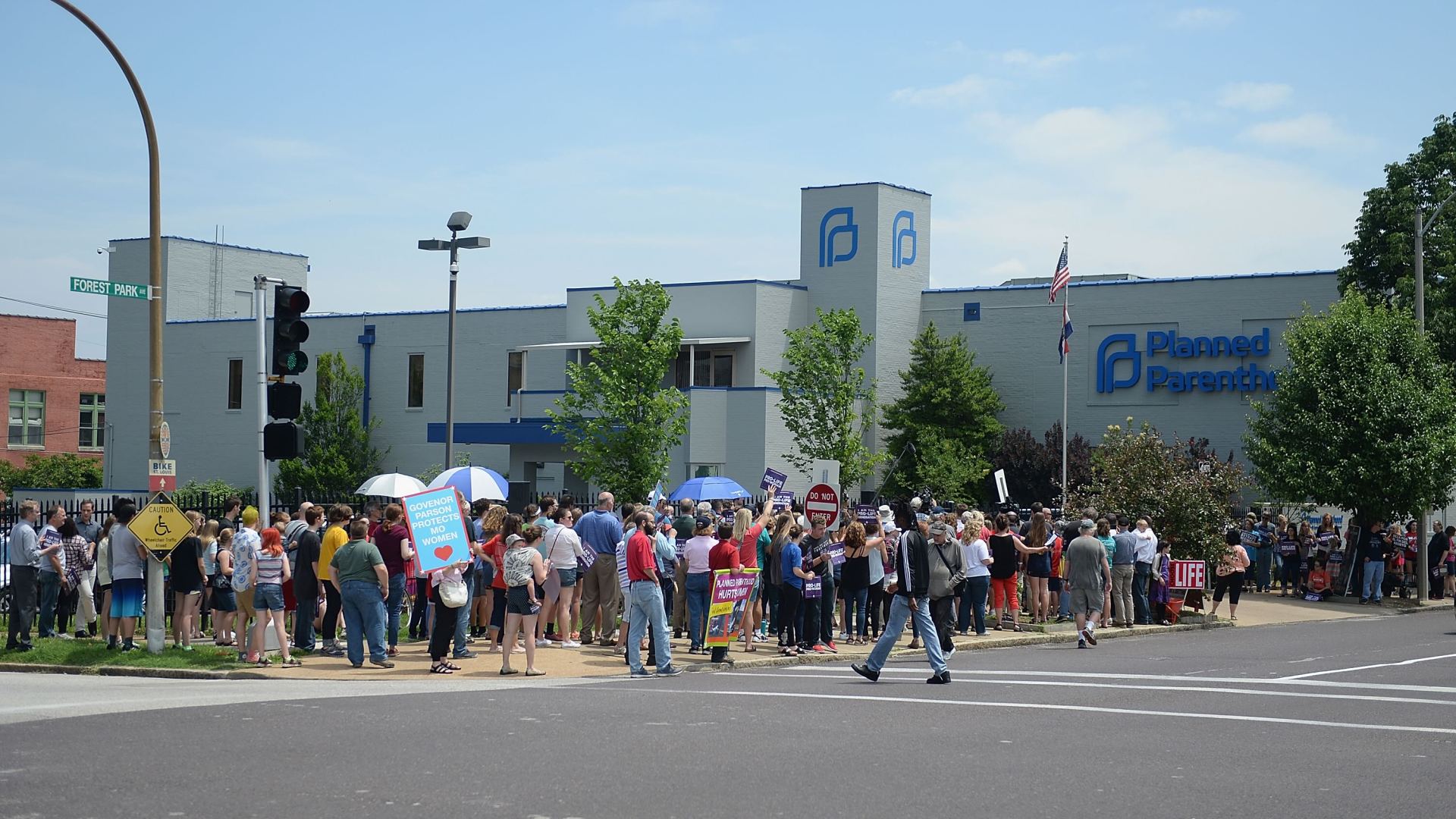
Federal Convictions of Pro-Lifers Blocking Clinics Are Rising

Six more protestors received guilty verdicts this week and face more than 10 years in prison. Prosecutors are using a charge that has prompted a new legal debate.

Pro-life protestors gather outside a Planned Parenthood clinic in Missouri in 2019.

Pro-life protestors gather outside a Planned Parenthood clinic in Missouri in 2019.

Christianity Today February 2, 2024
Michael B. Thomas / Getty Images

Update (May 17, 2024): Eight pro-life protestors were sentenced this week in connection to a blockade of a Washington, DC, abortion clinic. Lauren Handy, the leader of the operation, received a nearly five-year sentence (57 months), the longest of the sentences.

Jonathan Darnel, who remained outside the clinic livestreaming the blockade, received a nearly three-year sentence (34 months). The others in the case received roughly two-year sentences, and one, Jay Smith, the only one who had pleaded guilty, received a 10-month sentence. They have been incarcerated since their convictions last year.

After sentencing, all of the defendants except Smith immediately appealed their convictions to the DC Circuit Court of Appeals. Sentencing for six protestors in Tennessee convicted of similar charges, including the civil rights violation that is resulting in longer sentences for these protestors, is set for July 2.

————

A growing number of federal prosecutions and convictions of pro-life activists is prompting a new legal debate that their attorneys hope will go to the Supreme Court. This week, six pro-life activists were convicted of federal crimes in Nashville for demonstrating outside a clinic in early 2021.

In the wake of Dobbs v. Jackson Women’s Health Organization, the Justice Department increased prosecution of pro-life protestors outside of abortion clinics. Those cases included both peaceful protestors and those who were obstructing clinic entrances, which is a violation of the federal Freedom of Access to Clinic Entrances (FACE) Act.

More than a dozen protestors have now been convicted of federal crimes in the last year, and face sentences of more than 10 years. Eight more face trial in Michigan in April. Those criminal prosecutions were rare before 2021, with one or two cases annually for the past decade.

The six activists convicted in Tennessee this week argued they demonstrated peacefully, saying they were singing hymns and praying in a medical pavilion hallway outside the clinic. A police officer testified at the trial that the protestors were peaceful, according to The Tennessean, but they refused to leave. They were convicted of “obstructing access to reproductive health services.”

Some activists’ stated goals are to physically block women from having abortions by obstructing entrances, while others hope that their peaceful presence outside a clinic would convince those seeking abortions to make a different choice.

The FACE Act doesn’t clearly distinguish between types of activism outside clinics: It covers those who attempt to injure, intimidate, or interfere with anyone at a place “providing reproductive health services.”

The protestors face longer prison sentences than in the past because prosecutors have added a civil rights conspiracy charge to the most recent batch of cases, which carries a maximum 10-year sentence.

“This ‘conspiracy to violate civil rights’ [charge]—it’s a new strategy the DOJ is using,” Calvin Zastrow, one of the pro-life protestors in Tennessee who is a Christian, told CT shortly after his conviction this week. He faces an 11-year sentence, but unlike defendants in other FACE cases, he and others in his case were not immediately taken into custody.

Zastrow has participated in many demonstrations at clinics over the years and said charges were usually “just trespassing or disturbing the peace or disorderly conduct.” He argues that abortion is the violent act: “We are the peacemakers.”

Former federal prosecutor Ed Mechmann, in a blog post on the pro-life protestors’ convictions, described the civil rights conspiracy charge as a “prosecutor’s best friend” because it allows prosecutors to charge a wide range of people—even those who may not have participated—with conspiracy.

“This creates a huge disadvantage for minimal participants,” he said. “You may have thought that you were agreeing to something peaceful, but you’re still legally responsible if one of your cohorts committed an act of violence.”

In August and September 2023, eight protestors were convicted of civil rights conspiracy and FACE violations for an incident at a DC abortion clinic in 2020. Some members of the group forcefully entered the clinic and blockaded it, and prosecutors said the forceful entry caused a nurse to stumble back and sprain her ankle. Their sentencing is in May, and they have been incarcerated since their convictions.

One of the eight convicted in DC, Jonathan Darnel, faces the same maximum sentence of 11 years, though he remained outside the clinic and livestreamed the incident.

“FACE was designed to break up pro-life civil disobedience,” said Darnel in a text message with CT soon before his incarceration. “And it succeeded in doing that.”

In June 2023, a Franciscan friar was sentenced to six months in prison for obstructing the entrance to an abortion clinic. Though he has protested at clinics in the past, this was his first FACE conviction.

Pro-life attorneys have criticized the Department of Justice for one-sided prosecution of FACE, when pregnancy centers in 24 states have been vandalized or set on fire. Perhaps in response, in 2023 the DOJ filed FACE Act and civil rights charges against four individuals in Florida for a 2022 attack on a pregnancy center.

Those pro-choice defendants, like the pro-life protestors, face more than 10 years in prison because of the civil rights conspiracy charges. The jury trial for that case is currently slated for March.

Attorneys for the pro-life defendants plan to appeal to higher federal courts but must do so after sentencing. They want to challenge the use of the civil rights conspiracy charge as well as the validity of FACE prosecutions post-Dobbs. National pro-life groups are watching these cases too, though clinic blockades are not a strategy they engage in.

“We will watch this through the appeals court and possibly to the Supreme Court,” Steven Aden, chief legal officer and general counsel at Americans United for Life, told CT. “Our legal team is considering filing a brief on their behalf.”

Aden thinks that federal courts might not have jurisdiction to enforce FACE after Dobbs.

“Federal criminal law constitutionally only exists to enforce federal interests,” he said. “Consequently, every federal prosecution has to have a federal hook—a constitutional right that’s been violated, such as the right to vote, or the violation of a federal statute. You have neither here. You have no federal constitutional right to abortion after Dobbs, and there is no federal statute that grants a woman a right to abortion.”

Mechmann, the former prosecutor, argued that for the convicted DC protestors’ case, at least, abortion is legal by statute in DC, a federal district.

“Access to a clinic is also guaranteed under federal law. So anyone who blockades an abortion clinic denies a person of a right ‘secured … by … the laws of the United States,’” he wrote. “The Supreme Court’s decision in Dobbs, which held that there is no right to abortion in the US Constitution, is entirely beside the point.”

In the DC protestors’ case, Judge Colleen Kollar-Kotelly issued a 10-page opinion that addressed the inclusion of the civil rights conspiracy charge, saying it protected federal rights established by the FACE Act. She said Dobbs did not have any impact on the case.

One protestor who pleaded guilty to participating in the DC clinic blockade was sentenced to 10 months in prison. Mechmann estimates that those without previous convictions will get sentences of less than a year to potentially two years. But many participating in these blockades have a previous record for these types of actions. The protestors believe it is nonviolent direct action akin to the civil rights movement.

These groups call these tactics “rescues,” which originated with Operation Rescue’s sit-ins at abortion clinics in the 1980s. Operation Rescue participants had to pledge nonviolence, but more extreme pro-life activists’ violence toward abortion providers, including the killing of an abortion provider in 1993, led to the passage of the FACE Act the following year.

“You can only hold a gun or a cross, and we’ve chosen to take up a cross,” an Operation Rescue staffer, Rev. Jim Pinto, said in 1993, condemning the violence against abortion providers.

Clinic blockades declined after passage of the FACE Act, and local buffer zone laws also prevent activists from congregating near clinic entrances. Most pro-life activists outside clinics now focus on praying instead of blocking women from entering, but the number of activists at abortion clinics has been growing during the last few years.

One currently in detention for the DC incident is Joan Bell, 74, who has been arrested at clinics many times over the years and is considered one of the originators of this type of “rescue” activism. Her son, Emiliano Bell, attended the federal trial of the Tennessee protestors this week.

“Even though she was in jail more than 200 times in her lifetime, I was a child and it didn’t really hit me,” he said. “This last conviction—when I heard she might get 10 to 11 [years]—it was really hard.”

News

Report: Myanmar’s Military Is Destroying Churches in Chin State

Local Christians and rights groups believe the targeting is deliberate in the Buddhist-majority country.

Damage to the interior of Khuafo Baptist Church from a claimed airstrike.

Damage to the interior of Khuafo Baptist Church from a claimed airstrike.

Christianity Today February 2, 2024
Courtesy of Verification by Myanmar Witness

Last August, a Myanmar Air Force fighter jet dropped two bombs on the village of Ramthlo in Myanmar’s Chin State. One bomb hit the spacious Ramthlo Baptist Church, blowing a gaping hole through its roof and covering the wooden pews with dust and debris. The other bomb damaged nearby houses, injuring seven people.

The bombings were originally reported by Khit Thit Media, one of the few independent news outlets in the country, and the nonprofit Myanmar Witness recently verified the attack using geolocation and digital data collection. The investigation confirmed claims that churches in Myanmar’s majority-Christian Chin State have faced extensive damage amid the current civil war.

This January, Myanmar Witness (a project of the UK-based Centre for Information Resilience) published a report analyzing 10 claims of physical damage to Chin churches between March and August 2023, most of which involved airstrikes. All of the incidents occurred in areas under martial law.

The Myanmar military has destroyed at least 107 religious buildings, including 67 churches, in Chin State since the military coup began nearly three years ago, according to the Chin Human Rights Organization. Elsewhere in the country, the destruction of houses of worship, including Buddhist temples and churches, is also growing. In mid-January, junta soldiers burned down a 129-year-old Catholic church in Sagaing Region.

While the Myanmar Witness report did not comment on whether the military is deliberately targeting churches, Chin Christians and rights activists believe it is. They claim the government sees churches as a symbol of Christian identity, a sanctuary for the resistance, and a haven for the displaced.

“The military pilots feel so free to attack churches … because we have practiced a religion different from theirs,” said a Chin Christian scholar who asked not to be named due to security concerns. “There is a long history of religious persecution against us.”

Ethnic minorities in Myanmar, including the Chin, have long fought with the military junta, desiring increased autonomy for their communities. At the same time, Buddhist nationalism is deeply ingrained in the country; former Burmese prime minister U Nu famously touted the idea that “to be a Burmese is to be a Buddhist” in 1961.

This ideology resulted in the ethnic cleansing of the Muslim Rohingya people, killing thousands and forcing 700,000 to flee to Bangladesh. Buddhists make up 88 percent of the population, while 6 percent of Myanmar is Christian and 4 percent is Muslim.

Although Myanmar started to open up and become increasingly democratic in 2010, in 2021, the military overthrew the elected government, setting off an ongoing war that pitted the well-funded Myanmar military against the People’s Defense Force (civilian militias) and ethnic armed groups. Yet since late October, the tide seems to be turning as three ethnic armed groups have started to gain control of towns in the country’s north, west, and southeast, stretching the military’s capacity.

The Myanmar Witness report conducted five in-depth case studies (four Baptist and one Presbyterian church) to assess damage to churches in Chin State. Some of the cases included claims of multiple churches in the same town being bombed by airstrikes, damaging windows, roofs, and sanctuaries. Others included claims that government troops ransacked and looted churches following the air attacks.

It concluded that the attacks in all five case studies could be verified, indicating a wider impact on the cultural and religious landscape of Chin State. “The examples analyzed in this report reflect the degradation of Myanmar’s built environment, including sites with special protections under international law during armed conflict,” the report read.

The group also analyzed data from the Armed Conflict Location and Event Data Project, which collects information on violent conflicts around the world, and found 28 reports of damage to churches in Chin State between 2021 and 2023.

It also found that while in 2021–2022 churches were reportedly mostly damaged by arson and artillery attacks, in 2023, airstrikes were allegedly involved in most of the cases: “The Myanmar Air Force (MAF) maintains overwhelming air superiority across Myanmar, supporting the claim that the Myanmar military is responsible for the alleged airstrikes.”

“Airstrikes were pretty rare in Burma until about 2012, and they were mostly focused on the Kachin [ethnic group] … but then after the coup they have gone everywhere in Burma,” said Dave Eubank, director of the Christian humanitarian service movement Free Burma Rangers.

Eubank, who has worked extensively in the largely Christian state of Karenni, noted that their churches have also been targeted. “Just about every church I’ve seen in Karenni State has been either destroyed, burned, or hit by small arms, fire, airstrikes, and mortars,” he said. “Over 100 churches up here [have] been destroyed since the coup, it’s systematic destruction.”

He noted that before the coup, attacks on churches were “episodic” and depended on the military commander. Now, the churches are “deliberately attacked, bombed, and destroyed.”

Another factor as to why the military targets churches is that houses of worship are seen as providing shelter or assistance to resistance groups, Salai Mang Hre Lian of the Chin Human Rights Organization told the Associated Press.

“[The attacks] send a powerful signal to all civilians that even in places protected by international humanitarian laws, if they support non-junta groups, they will be targets,” he said.

David Moe, a lecturer of Southeast Asian studies at Yale University, said the fighting in Chin State is so intense because after the coup, the Chin were one of the first groups to resist the junta.

Church buildings have become a target because they “symbolize Christian identity,” which bristles against Buddhist nationalism, said Moe, who grew up in Chin State. Also, “the church has become a place to house refugees or internally displaced people,” Moe said. “The military is trying to stop people [from] joining the resistance and is trying to cause them to fear ordinary church people.” He said the military fears refugees would be more open to Christianity, which they consider to be Western.

Chin Christians are now among the millions displaced by the war, said the Chin scholar. Many live in camps on the border of Chin State as well as in Mizoram in northeast India.

“The military can destroy the church as the building, but the military cannot destroy the body of Christ,” Moe said. “Christians gather together at private houses like the early church did—quietly trying their best to worship. They might use Zoom or gather in the jungle.”

Eubank sees a similar story playing out in Karenni State. While the deliberate targeting of churches aims to deter people from participating in the resistance by causing fear, chaos, and confusion, there is hope and life among the persecuted and displaced believers.

“Christians don’t give up,” Eubank said. “We just had a church service [in a Karenni refugee camp] yesterday. … The first thing they do is build a church, which is also the school during the week, and they’re praying all the time. There’s going to be a wedding today among our team leaders here in a displaced community. They don’t give up praising Jesus.”

Culture

‘The Chosen’ Sets Its Face Toward Jerusalem

Season 4 of the popular Jesus show, now in theaters, takes a turn for the serious. CT reports from its premiere and press junket in LA.

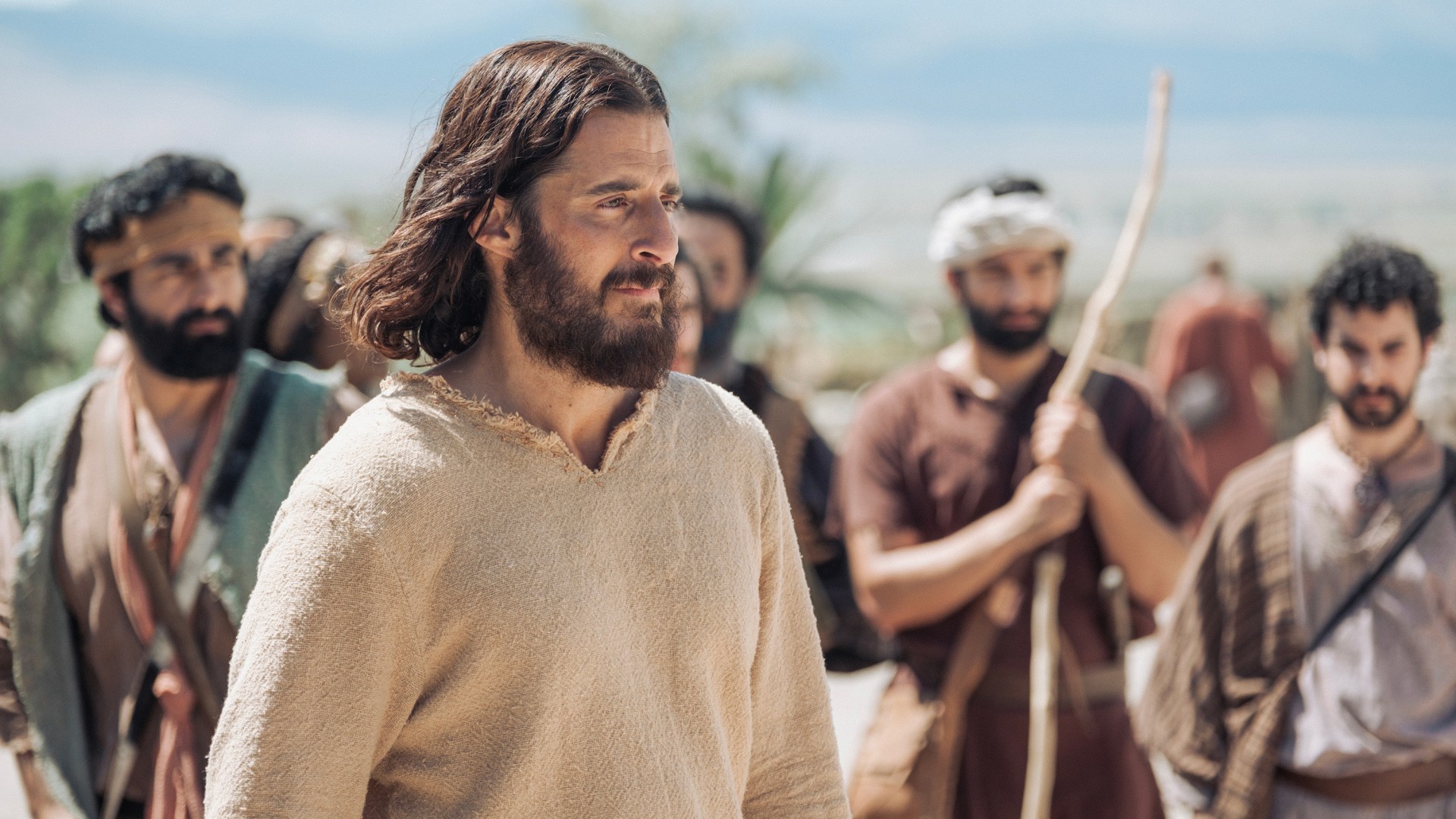
Jesus, played by Jonathan Roumie, and the disciples in The Chosen season 4.

Jesus, played by Jonathan Roumie, and the disciples in The Chosen season 4.

Christianity Today February 1, 2024
Courtesy of The Chosen

There’s a moment in season 4 of The Chosen—coming to a theater near you on Thursday, February 1—in which Jesus (Jonathan Roumie) steps outside for a moment. Some of the disciples are bickering over some trivial matter or other, and Jesus finds himself alone with Little James (Jordan Walker Ross) and Thaddaeus (Giavani Cairo), the first two men who followed him.

By this point in the story, Jesus has been dealing with all sorts of issues. He has received some very bad news about his cousin John the Baptizer (David Amito); his disciples are competing for status within his movement; the movement itself has attracted thousands of followers, critics, and onlookers thanks to the sermons and miracles that Jesus has performed; and now, his opponents are turning into outright enemies as verbal arguments start shifting into physical violence.

In the midst of all that, Jesus quietly sits down with James and Thaddaeus and asks if they can remember what it used to be like when it was just the three of them, hanging out together. “Do you ever miss those days?” he asks.

It’s hard not to see an element of autobiography from series creator Dallas Jenkins and his collaborators. Like the nascent Christianity it depicts, The Chosen has grown by leaps and bounds since the first four episodes were released online just in time for Easter 2019.

The first big leap came in the early days of the COVID-19 pandemic, when the producers made the series available for free. It was supposed to be a temporary measure to help people get through lockdowns and self-isolation, but the showrunners found that the “pay it forward” donations from the show’s fans surged so quickly they could keep the show free indefinitely. (It is now funded through charitable donations made to the Come and See Foundation.)

After finishing the second season in 2021, the producers began experimenting with theatrical releases, starting with a Christmas special that year and continuing with the season 3 premiere in 2022 and the season 3 finale in February 2023. Altogether, including another Christmas special that came out this past December, The Chosen’s theatrical releases have grossed about $38 million so far. Some episodes have done better in North America than would-be blockbusters and Oscar contenders that came out at the same time.

Along the way, the show became a big hit on Netflix, Amazon Prime, The CW Network, and other platforms that licensed it, and the show’s lead actors lent their stardom—niche though it may be—to faith-based hits like Jesus Revolution and The Shift.

Season 4 will be the show’s boldest experiment yet. Every episode will premiere in theaters: the first three on February 1, three more on February 15, and the last two on February 29. (The first installment will run for about 3 hours and 20 minutes—longer than Oppenheimer, but shorter than Killers of the Flower Moon.) It’s the first time an entire season of a television show has ever debuted on the big screen.

But along with that success and support from the show’s fans, The Chosen has had growing pains too. Some plot twists, like Mary Magdalene (Elizabeth Tabish) suffering a relapse of sorts in season 2, have been controversial. A “reverse psychology” ad campaign—in which billboards depicting Jesus and the disciples were “vandalized”—backfired. And every trailer and behind-the-scenes video has been scrutinized for questionable elements, from an LGBTQ pride flag used on-set by one of the camera operators to the theology behind some extrabiblical lines of dialogue.

So as The Chosen’s Jesus and others look back and marvel at how big and unwieldy their movement has become since its humble beginnings, it’s tempting to think that the filmmakers are writing some of their own experiences into the show.

But Jenkins, who has talked in the past about the real-life influences on his show, says any similarities on this front are purely unintentional. Speaking to Christianity Today on the eve of the show’s “teal carpet” premiere in Los Angeles, he says the story is shaping the Chosen phenomenon and its stewards more than they are shaping it.

“I think it’s less us imbuing some of that into the show, and it’s more the show imbuing some of that into us,” he told CT. “I think we actually end up trying to live out some of the lessons we learn from the show as we tell the story. My wife always says, ‘We’re not free from the lessons of each season,’ and so I do think that what’s happening in the season is impacting us.”

“There could be some subconscious stuff coming in,” he added, “but we’re not intentionally going, ‘Ooh, as Jesus’ ministry exploded; the show’s growing as well; so let’s talk about it in that way.’ I think it’s kind of come via happenstance.”

Noah James, who plays the disciple Andrew, seemed more open to the idea that art might be reflecting life in this case. “We really had no idea where this show was headed,” he told CT. “We hoped, but even in our wildest imagination, we did not think that we would be here, speaking to you today, about releasing season 4 in theatres. That was not even on the radar.”

“And I think similarly, in the show, we as the disciples are doing the best we can to, you know, keep the roof on the house. We don’t know how it all is going, but it gets very, very scary, especially in this season, because as the movement becomes bigger, it attracts attention—sometimes perhaps unwanted attention—and you see the disciples struggle to deal with it.”

Season 4 marks a significant turning point for the series. Jenkins has said for a while that the show will run for seven seasons, so season 4 is the middle point, the part where all the emotional highs of the previous seasons—the feeding of the 5,000 and the walking on water—give way to a growing sense that things could go very badly for Jesus and his followers.

With that darker, more ominous turn in the story, the show takes a deeper dive into the emotions of its characters—emotions that resonate all the more because viewers have now spent almost five years getting to know these people. And one of the most deeply affected characters, of course, is Jesus himself.

One of The Chosen’s most daring choices is how it has leaned into Jesus’ humanity, inventing page after page of dialogue for him that has no clear source in the Gospels, while also affirming his divinity.

On the one hand, the Jesus of this series has casually talked about how the creation of the world is “a favorite memory” of his. But the show also treats him as a regular person with an ordinary interior life. He gets quite vulnerable at times and occasionally feels the need to process what he’s going through.

One episode in this season begins with Jesus waking from a dream, and for a moment, it’s like we’ve been given a glimpse inside his mind. At another point, while contemplating the suffering that is to come, Jesus leans on someone for emotional support—and the person he turns to is not whom you might expect. And when The Chosen gets to Lazarus’s tomb and the famously short verse that says Jesus wept (John 11:35), the Jesus of this series doesn’t just shed a dignified tear or two. He falls to his knees and practically sobs.

Jenkins admitted he’s getting into “dangerous waters” by putting the audience “inside Jesus’ head,” “because how can you ever fully do that?”

But he insisted it’s all part of a healthy exploration of what it meant for the divine to become human, and for the Creator to become Immanuel, “God with us” (Matt. 1:23). “It’s not God above us while he was here,” said Jenkins. “He was with us. He dwelt among us. He danced with his friends at weddings, and he had dreams, no doubt, and he got sad. We see him sad in Scripture, and so I think it’s interesting to explore why.”

Roumie—who first played Jesus in short films made by Jenkins before they worked together on The Chosentold CT it’s important to show Jesus experiencing all of these things because it is the full humanity of Jesus that connects us to him and allows us to relate to him and his ability to empathize (Heb. 4:14–16).

“He knows exactly what it’s like to be human, because he was fully human,” Roumie said. “So he would go through all the things that humans go through: dreams, laughter, crying, and feeling pain, frustration, anger—righteous anger, in his case, obviously—but, you know, frustration with people not taking him at his word and believing him and hearing him. He must have dreamt. He must have done all those things that we do.”

There’s a long-standing debate on how much Jesus knew about the future during his time on earth, and that question takes on new urgency in The Chosen as certain plot twists put new strains on the relationships within the Jesus movement. Does the Jesus of this series know that those twists are coming?

“There’s going to be a lot of questions about that,” admitted Jenkins, who added that he and Roumie have tended to “mix and match” when deciding how often God the Father “granted Jesus knowledge of certain things.”

“In fact,” Jenkins told CT, referencing Matthew 24:36, “Jesus said, There are some things the Father knows that I don’t know. So we’re comfortable in that tension.”

Still, as serious as the story turns this season, there’s also a lot of joy to be had—at times, you can feel the fun the actors are having. Nowhere is this more evident, perhaps, than in a scene where some of the disciples play actors themselves, putting on a skit for the other disciples that re-enacts the events celebrated every year at Hanukkah.

Jenkins said the levity in scenes like this, which might not seem central to the show’s purpose, help lay the groundwork for the show’s more serious parts.

“We love to show these personal moments, these human moments, these fun moments, that in many ways are the calm before the storm,” he explained. “And we feel like when you know Jesus more—and you know these people more, and you spend time with them even in their fun moments that have little to do with their ministry—then when they do experience the big things, it makes it that much more impactful.”

So, what comes next?

Three more seasons, for starters. The Gospels don’t say exactly how long the earthly ministry of Jesus lasted, but it’s traditionally thought to have been about three years, and The Chosen has already been airing two years more than that. “We’re racing against time to make sure our actors don’t look like they’ve aged a decade!” joked producer Chris Juen.

Jenkins has floated the possibility of making a theatrical movie during one of The Chosen’s future seasons instead of simply repackaging existing episodes for the big screen. And both Jenkins and The Chosen’s president of production, Mark Sourian, have talked about telling more stories set in “the Chosen universe.”

For now, those are just ideas, and it’s too early to say where any of them might lead. But the series’ open future is itself reminiscent of another scene in season 4, in which Little James ponders all that has happened.

“None of us could have dreamed where all this was headed,” he says to Mary Magdalene.

“We still can’t,” she replies.

Peter T. Chattaway is a film critic with a special interest in Bible movies. He lives with his family in Abbotsford, BC, Canada.

Church Life

God Called Him to Preach with a Broken Heart

Preaching legend and longtime professor Robert Smith Jr. is retiring after years of scholarship, accolades, and personal loss.

Robert Smith Jr.

Robert Smith Jr.

Christianity Today February 1, 2024
Courtesy of Beeson Divinity School

A student at Beeson Divinity School once came to preaching professor Robert Smith Jr. in tears. The young man’s fiancée had returned the ring to him and called off their engagement. Smith cried with him. Then he made the student preach his scheduled sermon that day in class.

“I told him ministry is like that,” Smith said. “You can’t cancel a sermon” and say, “I won’t preach today because my heart is broken.”

It’s a lesson Smith has learned well through his own tragedies. He has performed the funerals of one wife and two sons, yet he keeps preaching.

Over his decades in ministry, the 74-year-old has trained classroom after classroom of aspiring pastors to proclaim the Word and earned acclaim for his powerful example. He preaches in the traditional African American exhortation style with a rich array of theological and cultural references sprinkled in. His sermons always center on a biblical text.

Beeson’s founding dean Timothy George said Smith “once wanted to become a professional baseball player, and he preaches like a great shortstop: agile, athletic … musical, and strategic, poetry in motion.” He recalled seeing him “stride an entire pulpit in an exuberant pulpit moment.”

Smith serves as the Beeson’s Charles T. Carter Baptist Chair of Divinity, and the school named its preaching institute for him.

He has spoken at 135 colleges, universities, and seminaries worldwide along with churches from a slew of major US denominations. His book Doctrine That Dances was named the 2009 Preaching Book of the Year by CT’s Preaching Today. Smith received a living legend award in 2017 from the E. K. Bailey Expository Preaching Conference, a prestigious honor among African American pastors.

Dean Douglas A. Sweeney called him “one of the most influential preachers and teachers of preaching in the world,” yet he’s also known for investing in students so much that “hundreds around the world count him as a spiritual father.”

Upon his retirement the end of this semester, Smith will launch a new chapter in his ministry journey. Yet he will remain a popular preacher characterized by joy and shaped by tragedy.

From Cincinnati to Louisville

Four decades ago, it seemed unlikely Smith would become a preaching legend. He was pastor of New Mission Baptist Church in Cincinnati, the father of three young boys, headed back to school for his bachelor’s degree at Cincinnati Bible College.

Smith was one of the college’s only African Americans, and the registrar once suggested he should “go to one of your own schools.” But he persevered.

Then the bottom fell out in early 1984. His wife, Gayle, who had lupus, caught a cold she couldn’t shake. Eventually, she went to the University of Cincinnati Hospital, where a doctor said she would be fine. Smith left the hospital on a Sunday morning to preach before returning with some clothes for Gayle to wear home.

That afternoon her hospital room was empty. A nurse said Gayle had been taken to ICU with seizures. A week later she died. Smith preached her funeral from Ezekiel 24, where the prophet’s wife died and God told him to continue preaching.

Courtesy of Beeson Divinity School

The big question was “Can you go on and preach the message that God has given you even though your heart is broken?” Smith said.

He could.

Smith graduated from college two months later, continued pastoring in Cincinnati, and earned a master of divinity degree four years later from Southern Seminary in Louisville, Kentucky. Amid his educational journey, he married his second wife, Wanda, who remains by his side 38 years later.

In 1993, he earned a PhD in homiletics from Southern and immediately was given a position as associate professor of preaching by the administration of Albert Mohler, then in the controversial first year of a presidency focused on turning the seminary back to its conservative roots.

For a year and a half, Smith was a full-time pastor and a full-time professor, driving the 254-mile round trip from Cincinnati to Louisville hundreds of times. “I know the road from Cincinnati, Ohio, to Louisville,” he said. “I can drive it with my eyes closed.”

In 1997, Smith ended his 20-year pastorate at New Mission Baptist, feeling released to leave once the congregation’s mortgage was paid off. Now focused fully on teaching, he began to pile up awards, honors, and speaking engagements. He led Southern’s preaching department, wrote curriculum for African American doctor of ministry students, and was on track to receive tenure.

Smith even planned to be buried at Louisville’s Cave Hill Cemetery, where Southern Seminary legends James P. Boyce, John Broadus, and A. T. Robertson have their graves (along with the graves of KFC founder Colonel Harland Sanders and boxing legend Muhammad Ali).

‘My students became my parishioners’

But God wouldn’t let Smith coast through the rest of his academic career. In 1997, he received a call from Beeson, the divinity school of Samford University in Birmingham. Established in 1988, Beeson was less than a decade old, and its success was not assured. When Wanda advised him to give Beeson a résumé in case God was up to something, he replied, “I don’t want God to be up to anything.”

Nonetheless, Smith said, he was. Smith accepted the call and has been teaching there 27 years—commuting between Birmingham and Cincinnati the whole time. Smith’s chief legacy at Beeson has been caring for students. He meets individually with each of his students each semester. Often he marries them. Sometimes he buries them.

“I asked the Lord to let me pastor again,” he said. But “the Lord said no,” and “my students became my parishioners.”

Beeson’s interdenominational atmosphere fits well with Smith’s theological affinities. The school’s professors and students are Baptist, Methodist, Anglican, and Presbyterian, along with a sprinkling of other denominations. Smith says he won’t compromise on doctrinal essentials, but he is at home in various theological camps.

He has friends with different views of female pastors, baptism, church polity, and social ministry.

“People hold things that are different from me that are nonessential, and it’s okay,” Smith said. “I baptize people through the mode of immersion. Presbyterians don’t. We’re not going to split, in terms of fellowship, over that. It’s not essential. Whether you baptize in the Pacific Ocean or pour some water over their head,” in “all things there must be charity.”

Uncharted waters

Tragedy continued to follow Smith through his journey at Beeson. His son Tony was murdered in 2010 during a failed robbery at the restaurant where he worked. Tony’s death helped inspire Smith’s 2014 book The Oasis of God: From Mourning to Morning, Biblical Insights from Psalms 42 and 43. Last year, his son Bobby succumbed to cancer after a 15-year battle. Smith preached both funerals.

George said Smith’s preaching has been shaped by tragedy.

“Robert has lived in the depths,” George said, “and he preaches out of the depths.”

Enduring tragedy isn’t a badge of personal honor, according to Smith. He sees it as a badge of honor for Christ alone.

“It wasn’t a matter of trying to be heroic and trying to show people how strong I was,” he said. “I wasn’t strong, and they knew that. But they got a chance to see God demonstrate his power through a weak vessel.”

Smith’s spiritual endurance through tragedy is due, at least in part, to what George calls his “inscripturated soul.” Smith is known to quote lengthy Bible passages from memory during sermons. Long car rides together have given George a front-row seat to Smith’s knowledge of the Bible.

“Sometimes we will be traveling along in the car, and he will just start singing Scripture,” George said. “While we travel maybe 40–50 miles, he will just be singing Scripture over and over again. I think it’s in the deepest level of his soul.”

At Beeson, Smith brings a fishbowl to preaching class, filled with papers listing challenging Bible passages. Students each draw a passage, then preach on the text they draw.

In retirement, Smith plans to do something similar: accept whatever new challenges he draws and keep preaching the Bible.

“I am sailing uncharted waters,” he said. “It’s really exciting to see what God is doing. I’m more excited and more passionate than I have ever been before in ministry.”

David Roach is a freelance reporter for CT and pastor of Shiloh Baptist Church in Saraland, Alabama.

Church Life

How Doubt Derailed a Train Town

After a major chemical spill in Ohio, disagreement tore close-knit East Palestine apart. Local churches are working to heal the ravages of mistrust.

Illustration by Israel G. Vargas

In East Palestine, Ohio, days after last year’s train crash and subsequent burning of more than 100,000 gallons of toxic chemicals, 14-year-old Jameson Kenneally noticed that his family’s chickens were producing wrinkled eggs. They live three miles from where the chemicals ignited. His mom, Jamie Kenneally, explained to him that the eggs could be wrinkled for a variety of reasons. Maybe it wasn’t the chemicals. After all, their chickens had been through a stressful experience.

On February 3, 2023, a Norfolk Southern train derailed just outside of town, near the Pennsylvania border. Twenty cars carrying hazardous chemicals—vinyl chloride (the most alarming), ethylene glycol, ethylhexyl acrylate, butyl acrylate, and isobutylene—caught fire and spilled into a nearby stream. The chemicals were heading from Texas to a plastics factory in New Jersey, according to The New York Times, a journey of around 1,600 miles. That meant what happened in East Palestine could have happened anywhere.

After the chemical fire burned for three days, local officials decided to drain and detonate the remaining substances in a “controlled release” to prevent a larger explosion. A flurry of police went door to door in the town of 5,000, telling people to leave, and the Kenneally family evacuated.

At first they slept in the youth room of Bethel Evangelical Presbyterian Church in nearby Enon Valley, Pennsylvania, where Jamie’s husband, Steve Kenneally, is a pastor. Eventually, they retrieved their chickens and relocated with them to a friend’s house, after police announced that it might be days before they could return home.

The burn-off created a chemical cloud that was visible for miles—an indelible memory for residents who evacuated against a backdrop of towering flames and smoke. When I visited East Palestine, seven months after the derailment, people pulled up pictures on their phones, ready to show me the inferno from that night.

It’s a beautiful town on the edge of Appalachia, not far from the Rust Belt cities of Youngstown and Pittsburgh. Surrounded by rolling hills and farms, East Palestine’s downtown is densely built. The train tracks run right through the middle, with homes on both sides. Everyone’s thankful the derailment happened on the east side of town instead of there, where it could have killed people.

The fire coated the Kenneallys’ windshield in some kind of residue, which meant everything on their property must have been coated. So they got their well tested. The test found no detectable contaminants, but they weren’t sure if they had even tested for the right chemicals—at the time, people in East Palestine didn’t know what chemicals were on the train or what other compounds had been released by the burn. They weren’t sure of anything. The Kenneallys bought a water filtration system and air purifiers for extra peace of mind.

Uncertainty was a theme over and over in my interviews with East Palestine residents in fall 2023. No one knew what exactly had happened to their town. Was the water safe? Were officials lying to them? Were neighbors faking symptoms to get payouts from the railroad company? If they wanted to leave, could they sell their homes? If they stayed, would they get cancer? Could their children play in the park? Was it all overblown?

Disasters often bring a community together. But in East Palestine—a place where families go back generations—the opposite is happening. All the unknowns have divided neighbor against neighbor, churchgoer against churchgoer, husband against wife.

Community conflict was the first thing anyone brought up with me about the derailment. In a local store, one woman told me bluntly that anyone still anxious about the crash could just move. Some residents didn’t want to be interviewed for fear of being seen as on one side (“Everything is fine”) or the other (“Our town is ruined”) of the social divide. Conflict spilled into—or perhaps was encouraged by—comments on social media. When a news story appeared on Facebook announcing that testing for a particular chemical was no longer necessary, someone posted, “Everybody can be totally hooray for this good news!” Someone else responded, “Bulls—.”

In the months after the crash, it was unclear for many whether life could or even should return to normal. Trains had resumed running through town five days after the derailment, and at times they barreled past roughly every 15 minutes. Some people were going about their ordinary lives, clocking in at work or attending high school football games. Others couldn’t return to their homes in town without nausea, headaches, and sore throats.

Were they imagining it?

Relationships were strained over disagreements over such questions, because East Palestine was in a knowledge crisis. Foreign actors even contributed: Russian social media accounts parroting Kremlin talking points circulated ideas that US officials were hiding the impact of the crash and that the government was giving aid to Ukraine but not Ohioans. The head of the Federal Emergency Management Agency, Deanne Criswell, said that the spread of misinformation after disasters like East Palestine is a “new threat landscape. … Our adversaries know when we are most vulnerable and know how to take advantage of those times.”

If a knowledge crisis could devastate relationships in a close-knit community like East Palestine, the kind of place where locals can reel off the name of every business owner in town, what could it do elsewhere in the United States?

When I was in town, trucks were constantly rolling in and out, bringing cleanup equipment or carting away contaminated soil. By that point, Norfolk Southern had removed more than 88,000 tons of hazardous waste and collected 28 million gallons of hazardous water from above and below ground. The company estimates that it has spent about When I was in town, trucks were constantly rolling in and out, bringing cleanup equipment or carting away contaminated soil. By that point, Norfolk Southern had removed more than 88,000 tons of hazardous waste and collected 28 million gallons of hazardous water from above and below ground. The company estimates that it has spent about $1 billion on the cleanup so far. billion on the cleanup so far.

Less than a month after the derailment, Ohio declared the tap water safe and the Environmental Protection Agency (EPA) said it wasn’t finding contaminants in homes. But many residents could not shake the uneasy sense that they were still living in a disaster zone.

At the time I visited, Norfolk Southern had a secure perimeter around the cleanup area, and a key local road remained closed. Small things became points of tension, like whether one’s children played in the town park. One of the cleanup sites was a contaminated creek that ran through the park. Some parents kept their children away; Jameson Kenneally didn’t compete in his usual tennis season there because the park courts were close to the creek. But other parents made a point to take their children to the park to indicate that everything was fine—to show that the town was “East Palestine Strong,” as some yard signs read.

Local businesses struggled after the derailment. Some business owners told reporters they were treated like villains simply for marketing themselves and trying to draw customers back to East Palestine. Meanwhile, there were constant meetings about the derailment: city council meetings, meetings with lawyers, meetings with the railroad, cable news town halls. And in a place where the COVID-19 pandemic had already fostered distrust of government officials, suspicion of authorities compounded the inability to fully understand the disaster.

So those meetings sometimes boiled over. When Ohio’s top health official, Bruce Vanderhoff, met with residents soon after the derailment to discuss what, besides the derailment, might be causing health symptoms, they rebuffed him. “I don’t know what to do to provide further assurances,” he responded, according to The Independent. During a visit that same day, EPA administrator Michael Regan insisted that everything was fine: “If we say that the water is safe and the air is safe, we believe it, because we’ve tested it and the data shows it.” A local farmer suggested Regan drink the tap water himself if he was so sure. (Regan did have a glass.)

Months later, the striving for information was still everywhere in town. Vans drove the streets testing the air. Residents received fliers from various universities conducting studies. The EPA sent regular newsletters.

Many residents took precautions—culling their chickens, not gardening for the year—and carried on. But months later, some people in town could still smell chemicals. Some had headaches or nausea, and their children had regular nosebleeds. Symptoms raised questions: Is that rash because of the derailment?

Illustration by Israel G. Vargas

Some people in town told me they felt overwhelmed by anxiety. Some felt they had to choose between financial ruin (by abandoning homes they could not sell) and getting cancer in 20 years (since vinyl chloride exposure is associated with several cancers).

Even where there was information, it sometimes didn’t seem like enough.

Contaminated water killed about 44,000 wild animals around East Palestine, according to Ohio officials, including small fish, crayfish, amphibians, and macroinvertebrates. When a local fox keeper reported that some of his foxes died suddenly after the derailment, however, who could be certain if it was vinyl chloride poisoning or something else?

“You didn’t know who to believe,” said Jamie Kenneally. “I want to love and serve, but there’s so much information.” She was just one person raising children and chickens, trying to sort through conflicting accounts from neighbors, on social media, and in the news and trying to feel trust in the people around her.

East Palestine is a place where everyone expects to know everyone else. There is general political agreement: 72 percent of surrounding Columbiana County voted for former president Donald Trump in 2016.

But being in decades-long relationships and living among like-minded people didn’t save East Palestine from division when the train crashed. The knowledge crisis piled a relational disaster on top of a chemical one.

Misti Allison, a congregant at First Church of Christ, the largest church in town with about 200 people, said she knows marriages that broke up because of disagreements about the derailment. Others said the same.

Fritz Nelson, the pastor of First United Presbyterian Church in East Palestine, has parishioners who lived across the street from the derailment. He went to check on them at their homes the day after the evacuation order was lifted. They didn’t clean anything and were fine—“I’ll take their word for it,” he said. But another parishioner four doors down had rashes and breathing issues that built to the point that she moved out of state.

“They know each other. … They’ve been in this church together forever,” Nelson said. “Both of them are thinking the other is absolutely bonkers: ‘You’re overreacting.’ ‘You’re underreacting.’”

Several people I interviewed who were nervous about returning to their homes said they had stopped going on social media because their neighbors would accuse them of fearmongering or trying to suck money from the railroad. The town has a strong culture of self-reliance; many look down on taking cash assistance or suing for damages.

“It breaks my heart to see the town divided. … This is not the town I’ve lived in for 30 years,” said Barbara Kugler, whose home is near the tracks. She was sitting in a coffee shop one fall day, months after the crash, to talk with Bethel Evangelical Presbyterian Church members and deacons. “We weren’t angry like this before,” Kugler said, beginning to cry.

The deacons had been arranging these conversations regularly since the crash. While they didn’t exactly know what kind of disaster response to engage in, they knew East Palestine needed consolation. The conversations were one small thing a church could do to address the relational and knowledge crisis.

“We felt so helpless, and we didn’t know what to do,” said Beth Kissling, one of the deacons. So they decided to pray with people.

In one of those meetings, Kissling remembered praying with a woman whose husband wanted her to go back to work in East Palestine. The wife wasn’t so sure she wanted to after the crash, but their family also needed the money.

Barbara Kugler’s mother, Rhae Leslie, is also a Bethel deacon. She owns a nearby dairy farm. After the burn-off, Leslie had the farm’s air, water, and soil checked, and she felt fine. She was less anxious about the situation than her daughter was, but she saw her role as just listening well to others. The way through the crisis of anxiety and tension, she said, was “time and prayer.”

Some worried to the deacons about coughs, the streams near their farms, or that their homes would be hard to sell. Kugler worried her grandchildren might leave town. Others came to the meetings and insisted that everything was fine: Dairy cows weren’t dying, plants were growing, and tests for contaminants were coming back negative.

Susanna Shofstahl, Bethel’s music ministry director, knows children who have had horrible bloody noses that seem unusual. But her husband thinks everything is fine and gets “annoyed” by any suggestion otherwise, she said. He thinks the town’s recovery is going well; he runs a welding company across the street from the derailment site, welcoming EPA cleanup workers who stop by his shop to eat lunch and check on the Shofstahls’ dog.

“This was an odd disaster,” said Nelson, the United Presbyterian pastor. “No buildings were destroyed. Your house was still here when you came back. No one could agree on toxicity. … Everyone in town has a different perception, almost to the person, of how big of a disaster it was.”

Some people are leaving homes they’ve lived in for generations. Nelson talked to a longtime resident who moved out of town because her grandchildren were no longer allowed to come to her house. Their mother was concerned about the chemicals.

The Way Station is the one staffed relief organization serving East Palestine. The Christian group runs a thrift store in First United Presbyterian’s basement, along with mentoring, job training, and reentry programs for veterans and the formerly incarcerated. After the derailment happened, it became more of a disaster relief organization than an antipoverty organization.

A sign on The Way Station wall says, “Err on the side of caution,” but the word caution is crossed out and replaced with generosity. The Way Station distributed 30 semitrailers’ worth of relief to the town’s residents; bottled water was in high demand for months after the disaster.

National church disaster relief groups had conversations about how to help East Palestine, Nelson said. But “at the end of the day, nobody could really figure out how to respond.” One church nearby had offered volunteers, water, and cleaning supplies. But then they called to back out; their volunteers were nervous about setting foot in the town.

“If it was a hurricane or a flood or a tornado, it would have come in and destroyed,” said Chaney Nezbeth, who runs The Way Station and grew up in East Palestine. “And then groups would have been able to come in and volunteer and clean up and patch it and put it back together to the best of their abilities. [But this] continues to destroy. … It’s not ending.”

The Christian disaster response, then, was largely local. And The Way Station became one little place where the fabric of East Palestine could weave back together. “Disgruntled” people with very different opinions about the derailment were volunteering next to each other, Nezbeth said, loading gallons of water into trunks of cars.

First Church of Christ saw four families from the congregation move away because of the chemical fire. Six months after the derailment, three other families were still renting outside of town. One family had left the night of the evacuation and never come back. Another had foster kids and left for their sake, according to the church’s pastor, Bob Helbeck.

Seven months after the crash, Helbeck was sitting in his office, which was stacked with air purifiers the church was giving out. “Everyone is asking, ‘What can we do to help?’” he said. “If you could get rid of Facebook, everything would be okay.”

Pastors wish they could do more to curb the town’s disagreement. In the past, they had worked together to exert more influence—making sure youth sports events weren’t scheduled on Sunday mornings, for example. But their churches have dwindled—Nelson’s to about 10 people, a Methodist church to about 50. A Lutheran church has closed. “I wish the other churches were doing better,” Helbeck said.

Barbara Kugler’s home, where she and her husband raised their children, is near the tracks, by a machine shop.

The town Kugler knows is one where kids could ride their bikes all over. She and her family would watch movies on the side of the machine shop building next door with their neighbors. Homes had signs outside saying things like “We Won’t Be Derailed.”

Christians in town think that if people can wait out the division, maybe their relationships will survive. The problem, of course, is that staying in town could be a life-or-death decision—no one knows.

Seven months after the derailment, Candy Kiehl was still living at a hotel close to East Palestine, in Columbiana, Ohio. The railroad was covering lodging for people who were displaced. (At the time, Nezbeth estimated that about 200 households of the 2,200 in town remained displaced.)

Kiehl’s home in East Palestine, less than a mile from the explosion, had been passed down from her grandmother. She had just put on new siding when the train derailed. She brought only a blanket to the hotel because she had heard that everything might be contaminated. She wasn’t sure what to believe.

She couldn’t go back—she got a sore throat, headaches, and nausea every time she returned to the house—but she didn’t want to leave, either. She didn’t have the money to buy a home elsewhere. “I can’t start over again,” she told me.

Living out of a hotel meant she hadn’t had a home-cooked meal in half a year. When I visited, she and another displaced couple from the town would sit in the lobby each night and talk or knit. She knew the names of the hotel employees. She made decorations for the lobby to match the changing seasons.

One night in the lobby, Kiehl was reading the local newspaper, the Morning Journal. The front page led with the headline “Work Plan Broadens Scope of Potential Contamination.” She knew it. The contamination was worse than officials had originally said.

“Contamination may have spread to other areas of the village, including the wetlands, parts of Park Drive, an area on Bacon Avenue, and an area inside the city park,” the article read. Kiehl showed the article to anyone who would stop to talk. It was a shred of evidence she could use to justify living for so long in a hotel away from her community.

Two other friends in town were also texting about the news. Nezbeth, The Way Station’s director, said she got a text from a friend who is “loud” about the derailment and used the article as a sort of I told you so. Nezbeth was tempted to say that she’d still be taking her kids to the park, but she didn’t want to slam shut the conversation.

Instead, she responded that she was cautious about the news: “I don’t know if the journalist did all of their research when they put that article together. … I need more information.” Nezbeth said the woman didn’t text back.

Right after last February’s disaster, First United Presbyterian had a church meeting. The congregants surprised Nelson by having three specific ideas of how they should respond.

First, they wanted to throw their weight behind their partner, The Way Station, where half the congregation volunteered. Second, they wanted to make their building available for whatever community conversations needed to happen. And third, they wanted to support scientific research on the train crash’s effects.

They had no idea how to act on the third idea. “It was all well above their pay grade,” Nelson said. But they told him the town needed an “independent source of knowledge” that was not the railroad or the EPA. It wasn’t a normal church disaster response, but it was one way these Christians wanted to address a knowledge crisis.

Illustration by Israel G. Vargas

A short time later, the church got a call from Erin Haynes, an environmental health researcher at the University of Kentucky who has focused her work in Appalachia and on hazardous exposures. She was looking for a local base to do research from in East Palestine, and the church agreed to provide space.

“I appreciated greatly their willingness to be a host for knowledge,” Haynes said.

Nelson saw his church’s response as a reaction to other Christian responses that were basically, We just have to pray through it. He said his congregation is a praying congregation, but they also wanted to do something. “It does give them a sense of life as a small church, a sense of purpose,” he added. “Small, elderly congregations—hands-on mission isn’t a normal response they can make.”

Haynes has since conducted research, collected samples, and communicated with residents. She grew up in Appalachia, in a place where a train ran through her backyard; she had empathy for the community. She rode into East Palestine in a pickup, not one of the fancy research vans that were crisscrossing the town.

Also, Haynes had already researched another hazardous chemical exposure in the area­­—studying residents near a ferromanganese refinery in Marietta, Ohio—so she had local relationships. To make her research in a region work, Haynes said, she needs “one committed community partner.” Misti Allison, the First Church of Christ member, decided to be that for East Palestine; she headed Haynes’s community advisory board.

As a scientist, Haynes wanted to help the town get through its knowledge crisis. She wanted to find answers people weren’t getting about their exposure. She wanted to help people understand how chemicals move through the environment. For example, measuring well water immediately after the derailment, which both the EPA and residents did, was inadequate, Haynes said; chemicals can take years to spread into the soil and show up in water.

In November, she got some test results for the few hundred residents who’d agreed to participate in her study, and she did one-on-one meetings with the individuals involved to share the news. (Her results are not yet public.)Vinyl chloride and butyl acrylate—two of the hazardous chemicals on the train—don’t stay the same in the human body after exposure, Haynes explained. They change and metabolize. Currently the tests to measure these metabolizing chemicals don’t exist, Haynes said, but scientists like her were working to develop them.

In her time in the town, Haynes noticed the interpersonal division.

“I am not in despair for the town,” she said. “They are an amazing group, a close-knit community. But I think their comeback requires an attention to public health.”

In all of her studies, Haynes emphasizes looking at questions the community is asking rather than imposing questions from outside. “Any question the public has is a good one,” she said. That helps her ask the right questions and helps communities trust the results. This approach stood in contrast to the EPA administrator who insisted that East Palestine trust results because “the data shows it.”

Haynes’s approach to her scientific research echoes what Christian philosopher Esther Lightcap Meek calls “covenantal epistemology.” Meek thinks this approach can heal our modern knowledge crisis and could help East Palestine.

Covenantal epistemology means that knowledge comes through unfolding relationships and is based on love. The modern person thinks of knowledge as information, but that gets everything wrong about reality, Meek argues. Knowing the truth about something is more like marriage. The knower pledges him- or herself to the yet-to-be-known, in Meek’s framework. “We love in order to know,” she often says.

Coincidentally, Meek lives not far away in Steubenville, Ohio, and retired from Geneva College, a Christian school a short drive from East Palestine. She’s followed its news closely because she loves the small towns in her part of Ohio. “I love the river. I love the hills. I weep over the awful messes. I love trains! That broke my heart when that happened,” she told me.

Meek says the path out of a knowledge crisis for East Palestine is first loving the city—which means making a pledge to it but also “includes delight.”

“I’m thinking of loving the city with a twinkle in your eye,” she said. Her own town, for example, has life-sized nutcrackers at Christmas that everyone is proud of. Loving in order to know can mean “people doing cool stuff that they know is good for the region, whether or not it’s on somebody’s political agenda.”

Exalting information—a news article or data from a test to prove your position right—“inhibits action,” she argued. People in East Palestine have to make decisions for their families’ health with scientific data, but information can’t operate alone for people to obtain knowledge.

“You think about the sentence ‘This is my home,’” she said. “That’s not a piece of information. That is a ringing commitment. … It’s a ‘let there be’ that brings reality to be. … Whether we have the test results or not, we’ve got to figure out how to live, and that involves more of a pledge.”

Christians in East Palestine might not use the phrase covenantal epistemology to describe what they hope will happen in the wake of the train wreck. But several people said in interviews that they thought long-term relationships would help heal the division. As Meek might say, a pledge of relationship could help them know, understand, and be transformed.

“These are families that have been playing together in the same sandbox for a very long time,” Nelson said. “And usually, at the end of the day, that holds.”

Jamie Kenneally has been praying for healing in her community as neighbors deal with even the smallest decisions, like whether their kids can play in the creeks.

“There is darkness moving in,” she said as she sat in a coffee shop with Barbara Kugler across from her. “We’re in a sin-sick world. We know full restoration isn’t going to come till Jesus comes.”

But, Kenneally added, she wanted “restoration of something.” Kugler nodded. “We want to stay and work it out,” she said.

Emily Belz is a news writer for CT.

News
Wire Story

Alistair Begg Stands by LGBTQ Wedding Advice with Sermon on Jesus’ Compassion

Despite his opposition to same-sex marriage, Begg’s “grandfatherly” pastoral counsel cost him his place on American Family Radio and at the Shepherds Conference.

Alistair Begg

Alistair Begg

Christianity Today January 31, 2024
Parkside Church / screengrab

For the past few weeks, Alistair Begg, pastor of Parkside Church in Chagrin Falls, Ohio, and host of the Truth for Life radio program, has been caught in what he calls “a storm in a teacup” over advice he gave about attending an LGBTQ wedding.

That advice, he said in a sermon this past weekend, was based on Jesus’ command for Christians to love even those they disagree with or disapprove of.

“Jesus said you are supposed to love your enemies,” said Begg, drawing on a series of Bible texts to claim that Christians should show compassion—and not condemnation—for those who have gone astray.

The sermon was a response to a controversy over comments Begg made during a promotional interview for a book last fall, which recently went viral on social media. During the interview, Begg recounted talking to a woman whose grandchild was getting married to someone who was transgender. Begg, who opposes same-sex weddings, suggested she go to the wedding and bring a gift. By doing so, she would show her love for her grandchild—even though she did not approve of the wedding.

“Your love for them may catch them off guard, but your absence will simply reinforce the fact that they said, ‘These people are what I always thought: judgmental, critical, unprepared to countenance anything,’” the evangelical pastor said. He added that Christians would have to take risks in order to show love to those around them.

Begg’s comments set off a firestorm among some of his fans and supporters—in particular those in conservative Calvinist and other evangelical communities. White evangelicals remain one of the least likely of all US religious groups to support same-sex marriage, according to the Public Religion Research Institute.

Thirty-eight percent of white evangelicals say they support same-sex marriage, according to PRRI. By contrast, 87 percent of nones, 81 percent of Jews, 77 percent of Buddhists, 77 percent of white mainline Protestants, and about three-quarters of Catholics approve of same-sex marriage.

Begg had been scheduled to speak in March at the Shepherds Conference, a major Reformed evangelical pastors’ gathering led by California pastor and author John MacArthur. After Begg’s comments became public, he and MacArthur talked and decided the controversy would be “an unnecessary distraction,” according to a spokesman for Grace to You, one of the conference sponsors.

“Pastor MacArthur’s counsel on that issue would be completely different from the counsel Alistair Begg said he gave an inquiring grandmother,” said Phil Johnson, executive director of Grace to You told Religion News Service in an email. “So both agreed that it was necessary for Pastor Begg to withdraw.”

American Family Radio, an evangelical broadcasting network, dropped Truth for Life, a program based on Begg’s sermons, last week after his advice resurfaced and went viral.

It also led to a series of articles by other Christian leaders, saying Christians should not attend LGBTQ weddings. “After all, attendance so as to show ‘love’ or avoid giving offense is a form of blessing, just without the name,” wrote Carl Trueman, professor of biblical and religious studies at Grove City College, for the Catholic publication First Things.

Tim Wildmon, president of the American Family Association, hosted a special broadcast explaining why the group parted ways with Begg. Wildmon said the ministry got calls complaining about the broadcast—and reached out to Begg, whose radio program had appeared on AFR for more than a decade.

“The goal of the call was reconciliation, but reconciliation with truth,” said Walker Wildmon, an AFA vice president. He added that Begg refused to back down from his comments, which Walker Wildmon compared to a dad offering to drive his alcoholic child to a bar.

A staffer from Parkside Church told Religion News Service that Begg has no comment about being dropped from American Family Radio.

Begg, a native of Scotland who has lived in the United States for four decades, said he has long taught that sex outside of a marriage between a man and a woman is wrong—and so he was surprised at the controversy over his comments and the accusations that he had abandoned Christian teaching.

“Now, we can disagree over whether I gave that grandmother good advice. Or not,” he said. “Not everybody on the pastoral team thinks I gave very good advice.”

During the sermon, he drew from the New Testament parable of the prodigal son—which emphasizes forgiveness over judgment—and the parable of the good Samaritan, which emphasizes compassion over claims of holiness. Both stories, he said, showed the power of God’s grace.

He also drew from a story Jesus told of a shepherd who had 100 sheep and lost one of them—and left the 99 behind to find the one that was lost.

“I tell you that in the same way there will be more rejoicing in heaven over one sinner who repents than over ninety-nine righteous persons who do not need to repent,” Jesus says in Luke 15.

Begg warned his congregation about Christians who seem unwilling to show grace or forgiveness to others, telling his congregation to be wary of pastors who are eager to loudly condemn sinners. Begg said he was thinking with his “grandfatherly hat” when he gave that advice, hoping to help that grandmother show God’s love

“All I was thinking about was how can I help this grandmother,” Begg said, adding that he didn’t want her to lose her grandchild.

To a different person in different circumstances, he said, he might have given different advice. But he has no plan to repent of his advice, no matter what happens on social media.

Begg also said he was glad his advice to this grandmother—rather than his other sermons about sexuality—had gone viral.

“Because If I’ve got to go down on the side of one or the other, I’ll go down on this side,” he said. “I’ll go down on the side of compassion.”

Theology

Indian and Chinese Cultures Favor Baby Boys. Here’s How Immigrant Churches Counsel Expectant Couples

Honor-shame dynamics color how Christians have these sensitive conversations.

Christianity Today January 31, 2024
Illustration by Mallory Rentsch Tlapek / Source Images: Unsplash / WikiMedia Commons

The two most populous countries of the world, China and India, both suffer from skewed sex ratios due to a cultural preference for boys that causes families to abort or abandon their daughters. From 2000–2020, 115 boys were born for every 100 girls in China, while in India that ratio was 110 boys for every 100 girls. This has led both countries to ban the use of ultrasounds to determine the sex of the baby, although the illegal use of ultrasounds is common.

In Chinese and Indian cultures, giving birth to a girl is traditionally seen as a burden on the family, as women end up joining their husband’s family once they are married. (In India, the wife’s family also needs to pay an expensive dowry.) On the other hand, having a boy not only means passing down the family name and inheritance but also means gaining a daughter in marriage.

In China, the problem has been exacerbated by 40 years under the one-child policy, which led parents to abort their baby girls for a chance to have a son. Since 2016, the government has loosened the policy as the country fears a demographic time bomb. As of last year, China has abolished all fees and fines associated with having more children. While young people have rejected some of the more traditional ideas about gender, in 2021, there were still 112 male births per 100 female births.

Over in India, the country has 9 million “missing” girls from the past two decades due to sex-selective abortions, according to a 2022 report from Pew Research Center. As CT reported last year:

Despite the current significant disparity, researchers found that bias toward sons is waning among all religious groups in India and say that the annual number of missing girls has dropped from about 480,000 in 2010 to about 410,000 in 2019. Though Christians comprise 2.3 percent of India’s population and “only” 0.6 percent of the missing, Pew nevertheless estimates that Christians account for 53,000 of the country’s missing girls.

When Chinese and Indians immigrate to the United States, leaders of immigrant churches and ministries differ in how they discuss the topic of abortion and gender preferences as ultrasounds are widespread. Honor-shame dynamics have strongly influenced both Chinese and Indian cultures, and sex, unplanned pregnancies, and abortions are not commonly spoken about.

CT talked to six church leaders, all based in the US, about how they broach the topic of the sanctity of life and gender equality with their congregants and how new immigrants view these topics. Answers are ordered from those who speak about the issue more publicly to those who do so more privately.

Ruth Zhou, director of ministry at a Chinese ministry in Monterey Park, California

At my church, abortion, the sanctity of life, and gender equality are addressed in Sunday sermons. Sometimes we have conferences or lectures about rejecting abortion, sometimes it is mentioned in our fellowship groups. Most of our congregants do not support abortion or gender selection—they accept the gender given by God.

I have counseled some women who are considering abortion often due to conflicts in the marriage. I listen to them share from their heart—mostly they complain a lot. Sometimes they want me to support their decision, but I reply firmly that I won’t support them to get an abortion.

I try to persuade them, telling them that the baby in a mom’s womb is life and that there is no difference between the fetus in a mom’s womb and after birth. They might say, “I have no ability to raise the baby,” and I try to persuade them to keep it, saying that if she doesn’t want to raise the baby, you can give birth first and let someone else adopt it, which is better than having an abortion. Then I pray for her, letting her heart be touched by the Holy Spirit.

James Hwang, former executive director of Chinese ministries at Far East Broadcasting Company (FEBC) and former senior pastor of Clear Lake Chinese Church in Houston

I emphasize the value of life and gender equality, as per biblical teachings, and preach on these topics from the pulpit. I usually have at least one yearly message around Mother’s Day to emphasize God’s plan and purpose for women. For instance, I preached on the four Gentile women in Jesus’ genealogy (Matt. 1), God’s call to mutual submission (Eph. 5:21), and how both men and women were created in God’s image (Gen. 1:27). So, the topic of “every life, male or female, is a sacred creation” is preached multiple times each year.

My personal experience with my own family—we are blessed with three daughters—reflects these values. Despite knowing their gender through medical procedures, abortion was never a consideration.

Most Chinese families still hold to the tradition of carrying on the family name and naturally prefer to have at least one son. In the past, this meant families would keep trying until they had a son. This tradition did not lead to abortion until the Chinese Communist Party started to enforce the one-child policy in 1979.

For our Chinese immigrant congregants, many of them only became Christians after they came to the US, and they are working very hard to become a new creation and learn about this new worldview. As far as I can remember, none of my congregants have sought my counseling as to whether they should have an abortion due to the sex of the baby. Some have come to me when the mother’s health was at risk.

Larry Varghese, ordained priest at Mar Thoma Syrian Church in Atlanta

I have often addressed the sanctity of life from the pulpit, but on the particular issue of abortion, I usually speak in smaller, more personal settings as it provides an opportunity to give a more nuanced response. Not every situation is the same, and from the pulpit, unintentional generalizations may cause some to not seek clarifications.

The topic of the equality of sexes is addressed at all levels and settings as possible. I reference Genesis 1–3 (the creation of humanity, the culminating act of creation in Gen. 2, and the impact of gender relations from Gen. 3). I reference women of the Bible, their roles, and their impact. I also point out the nuances of Paul’s thoughts on women throughout his letters, as letters are by nature contextual. For instance, what does long hair imply in Corinth? What do we know about women with short hair in that time and place? Was this the culture of the day or something Paul is laying out for all time?

The South Indian Christian immigrants that I am familiar with usually have an ultrasound done and are ready to know the gender. Few choose to not know the gender for personal reasons (often out of an unspoken solidarity with how life would have been, had they stayed in India), but even they will still have an ultrasound to know the health and development of the child.

Most of the immigrant couples who settled here from the southern state of Kerala following the Immigration and Nationality Act of 1965 were primarily supported by working women, often nurses. I think the self-selected demographic that immigrated reflects a continued appreciation of women, and so the viewpoint toward female children isn’t what it was once was.

Pastor Chen Daode, pastor at Mandarin Baptist Church in Los Angeles

At my church, we will discuss the topics of abortion and gender equality, yet there are no specific sermons on it. Instead, it is implied from certain Scriptures, such as Psalm 139:13–14: “For you created my inmost being; you knit me together in my mother’s womb. I praise you because I am fearfully and wonderfully made.” At that time, we will apply it to the sanctity of life. The message of equality between men and women is implied in the creation account in Genesis and in Galatians 3:28.

I have found that modern young Chinese people, including immigrants from mainland China, seem not to care whether they are having a boy or a girl. Perhaps it is because they have more progressive ideas or because they are further from home. In my time as a pastor, I’ve never had a young couple tell me they were considering abortion due to the gender of their child.

I only know of some couples whose first child is a son and who hoped to have a daughter with their second child. Therefore, no one pays too much attention to the fact that ultrasounds can be used to identify the gender here in the United States.

Joy Cheng, founder and director of Family Ministry at FEBC Chinese in La Habra, California

In my ministry, we provide resources and help Chinese churches with customized ministry planning and walk with them to build up their own family ministry. I use Genesis 1–2, Psalm 139, and Jeremiah 1:5 to emphasize the special design and value of life and the sexes. I believe only God’s eternal truth can help people value their sexuality and their life, and sustain them to live to their fullest potential. When the topic of abortion comes up, I provide them with resources for other options and try to help them think before they make decisions.

Most of the Christians I serve have never heard about the gospel before they came to the US. For many, even after they became Christians, what God says about life and marriage and the sexes is still unknown and vague to them. Therefore, I develop ministries and courses to help them build their new life in Christ and God’s truth.

When I teach God’s design of marriage, I emphasize the different functions of each gender and the importance of unity and equality in marriage. When teaching about parenting, I explain about the sanctity of life, the parents’ stewardship, and children as property of God.

For expectant parents, ultrasounds provide an opportunity to see and bond with their unborn child. I personally have never encountered anyone who decided to abort the child after they found out the sex of the baby.

Anil Yesudas, an interfaith catalyst in Chicago

I don’t have direct conversations about abortion in my ministry. But in general, we do everything to dissuade a person from going for an abortion even if we know that there will be some medical problems with the child. Those are the children that teach us how to love. And every life is priceless.

Nobody has come to us recently with those issues, but we know what our position is. Our position is that the girl or the boy child are equal. We have cherished our daughter and we have cherished our son.

Indian families tend to keep quiet and tell very few people if they plan to have an abortion. If they do tell people of the older generation of Christians, the older people won’t push back unless they have a very strong biblical conviction. Usually they don’t want to give any opinion, good or bad, positive or negative. They just act as if, I don’t understand all these things. But they understand these things. They are kind of [promoting] abortion by trying to be neutral or feigning ignorance.

My mom and dad were evangelists in India, and we lived next door to the government hospital. One of the nurses was a Catholic and did not believe in abortions. From time to time, somebody would come and they would look for abortion. So she would inform my mom and tell her to speak to the lady sitting on the bench.

My mom would talk to them and end with, “I think you should just walk away. Don’t tell anybody, just walk away. It’s better to keep your baby.” And these random women would really get up and walk away from the hospital. She did that for many years, quietly, because if the hospital staff had known, they would have blocked her from coming.

addApple PodcastsDown ArrowDown ArrowDown Arrowarrow_left_altLeft ArrowLeft ArrowRight ArrowRight ArrowRight Arrowarrow_up_altUp ArrowUp ArrowAvailable at Amazoncaret-downCloseCloseellipseEmailEmailExpandExpandExternalExternalFacebookfacebook-squarefolderGiftGiftGooglegoogleGoogle KeephamburgerInstagraminstagram-squareLinkLinklinkedin-squareListenListenListenChristianity TodayCT Creative Studio Logologo_orgMegaphoneMenuMenupausePinterestPlayPlayPocketPodcastprintremoveRSSRSSSaveSavesaveSearchSearchsearchSpotifyStitcherTelegramTable of ContentsTable of Contentstwitter-squareWhatsAppXYouTubeYouTube