Books

Why Young Men Are Failing to Launch

For Gen Z men who feel purposeless and lost, the way off the couch is the way of the Cross.

Christianity Today January 26, 2024
Felipepelaquim / Unsplash

This piece was adapted from Russell Moore’s newsletter. Subscribe here.

A few weeks ago, I was talking to a group of men—some atheists, some Christians, some Jews; some conservatives, some progressives, some centrists—from completely different geographical, cultural, and vocational backgrounds.

They all wanted to talk about one thing: the number of young men they know who seem purposeless and lost. For some of them, the problem was pressing because it was about their own sons. For most, it was about their nephews or godsons or the sons of their friends and neighbors.

In most cases, they weren’t talking about the sort of things people used to worry about with boys and young men. They weren’t concerned about gang violence or drug addiction or drag racing or street fights. They weren’t even talking about sexual promiscuity or binge drinking. They were talking about something quite different: a kind of hopelessness, a lack of ambition, in some cases even to leave the house at all, much less to go out into the world and start families of their own.

One way to identify this problem is to follow the old tried-and-true path of blaming the next generation for laziness and being coddled. You know you are getting old not when you see the first gray hairs or when your muscles ache from picking up a sock on the floor, but when you see Instagram memes for your generation showing streetlights at dusk with the words Hey Gen Z, this was the app that told us when to come home.

Usually this kind of You kids get off my lawn (or Get on your own lawn instead of gaming on the couch) mentality is vapid—a mixture of self-deceiving nostalgia with We’re better than you generational narcissism.

Plus, those of us who are actually around young men and women know these stereotypes just aren’t true. I would trust my high-school senior and junior sons more than I would have trusted myself or any of my classmates at that age. Those I know who lead campus ministries often say the same thing about the young men and women they know.

One need not give oneself over to all of that, though, to see that something really is wrong, and that, in some ways, it’s hitting boys and girls, young men and young women, differently. It’s also important that we see that this is not something wrong with the kids so much as it is something wrong for the kids.

The conversation about young men failing to launch, like the one I had with my friends, is itself rare to the point of obsolescence because it means putting away for a moment the things one is “supposed to” say in order to stay in the bounds of one’s tribe.

For those on the Left, it means saying what would perhaps get you reported to the HR department in some workplaces—that there really is a male/female gender binary, and that differences between men and women are more than (though not less than) cultural constructs. For those on the Right, it means acknowledging that raising boys with “traditional values” and sheltering them from liberal ideas isn’t resolving the problem—and that one of the main crises facing the country is the radicalization of too many young men into white nationalist or white-nationalist-adjacent ideas online.

There are, of course, many factors at work here—some that we don’t fully know, and won’t for years to come. But we do know some things. Jonathan Haidt’s forthcoming book, The Anxious Generation: How the Great Rewiring of Childhood Is Causing an Epidemic of Mental Illness, makes what I think is the best, most convincing argument I’ve seen about the ways technology has “rewired” an entire generation, while also demonstrating how the maladies resulting from all of this tends to hit boys and girls differently.

Part of the problem, even for some Christians, is the reluctance to acknowledge what almost all of us know: One need not veer off into gender stereotypes to see that males and females—while the same in the most important ways of createdness and fallenness—are also different in some important ways too. Scripture mostly speaks to all of us, men and women, as people, but it also directs specific words to men and to women about issues that generally present more vulnerability to one group or the other.

When the apostle Paul instructed Timothy that the men should pray “without anger or disputing” (1 Tim. 2:8), he wasn’t suggesting that women are free to brawl during prayer requests. He was speaking instead to where the primary temptation to being quarrelsome would be. Likewise, when Paul and Peter directed women, particularly, to avoid costly attire and shows of wealth, finding their identity and worth not in external comparison with others but in godliness (1 Tim. 2:9; 1 Pet. 3:3–4), he was not implying that men could be clothed like peacocks. Again, generally speaking, the points of vulnerability were different between the two.

To address the reasons so many young men are losing their way, we must address the crises facing both sexes in the ways they are similar and in the ways they tend to be different.

That means recognizing, first of all, where the problems actually are, rather than focusing all our attention on where they used to be. The primary problem for young men right now is not usually a Lord of the Flies sort of debauchery but a sort of deadness that comes from an imagination that cannot envision another way. Yes—as in every age since Eden—there are overt sins of immorality and violence, but even those tend to be overwhelmingly digital today rather than personal. That does not make the situation easier, but more difficult to locate.

In his novel The Moviegoer, Walker Percy identified what he called “malaise”—a kind of despair that sees no place for oneself in the world. We don’t notice it, he wrote, because we’re accustomed to seeing sin in the outward commission of immoral acts. The problem now, he wrote, is that when it comes to overt sin, “the truth is that nowadays one is hardly up to it.” We always try to anesthetize whatever problem we face—often on either side of the problem, usually in ways that make it worse.

The other day I had the British historian Tom Holland on my podcast to discuss his book, Pax, on the Roman Empire. I asked him what I’m sure almost everyone has asked him lately: Why was the meme / news story of a few months ago, about how many times a day the typical man thinks about the Roman Empire, so viral? He responded with the words, “Tyrannosaurus rex.”

Holland explained that little boys (and some little girls too) tend to be mesmerized by the T. rex, the apex predator of old. Holland said that was for two reasons: power and extinction. The dinosaur is scary, fearsome, and dominant over any potential enemy—and the dinosaur no longer exists. It’s scary but can’t really hurt you anymore.

Except when it can.

Too often right now, when our young men are asking what it means to be a man, too many of us offer them Roman virtues. Some of these, at certain aspirational points, intersect with Christian virtues, but the fundamental paradigm is not just wrong-headed, it’s explicitly denounced by Jesus himself (Luke 22:25–27). The Roman way of seeking dominance and pulling rank is what Paul contradicted in, well, the Book of Romans, among other places. And the Beast of John’s Revelation is literally caesarean, and is, like the T. rex, an alpha predator (Rev. 13:4 says, “Who is like the beast and who can fight against it?”).

The cross is a Roman instrument of torture—a contest of power that, it seemed, would prove that the caesar always wins, so watch yourself. The Cross undoes all of that—not by giving us a different caesar to fight the old one but by giving us what we never thought we needed, a crucified King who willingly surrenders his life for the world.

That’s exactly what’s still needed today.

When I think of how I came to internalize—from earliest memory—what “success” looked like as a man, I could see my own father, of course, but I could also see the men of my church taking responsibility—taking up the offering, praying for the lost, powering up their chainsaws for disaster relief after a hurricane. I could see the man who stayed faithful to his wife through years of cancer; the man who kept loving his prodigal kids even after others thought they’d embarrassed him.

And what is really key is that they didn’t leave us little boys out of it. There were rites of passage, points where we knew that we had made a transition from some kind of boyhood to some kind of manhood. That transition was clearly not about feats of strength or locker-room-talk sexual immorality but about the ways we were now expected to model self-control, to direct our lives toward serving the rest of the body.

When that’s missing, how do young men know the difference between childhood, adolescence, and adulthood—other than how much money one has to spend on one’s passions? More than that, how do young men know how to belong—not just as human beings or as Christians in general, but specifically as men who are expected to define manhood not in terms of self-satisfaction but in terms of membership, responsibility, sacrifice, and fidelity?

When we ignore this question, we ignore the ways the next generation is hurting. And we leave them to the old, dead gods who can only destroy them.

If a young man doesn’t know how to take up the cross of Christ to follow him, he will often take up the hammer of Thor, to follow him. If by default the model of mature manhood that we give is that of Barabbas, not that of Jesus, if our model of manhood looks more like the crucifiers than the Crucified, we shouldn’t be surprised if what we end up with is a quest for pretend caesars and pretend harems. We shouldn’t be surprised, then, if the skeleton of a dead Tyrannosaurus looks more powerful than “a Lamb standing, as though it had been slain” (Rev. 5:6, ESV).

And with that, we end up with many more who don’t want to go that pagan way, are resisting it, but are caught, as Percy warned, between a surging but awful paganism and a dead and lifeless Christendom. The result is despair.

There’s too much at stake for that.

Russell Moore is the editor in chief at Christianity Today and leads its Public Theology Project.

Brazil’s Churches Must Now Pay a Social Security Tax. Should This Count as Persecution?

Six Christian leaders and professionals respond to the government’s new directive.

Christianity Today January 25, 2024
Illustration by Mallory Rentsch Tlapek / Source Images: WikiMedia Commons / Unsplash

This month, Brazil’s federal revenue agency suspended a rule removing tax exemption for religious leaders, sparking controversy in the evangelical community. Reversing an interpretation issued in 2022, the Receita Federal do Brazil (RFB) suspended the rule that caused, in two years, a loss to the country around million a year (300 million reais.)

Despite the RFB’s announcement saying that it is complying with a determination by the Brazil’s Federal Audit Court to suspend the rule, the court has since clarified that they have yet to make a decision on the process that evaluates whether or not to exempt religious workers’ salaries from making these contributions and that the matter is under review.

Evangelical leaders in the Senate and Chamber of Deputies were in an uproar about the measure, claiming religious persecution by the Lula government. Last week, they issued a note of rejection to the federal government for suspending this exemption:

It is actions like this that increasingly distance the Christian population from the federal government. It is very clear the attacks that are continually being made against the Christian segment through government institutions, attacking those who do not support their proposals. This is an “explicit attack” on the religious segment, an important portion of Brazilian society.

Lula’s government has defended the decision, saying that there were doubts about the legality of the exemption.

“We don’t want to harm anyone,” said finance minister Fernando Haddad, who reached out to evangelical senators and deputies for a meeting to discuss this change.

“[This 2024 change] was not a revocation nor a validation; it was a suspension. We will understand what the law says and we will comply with the law,” he said.

CT interviewed six Christian leaders and professionals and asked them to answer the following question: Can the suspension of tax exemption for religious leaders be considered religious persecution?

CT has also included an answer from an evangelical politician below.

Magno Malta, senator for the center-right Liberal Party, and pastor (This version of this answer was originally posted on X.):

Tax exemption for churches is a right provided for in the Constitution, which also extends to unions and political parties. This is not a favor from the government, but a constitutional right.

I respect Senator Carlos Vianna, president of the Evangelical Parliamentary Front [a coalition of evangelical parliamentarians from different parties], but this issue goes beyond everyday politics. Pastors are not obliged to kiss the hand of Haddad, Lula or [chief of staff] Rui Costa. Our fight is different. I spoke with senators from the Front, such as Senator Damares, Senator Jorge Seif and Senator Marcos Rogérii. They were not consulted and did not agree with the meetings mentioned in the note from the Parliamentary Front.

But everyone agreed on one point: This whole situation involving religious leaders is one more action among many others that show that the Lula government does not dialogue or have respect for Christians. He is fulfilling a campaign promise. “Put pastors in their place.”

Karine Carvalho of Recife, attorney specializing in medical, tax, and civil law:

The taxation of churches should not be interpreted as persecution. Adopting such a perspective implies that the state would be persecuting all individuals who are taxed.

It is crucial to note that the recent decision did not remove tax immunity from religious institutions but rather their tax exemption. In simple terms, this measure had exempted churches from paying certain taxes and also from reporting data, giving them the exclusive privilege of not disclosing information about their financial activities, including cash inflows, outflows, and the distribution of resources among church leaders.

The withdrawal of this benefit and the equality of religious institutions with other taxpayers recognize that these entities must also bear tax obligations toward society.

Furthermore, the suspended rule, which expanded the tax exemption on salaries of religious leaders, was created irregularly, with the FRB exceeding its authority in 2022 and interfering in an area that should be deliberated by the National Congress. Therefore, the withdrawal of this tax exemption does not constitute persecution but rather is a correction that seeks to meet two fundamental principles in our Constitution: tax equity and accountability.

We emphasize that the taxation of pastors does not constitute a moral transgression or a challenge to religious principles. On the contrary, from the Old to the New Testament, biblical precepts guide all Christians to obey the law and the authorities, which includes the obligation to pay taxes to the state.

Vitória Tavares of Recife, attorney specializing in family and consumer law:

Tax immunity is a limitation on the state’s power to tax, a guarantee provided for in the “federal” Constitution, which seeks to protect our society’s fundamental values, including freedom of religion. Therefore, religious entities are immune to taxes in general. Tax exemption is a legal exemption from paying a tax and is a privilege granted by ordinary law for fiscal, social, or economic reasons.

The withdrawal of tax exemption for religious leaders could be considered religious persecution if it was motivated by prejudice or discrimination against a particular religion or religious group.

However, in the case of the withdrawal of tax exemption for religious leaders in Brazil, which took place this month, the federal government reiterated that the measure was necessary to correct a distortion in tax legislation, since the exemption was being used improperly by some religious entities, which were paying exorbitant salaries to their leaders.

Therefore, this measure does not remove the constitutional immunity granted to churches by the federal Constitution but only removes the exemption from the collection of taxes from religious leaders previously granted by the Bolsonaro government.

Leonardo Girundi , religious freedom commission coordinator at São Paulo’s bar association, specialist in family, business and religion law:

Our federal Constitution guarantees churches tax immunity, which is a constitutional limitation on public entities in creating taxes for particular entities. This designation is distinct, therefore, from exemption, which legally exempts an entity from paying a given tax. To guarantee religious freedom, churches do not pay taxes, but pastors pay them, like any citizen.

Recently a discussion arose due to a decision issued by the RFB. The topic is related to a tax called Contribution to the Financing of Social Security (COFINS). Since 2000, churches and other religious institutions have been exempt from this contribution since Law 10,170 (which added new wording to Law 8212) determined that churches are exempt from collecting the employer’s share of this tax, maintaining the religious leader’s obligation to collect his or her own share.

It turns out that, even though this exemption was described in the law, the RFB had been generating numerous administrative proceedings to collect this tax from churches. In response to the number of administrative proceedings, the RFB clarified its position in the 2022 Interpretative Declaratory Act, simply and exclusively to help with the interpretation of the law. But recently we were surprised by a new publication issued by the RFB, which suspended this 2022 act and has generated all this controversy.

Thus, the 2022 act did not increase the exemption in relation to this specific tax (COFINS), nor did its suspension remove it. But as it was an act that interpreted the law, the risk of suspending it is that questions about this tax will still persist and that litigation will increase. Even so, I don’t see this change as religious persecution but rather as a political strategy to approach or increase revenue.

Gutierres Fernandes of São Paulo, theologian and writer:

It is absurd to treat the end of a tax privilege as religious persecution. Little by little, we are seeking the same privileges that the Catholic church enjoyed long ago in Brazil.

Unfortunately, although Protestantism invented the concept of a secular state, evangelicals, on average, think that religious equality is bad.

This negativity toward religious equality contrasts with the idea of secularism, which seeks the impartiality of the state in religious matters, thus guaranteeing freedom and equality of belief for all. Calling tax review persecution is a slap in the face of those Christians who, in history, have suffered real persecution.

Iza Vicente, city council member in Macaé, a city of 250,000 in the state of Rio de Janeiro:

As an evangelical Christian, I believe that this is not religious persecution. Our constitution continues to guarantee tax immunity for congregations of any faith, something that exists precisely to strengthen the separation between church and state and to protect the freedom of belief or religion.

Now exempting individuals from paying taxes only because they engage in religious activity would be individualizing a prerogative that belongs to the religious institution, not to its leader. Until 2022, this exemption did not exist; this tax was paid, and this was never considered religious persecution. In fact, the exemption in this case is to privilege a category to the detriment of thousands of Brazilians who annually fulfill their tax obligations, including many of them Christians. This whole situation makes me think about what Jesus said when asked about the lawfulness of paying taxes to the Roman Empire: “Give back to Caesar what is Caesars, and to God what is God’s” (Matt. 22:21).

Additionally, there is controversy because the change was issued by RFB and not through a law (as some believed it should have been). Further, the fact that this change happened two months before the presidential election suggests it might have been a move by Bolsonaro to pander to pastors.

News

Above Reproach? Fewer Americans See Pastors as Ethical

The biblical call to maintain “a good reputation with outsiders” is becoming a bigger challenge in the US as public perception of clergy falls to a record low.

Christianity Today January 25, 2024
Chris Pochiba / Lightstock

In this series

Americans are having a harder time trusting anyone these days—including pastors.

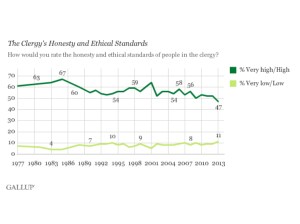
The country’s perception of clergy hit a new low in recent Gallup polling, with fewer than a third of Americans rating clergy as highly honest and ethical.

People are more likely to believe in the moral standards held by nurses, police officers, and chiropractors than their religious leaders. Clergy are still more trusted than politicians, lawyers, and journalists.

The continued drop in pastors’ reputation—down from 40 percent to 32 percent over the past four years—corresponds with more skepticism toward professions (and institutions) across the board.

Americans are also less likely than ever to know a pastor, with fewer than half belonging to a church and a growing cohort who don’t identify with a faith at all.

“As American culture becomes increasingly pluralistic and post-Christian, we can’t assume that Americans in general default to a positive view of clergy,” said Nathan Finn, executive director of the Institute for Transformational Leadership at North Greenville University. “Ministers must work harder to gain public trust than was the case even a generation ago.”

Finn also pointed out how scandals like clergy sex abuse, growing political polarization, and evangelicals’ countercultural moral positions can contribute to the decline in credibility among clergy, “especially among those who have either had bad church experiences or whose worldview assumptions are already at odds with historic Christian beliefs.”

The most dramatic decline in clergy trust came around the crisis of sex abuse by Catholic priests in the early 2000s, when positive ratings fell from 64 percent to 52 percent. They’ve steadily declined since.

Gallup found that white, high-income, and college-educated Americans thought best of pastors. The ratings were about the same across political parties, with 38 percent of Republicans and 36 percent of Democrats seeing high levels of honesty and ethical standards among clergy.

Views of pastors did vary by generation. Elder millennials and Gen X were most cynical; fewer than a quarter of people between ages 35 and 54 had a positive view of clergy ethics, compared to 38 percent of older Americans and 30 percent of those under 35. Positive perception of clergy among young people jumped by 10 percentage points compared to 2022.

Previous polling has shown that people tend to trust their own pastor more than pastors overall. According to Barna research, nearly two-thirds of Americans have a “very positive” opinion of a pastor they have a personal connection with, compared to a quarter who said the same about pastors in general.

But even that discrepancy has the potential to erode trust on the local church level.

“It may be that people are thinking, ‘I trust my pastor but not the ones I see on social media.’ However, sooner or later this drop will influence local decisions. For example, if a senior pastor has a conflict with the governing board, people may more quickly say, ‘Well, our pastor is just like those other pastors,’” said David Fletcher, founder of XPastor, a resource for executive pastors.

“Changes in societal views can influence church members and leaders beneath the surface—it is like the tide, carrying us along for quite some time before we realize we have moved.”

Even though public trust is slipping across professions—groups like doctors, pharmacists, and bankers saw slightly bigger declines than clergy—Christians still want to see pastors held to a higher standard.

“Scripture charges Christians in general and pastors in particular to be concerned about their reputation with the outside world,” said pastor Aaron Menikoff, author of Character Matters, a book focusing on the fruit of the Spirit in church leadership.

Menikoff cited 1 Timothy 3:7, where the qualifications of an elder include “a good reputation with outsiders,” and 1 Peter 2:12, which urges Christians to live “good lives” so that those outside the church notice their “good deeds.”

Evangelical leaders agreed certain church stances and doctrines may cause pastors to lose credibility in today’s culture, but that pastors should take their character and public witness seriously.

“Pastors will fall short, they are works in progress too. Nonetheless, by God’s grace they ought to strive for that holiness without which no one will see the Lord (Heb. 12:14),” said Menikoff, whose Atlanta-area church hosts an annual pastors’ conference called Feed My Sheep.

Glenn Packiam pointed to the need for pastoral humility and a rethinking of authority as he explored Barna research on the declining trust in pastors in his 2022 book The Resilient Pastor. He wrote:

I am less interested in finding ways to regain our credibility than I am in our willingness to take responsibility for why we’ve lost it. … From small country churches to uber-megachurches, many pastors have been found to be bullies and hypocrites, alcohol abusers, and womanizers. The crisis of credibility is a symptom. The misuse of authority is the root cause.

In the wake of public scandals involving pastors, ministries are developing accountability and discipleship training for pastors. For example, a free workshop through XPastor (involving CT partner publication Church Law & Tax) focused on legal, financial, and sexual standards as well as challenges around Sabbath rest, with the hope that setting church integrity “guardrails” can keep leaders on track.

Also important, said Finn, is how pastors respond when things go wrong: “It is within the power of church leaders to rebuild at least some trust if we respond faithfully to our own moral failures.”

Church Life

The First Native Hawaiian Pastor Became a Missionary to the Marquesas

James Kekela and his team stuck it out on the remote Pacific island chain—and earned recognition from Abraham Lincoln along the way.

James Kekela and his wife Naomi

James Kekela and his wife Naomi

Christianity Today January 25, 2024
Illustration by Christianity Today / Source Images: WikiMedia Commons

In 1853, the Hawaiian Missionary Society sent missionaries to the Marquesas, an island chain about 2,400 miles away. American and English missionaries had already attempted and ultimately failed to reach the area made famous in the West by author Herman Melville’s 1840s novels Typee and Omoo.

The ordination of the first Native Hawaiian pastor, James Kekela, catalyzed the beginning of this mission.

“Several Hawaiians had been licensed to preach, but Kekela was the first to receive ordination, becoming the first pastor of a church,” later wrote Rufus Anderson, the foreign secretary for the American Board of Commissioners for Foreign Missions (ABCFM).

Sending Native Hawaiian missionaries to faraway Pacific Islands on independent missions was seen as a vital step in preparing for the end of the oversight and support of the ABCFM. By 1864 the Hawaiian Evangelical Association had replaced ABCFM’s Sandwich Islands Mission.

In 1853, Matunui, the high chief of the Marquesan island Fatu-hiva, accompanied by his son-in-law Pu‘u, a native Hawaiian, arrived in Lahaina, Maui, where Pu‘u was born and raised.

“It soon became apparent that Matunui came to Hawaii for the specific purpose of soliciting missionaries,” wrote Dwight Baldwin, a missionary physician at Lahaina. “In reply to [a] query about his request for missionaries, Matunui replied, ‘… we have nothing but war, fear, trouble, poverty. We have nothing good, we are tired of living so, and wish to be as you are here.’”

The Hawaiian Missionary Society selected four Hawaiian ministers and schoolteachers, who were accompanied by their wives. This included Kekela, “a modest, persevering man,” Maui kahu [pastor] Samuel Kauwealoha, and deacons and teachers Lot Kuaihelani and Isaia Kaiwi.

But the rosy vision for the Marquesan mission soon waned, and a harsh reality set in. Matunui’s missionary fervency cooled, wars continued, and the Marquesans struggled to provide material support for Kekela and the other missionaries. Yet the Hawaiian mission persevered, with Kekela settling on the island of Hiva Oa.

In time, the Marquesans adopted a more Western demeanor and culture. Missionary James Bicknell, who had joined the Hawaiians, noted the change positively in an 1862 Hawaiian Missionary Society report:

In general appearance the people are much improved, their manners are softening, they are better clothed, and in some the sense of shame is beginning to manifest itself. … In general intelligence, the people have made considerable advances. … Their knowledge of foreign countries is increasing, and there is a thirst for more. The people have learned also to distinguish between missionary and other foreigners. The distinction is very marked, and holds good in parts remote from direct missionary influence.

In 1864, Kekela and others rescued an American whaler named Jonathan Whalon, who had been trading on Hiva Oa. The community had gone after Whalon, furious at a Peruvian slaver that had kidnapped Hiva Oa men. As they were preparing to cook and eat him, Kekela came to the rescue and sacrificially traded his prized six-oar whale boat for the life of the whaler.

For his brave rescue, President Abraham Lincoln rewarded Kekela with a large gold watch and sent gifts to the others who had helped rescue the whaler. Kekela’s watch bears this inscription: “From the President of the United States to Rev. J. Kekela For His Noble Conduct in Rescuing An American Citizen from Death On the Island of Hiva Oa January 14, 1864.”

Seventeen years later, foreign secretary Anderson reported that, despite years of hardship, Kekela, Kauwealoha, and Kaiwi still persisted on the Marquesan mission field. In 1899, the Marquesan mission finally folded when the elderly, infirmed, and nearly blind Kekela returned home to Hawai‘i for a much-deserved retirement.

Back in the Marquesas, the Kekela Hawaiian-Marquesan family continues to minister in the Protestant churches of the remote Polynesian island chain. Like the Hawaiian Islands, the area is undergoing a cultural revival and becoming a society well connected to the 21st-century world outside their remote islands.

Christopher “Chris” Cook is a Kauaʻi, Hawaiʻi-based author and researcher into the monarchy-missionary era of Hawai’i’s history. He is a graduate of the University of Hawaiʻi and author of a biography of Opukahaia-Henry Obookiah, the first baptized native Hawaiian Christian. He blogs at www.obookiah.com

Church Life

Tahitians First Came to Hawaiʻi in Power. They Later Returned with the Gospel.

A husband-and-wife team introduced a royal to Christianity and her conversion changed the islands forever.

Kaahumanu, Queen Dowage of the Hawaiian Islands, who promoted Christianity in her kingdom.

Kaahumanu, Queen Dowage of the Hawaiian Islands, who promoted Christianity in her kingdom.

Christianity Today January 25, 2024
Illustration by Christianity Today / Source Images: WikiMedia Commons / Paʻa Studios Archives

In 1822, a group of Protestant missionaries arrived in Hawaiʻi. But unlike the dozens of American missionaries who would make their way from New England over the course of the 19th century, this party sailed from another Polynesian island, Huahine. Among those aboard were three English missionaries and four Tahitian missionaries.

Though Tahitians had settled in Hawai‘i hundreds of years previously, the two kingdoms had had little contact until recent decades. The missionary party saw the Hawai‘i trip as merely a stopover on a voyage to restart a mission to the Marquesas Islands. Instead, in a series of serendipitous coincidences, the Tahitian missionaries connected with the Hawaiian royalty and used their shared Polynesian culture to share the gospel with them.

After centuries of no contact between Tahiti and Hawaiʻi, British explorer James Cook unknowingly sailed the ancient sea lane between the two kingdoms in late 1777. When he anchored off Kauaʻi in 1778, Cook asked native Hawaiians if they knew Tahiti, and they responded that Kahiki, as they called Tahiti, was their homeland in the South Pacific. (In the Hawaiian language, Kahiki refers to both the islands of Tahiti and all the lands in all directions located beyond the horizon of Hawaiʻi.)

While the ancestors of the pioneer settlers of the Hawaiian Islands are likely indigenous people from the Marquesas Islands who arrived between A.D. 1000 and 1200, a second wave of settlement came from Tahiti between 1200 and 1400.

By 1400, the Tahitians ruled Hawaiʻi politically and transformed how it practiced religion. An influential Tahitian tahu‘a (kahuna, priest) introduced human sacrifice and helped establish an all-powerful royal caste known as the aliʻi. Over time, members of the ali‘i became considered godlike.

Despite their previous close relationship, within a century of this reformation, long-distance sailing between the two kingdoms ceased. After Cook died in Hawaiʻi in 1778, his maps, engravings, and journal accounts put many of the Polynesian islands on the global maps of the Western world. Soon, Western explorers and missionaries were poring over his work, eager to set out on their own trips.

One of those individuals was William Carey, who, while cobbling shoes, read a detailed account of Tahiti in Captain Cook’s journals of the Pacific Ocean and first felt the lure of mission. To guide his prayers on the subject, the man later dubbed “the father of modern missions” hung a hand-drawn map of the routes of Cook’s voyages, envisioning Tahiti as the most promising location for a mission to a “heathen,” non-Christian nation.

By 1795, merchant ships and exploring expeditions were often making the one-month sail (around 2,400 nautical miles) between Tahiti and Hawaiʻi. On the British Isles, enthusiasm for sending missionaries to Tahiti grew due to its warm climate, the detailed accounts of its people written by explorers, and a mistaken belief that Polynesians spoke a very simple language.

Though Carey ultimately sailed solo to India, in 1796 the London Missionary Society (LMS) sent its pioneer foreign mission to Tahiti. Almost immediately, the mission in Tahiti suffered from internal personal conflicts and struggled to evangelize the Tahitian people. Thomas Haweis, a prominent Church of England clergyman, had pulled together a group of carpenters, masons, and other skilled men, hoping that they would evangelize the Tahitians through teaching practical trades. Haweis’ missions theory largely failed, and by 1805 nearly all the original missionaries had left for Australia.

Nevertheless, the introduction of the gospel impacted Tahitian society. In 1814 a revival broke out, and the Pomares, an influential royal family, converted to Christianity. Hundreds more followed after Pomare II, having successfully defeated his fellow Tahitians and taken control of the island, offered his former enemies feasting and celebration rather than the customary massacre. His Christian mercy drew many Tahitians to Christ.

Despite this evangelistic success, mission organizations ultimately changed their strategies and embraced the evangelical missions theory of seminary leader David Bogue. Bogue advocated for seminary training for ordained missionaries and the recruitment of educated young men and their wives as leaders.

William and Mary Mercy Ellis from London fit this bill perfectly. In 1816, the Ellises landed at the LMS mission station at Matavai Bay, Tahiti Island, and soon met a local Christian couple, Auna and Aunawahine.

Auna descended from a priestly family who served the powerful god Oro and had been trained by his own father to one day do the same. But after he had fought alongside the Pomares, his life had taken a major turn. Auna declared himself a Christian and had studied at the LMS Bible college on the islands, ultimately becoming a deacon at the mission church. Within months of meeting, the two couples traveled together to Huahine (another island in what would later become known as French Polynesia), to plant a church, which soon hosted a thriving congregation.

When Auna, Aunawahine, and the Ellises left Huahine to arrive in Hawai‘i in 1822, they quickly encountered another missions party that felt threatened by the new arrivals: American missionaries who had landed in 1820. The American missionaries had established two mission stations but had yet to become fluent in the Hawaiian language and had thus been unable to translate the Bible or preach sermons without using native translators.

Further, they had had no success at converting the aliʻi. The Hawaiian people strictly followed the lead of their rulers, and the aliʻi demanded that the missionaries first be taught palapala (reading and writing). The lack of language comprehension had stalemated the mission.

The new missionaries’ linguistic facility only highlighted this deficiency. William Ellis’s fluency in the Tahitian language allowed him to understand and speak the Hawaiian language.

“We perceived that the Sandwich Islanders [an obsolete term referring to Hawaiians] and Tahitians were members of one great family, and spoke the same language with but slight variations: a fact which we regarded as of great importance in the intercourse we might have with the people,” he later wrote.

It also immediately facilitated a surprising interaction:

As our boats approached, one of the natives hailed us with Aroha, peace, or attachment. We returned the salutation in Tahitian. The chief then asked, “Are you from America?” We answered, “From Britain.” He then said, “By way of Tahiti?” and, when answered in the affirmative, observed, “There are a number of Tahitians on shore.”

As the ship made its way from the Island of Hawaiʻi, the party made another connection after a Tahitian canoed past them in Honolulu Harbor.

“Auna’s wife soon discovered that this Tahitian was her own brother, who had left Tahiti when a boy, and they had not heard of him for nearly 30 years!” LMS mission station inspector William Tyreman wrote in his journal.

For one Hawaiian monarch, this chance reunion held even more significance. Kaʻahumanu, the late Kamehameha’s regent who now ruled the Kingdom of Hawaiʻi, recognized mana (a sense of spiritual power) in this reunion. She immediately invited Auna and Aunawahine to dwell in her royal compound.

That evening the Tahitian missionary party flowed directly into the work of the American missionaries. Ellis recalled:

In the evening of this day we were present when Auna read the scripture, and offered family prayers publicly in Kaʻahumanu’s house: we united with no ordinary feelings, for the first time, in the worship of the true God with the people around us. The next day, the 17th of April, being the day on which our American friends held the weekly religious service, I had an opportunity of preaching in the Tahitian language.

That evening, Ellis, who preached his sermon in a Polynesian tongue, accomplished a key first step in breaking the icy relationship between Kaʻahumanu and the American missionaries, in particular their leader, Hiram Bingham.

By mid-May Kaʻahumanu had begun to express a strong interest in Christianity and asked that Auna, Aunawahine, and the Ellis family move in with the royals.

Soon Auna and Aunawahine left Honolulu with Kaʻahumanu for a tour of Maui and Hawaiʻi Island. In the days that followed, Auna walked with the regent as her feelings toward Christianity shifted from skepticism, to conversion, to an enthusiasm that fueled her passion for others finding the same faith she had.

“I read a portion of the Tahitian gospel by Matthew, and then prayed to Jehovah to bless them with his salvation,” wrote Auna in May from Lahaina, as part of his journaling on their trip. “After the meeting, we sat down under the shade of the large tou [kou]-trees. Many gathered round us, and we taught them letters from the Hawaiian spelling-book.”

In the ensuing weeks, Auna began to explain the basics of Christianity through a Polynesian worldview and organized a worship service around a morning surf session. At one point, one leader ordered his community to get rid of their idols—and more than 100 were burned.

“Then I thought of what I had witnessed in Tahiti and Moorea, when our idols were thrown into the flames … and with my heart I praised Jehovah, the true God, that I now saw these people following our example,” Auna wrote.

Kaʻahumanu returned from her tour of Maui and Hawaiʻi Island now eager to promote Christianity. She backed the creation of the Hawaiian Bible and used the Ten Commandments to shape her kingdom’s civil law. Soon after, she began to tour villages in rural Oʻahu and the neighboring islands, teaching the Bible and proclaiming the gospel.

Longing to go home, and with Aunawahine being ill, Auna returned to the Society Islands in 1824, where the couple ministered to their people. Auna died in 1835.

Similarly, due to Mary Ellis’s poor health, in 1824 the Ellises departed for England, where William became a traveling promoter for LMS support and fundraising. He took up photography in the early days of the art and used that skill to enter Madagascar on a new foreign mission, winning favor by photographing portraits of the rulers of the island.

The arrival of the Tahitian missionaries in Hawaiʻi in 1822 permanently bonded the South Pacific English mission with the American North Pacific Hawaiʻi missionaries and arguably rescued the latter’s mission from failure. Because the Tahitian missionaries arrived from Kahiki, the legendary Hawaiian homeland and traditional source of national spiritual revelation, the mana (spirit) of the missions was placed within the Polynesian cosmos. It opened the door to Hawaiʻi becoming among the most successful of 19th-century American Protestant global missions.

“In cooperation with the Hawaiians Thomas Hopu and John Honoli‘i, Auna had been influential in commending Christianity to the native Hawaiian decision makers at a time when they needed persuading in terms they understood,” wrote John Garrett in To Live Among the Stars: Christian Origins in Oceania. “The church in the Sandwich Islands owes its Tahitian visitors a large and not always fully acknowledged debt.”

Christopher “Chris” Cook is a Kauaʻi, Hawaiʻi-based author and researcher into the monarchy-missionary era of Hawai’i’s history. He is a graduate of the University of Hawaiʻi and author of a biography of Opukahaia-Henry Obookiah, the first baptized native Hawaiian Christian. He blogs at www.obookiah.com

Church Life

Euthanasia: Why Some Despair Unto Death

As a Christian physician, opposing medically assisted suicide wasn’t enough. I needed to understand why people decide to die.

Christianity Today January 25, 2024
Illustration by Mallory Rentsch Tlapek / Source Images: Unsplash / Getty

When I began research for my book on physician-assisted death, I set out to answer the question Why not? The question is not theoretical. Even a decade ago, not long after I had finished my training as a doctor specializing in intensive care medicine, serious conversations were beginning about the possibility of legalizing physician-assisted death. I realized that “where causing death was once a vice, it was soon to be a virtue”—as I shared in a previous piece for CT.

Ever since my country, Canada, legalized MAID (Medical Assistance in Dying) in 2016, I have tried to demonstrate to my colleagues and fellow citizens—beginning with, but going well beyond, my faith convictions as a Christian—that intentionally causing someone’s death contravenes and violates their incalculable worth. So long as we are committed to upholding the intrinsic value of persons—so long as we insist that their value does not merely derive from their usefulness to others or to themselves—it is inappropriate and unethical for us to seek or to offer physician-assisted death.

More than that, relying on our own sense-experience and human faculties, we cannot confidently claim to know what it is like to be dead. Therefore, it is unwise and imprudent to seek and (especially) to offer physician-assisted death. Both these reasons, I think, count quite strongly, and seem to provide a very good answer to the Why not? question.

Is the case then closed? Not quite, I think.

For to respond effectively to this issue, we must not only address the Why not? question. We must also respond to the Why? question. We must address the deep, underlying motivation for seeking or offering physician-assisted death. We must face the suffering of the sufferer, and we must have something better to offer than death.

When I met Michael, he was about 30 years old. I was a young medical student, learning how to take the patient’s history and to perform a physical examination. He was the patient, admitted to the hospital for a urinary tract infection—one of many previous such admissions. Michael had primary progressive multiple sclerosis. He could barely move his arms and legs; they were stiff and contracted. He was blind.

I recall peering with my ophthalmoscope into his unseeing eyes, the white plaques of optical neuritis from multiple sclerosis effacing the surface of the retina. With the loss of some spinal cord functions, his bladder no longer contracted. To prevent urinary retention, he had an indwelling urinary catheter, but this was also a conduit for repeated infection. These infections left him much weaker even than normal—prostrate in bed, nauseated, in pain, and profoundly unwell.

As a young medical student, seeing his condition made a striking impression of suffering and disability. To that point, I had not encountered many people with such severe chronic illness. My world had been walled off from people like him. I lived with my new wife in our comfortable apartment; he lived in his nursing home. I was surrounded by friends and family; he was alone. I came and went as I pleased; he was bed-bound.

My future was that of expanding skill and opportunity. His future held out progressively increasing discomfort and limitation. In that hospital room, our worlds collided. I was the doctor-in-training; he was the lesson. But we were also just two young men struggling to find our way in the world.

Michael was shrouded in despair. He was diagnosed with multiple sclerosis as an older teenager, and the disease had progressively taken away his abilities and liberties; it had stolen everything a young man dreams of in life. Now, a decade later, he was desperately alone and desperately sad. He was deeply lonely since his disease effectively cut him off from his relationships. It was not for lack of interest on his part, although friendships under such circumstances were undoubtedly difficult.

Perhaps it was too easy for others to forget about him; perhaps it was too uncomfortable to visit. After all, we often feel threatened when we see such suffering, for we are tempted by a vague horror that the same might happen to us. Only with the kind of repeated exposure to suffering and disease that medical professionals experience during their training can one develop the disciplined sense of invulnerability necessary to cope (although this too can be profoundly unhealthy).

His loneliness was compounded by profound hopelessness. His was a progressive disease, unrelenting in its attack on his brain and spinal cord. His future held no hope for meaningful improvement, no possibility of freedom or relief. He spoke of the struggle to get through the day, feeling that there was little point in going on.

What was the purpose, the meaning, the point of such a life? It was gut-wrenching for me to sit and listen to him. I felt the cruelty and injustice of the world. Why him? Why not me? I thought.

Our clinical encounter was soon finished. I left, profoundly moved by his suffering. For a moment, I had the privilege of seeing the world through his eyes. I could sense his struggle to keep from coming apart and to retain his sense of personhood and dignity in the face of his disability and suffering. He was mourning a deep sense of loneliness, pointlessness, and hopelessness. His war for survival involved a relentless battle with despair.

This is how the desire for physician-assisted death should be understood: It is a cry of despair that cannot be ignored. To ignore that cry denies the worth of the sufferer’s life—just as much as causing their death denies their value.

Imagine for a moment that you are walking near a cliff, and you hear a cry of distress from below. Looking over the edge, you see a man clinging to a ledge, hanging precariously and desperately fearful of plunging to the rocks below.

Suppose a friend who is with you offers him a high dose of fast-acting sleeping medicine to help him fall asleep, so he no longer experiences fear or distress. You might successfully convince both your friend and the man whose life is in danger that it would be unhelpful, unwise, and inappropriate to offer or ingest the sleeping medicine. But the problem remains: How do you help the man in his moment of peril?

Likewise, even if we have successfully shown that physician-assisted death is an inappropriate and unwise way to respond to suffering, our task is not complete. We have failed to truly care for our patients if we hear their cries of despair, particularly in their requests for death, and simply throw our hands up to say, “Sorry, it’s wrong for me to end you, so I can’t help you.”

Rather, we must probe the reasons behind such a request; we must understand the fears and the pain that lead to such a cry. And we must find a way to come to their aid. It remains up to us to offer a better way for our fellow humans who find themselves in the crucible of suffering.

In many ways, an effective response to the Why? question would nullify the Why not? question. If we can show that physician-assisted death is unnecessary in the first place—if we can show how to bear the unbearable—then we might go a very long way to resolving the issue. Answering Why not? is secondary to finding a deep solution for Why?

Ultimately, when there seems to be no escape to a person’s despair, the only solution is for us to learn how to bear their suffering as the body of Christ.

Ewan C. Goligher is assistant professor of medicine and physiology at the University of Toronto.

The following excerpt is adapted with permission from Ewan C. Goligher, How Should We then Die? A Christian Response to Physician-Assisted Death (Lexham Press, 2024). Update (January 25, 2024): An earlier version of this article misstated why the author began his book research. We regret the error.

If you or someone you know needs help, call the Suicide & Crisis Lifeline at 988 or text a crisis counselor at the Crisis Text Line at 741741. In Canada, call Talk Suicide Canada at 1-833-456-4566.

Pro-Life Policy in a Post-Roe World

The landmark abortion ruling is dead. We have much to do to make sure babies live.

Christianity Today January 25, 2024
Illustration by Elizabeth Kaye / Source Images: Unsplash

For 50 years, the overturning of Roe v. Wade (1973) was a focal point for many abortion opponents. That goal was accomplished in 2022 when the Supreme Court’s Dobbs v. Jackson Women’s Health Organization decision returned abortion law to the states.

Chaos and confusion have followed the end of Roe as much as victory and celebration. Pro-lifers like me had been marching for life and calling for the overturn of Roe for so long. The movement was hardly prepared for what would happen next—what is now happening—in 50 different states with 50 different political contexts; legal histories; levels of medical preparedness, access, and expertise; and overall dispositions toward the needs of women and unborn children.

The reality of a post-Dobbs world is that there is no longer one big political goal. There are 50 or 500 or 5,000 smaller goals. Pro-lifers face unprecedented opportunities to promote a whole-life, pro-life ethic through a variety of policies—medical, financial, social, and educational—that will encourage those making decisions around abortion to choose life and help communities support those lives.

Creating a more pro-life America post-Roe will require work on many, many fronts, particularly since the percentage of people who find abortion morally acceptable recently increased, and abortions are actually on the rise. Changing hearts and minds is the most important work. But changing laws can help too.

States now have the opportunity to pass their own abortion-related legislation. This patchwork approach makes it imperative that legislators developing laws to protect unborn children and their mothers are well-informed. They must seek out the expertise of health care providers, agency heads, and others whose knowledge and experience can ensure sound, compassionate, holistic policies.

A “shoot first, ask questions later” approach to abortion law unmoored from the best-available medical practices and technology does not uphold a pro-life ethic, and pro-life legislation must be more than mere posturing when the lives of both mother and child are at stake. The stakes are too high to experiment with exciting but ultimately impractical—or dangerous—legislation that puts lives at unnecessary risk.

Beyond medical law, financial policies can determine life-and-death decisions around abortion. Indeed, three in four abortions take place among low-income families, and women who choose abortion consistently cite financial limitations as a major reason for their choice. This month, a diverse group of pro-life leaders—including Kristan Hawkins of Students for Life of America, Roland C. Warren of Care Net, Kathryn Jean Lopez from the National Review Institute, and Leah Libresco Sargeant of Other Feminisms—asked Congress to expand the child tax credit in light of the Dobbs ruling.

“We understand,” they wrote in a letter sent to congressional leaders on January 10, “that the work of upholding the sanctity and dignity of life is far from over.” Pointing to long-standing bipartisan agreement around expanding this tax credit, the letter argues that such a shift is a simple, politically viable way to decrease the abortion rate. “Many mothers face significant health and financial challenges throughout pregnancy and into the early years of raising a child,” it says. “We can, and should, do more as a nation to provide for their needs.”

This kind of proposal is not only right; it’s also prudent. “In a post-Roe landscape,” as Patrick Brown of the Ethics and Public Policy Center argued last year, “it is essential that abortion opponents stand up in favor of the health and wellbeing of mothers and the babies they carry—for political reasons, in addition to moral ones.” Brown proposed a federal provision that would extend postnatal Medicaid coverage from 60 days to one year, ensuring all babies would have medical coverage throughout infancy.

Many pro-life leaders and organizations are coalescing around similarly practical projects in municipal, state, and federal policy. These efforts, which can bolster both social and financial support networks that effect abortion-related decisions, include:

  • Increasing resources for childcare, ensuring that faith-based childcare providers would be included in these expanded programs, and including resources for in-home care by parents or relatives
  • Meeting health care needs for pregnant mothers, new parents, and children through existing programs, including community health care centers and pregnancy resource centers
  • Supporting adoption and adoptive parents, including expansion of the adoption tax credit, along with strengthening the foster care system through expanded partnerships that assist both foster and biological families
  • Creating a national online resource to offer information to pregnant and new mothers and to connect them to existing federal, state, and local resources
  • Strengthening connections and collaborations between governmental resources and programs and faith-based resources and programs that serve pregnant women, children, and families

Some of these projects are already in action. For example, Mississippi Attorney General Lynn Fitch launched a website, Mississippi Access to Maternal Assistance (MAMA), which directs women and families to both public and private resources in their state. “Whether you’re a mother-to-be or a mother of three, MAMA can quickly connect you to health care services, infant essentials, clothing, food, shelter, financial assistance, child care, jobs, education, legal aid, adoption services and more,” the site reads. “Remember, Mama, you can do this!”

A website seems, perhaps, so simple—perhaps even unimaginative. But its link to resources can be a bridge between life and death, or at least a steppingstone to a higher quality of life. There will be many such small steps toward our smaller goals in the post-Roe era. The ways to help pregnant women in need are only as limited as our imaginations. And after pregnancy, care is needed into the “fourth trimester,” because the most urgent needs of a new mother and new child continue into the weeks immediately following birth.

At the federal level, one possible route is the Providing for Life Act, which Iowa Rep. Ashley Hinson introduced last year. The bill “charts the policy course for a culture of life in America,” Hinson said, by expanding the child tax credit, providing tax breaks to working families, enhancing paid parental leave, establishing a federal clearing-house of resources available to pregnant mothers, expanding WIC eligibility for postpartum women, and enacting multi-tiered child support reform, among other policy reforms. Florida Sen. Marco Rubio published a memo with similar ideas on this month’s anniversary of Roe.

Life-affirming polices at the local scale also go well beyond abortion law. For example, where I live, one hospital recently announced it will temporarily suspend obstetric services because of a national ob-gyn shortage. Expectant mothers who would normally deliver their babies at this facility will now have to travel to a neighboring hospital.

This shortage of ob-gyns is an ongoing problem—not a result of the Dobbs decision, but the consequence of a number of factors developing over the past decade. Now, some expectant and new mothers are going without the basic health services needed for labor, delivery, and postpartum care. Addressing the causes of this shortage is just one task in a breathtaking range of work we need to do to create a more pro-life world, and Christian universities with medical schools should seize this opportunity to proactively train and credential the next generation of ob-gyns.

In all this work, remember: The baby whose life we save in the womb is also a baby who deserves to be delivered safely and lovingly into the world, and that has never been reducible to outlawing abortion or overturning Roe.

Now Roe is dead. But there is much more we can and must do to make sure babies live.

Karen Swallow Prior, author of The Evangelical Imagination: How Stories, Images, and Metaphors Created a Culture in Crisis, is a columnist at Religion News Service and writes regularly on Substack at The Priory.

Five Indian Christians Who Fought for India’s Freedom

Following Jesus’ example, many lived simply, humbly, and selflessly to uplift the poor and marginalized, and their faith in God nurtured their hopes for liberation.

Christianity Today January 24, 2024
Illustration by Elizabeth Kaye / Source Images: Wikimedia Commons

This year, India celebrates its 75th Republic Day, a holiday commemorating the nation’s constitution coming into effect in 1950. While the efforts of towering figures like reformers Mahatma Gandhi and Jawaharlal Nehru are widely celebrated, the courageous participation of Indian Christians in the freedom struggle often goes unrecognized.

Following Jesus’ example, many lived simply, humbly, and selflessly to uplift the poor and marginalized of India, and their faith in God nurtured their hopes for Swaraj, or self-rule. From sheltering dissidents to mobilizing women, educating youth to building institutions, these Christian stalwarts contributed in diverse ways. Their work dispels the myth that the Indian independence struggle was solely a Hindu-Muslim endeavor.

Below are five Christian leaders who dedicated themselves to the cause of Indian nationalism and of overcoming British colonial rule. From Kerala in the south to the Punjab in the north, these men and women of faith were driven by a deep patriotism and a desire to see their motherland free.

1. Sushil Kumar Rudra (1861–1925)

When Kasturba “Ba” Gandhi, otherwise known as the wife of Mohandas “Mahatma” Gandhi, returned to India from South Africa in 1915, she and her children were welcomed by Sushil Kumar Rudra, a second-generation Bengali Christian and the first Indian principal of the prestigious St. Stephen’s College in Delhi.

Rudra had traveled to Bombay (now known as Mumbai) specifically to receive the Gandhi family, and he hosted them in Delhi while they awaited Mahatma Gandhi’s arrival from London. He had also been the man largely responsible for convincing Gandhi to return to India.

As principal, Rudra encouraged nationalism among the students. He had long supported the Indian independence movement, even before he risked his relationship with the British by sheltering the Gandhi family in his Delhi home in 1915. Gandhi referred to Rudra as a “silent servant” for his quiet acts of resistance, which included helping Lala Har Dayal, Rudra’s former student and the leader of the Ghadar movement, leave the country in 1911 to avoid being arrested by the British. When Gandhi himself returned to India from South Africa, he stayed in Rudra’s house, where he wrote important letters and documents related to civil disobedience and Hindu-Muslim relations.

Sushil Kumar RudraWikimedia Commons
Sushil Kumar Rudra

Rudra was born to parents who had converted to Christianity under the influence of Scottish missionary Alexander Duff. Rudra graduated from Calcutta University and left for the Punjab, where he joined the staff of St. Stephen’s College in 1886. He married Priyobala Singh in 1889, who tragically passed away due to typhoid in 1897. The couple had three sons, and the youngest, Ajit Anil Rudra, rose to prominence, becoming one of the first Indian major generals in the Indian Army.

After several years as a teacher, Rudra was appointed principal, becoming the first Indian to head a missionary institution during the colonial era. Under his leadership, the college grew in size and reputation, shifting toward a more residential model. Rudra helped draft a new constitution for the college that increased Indian control by reducing the influence of the British founders. He also instituted equal pay regardless of race. As documented by Daniel O’Connor in Gospel, Raj and Swaraj, Rudra observed the Englishmen’s inclination to impose their views and convert others, a stance he resisted.

Rudra is considered to be one of the first to promote the idea of a Christian ashram, mentioning the idea in an article in 1910. (Up to that point, ashrams were Hindu communities where students educated themselves under the tutelage of a guru. In the 1930s, American missionary E. Stanley Jones began a Christian ashram, though it is unclear whether his idea was inspired by Rudra.) He was close to Sadhu Sundar Singh, better known as “the apostle with the bleeding feet,” having met Singh long before he met Gandhi or Tagore.

Charles Freer Andrews, a missionary, educator, and very close confidant and collaborator of Rudra, credited his friend’s prayer life with teaching him to love God with all his heart, mind, and soul:

I learnt from my friend to understand what Christ is to the heart of men in new and living ways. I found that the new thoughts and visions of Christ were not strange or unfamiliar to India, but intimately one with India’s own higher spiritual life. This transformation of my Christian faith into a more living reality I regard as the greatest gift which Sushil Rudra’s friendship brought into my own character and nature.

Upon concluding his tenure at St. Stephen’s College, Rudra established his residence in the Himalayan foothills, where he died in 1925 at the age of 64. Gandhi, in an obituary featured in his English publication Young India, characterized Rudra as a quiet but deeply interested spectator in the events of the national struggle.

2. Accamma Cherian (1909–1982)

Accamma Cherian was a pioneering advocate for women’s rights and a courageous freedom fighter from the Christian community in Kerala, then known as Travancore, who overcame immense odds to play an important role in India’s independence struggle.

Cherian was born in 1909 into a prosperous Syrian Catholic farming family. Despite living in a traditional society, her forward-thinking parents supported their daughters’ education. Cherian took full advantage of these opportunities and graduated with her teaching credentials by age 24 and soon became the headmistress of a reputable school in the town of Edakkara.

However, by the 1930s, Cherian had renounced her prestigious teaching career to actively join India’s independence movement. The Indian National Congress (or Congress Party), the political party under Mahatma Gandhi’s leadership, recognized Cherian’s bravery and organizational skills, entrusting her with establishing the Desasevika Sangh, or Female Volunteer Corps, across India. Cherian ultimately recruited and trained thousands of women volunteers, giving them a voice and a means to participate in the male-dominated freedom struggle.

In 1938, Cherian’s courage was tested when she was thrust into leadership in the Travancore State Congress Party (TSC), a chapter of the INC, after the authorities ruthlessly suppressed protests and imprisoned party leaders there. Before his own arrest, the TSC president nominated Cherian to lead in his place.

“I was aware of the seriousness of the assignment and knew what the consequences could be, yet I volunteered to do the job,” she later wrote in her autobiography.

Accamma CherianWikimedia Commons
Accamma Cherian

Defying a ban, Cherian fearlessly organized a rally of 20,000 people demanding the government revoke its ban on the TSC, free political prisoners, and expel the region’s corrupt leader. Facing armed British police ordered to shoot protesters, she dared them to shoot her first. Her bold stand forced the police to withdraw without firing on the crowd.

For her valor in the face of grave danger, Cherian was arrested multiple times. But her courage earned praise from Mahatma Gandhi, who hailed her as the “Jhansi Rani of Travancore,” comparing her to the brave Queen Lakshmibai who rebelled against British rule in 1857. Inspired by their sister’s example, Cherian’s siblings Rosamma and K. C. Varkey also joined the independence struggle.

After India gained independence, Cherian was elected to the Travancore legislative assembly in 1948, becoming one of the first women to hold political office in the state. However, she soon faced challenges from the male-dominated Congress Party. Disillusioned, she resigned from the party in 1952 and accused it of being taken over by opportunists.

In November 1952, at age 43, Cherian married V. V. Varkey Mannamplackal, a seasoned Congress activist from her hometown. After leaving the assembly, she attempted to restart her political career by contesting the 1953 elections as an independent candidate while pregnant. Facing attacks on her character as well as significant opposition due to jealousy and her sister’s Communist affiliation, she lost the election.

After this defeat, Cherian retreated from politics for over a decade to focus on managing the family’s rubber plantation and raising her son. She made one final attempt to revive her political career in 1967 but met defeat again, ending her aspirations.

“Shakespeare has said that the world is a stage and that all the men and women are merely players; but to me, this life is a long protest,” she later wrote in her autobiography. “Protest against conservatism, meaningless rituals, societal injustice, gender discrimination against anything that is dishonest, unjust. When I see anything like this, I turn blind, I even forget who I am fighting.”

In the 1970s, Cherian and her family relocated to Trivandrum so she could oversee her son’s engineering education. She lived out her final years quietly there until her passing in 1982 at age 73.

3. Harendra Coomar Mookerjee (1877–1956)

Harendra Coomar Mookerjee was an Indian academic and public figure who contributed to India’s independence movement and the founding of the free country. He was vice president of the Constituent Assembly of India.

Mookerjee was born into a Brahmin Bengali Christian family in Calcutta in 1877. The family had converted to Christianity after his grandfather, Bhairabchandra Mookerjee, embraced the faith after receiving kind treatment from Serampore missionaries following an accident. He was possibly their first Brahmin convert, and his decision cost him his ancestral property. His death at a young age orphaned his son (and Mookerjee’s father), Lalchand Mookerjee, and left him reliant on the missionaries for his education. Nevertheless, he excelled in studies and ultimately became self-sufficient.

Mookerjee also found academic success and became the first Indian to receive a doctor of philosophy degree from the University of Calcutta. Mookerjee’s doctorate was in English literature, and he went on to work in academia and public service. As he continued to progress in his career, he was forced to work through the loss of his son, who died from typhoid fever at age 17, and several months later, the death of his wife, Chipmoyee Goswami.

In 1937, Mookerjee ran for a seat in the Bengali legislative assembly as a representative of the Christian community. He also served as president of the All India Conference of Indian Christians, an association for Christians connected with the freedom struggle, and was an active member of the Indian National Congress.

Mookerjee played a key role in drafting India’s constitution. The Constituent Assembly, which drafted and adopted the constitution of India, unanimously nominated him and another politician from Jaipur to serve as vice presidents of the body.

A devoted patriot, Mookerjee also deeply cherished his Christian faith, expressing profound reverence for “my Master” and “my Lord.” As evidenced in his speeches, his love for Christ enabled him to transcend communal divides and see everyone as brothers. Firm in his beliefs, he made the case that Indian Christians should be allowed to evangelize.

“We believe that the faith we follow has a deep significance in religious life, bringing about a positive change in a person’s character more effectively than other prevailing religions,” said Mookerjee in one speech. “This belief is our only justification for sharing our perspective with our non-Christian brethren. As Christians, we assert the same right to share our faith, a right enjoyed by Muslims, Sikhs, Arya Samaj, and advocates of the Sangathan and Shuddhi movements.”

Throughout his life, Mookerjee wrote extensively on Indian politics and society, and in a speech, he detailed how he had transitioned from being a “Christian communalist” to a “Christian Indian nationalist.”

After the constitution was approved, the president appointed Mookerjee as governor of West Bengal in 1951, a position he served in until his death from a heart attack in 1956.

4. Titusji (1905–1980)

India’s old 500-rupee note depicts a sculpture in Delhi that portrays Mahatma Gandhi leading ten followers at the Salt March, a historic civil disobedience protest. One of those ten is Titusji, the only Christian among the 78 people who accompanied Gandhi during the iconic 1930 event.

Freedom fighter and social reformer Titus Theverthundiyil was born in 1905 to a Mar Thoma Syrian Christian family in Maramon, Kerala. Gandhi later dubbed him Titusji as a term of affection and respect. Raised on a farm, Titusji attended school and later became a teacher before studying dairy management. His son Thomas later noted that his father had become an “expert at pasteurising and chilling milk and at making curds, buttermilk, butter, ghee and different varieties of cheese (then consumed by the Westerners only).”

In 1929, Titusji began applying his dairy expertise at Gandhi’s ashram in Sabarmati, where his expenses were provided for but he received no salary. (Gandhi did send five rupees monthly to Titusji’s family to support his aged father.) As a community member, Titusji was asked to observe celibacy, clean the latrines, and wash his clothes in the river.

In 1930, as the statue later depicted, Titusji joined Gandhi in a 24-day, 239-mile march from the ashram to the coastal town of Dandi, protesting British salt taxes. Marchers of all faith backgrounds walked 10 miles daily while spinning handwoven clothes and praying. At the Salt March’s end, Titusji was beaten, arrested, and jailed. After his release from prison, he went back to the ashram.

In 1933, Titusji married Annamma, who was also from Kerala. Gandhi allowed the new couple to live in Titusji’s room temporarily, but life in the community was hard for Annamma, who, against her will, was forced to relinquish her gold jewelry and clean the latrines at the request of Gandhi and her husband. The couple ultimately had seven children, and when Gandhi dissolved the ashram, the family traveled around the country working on dairy farms. To make ends meet, Titusji ultimately sold their family car and property in Kerala.

In 1970, Titusji published The Bharat of My Dreams, expressing his hopeful vision for a nation where everyone was considered equal. He passed away at the age of 75 in 1980. Unlike his fellow freedom fighters, he never received any medals or pension.

Titusji is remembered as a devout Christian who believed in the dignity of every individual. In Bhopal, he played a key role in establishing a Christian church and its missions ministry.

5. Amrit Kaur (1887–1964)

Rajkumari Dame Bibiji Amrit Kaur was an Indian freedom fighter and independent India’s first health minister. Born into Punjabi royalty, she was the youngest of ten children. Her father Raja Harnam Singh was a Christian convert and prince of Kapurthala (Punjab) who married a Bengali missionary’s daughter. Raised Protestant Christian, Kaur entered India’s independence movement after the 1919 Jallianwala Bagh massacre, joining Mahatma Gandhi’s Congress Party.

Kaur’s father, Singh, is remembered as a dedicated Christian who had many learned and patriotic Indian friends who exposed his children to nationalist ideas through their conversations at the family’s house. Among these friends was Gopal Krishna Gokhale, a social reformer whom Gandhi considered his political guru. “The flames of my passionate desire to see India free from foreign domination were fanned by [Gokhale],” Kaur later wrote.

An advocate of women’s rights, Kaur campaigned against temple slavery, child marriage, and cultural norms that forced women out of public spaces. In 1927, she founded the All India Women’s Conference and was jailed for joining Gandhi’s Salt March (via Bombay).

In 1934, she moved to Gandhi’s ashram, adopting its simple lifestyle. Along with economist J. C. Kumarappa, Kaur became one of Gandhi’s few Christian confidants, functioning as his secretary for nearly 17 years.

Rajkumari Amrit KaurWikimedia Commons
Rajkumari Amrit Kaur

In 1937, Kaur was jailed again, this time on charges of sedition, during a goodwill mission in present-day Pakistan, and then again for 20 months in 1942 for the Quit India Movement, for which she organized several demonstrations and marches against British rule. The toll on her health was evident after she endured a brutal baton charge. Eventually, she was released from jail and put under house arrest in a city in the foothills of the Himalayas.

As independence neared, she championed universal suffrage and chaired the All India Women’s Education Fund Association. TIME magazine declared her 1947’s “Woman of the Year.”

Post-independence, Kaur was elected to parliament and served as the minister of health for ten years. She spearheaded public health campaigns against malaria and tuberculosis, and founded the All India Institute of Medical Sciences.

In 1950, she became the first female and Asian president of the World Health Assembly and tirelessly advanced women’s rights, child welfare, and public health. She was a founder and chair of many significant social organizations that persist to this day and she played key roles in international health organizations. She also founded Lady Irwin College in Delhi.

Kaur was also a personal friend of American evangelist Billy Graham. She presided over his crusade in Delhi in 1956, later saying of him: “Billy Graham is one of those rare jewels who tread this earth periodically and draw, by their lives and teaching, millions of others closer to God.”

Kaur is remembered as someone who followed the doctrine of equal respect for all religions. In Gandhi’s ashram, she was a regular participant in prayers featuring scriptures from all religions.

Throughout her life, Amrit Kaur consistently fought for India’s independence and its people’s welfare, laying aside her privileged roots as a princess to exemplify selfless service. As she was described when receiving an honorary doctorate from Princeton University in 1956:

A Princess in her nation’s service. She has gone among the poor and the weak, the mothers and the children, the sick and the starving, not only with messages of hope and faith but also with substantial and highly effective programmes of action. … She stands thus as a living image of faith, hope and love— believing like St. Paul that the greatest of these is love.

News

Iranians Gain 12 New Ways to Read the Bible

Marginalized minority groups receive New Testament translations. “If Jesus delays his return, they will say: Christians preserved our culture.”

Unveiling 12 new Iranian minority language New Testaments.

Unveiling 12 new Iranian minority language New Testaments.

Christianity Today January 24, 2024
Courtesy of Korpu

Home to the world’s fastest-growing church, with up to an estimated 1 million Christians, Iran has many underground fellowships that had previously worshiped in the Farsi language. But according to a 1991 survey of new mothers in Iran, only 46 percent reported Farsi as their mother tongue.

Minority Gilaki, Mazandarani, and other citizens can now read the New Testament in their own language, thanks to the publication of 12 new Bible translations. Far from a Persian monolith, Iran has 62 distinct languages, according to the Korpu translating agency, 9 of which number more than 1 million speakers.

And God’s concern for Iran goes beyond their individual souls.

“Translating the Bible is God’s way not simply to save people,” said Yashgin, a Korpu exegete-in-training, “but to return glory to humiliated minority peoples.”

Now living in Turkey and a Christian since 2007, Yashgin requested anonymity to protect her believing family back in Shiraz, 525 miles south of Tehran. A member of the Qashqai Turkic minority of Iran, she fled the country after two brief detentions in jail for her faith, connecting with Korpu in 2017.

Seven years later, she helped birth the first Qashqai New Testament.

Yashgin said she was mocked as a child over her accent and Turkish name. (Minority Rights Group (MRG) states that Iran represses its minority languages, mandating Farsi alone in education and civil affairs.) But studying the Bible, she learned that God called Israel as a minority people (Deut. 7:7), and translation, she said, proves the truth of John 3:16.

God loves the world, not just the majority.

“No one cares for us more than our mother,” Yashgin said. “God showed us he cares also, by speaking her language.”

Language and ethnicity figures are contested in Iran, whose 88 million people reside in a territory roughly the size of Alaska. Slightly more than half speak a variant of Persian, with Azeris and Kurds as the largest minority ethnic groups.

Local Armenian and Assyrian Christians have long had their own Scriptures. The first Kurdish Bible was published in 1872, and an Azeri Bible was published in 1891. While the first reference to a Persian translation dates back to the fourth century with archbishop of Constantinople John Chrysostom, fifth-century manuscript evidence was found in a Nestorian monastery in Chinese Tajikistan.

Missionary Henry Martyn led the first modern version, completed in 1846.

But while missionaries were exceptional in their geographic reach, said Lazarus Yeghnazar, founder of Transform Iran, they established Farsi-speaking congregations even in regional capitals. His church planting organization has congregations in over 50 Iranian cities, he said, and seeks to reverse this ethnic neglect.

Working with unfoldingWord’s Open Bible Stories, Transform Iran has used regional accents to orally translate key biblical episodes in 22 minority languages, set to a background of local folk instrumentation. Few minority Iranians can read their mother tongue, he said, many of which experts fear are at risk of disappearing.

“When they hear their music, it touches their soul,” said Yeghnazar, an ethnic Armenian. “If Jesus delays his return, they will say: Christians preserved our culture.”

An ethnic Azeri agrees—while recognizing the political implications.

Feridoon Mokhof, director of Korpu, said that Iran wrongly sees the spirit of nationalism behind ethnic desires to use their native speech. The logic goes like this: A language implies a people, a people implies a nation, a nation implies land, and a land implies separatism. MRG states that language activists in Iran have been imprisoned or exiled.

When Korpu translators are arrested, Mokhof said, it is often due to their being seen as a threat to national security. Adding Arabic as an official religious language after its 1979 revolution, the Islamic Republic has largely continued the earlier government policy to suppress ethnic identities. But they have also disturbed relations that had previously been cordial and historical.

The Bible speaks of the Persian King Xerxes’ 127 satraps, with central authority in Susa—where the Lak people live today. And King Cyrus governed biblical Elam—where the Lur people reside. Both these languages now have a New Testament—possession of which, Mokhof said, is a basic human right.

“The Lur don’t need their own country, but their language and culture should be preserved in their own community,” he said. “The Bible is the only literature that can keep it.”

Mokhof became a Christian in 1974 as a university student and began his linguistic career in 1990, translating the Bible into his native southern Azeri. Five years later, the Azerbaijan Bible Society was founded across Iran’s northwestern border in Baku to work on the northern Azeri translation, while he founded Korpu—which means “bridge” in Azeri.

It was always his goal that the Bible would connect peoples.

In 1998, Mokhof began translating the New Testament into Gilaki, with Mazandarani and Luri following a few years later. But much of this work was put on hold until the southern Azeri Scriptures were finished in 2014. Thereafter, Korpu began work in Talysh, Tati, Ahwazi Arabic, and others, with the finished 12 New Testaments dedicated in a London presentation last weekend.

Six more translations are scheduled to be published in June.

Working with United Bible Societies (UBS), Seed Company, Operation Mobilization, and the Southern Baptist Convention’s International Mission Board, Korpu employs 73 staff including 58 translators, two-thirds of whom work from inside Iran. Mokhof is also the assistant superintendent of the Hamgaam Council of United Iranian Churches, which oversees 850 house churches in Iran. Several are located in minority areas.

Where security permits, translators check their work with friends and relatives in Iran. This can open opportunities for evangelism, and Yashgin said one friend of hers believed after hearing the gospel in Qashqai, having rejected it years earlier in Farsi.

“When you speak of Christianity in Iran, their first thought is that it is a Western religion,” she said. “Hearing the Bible in one’s mother tongue proves this is a false idea.”

But until now, Mokhof said that house churches—which largely match the ethnic composition of the nation—relied on Farsi Scriptures. Following the Islamic Revolution, Christianity exploded first in Tehran, the Farsi-dominated cosmopolitan and culturally open capital. It then took about 10–15 years for satellite television to widen the revival to the ethnic peripheries.

Prior to persecution dividing believers into smaller family-based units for safety, Yashgin’s congregation was originally mixed Farsi-Qashqai. Although her believing grandmother understood the national language, she would translate the Bible orally to help it resonate better. But as people from across Iran have fled into Turkey, church is once again a multiethnic assembly—with Farsi central.

As it is for scattered Iranians everywhere.

“We don’t use labels, which helps our national unity,” said Nahid Sepehri, executive director of the Iranian Bible Society in Diaspora (IBSD), referring to the Iranian Church in London and similarly named churches elsewhere. “But if other ethnicities want to worship in their own language also, why not?”

She has not heard of any diaspora congregation that is ethnically unique, but the IBSD will partner with Korpu to get these translations to any who need it. They currently distribute 300,000 Scripture copies a year, cooperating with national Bible societies aware of the Iranian diaspora. Elsewhere they ship literature to less-developed countries, or hand carry it to less-friendly regimes.

The IBSD was founded in 2015, growing out of a UBS-sponsored project to translate Today’s Persian Version into contemporary Farsi. Finished in 2007, a revised edition was finalized last year. And with the completion of 12 new ethnic New Testaments, Korpu will discern the local desire for the entire Bible. Under current resource commitment, Qashqai speakers and others will have the whole counsel of God within three years.

Should freedom come to Iran, which language will they choose for church? Yashgin said while both models are good, monocultural service yields more intimacy while mixed groups nurture wider fellowship. She hopes that Iran will permit local language education, yet she recognizes the need for a uniting identity.

“Translation fulfills Colossians 3:11—‘Here there is no Gentile or Jew … but Christ is all, and is in all,’” Yashgin said. “But I am also an Iranian, and the only difference is my language.”

Editor’s note: Consider sharing this article on Telegram, where more than 10,500 readers (with 3/4 outside North America) now follow CT.

Books
Review

One Underrated Way to Enrich Your Christian Political Witness: Be a Better Christian

Personal discipleship and spiritual formation are hardly irrelevant to the rough-and-tumble of public debate.

Christianity Today January 24, 2024
Illustration by Elizabeth Kaye / Source Images: Wikimedia Commons

As another election year begins and Americans brace for what will undoubtedly be another contentious presidential race, Michael Wear’s new book, The Spirit of Our Politics: Spiritual Formation and the Renovation of Public Life, has an important message for us: If politics is causing you to stumble, care less about it.

The Spirit of Our Politics: Spiritual Formation and the Renovation of Public Life

The Spirit of Our Politics: Spiritual Formation and the Renovation of Public Life

HarperCollins Children's Books

256 pages

It’s an intriguing message from a political consultant who now runs The Center for Christianity and Public Life, a nonprofit dedicated to bringing more robust Christian presence and resources to political life in America. After all, politics has defined Wear’s career, beginning when he somehow managed to finish his undergraduate degree while working for President Barack Obama (first as an intern on his presidential campaign, then in the White House Office of Faith-based and Neighborhood Partnerships).

You might expect, in an election year, to hear calls to whip ourselves into a greater fervor because the stakes are so high. But Wear has written a book that urges the exact opposite. If there’s ever a conflict between political victory and moral faithfulness, he argues, we ought to choose faithfulness every time.

Rejecting silence and subservience

Indeed, the central contention of The Spirit of Our Politics is that undisciplined political fervor and a desire to defeat our political enemies is poisonous for our spiritual health. We must first seek the kingdom of God before aspiring to participate in political action.

Wear is deeply concerned that the toxicity and rancor of American politics are seeping into American churches, leading to the use and abuse of Christianity as a blunt instrument in political discourse and furthering a mass epidemic of shallow faith defined less by trust in God and more in political affiliation. At the same time, there is a strong countercurrent of opinion that wants to dismiss the role of Christian teaching and faith in politics, denying Christians a political voice as Christians.

The theme that unites these dangerous developments is the idea that politics is a realm in which Christian discipleship and personal moral development do not apply. Wear describes this as “a fatal choice between a Christian silence in politics and a Christian subservience to political programs, ideologies, and aspirations.”

Some Christians argue that politics is a rough-and-tumble world of brute force and power plays, so trying to apply the principles of the Sermon on the Mount is like trying to enforce tea party etiquette during a rugby match. Other Christians, like many non-Christians, see the moral strictures of Christianity as irrelevant to politics because faith is merely a personal choice akin to one’s opinion on the color of the carpet on the Senate floor.

Both perspectives entail divorcing spiritual formation from political life; Wear’s argument is that good spiritual formation will make us better participants in political life and that America’s political life needs well-formed Christians more than ever.

Wear draws heavily from the work of Dallas Willard, author of many books on spiritual formation and philosophy, to make these intertwined arguments. Willard wrote about what he calls “the disappearance of moral knowledge,” that is, the cultural transformation of moral truths into a set of personalized beliefs that have no grounding beyond the faith of the individual who asserts them. This has made politics an arena in which Christian teaching is felt to be irrelevant or even harmful.

Politicians nowadays make statements about separating their “personal beliefs” from their political actions, as if there is some neutral, impersonal body of knowledge that will guide them apart from religious commitments. Life without moral knowledge is impossible, though, and Wear sees a natural hunger for moral knowledge experiencing the kind of resurgence that opens new avenues for Christian influence.

Willard was also highly critical of what he called “the gospel of sin management,” which leads Christians to think of their faith as merely a set of beliefs that get them out of hell and into heaven. In this view, Jesus is a “fixer” who deals with our “sin problem,” a point of view that tends to produce a weak sense of discipleship.

While Willard certainly seems accurate in this assessment, Wear’s attempt at bringing it into politics seems a bit muddled and hard to follow. He argues that Christians often look at Christian faith and politics with a “fixer” mentality, but his primary examples are Christians who absolutize political principles as tests for Christian faithfulness.

I struggled to see the connection between these two points, but the examples were disturbing enough on their own. Take, for instance, a progressive preacher leading his congregation to shout, “Filibuster is a sin!” Or a conservative minister telling his followers that if “they do not vote, or they vote wrongly, they are unfaithful.”

Both admonitions struck me as simultaneously absurd and disheartening. Wear describes this approach as spiritually corrupting, claiming that it is “a form of blasphemy to flippantly ascribe to our preferred policy instruments and political judgments the weight of religious dogma.” What Wear recommends instead is making political commitments informed by our faith rather than allowing our faith to be driven by political commitments.

A good chunk of the book is spent simply on biblical reflections about developing the kind of character we want, which is, of course, relevant to much more than politics. Drawing on Willard’s The Allure of Gentleness to describe an ideal of loving service and an emphasis on “vision, intention, and means” as the pathway to achieving our spiritual vision, Wear wants us to see that a healthy relationship to politics in a Christian’s life should naturally result from a strong relationship with God.

If we think that God’s moral commands apply in all arenas of life, we won’t treat politics as a place where those commands can be waived off in favor of fear, anger, vulgarity, and false confidence. If we’re confident in God’s power to bring about the kingdom he has promised us, then we won’t treat every election as an apocalyptic spectacle. If we’re grounded in a theological conviction about the nature of our relationship with God, we won’t anathematize our fellow believers over voting choices.

Besides the more obvious habits of prayer, reading Scripture, fasting, and worship that should characterize every believer’s life (and, let’s face it, these are probably some of the first things we neglect when we instinctively reach for our phones each morning), Wear suggests other spiritual disciplines that are key to political engagement.

He recommends service to others rather than “othering” people, relating a story about a pastor who changed his political views after spending time ministering to people he had only known through news reports and op-eds. He advises us to critique those we support and affirm those we oppose, practices that keep our minds from being warped by polarization.

He asks a critical question about solitude and silence: “Different noises make us feel fun, productive, in control, alive. What do we hear in the silence? Who are we there?”

Something worth saying

Wear concludes with a word to parents and pastors, who in many ways have borne the brunt of political polarization. He gives pastors permission to ignore political concerns in just about every aspect of their church’s liturgy except for prayer, and he exhorts them to use any political topics that do come up to connect congregants with the love of God for them and for all people. As important as politics may be, what comes first is leading people to worship God and letting any political applications flow out of that.

For parents, Wear wants them to make sure their faith and their political judgments avoid hypocrisy. And he encourages parents who are concerned about their kids’ political development to get them involved in some kind of real-life activism rather than leaving them to merely absorb information through a screen.

Wear’s first book, Reclaiming Hope: Lessons Learned in the Obama White House About the Future of Faith in America, was an honest look at what politics can and cannot accomplish, informed by his successes and failures at the White House. In many ways, his new book offers a natural continuation of those stories by describing politics as an important part of life but not as the primary or most critical means of effecting change.

If you or someone you love has gotten locked into a world that thinks only in terms of political activism, even to the point of destroying relationships, this book is a helpful antidote. I suspect, however, that some have gone so far down that path that they will dismiss what Wear has to say. Still, for people who have been turned off by politics in recent years, Wear’s vision of a political life grounded in Christian discipleship can give valuable hope and a compelling reason to engage in a process that seems hopelessly corrupt.

Even though we won’t be casting our final votes for nearly a year to come, I’m already seeing friends on social media venting their anxieties and hatreds. The Spirit of Our Politics isn’t just a much-needed corrective to those tendencies; it’s a strong argument for a much healthier way of life.

Dallas Willard’s work is worth revisiting these days, even if Wear’s reading of Willard doesn’t always map well onto what he wants to say about politics. Honestly, it’s refreshing just to read a book about politics and faith that only mentions Donald Trump in passing, doesn’t play on vague tropes about “the common good” or “moral values,” and isn’t obsessed with Christian nationalism (while still speaking to the questions it raises).

Wear wants Christians to have a closer walk with Jesus so that when we engage in politics, we’ll have something worth saying. In 2024, we need to practice what he’s preaching more than ever.

Matthew Loftus lives with his family in Kenya, where he teaches and practices family medicine. You can learn more about his work and writing at matthewandmaggie.org.

addApple PodcastsDown ArrowDown ArrowDown Arrowarrow_left_altLeft ArrowLeft ArrowRight ArrowRight ArrowRight Arrowarrow_up_altUp ArrowUp ArrowAvailable at Amazoncaret-downCloseCloseellipseEmailEmailExpandExpandExternalExternalFacebookfacebook-squarefolderGiftGiftGooglegoogleGoogle KeephamburgerInstagraminstagram-squareLinkLinklinkedin-squareListenListenListenChristianity TodayCT Creative Studio Logologo_orgMegaphoneMenuMenupausePinterestPlayPlayPocketPodcastprintremoveRSSRSSSaveSavesaveSearchSearchsearchSpotifyStitcherTelegramTable of ContentsTable of Contentstwitter-squareWhatsAppXYouTubeYouTube