Theology

How to Combat the Conflict Entrepreneurs

Pugilists can only succeed where there are willing customers. All of us can resolve to invest elsewhere.

Christianity Today November 10, 2023
Illustration by CT / Source Images: Lightstock

This piece was adapted from Russell Moore’s newsletter. Subscribe here.

An episode of my podcast must have hit a chord with many of you, because countless people have brought up one section of my conversation with Amanda Ripley—the part in which she talks about “conflict entrepreneurs.”

Whether in business, families, or the church, scores of people have identified this exact phenomenon in their own lives. For many, the question is: “So how do we confront conflict entrepreneurialism without becoming conflict entrepreneurs ourselves?”

First, a reminder of the definition. In her book High Conflict: Why We Get Trapped and How We Get Out, Ripley notes, “One way to prevent high conflict is to learn to recognize the conflict entrepreneurs in your orbit.” These are people for whom keeping those around them in a state of high conflict is the goal itself.

Ripley offers some advice for finding who, if any, are the conflict entrepreneurs around you. “Notice who delights in each new plot twist of a feud. Who is quick to validate every lament and to articulate wrongs no one else has ever thought of? We all know people like this, and it’s important to keep them at a safe distance.”

In an article on foreign policy obstacles of the moment (which I first saw referenced on Jonathan V. Last’s excellent Substack), Peter Singer and Josh Baughman report on the way that the Chinese government is counting on “cognitive warfare” against the West. The primary arena for this sort of battle for the minds is, of course, social media.

One of the ways the Chinese Communist Party seeks to do this—like Vladimir Putin’s authoritarian Russian regime—is through a “trolling strategy,” in which the goal is to “‘fuel the flames’ of existing biases and manipulate emotional psychology to influence and deepen a desired narrative.” Social media works perfectly for such a strategy, because once emotions are roiled a few times, the algorithms will take care of the rest—giving a person more and more of that.

Do Chinese autocrats really care what sort of body image the teenage girl in your church youth group has? Not on its own terms, of course. What they care about, though, is a demoralized and psychically crippled American population—and that’s one way to get there. The point is not usually the end-result policies (though sometimes it clearly is; both Russia and China have an interest in seeing NATO fall apart or Ukraine surrender). Usually the point is the conflict itself.

The conflict entrepreneurs in your church foyer or at your family reunion don’t have sophisticated tactics or strategies like this, of course. Often, they don’t even consciously reflect on the fact that they are fueling conflict. They just know that they are bored or lifeless without it.

Often, the motives for such conflict-marketing include envy. Think of the lyrics of the Lee Ann Womack song “I’ll Think of a Reason Later”:

Inside her head may lay all the answers
For curin’ diseases from baldness to cancer
Salt of the earth and a real good dancer
But I really hate her
I’ll think of a reason later.

The Gospels give us multiple examples of the conflict entrepreneur dynamic. The Herodians and the Pharisees, for example, asked Jesus about whether paying taxes to Caesar was lawful or not. This was not a debate over tax policy. They wished “to trap him in his talk” (Mark 12:13, ESV).

If Jesus had said to pay taxes, he would have been charged with heresy—with saying that the throne of David should remain vacant and be filled not with, as God commands, an offspring of the line of Judah but with the puppet of a foreign empire. If he had said to not pay taxes, he would have been accused of seeking to overthrow the Roman government. The point was not the issue. The issue was a means to the conflict itself.

Jesus, of course, recognized all this. That’s why he handed them back their coin, noting Caesar’s face on it, in a way that dismissed the imperial pretentions to godhood. In the same way, Jesus recognized that the same people were attacking John the Baptist for fasting and abstinence from alcohol while blasting Jesus for feasting and drinking wine. He compared it to children taunting one another with a kindergarten song: “We played the pipe for you and you did not dance; we sang a dirge, and you did not cry” (Luke 7:32).

The uproar that greeted the apostle Paul in Ephesus was, from the crowd, about a synthesis of Ephesian nationalism and Artemis religion. But behind all of that goddess-and-country talk was a much more concrete motive—keeping the silversmiths and the tourism board in business (Acts 17:21–41).

Discerning things like this requires the wisdom to be able to tell the difference between genuine healthy conflict and conflict entrepreneurship. That’s a wisdom we often lack. Sometimes we assume that appeasing those with a list of complaints will make them less unhappy. That’s true—unless the unhappiness is the goal, and the complaints are just how to get there.

That means that, in order to take on the conflict entrepreneurs, we need to know when there should be conflict. Jesus sometimes walks away from a conflict. Sometimes he reframes it. Sometimes he hits it head-on. Conflict entrepreneurs, though—like a few actual entrepreneurs—want a monopoly. They want to engineer conflict while counting on the “normal people” feeling “divisive” or “ununified” if they don’t get absorbed into the cycle.

Every golden calf in the Bible is an exercise in unity. Everyone’s dancing in concert. Everyone’s singing in unison. The Israelites don’t have to leave to go to Jerusalem—they can stay put and not go on with the difficult journey. That’s a kind of unity. It’s the kind of unity, though, that disintegrates. Sometimes unity means asking who’s being hurt and whose voices aren’t loud enough to be heard.

That requires the people who don’t like conflict being the ones who lead it when it’s necessary. General Dwight Eisenhower defeated Hitler not in spite of the fact that he hated war but because of it. An allied commander who was just enlivened by carnage for the sake of carnage could never have planned D-Day.

In a religious context I was once in, I heard myself complaining to a friend, “I feel like we have a two-party system here—Dumb as Hell, and Hell.” I was exaggerating, of course, but the point was that, in every system, evil succeeds because good people assume the conflict entrepreneurs will become embarrassed by their actions, and so we just politely pretend the situation isn’t there until then.

That’s not how shamelessness works. Sometimes people—not the pugilists or the warhorses—get to unity and to peace by standing up and saying, “What you’re doing is not in step with the gospel, and it ends now.”

If that prospect is thrilling to you, step back. If you dread it, step forward. Conflict entrepreneurs can only succeed where there are conflict customers. We will always, this side of the eschaton, have conflict entrepreneurs. We can resolve, however, to invest elsewhere.

Russell Moore is the editor in chief at Christianity Today and leads its Public Theology Project.


News

Died: Frank Borman, Apollo 8 Astronaut Who Broadcast Genesis from Space

Commander of first lunar flight was moved by the sight of “the good earth.”

Christianity Today November 10, 2023
NASA / edits by Rick Szuecs

Frank Borman, the astronaut who selected the opening passages of Genesis to read during the first manned mission to orbit the moon and concluded the Christmas Eve broadcast by asking God to bless everyone on “the good Earth” 240,000 miles away, died November 7 at the age of 95.

An estimated one billion people listened to the Apollo 8 astronauts read the Creation story in 1968. According to TV Guide, one out of every four humans on Earth turned on a TV the night to see Borman, James Lovell, and William Anders circle 60 miles above the rocky surface of the moon.

The three men were the first to leave Earth’s orbit and reach humanity’s nearest neighbor in space. The awe of the moment was acknowledged with the reading of the first 10 verses of the King James Bible. The words thrilled many, caused a bit of controversy, and confused those who couldn’t see the connection between the greatest scientific adventure of the modern era and an ancient religious text.

Borman, an Episcopal lay reader, said he was just trying to find something “appropriate” for the occasion.

“I’m not a fundamentalist. I don’t believe in a literal interpretation of the Bible; I believe in a liberal interpretation,” he explained to Parade magazine the following year. “And I accept its scriptural message—that God created the earth.”

Like many of the American astronauts in the space race with the Soviet Union, Borman saw the quest to put people on the moon as a scientific and technological test, a patriotic contest, and also something deeply religious. He echoed what others said about the essential spiritual aspect of space exploration.

“I’m not aware of any man that could undertake this kind of journey without some belief,” Borman told reporters. “Or at least I couldn’t.”

Borman was born to Marjorie Ann and Edwin “Rusty” Borman in Gary, Indiana, on March 14, 1928. The family owned a mechanic’s shop and gas station, and Rusty built model planes. As soon as Frank was old enough, his father involved him in the hobby and eagerly encouraged his interest in flying.

The young Borman struggled with sinus infections caused by enlarged adenoids. He underwent several surgeries before he was five, and his family moved to Tucson for his health. Borman learned to fly in Arizona.

He was a star quarterback in high school, taking the Tucson High Badgers to state championship victory in 1946. He went on to the United States Military Academy at West Point, joined the US Air Force, became a fighter pilot and a flight instructor, and then earned a master’s in aeronautical engineering and returned to West Point in 1957 to teach.

There, for the first time, his attention turned to space. That October, the Soviet Union launched Sputnik, the first artificial satellite to orbit the earth. A month later, the Russians launched Sputnik 2, a 1,100-pound spacecraft outfitted with a telemetry system and radio transmitters and carrying a mixed-breed dog from Moscow named Laika. The demonstration of Communist technological prowess shocked Americans, including Borman, who feared the United States had fallen behind in the arms race that would decide the ideological struggle over the fate of the world.

“There was a real Cold War going on back then, and it appeared that the Russians had got a big leg up,” Borman said in an interview for an official NASA history. “To be honest with you, I’d never even thought about rockets or space before. …When they launched Sputnik, it was a real shock to me.”

Borman left the air force and joined NASA. He was assigned to the Gemini 7 and given the mission to orbit the earth for 14 days with copilot Jim Lovell so NASA could measure human endurance, run medical tests, and work out some of the details of spaceflight, like the best ways to package food and what to do with human waste.

In the days before the flight, Borman found himself overwhelmed by the thought he might die in space. He turned to his faith for help. He was raised Episcopalian and remained in the church into adulthood. His Christianity was, by all accounts, simple and faithful. He attended church and prayed regularly, and in the midst of his anxiety, he committed his wife and children to God and asked for the strength to focus on the mission.

“I didn’t want to be a heroic casualty in man’s conquest of space,” he recalled. “I wanted to be a living, breathing husband and father.”

The Gemini 7 ran into several problems during its two-week mission. The astronauts had to deal with failing thrusters and fuel cells. But the spacecraft returned safely to Earth after 206 circuits, plopping down in the Atlantic Ocean. Borman said he realized later everything he cared about was on Earth.

The life-and-death stakes of space travel became painfully clear to everyone two years later, when the Apollo 1 caught fire during prelaunch testing and three astronauts were killed trying to escape the sealed command module. Borman was assigned to the investigative team to determine what went wrong. He stood and looked at the burned-out husk of a spacecraft. He listened to the recording of his colleagues dying in the fire over and over again.

“Flames!”

“We’ve got fire in the cockpit.”

“We’ve got a bad fire.”

“Get us out of here now!”

Despite his own concerns, Borman defended the Apollo program to politicians who wanted to kill it, including Walter Mondale and Donald Rumsfeld. He argued that the goal of beating the Russians to the moon was worth the risk.

When it came time for Borman to go to space again, NASA internally estimated the mission had a 50-50 chance of success. Borman’s wife and children did not come to see him launch off in the Apollo 8.

As Borman was preparing for that flight in 1968—a process that included memorizing the 566 switches, 71 lights, and 40 indicators so he could locate each of them while blindfolded—NASA’s deputy public information officer, Julian Scheer, told him he should probably plan something to say while in orbit. The crew was scheduled to broadcast from the moon on Christmas Eve and they were expected to have a large television audience—the largest, in fact, ever listen to a human voice. When Borman asked the public relations professional what he should say in the broadcast, the advice was “something appropriate.”

Borman was impressed the American government wasn’t feeding him propaganda, like he thought the Soviet Union would do if a Communist cosmonaut were the first to reach the moon. But he still didn’t know what to say. Everything he thought of sounded trite.

He asked a Jewish friend named Simon Bourgin for help. Bourgin, a former Newsweek editor who had worked for President Lyndon Johnson, turned to another friend, an official at the Bureau of Budget. He also was stumped by what to say and asked his wife, Christine Laitin, who had been a ballerina and a member of the French Resistance during the Nazi occupation.

Laitin suggested the astronauts “go back to the beginning” and read the Creation account from Genesis. The idea was passed back to Borman. He liked it and wrote it into the mission plan.

On December 24, as a camera showed the lunar surface passing below a window, the three astronauts read the Scripture from a piece of paper. Borman went last, closing with verses 9 and 10: “And God said, Let the waters under the heaven be gathered together unto one place, and let the dry land appear: and it was so. And God called the dry land Earth; and the gathering together of the waters called he Seas: and God saw that it was good.”

Then he said, “From the crew of Apollo 8, we close with good night, good luck, a Merry Christmas and God bless all of you—all of you on the good Earth.”

In his retirement on a ranch in Montana, Borman confessed he didn’t actually like the moon that much. Sometimes, he said, he would look up at it and try to feel like people seemed to think he should, but when he was up there, it had just looked desolate, bleak, and lonely. He had no desire to walk on the surface and scoffed at those who dreamed of moon colonies.

The thing that moved Borman, spiritually, was the sight of Earth “rising” from the lunar horizon.

“It was,” he recalled, “the most beautiful, heart-catching sight of my life, one that sent a torrent of nostalgia, of sheer homesickness, surging through me. It was the only thing in space that had any color to it. Everything else was either black or white. But not the Earth.”

The astronaut looked down and, like God, called it good.

Borman was predeceased by his wife, Susan, in 2021. He is survived by sons Frederick and Edwin Borman.

News

‘Whatever They Need’: GOP Candidates Focus on Israel Support

Debate participants appealed to Zionist evangelicals while condemning campus antisemitism.

Nikki Haley at the third GOP presidential primary debate

Nikki Haley at the third GOP presidential primary debate

Christianity Today November 9, 2023
Joe Raedle / Getty Images

In the first debate since war erupted in the Middle East, candidates in the third GOP presidential primary debate spent over an hour addressing the conflict and coming to Israel’s defense.

Israel has become a flashpoint in the campaign over the past month, with Republican presidential candidates mostly seeking to outdo their rivals in showing support for the Jewish state.

For many evangelical voters, “Israel is non-negotiable. There is a reflexive support of Israel,” Mark Caleb Smith, a political science professor at Cedarville University, told Christianity Today. “So I’d be surprised if that fractures.”

The United States must “support Israel with whatever they need, whenever they need it,” said former ambassador to the United Nations Nikki Haley, who is vying for second place in the polls. Haley argued Israel is a strategic ally in the region for the United States when it comes to countering the influence of Iran and is the “tip of the spear when it comes to Islamic terrorism.”

Throughout her campaign, Haley has been intentional in wooing prominent Christian Zionists. The launch of her presidential campaign in February featured Texas megachurch pastor and televangelist John Hagee, founder of Christians United for Israel, who gave an invocation prayer. Hagee endorsed Trump in 2016 but has yet to endorse a candidate this cycle. His group has sent over $1 million in relief to Israel following the October 7 attack.

On Wednesday, Haley distanced herself from the Biden administration’s recent calls for a humanitarian pause in the fighting. “The last thing we need to do is to tell Israel what to do,” she said. “The only thing we should be doing is supporting them in eliminating Hamas.”

Haley also called out college administrators for failing to take antisemitism seriously. “If the KKK were doing this, every college president would be up in arms,” she said. “Antisemitism is no different—it’s just as bad as racism.”

Joel Rosenberg, a Jewish evangelical involved with the Trump administration’s Abraham Accords efforts and founder of The Joshua Fund, a pro-Israel Christian group, posted in response to Haley’s line that “every candidate should be saying this.”

Many US evangelicals cite theological reasons for backing Israel’s right to its land and to defend itself. In a 2017 Lifeway Research survey, over half of evangelicals said the Bible has shaped their views of Israel, and just 7 percent say elected officials influence their stance. At the time, 31 percent said the US does enough to help Israel and another 24 percent wanted to see more support.

The discussion on international affairs may be a further boost for Haley. She received plaudits from political analysts post-debate for the ease with which she leaned into her foreign policy chops.

Florida Gov. Ron DeSantis, who has at times expressed more of an isolationist bent when it comes to the United States’ involvement abroad, adopted a strident tone when it came to the conflict, calling for Israeli prime minister Benjamin Netanyahu to “finish the job once and for all with these butchers, Hamas.”

DeSantis also highlighted that his support for Israel was more than just rhetoric. He’s authorized the state of Florida to fly home hundreds of Americans evacuated from Israel; ordered state universities to disband chapters of Students for Justice in Palestine, a pro-Palestinian student organization; and sent cargo planes with drones, body armor, and other unspecified amounts of weapons and ammunition to Israel.

He said he’d continue that crackdown on campuses that receive federal funding and have instances of antisemitism: “We’re not going to use tax dollars to fund jihad,” he said. He also derided the Biden administration for its recently launched initiative to counter Islamophobia.

Entrepreneur Vivek Ramaswamy, the most staunchly isolationist voice on stage, said that Israel should defend itself but the United States must be “careful to avoid making the mistakes from the neocon establishment of the past,” and he criticized US involvement in Afghanistan and Iraq.

Ramaswamy denounced antisemitism but said students at pro-Palestinian rallies were uninformed: They “have no idea what the heck they’re even talking about.” He argued against any form of censorship of student activities, saying that “creates a worse underbelly.”

Former New Jersey governor Chris Christie said his message to Israel was that “America is here, no matter what it is you need.” He was the sole candidate to be asked about Islamophobia. Christie said he’d addressed hate crimes against both Jewish Americans and Muslim Americans as a US attorney in his state.

“Wipe Hamas off the map,” Sen. Tim Scott, a South Carolina Republican, said. “You cannot negotiate with evil.”

On social media, Scott noted he had invited a group of Jewish students to attend the debate. And during the debate, he said universities that don’t do enough to combat antisemitism should lose federal funding. He also called for students here in the United States on visas to be deported if they were found to be “encouraging Jewish genocide.”

Scott also continued to make the most obvious overtures to conservative religious voters and referenced the Bible in both his opening and closing statements. “It is the loss of faith in this nation that is a part of the erosion we’re seeing every single day,” he said early on in the debate. “It is restoring faith, restoring Christian values that will help this nation once again become this city on a hill. When Ronald Reagan talked about a city on a hill, it was coming from Matthew 5.”

The reference to one of the themes of Reagan’s presidency comes from Matthew 5:14, “You are the light of the world. A city that is set on a hill cannot be hidden” (New King James Version).

At the close of the debate, Scott said, “I do not want to win the battle against Joe Biden. I want to win the war for Christian conservative values.”

The party’s front-runner from the debate, former president Donald Trump, was again absent. At a rally last month, though, Trump sought to highlight his record on the Middle East, saying, “I can’t imagine how anybody who’s Jewish or anybody who loves Israel—and frankly, the evangelicals just love Israel—I can’t imagine anybody voting Democrat.”

On Wednesday, Trump hosted a big political rally at Hialeah, a majority Latino city outside Miami. As part of his strategy to make inroads with Latino voters, Trump sought to court religious voters by going on the attack and accusing Biden, a lifelong Catholic, and the Democratic party of going “after Catholics.”

“Any Catholic or Christian that votes for a Democrat, I have to say, they’re fools,” he added.

The fourth Republican presidential primary debate will take place on December 6 in Tuscaloosa, Alabama.

I Promised God I’d Return to Haiti. As the US Opens Its Doors, It’s a Hard Promise to Keep.

I moved back after the earthquake and am determined to stay, even as my country’s circumstances are graver than ever before.

Migrants, most from Haiti, ford one of many rivers they will cross on the trek toward the United States.

Migrants, most from Haiti, ford one of many rivers they will cross on the trek toward the United States.

Christianity Today November 9, 2023
John Moore / Getty Images

When my wife and I decided we were moving to Haiti in 2010 after the devastating 7.0 magnitude earthquake, we knew we were coming to a battlefield.

We were newlyweds—young, full of vigor and conviction that we could change the world. We packed our bags and left Jackson, Mississippi, for Cap-Haïtien without even knowing the house we would move into. Some of our friends called us foolish. “Everyone is trying to escape this godforsaken place but you,” they said.

Indeed, moving back to my homeland after a disaster that devasted the country was like swimming upstream against the current. But I was only trying to be obedient to God’s call.

I was the only child among nine siblings to finish high school. After graduating in 1995, I spent five years pleading with God to send me to college. But I always wanted to study abroad and in English, a very ambitious dream that made me look ridiculous to many of my friends and relatives.

One day in January 2001, while I was crying to the Lord on my knees in my devotion, the Lord finally answered me, but with a clear and unmistakable command. In my spirit I could clearly hear the voice of the Lord telling me, Wherever in the world I send you, I need you to return and serve me in Haiti. I agreed to the deal. I had no other option!

The Lord subsequently sent me to many beautiful and wealthy countries across the world. I began my studies in Jamaica, where I met my wife. Then I moved to Canada to complete my first degree, and then to the US and the UK for my master’s and doctoral degrees.

Since returning to Haiti, disease outbreaks, natural disasters, and political upheavals have been the daily routine. Our faith, hope, and resilience have been seriously tested. Within months after returning, by December 2011, I was on the brink of packing my bags and migrating permanently back to North America.

We could barely put food on our table. We struggled to pay our rent. Our car was stolen by a shipping agent. The cholera pandemic was rampant. We had no electricity. We felt abandoned by God and started to question our decision to return to Haiti.

But we found strength and encouragement in Scriptures like James 1:2–4, which reads, “Consider it pure joy, my brothers and sisters, whenever you face trials of many kinds, because you know that the testing of your faith produces perseverance. Let perseverance finish its work so that you may be mature and complete, not lacking anything.”

This is the reason we are still here fighting the good fight. But the battlefield has never been so overwhelming as it is today.

Since our president was assassinated in 2021, the country has spiraled into a dark sinkhole and has been surrounded and battered by troubles of all kinds. We have been physically exhausted. We have been mentally drained. We have been economically depleted. We as the church have been spiritually terrorized. The battle has never been so fierce.

Even as these situations have intensified, it’s been an increasing struggle to share this load. This past year, the Biden administration made it easier for Haitians to live and work in the US. Within six months, 70 percent of my church board migrated to the US. (As of the end of September, more than 85,000 Haitians had arrived in the US.)

Such a program has been a blessing to individuals and families who might have a better life in America. But it is a curse to my country because it is ridding Haiti of its most brilliant and upright people easily and quickly. It reinforces the escapism mindset that enslaves so many Haitians and kills our desire to fight for sustainable change in our country. It represents a golden calf alluring our most faithful believers to trust man, rather than God, to supply their needs.

As I’ve wrestled with the loss of my community, I’ve been kept up at night with questions. How do I comfort the church after our drummer and bus driver, a 28-year-old young man, died unexpectedly? How do I answer the pleas of so many people in need of food, school supplies for their children, medicine, shelter, and spiritual deliverance?

Courtesy of Guenson and Claudia Charlot

As a leader in my community, what do I say when those who should be in jail are imprisoning people in Port-au-Prince? How do I articulate a theological response to gangs interrupting church services at will in the capital? What do I tell people to do when gang members enter their villages and take their land, homes, and goods?

Now that a dispute over a canal has led to the close of the border between Haiti and the Dominican Republic, how do I encourage people whose livelihood has always been linked to the bi-national trade between the two countries?

As the president of Emmaus University, how do I tell my students that we will soon no longer be able to feed them as food costs skyrocket? How do I prepare the next generation of Haiti’s leaders at Emmaus to stop their training during this desperate time because we simply can’t continue to afford financial aid?

How do I wrestle with the reality that Haiti desperately needs Christian leaders with integrity when I’m struggling with the challenges of fundraising for a library, classrooms, and scholarships?

That is the everyday reality in the battlefield, and I’m overwhelmed. What now shall I do? Do I run for my life and leave everything behind?

While my body might be physically safe elsewhere, I know leaving Haiti would cause my soul to languish. I would rather die on my knees on the battlefield with my heart at peace than enjoy the comforts of this life with a broken spirit.

Let the battle rage. Let me fulfill my calling, until my Lord Jesus says it is time for me to get my crown. We shall prevail as we stand firm on the words the apostle Paul spoke long ago to the Corinthian church, saying, “We are hard pressed on every side, but not crushed; perplexed, but not in despair; persecuted, but not abandoned; struck down, but not destroyed” (2 Cor. 4:8–9).

Today’s reality might soon change. But right now, the pressure is overwhelmingly strong. To our church family around the world, please pray for and stand strong with us in remaining in Haiti and finishing the race.

Guenson Charlot is the president of Emmaus University in Acul-du-Nord, Haiti. You can learn more from his wife Claudia’s book, Haiti: The Black Sheep?. You can reach Guenson via email at guenson.charlot@emmaus.edu.ht

News
Wire Story

Among Chinese Southern Baptists, Women Continue to Use Pastor Title

Leaders say “due to history and language” churches use the term for non-ordained ministers and women.

Christianity Today November 9, 2023
JC Visual Studio / Getty Images

The title of pastor is used for women in Chinese Southern Baptist churches because of language, history, and culture, but does not indicate churchwide authority, the Chinese Baptist Fellowship of the USA and Canada (CBFUSA) said in an official statement.

Rather, the title of “Reverend” is used to denote authority in the Chinese Southern Baptist church, is given through ordination and is limited to men, the CBFUSA’s board of directors said in its November 3 statement, “Women in Ministry: Roles and Titles in Chinese Baptist Churches.”

The group released the statement to inform Southern Baptists of the unique circumstances Chinese Southern Baptists face in using the title of pastor, and in light of messengers’ votes at the 2023 SBC Annual Meeting signaling the title be limited to men, CBFUSA senior liaison Amos Lee told Baptist Press.

“We feel the need to clarify the unique situation in Chinese Baptist churches, most of which are affiliated with Southern Baptists, regarding the designation we use for ministers who serve in our churches to avoid misunderstanding of where we stand in light of the issue of ‘women pastors’ debated at the 2023 SBC,” Lee said.

“It is also important because we want those in the leadership of the SBC to consider and be aware of the diversity we have within the larger family of Southern Baptists whose practices and nuances that are unique to our communities because of history and culture, especially in language which is somehow ‘lost in translation.’”

Women hold the titles of pastor, minister, evangelist, teacher, and “Bible women” in Chinese Southern Baptist churches today, according to the official statement, based on at least five Chinese words and their English translations. Additionally, because the fellowship recently adopted the title of pastor for non-ordained ministers, the Chinese word for minister is also translated as pastor.

“The practice is not over fidelity or obedience to Scripture but rather due to history and language,” the statement reads. “In addition, the Baptist principle regarding autonomy of the local churches allows for individual churches to practice male headship/leadership in their local context based on history and language.”

Women have been vital in Chinese church ministry for generations, the statement reads, because many of the first converts in China were women who were influential in evangelism and church planting “similar to Lydia in Philippi.”

“Due to persecution and a lack of mature male leaders, women played a pivotal role in evangelism, teaching, and discipleship” historically, according to the statement. “This still takes place today within the Chinese church in China and among the Chinese diaspora including North America, with women having shepherding roles and caring responsibilities for women’s, children and youth, administrative, and other ministries under the male leadership of a senior pastor.”

Several Chinese Southern Baptist churches use the title of pastor for various women in ministry, Lee said, but an exact number was not available.

Dropping the use of the word pastor would be culturally cumbersome for Chinese speaking congregations, but the CBFUSA leaves each congregation free to make its own decisions regarding the term.

“For us, the word translated as ‘pastor’ in English best describes our understanding of the role servants of God play in the church. They are the shepherds of God’s church in whatever aspects of the role they play,” Lee told Baptist Press.

“We will not dictate to churches what they need to do and will leave it up to them to make the changes, but we do not see any word in English that best describes the role they have historically, theologically and semantically.”

The CBFUSA is the second Southern Baptist ethnic fellowship to release a statement on women’s roles and titles in ministry, following an open letter July 3 from the National African American Fellowship of the SBC.

Messengers to the 2023 SBC Annual Meeting in New Orleans deemed two churches not in friendly cooperation with the SBC for having women pastors, amended Article VI of the Baptist Faith and Message 2000 to specify that “the office of pastor/elder/overseer is limited to men as qualified by Scripture,” and approved the first of two required votes to amend Article III of the SBC Constitution to specify that only churches that employ “only men as any kind of pastor or elder as qualified by Scripture” can be deemed in friendly cooperation with the SBC.

Messengers also approved the creation of a study group composed of both genders to explore the defining factors of friendly cooperation for SBC churches. The group is charged with reporting its findings to messengers in 2024.

The CBFUSA’s full statement is available here.

Editor’s note:

CT now offers 600 articles translated into Simplified Chinese and Traditional Chinese, as well as Chinese-language newsletter, Facebook, Twitter, Instagram, and Telegram accounts.

Theology

A Leader of India’s ‘Untouchables’ Considered Christianity and Found It Wanting

Why B.R. Ambedkar, a Dalit himself, ultimately embraced Buddhism as the faith best for him and his community.

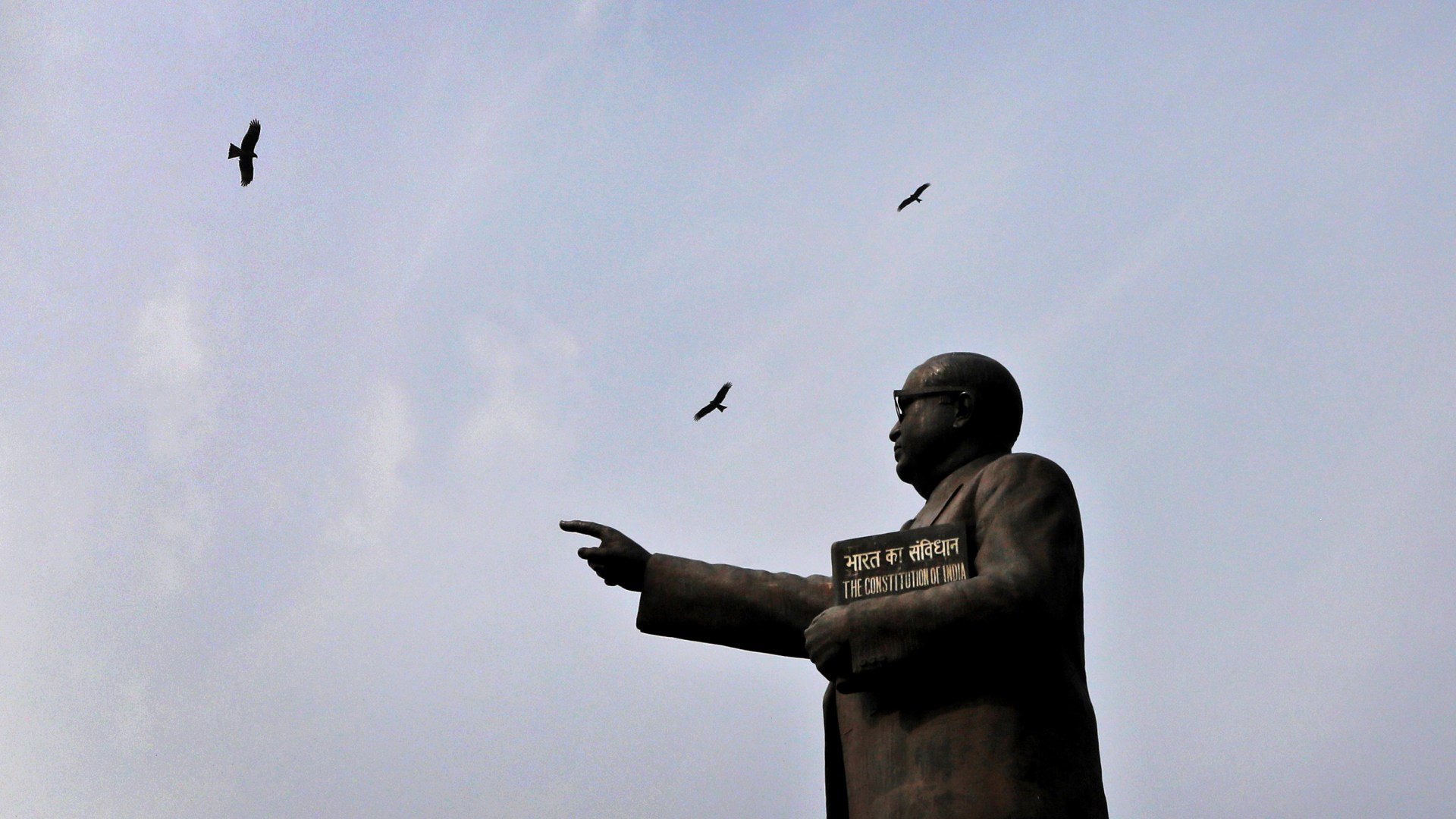
Birds fly over a statue of B.R. Ambedkar, who is regarded as the architect of India's constitution.

Birds fly over a statue of B.R. Ambedkar, who is regarded as the architect of India's constitution.

Christianity Today November 9, 2023
Manish Swarup / AP Images

Last month marked the 67th anniversary of India’s most famous Dalit’s conversion to Buddhism.

“Though I was born a Hindu untouchable, I shall not die as a Hindu,” wrote Bhimrao Ramji Ambedkar, who devoted his life to abolishing the caste system and who embraced his new faith just two months before his death in 1956.

The Dalit community cherished the activist and politician so much that half a million of his followers followed him to Buddhism. But Ambedkar was not always certain he would leave Hinduism for this other Eastern faith and he spent years engaging with the Bible and Christian leaders. A friend who served as a Methodist bishop later said that Ambedkar had twice asked to be baptized, and when in Delhi, he attended an Anglican church and was friends with its vicar.

“I have had a great impact on my mind of two great personalities, Buddha and Christ,” he said at a Christian gathering in 1938. “I want a religion which could teach us to practice equality, fraternity, and liberty.” But though he admired Jesus, Ambedkar was disappointed by the blind spots church leaders appeared to have toward his community and ultimately found numerous tenants of Buddhism that spoke to the Dalit condition.

Today, while many Dalits have rejected Hinduism for Christianity, millions more have converted to Buddhism. On April 14 of this year, 50,000 Dalits and individuals belonging to tribal communities participated in a Buddhist mass conversion ceremony on Ambedkar’s 132nd birthday.

Christians seeking to reach those in this community today would do well to remember Ambedkar’s praise of Buddhism—and his critiques of the church. Many of these feel sadly still true today.

Why Buddhism?

Born in 564 B.C., Buddha spent a significant portion of his life in India combatting chaturvarna, an ideology that would eventually evolve into the caste system. He staunchly opposed the rigid hierarchical social structure that classified individuals based on birth, challenging the notion that one’s status should be predetermined by factors such as caste, or varna.

A central theme in Buddhist teachings is the belief in the equality and inherent worth of all individuals, regardless of their social background. Because of this, Ambedkar saw Buddhism as a tool to challenge the caste system and attain social equality, which resonated deeply with the Dalit community.

Ambedkar spent considerable time comparing Buddha with Jesus, Mohammed, and Krishna, noting many of his observations in his essay, “Buddha and the Future of His Religion,” which he wrote in 1950, six years before his conversion. He noted Buddhism’s unique elements, such as:

  • The core of Buddhist faith lies in morality rather than a deity, distinguishing it from other religions where God holds that role.
  • Jesus asserted his divine identity as the Son of God and emphasized the need to recognize him as such for entry into God’s kingdom; Mohammed taught that salvation required accepting him as the final messenger of God; and Krishna declared himself as Parameshwara, the God of Gods. But Buddha was a regular man, who chose to live and preach as an ordinary individual.
  • Buddha’s religion was rooted in reason and experience. He urged followers not to blindly accept his teachings. He allowed for modification or abandonment of his teachings if they no longer applied.

Ambedkar’s overall case for Buddhism rested on his deeper conclusions about religion: society needed morality to function; religion needed to be in accord with science and also needed to recognize “the fundamental tenets of liberty, equality and fraternity,” and it could not “sanctify or ennoble poverty.”

“So far as I know, the only religion which satisfies all these tests is Buddhism,” he wrote.

[Buddha] taught as part of his religion, social freedom, intellectual freedom, economic freedom and political freedom. He taught equality, equality not between man and man only, but between man and woman. It would be difficult to find a religious teacher to compare with Buddha, whose teachings embrace so many aspects of the social life of people, whose doctrines are so modern and with main concern to give salvation to man in his life on earth and not to promise it in heaven after he is dead!

Today embracing Buddhism has allowed Dalits to reject the oppressive hierarchical structure of the caste system that has marginalized them in society, while simultaneously staying connected to their historical and cultural roots, since Buddhism began in India. (Though Christianity arrived in the first century, the religion is not indigenous to India.) Further, though the faith did not have a historically robust political presence, Ambedkar’s influence led to the rise of a neo-Buddhism movement that helped further fight for Dalit rights and representation.

Why not Christianity?

During his struggles against caste and untouchability, Ambedkar at one point considered encouraging Dalits to convert to Christianity. In order to defend themselves from the Hindu community, “Dalits had to think in terms of supplementing their strength from the outside,” wrote Anand Teltumbde, in Strategy of Conversion to Buddhism: Intent and Aftermath. “This strength could come only through merging with some other religious community, by converting to its religion.”

However, Ambedkar ultimately rejected this idea, recognizing that even within India, Christianity was not exempt from caste divisions. He likely understood that Dalits converting to Christianity wouldn’t alter their social standing; they would still be viewed as untouchables, not just by Hindus but also by those of higher castes.

Further, Ambedkar himself had faced discrimination from Christians during challenging times. After studying in the West, Ambedkar returned to India in 1918 and moved to Baroda (Vadodara) in Gujarat. He immediately ran into housing troubles; all the hotels had Hindu owners who did not allow untouchables. After he was forced to leave a hotel specifically for Zoroastrians, he asked a Christian friend to accommodate him in his house. The friend said that he would have to ask his wife.

“He and his wife came originally from a family which was Brahmin by caste and although on conversion to Christianity the husband had become liberal in thought, the wife had remained orthodox in her ways and would not have consented to harbour an untouchable in her house,” he later wrote.

Echoing Ambedkar’s experience, another prominent Dalit leader, the former speaker of the Indian Parliament’s lower house, was denied housing by an Indian Christian in London due to her Dalit identity.

These actions challenged Ambedkar, an avid student of the Bible who had a vast collection of biblical literature. In a 1938 speech, he had sharp words for missionaries and the Christian community in general, calling for Christians to go beyond religious conversion to address the broader issues faced by the Dalit community.

“Missionaries feel they have done their duty when they convert an untouchable to Christianity,” he said. “They do not look after their political rights.”

“The Christian missionary has never thought that it was their duty to act and get the injustice that pursues the untouchable, even after his conversion to the Christianity, removed. That missions should be so inactive in the matter of the social emancipation of the untouchable is of course a very sad thing. But far more painful is the inaction of the untouchable who became a convert to Christianity. It is the saddest thing. He continues to suffer from the Hindus the same disabilities which were his lot before conversion,” wrote Ambedkar, as quoted in volume 5 of his Speeches and Writings.

In Ambedkar’s view, the division between the secular and sacred within the Indian Christian community had largely kept them away from actively participating in Indian politics. Ambedkar urged Christians to actively engage in democracy and encouraged them to participate in politics and in government service.

Ambedkar highlighted the historical absence of Christians in Indian politics and emphasized the vital role of political support for the church’s institutional survival, noting that despite being labeled as ignorant, many untouchables had actively engaged in politics, holding 15 seats in the Legislative Assembly (at the time of his writing his speech), and benefiting from affirmative action scholarships and government hostels, which housed students who were poor, Dalit, or from a tribal background.

But at the same time that Dalits began to politically represent themselves and assert their rights, Christians failed to organize politically and had virtually no representation among the judiciary, wrote Ambedkar. In the absence of this power, they had no means of rectifying the injustices experienced by Christian untouchables.

Ambedkar placed much of this blame on the shoulders of educated (and higher caste) Christians, who he deemed responsible for building solidarity and for leading a political movement on behalf of Dalit Christians.

Ambedkar also questioned why Indian Christians had become inconspicuous in their own nation, despite the fact that they were overrepresented as educators and the educated. One of his theories concerned Christian Dalit and tribals’ dependence on foreign missionaries for economic sustenance. If they depended on the government, they would need to mobilize, agitate, educate, and organize their masses for effective political action. Without such organization, governments would not address their needs, leaving them marginalized in public life due to their lack of engagement in current affairs.

What Christianity does offer

For most Dalits, their fundamental existential question is the identity placed on them by the caste system. The historic Indian church and Western missionaries emphasis on Christianity’s salvation image and forgiveness from personal sin have often felt peripheral or like secondary concerns. For Dalits, too often, Christianity doesn’t present a trip to the Promised Land, or of liberation from physical suffering, but to a wonderful afterlife, that is Swarga or Indraloka (heaven).

Though Christians in India may not have been clear to Dalits about where God’s heart stood toward their condition, the Bible itself is clear. As the first chapter of the first book of the Bible states, “So God created mankind in his own image, in the image of God he created them; male and female he created them” (Gen. 1:27).

While Christianity can indeed offer Dalits the answer to their deepest questions about who they are, the church would do well to reflect on Ambedkar’s words. Even after all these decades, his prophetic voice continues to echo, urging the Indian Christian community to address broader issues and systemic problems. To this day, Dalit Christians have still not been able to secure their constitutional rights to affirmative actions, and the caste system is unfortunately pervasive in sections of the Indian Christian community.

In the light of this reality, the call for justice and a pursuit of the values of the kingdom of God become paramount. The church of Christ in India must continue to pursue the values of the kingdom of God and strive for justice for Dalits in India, especially Dalit Christians, and strive for a society where constitutional rights are upheld and the ubiquitous caste system is dismantled.

Ram Surat, a doctorate, has spent 27 years sharing the vision and mission of Bhimrao Ramji Ambedkar and fellow Indian anti-caste social reformer Jyotirao Govindrao Phule. Currently based in Bihar, India, he champions the cause of caste reconciliation among the Dalit and OBC communities in North India.

Surinder Kaur is Christianity Today’s South Asia correspondent.

News

Kids’ Access to Porn Is a Problem. Are State Laws the Solution?

As some Christian advocates fight for age verification, others say it’s parents’ responsibility to monitor.

Christianity Today November 9, 2023
Edits by CT / Source Image: Getty Images

When parents ask Chris McKenna at what age they should give their kid a smartphone, he has a stock answer: “the age you want them to see porn.”

The former youth pastor started Protect Young Eyes, a nonprofit that teaches tech safety to schools, businesses, churches, and parents, in 2015 after he became concerned about the dissolving barriers between pornography and young people.

“I was watching for the first time in human history as we were putting the internet in the pockets of kids,” he said, “and that terrified me.”

In the years since, the average age at which kids are first exposed to pornography has trended younger. Researchers estimated in 2021 it was somewhere around 11.

As data continues to show the harms of viewing porn, particularly for children, support for stricter legal limits on pornographers has grown. McKenna’s job description as head of Protect Young Eyes has grown too—it now includes political advocacy.

In 2019, McKenna testified before the US Senate Judiciary Committee, recommending lawmakers hold tech companies responsible for making safety filters and parental controls on their devices easier to use.

This year, McKenna consulted with lawmakers and testified before legislators in several states in support of new age-verification laws, which require porn websites to verify their users are 18 or older. Seven states—Texas, Louisiana, Utah, Mississippi, North Carolina, Arkansas, and Virginia—passed age-verification laws this year.

In Texas, McKenna helped lawmakers draft what became House Bill 1181, which Gov. Greg Abbott signed into law over the summer. The measure was immediately challenged on First Amendment grounds, and a district court judge struck it down, citing free speech and privacy concerns. The office of Texas Attorney General Ken Paxton is appealing his decision.

Paxton’s wife, Texas state senator Angela Paxton, was the original sponsor of HB 1181. The Paxtons are members at Prestonwood Baptist Church, a megachurch in Plano. A Prestonwood pastor, Mike Buster, worked with Paxton and Chris McKenna on drafting and advocating for the bill at the Texas statehouse.

The mechanics of each age-verification law differ across states. In Louisiana, porn websites automatically redirect visitors to a state-run website where they must upload their ID information. Most other states require the porn websites themselves to collect and verify users’ ID information.

But there’s no doubt the laws have curbed access to online pornography, whether directly or indirectly.

Pornhub, the nation’s largest pornographer, now blocks access to their site from users in at least four states—Utah, Arkansas, Virginia, and Mississippi—in an effort to evade requirements to collect user ID data. Four months after Louisiana’s law went into effect last January, a Pornhub spokesperson told CNN visits to their site from Louisiana IP addresses had decreased by 80 percent.

Christian ministries like Focus on the Family and Covenant Eyes have advocated for stricter obscenity limits in entertainment and in law for decades, often without any secular support. The National Center on Sexual Exploitation, a nonsectarian organization with Christian roots as the formerly known Morality in Media, has also spoken up in favor of regulations.

Sometimes caricatured as prudes or scolds, Christian anti-porn advocates grounded their advocacy in the biblical teaching that sex is sacred and that every human person, and their bodies, should be treated with respect and dignity. (Responses to new House Speaker Mike Johnson’s use of Covenant Eyes highlight the gap between how evangelicals and secular culture approaches porn use.)

But McKenna and other anti-porn Christian advocates argue that creating or viewing porn isn’t just sinful for Christians. They believe, like all other sins, it’s destructive for everyone.

Research continues to bear that out, which has moved the anti-porn position closer to the mainstream. So far, 17 states have passed resolutions naming porn a “public health crisis.”

Still, McKenna hopes more Christians will engage the issue. “I believe that church leaders should be showing up in flocks to support legislation that works toward creating safer digital spaces for children,” he said. “Families need more help.”

Some Christians and conservatives, however, don’t support a legislative approach. The provocatively named XXXChurch, a ministry that helps people struggling with porn addiction, says on its website that “blaming the porn industry for our problems or relying on legislation to protect us doesn’t work.”

Others are concerned that age-verification laws are an invasion of privacy or that the responsibility to protect kids from pornography rests with their parents, not the government.

Steve Demetriou is the parent of two young sons with a new baby on the way. He’s also a state representative in Ohio, where he recently introduced an age-verification bill. Demetriou is a member of the Greek Orthodox Church and said his faith, as well as prompting from a Catholic legislative aide, motivated him to introduce the bill.

“It’s already illegal in Ohio to distribute pornography to children,” Demetriou said. “We’re just bringing this into the digital age and creating common-sense barriers online.”

Demetriou says he’s sensitive to First Amendment concerns about the Ohio bill, which includes criminal penalties for using AI-manipulated images of a real person in pornographic videos without the person’s knowledge or consent. He said he plans to ask Ohio’s Casino Control Commission how they verify the age of their customers without violating free speech or privacy laws.

“We need to make it as difficult for kids … to watch porn online as it is to place underage sports bets or buying cigarettes,” Demetriou said.

Danny Huerta is a licensed professional counselor and the vice president of parenting and youth at Focus on the Family, where he oversees Plugged In, the conservative organization’s media reviews and ratings publication. He said age-verification laws are a “good start” in the effort to protect kids from online porn.

“I do think it could help some,” Huerta said. “It’s still not a substitute for parents to put filtering … and to be very intentional in their conversations with kids.”

Huerta, who has also counseled families in his private practice for 20 years, said he’s seen an alarming increase in the past decade in the number of kids watching pornography, as well as a troubling increase in the degree of deviancy in porn, including sexual violence, sexual activity with animals, and even sexual attraction to blood.

Huerta often recommends parents install porn-blocking software on their kids’ devices, even though it may slow the system’s processing. Products such as Net Nanny, OpenDNS’s FamilyShield, BrowseControl, and Net Angel offer to block certain websites identified as containing “adult content.” Huerta is particularly hopeful about Canopy, a filtering software that uses AI to learn in real time whether an image is pornographic and can instantly block it.

Still, Huerta said filters and even age-verification laws won’t fix everything. “Let’s say there’s an 18-year-old brother or 19-year-old who is accessing [porn]. Kids can still accidentally run into that,” he said.

That’s why Huerta is primarily focused on helping parents disciple their kids toward choosing to look away from pornographic images on their own. To that end, Focus on the Family has created a “phone contract” template that parents and kids can fill out together as they negotiate tech limits and consequences.

McKenna at Protect Young Eyes said the responsibility to protect kids from pornography can’t and shouldn’t rest solely on parents. He worries particularly about kids whose parents don’t have the time, knowledge, or motivation to guard their children’s tech use.

Instead, McKenna believes tech companies should be accountable to make their devices as safe as possible for kids. In Texas, he helped draft companion legislation to the age-verification law that would have set requirements for stricter default settings and simpler parental controls on device creators like Apple and Google.

“It currently takes over 30 steps to properly set up parental controls on an iPhone,” McKenna told federal lawmakers in 2019. He urged Texas lawmakers to force device manufacturers to simplify that process and make the default settings on any device that may be used by children the strictest possible. That could include blocking access to the internet or certain apps during school hours or overnight.

Texas lawmakers “ran out of time” to pass that bill, McKenna said, but he believes focusing policy efforts at the “device level” is the best way forward.

“We’ve created patterns of living and learning that require children to be online,” McKenna said. “Every single device knows when a child is using it. … Shouldn’t the default of that device be its safest possible version? Isn’t that how we treat everything else that kids use—cribs, car seats, bicycles, playgrounds?”

Some advocates say they favor the device-filtering laws since age-verification laws risk being overturned on constitutional grounds like in Texas.

Nevertheless, McKenna at Protect Young Eyes is hopeful Texas’s age-verification law will survive judicial scrutiny and prove ultimately worthwhile—and that other states will consider similar measures.

“It has to work at some level,” he said.

Theology

The Eternal King Arrives

Journeying through Advent with our humble and mighty Savior

Phil Schorr

Welcome to the season of Advent. It’s a special time in the Christian calendar—one that we all want to take heed of, with its deep and lasting significance, even in the midst of the season’s sometimes overwhelming demands. As you and your family approach a time of full calendars and bustling kitchens, candlelit services and living rooms strewn with wrapping paper, we invite you to journey through the season with this Advent devotional.

This devotional is meant to help you dive deep into theological truths and personal revelations as we prepare to celebrate the arrival of our humble and glorious King. We have structured the devotional to help us ponder the glory and tenderness of Christ, who came in the form of a vulnerable baby and displayed a gentle love for his creation through his incarnation. Throughout the month of December, we will herald both the sovereignty and power of his kingship and his self-emptying lovingkindness.

First, we will immerse ourselves in the prophetic inauguration of Christ, with devotionals that speak to the hopeful yearnings of Israel for the promised King—and the signs that would accompany his revival—woven throughout the Old Testament. Next, we will celebrate the eternal jubilee that Jesus’ incarnation heralds: a time of freedom, joy, and new life that he now offers. Finally, we will draw near to Christmas Day by gazing in awe at Christ’s royal enthronement and the establishment of his kingdom. He is our long-awaited Savior, and this Advent we celebrate the life-changing truth that our eternal King has arrived.

This article is part of The Eternal King Arrives, a 4-week devotional to help individuals, small groups, and families journey through the 2023 Advent season . Learn more about this special issue that can be used Advent, or any time of year at http://orderct.com/advent.

Church Life

I Started Attending Diwali Parties to Break Out of My Christian Bubble

I was raised in a vibrant Indian community. How I’m trying to build relationships with Hindu friends in America.

Christianity Today November 9, 2023
Illustration by Abigail Erickson / Source Images: Getty, Unsplash

“We have turned into the kind of Indians we have always hated.”

I cringed. I couldn’t believe my husband would say something like this—at least out loud. But inside, I agreed.

Though we are both ethnically Indian, I grew up in the Middle East among other Indian immigrants, while my husband was born and raised in India in a town where his family has lived for generations.

We’ve both been living in the United States for nearly two decades now. And while we both wanted to retain ties to our Indian community in the US, over the years, we’ve struggled to keep the connection.

Part of the reason was because we wanted to strengthen our Christian connections. We became increasingly involved in our (predominantly white) church, and our family found it comfortable to stay in our “holy huddle” even if that meant becoming more and more Americanized. But even as we judged others who had forsaken their Indian traditions, we worried we were doing the same.

Something has changed in recent years, though. I have felt God prompting me to cultivate closer relationships with my Hindu Indian friends. I still receive invitations to Diwali and Holi celebrations, and lately I’ve begun to accept these offers.

I’m not interested in worshiping their deities or adopting a syncretistic faith. Rather, I now see that my Indian heritage is a gift that allows me to build relationships with people who share my culture, who intuitively feel comfortable with me. Sometimes that leads to opportunities for me to thoughtfully share about my relationship with God.

After years of trying to find a Christian community in America, I realize I’m now called to lean into the process that the apostle Paul described as “being all things to all people” for “the sake of the gospel” (1 Cor. 19:22–23).

I grew up in a religiously diverse community in Oman, where my family and I lived in an Indian immigrant enclave. Thousands of miles from our loved ones, we attended each other’s birthday parties, watched movies together, and ate dinner with one another.

Whether Christian, Hindu, or Muslim, we didn’t live as isolated nuclear families; rather, mothers and fathers parented every child as their own, and I knew each adult as my uncle or aunt. We learned our mother tongues and retained our traditions easily. I had a ringside seat to the celebration of many Hindu festivals and felt that casually observing religious holidays didn’t compromise my Christian faith.

After moving to the US, our Hindu friends always remembered us and invited us to celebrate. They kept asking us to join them. But our schedules filled up, often with church events, and we found ourselves declining most invitations.

While these rejections were primarily due to family logistics, in speaking with Indian church leaders, I noticed deeper theological concerns. Christians attending Diwali or Holi events risk “making the gospel softer,” Nitin Christopher, senior pastor at Church of the Way in Plano, Texas, warned me.

Though American culture may see these holidays as more broadly “Indian,” pastors of Indian immigrant congregations I spoke to in Texas, where I live, said they don’t see these holidays as ideal outreach times because of their Hindu origin.

In some ways, the fact that I grew up (casually) celebrating these holidays makes me more of what I would call a “normal” Indian. Most Indian Christians do not observe the festivals with the intent of a puja (act of worship).

Many of us would have a day off from school for Diwali or Eid, and we loved it when our friends came with sweets prepared specially for the day, and even small gifts or trinkets. We lit sparklers and firecrackers for Diwali, and everyone loved playing with the colored powder for Holi. It did not seem sinful to be happy for our friends on their special festival days.

When I moved to the US, I wanted my family to belong. But belonging in America looked different from the kind I had experienced growing up.

It often meant pretending to understand what TV shows or singers everyone was discussing. American friends and acquaintances misunderstood my Indian slang, and I determined to never use those phrases out of the house again. I felt exhausted from my self-consciousness about my “conspicuous” attire, with its bright colors and ethnic jewelry. I decided to attend church events in Western clothes to fit in.

But what if there was a place where these parts of my culture—which I had learned to reject—might not only be accepted but also help me lean into what I believe is God’s call in my life: to be a bridge builder?

Since I’ve begun actively reaching out to my Hindu friends again, I’ve started to reflect on Paul’s words in 1 Corinthians 9:19–23:

Though I am free and belong to no one, I have made myself a slave to everyone, to win as many as possible. To the Jews I became like a Jew, to win the Jews. To those under the law I became like one under the law (though I myself am not under the law), so as to win those under the law. To those not having the law I became like one not having the law (though I am not free from God’s law but am under Christ’s law), so as to win those not having the law. To the weak I became weak, to win the weak. I have become all things to all people so that by all possible means I might save some. I do all this for the sake of the gospel, that I may share in its blessings.

Paul also tells us in Galatians 3:28, “There is neither Jew nor Greek, slave nor free, nor is there male and female, for you are all one in Christ Jesus.”

This verse “does not mean the dissolution of all identities under one; instead, it can be shown through other passages in Paul that he expects his pagan listeners to accept a new identity as Christians, but at the same time not to discard or deny previous identities,” writes Felix K. Maier, who studies cross-cultural interactions in the Roman Empire.

Paul embraced various identities and spaces, viewing them as tools provided by God for spreading the gospel. Despite his role as an apostle to the Gentiles, he cherished his Jewish heritage and maintained ties with his kin. His Roman citizenship endowed him with rights and credibility. He respected the cultures he encountered and used this knowledge to connect with people effectively.

Further, Paul’s upbringing in the multicultural city of Tarsus shaped his complex character. His ministry primarily focused on Gentiles, forming diverse churches with leaders from various backgrounds. He fostered relationships with individuals across societal hierarchies, from slaves to their masters, exemplified in his correspondence with Philemon and Onesimus.

As I studied Paul’s example, I asked myself what it would mean for me to lean into my eclectic identities and begin using them to build relationships. Could I once again get comfortable in Hindu spaces? I hardly felt like I could invite my Hindu friends to church events or functions if I was unwilling to meet them at gatherings they were organizing.

Despite my convictions and my shared heritage, truthfully, I felt awkward the first time I accepted my Hindu friends’ invitation to a Diwali celebration.

I had become used to a very Western form of Christianity and Western hospitality expectations. Even dressing up in Indian clothing felt unfamiliar, let alone dealing with Indian culture, which includes tables filled with sweets and delicacies, children running around, silks, sarees, jewelry, the scent of flowers, agarbatti (incense sticks), and people stepping in to help the hostess and make themselves at home. Things are not always super scheduled at Indian events—not that we don’t ever plan things—and time often flows freely.

I wondered if I had forgotten how to behave around people who were Indian, as even the Indian Christians I knew had adopted Western habits. And yet, on the other hand, I knew the rituals and inside jokes—and that affirmed my presence.

Over time, our shared culture has allowed me to build trust more quickly, to engage my friends in spiritual conversations, and to discuss God with them. Sometimes I even end up pushing them slightly out of their comfort zones by asking how I might pray for them.

As an Indian, I see myself as a counterexample to my Hindu (and Muslim) friends, who might worry that becoming a Christian might cost them their heritage. (Christianity, I often point out, has been in India since St. Thomas shared the gospel here in the first century.) And regardless of where Christians might fall on this holiday discussion, Indian Christians, like other Christians who are part of a specific subculture, have a unique responsibility and role in reaching the people with whom we share a heritage.

Today, part of being a Christian in the Hindu community means being an ambassador for Christianity.

Growing Hindu religious extremism has increased violence against Christians and other religious minorities in India. An unfortunate number of Indian Americans and immigrants to America have continued to cheer Modi and his regime on. Among other reasons, the intense persecution of many Christians in India underscores the criticality of the American Hindu community’s relationship with Indian Christians.

Having wrestled with these feelings for years, I have concluded that Christ has not called me to discard or deny the identity I was born into—or the one I’ve put on since coming to America. Instead, I believe Christ seeks to reconcile my different parts into a cohesive bridge that connects non-Christians in my world to him.

Perhaps my husband’s statement—that we’d become exactly the kind of Indians we didn’t want to be—is one we both needed to think about and contemplate. Maybe it wasn’t about hating the kind of immigrants we had become, but about the wake-up call we needed to hear to become the immigrants God intended us to be.

Sherene Joseph is a third-culture kid born in India, raised in the Sultanate of Oman, and now living in the United States. She is currently working on the SICNA21 (Study of Indian Christians in North America 2021) project, including recording an oral history of the community and studying the prospects and challenges facing the diaspora.

Church Life

Pray for the Persecuted Church. But First Learn About It.

Amid rising persecution to Christians in the world, here are some stories that can guide your intercessions.

Schoolchildren participate in a peace rally against ethnic clashes in Manipur state.

Schoolchildren participate in a peace rally against ethnic clashes in Manipur state.

Christianity Today November 8, 2023
Bikas Das / AP Images

Christians around the world are praying for their 360 million brothers and sisters in Christ who live in countries with high levels of persecution and discrimination, as part of the International Days of Prayer for the Persecuted Church, which fall on Sundays November 5 and 12.

One in 7 Christians worldwide—including 1 in 5 believers in Africa, 2 in 5 in Asia, and 1 in 15 in Latin America—suffer greatly for their faith, according to the 2023 World Watch List (WWL). That’s up from 260 million in the 2020 report.

https://datawrapper.dwcdn.net/zZvb1

Among believers who live under threat of violence, in Latin America, Colombian Christians are most at risk, followed by Mexican. In Asia, Pakistan ranks first, closely followed by India and Myanmar, while Nigeria ranks first in Africa and worldwide.

https://datawrapper.dwcdn.net/dCNp8

The hardship affecting the greatest number of Christians is displacement, with 124,310 Christians forced to leave their homes or go into hiding for faith-related reasons, in addition to 14,997 Christians who were forced to leave their countries.

While persecution is on the rise, however, the number of Christians coming to the United States from countries on WWL resettled as refugees dropped from 32,248 in 2016 to 9,528 in 2022—a decline of 70 percent.

In 2021, President Biden set the refugee ceiling at 15,000 before raising it to 62,500 after faith groups protested. This past year, the ceiling was set at 125,000—however, the US resettled only about 60,000 refugees in fiscal year 2023.

https://datawrapper.dwcdn.net/AjZLY

CT seeks to report the news affecting the global church, so that as the body of Christ cries out in pain, Christians can cry out to the Lord on their behalf. Believers can extend their prayers for non-Christians who may be part of the same targeted minority groups as Christians. Believers also may pray for the persecutors, as Jesus himself instructs (Matt. 5:43–48).

Here are 10 stories about the persecuted church that CT hopes readers can use to guide their prayers this year.

Apple PodcastsDown ArrowDown ArrowDown Arrowarrow_left_altLeft ArrowLeft ArrowRight ArrowRight ArrowRight Arrowarrow_up_altUp ArrowUp ArrowAvailable at Amazoncaret-downCloseCloseEmailEmailExpandExpandExternalExternalFacebookfacebook-squareGiftGiftGooglegoogleGoogle KeephamburgerInstagraminstagram-squareLinkLinklinkedin-squareListenListenListenChristianity TodayCT Creative Studio Logologo_orgMegaphoneMenuMenupausePinterestPlayPlayPocketPodcastRSSRSSSaveSaveSaveSearchSearchsearchSpotifyStitcherTelegramTable of ContentsTable of Contentstwitter-squareWhatsAppXYouTubeYouTube