Inkwell

Chapel

Inkwell October 23, 2023
Photography by Gauhi H.

I’ve burned a lot of chapels,
but I left this one standing.
Particles lilt and descend
in the sanctuary
like slow manna,
the thought of snow
and providence.
There’s no ground
past the stained glass,
the cave of holy beasts,
the hollow atrium
waiting on the promise
of an impulse.

There are three souls
here with me;
they carry
no words
in their briefcases,
they clothe
their eyes
and teeth.

The chapel faces east;
the sun
is threaded
through four
windowpanes
intersected by
a cross.
By four panes
we wait
for movement
through glass
and such resplendence
that we shed
these atoms
and find
valence
in the speaking
Light.
By four panes
we wait
for lift. 

Riley Bounds is a poet and editor of Solum Literary Press work has appeared or is forthcoming in Amethyst ReviewThis Present Former Glory: An Anthology of Honest Spiritual LiteratureHeart of Flesh Literary Journal, and Saccharine Poetry, among others.  

News

Abolitionist Bible to Go on Public Display

And other news briefs from Christians around the world.

On one of the first pages in the Bible, William Turpin kept a handwritten list of names and details of dozens of enslaved people he freed between 1807 and 1826.

On one of the first pages in the Bible, William Turpin kept a handwritten list of names and details of dozens of enslaved people he freed between 1807 and 1826.

South Carolina State Museum

A Bible containing a rare record of Christian opposition to slavery is going on display for the first time in the South Carolina State Museum in Columbia. The Bible once belonged to William Turpin, who with his business partner Thomas Wadsworth bought human beings in the late 1700s. The men then became convinced slavery was immoral and freed them. Turpin recorded the names of 31 people freed from their enslavement in his Bible.

CMA sees small split over women in ministry

At least eight congregations have left the Christian and Missionary Alliance (CMA) over women in ministry. In June, after several years of discussion, the denomination decided that women may be ordained and carry the title “pastor” at the discretion of local churches, while eldership, which includes the lead pastor, will remain exclusive to men. According to the CMA, the new position recognizes that people who are equally committed to the authority of Scripture interpret key passages about women in church roles differently. But some of those leaving say it is “a significant step toward egalitarianism.” The departing churches have not indicated whether they will form a new denomination.

Canada: Court won’t hear churches’ COVID-19 case

The Supreme Court of Canada declined to hear an argument by a group of British Columbia churches that COVID-19 restrictions violated their constitutional rights. A lower court ruled the pandemic restrictions may have violated Charter rights but were nonetheless permissible as the government had to balance those protections with the legal mandate of the provincial health department. The lower court also noted the restrictions were time-limited, setting-specific, and following the best available scientific advice. Similar legal challenges have been dismissed in other provinces as well.

Haiti: Church members die while attacking gangs

Seven evangelicals died in a confrontation with the gangs that have taken over most of Haiti’s capital, Port-au-Prince. Pastor Marcorel Zidor reportedly told members of his church that their faith would make them bulletproof. Church members marched with sticks and machetes and attacked the armed gangs. Haiti has been in crisis since its president was assassinated in 2021.

United Kingdom: “Wycliffe’s Oak” up for tree award

An old oak believed to have once shaded Reformer John Wycliffe as he preached in Surrey, England, was nominated for a conservation charity’s tree-of-the-year competition. The tree is about 800 years old, and its trunk measures nearly 24 feet around. Wycliffe is said to have preached under it in 1370. The Baptist Charles Spurgeon preached beneath it in 1872.

Switzerland: WEA criticized for meeting with Iranians

The World Evangelical Alliance (WEA) accepted a controversial invitation to an Iran-hosted forum on religion and human rights. The country ranks eighth on Open Doors’ persecution watch list, and some evangelicals sharply criticized the WEA for agreeing to meet with Iranians. Johnnie Moore, who previously served on the US Commission on International Religious Freedom, said the WEA is “becoming part of the problem,” and the head of Iran Alive Ministries said the organization was dangerously naïve. WEA’s secretary general Thomas Schirrmacher defended the meeting, however. He argued it is good for Christians to be seen as conversation partners by countries that usually regard them only as troublemakers. “They asked us to explain: What can evangelicals contribute to the good of society?” he said. “I would have a bad conscience if we did not use such opportunities to testify in the court of the world.” Iranian officials arrested 134 Christians last year, according to the best available records. Nearly 50 were tortured.

Rwanda: Bible price increases

The Bible Society of Rwanda has raised the price of Bibles by about 200 percent after seeing donations drop sharply. Antoine Kambanda, the Catholic cardinal who heads the multidenominational organization, said the Bible society had become too dependent on foreign funds, relying on Christians outside of the country to cover about 85 percent of publication expenses. “It is high time Rwandans begin to contribute to that work of publishing the Scriptures,” he said. The organization now sells Bibles for around 8,000 Rwandan francs (the equivalent of about $7 USD).

China: Church growth stagnant, study finds

The growth of Christianity has stalled in China, according to a new Pew Research Center study of Chinese academic and government surveys. Depending on the wording of the survey question, between 2 and 3 percent of adults said they are Christian. That correlates to about 18 million Protestants. While churches are seeing new converts, many Christians also leave the faith. In a four-year period, researchers found that roughly one-quarter of believers stopped identifying as Christian. The most recent data Pew evaluated is from 2018.

Japan: Missionaries get new title

A3, an evangelical organization that started in the 1960s with short-term missionaries teaching English in Japan, has decided it will no longer use the word missionary. Christians sent to work in cross-cultural contexts will now be called “missional partners.” A3, formerly known as Asian Access, has been led by Japanese Christians since 2022. They decided missionary seemed too Western. Other Christians who do cross-cultural ministry have also argued the word is not biblical and has lost its usefulness, even preventing people from answering a call to missions. Today, A3 sends people to 18 Asian countries, as well as the Middle East and Central America, to form learning cohorts that develop Christian leaders.

The winds of change are not blowing gently at Regent University in Virginia Beach. In July, the board of trustees named a new president and an interim law-school dean. Some students and alumni say those changes signal a disturbing philosophical shift away from Regent’s conservative moorings. Students are also crying foul over the manner in which the former law-school dean, Herbert Titus, was removed.Student leaders claim Titus’s removal violated the school’s policy on tenure and that it will upset the ratio between students and faculty. For those reasons, some fear the law school will be unable to gain full accreditation with the American Bar Association (ABA). The school currently has provisional ABA accreditation.Regent University policy requires faculty contract renewal unless the faculty member has breached that contract, says student council member Norm Sabin. “[Breach of contract] has not been put forth or even alleged in the situation with Dean Titus.”“The events and the way they were brought about … shed some doubt on whether the tenure system as represented was really there,” Sabin says. “Without tenure we cannot get ABA approval.” Further, he says, replacing Titus with faculty member Paul Morken helps bring the student-to-faculty ratio to a level the ABA considers “unacceptable.”Titus holds a conservative approach to constitutional law that Sabin characterizes as “very much textually oriented.” Some speculate he was removed in an effort to tone down the school’s conservative emphasis. Trustees have not explained their reasons, saying only that before his dismissal Titus was offered a paid sabbatical and a professorship, which he rejected.In an interview with CT, new president Terry Lindvall declined to explain why Titus was removed, indicating that litigation is pending. Lindvall says that Regent is “still very much committed to accreditation,” and administrators are “adjusting” to the upset student-to-faculty ratio. “We’ve got some professors who are teaching more than what’s really healthy, but at the same time it is not endangering the quality of education.”Titus’s removal is not the only personnel change making waves. Several alumni and students believe Lindvall’s appointment is another indication of a philosophical move to the Left.Says Tom Blackstone, Regent alumni association president, “Our primary concern is … to avoid institutional drift and what we call the ‘Duke-Harvard syndrome,’ whereby schools that began with a godly base within generations became secular humanist bastions in the areas of the liberal arts.”Lindvall, a communications professor and film producer, says Regent is going through “growth pains,” and that his first priority is to “bring reconciliation to the whole community.”“Regent has been almost sectarian and provincial in its first 15 years,” says Lindvall. He wants to stress Christian scholarship and women and minority enrollment.By Thomas S. Giles.
News

Trump-Era Controversies Had a Measurable Effect on Church Attendance

Politically moderate and left-leaning evangelicals appear to be most impacted.

Seventyfourimages / Envato / Edits by CT

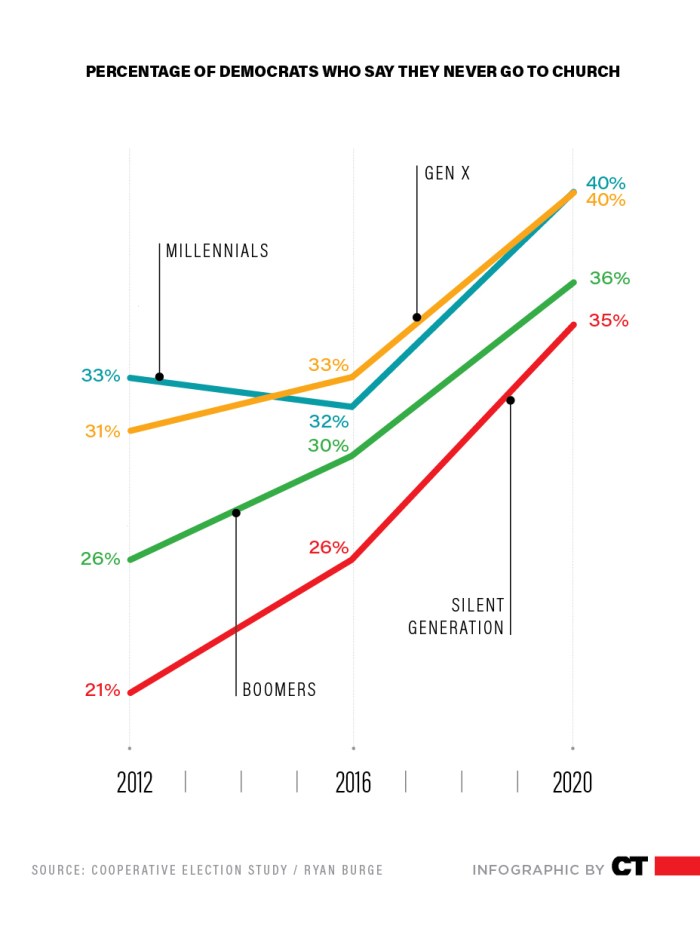
Donald Trump’s presidency accelerated the decline of church attendance in America. While the number of people going to church was already going down steadily, data from Harvard University’s Cooperative Election Study shows an “exogeneous shock” in 2016, according to political scientist Ryan Burge, who specializes in the study of religious data.

“For every action there is a reaction,” Burge told CT. “Donald Trump is the action. His election caused all these ripple effects in American society, and you can see it in the pews.”

Politically moderate and left-leaning evangelicals appear most impacted. A growing number seem to have felt estranged from their congregations in the Trump era. The rate of self-identified Democrats giving up on church in their 20s–50s doubled from the end of Barack Obama’s presidency to the end of Trump’s, according to Burge. And the dramatic change came in 2016. At the same time, more Republicans started identifying as evangelical but not attending any worship services.

The growing consensus of social scientists is that political identities are currently much, much stronger than religious commitments.

The winds of change are not blowing gently at Regent University in Virginia Beach. In July, the board of trustees named a new president and an interim law-school dean. Some students and alumni say those changes signal a disturbing philosophical shift away from Regent’s conservative moorings. Students are also crying foul over the manner in which the former law-school dean, Herbert Titus, was removed.Student leaders claim Titus’s removal violated the school’s policy on tenure and that it will upset the ratio between students and faculty. For those reasons, some fear the law school will be unable to gain full accreditation with the American Bar Association (ABA). The school currently has provisional ABA accreditation.Regent University policy requires faculty contract renewal unless the faculty member has breached that contract, says student council member Norm Sabin. “[Breach of contract] has not been put forth or even alleged in the situation with Dean Titus.”“The events and the way they were brought about … shed some doubt on whether the tenure system as represented was really there,” Sabin says. “Without tenure we cannot get ABA approval.” Further, he says, replacing Titus with faculty member Paul Morken helps bring the student-to-faculty ratio to a level the ABA considers “unacceptable.”Titus holds a conservative approach to constitutional law that Sabin characterizes as “very much textually oriented.” Some speculate he was removed in an effort to tone down the school’s conservative emphasis. Trustees have not explained their reasons, saying only that before his dismissal Titus was offered a paid sabbatical and a professorship, which he rejected.In an interview with CT, new president Terry Lindvall declined to explain why Titus was removed, indicating that litigation is pending. Lindvall says that Regent is “still very much committed to accreditation,” and administrators are “adjusting” to the upset student-to-faculty ratio. “We’ve got some professors who are teaching more than what’s really healthy, but at the same time it is not endangering the quality of education.”Titus’s removal is not the only personnel change making waves. Several alumni and students believe Lindvall’s appointment is another indication of a philosophical move to the Left.Says Tom Blackstone, Regent alumni association president, “Our primary concern is … to avoid institutional drift and what we call the ‘Duke-Harvard syndrome,’ whereby schools that began with a godly base within generations became secular humanist bastions in the areas of the liberal arts.”Lindvall, a communications professor and film producer, says Regent is going through “growth pains,” and that his first priority is to “bring reconciliation to the whole community.”“Regent has been almost sectarian and provincial in its first 15 years,” says Lindvall. He wants to stress Christian scholarship and women and minority enrollment.By Thomas S. Giles.
News

American Evangelicals Divide over Ukraine

Republican candidates make competing arguments to potential voters.

Illustration by Mark Harris

Ministers detained by police. A secret service that searches sanctuaries, questions clergy with polygraphs, and puts church leaders under house arrest. A president who threatens to ban any religious organizations with ties to a neighboring country.

For American evangelicals concerned about international religious freedom, these reports would be enough to raise alarms about any country. But they’re even more alarming when they’re coming from a nation their government is backing in a war.

These were likely the kind of stories former Fox News commentator Tucker Carlson had in mind in July when he asked former vice president Mike Pence whether Christian voters could, in good conscience, continue to back US support for Ukraine and Volodymyr Zelensky in the war with Russia.

“The Zelensky government has raided convents, arrested priests—has effectively banned a Christian denomination,” Carlson claimed, referring to the Ukrainian branch of the Russian Orthodox Church.

The exchange, at a gathering of conservative Christians in Iowa, quickly got testy. And Carlson was roundly criticized by supporters of Ukraine. The Orthodox Public Affairs Committee, a US-based group, accused Carlson of spouting “Russian propaganda.”

But a growing number of American evangelical voters appear to be asking the same questions Carlson is asking. Many are expressing growing doubts about US support for the war.

American evangelicals backed Ukraine pretty vigorously at the outset. In fact, when Russia invaded Ukraine last February, they were more likely than other Americans to support Ukraine. According to an Economist/YouGov poll in March 2022, 77 percent of American evangelicals said they were sympathetic to Ukraine, compared to 73 percent of the general US population.

Some Americans’ support is as strong as it ever was. Brent Hobbs, a Southern Baptist pastor from Virginia Beach, Virginia, sees the issue as a litmus test of who he would vote for in an election. For him it’s a question of good and evil. And he believes that because of its geopolitical implications, the war is the No. 1 issue facing the US.

“I would not support someone who is saying, ‘We’re supporting Ukraine too much,’ or ‘We need to stop funding the war’—like, that’s off the table,” Hobbs said.

Others, however, seem to be having second thoughts. By the end of July 2023, 55 percent of Americans told CNN that they thought Congress should not authorize more funding for Ukraine. The exact amount of evangelicals isn’t broken out, but among Republicans, more than 70 percent said too much money has already gone to the international conflict.

There are other signs of a sea change. At a July event put on by Turning Point USA, the conservative political organization asked the 6,000 people who had come to see former president Donald Trump how they felt about Ukraine. Should the US continue to be involved? Ninety-six percent said no. It is unclear how many of those in attendance were evangelical, but the group has been hosting many events at churches and pitching its political vision to evangelicals in particular.

Turning Point USA founder Charlie Kirk, who identifies as evangelical, read the results on stage and urged Republican candidates to pay attention.

“When will politicians learn that you can’t tell voters what to believe?” he said.

Views of Russia’s Vladimir Putin seem to be shifting too. Evangelicals, like most Americans, have largely held a negative view of Russia during the conflict, but some have expressed warmer feelings toward Putin, who has positioned himself as a defender of traditional family values. A recent survey found that people who believe the US should be a Christian nation were more likely to support him.

Eschatological expectations might prompt some evangelicals not to want to get involved in the conflict, too. Before his death, televangelist Pat Robertson said Putin was “compelled by God” to invade Ukraine as preparation for war against Israel, which some believe will be a precipitating event, foretold by the prophet Ezekiel, at the start of the end times. Popular preachers Greg Laurie and Tony Evans have said similar things.

But mostly, evangelical sentiments on Ukraine seem to reflect the shifting views of politicians.

Some Republicans, such as Pence, who dropped out of the race in October, vowed to continue supporting Ukraine. Others, notably Trump, who once called Putin a “genius,” have expressed mounting skepticism. Presidential candidates Ron DeSantis and Vivek Ramaswamy said they would stop sending money to Ukraine.

According to the CNN poll, most Americans believe the US has sent enough aid. And at least some seem concerned over reports of the Ukrainian government cracking down on the Ukrainian Orthodox Church.

Last year, the church voted to cut ties with Moscow, though due to the complexities of canonical law, it has not been a clean break. Tetiana Kalenychenko, a sociologist who wrote her doctoral dissertation on religious aspects of the war in Ukraine, said the church has split into three factions. Zelensky proposed a law that would criminalize the one that has ongoing affiliation with Moscow.

“These actions are not the actions of a democracy, as many within the international media have tried to portray Ukraine,” Charisma magazine staff writer James Lasher argued. “Instead, these actions are reminiscent of Vladimir Putin, who is known for his crackdowns on political and religious opposition and the one whose hunger for power led to the conflict between Russia and Ukraine.”

The United Nations Office of the High Commissioner for Human Rights also warned the law would violate protected freedoms. The bill was ultimately tabled.

But Ukrainian authorities insist this isn’t about opposition to Orthodox priests but opposition to people inside Ukraine who are using religion as a cover to aid the invasion and support Russia. Some priests have been accused of spying, sending geolocations of troops to the Russian military. Ukraine’s secret service has raided churches and monasteries and found Russian propaganda.

Taras Dyatlik, regional director of the United World Mission’s Overseas Council, says some of the allegations may be valid, but people outside Ukraine should not be too quick to judge people living in a war zone, facing an existential threat. The details are complicated. There are extenuating circumstances.

“Western media try to judge and assess the religious situation in Ukraine from the normalities under your peaceful skies where you do not have the ongoing full-scale war and you are protected with NATO and nuclear weapons,” he said, “but living in the country during the war gives you [a] different reality.”

Voters, however, will have to judge one way or another. In the Republican primaries, candidates are making their cases. In front of an audience of 2,000 evangelicals at the Family Leadership Summit in Iowa, Pence said supporting Ukraine was in American interests.

“Anybody that says that we can’t be the leader of the free world and solve our problems at home has a pretty small view of the greatest nation on earth,” he said. “If Vladimir Putin overruns Ukraine then I have no doubt that the Russian military will cross the borders of a NATO country that our military will have to defend.”

There was a smattering of applause at the Iowa gathering. But there were boos, too, and right now it’s hard to tell which are louder.

Jonny Williams is a reporter based in Rhode Island.

Editor’s note: CT now offers select articles translated into Russian and Ukrainian.

You can also join the 10,000 readers who follow CT on Telegram: @ctmagazine (also available in Russian and Chinese).

News

Indian Church Draws Strength from Ostracism

Facing fresh attacks from Hindu nationalists, Wesleyans recall the history of God’s faithfulness in a Gujarat village.

Surinder Kaur

The Easter baptism video didn’t cause a stir when it first appeared online. It was shared by Christians at the Wesleyan church in the small village of Dandi in Gujarat, India, to celebrate the baptism of seven brothers and sisters in Christ. The ceremony and the video were both simple. The Christians rejoiced as they have since a woman named Ela Burman made the first profession of faith in Dandi more than 80 years ago.

Then, after the COVID-19 pandemic restrictions eased, the video mysteriously started circulating again. This time, it came with a warning.

“This is a wakeup call to all Hindus,” the edited video said. “If we do not wake up and act now, the entire village will become Christian.”

The next day, the baptism video made headlines in local papers and the story was picked up by several TV stations. The day after that, police showed up and took the church’s pastor, Daniel Dandiwala, into custody.

“I think it was planned,” Dandiwala told CT.

Dandiwala hadn’t done anything illegal, so authorities had to release him. But that didn’t end the harassment. Local authorities seized all the church’s account books and files and, according to leaders at the Evangelical Fellowship of India, attempted to challenge the church’s long-established legal standing.

Then right-wing Hindu nationalist groups organized a march, gathering around 1,000 people to protest conversions. A temple was constructed right next to the church, opening its doors in January 2023. Hindu religious leaders seemed to start targeting the 80 young people who attended Wesleyan prayer meetings.

By late summer, the temple had convinced about a quarter of them to “revert” to Hinduism.

“They are engaging in a form of rivalry with the church,” said John Parmar, the current Dandi pastor. Some of the young people, he said, “have been deeply swayed by right-wing ideology and a few of them have even developed a negative sentiment toward the church.”

Christians in India have faced a rising tide of hostility, aggression, legal problems, and violence ever since Narendra Modi’s ascension to prime minister in 2014. Many in Modi’s political party promote “Hindutva,” or Hinduness, and see pluralism and secular democracy—where everyone has equal rights—as a threat to a Hindu nation.

The number of verified incidents against Christians has gone up more than 300 percent between 2015 and 2022, according to the United Christian Forum, and some experts think the group’s count of nearly 600 attacks last year is too conservative. The number might be close to twice that. The worst ones have left Christians dead, churches on fire, and thousands fleeing their homes.

Christians in the country are exhausted by accusations of illegal proselytization that nationalists make hoping to whip up Hindutva supporters. Yet many, like the steadfast Wesleyans in Dandi, are facing these challenging times with equanimity. Their trust in God is not shaken, they say, and their call as followers of Christ has not changed.

“Opposition and persecution have been promised to us in God’s Word,” Parmar told CT, “and this church has endured it for years.”

The Dandi church can remember past periods of intense ostracism—years before the current political climate made things difficult for Christians—and they recall that God was faithful.

The first missionaries arrived in the fishing village in 1913 and built a medical dispensary. They saw no conversions in the first 10 years. No conversions in the next 10. And then, after 24 years, a woman brought her infant son to them and asked them to heal him. Two days later, he was better, and Ela Burman placed her faith in Christ.

“Nobody knows if the missionaries treated the baby only with medicine or also prayed over him,” said Vamman Bawa Bari, an 86-year-old Wesleyan pastor. “But Mom was happy I was alive.”

The church grew despite opposition.

By the time Bari was in his teens in the 1950s, seven young people had dedicated their lives to Christ. Around that time, the missionaries left and the village decided the small squad of converts was a problem and ostracized them. The young Christians were isolated completely: People wouldn’t talk to them, they weren’t allowed to share a meal with a relative, they couldn’t get water from the common tap, and shopkeepers wouldn’t sell to them.

“We go to the nearby villages where different communities live and buy our groceries, vegetables, fruits, and all necessities from there,” Bari recalled. “There were years when we walked from one village to the next every day, and the villagers with bullock carts would go past us but refuse to give us a ride.”

Those seven young people, however, refused to waver. They stayed strong in the faith, and the village could see there was something different about them. The intended effect of ostracism is to make people sad, depressed, and despairing, but the Christians were exuberant and full of joy.

“Despite ostracism, the gospel in the village spread,” said the former Dandi pastor Dandiwala, who is also the son of one of the original converts.

Sunday school was a big draw, and Dandiwala remembers that when he was a child in the 1980s, around 120 people showed up to youth group. Some of them were punished by their families but came anyway. Some would show up for cricket matches but then stay for worship services. About 75 confessed faith in Jesus.

The Christians were often forced to leave the village to find work. But they succeeded, establishing themselves and their families elsewhere, and their testimonies added to the prestige of the church.

“Children from the poor fishermen community are very successful today,” Dandiwala said. “All of them are in good positions in their offices and government establishments. Some are businessmen.”

The Wesleyans also established a tradition of evening meetings. They would worship, study the Bible, and pray together—every night. While the believers were technically ostracized, their lives were full of community and their hearts full of joy. Today, 42 of the village’s 225 households are Christian.

The attacks from their neighbors are upsetting. The surge of laws that criminalize evangelism is very concerning. Christians in Dandi, like Christians in other parts of the country, worry about the growing power of Hindu nationalism and the rise of politicians who see all non-Hindu faith as a threat.

But the believers in the village also know that for them, nothing has changed. God is still faithful. Hearts will still be warmed by the good news of Jesus Christ, and people will still confess and be baptized. And the mission of the Wesleyan church is still the same.

“We … will continue to love and serve God and the people he has placed around us,” Parmar said, “even if they do not accept us. That is the mandate and the way of Jesus.”

Surinder Kaur is CT’s South Asia editor. She lives in India and reported this story from the village of Dandi.

Books
Excerpt

There Is an Edge to Living on the Edge

My outsider experiences have only strengthened my confidence in God’s goodness and sovereignty.

Edits by Christianity Today / Source Image: Unsplash

Four years ago, I embarked on a master’s program at a theologically conservative seminary. As a Black, politically liberal woman, I stood out from most of my classmates.

The Gift of the Outsider: What Living in the Margins Teaches Us About Faith

The Gift of the Outsider: What Living in the Margins Teaches Us About Faith

224 pages

$12.10

I’m toward the lower end of the income scale compared to most of my peers. I’m also in my late 30s and happily unmarried, while my friends have nearly all coupled off. Three years ago, I began suffering from as-yet-undiagnosed health problems. To top it all off, I run in nerd circles, but I’ve never seen any of the Star Wars, Star Trek, or Harry Potter movies, and I’ve never heard the Hamilton soundtrack.

Sometimes being an outsider has been beyond my control. Sometimes it was a consequence of my choice to pursue certain interests or communities. Other times I sought it out, as with my choices of universities, churches, and living abroad.

No matter how being an outsider has come about for me, I’ve always learned from it. Over time, I moved from insecurity about my difference to neutrality to recognizing the value in it and letting it better me. It has taught me about the bigness of God, his closeness, his power, and his person- and circumstance-specific care.

During a trying season of life, I wrote to a friend, “Are all stations and circumstances that illuminate the true nature of grace a gift? Since Paul boasts in his weakness and hardships because they facilitate his most powerful encounters with grace (2 Cor. 12:8–10), then are all things gifts that bring to rest on us Christ’s power?”

It was my very differences that convinced me of God’s sovereignty over things like the time and place in which I lived and the family into which I was born. The realization that God was working for my good not despite my race but because of it deepened my faith. And with every new dimension of difference granted to me, my understanding of God’s grace only grows.

In The Outside Edge, author and CEO Robert Kelsey says being a true outsider is exclusively negative: “There’s nothing inherently enabling about this situation, no matter what the view of fashionable commentators. There are no advantages. There’s no edge to being on the edge.” A bleak outlook indeed.

But if I could go back and reverse any of my outsider experiences, I wouldn’t. All the privileges of the inside could not tempt me to part with all I’ve gained from being on the outside. A world where I don’t see what I now see, feel what I now feel, or know what I now know is unimaginable. I am convinced the world and church need certain things for their flourishing that sprout only from seeds of difference.

Taken from: The Gift of the Outsider, Copyright © 2023 Alicia J. Akins. Published by Harvest House Publishers, Eugene, OR. www.harvesthousepublishers.com

Books

New & Noteworthy Books

Chosen by Matt Reynolds.

Crowned with Glory: How Proclaiming the Truth of Black Dignity Has Shaped American History

Jasmine L. Holmes (Baker Books)

During the Jim Crow era, leading Black educators wrote history textbooks meant to elevate Black experiences that other textbooks ignored or obscured. Jasmine L. Holmes, a writer with an extensive teaching background, pursues a similar goal in Crowned with Glory, which uplifts a range of Black Americans who bore witness to God’s image in all people. As she explains, “I have written of Black Christians who understood their rights came from the Word of God, defended those rights in word and deed, and forged citizenship for themselves in a country that claimed to be founded on them.”

Love the Ones Who Drive You Crazy: Eight Truths for Pursuing Unity in Your Church

Jamie Dunlop (Crossway)

Conflict within churches over matters of politics and personality can sometimes signal a failure of gospel unity. But the good news, argues Jamie Dunlop, a pastor in Washington, DC, is that such conflicts offer valuable opportunities to affirm and live out the centrality of Christ. In Love the Ones Who Drive You Crazy, Dunlop turns to the later chapters of Romans for wisdom on bearing patiently with fellow believers. As he observes, “the glory [God] receives in your church’s unity is greater in disagreement and difference than if everyone were in the same place to begin with.”

C. S. Lewis in America: Readings and Reception, 1935–1947

Mark A. Noll (IVP Academic)

C. S. Lewis became a household name in America on the strength of his Narnia novels and his most famous work of apologetics, Mere Christianity. But even in the years preceding The Lion, The Witch, and the Wardrobe (1950), his star was already rising. In this volume, adapted from lectures given at Wheaton College’s Marion E. Wade Center (and responses from Wheaton faculty), historian Mark A. Noll tracks the early attention to Lewis among Catholics, Protestants, and secular commentators. He writes, “By bringing together what Lewis wrote and what Americans wrote about Lewis, we gain deeper insight into both Lewis and America.”

Books
Review

Secular Figures Are Giving Faith a Second Look

A surprising number are expressing unmet longings for beauty, truth, and meaning.

Illustration by Mallory Rentsch / Source Images: Unsplash

On one recent weekday evening, I was sitting in a circle in a concrete garage praying Compline, a traditional nighttime liturgy, by candlelight. Within our small intentional community in London, we often recite these strange, rhythmic old sentences stitched together from the Psalms.

The Surprising Rebirth of Belief in God: Why New Atheism Grew Old and Secular Thinkers Are Considering Christianity Again

Our visitors, though, likely found them unfamiliar. Around the flickering flames, I could see a philosopher, a Marxist (and polyamorous) political theorist, a prominent feminist, a historian of ideas, and a columnist for a major magazine. None of them would call themselves Christians, but all had willingly chosen to join this nightly ritual.

Justin Brierley’s new book, The Surprising Rebirth of Belief in God, names this phenomenon, which I have experienced for several years: a new openness to spiritual matters among those we might have thought hostile. Brierley, until recently, hosted the long-standing apologetics radio program Unbelievable?, which has welcomed many serious public intellectuals. Having witnessed numerous debates between those inside and outside the church, he reports a dramatic “change in tone and substance.”

A century and a half after the poet Matthew Arnold heard the “long withdrawing roar” of the sea of faith, Brierley opens with a provocative observation: Seas don’t withdraw forever. The tides go out, and then they come back in. Brierley is betting the sea is on the turn.

As evidence, he tells the stories of several recent high-profile converts (like writer Paul Kingsnorth) and Christian-friendly skeptics (like historian Tom Holland). He spells out that many outside the church today are not acidly dismissive of faith but are curious, even wistful, for its ideas and communities. He tells these stories both to encourage believers and to warn the church against “answering yesterday’s objections, rather than engaging with those who are asking a different set of questions altogether.”

Brierley rightly sees that such questions are rarely seeking purely intellectual answers. Whereas the New Atheists rejected religion because the Bible didn’t read like a science textbook, those now feeling the pull of the church are driven by “the meaning crisis,” to cite psychologist John Vervaeke. Beset by existential angst, they hunger for a story in which to orient themselves. Take Jordan Peterson, the Canadian psychologist and cultural commentator Brierley makes central to his narrative. He, and those under his influence, praise Christianity for its imaginative resources—its myth and ritual, its moral clarity.

Brierley offers an astute analysis of this new spiritual atmosphere, in which many are drawn to Peterson and like-minded figures partly because they “talk about people as though they have a soul. As if beauty, truth, and meaning really exist.” What Brierley believes (and I do as well) defines this new spiritual openness is how imaginative and experiential it is. And this is a challenge for the more analytical, book-learned parts of the church, those who are nervous about imagination and emotion. The “spiritual but not religious” don’t always mix well with the “religious but not spiritual.”

At points I wished Brierley would take more of the medicine he is prescribing. While his first concrete advice for those wishing to engage this coming tide is “Embrace Both Reason and Imagination,” he clearly feels more comfortable with reason. Indeed, a few chapters digressed into the kind of content you would have found in a solid apologetics primer from a decade ago.

I was also nervous about Brierley’s enthusiasm for Peterson, who has encouraged a generation of young men to respect the Scriptures but has done so without (as far as we know) personally surrendering to Christ. His culture-warrior approach makes me anxious about anointing him a savior of the faith.

Another noteworthy aspect of the book is its disproportionate focus on men. Many are thick-skinned controversialists, always ready to wade into debates. Brierley never asks whether spiritual revival is showing up mainly among men and, if so, why that might be. I see similar longings expressed in the recent novels of Sally Rooney and Patricia Lockwood, two progressive, feminist literary superstars who have an outsized influence on my generation of women. They are also suffering from a crisis of meaning but would be nervous about a church that embraces a macho and contemptuous tone.

Brierley notes how many of his stories involve center-right figures, but for balance he only names Marxist academic Terry Eagleton, an old New Atheist sparring partner. I’d love for Brierley to examine the openness I am seeing among environmentalists whose existential terror and burnout has them seeking a stable place to stand. And there is a related wave coming from those who have taken psychedelic drugs and found them to undermine their materialist worldview. More than once, I have spoken with someone who wants to hear about Jesus after meeting him on a mushroom trip.

These groups might be more challenging for the church to welcome, but if we neglect them, we will have betrayed the Great Commission. Part of the strength of Brierley’s public ministry is precisely this willingness to listen to anyone, and I wish the book had gone further in modeling that virtue.

Some of the book’s freshest and most moving moments come when Brierley considers stories from ordinary people. Tamara, for instance, answers the question of why she converted with this beautiful stream of consciousness:

The person of Jesus; the fact that everyone I know wants love, relationship, connection; the fact that everyone I know is often living somewhere between angst and misery and wanting “more” (mixed with times of happiness); because people create and because beauty matters; because of morality.

Another respondent, Dean, says, “Intellectually I’m kind of there. But there’s something missing. There’s a spiritual and an emotional ingredient that I’m looking for.”

I hope Dean meets someone with the imaginative breadth he clearly needs. Brierley encourages believers to “keep Christianity weird.” So if you meet a Dean and you need somewhere to start, consider extending an invitation to pray Compline by candlelight.

Elizabeth Oldfield is host of The Sacred podcast and a former director of Theos, a UK-based think tank.

Books

Mystics, Monastics, and the Moderns Who Need Them

Medieval Christianity holds up a helpful mirror to the contemporary church.

Illustration by Abigail Erickson / Source Images: Wikimedia Commons

In recent decades, evangelicals studying faith in the Middle Ages have done much to recover its variety and richness. Yet a popular perception persists of this period as a “dark age” of artistic and cultural stagnation. In Jesus through Medieval Eyes: Beholding Christ with the Artists, Mystics, and Theologians of the Middle Ages, Grace Hamman, an independent writer and scholar, brings this era to life for contemporary believers. Greg Peters, professor of medieval and spiritual theology at Biola University, spoke with Hamman about her efforts to make medieval Christians better known and appreciated.

Jesus through Medieval Eyes: Beholding Christ with the Artists, Mystics, and Theologians of the Middle Ages

What made you want to write this book?

The idea first came to me during the COVID-19 season. I had just had a baby and left the academy, and I was feeling sad about leaving medieval literature behind and not knowing what was coming next. I started thinking about how I could make space for people outside the academy to encounter medieval literature in a nonintimidating way. This paved the way for a series on my podcast, Old Books with Grace, where I explored the various ways medieval folks speak about and portray Jesus. From there, I figured I could keep running with this theme. I didn’t want to stop.

In the book, you examine seven images of Jesus as seen through medieval eyes. Do you have one or two favorites?

It’s hard to say! But one that comes to mind is the image of Jesus as a mother. Medieval contemplatives like Julian of Norwich and Marguerite of Oingt were riffing on a preexisting monastic tradition of depicting Christ in this way. To modern Christian ears, this can sound vaguely New Age or slightly heterodox. But the image has deep roots in Scripture, such as when Jesus speaks of himself as a mother hen (Matt. 23:37). It also shows up in the imagery of the Bible’s wisdom literature.

Monastic writers really enjoyed this image and tried to think about what it means to exercise compassionate authority. And then mystical writers like Julian ran with it in a beautiful way that changed how I think of the nature of God’s love and of myself as an embodied creature. It’s taught me about humility and embracing the gift of limitations in my role as Christ’s little child.

The appeal of another image—Jesus as judge—surprised me, because I had dreaded writing about it. It’s hard to think of infinite justice and everlasting mercy as belonging together. But medieval people drew upon this image in interesting ways, in both their art and poetry.

One of the most challenging images for evangelical audiences might be Jesus as lover. How, in the context of today’s hypersexualized culture, can we best understand medieval portrayals of our desire for Christ and his desire for us?

This was another chapter I wrestled with a lot. These images are firmly rooted in Scripture. And they were incredibly popular themes in the Middle Ages. Medieval writers were picking up on all this language in Revelation, Song of Songs, and the Gospels that depicts Jesus as a bridegroom or a lover. I took this as an invitation to understand why they used it so enthusiastically and why it feels uncomfortable in today’s hypersexualized culture.

It’s important to hold tight to the metaphorical nature of Jesus as lover. We get into trouble when we try to map it too neatly onto bodily functions or what’s going on in the bedroom. There was a kind of universality to this image. Studying the medieval era, I saw that it wasn’t just for women or for monks and nuns who had sworn off marriage. All kinds of people were picking up on it.

I think this is because the intimacy and desire of lovers goes beyond what the language of friendship can express. There’s a nakedness and vulnerability involved, where nothing is left hidden before God, and yet he loves you just as you are, with all your creaturely idiosyncrasies. This desire is so overpowering that it culminates in the Cross and the Resurrection. There are beautiful medieval poems where Christ is depicted as a knightly lover, wounded for his bride. Many of us have had unfortunate experiences in youth group with the “Jesus is my boyfriend” mentality or something similar. But medieval imagery has a real and surprising tenderness that resists that kind of unhelpful sexualization.

Are there other medieval images of Jesus you wish you’d included? Why?

I wish I had done more to explore the image of Jesus as baby, because medieval people were very interested in how God could come to earth and grow and develop just like other human beings. There is a long tradition of medieval artists portraying Jesus looking like a little man rather than a little baby—not because they didn’t know how to draw babies but because they were genuinely pondering the strangeness of God in this form.

Throughout the book, you raise certain criticisms of the contemporary church. How do you see medieval Christianity illuminating our current challenges?

When I think of the contemporary church in relation to medieval Christianity, I do worry that we’re at risk of a certain arrogance. There’s a constant temptation to think that our era of Christian history is the era that’s finally gotten the gospel right.

Of course, this temptation appears in the Middle Ages as well—as it has in every era of church history. But medieval writers often spoke of literature—whether that was theological, practical, or poetic—as a kind of mirror. You look into it, and you see yourself in a different way. Pride and arrogance are hard to spot, because naturally we think we’re right, about faith and other matters. But when we look at other time periods and read deeply of their literature, we begin to catch some of the ways we’ve grown too rigid or complacent in our views of God and ourselves.

In medieval literature, I sometimes see a temptation for believers of that time to use Jesus or make him look too much like themselves. But this is a temptation that’s still powerfully at work today. We can instrumentalize Jesus to get what we want in both public and private spaces. And we can domesticate him to the point where everything we do is good because we think Jesus is like us and we’re like him.

C. S. Lewis once said that reading literature from the past is like a clean sea breeze blowing through our musty minds. There’s a refreshing sensation, in reading medieval writing with an open mind, of beginning to uncover things you’ve taken for granted about the world.

Ultimately, how do you hope that readers will respond to this book?

On an obvious level, one thing I hope is that the book will help people love Jesus. I am always encouraged when I see how deeply other people love Jesus, either in the present day or in the context of Christian history. I want readers to see the church in action in imperfect times and imperfect places, just as it is today.

For me, this project was a school of love. I already loved the medieval church because of my studies, but that love only grew while I was writing the book. I hope readers get a glimpse of the beauty there to behold.

Then, I really hope they’ll go read something medieval for themselves! Try picking up a translation of Julian of Norwich or of Thomas Aquinas’s beautiful prayer book, or go look at some medieval art. Take advantage of the blessing of encountering these voices from the Christian past.

Ideas

The Black Church Models a Different Conversation About ‘Gender Roles’

How women’s roles have changed in the Black church.

Illustration by Monica Garwood

Debates about women’s roles in the church are back in the headlines, but a lot of them leave out a large and important group of American Christians: the Black church.

Here, discussions about the place of women in Christianity don’t happen on white evangelicals’ terms. Black churches don’t use the same language or framework as white evangelicals, particularly concerning gender roles; the terminology of “egalitarian versus complementarian” is rarely used. Focusing only on how this discussion happens in predominantly white denominations misses the insights that the Black church can bring to conversations about women in the church.

When I speak of the Black church, I mean the faith body of African American Protestant congregations across multiple denominations. We call ourselves the Black church not just because of the color of our skin but because of the institution’s unique historical and cultural significance within the African American community. “In the centuries since its birth in the time of slavery, the Black Church has stood as the foundation of Black religious, political, economic, and social life,” wrote Henry Louis Gates Jr.

Black women have always been vital to the Black church, making up 60 percent of the average congregation, according to the Pew Research Center. And though the Black church has historically sought equality for Black people in society at large, Black women have often been marginalized within the institution and kept out of leadership roles.

In recent decades, however, the roles of women in the Black church have started changing, even as denominational differences persist. I reached out to leaders in Baptist, African Methodist Episcopal (AME), and Church of God in Christ (COGIC) congregations to get a sense of where they land in the ongoing discussion around Black women’s leadership in the church.

Black Baptist churches are a broad group, affiliated with the National Baptist Convention, American Baptist Churches, or the Progressive National Baptist Convention. These congregations are autonomous. They’re typically led by a senior pastor, and traditionally those pastors (along with deacons, trustees, and other ministers) have been men. Meanwhile, the roles of missionary, deaconess, pastor’s aide, and pastor’s wife—often referred to as “first lady”—were considered “women’s work.”

In some denominations, that’s changing—or has already changed. “We had women who were licensed to preach, a woman who was ordained; we had women deacons,” said Donna Owusu-Ansah, pastor of First Baptist Church of Englewood, New Jersey, about the church she attended growing up. Because of that, “when I answered my call to ministry, [pastoring] didn’t feel wrong for me,” Owusu-Ansah said. “It wasn’t until I went to seminary and connected with other Baptist women that I realized that my story wasn’t everyone’s story.”

Some Black Baptist churches still decline to ordain women, Owusu-Ansah noted, and she believes others include women in their pastoral search processes to appear progressive but would never actually consider hiring a woman. Just recently, one historic Black Baptist church in Harlem allegedly removed all women applicants from its pool of candidates in its search for a successor after its pastor of 30 years passed away. “We’re moving,” Owusu-Ansah said, “but we’ve got a long way to go.”

The AME Church, by contrast, has long been at the forefront of including ordained women in ministry, licensing them to various preaching and pastoral roles since the late 1800s. The AME was the denominational home of Jarena Lee, the first Black woman preacher in America, who spoke to racially mixed audiences in the early 1800s. The denomination elected its first female bishop, Vashti Murphy McKenzie, in 2000.

“I joined an AME church in the Boston area many years ago, and that was the first time I saw a fully ordained woman,” said Elaine Flake, senior pastor of the Greater Allen AME Cathedral, a prominent New York church known for its commitment to social justice and community development initiatives.

“I grew up Baptist, and I didn’t know ordained women was a thing,” Flake recalled. “They might have let the first lady speak for Women’s Day or something, but I had never seen it.” For Flake, meeting ordained women was “a culture shock.” Since Flake’s time in seminary, however, the culture has shifted further. “When I went through the ordination process, there were probably equal if not more men,” she said. “But now I’m seeing ordination classes that are largely women or all women.”

Yet in practice, she added, women’s roles vary by district and by bishop. Lauren Harris, an itinerant elder in the AME Church in Maryland, agreed. “We can be elected and consecrated as bishops, we can be officers on a denominational level, we can be ordained as elders and deacons, and we can be pastors,” she told me. “It depends on the district you serve, where some churches do still prefer men.”

In the Church of God in Christ, one of the largest and most influential Black Pentecostal denominations, every district is still led by men. The denomination’s presiding bishop, its general board, and its board of bishops are also exclusively male.

From COGIC’s inception, “women were not allowed to be ordained,” said Keon Gerow, senior pastor of Catalyst Church in Philadelphia. But “women were given opportunities without titles,” he continued, “that they were able to harness for their benefit and garner major power.”

Every COGIC woman is part of the denomination’s International Department of Women (IDW), the supportive arm of the church that caters to women’s spiritual growth. The IDW has its own governance, and beyond formal appointed roles, COGIC churches honor the position of “church mother,” which Anthea Butler describes in Women in the Church of God in Christ: Making a Sanctified World.

“The title of ‘church mother’ or ‘mother,’ given to older women within many black churches, is the seed of leadership and eldership” within the IDW, Butler explains. The designation, a reference to Titus 2, is usually bestowed upon longtime members of the church and provides “the link between the ordained men” and the women in their pastoral care.

With or without the role recognition, though, Black women are the backbone of the COGIC church. Two-thirds of the denomination’s membership is female, Gerow reported, which means women disproportionately affect its “giving, finances, decision-making, influence outside the pulpit, systematic organizing, and coalition building.” In the COGIC church, women’s influence doesn’t come from official positions, he said, but that “did not keep women from being self-determined and having agency” in their faith.

Black women have been pivotal in shaping the Black church’s history and continue to play a vital role in its development and influence on broader church and societal issues. Despite facing many challenges, Black women have been at the forefront of advocating for themselves within these institutions.

From religious and spiritual leadership to social activism and community building, Black women have created a blueprint for how women in other denominations and churches can lead from within their own faith communities. In conversations about gender roles in the church, our history is worth remembering.

Khristi Lauren Adams is dean of spiritual life and equity and an instructor of religious studies at the Hill School. She is the author of several books including Parable of the Brown Girl and Unbossed: How Black Girls Are Leading the Way. Speaking Out is Christianity Today’s guest opinion column.

Apple PodcastsDown ArrowDown ArrowDown Arrowarrow_left_altLeft ArrowLeft ArrowRight ArrowRight ArrowRight Arrowarrow_up_altUp ArrowUp ArrowAvailable at Amazoncaret-downCloseCloseEmailEmailExpandExpandExternalExternalFacebookfacebook-squareGiftGiftGooglegoogleGoogle KeephamburgerInstagraminstagram-squareLinkLinklinkedin-squareListenListenListenChristianity TodayCT Creative Studio Logologo_orgMegaphoneMenuMenupausePinterestPlayPlayPocketPodcastRSSRSSSaveSaveSaveSearchSearchsearchSpotifyStitcherTelegramTable of ContentsTable of Contentstwitter-squareWhatsAppXYouTubeYouTube