Cover Story

One Christian’s Quest to Change the Way We See Immigration

Equipped with Scripture, history, and a defunct restaurant on the southern border, Sami DiPasquale hopes he can soften politics-hardened hearts.

Sami DiPasquale looks through the fence along the US-Mexico border in El Paso, Texas.

Sami DiPasquale looks through the fence along the US-Mexico border in El Paso, Texas.

Photograph by Paul Ratje for Christianity today

When Sami DiPasquale visited conflict-torn Kurdistan for a research trip in 2009, he did not expect anyone there to know or care much about where he lived: El Paso, Texas. But when he told people where he was from, their eyes would widen.

El Paso! Wow! Isn’t it dangerous?

Aren’t things kind of crazy there?

He was barraged with similar questions about the southern US border in Egypt when he traveled there with a nonprofit in 2015. And in Thailand. And in Italy, which he visited in 2017 for his wedding anniversary.

Even in the United States, it was clear that people he met knew his town mostly as a symbol of chaos and violence at the nation’s border—despite the fact that El Paso consistently ranks as one of America’s safest major cities.

Over time, a wild idea took shape in DiPasquale’s imagination. What if El Paso could instead be sacred ground, a place where pilgrims came to seek the heart of God?

That idea is why, on a sunny March afternoon earlier this year, DiPasquale was leading a nine-person group from Christ Church Austin on a tour along the border wall. DiPasquale is the executive director of Abara, a nonprofit that seeks to build “connections beyond borders through mutual understanding, education, and meaningful action.” One way Abara does that is through Border Encounters, three-day educational immersion trips to the border.

That afternoon, the Border Encounter group shielded their eyes from the sun and walked beside the 30-foot-high steel slats dividing El Paso and Ciudad Juárez, Texas and Mexico. On a crunchy patch of dirt, the travelers came to a granite plaque commemorating El Paso pioneer Simeon Hart, who on that spot in the 1850s built his private residence, a once-luxurious adobe-style building that’s now one of El Paso’s oldest structures. It’s also where a vendor served the group beef tacos for lunch.

In 1992, Atlantic correspondent William Langewiesche visited El Paso and described the border as “grimy, hot, and hostile. In most places it is ugly… . The border is transient. The border is dangerous. The border is crass. The food is bad, the prices are high, and there are no good bookstores. It is not the place to visit on your next vacation.”

But here on a seared desert parcel jammed between the border fence and a busy overhead highway, DiPasquale likes to blow people’s minds with the rich history of El Paso. The bearded 47-year-old gestured at the Rio Grande to his right, which drought had shrunk to an emaciated trickle, then motioned ahead toward the bare mountains that bisect El Paso like giant sand dunes: “That’s where the river goes through.”

Centuries ago, the only way through the mountainous barrier was to ford the river in a spot where floods and natural currents had carved a rocky path shallow enough for horses and wagons to cross. That’s where they stood right now, DiPasquale said. “Literally for hundreds of years, from back to the Native American communities, this was the natural river crossing.”

Today, the Rio Grande—which flows from Colorado through New Mexico and Texas—serves as the part of the US-Mexico border that runs from El Paso to the Gulf of Mexico. Levees have tamed it, straitjacketing the streams in concrete collars. But once upon a time, the river ran free, wild, and providential. The waters fed the marshy plains of the otherwise arid land producing vineyards, fruit orchards, and wheat fields so vibrant that travelers 500 years ago called El Paso an “earthly paradise.”

Photograph by Paul Ratje for Christianity Today
The US-Mexico border runs along the Rio Grande.Photograph by Paul Ratje for Christianity Today
The US-Mexico border runs along the Rio Grande.

The river was also treacherous. There are written records of dehydrated travelers who, after days of walking through the Mexican desert, would dive headfirst into the river and drown in its powerful currents.

As the most feasible route from the Gulf of Mexico to what is today the Western United States, the ford was where history was forged. Indigenous communities, such as the Mansos and the Piros, built small grass pueblos and irrigation canals by the river, crossing back and forth to hunt and trade. In 1598, Spanish conquistador Juan de Oñate and his entourage of almost 500 people were led to this ford by some friendly Mansos, who found them wandering and weary, hemmed in by river and mountains.

Oñate named this pass “El Paso del Río del Norte,” which became part of the famed El Camino Real de Tierra Adentro, a 1,590-mile route between Mexico City and San Juan Pueblo, New Mexico. (Oñate would later form the first European settlements in the upper Rio Grande valley and tyrannize indigenous communities; he was so cruel even by contemporary standards that he was put on trial in Mexico City.) For almost 300 years, this pass served as the only wagon-accessible road into the Southwest, opening the gate for thousands of Spanish colonists, missionaries, and settlers to freely traverse into the region.

“Now of course, there’s only echoes of that, because we have all this infrastructure”—DiPasquale waved at some Border Patrol surveillance towers—“and the river has been turned into canals. And now, we have a fence.” He gazed up at the seemingly impenetrable steel slats.

This part of the talk is when DiPasquale gets really excited. Juárez and El Paso were one community until 1836, he explained—when colonists defeated Spanish troops in the Texas Revolution and declared independence from Mexico.

Then, in 1846, under the spirit of Manifest Destiny, the US waged war against Mexico and eventually seized what is now western Colorado, Nevada, California, Arizona, New Mexico, Utah, and Texas.

“This is sort of crazy,” said DiPasquale, his voice rising. “It’s like borrowing this Old Testament theology of God’s covenant with Israel. Fast-forward 2,000 years, and here arrives English-speaking European settlers who believe God has transplanted this blessing onto them and has given them the land from sea to shining sea. I mean, it’s sort of wild, right? It’s beautifully arrogant.”

Soon after the Mexican-American War, veteran Simeon Hart arrived in what was then a very sparsely populated El Paso. He squatted next to the river ford and built a flour mill, eventually becoming the wealthiest man in the frontier town. Historians believe Hart brought with him the only Black slaves on record in El Paso. During the Civil War, he helped finance the Confederacy by trading cotton for war goods in other countries.

Even after the Rio Grande became a national boundary, people seeking a new life continued to cross it. From the 1830s until Emancipation, enslaved Americans fled across the river into Mexico (which had outlawed slavery in 1829). In the late 1800s, Chinese workers helped the railroads connect El Paso to Los Angeles, turning El Paso into a boomtown and earning it a reputation as the “Chinese mecca of the Southwest.” The Chinese Exclusion Act curtailed Chinese immigration in 1882, but migrants continued arriving anyway. They hid in smuggling houses in Juárez and illegally crossed the border into El Paso, using what’s now known as the Chinese Underground Railroad and what may have involved actual secret tunnels. (The precursor of the US Border Patrol was formed in El Paso in 1904 to keep Chinese people out.)

Around the same time, Arabic-speaking immigrants began arriving in El Paso through Mexico. They were followed in the 1920s by Jewish immigrants from Eastern Europe, who also crossed the border illegally.

As DiPasquale told these stories, the Border Encounter group listened with mouths agape. One woman, a native Texan, said she never would have imagined West Texas to be a place of such diverse heritage: “When I think about this kind of overlap of cultures, race, languages, history, and trade, my mind goes to maybe the Mediterranean or the Silk Road.”

Many El Pasoans are also unaware of this history. DiPasquale collected these little-known stories during many sleepless nights. Often he lies in bed next to his wife, wide awake and digging into online archives on his iPhone, emailing himself articles and research, until Marianne complains that he’s disturbing her sleep.

The stories of people at the southern border continue to fascinate him. El Paso may be at the literal edge of the United States, but it represents something central to the American story. El Paso is a crossing. Over centuries it has been the scene of thousands of inflection points, of watershed moments for people on the very human search for survival, refuge, wealth, and family.

In a way, El Paso is a place we all visit in life, sooner or later.

Rivers are rich in symbolism. The word abara comes from the Hebrew and Arabic words for “cross over,” “river crossing,” or “ford.”

“Crossing over” is a dominant theme throughout the Bible. In the spiritual sense, Christians cross over from death to life, moving from sin to righteousness. And in the physical sense, many of the Bible’s protagonists were marked by physical relocation: Abraham was an immigrant; so were Jacob and Joseph and their descendants in Egypt. Jesus was a refugee. Christians in the New Testament are referred to as “sojourners” (1 Pet. 2:11, ESV). Old Testament laws repeatedly reminded the Israelites to be gracious, generous, and fair to immigrants because they too were once outsiders.

In hindsight, DiPasquale had been preparing for Abara his whole life. He was born and raised in Jordan, the only blond-haired, hazel-eyed boy in his local Jordanian school. He spoke English at home but Arabic on the streets and in church. His late teenage years were spent in Nicosia, Cyprus, known as the world’s last divided capital, where barbed wire and metal barrels segregate the Christian Orthodox Greek and the Muslim Turkish communities. DiPasquale estimates that a quarter of his classmates were Lebanese refugees who’d fled that nation’s civil war.

He was not intending to build his whole career on the frontlines of America’s migration crisis.

In 2004, DiPasquale followed his wife, Marianne, to her hometown of El Paso. He was a 28-year-old newlywed and figured they’d move back to the Middle East within two years. He waited tables at an old-school Italian restaurant in a building that had reportedly functioned as a Border Patrol outpost in the 1930s. He took a part-time job at a local nonprofit and eventually became its executive director. A decade passed.

Then came the 2016 presidential election. DiPasquale started receiving emails, texts, and phone calls from organizations and individuals—friends, friends of friends—asking him, What’s happening at the border, really? They were hearing different things on different news channels and didn’t know what to believe. Could they come down to El Paso and see for themselves?

At the time, a large share of arriving migrants were children and families from El Salvador, Honduras, Guatemala, and southern Mexico seeking asylum. So in 2018, DiPasquale toured those countries with a group from the Christian Community Development Association (CCDA) to understand what was driving people to flee. He met with pastors and community leaders and asked them, “What would you like to tell the American church?” Many replied, We’re not animals. We’re brothers and sisters in Christ, and our brothers and sisters are fleeing to your borders, seeking refuge.

“That was really hard, that they felt like they even needed to say that,” DiPasquale recalled. “All of a sudden, I just felt compelled. I was overwhelmed by this sense, drowning, almost … that I, Sami, need to do more about this work.”

Sami DiPasquale is the executive director of Abara in El Paso.Photograph by Paul Ratje for Christianity Today
Sami DiPasquale is the executive director of Abara in El Paso.

For years, DiPasquale had been nursing a desire to pursue peace-building work, inspired by efforts he had seen in the Middle East and Africa. When DiPasquale was in Central America, he felt God was weaving all the loose threads from various points of his life into one seamless quilt: He lived in a border town but had a global perspective on displacement and migration. Through his nonprofit work, he had built long-term relationships with churches and leaders on both sides of the border. And now, American Christians wanted to come to El Paso and learn.

Border tours were not new. DiPasquale had helped mobilize several over the years, and he noticed a pattern: Evangelicals came eagerly, hearts throbbing with compassion. They nodded in agreement with Scripture verses about welcoming the sojourner and with PowerPoints about immigration reform. Then a presenter would step up and say something about “social justice” or “liberation theology,” and everything would screech to a halt.

“All of a sudden, it was like, ‘Oh, this is all about Catholic social teaching. This is just a liberal thing. It’s not relevant to my faith,’” DiPasquale said. Three or four phrases would derail the entire exercise. “What really troubled me was that that was almost the only barrier for them to action.”

That’s why DiPasquale likes taking Border Encounter groups to the old river crossing. There, he doesn’t focus on current events or political polarization. Instead he tells stories of Chinese migrants in the 1880s, of the once-vibrant Black Wall Street in the early 1900s, of El Pasoans who can trace their ancestry to Jewish refugees and Arabic-speaking migrants.

Human history recycles the same old themes, DiPasquale said. Who’s wanted and who isn’t? Who belongs and who doesn’t? “There’s something in getting a little bit of distance from the present day, where we can start self-reflecting on issues. We need a little historical distance, to see a little clearer looking back and go, ‘Whoa, I can’t believe that happened then.’ And then even, ‘Wait, you know, what are the ways I might be doing that right now?’”

DiPasquale had been eyeing the land where the ancient ford existed ever since he founded Abara in 2019. He remembers reading about Bethabara, literally “house of the ford,” a place on the banks of the Jordan River where tradition says the Israelites crossed with Joshua to the Promised Land and John the Baptist baptized Jesus. DiPasquale envisioned an Abara House by the Rio Grande—a place where people cross all kinds of barriers, a place where fellow peacemakers could connect with strangers, neighbors, cultures, and histories beside the river.

When he shared his vision with his wife, “she thought I was crazy,” DiPasquale said. He thought he might be, too. “What on earth are you trying to buy all the way down at the border fence? Especially because, you know, the border is so polarizing and you have people arriving with heightened emotions, some people very angry.”

It did seem far-fetched. For more than 15 years, the three properties DiPasquale wanted had been dusty and chaotic, surrounded by the noisy construction of a highway and the reconstruction of the border fence. Simeon Hart’s former residence had opened and closed under several owners as a Mexican restaurant—at one time popular with college students and rife with ghost stories—but eventually stood cobwebbed and vacant. Many people had tried to buy the property, only to have the deal fall through.

Then in March 2021, all three properties went on sale within a span of 10 days. Abara signed contracts on all of them. “That was sort of miraculous,” DiPasquale said. Abara didn’t have funds to purchase them outright. For one property, they had about three months to come up with the money. For another, they had just three weeks.

The next few months were a rush to procure loans from big donors—most were on Zoom during the pandemic. The owner of one of the properties pulled out, but Abara raised $1.15 million to purchase the other two. They encompass more than four acres and include the historic Hart residence.

The Hacienda at Hart’s Mill, the future site of Abara House, sits on the US-Mexico border.Photograph by Paul Ratje for Christianity Today
The Hacienda at Hart’s Mill, the future site of Abara House, sits on the US-Mexico border.

This year, Abara started a $15 million capital campaign to repay borrowed funds and restore the properties. If all goes according to plan, Abara will boast space for conferences and training, apartments for guests, a chapel, and a prayer garden. It will offer a café that serves food and drinks from impoverished and conflict-torn regions, a marketplace selling items from Abara’s migrant microenterprise program, and a gallery exhibiting art and history depicting the complexities of the border.

What does border art look like? Over the past year and a half, DiPasquale has been collecting flimsy wire ladders left behind after migrants used them to climb the border wall. So far, he’s amassed more than 120 and is hoping someone can turn them into an art installation that Abara can showcase.

“You can really get caught in a rabbit hole thinking about it,” DiPasquale said. “Like, whose story does this represent? What was their name? Where did they come from? Where did they go? All of a sudden, it’s just human beings and not this huge, crazy issue. And you’re just trying to figure out what to do with all of it.”

People join Border Encounters for all kinds of reasons. The nine visiting in March from Christ Church Austin had nine different explanations.

“I’m just tired of being angry about the border,” said Faye Gorman, a 70-year-old retired nurse.

Christopher Johnson came to El Paso to “learn to love people on both sides of the issue.” The 56-year-old architect and native Texan’s in-laws, who he says exclusively follow Fox News and Truth Social, drive him crazy sometimes with their politics. When people gripe about the “illegals” storming in with drugs and stealing jobs, he clenches his jaw. “But honestly,” Johnson confessed, “I didn’t really even know there’s a problem at the border until”—he lowered his voice—“Trump.”

Andrew Hadd, a 54-year-old director at a global genetic testing and diagnostics company, said he joined Border Encounters because “what I know about the border is a pantry, but what I don’t know is an Amazon warehouse. And I was falling for sound bites, not people.”

About a month before the trip, Hadd said, he was listening to Verdict, a podcast with Sen. Ted Cruz, in which Cruz blasted the Biden administration for producing “the worst crisis of illegal immigration in the history of our country.” Cruz claimed it was all part of Biden’s agenda: “That’s not a bug, that’s a feature. They want more of it! He doesn’t intend to fix this; he doesn’t want to fix this. Instead, he wants full-on open borders.”

The riling words worked. The image of an uncontrolled border allowing millions of strangers through made Hadd’s heart race. That’s why he needs Border Encounters, Hadd said. “I want my prejudices and misconceptions about the border to be destroyed.”

Kevin Lee, a 33-year-old archaeology PhD student, said, “I wanted to start to make amends and work off some of the guilt I’ve been carrying.” Eight years ago, he got sucked into the r/The_Donald subreddit thread, a now-banned online community known for hosting conspiracy theories and hate speech. He enthusiastically voted for Trump and supported Trump’s immigration policies.

Mount Cristo Rey overlooks the Rio Grande as it trickles through a canal.Photograph by Paul Ratje for Christianity Today
Mount Cristo Rey overlooks the Rio Grande as it trickles through a canal.

And then January 6 happened. If the events of 2020 and early 2021—a global health crisis, racial tensions and riots, an attack on the US Capitol—pushed a lot of otherwise reasonable people off the rational cliff, they did the opposite for Lee. He sobered up, calling January 6 his “personal apocalypse.” He chopped far-right blogs from his diet. He started questioning why he had gotten obsessed with Trump in the first place, why he pinned so much hope on him, and what he’d gotten wrong. And if he was wrong on this, what else had he gotten wrong?

“I want to get past the sound bites that I’ve fallen prey to,” Lee said. “I want to shut the door to my past opposition to immigration, which was not thought through at all. I want to learn the stories of people who once were nothing but faceless categories.”

These are exactly the kind of people DiPasquale hopes to attract: people from various political, cultural, and geographical backgrounds who know they have much to learn and who are open to learning more. The point of Border Encounters isn’t to raise activists and reformers, DiPasquale said, but to invite people into a pilgrimage. At every introduction session, he warns that some people might disagree with certain presenters during the course—and that’s okay. “We’re not here to correct anybody or solve the situation. We’re here to absorb and learn and make our way through the murkiness.”

Border Encounters invite both Border Patrol agents and pro-immigration advocates to share their perspectives as guest speakers. That made Border Encounters “feel safe enough to try,” Hadd said. He had voted for Trump and was weary of shrill rebukes. But it didn’t sound like Abara was going to harangue or guilt-trip him into repentance for his voting record.

Hadd also felt convicted: He has a PhD in analytical chemistry. He’s a naturally curious, passionate guy who likes data and facts and people, so much so that when he first told his wife he was interested in going to the border, she half worried he might come back radicalized and uproot his family to El Paso.

But Hadd couldn’t shake the conviction that he needed to go. “If I’m going to be in the world, and we are looking at an unprecedented amount of human migration in the world, what does this mean? I really don’t know what’s going on here. But I should find out.”

On day two of their visit, the Austin group crossed the border from El Paso to Ciudad Juárez to visit a church shelter for migrants. They stopped for lunch at a small museum by mile marker 1, which signals the international boundary between Mexico and the US. A group of men loitered in the parking lot on the Mexican side—most likely coyotes waiting to guide migrants, an Abara staffer told the group. Above them loomed a privately funded border fence running about a mile up a mountain. The wall sprang up almost overnight in 2019, after a group led by Steve Bannon called We Build the Wall raised millions of crowdfunded dollars. (Bannon is currently on trial for allegedly pocketing some of that money.)

Border walls became Trump’s political brand, but previous presidents, including George W. Bush and Barack Obama, also built them. In fact, what Trump mostly did was raise parts of the preexisting fence from 18 feet to 30 feet, which didn’t quite keep people out but caused more injuries as people attempted to climb it.

Migrants shelter beneath highway overpasses in Ciudad Juárez, waiting to cross into the United States.Photograph by Paul Ratje for Christianity Today
Migrants shelter beneath highway overpasses in Ciudad Juárez, waiting to cross into the United States.
Cars idle at the border as they prepare to enter El Paso. Photograph by Paul Ratje for Christianity Today
Cars idle at the border as they prepare to enter El Paso.

“People die,” Border Patrol agent Tessa Reyes told the Austin group that morning. “People break their femurs. Women get scared, and they’re pushed over.” It’s a conflicting issue for some border agents. Even if the fence doesn’t stop people, it is still a deterrent in moments when 1,700 border agents are trying to stop 4,000 migrants from crossing at once.

“It’s hard for us, because at the end of the day, we consider ourselves humanitarian arms,” Reyes said. But Reyes also implied in her remarks that a country isn’t a country without borders, and the scale of migration at the southern border demands better border enforcement.

This was surprising information for some in the Austin group who mostly listen to media sources that downplay the hard realities at the border.

Both “push” and “pull” factors affect migration. War or violence or famine push people out, but a perception of lax immigration enforcement can also pull people in. After Biden promised a more welcoming approach, the number of migrants caught at US borders catapulted to a record high of more than 2.7 million in 2022. Border Patrol agents were outnumbered and underresourced as they attempted to process the thousands turning themselves in and requesting asylum in a system that was already backlogged with asylum claims. Shelters in border states filled beyond capacity.

The Biden administration backpedaled. In hopes of discouraging would-be crossers, it tightened border policies to prohibit migrants from Venezuela, Cuba, Nicaragua, and Haiti from requesting asylum at the border. But the move drew sharp criticism from immigration activists who say it will hurt those who lawfully qualify for the US asylum program.

Even tough immigration policies can only be so effective. Trump’s “zero tolerance” border strategy—which was best known for forcibly separating children from their parents at the border and which many viewed as cruel—failed to stop hundreds of thousands of people from attempting to cross.

In Juárez, the Austin group spent about two hours with such people at a church shelter that has received hundreds of migrants from more than two dozen countries in recent years. The Texans ate candy, played Jenga, and tried to communicate through broken Spanish and hand gestures. One 15-year-old boy showed Lee pictures of his hometown on his cellphone. Hadd and a woman in the Border Encounter group, who asked not to be named, kicked off their shoes and played soccer against two young teenage boys from Central America. The boys won.

It was a brief lifting of the veil, an awkward bumping of cultures. Meeting the eyes of these children, exchanging smiles with them, reminded Lee of the hours he had once spent reading blog posts that fomented outrage about the border. “I didn’t directly harm anyone, but I certainly harmed myself,” he said. “I felt guilty toward God that I would misuse my time and deform myself by turning a serious and complicated problem into cheap emotional entertainment.”

Johnson, the architect, watched a pregnant woman sitting propped against her husband’s chest. Her T-shirt was folded up above her stomach, and the man gently rubbed the flesh of her swollen belly. That look on the husband’s face—one of so much pride and hope—moved Johnson.

Until this point, Johnson had felt mostly despair and lament after coming on the trip and hearing migrants’ stories. “The world seems like such an incredible mess,” he said. Why would God allow this cycle of suffering to continue? And how was it that this couple at the shelter, who came with practically nothing and faced incredible challenges ahead of them, seemed to exude so much hope? It didn’t make sense. Johnson had come to the border on an airplane and lost hope. Meanwhile, some had trekked thousands of miles to the border on foot because of hope.

The border is strange like that.

The last day of the Border Encounter, the Christ Church Austin group gathered at Abara’s office early and read the Beatitudes together with fresh eyes.

“Blessed are those who are persecuted,” Lee said. He was thinking of women fleeing violence in their hometowns.

“Blessed are those who hunger and thirst,” Johnson said. He was thinking of malnourished children.

“Blessed are the peacemakers,” said another woman. She was thinking of Abara.

The group prayed together. “Help us show winsomeness as we engage with others about this,” Johnson said.

“Help us become salt and light,” Hadd asked.

It was time to go home. They climbed into the van that would ferry them to the airport. Three days was not enough to fully grasp the complexities at the border, but it was enough to overwhelm a person.

Several weeks later, Hadd was at Nebraska’s Platte River with his family, watching another migration. About half a million sandhill cranes flocked to the cornfields by the river, fattening up on insects and discarded corn in preparation for one of nature’s most epic journeys, from the American South to breeding grounds in Canada and Alaska.

“It’s stunning,” he exclaimed. “The heavens declare the glory of the Lord.”

The glory of God was manifest at the border, too, though Hadd isn’t certain he’s gained the clarity he had hoped for. “I don’t know if I learned ‘the truth.’ But I did get to meet people”—like Viktor and José, the boys who crushed him in soccer at the church shelter in Juárez. Hadd sent the church a soccer ball and pump in their honor.

He then looked up how his own ancestors came to the United States. Some fled oppression in Russia in the late 1800s. Some left Cornwall, England, after the tin mines failed. Others left France and England in search of better economic opportunities in Canada and Michigan.

“All of these fourth- to fifth-generation-ago folks came to the USA for similar reasons that we are seeing today (albeit with much less violence and challenges),” Hadd wrote in an email. “So, per our trip and discussions, I am more supportive of a major change in policy and ways to ‘open’ the border.”

Lee, the archaeologist, was in Naples over the summer doing fieldwork and research. He is used to excavating the knickknacks of long-gone people and resurrecting history. In a way, that’s what Abara did for him: It resurrected the stories of people who suddenly matter to him.

He remembers feeling giddy when Trump first won the presidency. “Looking back after seven years, it kind of feels like the center of a cheese puff,” he said. “It’s all air. There’s no heft to it. It was a very vaporous hope.”

But the hope Lee carried after the border trip felt different: “This hope feels rooted and anchored in something actually substantial and real.” This hope points to “God’s heart for healing and reconciliation and restorative justice”—and if God could mold Lee’s heart to reflect his, he can do it for others.

Lee turned 33 this year. He plans to return to Abara House in 40 years. He will be 73 then, hopefully a grandfather with a bit more wisdom. What will the house of the ford look like then? “I can’t wait to see,” he said. “This is the model. This is part of how our country is going to move into the future for all of us.”

Sophia Lee is global staff writer for CT.

Church Life

Christian Moms Feel More Pressure to Get It Right

Today’s resources aim to offer reassurance instead of adding to the weight parents already feel.
Christianity Today October 20, 2023
Pearl / Lightstock

A majority of mothers with kids at home today—69 percent in a new survey from Barna Group—say they struggle to “feel like they are enough” as a mother. Only 19 percent said that they feel they are “able to contribute meaningfully to the world.”

What does it mean to be “enough,” and where do moms look as they try to figure it out?

Overwhelmed young moms see social media feeds filled with practical tips, assurance, and, at times, unrealistic expectations. Christian influencers suggest moms should be doing everything from building seasonal sensory bins to catechizing their kids at snack times.

“Moms are discouraged,” said Sissy Goff, cohost of the podcast Raising Boys and Girls and author of The Worry-Free Parent. “They feel defeated or like failures now more than ever in my 30 years of counseling.”

With those changes in attitudes, the tone of popular Christian parenting literature and advice has also changed over the past few decades. It’s less combative than what parents found in bestsellers like James Dobson’s Dare to Discipline (1970) or The Strong-Willed Child (1978).

Instead of emphasizing the importance of requiring good behavior and first-time obedience, newer resources encourage parents to look inward and consider how their beliefs, perceptions, and anxieties affect their ability to train up children in the way they should go.

And yet, Goff observed, this shift away from behaviorism to a gentler approach to Christian parenting guidance hasn’t done much to lessen the guilt and pressure many mothers feel. Books and podcasts can’t compete with the ever-presence and magnetism of social media. And on social media, moms find content that’s meant to be inspirational but still sets up new hoops to jump through.

“Part of the problem is that parents have too many voices, too many gurus,” said Goff. “And there are influencers whose job is to curate the best birthday parties, put together the best-looking meals and Christmas decorations. We’re seeing all of these highlight reels.”

For years, Christian moms have felt the pressure. Books like Stormie Omartian’s The Power of a Praying Mom and Sally Clarkson’s Ministry of Motherhood set the bar high for spiritual nurturing. Sarah Milano Redelman, a mom in Aurora, Illinois, recalls receiving Clarkson’s book as a new mother. She found it discouraging.

“I felt a lot of shame, like I’m never doing enough,” said Redelman, who has four kids between the ages of 5 and 10.

Courtney Bontrager, a mother of two who also holds a master’s degree in marriage and family therapy, notes that on social media even the content that foregrounds messiness or imperfection doesn’t solve the problem of moms looking to someone else for validation and affirmation of their performance of Christian motherhood.

“You’ll see posts that say things like ‘You don’t have to be perfect,’ but even those posts can go wrong too,” said Bontrager, who pastors a church in Indianapolis with her husband. “Whose opinion matters? What you focus on gets bigger. Even though there are external pressures, we can choose how we respond.”

Christian parents have always had to contend with external pressures. Those who became parents in the 1980s and ’90s, during the dominance of James Dobson and Focus on the Family, were told that discipline was a battle for the souls of children and perhaps for the soul of the country.

“Nothing short of a great Civil War of Values rages today throughout North America. Two sides with vastly differing and incompatible world-views are locked in a bitter conflict that permeates every level of society,” wrote Dobson and his coauthor in their 1990 book, Children at Risk.

Dobson was part of what Ann Hulbert labeled the “parent-centered” camp of child-rearing experts in her 2003 book, Raising America. Hulbert reflected on what she saw as two opposing (but by no means monolithic) camps of parenting teachers and authors: the parent-centered (discipline-oriented, behaviorist figures like Dobson) and the child-centered (advocates of child-led, attachment-oriented parenting like Benjamin Spock).

The publication of Dobson’s best-selling Dare to Discipline in 1970 was a milestone in the formation of a growing body of popular Christian parenting books that offered practical advice and often capitalized on parental fears about discipline, obedience, and the faith formation of children. Dobson and his peers in the Christian market were parent-centered in their insistence that parents establish authority and refuse to be governed by the desires and demands of their children.

Recent books like Paul David Tripp’s Parenting: 14 Gospel Principles That Can Radically Change Your Family (2016) emphasize parental recognition of the spiritual weight of their position: “The big picture starts with knowing who you are as a parent,” Tripp writes in the introduction.

Goff’s The Worry-Free Parent, released earlier this year, directly addresses parental mental health, encouraging Christian mothers and fathers to get the help they need to cope with their anxiety, which has the potential to negatively affect their children. In it, Goff cites research that shows that children of parents who struggle with anxiety are seven times more likely to struggle with it as well.

Newer popular Christian parenting literature is still arguably parent-focused. But rather than emphasizing parental authority and behavior management, authors and teachers encourage parents to work on themselves, to prioritize their own spiritual growth and go to therapy to deal with their emotional baggage.

This shift in focus from child behavior to parent behavior might have promised a healthier perspective that removed some of the pressure on parents to control the behavior of their children. But it also lends credibility to those modeling a performative and aspirational vision of Christian parenthood built on aesthetics.

The Christian momfluencer sphere is also decidedly parent-centered but not in the way Hulbert described in her book (which predates the rise of social media altogether). Influencer content centers the persona and experience of the Christian mother.

It provides desirable models: edited or carefully posed images of female bodies in well-appointed homes, merchandise that promises to move followers closer to their ideal of motherhood, and an aesthetic lexicon that has become the filter through which many mothers see their own experiences of motherhood.

Without the grounding support of a flesh-and-blood spiritual community, immersion in the momfluencer sphere can be disorienting or breed discontentment. But living in close community with other parents can be intimidating too. More than half (55%) of the participants in Barna’s study agreed that they “often feel judged by other mothers.”

“We have to get away from ‘rightness’ and ‘wrongness’ when it comes to parenting,” said Bontrager, whose diverse Indianapolis congregation is trying to embrace a truly communal approach to parenting, in part because of the example of collaborative parenting among those in its substantial Nigerian population.

Church community can be a place of rest or yet another place to perform “good parenting,” and for some parents, just sitting in a Sunday service fills them with performance anxiety. As a newer mom, Redelman struggled to turn off the urge to compare her parenting and her kids’ behavior with other families in the pews.

“I’d see other families with their well-behaved kids in church. Everyone’s quiet; no one is crawling all over or complaining that they forgot their activity bag,” said Redelman. “And I’d think, All of these other parents must be doing a better job. They must be doing something right.

The desire to “do it right” or “be enough” drives mothers to seek out sources that promise to help them become better parents. This is especially true for Christian mothers, who see eternal stakes in their choices and practices.

As a reminder to let go of the pressure to “get it right,” Redelman has a printed copy of a post by author Ann Voskamp: “10 Real Helps for Really Busy Moms.” Point number 10 on the list is “The art of really celebrating life isn’t about getting it right—but about receiving Grace.

The post is part of a series of “Sticky Notes for the Soul” created by Voskamp—shareable text boxes emailed to subscribers and posted to social media. Redelman got the post in a subscriber email six years ago, and it’s still hanging on her fridge.

Theology

How True Crime Can Create a False Reality

Criminal dramas are becoming more popular today, but at what cost to a Christian’s conscience?

Christianity Today October 20, 2023
Illustration by Mallory Rentsch / Source Images: Getty / Unsplash

As a middle school girl, I enjoyed watching criminal dramas with my mom—especially Law & Order: Special Victims Unit. My father, however, believed such media ultimately created the kind of criminals they depicted. And while I didn’t become a criminal, I did grow up with a different sort of brokenness.

As a child, I had abnormal fears and paranoia about being kidnapped. I would lock the doors when my mother worked in the garden and check behind every door for kidnappers. Most of my childhood nightmares cycled through scenarios of rape, kidnapping, and murder. These images and scenes lodged themselves in my brain and replayed obsessively.

I didn’t consider this unusual until I found myself at 20 years old crying on the phone to my husband because a random car pulled into our driveway—and I assumed its occupants were about to break in, tie me up, and throw me in the trunk. In the following days, as I reckoned with reality, I felt ashamed for being so afraid of something I’d only ever seen on a TV screen.

Today, criminal dramas and true crime are becoming more popular than ever. A 2022 poll found that half of Americans enjoy consuming this kind of content—with one in three saying they consume it at least once a week—and 13 percent say it’s their favorite genre.

Of course, we’re not the first or only generation to be attracted to the macabre. People have killed for sport and glorified gore for millennia—from gladiator battles featured in the Roman Colosseum to public executions held in town centers that even children attended.

But treating evil as entertainment can impact an entire society, just as it takes a toll on individuals.

A reporter from Health with a similar experience to mine interviewed a psychiatrist who explained that crime dramas can negatively affect viewers’ mental health, especially in people who are already prone to anxiety.

“What people do not realize is the power of video to affect certain people, to cause vicarious trauma or full-blown PTSD,” Ottawa forensic psychiatrist Dr. John Bradford says. “We cannot minimize the powerful effect of these types of videos.”

This effect played out in real time for the contractors Facebook hired to sort through flagged content—including photos and videos of murders, abuse, and other forms of violence. The Verge reported that these contractors developed PTSD, which resulted in illegal drug use, sex with coworkers for “trauma bonding,” and a variety of mental illnesses.

Does this mean criminal drama and true crime producers, writers, and publishers should be shut down and people should boycott their programs? Not necessarily. One psychiatrist found that not everyone is affected in the same way. In some cases, watching crime shows can enable trauma victims to become empowered over their memories and emotions and to feel prepared for a future attack.

But this logic goes only so far, since consuming content like this can also distort our expectations of reality—which in turn can influence how we interact with the world and the people around us.

“Shows that focus on murder and rape can really take you to a bad place,” a psychologist from Cleveland Clinic says. “They can help you become more vigilant and aware, but you don’t want to become overly reactive to the point where you’re not leaving your house, you’re not socializing, you’re not functioning.”

In Northanger Abbey, Jane Austen’s character Catherine consumes gothic novels full of murder, villains, madness, and adultery. Catherine becomes so absorbed in these dark stories that she invents a similarly dramatic tale in her own life. She suspects a terrible secret of her friends’ family in whose home she is staying—believing their father is guilty of killing his wife.

Yet his real sin turns out to be prejudice, not murder. When he discovers Catherine’s status in society is lower than he thought, he sends her away into the dark of night. Obsessed with perils more phantasmic, Catherine failed to anticipate the ordinary danger of a faulty character.

What if, like Catherine, consuming criminal dramas can cause our fear and anxiety to grow to the point where we are blind to the true threats around us? What if we psych ourselves out looking for imagined hazards while overlooking the real ones in our midst?

Vice interviewed a psychologist about the negative effects of binging true crime content and confirmed that prolonged exposure can activate the sympathetic nervous system. In real danger, this activation is necessary for our survival, she explains—but when this system is overworked, it can lead to anxiety and depressive disorders along with other health concerns.

Scripture explains why our bodies react negatively when we witness horrific suffering, injustice, and crimes against the imago Dei. From Genesis on, we see how Yahweh created us for a life lived in his sanctified garden walking alongside him—forever. We were created for an abundant life centered on beauty, joy, peace-filled relationships, and dignifying work.

We are called to set our minds on things above (Col. 3:1–4)—on what is right, pure, and good (Phil. 4:8)—and to guard our hearts, for from them flow streams of life (Prov. 4:23). Our souls are patterned after God, and so they should likewise crave righteousness and hate injustice.

That said, the Bible itself recounts the tragic and gruesome stories of living in a good creation defaced by sin, which is why some Christians see a redemptive value in dark literature and media. As Sara Kyoungah White writes, the horror genre can sometimes reveal hidden hypocrisy.

To pray and fight against injustice as God calls us to, we must be aware of what tragic horrors are happening in our world. Likewise, protecting our children requires knowing what potential dangers we must guard them from. We also need selfless people in many different industries—including the justice system, law enforcement, and trauma therapy—who will not look away from evil but who are willing to contend with the darkness and defend the innocent.

So, cloistering ourselves away from all evil is not the answer—nor is it possible.

Still, we need to discern when we’ve crossed the line from striving to become informed advocates into indulgently consuming unhealthy entertainment. And to develop this kind of wisdom, our minds must be able to think clearly. For some of us, that may require leaving criminal drama and true crime content behind altogether—if only so that dramatized injustices won’t distract or numb our brains to the actual injustices we are called to fight against.

While sin, evil, and death are inevitable in this world, they are also enemies of God’s kingdom. As Kate Shellnutt wrote for CT last year, death “robs us of what God made and called good. It should make us mad.” Are we being entertained by things that should grieve us instead?

In the church, we tend to swing like a pendulum from one extreme to the other. Some embrace an “anything goes” attitude to escape the legalism breathing down their necks. Others hoist their guardrails 30 feet away from the appearance of sin and judge those who do otherwise.

Instead, Christians should encourage each other to pursue wisdom and discernment according to their own tolerance levels. Consider how Paul directed the believers in Corinth on matters of conscience (1 Cor. 8). Although he proclaimed freedom on the issue, he ultimately encouraged those who enjoyed their freedom not to flaunt it before those with tender consciences or coerce them to forgo their consciences altogether and so become a stumbling block to them.

Our consciences may not always be right, but to regularly disregard them can ultimately lead to disobeying God’s revealed law, as Kevin DeYoung wrote in The Hole in Our Holiness.

This is a call to be conscious consumers not only for our own sake but also for the sake of being sensitive and sympathetic toward those around us. As believers especially, we should be careful about the books, movies, and shows we recommend to others—giving content warnings when necessary. We must be aware that those we invite to the book clubs and movie nights we host may be highly triggered by certain topics. This is one way we can love our neighbors well.

Ultimately, we must be aware that crime entertainment can have a traumatic effect on our bodies and souls, and we cannot simply look to what our neighbor does. We must instead trust the Holy Spirit—who indwells and guides us into all discernment, wisdom, and truth—as we seek to make choices that show kindness to ourselves and grace for our neighbors.

To the one feeling embarrassed as I once did: Don’t feel ashamed if graphic horror leaves you with bile in your throat. It was never meant to be.

Lara d’Entremont is an editor for Calla Press Publishing, an editor-at-large for Beautiful Christian Life, and a staff writer for Gospel-Centered Discipleship.

News

Argentina Legalized Abortion in 2020. Will This Impact Evangelicals’ Presidential Vote?

(UPDATED) Upstart candidate Javier Milei says he’s pro-life. But for some Christians, his economic positions may be a bigger draw than his moral ones.

Presidential candidate Javier Milei (center left) interacts with supporters during a rally in Argentina.

Presidential candidate Javier Milei (center left) interacts with supporters during a rally in Argentina.

Christianity Today October 19, 2023
Tomas Cuesta / Stringer / Getty

Update (Nov. 20): Javier Milei has been elected the next president of Argentina, defeating Sergio Massa by a 56–44 percent margin in Sunday’s runoff. He will take office December 10.

—–

Update (Oct. 22): Libertarian upstart Javier Milei claimed 30 percent of the vote in Sunday’s election, running on a platform that would dramatically cut state services, swap the Argentine peso with the US dollar and put the country's abortion laws to a referendum. Milei will face Peronist candidate and economy minister Sergio Massa in the November 19 runoff. Massa pulled out a surprise performance in the race, taking 36 percent of the vote.

—–

SALTA, ARGENTINA—Clutching a yellow flag with a lion’s head, the logo of her favorite presidential candidate, Alicia Ramos rushed to catch a glimpse of the fiery figure she hopes will transform Argentina: Javier Milei, a wild-haired, self-styled libertarian who is currently the country’s presidential front-runner.

Ramos, 29, was one of the hundreds of young people attending a Milei rally in the northern city of Salta, and she remembers the moment she decided to back the unconventional candidate. It was “when he started to speak about dollarization and inflation and, above all, that the country is going to be a liberal country,” she said, referring to Milei’s pledge to replace the country’s currency with the US dollar and use Argentine parlance (liberal) for a more free-market economy.

Ramos, an evangelical, has found that Milei also shares some of her moral values, mentioning her unhappiness with legislation on gender issues and abortion and the progressive politics of the current Peronist government of President Alberto Fernández and his vice president, former president Cristina Fernández de Kirchner. The National Congress decriminalized abortion in 2020 over strong opposition from evangelicals and Catholics in the pro-life movement; Milei has promised to make the abortion issue a referendum.

“Now is the time for change in the country,” she said. Milei’s publicly stated opposition to abortion, meanwhile, was pushing “many, many people '' in her church to vote for him, she added.

Despite the enthusiasm for Milei that Ramos has experienced at her church, no evangelical voters CT spoke with listed Milei’s perspective on abortion as the reason they’d support him. Instead, heading into Sunday’s elections, the attention of evangelicals, like many of their fellow Argentines, seems focused on electing whoever they believe can best fix their economy, cut corruption, and rebuke the ruling elite.

Millions of Argentines are flocking to Milei, the eccentric anarcho-capitalist economist who promises radical change in the resource-rich South American country beset by recurring economic calamities.

In a surprise victory in the August primary elections, Milei bested candidates from the two main coalitions: Sergio Massa with the ruling Peronist alliance known as Unión por la Patria and Patricia Bullrich of the conservative-leaning Juntos por el Cambio coalition.

Milei hopes to repeat the strong performance in the October 22 election, advancing to a runoff scheduled for November 19—if not winning outright in the first round.

Famed for his mop of shaggy hair, thick sideburns, and vituperative speaking style, Milei cuts a controversial and unconventional figure in Argentine politics and public life.

For the past two decades, Argentine politics has been dominated by Peronism—the political movement founded by former president Juan Domingo Perón, who governed from 1946 to 1955 and briefly again in the 1970s. (President Mauricio Macri led the Juntos por el Cambio coalition to power in 2015 but was voted out of office four years later having failed to turn around a flailing economy.)

Spending soared under Peronist rule with an expansion of state services and social welfare payments, which critics decried as the formation of patronage groups, as the country recovered from a painful default in 2001. But inflation climbed—then soared—while the currency devalued consistently.

Peronism also more recently included a push toward progressive social issues such as gender ideology and an embrace of the burgeoning feminist movement—which took to the streets in a movement known as the Green Wave (for the green handkerchiefs waved by supporters) to demand an end to harassment and femicides and the decriminalization of abortion.

Milei speaks in hyperbolic outbursts, railing against the “casta” (the political caste) and capitalizing on a deep discontent with corruption in the country’s political class and recurring economic crises in a country with inflation touching 138 percent and poverty afflicting 40 percent of the population. He campaigned with a chainsaw to illustrate his seriousness in slashing spending.

“Politicians are going to say what they think people want to hear. Javier Milei says exactly what he’s thinking,” said Martha Rodríguez, a church leader and pro-life activist in suburban Buenos Aires.

That candor includes the abortion issue, which has drawn enormous interest as Milei identifies as libertarian. Last month, Milei explained to The Economist how his pro-life position could square with his stated libertarian ideals.

“It is based on a philosophical question, which has to do with the right to life,” he said. “Life is a continuum that begins with the moment of fertilization and ends when you die, and any discrete leap in the middle means you died.”

He continued, “For me, abortion is qualified murder aggravated by the bond. Because it is true that the mother has the right over her body, but not over the body of the child, which is a totally different body; it has a different DNA. Therefore, you have the right over your own body, but not over the right of the unborn child.”

But hot-button social issues seldom influence votes in Argentina, according to pastors and political analysts interviewed by Christianity Today. How much the abortion issue influences the 2023 elections remains a matter of dispute.

In a poll surveying evangelical opinion conducted several weeks ago, some 44 percent of respondents said they would vote for Milei.

“[Abortion], basically is the issue that has most seduced evangelicals, when it comes to Milei, even more than his economic ideas and his comments about the political caste, (although this is generally one of the main reasons voters like him),” said Damián Sileo, an evangelical journalist who oversaw the poll.

“I don’t know if the pro-life position is going to matter much at this time,” Rodríguez said. She pointed to the voices she hears at a soup kitchen run by her church, which serves 400 people daily.

“What’s going to matter is the issue of corruption,” she explained. “We have a government that over the past 20 years has left us in deep poverty.”

Other church leaders in Argentina express similar skepticism, noting evangelicals have not been politically organized—unlike neighboring Brazil—and Christians of all denominations have a history of supporting parties across the political spectrum.

“It’s an argument that some evangelical candidates use to attract votes, but the truth is the people are not going to pick a politician because they’re for or against abortion,” said Norberto Saracco, the senior pastor of Iglesia Buenas Nuevas (Good News Church) in Buenos Aires.

“Obviously a lot of people are going to vote on the abortion issue,” said Christian Hooft, president of ACIERA (Alianza Cristiana de las Iglesias Evangélicas de la Republica de Argentina or the Christian Alliance of Evangelical Churches of the Republic of Argentina).

“But that doesn’t mean he’s going to take the evangelical vote,” he added. “People don’t only vote on the abortion issue.”

Two of the main presidential candidates—Massa and Bullrich—met with ACIERA. Milei declined the meeting. But a person affiliated with his La Libertad Avanza movement insisted evangelicals were backing his candidacy.

“I see a lot of Christians who are supporting Javier Milei, mainly because he’s the only one really defending their interests and is not embarrassed to believe in God,” said Eugenia Rolón, an evangelical influencer and volunteer member of Milei’s social media team.

“I think any person who calls themselves Christian should support Javier Milei because he’s the only candidate with a public position who cites the Bible, who is against abortion, against gender ideology, against cultural Marxism, and against the 2030 agenda,” she added.

Many evangelicals mobilized during the 2010s and took to the streets, waving blue handkerchiefs emblazoned with the words Salvemos las dos vidas (“Let’s save two lives”) as the abortion decriminalization debate entered Congress. Decriminalization was narrowly defeated in 2018, but in December 2020, the legislature approved a measure allowing abortion during the first 14 weeks of pregnancy.

Since then, “the intensity of the struggle is less,” Ana Valoy, a pastor and political analyst from the northern city of Tucumán, said of the current situation. “People have become discouraged, and it’s understandable because they see progressive legislation advancing,” she added. “[Those of us more involved in the process] aren’t discouraged; rather, we’re committed to continue working.”

Still, some observers say the evangelical vote could sway a close election—something that could unfold on Sunday. Just three points separated the top three candidates in the August primary.

Evangelicals comprise 15.3 percent of the population, according to a 2019 study—up from 9 percent in 2008. (Argentina doesn’t collect census data on religious affiliation.) However, the number of nonbelievers is swelling even faster, with nearly 19 percent of Argentines now professing no religious affiliation.

Milei, like many in Argentina, grew up Catholic, though he has blasted Pope Francis, a fellow Argentine, as a “disgusting leftist” with “an affinity for murderous communists.” He also criticized the pope for defending “social justice”—a concept commonly spoken of in Argentina, especially among Peronist supporters who point to free education and health care as national achievements.

Rather than Christianity, Milei has embraced Judaism in recent years and recently compared his sister and close adviser, Karina Milei, to Moses and himself to Aaron.

“Moses was a great leader, but he was not good at spreading the word,” he said. “And then God sent Aaron to spread the word. Well, Kari is Moses and I am the one who spreads it.”

Church Life

Let the Children Play: Their Lives Depend on It

How the next generation’s mental health crisis might recall the timeless values of wandering and wayfinding.

Christianity Today October 19, 2023
David Clarke / Unsplash

This piece was adapted from Russell Moore’s newsletter. Subscribe here.

Most people know that something is going badly awry with the next generation.

We know this not because older people are, as always, complaining about how the morals and manners of kids these days are so much worse than they used to be. We know it instead because the young people themselves are telling us so. In almost every category of mental health disorder—anxiety, depression, and so on—we see spikes that are unprecedented. The question is why, and why now?

It’s not often that an executive summary from The Journal of Pediatrics ricochets around the internet. But this week we saw just that with the findings of a study from three researchers entitled “Decline in Independent Activity as a Cause of Decline in Children’s Mental Well-Being: Summary of the Evidence.”

The broad thesis is that, while many factors have led to the national emergency we are seeing with adolescent mental health, there is one major factor that is insufficiently recognized: the decline in unstructured, unmanaged, and unsupervised play.

The study shows, for instance, how rates of children playing outside has plummeted. This is not because of the “laziness” of video-gaming kids but because of parents’ fears of crime or traffic or, I would add, of not being seen as good parents.

This research is supported by social psychologist Jonathan Haidt’s upcoming book The Anxious Generation: How the Great Rewiring of Childhood Is Causing an Epidemic of Mental Illness, which releases in March 2024. After reading the manuscript, I believe this will be a decade-shaping book—Haidt’s arguments are compelling and reshaped my thinking.

Haidt demonstrates that what we are currently seeing are not just the “normal” patterns of anxiety true in every era. Something has dramatically changed since 2010. One of the major points of the book centers on a shift from what Haidt calls “play-based childhood” to childhood based on “safetyism”—defined by “over-supervision, structure, and fear.”

It turns out that play and exploration are essential for what it means for us to thrive as human beings. And by play, I do not mean organized sports or hobbies (while those are important). I mean the sort of unstructured freedom to independently encounter obstacles and problems—and overcome them. And to pursue this for its own sake, not to put an item on a college admission application or a résumé or even to gain status with one’s peers.

This might look like spending a day wandering through the woods, playing an impromptu stickball game with the neighbors on a city street, or combing the neighborhood looking for arrowheads or lost coins—without a hovering parent in sight.

Why do we need this?

In the book Wayfinding: The Science and Mystery of How Humans Navigate the World, M .R. O’Connor notes that one of the things that distinguishes human beings from animals is that our cognitive abilities are rooted not in instinct but in process.

No one tells cicadas when it’s time to find a mate or bees how to get back to the hive. Human beings, though, need to be lost. We need to find ourselves in situations where we must collect information, remember markers and monuments, and find our own way.

In this kind of “wandering,” we learn how to “record the past, attend to the present, and imagine the future.” A child who gets lost in a game of Capture the Flag or who doesn’t know how to get back from where she meandered in a forest becomes embedded in a story—a story filled with manageable “crises.”

“Out of the stream of information generated by our movement, we create origins, sequences, paths, routes, and destinations that make up narratives with starting points, middles, and arrivals,” O’Connor writes. “It’s this ability to organize and remember our journeys that gives us the ability to find our way back.”

In this week’s episode of The Russell Moore Show, I had a conversation with Amanda Ripley, who is probably the world’s most-respected living expert on matters of “high conflict.” Referring to some of my experiences over the past few years, she said, “I genuinely don’t know how you survived that.” I don’t either.

I can say that it was by the grace of God, which is true—but that grace didn’t just suddenly show up. Part of that grace was the fact that, growing up, I had ample time to explore on my own. When I wasn’t in school, at church, or at a family meal or outing, my parents did not know where I was.

I cringe when I think of the snake-infested swamps I explored and the busy roads on which I rode my bicycle with a friend—all without GPS or an app synced to a device in my mom’s pocket. That wasn’t because my parents were neglectful. In fact, just the opposite—both my parents were deeply involved in my life, as were both sets of grandparents, aunts, uncles, neighbors, church members, pastors, and the Avon lady. They just never thought to helicopter, mostly because they didn’t think they were supposed to.

They would never have allowed me in a place of danger that would be too overwhelming for me. They would have stepped in immediately had they found out that I was going to a knife-throwing competition, a biker gang meetup, an Alice Cooper concert, a Southern Baptist Convention executive committee meeting, or anything like that. But short of that, I was given the freedom to find my own way. And that is grace.

Without a sense of play and of wayfinding and of overcoming manageable obstacles, any one of us could start to see the world as a dark, foreboding place and ourselves as at its mercy. With that sort of pressure, one simply cannot engage the imagination or learn how to quiet the limbic system. By learning how to find our way home literally, we learn that we might also find our way home metaphorically when needed.

As Christians, this principle shouldn’t surprise us. The Bible repeatedly pictures human life as a pilgrimage. God put his people in wildernesses without maps, with only landmarks that pointed to past mercies and future promises—a Bethel here and an Ebenezer there.

Sometimes God led his people with an unpredictable pillar of cloud or fire, at times leaving them in the tension of it all with what seemed to be a silent sky overhead. It’s the wilderness, not the temple courts, that teaches us that “man does not live on bread alone” (Deut. 8:3).

When his disciples wanted to know where they were going, Jesus would say, “Come … and you will see” (John 1:39). When one of them wanted to know the way to the other side, to where they could find him, Jesus simply said, “I am the way” (14:6).

We ought to thus learn from this moment. The next generation needs security—counsel, guidance, affection, love. But they also need to not be responsible for assuaging all the adult anxieties of their parents or teachers. They need to play. They need to wander. They need to imagine. That’s true of parenting, and it’s true of discipleship too.

Perhaps the best thing we can do for the saved is to let them get lost sometimes.

Russell Moore is the editor in chief at Christianity Today and leads its Public Theology project.

Culture

‘Can You Find the Wolves in This Picture?’

Martin Scorsese’s “Killers of the Flower Moon” probes the unacknowledged darkness in every human heart.

Lily Gladstone and Leonardo DiCaprio in Killers of the Flower Moon.

Lily Gladstone and Leonardo DiCaprio in Killers of the Flower Moon.

Christianity Today October 19, 2023
Copyright © 2023 Apple Inc. All rights reserved.

Lament is at the heart of Killers of the Flower Moon, the latest film from director Martin Scorsese, which premieres on Apple TV+ and in theaters on Friday, October 20. The subject may seem well-worn—a true-life story of a murder spree—but Scorsese elevates it into a meditation on love, guilt, and what it means to be righteous.

Based on a journalistic history with the same title, Flower Moon’s story opens in Oklahoma just after the end of the First World War, when Ernest Burkhart (Leonardo DiCaprio) drifts into town following lackluster army service. His uncle, William King Hale (Robert De Niro), offers Ernest a home and work at his cattle ranch in Osage territory.

There, Ernest meets Mollie (Lily Gladstone), a member of the Osage people, in a context that may be unfamiliar to viewers acquainted with other stories of Native Americans. In Osage country, the tables are turned. The tribe’s land has oil—and lots of it. The Osages drive fancy cars, wear fur coats, and drip with jewels. They live in luxurious houses where they employ poor white people, like Ernest, as chauffeurs, cleaners, nannies, and cooks.

All that money—and the young women who inherit it—creates high temptation for ne’er-do-well men looking for a fast path to riches. If those riches come through love, so be it. If not, murder is an option too.

In other hands, this premise would produce a predictable story, a cautionary tale of white people’s injustice to Native Americans. That element is certainly there, but Scorsese has more to say, too, dwelling on all humans’ capacity to ignore the darkness in our own hearts.

The villains of the story are convinced of their own righteousness. They have no interest in repentance—no sense of their need for redemption—because they have muted their hearts to their own sin. “Can you find the wolves in this picture?” DiCaprio reads in halting voiceover, in one of the movie’s trailers, as an image appears of “respectable” white characters who would never think of themselves as wolves.

That depth is possible thanks to the performances of De Niro and DiCaprio, Scorsese favorites who are here returning to well-trod ground. DiCaprio’s turn as Ernest is particularly remarkable: It may be easy to play a big man—a dastardly villain or a dashing hero—but Ernest is a small man. He is not smart. He is not hardworking or principled or even ambitious in any real way. Yet DiCaprio manages to make him sympathetic by focusing on the one pure thing in his life: his love for Mollie.

This close focus creates something intimate and heartbreaking—and with it, Scorsese masterfully prods the audience to serious reflection, too, about how we would have behaved had we lived in this story’s era. It may be hard to imagine what we’d have done as a Custer or a Sitting Bull, because few of us are men or women of history. But we could all be Ernest or Mollie, ordinary folk who fall in love, start families, and witness history against the intimate backdrop of our own lives.

De Niro’s William King Hale, meanwhile, is an unsettling figure. He presents himself as a righteous man, full of care for his Osage neighbors, always ready with a lesson from the Bible. He lauds the Osages as good people, speaks their language, knows their families by their Osage names. He is a friend to the Osages, he claims. He loves each child of God equally, he claims—and perhaps sincerely. Scorsese is assured enough in his art to leave us with more questions than answers. Does Hale truly believe in his own goodness, and if so, how is that possible? Is the human heart really so self-deceived?

That examination of hypocrisy—of the Lord’s name taken in vain—is perhaps the most disquieting part of the film. Most characters are Christians who worship together in the local Catholic church (though the Osages also maintain older traditions). The contrast Scorsese explores is not between different faiths but between publicly professed faith and lived faith, between people who talk and people who listen.

The modern world is all noise, but the Osages seek the stillness of an empty church or the emptiness of the prairie to pour out their sorrow and confusion directly to God. Each Osage character is a Jeremiah: one who cannot help but see the surrounding darkness—and cannot help but hope for deliverance.

Despite the turmoil, the Osages live out their lives and faith in solemn quiet—the quiet of a running stream or whispering wind. And like them, the movie is most powerful in its silent moments. Scorsese has the confidence of a director who knows when to let the wind speak.

This does not mean Flower Moon is comfortable or calm. Perhaps the most disturbing moments are the instances of casual racism, the matter-of-fact comments on a baby’s skin color or a parade in the background in which a group of native mothers of soldiers march alongside the Ku Klux Klan. These details are all the more powerful for their nonchalance. The characters are undisturbed, but modern viewers will be knocked off balance.

More broadly, though, we are left with lament. There is much loss to be borne: loss of a people, loss of loved ones, loss of a dream, loss of one’s own soul. “Narrow is the way,” one character tells Ernest. In Killers of the Flower Moon, that narrow way is left uncharted.

Caveat Spectator

Killers of the Flower Moon is rated R for violence, grisly images, and some language. There is little sexual content, the most graphic being married love that is quickly faded out. There are some images of violence and several disturbing murders. Scorsese manages to make each death felt as a new outrage.

Rebecca Cusey is a lawyer and movie critic in Washington, DC.

Church Life

Pray for al-Ahli

A historian of Gaza’s only Christian hospital, where scores died in an explosion this week, shares the story of the longstanding refuge.

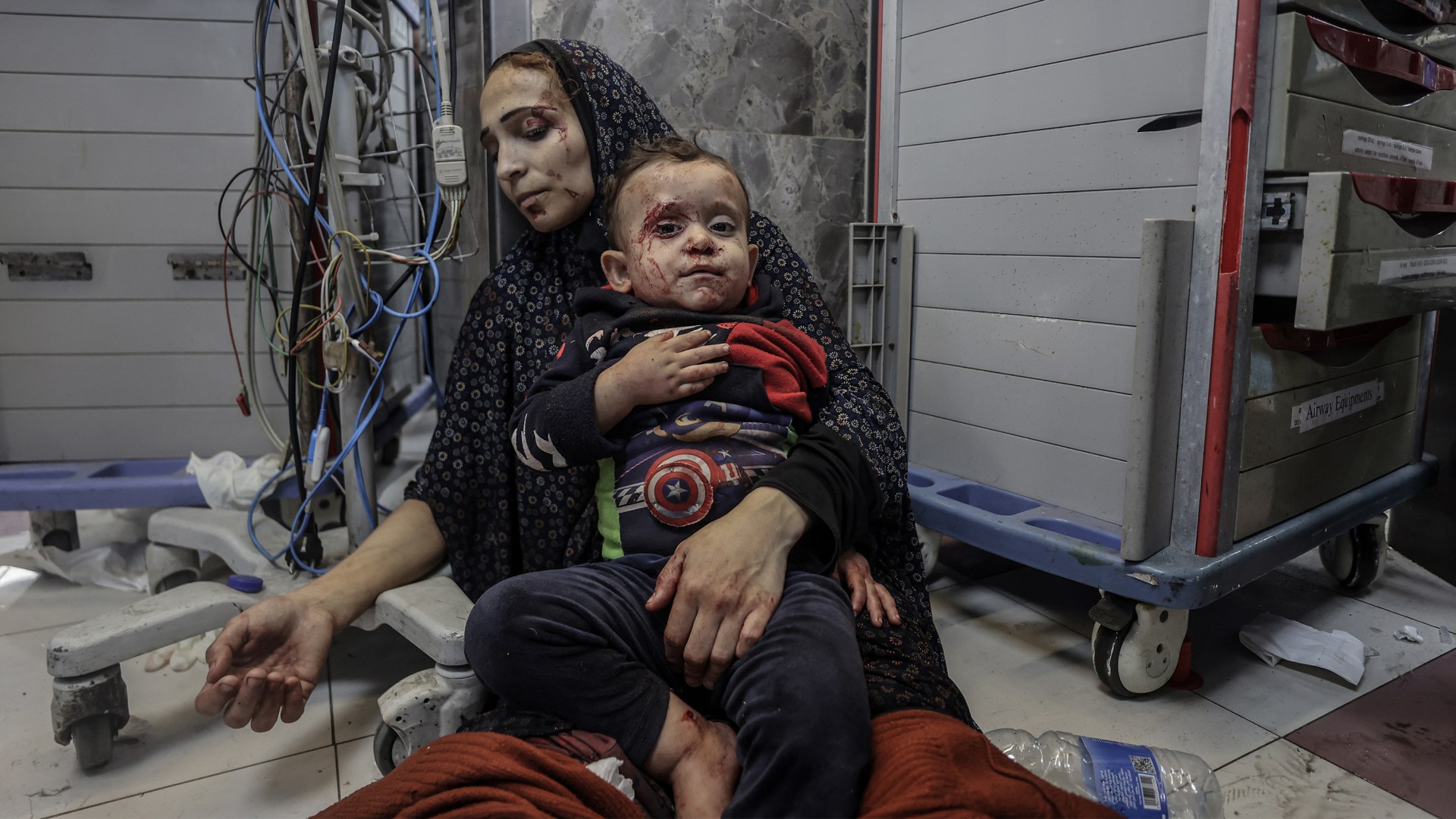
An injured mother and son taken to Al-Shifa Hospital following an explosion at Al-Ahli Hospital in Gaza.

An injured mother and son taken to Al-Shifa Hospital following an explosion at Al-Ahli Hospital in Gaza.

Christianity Today October 19, 2023
Anadolu Agency / Contributor / Getty

Update (October 19, 2023): This story has been updated to include newly available information from a US intelligence assessment.

The Arabic word ahli can be translated into English in several ways: family, membership, and people. This family is not limited to nuclear family membership. It’s capacious, expanding to include a wide range of people who belong together.

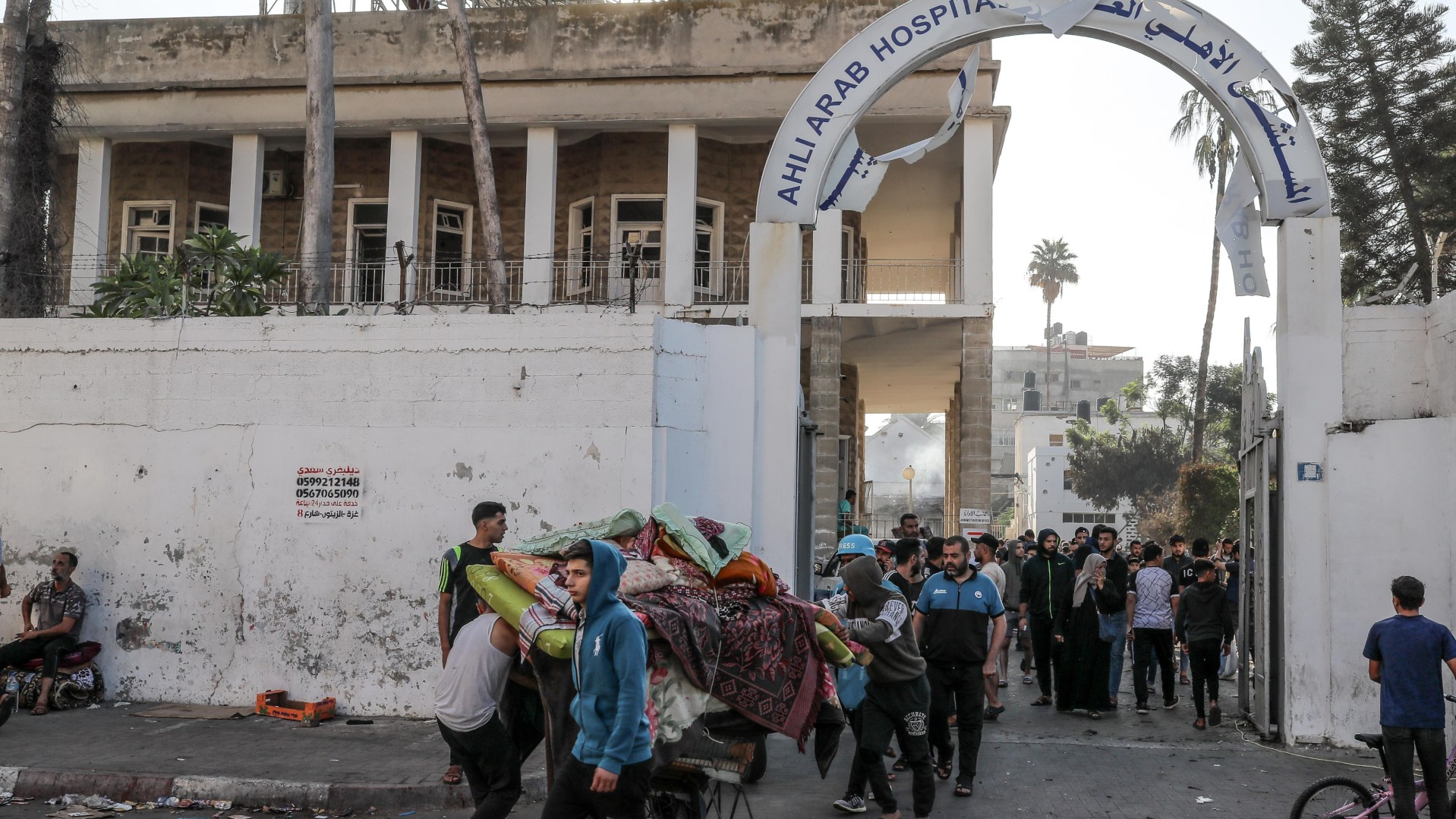
This word, ahli, has appeared in news headlines across the world this week, following the explosion that killed scores seeking refuge at al-Ahli Arab Hospital in Gaza City.

Narratives about who was to blame proliferated before the fires at the hospital were even extinguished. Some claimed an Israeli air strike was resonsible. Others blamed a misfired rocket belonging to Palestine Islamic Jihad. A US intelligence assessment, viewed by outlets including CNN on Wednesday, judged “that Israel was not responsible for [the] explosion that killed hundreds of civilians,” estimated the death toll at the “low end of the 100-to-300 spectrum,” and reported “only light structural damage at the hospital.”

As a historian who has published on al-Ahli Hospital, let me extend an invitation to pause while media debate and intelligence fact-finding continue. Let’s pause to learn. To think. To pray.

Praying about the destruction at this hospital in Gaza needs to start, first and foremost, with knowledge of the people who were affected. Who were the people at the hospital? Why did al-Ahli Arab Hospital experience this tragedy? And how can we turn to God when nothing makes sense?

To more fully comprehend who sought refuge within the hospital, we must start with its history.

The idea of establishing a Christian hospital in Gaza began in 1878, when the British Church Missionary Society (CMS) commissioned Alexander Schapira to relocate his family to Gaza City and determine the feasibility of a medical mission there. Schapira was the ideal choice for the CMS. He was raised in a Jewish family in Ottoman Palestine and spoke Arabic fluently. He became a believer later in life and joined the CMS, where he first served in West Africa before returning to Palestine.

In one of his first letters from Gaza, which I’ve reviewed in the CMS archives, Schapira described difficulty in finding accommodation, but he was nevertheless encouraged.

“What a happy thought it is,” he wrote, “when I think of my work here with its apparent difficulties; for it is His work and I feel sure that He will be with me and bless my labor here.” Shortly after writing this letter, Schapira spent everything he owned to buy medicine, print biblical tracts, and hire Asad Salim, a doctor from Beirut, to dispense free care to all those living in Gaza.

While Schapira trusted in God, distributing free medicine wasn’t a sustainable business model. The cost of medicine and printed tracts exhausted his personal finances. But in 1882, a sympathetic Englishmen donated £500 to ensure the continuation of the dispensary. This date is often cited as the beginning of the Christian hospital.

Focusing on medicine, however, misses one of the most important aspects of this Christian work in Gaza.

In 1891, the dispensary expanded into a hospital building where medical missionaries could perform both out-patient and in-patient procedures. They expected patients to attend the hospital because of their advanced surgical techniques but found that most patients were looking to fill more basic needs: a meal, a bed, a place of refuge.

From the establishment of the Christian hospital in 1891 until the present day, it has offered both healing and refuge for Gazans. It has been a site of courageous hospitality through times of peace and war.

In the 1950s, the CMS sold the hospital to the Southern Baptist Convention, who renamed it the Gaza Baptist Hospital. The Baptist name, al-ma’amadani, still resonates in Gaza due in part to the hospital’s service during the 1967 Six-Day War.

In the weeks leading up to that war, American surgeons Merrill Moore and David Dorr decided to remain at the hospital while their families evacuated. The surgeons and hospital staff continued to open their doors to patients, adding beds to the Baptist church sanctuary to accommodate hundreds escaping violence.

Dorr had little time to write but kept an audio diary which his family shared with me. In the recordings, his voice sounds anxious but resolute. He knew that if Christians abandoned the hospital in Gaza, they might never return.

In the midst of war, when Dorr wasn’t treating patients or offering radical hospitality to those seeking refuge, he paused to pray. He prayed for protection, safety, comfort, and a peaceful resolution to the violence that afflicted the hospital and those sheltered within it. That spirit of hospitality continued when administration came into Anglican hands for the last four decades.

Like many, I’ve felt helpless to comprehend the current situation. The geopolitical forces at play are beyond human understanding. They are rapidly changing, and they call on us to pick sides, to choose enemies. We may never have an answer to why the hospital was struck. But we should not forget to pray.

Pray for God’s work throughout the world. Pray for his protection over the innocent lives in Israel and Palestine. Pray for the hostages and their families. Pray for the people, al-ahli, who sought safety in the protection of Christian hospitality and faced the unrelenting atrocities of war.

Pray with confidence that, while human understanding is limited, full of gaps and inconsistencies, God is omniscient and omnipotent still.

Carter Barnett is a PhD Candidate in the Department of the History of Medicine at Johns Hopkins University. He researches the history of faith and healing in the modern Middle East.

News

Scores Killed in Blast at Gaza’s Only Christian Hospital

The fatal explosion hit a well-known facility run by Anglicans—and formerly by Southern Baptists—“in the middle of one of the world’s most troubled places.”

Palestinians carry usable items from the heavily damaged Al-Ahli Baptist Hospital building after bombing in Gaza City, Gaza, on October 18, 2023.

Palestinians carry usable items from the heavily damaged Al-Ahli Baptist Hospital building after bombing in Gaza City, Gaza, on October 18, 2023.

Christianity Today October 18, 2023
Photo by Belal Khaled/Anadolu via Getty Images

Scores of Palestinians were killed Tuesday in an explosion in the courtyard of Gaza’s only Christian hospital.

The Hamas-run Palestinian Health Ministry, which estimated a death toll of over 500, blamed the attack at al-Ahli Arab Hospital in Gaza City on Israel. The Israel Defense Forces (IDF) said the blast was a failed rocket launch from Islamic Jihad, a Hamas-aligned militant group. United States president Joe Biden, visiting Israel on Wednesday, referenced data from the Department of Defense backing Israel’s account. [Since this piece was originally published, the US government has published an unclassified intelligence assessment on the blast, placing the number of casualties between 100 to 300.]

Al-Ahli was founded by Anglican missionaries and has existed in the region since 1882. For some decades in the mid-20th century, it was operated by Southern Baptist Convention (SBC) missions. It currently sits under the Anglican Episcopal Diocese of Jerusalem.

Known colloquially as Al-Ma’amadani (or “the Baptist” in Arabic), it is one of 22 hospitals in northern Gaza. After Israel’s evacuation orders in the area, hundreds of Palestinians had taken refuge there, with families sheltering in the courtyard where the explosion took place, according to news reports.

“We are here as an instrument in the hands of God to show the love of Jesus Christ for all people. We are proud that in all conflicts, this hospital was there to eliminate the suffering of the injured, the poor, and to help those in need of a compassionate heart,” said al-Ahli hospital director Suhaila Tarazi, in an earlier appeal to Christian supporters.

“This hospital will continue to be a place of reconciliation, of love. The history of this hospital tells the story that we are all children of one God, whether we are Christian, Muslim or Jew.”

Tarazi, an Arab Christian from South Carolina, has navigated high unemployment, power cuts, and unrest during her 30-year tenure in Gaza. Weeks before the Israel-Hamas war, the Christian hospital was already overwhelmed and underfunded. Tarazi told one group that her work day began at 8 a.m. and ended at 4 a.m.

“We don’t have the money to pay full-time staff salaries,” she said. “Simply trying to secure the fuel we need just to run the generators adds another layer of seemingly insurmountable hardship and suffering. We are short on medicine. We are short on supplies. We are short of critical medical equipment. We are short-staffed. What else can we do but work all day and night? I am exhausted.”

Prior to Tuesday’s blast, the hospital had already suffered damage. The Anglican Communion News Service reported that the hospital was hit Saturday by Israeli rocket fire, damaging two floors of its cancer center and injuring four staff. Justin Welby, the Archbishop of Canterbury, issued a statement saying the hospital had been running low on medical supplies and could not evacuate its seriously ill and injured patients.

On Wednesday, Welby described the hospital explosion as “violating the sanctity and dignity of human life.”

“It is a violation of humanitarian law, which is clear that hospitals, doctors and patients must be protected,” he stated. “For this reason, it’s essential that we exercise restraint in apportioning responsibility before all the facts are clear.”

After Tuesday’s explosion at al-Ahli, approximately 350 casualties were sent to a nearby hospital, which was already overwhelmed by patients. The incident ignited protests in Arab nations, where demonstrators are calling for an end to Israeli airstrikes. As a result, Jordan called off a planned summit with Biden.

“In unyielding unity, we vehemently denounce this crime with our strongest condemnation. The initial reports of the Church hospital in Gaza tragedy have left us steeped in sorrow, for it represents a profound transgression against the very principles held by humanity. Hospitals, designated as sacred havens under international law, have been desecrated by Military Forces,” wrote the Patriarchs and Heads of the Churches in Jerusalem in a statement.

With more than a million Palestinians ordered to flee their homes, people are desperate for supplies, food, and water. After the hospital blast, Israel permitted the first humanitarian aid in 10 days to enter the Gaza Strip from Egypt.

Elsewhere in the region, following the October 7 terrorist attacks by Hamas, multiple Messianic Jewish ministries have mobilized to aid members of the IDF and to form an “emergency response and relief center” for Israelis fleeing the border attacks. As part of their work, they collected donations and distributed supplies to soldiers and sent out food to displaced families.

Over its long history in Gaza, al-Ahli has served as a Christian presence and also found itself caught in the crossfire of ongoing conflict.

The Anglican missionaries who opened the hospital in 1882 saw it as an opportunity to reach Muslims—mostly poor, rural, and female ones—with the gospel, according to a master’s thesis by Middle Eastern medicine historian Carlton Carter Barnett III.

Early hospital staff regularly read Bible verses and prayed with patients. They partially accommodated Muslims who did not want to die “under a Christian roof” by taking them outside the hospital—but not before offering the salvation message one last time. The British missionaries had more evangelistic success with students at the primary school located within the hospital compound.

In 1954, the SBC’s Foreign Mission Board (now International Mission Board) bought the hospital, renaming it the Gaza Baptist Hospital, and administered care there for the next three decades. Though proselytism was illegal in Gaza, SBC missionaries nevertheless also saw this work as a good opportunity for evangelism, opening Gaza’s only nursing school with missions in mind.

Gaza Baptist Hospital treated Palestinians injured in the 1956 Suez Crisis and other incidents in the region. During Egypt’s governance of Gaza from 1957–1967, Egyptian president Gamal Abdel Nasser visited the hospital to express his appreciation for its work.

During the Six-Day War in 1967, the hospital continued to operate despite being surrounded by significant firefights. It sustained broken windows and several collapsed walls, and one staffer was injured. The missionaries used Gaza Baptist Church (the previous Anglican sanctuary) to hold additional hospital beds, while 500 people sheltered inside.

By the late 1970s, the SBC returned the hospital to Anglicans, who placed it under the Anglican Episcopal Diocese of Jerusalem. The new operators gave the institution its current name, al-Ahli Arab Hospital, and Baptist staff continued to serve there until 1987, during what they noted was a season of heightened anti-Christian sentiment—including an assassination attempt by the Muslim Brotherhood on the acting hospital director.

In 1980, a Palestinian threw two hand grenades from behind a hospital wall, killing three people, including an Israeli officer and Arab bystander, and injuring others. In 1989, CT noted “the Episcopal-run Ali Arab hospital” as an example of Christian Palestinians partnering with American missionaries to help victims of the heightened violence in the region.

Gaza Baptist Church (GBC), still the only evangelical congregation in Gaza, used to meet in the hospital compound until the second Intifada made it too hard to have a congregation immediately next to the emergency room, said Hanna Massad, a former GBC pastor who used to work as a lab technician at al-Ahli.

“What happened yesterday is hard to imagine,” he said. “These precious people came to find shelter because they thought it’s a Christian hospital so it’d be more safe.”

The Diocese of Jerusalem runs medical facilities in Gaza, the West Bank, Jerusalem, Jordan, and Lebanon. According to the diocese, the hospital offered “some of the finest medical care available” in “the middle of one of the world’s most troubled places,” including free breast cancer screenings and Gaza’s first physician training program in minimally invasive surgery.

Local Baptist leader Bader Mansour noted that numerous news reports still referred to the hospital as “Baptist Hospital,” despite its current leadership.

“It seems that some in Gaza still remember the old name and the contribution of the Baptists in serving the people of Gaza, which continues to this day through the Baptist Church in Gaza,” he wrote.

During Tarazi’s time at the hospital, she has seen the treatment of hundreds of children who became disabled in the violence of the 2014 Israel-Gaza conflict. Five years ago, Tarazi confronted a steep decline in US aid to the United Nations agency that serves Palestinians, which dropped the hospital’s available beds from 80 to 50.

Meanwhile, Gaza’s Christian population, which has at times faced hostility and violence from Muslim neighbors, has dwindled to about 1,000 people.

Since the October 7 attacks by Hamas on Israel, more than 1,400 people have been killed in Israel and more than 3,000 in Gaza, according to authorities.

“The Arab Christian can be a mediator between the Jews and the Muslims, the West and the Middle East. For us, Christianity is peace and love for everybody,” Tarazi said, as Don Liebich quoted her in Memos from the Mountains. “But we fear that Jesus will not find one single follower when he comes back. The Church should help the Christians to stay there. This is the land of Christianity and all His followers. Christians should be here to help and give a good example of Christianity.”

Antisemitic Violence and Its Shameful Defense

Christians must care for both Israeli and Palestinian victims of war—and that means actively rejecting hatred of the Jewish people.

A protester holds up a sign at the All Out for Palestine rally in Times Square.

A protester holds up a sign at the All Out for Palestine rally in Times Square.

Christianity Today October 18, 2023
Hailey Swanson / AP Images

One day after Hamas’s Simchat Torah massacres in Israel, crowds gathered at a rally in Times Square promoted by the Democratic Socialists of America. “Our resistance stormed illegal settlements,” shouted one speaker, “and paraglided across colonial borders.” The crowd responded with rousing cheers.

It was an unapologetic celebration of the terrorists’ multi-front assault on Israeli cities, kibbutzim (progressive, communitarian farming villages), and an outdoor music festival. Hamas members have murdered more than 1,400 Israelis, raped, tortured, and injured thousands, and kidnapped around 200 more. Most of the victims were civilians, and many were children, the elderly, or infants. The vast majority were Jews.

The Times Square gathering was not an isolated case of pro-Hamas activism. Pro-Hamas demonstrations were held by the Chicago chapter of Black Lives Matter and Students for Justice in Palestine at California State University in Long Beach and the University of Louisville, each of which included images of paragliders in their promotional materials—a reference not to the Palestinian cause generally but to this specific Hamas attack on thousands of Israeli innocents.

The parent organization for those campus groups called the initial Hamas assault “a historic win for Palestinian resistance,” encouraging its members not merely to rally but to consider “armed confrontation with the oppressors.”

This war is still in its early days. It may be difficult to parse truth from lies and understand exactly why this kind of activism—which is misleadingly portrayed by its supporters as defense of the oppressed—is wrong. But we’ll have a clearer moral vision if we know the dark history this moment evokes.

We might wonder how the conscience can be warped to such a degree that it justifies or even celebrates such horrific violence. Being generous, I think the apparent power differential between Israelis and Palestinians shapes some of this response. No doubt (as Jewish journalist Bari Weiss chronicled last week), an incoherent ideology on campuses accounts for a significant degree of it as well. But we cannot ignore another subtler, more universal reason behind at least some of these responses: antisemitism.

There’s a sense in which antisemitism is as old as the Exodus, when the Israelites were singled out for slavery by Pharaoh (Ex. 1:9–10) and later, eradication by the Amalekites (Ex. 17:8–9). Hatred of Jews for being Jewish—for refusing to assimilate—is at the center of the book of Esther and remained prevalent under Assyrian and Roman rule. That same antisemitism was a factor, too, when the Romans sacked Jerusalem after a failed Jewish revolt in A.D. 70, sending Jews scattering out of Judea and across the Middle East, Africa, Russia, and Europe.

Through the centuries, Jews have continued to resist assimilation, maintaining and developing their distinct religious practices, language, and customs to this very day. As author Walker Percy once described it, the resilience of the Jewish people is a kind of historical miracle:

When one meets a Jew in New York or New Orleans or Paris or Melbourne, it is remarkable that no one considers the event remarkable. What are they doing here? But it is even more remarkable to wonder, if there are Jews here, why are there not Hittites here? Where are the Hittites? Show me one Hittite in New York City.

But that same resilience and resistance to assimilation continues to be the subject of distrust and hate—more of that ancient antisemitism.

In some ways, this isn’t surprising. As biologists have pointed out, we’re hardwired to feel anxiety about strangers because what makes them different—their language and social habits—triggers a warning in our brains, telling us we may be in competition with them for scarce resources.

But as Christians, we’re challenged to resist that impulse. A biblical admonition running through both Testaments calls us to love our neighbors and to care for sojourners and strangers (e.g., Deut. 1:16, Matt. 25:35). That this runs counter to our (fallen) human nature is evident in all the reasons Christians have manufactured to avoid loving strangers and aliens. Unfortunately, our historic treatment of the Jewish people is a case in point.

Christianity was primarily established by Jewish men and women who recognized a Jewish man as the Son of God. They read from Jewish holy books, and many continued to observe Jewish religious practices.

And yet, by the fourth century, the Jewish origins of Christianity were eclipsed by the contempt of church leaders like Ambrose of Milan, who called Jews “the odious assassins of Christ.” Christians should “never cease” seeking vengeance against the Jewish people, Ambrose said, going so far as to suggest that “God always hated the Jews. It is essential that all Christians hate them.”

All of these claims are antisemitic lies. They are also anti-Christ. The entire Old Testament is about God’s love for Israel as a called-out tribe in a fallen world, and Paul makes clear in Romans 9 that God’s love for Israel is unbroken—even as a “new Israel” is born in Christ.

The allegation that Jews “assassinated” Jesus also runs directly counter to the words of Christ, who said, “No one can take my life from me. I sacrifice it voluntarily. For I have the authority to lay it down when I want to and also to take it up again. For this is what my Father has commanded” (John 10:18, NLT). To say that Jews “murdered” Jesus is to call Jesus a liar.

But lies are seductive, particularly when they serve to alleviate anxiety or fear. The trope that “Jews murdered Jesus” took hold and has endured for centuries, serving as the justification for hostility to Jewish neighbors. In times of social upheaval throughout history, Jews have regularly been offered up as a scapegoat, blamed for everything from political instability to the Black Death.

In the 19th century, the lens for understanding historical events shifted from the Christian story to new ideas like Darwinism and the human-driven progress of history (something I recently wrote about for CT). But this didn’t decrease antisemitism; it merely shifted its shape. Instead of a historical, Christian inflection, Western antisemitism came to have a “scientific” feel.

The new rhetoric framed Jews as an alien race competing with and stealing from other nations. The “Jewish question” (as it came to be known) was the collective anxiety of European nations that didn’t want to offer a place for Jews as equal citizens.

This rhetoric intensified in the 20th century, with Nazis building on centuries of antisemitic history to frame the Jews as a “disease” and “vermin.” It’s awful but critical to note that as deep and vile as Nazi antisemitism was, the near-universal response of the countries Nazi Germany conquered or allied with—such as Poland, France, and Italy—was collaboration in their treatment of Jews.

In many of these places, Jews were rounded up by local officials, robbed of their possessions and land, forced into ghettos, and interned until they could be packed into trains and sent to death camps. For the Nazis, this was the “Final Solution to the Jewish Question.”

This week, as we’ve seen images of unimaginable horror in Israel—Jews tortured and burned alive, parents forced to watch the deaths of their children—that history is as relevant as ever. Israel exists in part to prevent exactly these horrors. The fact that they could happen again and that some in the West could respond with malaise or celebration is a sign of profound moral decay.

Our language in this moment matters. Before Nazi propagandists called Jews “vermin” to be exterminated, they were called aliens and made stateless—denied a place in the world. We must understand that when pro-Hamas protestors chant, “From the river to the sea, Palestine will be free,” they are not simply championing ordinary Palestinians’ plight. They are calling for the eradication of the Jewish state and, implicitly, violence toward Israeli Jews. And when Hamas’s ideological allies call Israeli citizens living in 100-year-old kibbutzim “colonizers” or “white settlers,” they imply that Jews are aliens with no rightful historic ties to the land. It’s the same alienating antisemitism as ever.

I confess, the iconography of the paragliders has disturbed me most of all. This was the method used to assault (among other places) the music festival where more than 260 young Israelis—mostly Jews—were killed while gathering to celebrate the cause of peace. They were slaughtered in open fields. Women were raped next to the dead bodies of their friends and abducted into Gaza to await horrors unknown. We should associate the paragliders with these crimes just like we link Nazi to smoke-billowing crematoria, mass graves, and bodies stacked like cord wood. Wielding a protest sign with a paraglider is like waving around a swastika.

To be horrified by the slaughter of Israeli innocents doesn’t require denying the suffering of the Palestinian people. And caring for Palestinian innocents doesn’t require being cold or numb to the horrors of antisemitism and Hamas. We can condemn Hamas while demanding accountability from Israeli leaders who have fomented violence, elevated right-wing extremists, and excused violations of international law. Indeed, Christians should be marked by our willingness to oppose all injustice and to care for Israeli and Palestinian victims alike.

And while that includes understanding that Palestinians have suffered great injustices from the government of Israel—as well as neighboring states of Egypt, Jordan, Iran, Lebanon, Syria, and Saudi Arabia, as well as Hamas and the Palestinian Authority itself—it must also include active rejection of antisemitism.

As a Jewish friend said to me shortly after the attacks, “We all know what’s coming. People are horrified today. Tomorrow, they’ll do what people have done for centuries. They’ll blame the Jews. It’s just a matter of time.”

That effort has already begun. I hope and pray that Christians can do our part in resisting it.

Mike Cosper is the senior director of podcasts at Christianity Today.

News

As Asian American Christians Decline, Most ‘Nones’ Still Feel Close to Religion

New Pew survey of 7,000 adults explores the beliefs and practices of Christians, Buddhists, Hindus, and Muslims and their affinity to Confucianism and Daoism.

Christianity Today October 18, 2023
Illustration by Mallory Rentsch / Source Images: Pexels

Christians comprise the largest faith group (34%) among Asian Americans.

But since 2012, Christianity has declined by 8 percentage points. Meanwhile, the share of religiously unaffiliated people has increased from 26 to 32 percent over the same period.

This is according to a new Pew Research Center survey of religion among Asian American adults who self-identified as Asian, either alone or in combination with other races or ethnicities.

Pew conducted surveys between July 5, 2022, and January 27 this year and also held focus groups and one-on-one interviews with over 100 Asian Americans to uncover what religion means to them. Besides surveying Christian, Buddhist, Muslim, and Hindu Asian Americans, the research center also explored peoples’ affinity with Confucianism and Daoism.

Pew released its previous report on the state of Asian American religion in 2012. At the time, researchers found that Asian American evangelical Protestants, who surpassed white evangelicals in terms of weekly church attendance (76% versus 64%), were one of the most religious groups in the United States.

https://datawrapper.dwcdn.net/YWrbP

The latest Pew data is representative of ethnic Chinese, Filipino, Indian, Japanese, Korean, and Vietnamese views on religion. People who were solely of Middle Eastern (e.g., Lebanese or Saudi) or Central Asian (e.g., Afghan or Uzbek) descent were excluded.

In many of these origin groups, well under half say that Christianity is their religion.

“At the pastoral level, these statistics match the countless stories of our immigrant churches struggling to remain healthy or viable,” said Gabriel J. Catanus, director of Fuller Seminary’s Filipino American Ministry Initiative. “Though we don’t know what the figures will say 10 years from now, this data should make pastors, parents, and leaders pause (and pray).”

Demographic profile

Protestants now make up 16 percent of the Asian American population, down from 22 percent in 2012. The share of evangelical Protestants has also dropped from 13 percent to 10 percent. Catholics have remained relatively stable at 17 percent today and 19 percent in 2012.

Of the six ethnic groups Pew surveyed, Filipino and Korean Americans are most likely to identify as Christian (74% and 59% respectively). Most Filipino Americans are Catholic (57%), while Korean Americans are largely evangelical (34%).

Indian Americans are least likely to say they are Christian. Fifteen percent identify as such, whereas 48 percent identify as Hindu, according to the Pew report. (In India, Christians comprise 2.4 percent of the population of 1.38 billion people.)

https://datawrapper.dwcdn.net/TsntN

Compared to people of other faiths, Asian American evangelical Protestants tend to be older, with a median age of 51. This is among the highest of any Asian American religious group measured in the survey, Pew said.

Most of the religion scholars and leaders CT interviewed said that Christianity’s decline among Asian Americans was not surprising, attributing it to factors such as second- and third-generation Asian Americans leaving the faith or to Western Christianity’s connection to the polarizing nature of American politics.

Christianity’s waning may also be a result of the “browning of the population,” said Russell M. Jeung, San Francisco State University’s professor of Asian American studies. “According to Pew, Indians and ‘other Asians’ made up about 31 percent of this racial group in 2012 but rose to 39 percent in 2023,” said Jeung. “Since these ethnic groups are less likely to be Christian, the overall numbers of Christians among Asian Americans should also drop.”

Amos Yong, author of The Future of Evangelical Theology: Soundings from the Asian American Diaspora, was less concerned by Christianity’s slump. “Perhaps the Asian American population grew such that 10 percent still is a larger aggregate number today than 13 percent ten years ago; so if this can be confirmed, that at least weathers a bit of the worry,” he said. If Pew’s latest data is an accurate representation of Asian American Christianity at present, however, “the decline of numbers may indeed be consistent with overall declines, which further press serious questions about the efficacy of evangelical evangelism,” Yong added.

Worship life

Asian American Christians are more likely than Asian Americans overall to say that religion is very important in their lives (54% versus 31%). Pew attributes this disparity to the large proportion (73%) of evangelical Protestants who said so.

Just over half of Asian American believers go to church at least monthly (55%), and three-quarters of evangelicals (74%) report higher attendance rates than that.

When it comes to building community, Asian American Christians can be an insular group. “Asian American Christians are more likely than the general Asian American population to say all or most of their friends have the same religion they do (38% versus 30%),” Pew said. “Evangelicals (45%) are among the most likely of all religious groups analyzed to say this.”

Hindu believers are a close second, with 40 percent saying that a large majority of their friends have the same religious beliefs. In contrast, Asian American Buddhists are one of the least likely to say so (21%).

The evangelical finding could be explained by religiosity levels, said Jerry Park, Baylor University’s associate professor of sociology. “Evangelical Christians, regardless of race, tend to be more active in their church community. This is the case for white evangelical Christians, and I might expect the same for Asian American evangelicals who often mirror the practices and patterns of their white peers.”

An age breakdown of evangelicals in this category would be helpful, as many of them might be young adults, said Soojin Chung, director of Princeton Theological Seminary’s Overseas Ministries Study Center.

Traditionally white campus ministries have become majority Asian American according to sociologist Rebecca Kim, Chung says. In 2006 (when Kim’s book was published), 80 percent of UC Berkeley’s and UCLA’s evangelical groups comprised Asian Americans, while Yale’s Campus Crusade for Christ was 90 percent Asian American.

The growing ‘nones’

About one-third of Asian Americans (32%) say that they are agnostic, atheist, or “nothing in particular.” In 2012, this figure was 26 percent.

Asian Americans who are religiously unaffiliated—often referred to as “nones”—are more likely than the general Asian American population to be below the age of 50 (73% versus 62%), to have been born in America (38% versus 32%), and to be Democrats or Democratic leaners (71% versus 62%), according to Pew.

The rise of the nones is concerning because “so much of our communities’ cultural practices are passed down in and through the various faith traditions—much of which are redeemed in Christ (think of Paul’s sermon at the Areopagus about the unknown god),” said Raymond Chang, president of the Asian American Christian Collaborative.

Out of all the ethnic groups, Chinese (56%) and Japanese Americans (47%) were most likely to say they are religiously unaffiliated. Yet they are also the most likely to feel close to a particular faith for reasons other than religion (47% and 58% respectively).

Closeness to a religion

Overall, 2 in 5 Asian Americans feel close to a religious tradition for reasons that are not religious. For example, while 34 percent identify as Christian, 18 percent feel close to the faith because of their family background or the culture they grew up in.

Asian Americans likely perceive the word religion differently compared to Americans, said Pew.

https://datawrapper.dwcdn.net/pklYi

“In the U.S., being Christian is often perceived as an exclusive religious identity with a clear set of associated beliefs (such as a creed) and normative practices (such as attending religious services),” Pew observed.

In contrast, many Asian Americans who do not identify with a specific religion may still consider themselves connected with “the religious or philosophical traditions that are common in their country of ancestry” or feel close to multiple faiths, Pew said.

These findings bear some similarity to Pew’s report on the state of religion in China, where many Chinese adults hold multiple, albeit contradictory, beliefs in various gods and deities and engage in a variety of religious practices.

Feeling close to Christianity is “an unavoidable result of living in the United States,” said some survey respondents. For instance, giving gifts at Christmas “was always part of our culture, even though we don’t believe in it,” said one Indian American respondent who is not Christian but considers herself close to Christianity.

Among the nones, one-quarter of Chinese Americans say they do not feel close to any religious or philosophical tradition. This is “the highest share among the large Asian origin groups to reject any kind of connection to religion,” Pew noted.

But a modest proportion of Asian American nones feel close to Buddhism (35%) and Christianity (34%).

https://datawrapper.dwcdn.net/BnxTe

“Many unaffiliated Asian Americans might be quite amenable to Buddhism and Christianity than we previously thought,” said Park. “Rather than assume that those with no religion are completely apathetic to it, perhaps religious leaders have more opportunity to reach these individuals than they realize.”

While 81 percent of Korean Americans said they feel connected to Christianity, unaffiliated Korean Americans have increased from 23 to 34 percent, and Korean American evangelicals have decreased from 40 to 34 percent, observed Helen Jin Kim, Candler School of Theology’s associate professor of American religious history. “We need a deeper dive into these numbers, but I am confident they, in part, reflect a broader story about the politics of American Christianity.”

Culture matters

Compared to the other religions surveyed, fewer than 1 percent of Asian Americans say that their present religion is Daoism or Confucianism. But some interviewees questioned whether these were to be considered forms of faith and regarded them as schools of philosophy instead.

Confucianism and Daoism have “an emphasis on filial piety, or respecting one’s elders and honoring one’s ancestors,” while only the latter includes “a pantheon of gods and deities along with dedicated clergy,” researchers noted.

Chinese Americans (24%), Korean Americans (22%), and Vietnamese Americans (13%) expressed a connection to Confucianism.

Half of those who said they are close to Daoism identify with either Christianity or Buddhism as well, Pew found.

Hien Vu, the Institute for Global Engagement’s Vietnam program manager, was surprised that the new survey did not reflect the declining share of Confucianism and Daoism compared to the 2012 survey.

Vu noticed the occurrence of a “great generational shift” among Vietnamese and Chinese Americans in her community, where these beliefs are practiced mostly among the first generation and younger generations do not “have the same level of attachment to traditional Asian philosophical and religious beliefs as their parents or grandparents,” she said.

Cultural assimilation may be another factor for this decline as Asian Americans adopt different worldviews that are more aligned with mainstream American culture, said Vu.

Reimagining the future

Despite Pew’s evaluation of Christianity as a religion in decline, the Asian American Christian leaders and scholars CT interviewed expressed hopeful sentiments for what the Asian American church will look like in the years to come.

“The bad news? People are walking away from the Christian faith in droves—Asian Americans included,” said Chang. “The good news? We aren’t alone, and the church is due for an overhaul that takes us back to the ways of Jesus.” Chang also serves as the executive director of TENx10, which is working with over 100 organizations, including denominations, parachurch ministries, and Christianity Today to help faith “matter more” to the next generation.

Catanus is “not yet convinced of a wholesale rejection of Jesus or Christian traditions” because 90 percent of Filipino Americans remain close to Christianity even if fewer (74%) identify as Christian. The number of people identifying as Filipino American has grown by nearly 10 percent in the last four to five years, he added.

“As my friend Dr. Jerry Park at Baylor University has observed, the Filipino American community is actually more than twice the size of the Korean American community and more likely to identify as Christian,” he said.

“So the Pew report tells an important story, but not the whole story.”

The large-scale migration of people out of Asia and into foreign lands such as North America—due to certain factors like the growing persecution of Christians in India and political developments in Hong Kong—will “continue to reshape the Asianization of American Christianity,” said Sam George, director of the Wheaton College Billy Graham Center’s Global Diaspora Institute.

“The migratory displacements are a theologizing and missionizing experience because immigrants bring their inherited religious beliefs and practices to the new land … [and] compare and contrast their faith with others.”

Apple PodcastsDown ArrowDown ArrowDown Arrowarrow_left_altLeft ArrowLeft ArrowRight ArrowRight ArrowRight Arrowarrow_up_altUp ArrowUp ArrowAvailable at Amazoncaret-downCloseCloseEmailEmailExpandExpandExternalExternalFacebookfacebook-squareGiftGiftGooglegoogleGoogle KeephamburgerInstagraminstagram-squareLinkLinklinkedin-squareListenListenListenChristianity TodayCT Creative Studio Logologo_orgMegaphoneMenuMenupausePinterestPlayPlayPocketPodcastRSSRSSSaveSaveSaveSearchSearchsearchSpotifyStitcherTelegramTable of ContentsTable of Contentstwitter-squareWhatsAppXYouTubeYouTube