Theology

Remembering ‘Grandma’ Lin Calvert, Missionary Doctor Who Brought Life to Remote Papua New Guinea

In her 69 years at Kapuna Hospital, Calvert delivered 10,000 babies, saved countless lives, trained healthcare workers, and loved the people.

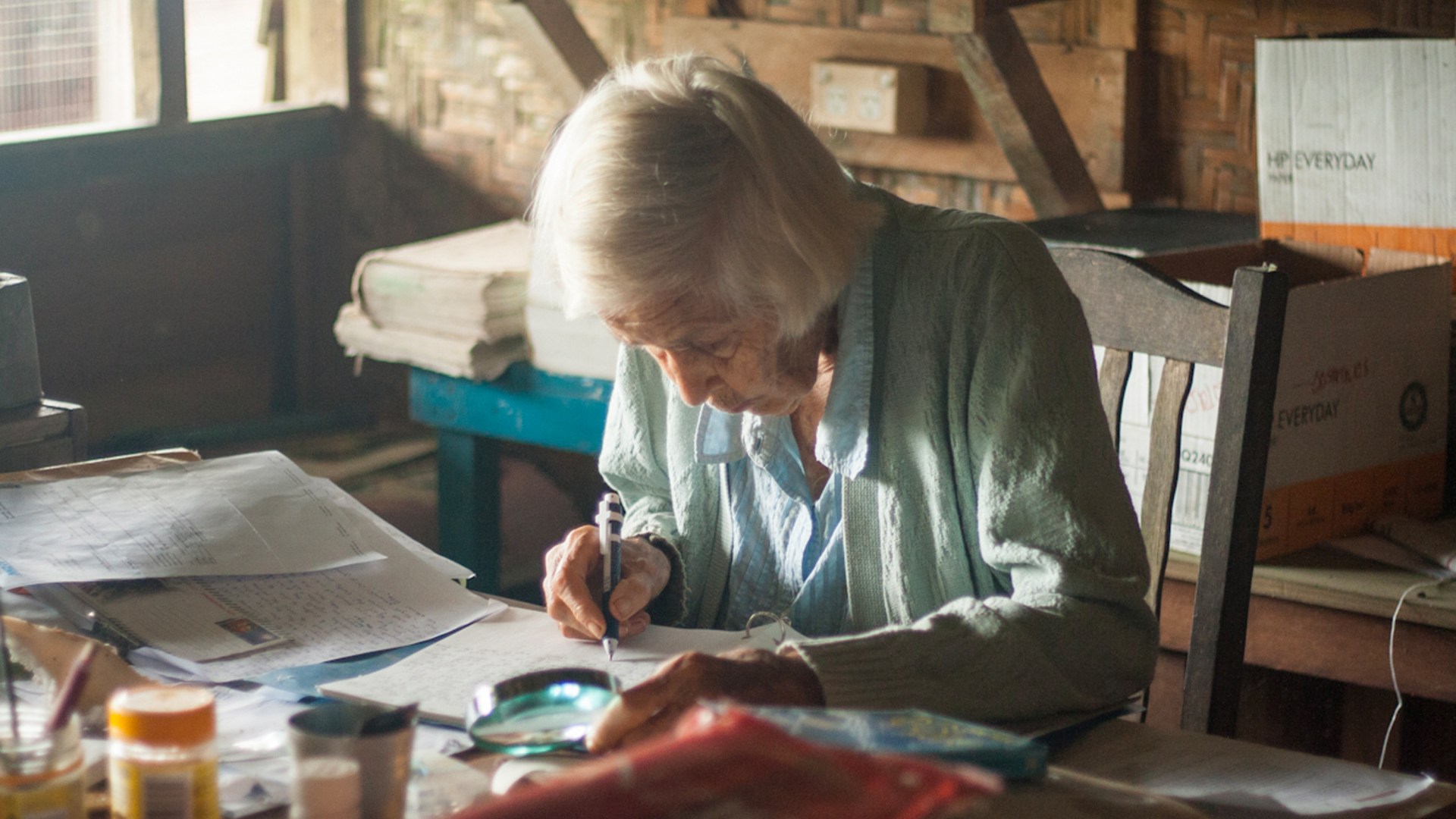
Lin Calvert using her magnifying glass to read papers.

Lin Calvert using her magnifying glass to read papers.

Christianity Today October 17, 2023
Photo by Erin Foley

I paused to soak in the scene before me. I had come to the remote Gulf Province of Papua New Guinea to write a book about the Calvert family, who, together with the local medical team, transformed medical care in the region.

Now, bathed in sunlight streaming through a window in her home, the elderly Lin Calvert sat bent over her Bible, grasping a magnifying glass. A doctor known as ‘Grandma,’ or Bubu Mei in the local Koaki dialect, the then-89-year-old didn’t notice me as she meticulously noted what God had taught her through the years.

I remembered this image when I learned that Bubu Mei died at age 98 on August 8, after serving nearly seven decades at Kapuna Hospital in Papua New Guinea. She and her husband Peter, along with their two young children, first arrived at the mission hospital in 1954. Their work enabled Kapuna to serve more than 45,000 tribal people making their home in the remote area accessible only by boat.

Calvert delivered generations of babies—an estimated 10,000 over her 60 years as a doctor at Kapuna—and saved countless lives through her aggressive treatment of tuberculosis (TB) and immunization against deadly diseases like measles and cholera. The Calverts also trained thousands of community health care workers in communities throughout the region, helped build the local church, and passed down their love for Kapuna and its patients to their children. Though Peter died in 1982, Calvert continued as head doctor until a fall forced her to retire at age 82.

“[Calvert] was adapted to living in the culture, knew how to communicate with local people in their language, and was committed to giving of herself for their benefit,” missionary doctor Neil Hopkins said at her funeral on August 9. “She was wholeheartedly devoted to honoring God and living for Jesus through the enabling power of the Holy Spirit.”

From rural New Zealand to Papua New Guinea

Born into a family of sheep farmers in Gisborne, New Zealand, Lin Calvert, née Tombleson, broke the family mold by enrolling in medical school. There she met Peter Calvert, who had recently returned from his service in World War II.

They both became doctors and married in 1949. While family and friends expected them to use their medical training to make money, the Calverts wanted to serve people who had nowhere to turn for medical help. In the early 1950s, the London Missionary Society asked them to work at Kapuna Hospital in “the low-lying swampy delta country of Papua” as they struggled to keep missionary doctors stationed there.

The remote region lacked electricity and was accessible only by boat on winding river systems. Coastal boats came every few months with correspondence and supplies for the hospital, but for the most part, it was cut off from the rest of the world.

Yet when the Calverts heard the offer, they looked at each other and said, “just the right place for us.”

In 1954, the Calverts and their two children, Valerie and Edward (Ted), arrived in Kapuna. As the family stepped across the threshold of the simple thatched house on stilts for the first time, two-year-old Valerie blurted out, “Home!”

“The people were so welcoming, and they accepted us straight away,” Calvert recalled in 2019 in a documentary filmed by her grandson, Jadon. “We were like people who had been away and now were united again and were very happy to see each other.”

Eradicating diseases and training health care workers

The couple took turns doing rounds in the hospital while the other looked after their home and children. A kerosene-powered refrigerator kept vaccines from spoiling. If an emergency operation had to take place after dark, nurses held flashlights and lanterns so the doctors could see.

Despite the hard work and simple life, Calvert felt that her childhood had prepared her for a life without amenities and modern conveniences. “I came from a farm,” she said in the documentary. “And I came used to having to do everything for yourself and make do. [Life in Kapuna] was just the same. I wasn’t aware that I’d made any big changes in my life.”
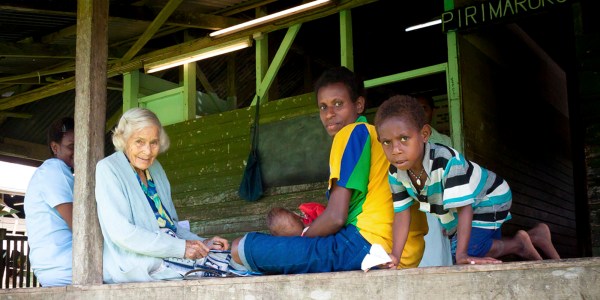
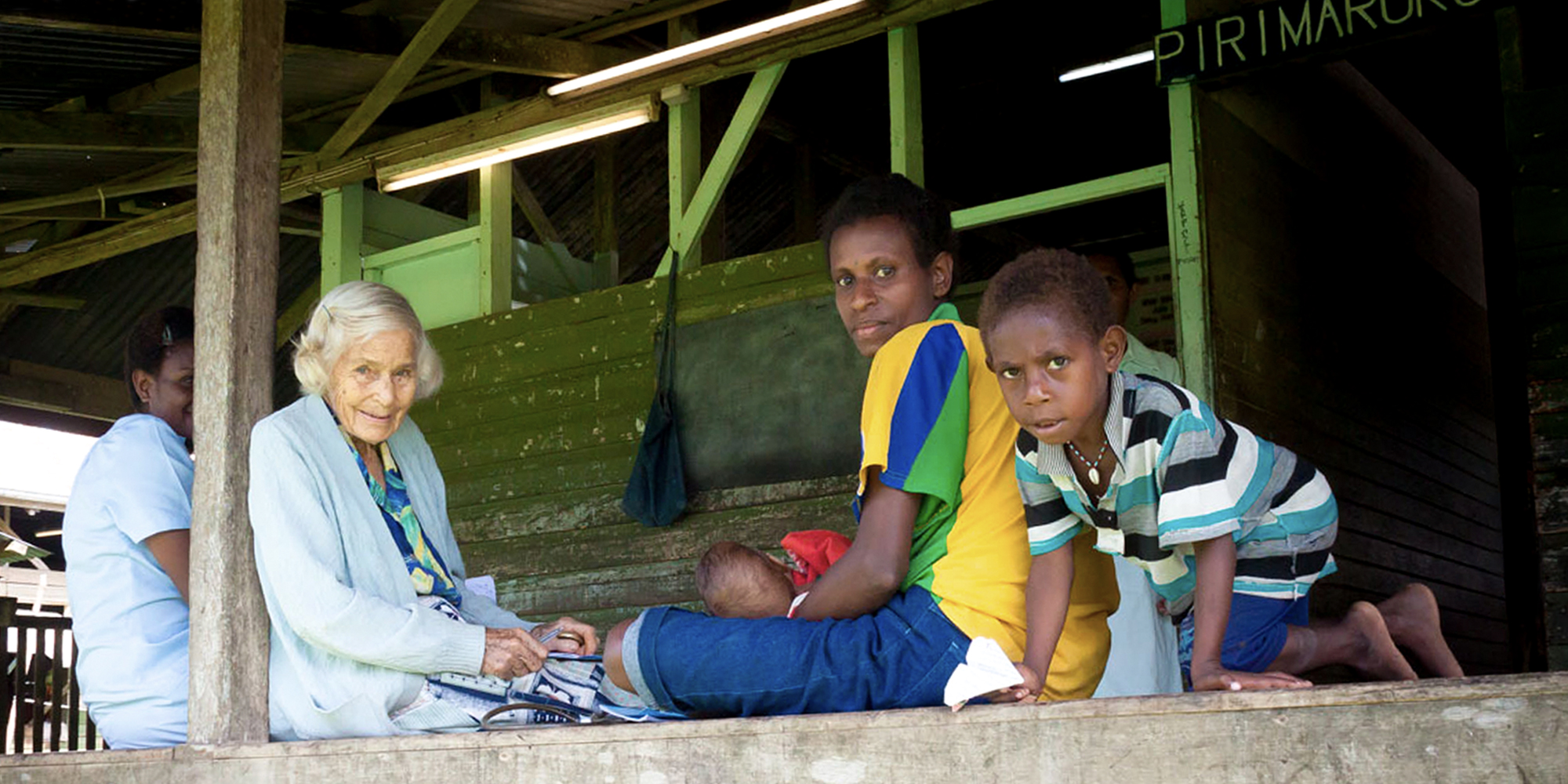
'Grandma' Lin Calvert visiting with some patients.Photography by Gerald Bengessar
‘Grandma’ Lin Calvert visiting with some patients.

Outside their hospital duties, the Calverts went on regular health patrols to villages in the surrounding area. Through consistent care and documentation, their immunization coverage and malaria prevention rivaled that of modern Western countries. They also eradicated scabies, a parasitic skin disease.

The Calverts also sought to improve remote villagers’ access to medicine. They provided medical advice to mission stations across Papua New Guinea via two-way radio. This could be a challenge, as the advice had to match the medicines available and the competence of those at the other end of the radio. Peter also set up 15 aid posts, small clinics run by locals that the Calverts trained to provide basic medical care (more serious cases were referred to the hospital).

The training manual for aid post workers developed into a school for community health workers run by the Calverts in Kapuna. Students under the Calverts’ tutelage astounded visiting doctors with their practical skills like suturing and giving injections, said Julie Bengesser, who worked for several years at Kapuna managing the hospital ’s shop while her husband oversaw IT and maintenance. The school has graduated thousands of health care workers and nurses from across the country, with 65 graduating classes.

“Grandma Lin inspired the community health workers to stay and serve the local community,” said Bengesser, who is originally from the mountains of Papua New Guinea. “Before, most people with an education or training left PNG or went to the city for better-paying jobs, but Grandma encouraged them to serve in the rural places in an exceptional way.”

Treating TB and delivering babies

Two of Calvert ’s most significant medical achievements in the region were her treatment of at least 7,000 TB patients and her maternal and infant care. Calvert was a stickler for giving patients immediate treatment in the early stages of tuberculosis, reducing the disease’s debilitating damage to their bodies. She learned to recognize TB as not only a disease of the lungs but one that presented in the spine and other organs, a topic that she wrote a book on.

In her 60 years as a doctor at Kapuna Hospital, she delivered and assisted in delivering countless infants. Seeing the life of an unborn baby as important as a newborn’s, she instilled in the nurses a sense that their role was “to guard the life of mother and baby.”

“Generations have come through Kapuna that normally would have died,” said Bengessar. “Grandma saved countless generations. People in their 40s and 50s would stop by Kapuna Hospital and claim Grandma had delivered them.”

When Bengessar gave birth to her daughter at Kapuna Hospital five years ago, Calvert ’s daughter Valerie, who also became a doctor, delivered Eliana. Grandma was there praying. “She prayed and prophesied over Eliana while we were still in the hospital,” Bengessar recalled. “Later, I brought Eliana to the office and put her in the swing. Grandma would sit there with her.”

She noted that Calvert didn’t show partiality toward those who received her love: young, old, rich, poor, foreigner, or local. “If Grandma could pour love into a person, she would.”

I witnessed this too: Nearly every day at Kapuna, I walked by the hospital to the office. If Grandma Lin was not in her garden, ripping up weeds, she could be found in the wards or sitting in the breezeway, talking with and praying over patients and staff.

Building up the local church

The Calverts cared deeply for people ’s spiritual health as well. They led daily prayer times at the hospital and supported the local church through the discipling of deacons and elders.

In the 1970s, a revival broke out in Kapuna and the surrounding areas after the Calverts put on a Christmas play in a nearby village. Though few responded to the message at the time, a month later, canoes full of Christians from nearby villages showed up at Kapuna asking for prayer to take the gospel to gangs of criminals from their clans and tribespeople. Spontaneous worship and singing broke out at the hospital.

“Peter and I had gone from one to another, laying hands on each bowed head and asking God to fill them afresh with His Spirit and power,” Calvert wrote in her book Let the Fire Burn.

The Calverts also began to realize that a lot of the practices within the church as they knew it were traditions built around Western culture, not necessarily the Word of God. They wanted to see an authentic local church where members were involved and willing to preach, teach, and help with music.

To keep the Kapuna church faithful to culture and Scripture, they chose not to have pastors, Calvert documented in her book. As a rule, decisions were made by discussion and prayer from the whole group. There were no paid leaders, no one was given a title other than “brother” or “sister,” and funds were raised and spent on the initiative of the whole.

Passing down the faith

The Calverts also continued their legacy through their family. Calvert gave birth to two more children, Alan and Colin, on the mission field.

“To their credit, our parents allowed us to grow up wild or free, depending on which way you look at it,” recalls Ted, who said he started using axes and machetes at an early age. “The only two safety rules I can recall were: ‘Don’t share spoons with any friend who is a TB patient’ [and] ‘No swimming after the generator comes on,’ i.e., after dark.”

Calvert would often pause on her medical rounds to ensure there were still four blond heads bobbing in the river. Even as the kids faced encounters with snakes, learned hunter-gatherer skills, and crashed speedboats, their parents found time to educate them and train them to love God.

Valerie, Ted, and Alan went on to study and live in New Zealand. While Valerie became a doctor like her parents, Ted and Alan became engineers, and the three regularly traveled back to Kapuna to help. Colin, meanwhile, stayed in Kapuna as the hospital administrator.

In 1982, Peter was diagnosed with terminal cancer. He continued to serve in the hospital until his final months. He had told his wife, “If I should die at Kapuna, I want the bush to grow over my grave.” Today, Peter is buried under frangipanis and hibiscus trees in the hospital compound.

Life at the hospital went on, with Calvert continuing her work as head doctor. Colin and his wife worked as administrators while raising their family in Kapuna. When Calvert retired, Valerie returned to take over as head doctor.
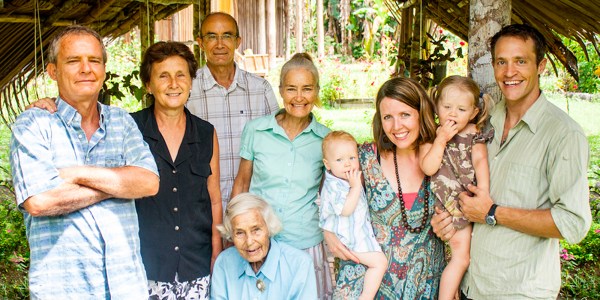
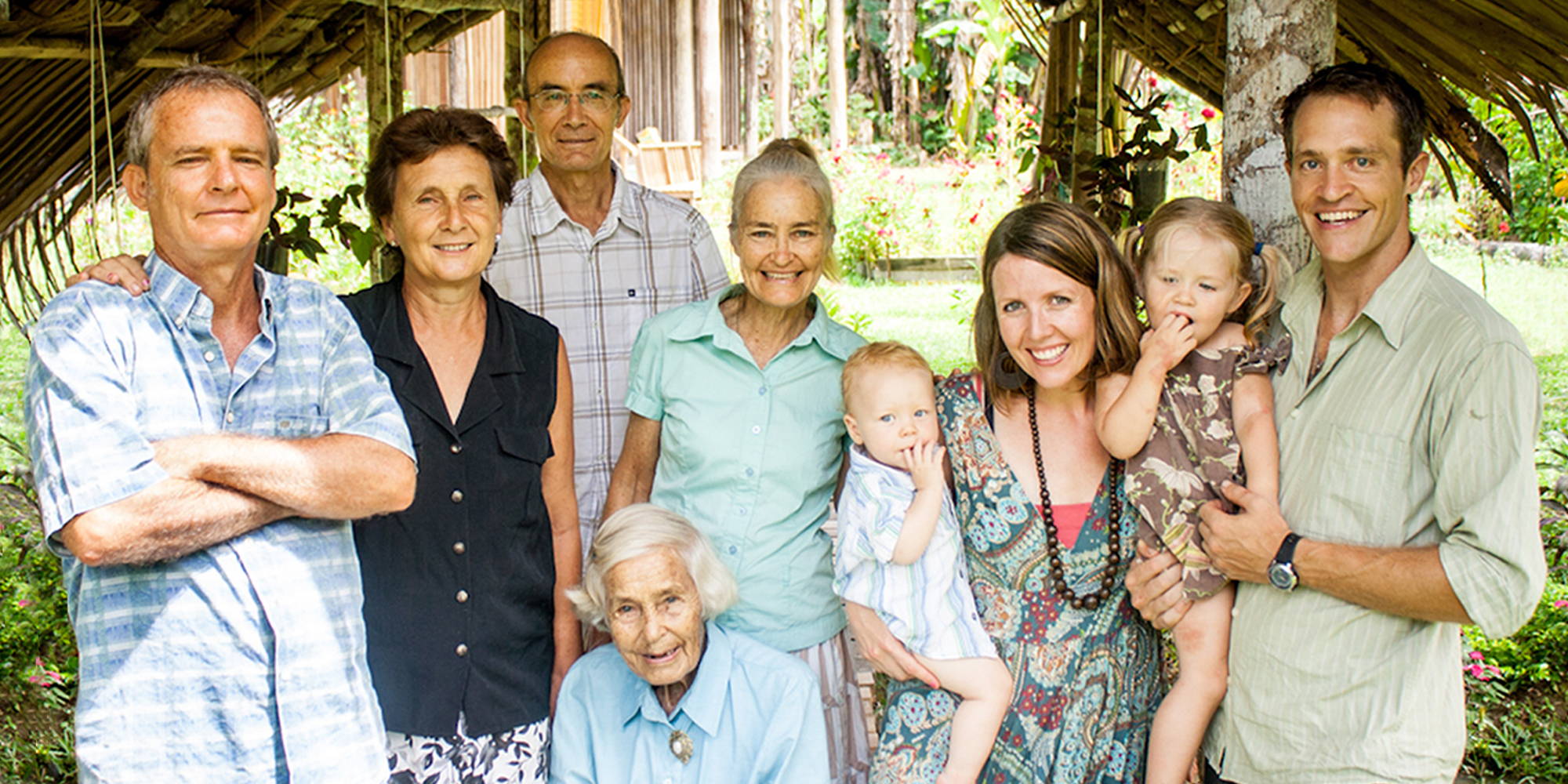
Lin Calvert (center) with her children Colin (left), Ted (third from left), and Valerie (fourth from left).Photography by Erin Foley
Lin Calvert (center) with her children Colin (left), Ted (third from left), and Valerie (fourth from left).

“Without their family, I don’t think Kapuna Hospital would have survived,” Bengessar said. “Now, many generations later, I think more PNG medical professionals can take it on, but not initially. She is leaving a legacy through her kids.”

Buried in Kapuna

In the last few years of her life, Calvert divided her time between wielding her machete against weeds in her garden and sitting with hospital staff and patients.

After Calvert took her last breath on August 8, nursing students carried her body to the church as Colin held her hand. The community held an all-night vigil, singing and telling stories of her life. More than 500 people gathered from surrounding communities until dawn. “I give ‘Grandma’ to you,” Valerie said. “She was my mother, but now I give her to the community as your mother.”

In the morning, her body was wrapped in a woven mat of palm fronds and placed in a carved dugout canoe. Nursing students carried the canoe through the breezeway at the hospital, where Calvert had spent countless days of her life ministering to families. Then they laid her in the grave beside Peter, in the land they had given their lives to.

As the service began, helicopters arrived with the governor of the Gulf Province and the staff of the natural gas company the hospital worked closely with. Word had spread across PNG. Great and small, young and old, wealthy and poor, all gathered to honor their Bubu Mei.

In the 2019 documentary about Calvert, her petite frame and wrinkled skin give away her age, yet her eyes still sparkle with energy as she looks back at her life in the bush. “Not many people stay 60 years, but the longer you stay, the less dogmatic you get, the less proud you get, and the feeling is, it was all God anyway who did it,” she said, sitting in a wheelbarrow in the garden she planted in Kapuna. “All the good bits were him.”

Erin Foley is the author of Kapuna: How Love Transformed a Culture, which is about the Calvert family.


Christians Have a Duty to Hate the Evil of Hamas

The example of Jesus, the teachings of the just war tradition, and Hamas’s own words make this clear.

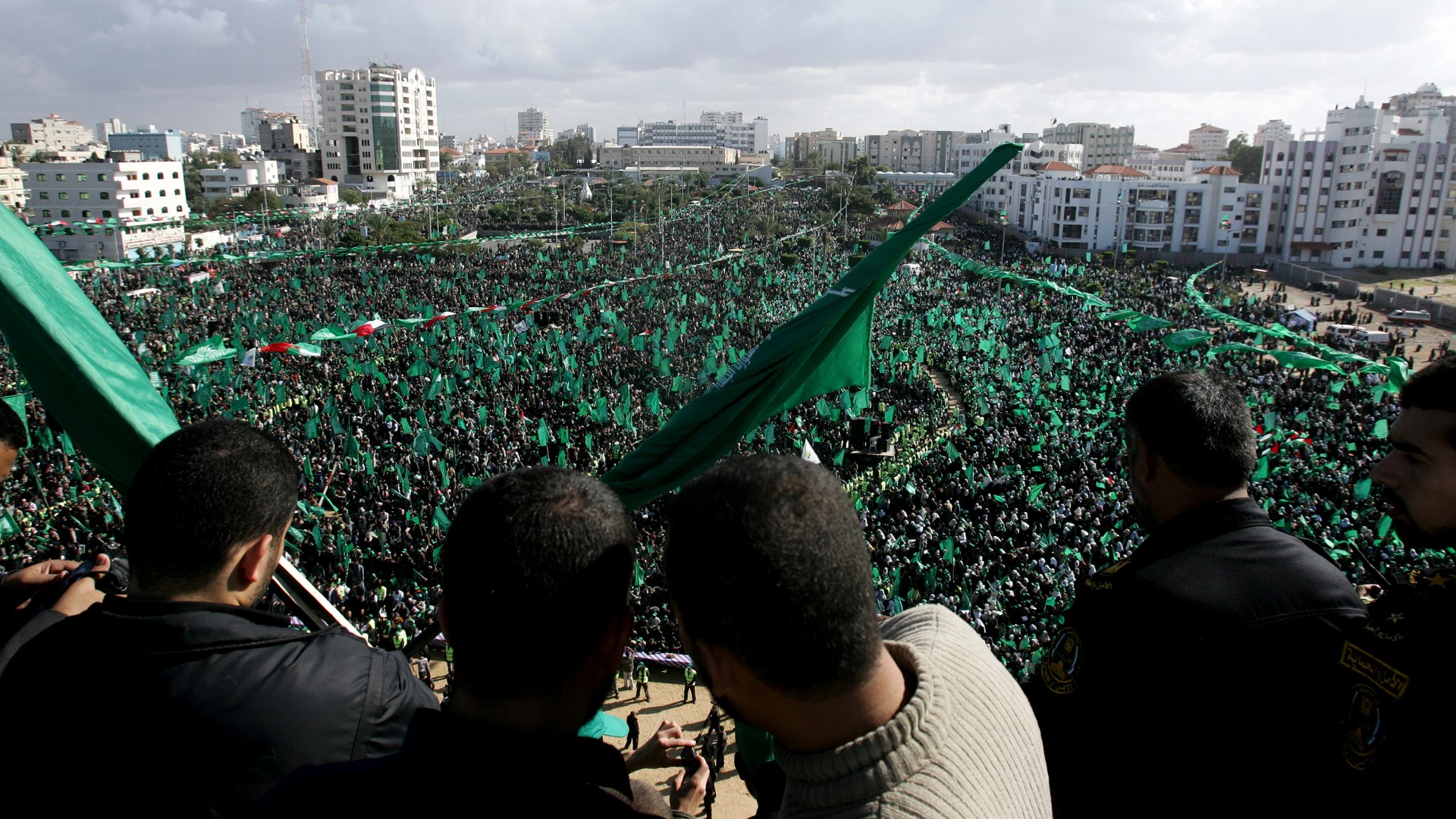
Thousands of Hamas supporters gather at a mass rally in Gaza.

Thousands of Hamas supporters gather at a mass rally in Gaza.

Christianity Today October 17, 2023
Abid Katib / Stringer / Getty

By now you will have heard of slaughtered Israeli babies, seen the graphic video of a kidnapped Jewish teenager being pulled by her hair with what appears to be blood between her legs, read of the 85-year-old grandmother taken to the Gaza strip without her medicines to die alone and in great pain.

By now you will know that Hamas terrorists have shot children, raped women, snatched infants from their families. By now you may have heard the account of one survivor of the massacre at the music festival: “The guy who was with me didn’t stop crying and begging for his life. … And then he didn’t scream anymore. They murdered him in front of my eyes.”

At this writing, Hamas has killed more than 1,400 Israelis, injured 3,000, and is holding around 200 hostage. This attack has been called Israel’s 9/11. It could equally be called its Dunkirk, the beginning of a war for survival whose outcome is uncertain.

For Christians watching these horrors from afar, it is imperative to condemn the evil perpetrated by Hamas—and to recognize that it must be resisted.

This should go without saying, but some American Christians refuse to denounce Hamas for its barbaric atrocities. A statement from the Episcopal Church in the United States, for example, mentions “a time of violence” but fails to say that Hamas was its instigator, suggests that “occupation” is the underlying cause, and charges that Israel’s response is “disproportionate.” The United Methodist Church similarly refers merely to an “escalation of violence” and urges “both sides not to resort to further violence.”

No further violence? Would we say the same if a terrorist group killed a proportionate number of Americans? (Scaled to our population, that’d be about 40,000 dead.) As The Wall Street Journal’s Elliot Kaufman contends, equivocation about the evil of Hamas is arguably a call for Israel to surrender instead of fighting back, because then Israel’s enemies will return to resume their massacres.

That’s not the only part of such equivocations which deserves scrutiny. Is “occupation” the cause of Hamas’s savagery? It cannot be, for Israel stopped occupying Gaza in 2005, and Hamas has run that city-state since 2007.

But more importantly, speaking of “occupation” suggests to many that Hamas wants to share the land with Jews. Yet Hamas declares openly that it wants to drive every last Jew into the sea—this is the meaning of the popular slogan—and kill all who try to remain.

This is not an unfair allegation from the group’s enemies. Article 7 of Hamas’s own founding charter quotes a saying of the prophet Muhammad: “The Day of Judgment will not come about until Moslems [sic] fight the Jews (killing the Jews), when the Jew will hide behind stones and trees. The stones and trees will say, ‘O Moslems, O Abdulla, there is a Jew behind me, come and kill him.’”

And Hamas has not drifted from its antisemitic roots. The senior Hamas official Moussa Abu Marzouk said in 2021 that his organization wants Israel “to come to an end just like it began.” This war that Hamas has launched on Israel is not about occupation. It is about the elimination of the state of Israel and all its Jews.

So is Israel’s planned response—to destroy Hamas—disproportionate? Article 51 of the United Nations Charter states that any nation has an “inherent right” to defend itself against armed attack. The response needs to satisfy the principle of proportionality, which involves avoiding as much as possible the killing of noncombatants.

More than any other world power, Israel has gone out of its way to avoid killing civilians. But that is impossible when Hamas uses human shields—both Palestinian and, now, Israeli hostages—by putting its command centers in hospitals and schools and mosques. Hamas is now ordering Gazan civilians not to move to escape Israeli bombs.

This is why simply comparing the number of Palestinian and Jewish civilians killed misses the point. Hamas deliberately targets civilians, while Israeli forces try to minimize civilian casualties. And even when those efforts fail, Hamas is responsible for Palestinian civilian deaths because it cruelly forces Gaza residents to remain with terrorists whom Israel will rightly target.

Hamas’s “desire to destroy Israel has brought only war and death to the Palestinians,” writes Middle Eastern scholar Bassam Tawil. “To achieve its goal of murdering Jews and eliminating Israel, Hamas appears ready to sacrifice endless numbers of Palestinians.”

These distinctions matter deeply for Christians’ response to the war. First, we are called by both Testaments to hate evil. Proverbs says to fear the Lord is to “hate evil” (Prov. 8:13), and the apostle Paul urges us to “hate what is evil” (Rom. 12:9). We should hate the evil of Hamas—and not be afraid to say so publicly.

It is not hyperbolic to compare Hamas’s antisemitism to Nazism, for, in fact, Hamas comes out of the Muslim Brotherhood, which counted among its early leadership in Israel Amin al-Husseini, the mufti of Jerusalem, who was paid by the Nazis to make radio broadcasts that urged Muslims to kill Jews everywhere.

Opposing Hamas is not Islamophobia. There are many Muslims who also hate Hamas and hope Israel destroys it. We can seek the destruction of the Nazi-like Hamas without demonizing all Muslims.

Jesus hated evil. He commended John in Revelation 2 for hating the works of the Nicolaitans “which I also hate” (v. 6). These were works of idolatry and sexual immorality (vv. 14–15).

Jesus also suggested he was not a pacifist but believed, as Ecclesiastes puts it, there is “a time for war” (3:8). In his parable of the wicked tenants, he said the vineyard owner punished the tenants who had killed his servants and then his son by “bring[ing] those wretches to a wretched end” (Matt. 21:41). This is the same Jesus whose robe is dipped in blood and from whose mouth comes a sword that slays the wicked (Rev. 19:13, 21)—and the same Jesus who, according to Jude, “destroyed those who did not believe” (v. 5, ESV).

While Jesus calls us to love our enemies, this love does not mean we do not hate evil. It does not contradict the tragic need for nations to defend themselves against those who seek their elimination.

This is a bit of the biblical grounding (there is much more) for a second Christian response: analyzing this conflict within the framework of the just war tradition.

Fundamental to that tradition is the idea that the genocidal attempt to exterminate a people, nation, or ethnic minority is always a great moral evil. This is precisely what Hamas intends and precisely what Israel is trying not to do.

A second principle of just war is that of discrimination: Noncombatants should never be directly and intentionally targeted. Yet again, this is what Hamas did in its horrific attacks on babies, children, unarmed women, and the elderly, while Israel warns innocent Gazans to flee before it attacks.

A third principle is proportionality: Retaliation should be proportionate to the harm suffered, and secondary effects, such as unintentional killing of civilians, must be proportional to the military advantage of the attack. Israel’s purpose is to defend itself against an enemy bent on its elimination, which makes its war against Hamas justified. And when Hamas uses Gazan civilians as human shields, it is Hamas that is disproportionate in its brutal endangerment of its own people.

Finally, Christians should recognize that Hamas’s war on Israel is also a war on Christians. Its aim is the elimination of Christianity from this planet. “We are not talking about liberating our land alone,” a co-founder of Hamas, Mahmoud al Zahar, said last year. “The entire 510 million square kilometers of planet Earth will come under [a system] where there is no injustice, no oppression, no Zionism, no treacherous Christianity” (emphasis mine).

Jewish tradition has a saying: “Whoever is kind to the cruel will be cruel to the kind.” Christians agree it would not have been just to be kind to Nazism, and we must equally support our “elder brothers” in Israel in their determination to end the cruelties of Hamas.

Gerald McDermott is an Anglican theologian who teaches at Jerusalem Seminary and Reformed Episcopal Seminary. He is the author of A New History of Redemption: The Work of Jesus the Messiah Through the Millennia.

News

Armenia Struggles to Aid 100,000 Artsakh Refugees After War

Evangelical, Orthodox, and secular aid workers care for traumatized Nagorno-Karabakh kin they say were ethnically cleansed from their homeland. Azerbaijani Christians reply.

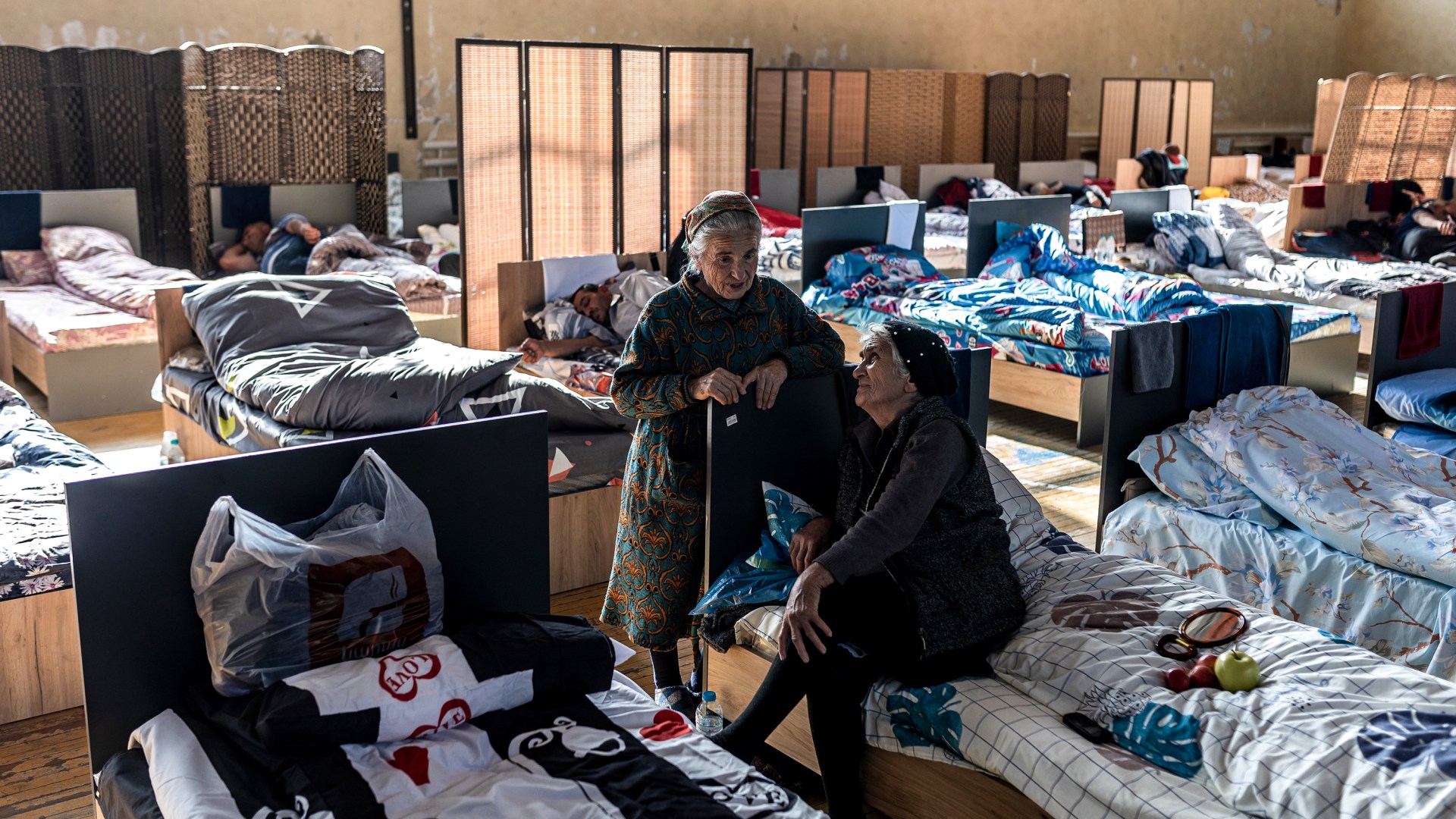
Two displaced women from Nagorno Karabakh talk at a temporary shelter in Armenia.

Two displaced women from Nagorno Karabakh talk at a temporary shelter in Armenia.

Christianity Today October 16, 2023
Diego Herrera Carcedo / Stringer / Getty

Karolin is one of 30,000 Armenian children without a home—again.

Fleeing the mountainous enclave of Nagorno-Karabakh in the face of Azerbaijan’s assault last month, the 12-year-old girl had an unexpected encounter. After crossing the Lachin corridor westward to Goris in Armenia proper, she found her beloved social worker waiting.

Arpe Asaturyan, founder of Frontline Therapists (FLT), was astounded as well. Amid the 100,000 refugees from what Armenians call their homeland of Artsakh, she had found the very same child displaced three years earlier. A special bond formed with then-9-year-old Karolin, who had gripped her tightly before returning home.

Located within internationally recognized Azerbaijani territory, the Armenian enclave suffered a bloody 44-day war in 2020. Over 6,000 soldiers died before a Russian-backed ceasefire left local Armenian authorities in control of only a portion of formerly held Artsakh land.

Karolin and her family went back anyway, vowing to continue their multigenerational presence. But after suffering malnutrition during an Azerbaijani-imposed nine-month blockade, they trudged three days in the slow-moving convoy of cars and buses across Lachin—the only road connecting the enclave with Armenia.

Over the week-and-a-half exodus, Artsakh residents crossed at a rate of 15,000 per day.

But the bittersweet reunion with Karolin is far from the worst of Asaturyan’s ordeal. Suffering in the chaos of relocation and the fog of war, several mothers told their children they would find their daddy in Armenia.

As counselor, Asaturyan was asked to tell them that their fathers had died.

“It is heartbreaking, and you know this will be the worst day of the rest of their lives,” Asaturyan said. “With all that has happened, it is hard to find faith.”

When the 2020 war broke out, the California native left behind a successful practice in trauma counseling to join her ethnic kin in ministering to returning soldiers and new widows. Funded by the Armenian diaspora, she oversees a small staff of paid and volunteer therapists providing free mental health services.

But in the weeks following last month’s conflict, her office turned into a humanitarian hub. Already, 20 truckloads of aid have been sent to Goris and the summer camp refuge in central Armenia where she first met Karolin.

“They know their life there was tenuous—they even laminate their documents,” Asaturyan said. “This is still the shock phase, but grief is set aside as bereft mothers must struggle now to find a job.”

The Armenian government initially prepared to receive 40,000 displaced from Artsakh; that was the single-day inflow on September 27 alone. The total number represents 3.4 percent of Armenia’s population, added to an existing refugee population of about 35,000. This does not include at least 65,000 Russians who fled to Armenia due to the Ukraine war, driving up real estate prices by 20 percent with skyrocketing rents.

The Armenian government is providing a relocation payment of $260 per person, with a promised monthly support of $100 to assist with rent and utilities. The UN High Commission for Refugees has called for $97 million in international assistance, and the United States has led the way with a pledge of more than $11.5 million.

“Peanuts,” said Marina Mkhitaryan, executive director of the Armenian General Benevolent Union (AGBU), a 180-year-old organization with institutional links to the Armenian Apostolic Church. “The level of support only adds insult to injury.”

Partnering with World Central Kitchen, AGBU has helped provide 80,000 nutritious hot-food boxes to those in greatest need. Soon AGBU will shift to dry-food packages so families can cook their own meals for up to four days. But a strong focus is on integration, equipping the displaced to live on their own.

A logistics center assists with mundane matters like official documentation, establishing bank accounts, and understanding taxes. And AGBU has partnered with a local employment agency to help the displaced find jobs and to provide training in entrepreneurship and the skills necessary for entry-level positions in Armenia’s strong IT sector.

But, being careful with terminology, Mkhitaryan wants more for Artsakh’s former residents than current stability.

“These are displaced persons who will eventually return to our historic homeland,” she said. “Refugee implies a state of no return, and that is not our stance.”

Pastor Vazgen Zohrabyan believes this will only be possible as Azerbaijani citizens.

“But there is no hope they will go back now,” he said. “My number one concern is where they will live.”

His 400-family Abovyan City Church (ACC) opened its doors, provided hot showers, and laid mattresses on the floors for as many as could fit. In all, they have helped 300 people find temporary shelter onsite and elsewhere, with ongoing food supply for 150 families.

Many had fled for their lives, leaving behind family pictures, shoes, and paperwork.

During the 2020 war and aftermath, Samaritan’s Purse and other organizations helped him offer aid to 12,000 families. While the US-based charity has since returned to Armenia, ACC’s current funding has been provided by a Pentecostal pastor in Argentina of Armenian descent.

But Zohrabyan has been approaching the end of his resources and nearly the end of his faith.

“We prayed for victory, and thought God would give it,” he said. “It was a very painful lesson: Jesus did not die for land, but for the souls of these precious people.”

Last Sunday, 40 refugees from Artsakh proclaimed their faith in Christ. Zohrabyan’s earlier outreach resulted in 70 new believers, who returned to the enclave to plant a sister church. He visited them once a month until the blockade severed their physical connection.

He says many Armenians put much of the blame on Russia.

Not absolving Azerbaijan, typical analysis says the northern neighbor plays one side against another to cement its regional power. And concerned about Armenia’s emerging democracy, the Kremlin is allegedly fomenting unrest through opposition parties, who claim the historic Christian nation can only survive if tied to Moscow.

Many Armenians are frustrated that Russia stood aside as Azerbaijan breached the ceasefire. Five Russian peacekeepers were even killed during the operation, with no protest issued.

Meanwhile, prime minister Nikol Pashinyan recently invited American forces for joint military exercises and joined Armenia to the International Criminal Court (ICC)—where Russian president Vladimir Putin faces war crime charges. Having seen evangelical colleagues cowed to silence in Russia, Zohrabyan fears that a proposed political union with Moscow will similarly harm believers at home. But he also does not trust the West as a consistent replacement ally for Armenia.

All is determined by interests, he said, not shared values.

“We are under huge pressure,” he said. “Pray for us—we want to see light at the end of this tunnel.”

There may be some, domestically.

“We say we want back our lands in Turkey, but we haven’t yet filled Armenia,” said Aren Deyirmenjian, Armenia director for the Armenian Missionary Association of America (AMAA), of genocidal displacement following World War I. “This is a golden opportunity.”

AMAA has joined in the early relief efforts, initially opening its small church in Goris to refugees and eventually providing short-term housing for 500 people at a summer camp and ten other centers throughout Armenia. Another 1,000 people have benefitted from food, clothing, and medical aid.

But Deyirmenjian has begun the medium-term planning. With the capital of Yerevan already overcrowded, refugees should be resettled in the rural hinterlands, he said. AMAA is planning an asset replacement project—to provide five cows, for example, to an Artsakh farmer who left five cows behind.

Armenia has many under- and depopulated villages ready to receive them. These are “strategic areas,” he said, because Azerbaijan has laid rhetorical claim on the nation’s southern region of Syunik, which stands in great need of development.

We are hard pressed on every side, Deyirmenjian quoted from 2 Corinthians 4, but not crushed… Therefore, we do not lose hope.

The 2020 ceasefire called for opening a corridor parallel to Armenia’s border with Iran, connecting Azerbaijan with its noncontiguous enclave of Nakhchivan, which narrowly borders Turkey. The initial proposal called for Russian peacekeepers to guard the corridor. But however it is negotiated, Armenia fears a threat to its territorial sovereignty.

Azerbaijan has threatened force, and marshaled troops on the southern border. For this reason, Deyirmenjian said many Artsakh refugees are understandably reluctant to resettle there, lest they be displaced again. Yerevan is much preferred, but many are talking of possible asylum in Canada, Russia, or Cyprus.

The AMAA has had meetings with Armenia’s ministry of social affairs and sees congruence with government strategy. If Artsakh residents can become self-sufficient in Syunik, Armenia as a nation will benefit from the additional 100,000 residents.

Even though their presence in Armenia is a historic injustice.

“First starve them, then scare them, so that they flee,” Deyirmenjian said. “Azerbaijan’s strategy was executed perfectly, but whatever means you use, it is ethnic cleansing.”

ICC statutes say that “forcible” displacement is not restricted to physical force but includes the threat or other abuses of power. Melanie O’Brien, president of the International Association of Genocide Scholars, stated the blockade of Nagorno-Karabakh created such a “coercive environment.”

Azerbaijan, however, has consistently stated that Armenians in the enclave would be welcomed as full citizens. Soldiers were pictured offering chocolate to children, while the new authorities opened a shelter for vulnerable residents who stayed behind.

A UN team visiting Nagorno-Karabakh stated it heard no reports of violence against civilians and saw no evidence of damage to hospitals, schools, or agricultural infrastructure. Though there were rumors circulating of atrocities in the villages, testimonies gathered by journalists revealed that most refugees did not encounter a single soldier.

Human Rights Watch interviewed over two dozen refugees and officials but did not report any abuses and stated that people fled “in fear and panic.” One woman stated that her local authorities told her to leave within 15 minutes. Another woman asked her village administrator if she could later return and was told that if she faced massacre, it would not be their responsibility.

“No one has pushed them to leave the territory,” said an Azerbaijani pastor, requesting anonymity to speak about political issues. “I hope they come back.”

Freedom House calls Azerbaijan “not free,” ranking the nation No. 13 from the bottom in its world freedom index.

The pastor recalled earlier days when Armenians and Azerbaijanis would live side-by-side in peace. Normal people do not hate each other, he said, but those who lost their homes or relatives in the conflict have grown bitter. He recalled that when Armenians took control of Nagorno-Karabakh in 1994, 500,000 Azerbaijani refugees fled the enclave, and another 186,000 left Armenia.

Around 30,000 people were killed on both sides, and 350,000 Armenians left Azerbaijan.

“I believe incidents [against Armenians] may have happened,” said another Azerbaijani Christian leader, requesting anonymity because of the sensitivity of the situation. “But compared to the history of the conflict, this takeover has been very peaceful.”

The leader said Azerbaijani soldiers would be unlikely to look favorably on the Armenians, who would understandably distrust official promises of fair treatment. But having seen his Muslim country evolve into a secular regime that grants freedom to Christian converts from Islam, he believes that Armenians would be welcome and protected.

If they return, within five years the region will be prosperous, he said. And with Nagorno-Karabakh returned to Azerbaijani sovereignty, he expressed hope that the two nations could now conclude a peace treaty.

Pashinyan has indicated a readiness for negotiations, the success of which he puts at 70 percent. Economic benefits would flow through trade, the Azerbaijani source anticipated, and oil pipelines could connect the two nations with Turkey and Europe.

“They didn’t have to leave,” he said. “But I can envision a future where Armenians and Azerbaijanis travel freely between the two countries.”

A third Azerbaijani Christian leader was terse in assessing the displacement.

“There is official news from both sides,” he said. “I don’t know anything more than that.”

Eric Hacopian, an Armenian political analyst with The Civilitas Foundation, dismissed the official accounts absolving Azerbaijan of ethnic cleansing.

“The UN visit was a much-ridiculed joke,” he said. “No one takes their report seriously.”

Noting how it was conducted by the Azerbaijani branch office after the atrocities were committed and cleaned up, Hacopian said he watched videos of alleged abuses posted by the soldiers themselves. And while only a handful of Armenians remained in the territory to testify, the UN’s greatest omission was not visiting the countryside villages from which the residents fled.

The truth will come out, he said.

And this is Asaturyan’s next major project. Working with a team of international specialists, she will prepare an academic paper comparing the trauma from 2020 to the trauma experienced by refugees now. To be peer reviewed and professionally published in a reputable journal, it will evaluate and then establish eyewitness accounts as fact.

Many have told Asaturyan secondhand stories of rape, beheading, and death by burning. Anonymous text messages told them they had 24 hours before the Lachin corridor closed for good, followed by other messages encouraging them to integrate into Azerbaijan. But one grandmother, who with her husband had at first sat on their front porch with gun in hand to defend their land, related the experience of why they left.

They beat a pregnant woman, she said, who later died of internal bleeding.

Nagorno-Karabakh officials reported that ten civilians—including five children—died in the Azerbaijani offensive that killed at least 200 soldiers. At least 400 others were wounded.

For these and the other 100,000 displaced, the relief work continues.

AGBU is refitting part of its center in Yerevan to house 170 people displaced from Artsakh. AMAA will continue to pay the salaries of its 79 Artsakh staff workers for a full year. ACC is preparing new believers for baptism and discipleship. And alongside its regular counseling sessions, FTL has provided emergency aid for over 500 families.

But why are they there in the first place, and not in their historic homeland? Even the monks have departed their monasteries—said to be the first time in 1,700 years that there are no Armenian Christian prayers in Artsakh.

“There is a natural instinct to protect your life and family,” said Asaturyan. “But the way they left—something happened.”

Ideas

This Is the Violent World in Which Christ Commands Peace

Contributor

The horror of terrorism reminds us anew of how impossible it feels to love our enemies.

‘The Armed Dove’ street art by Banksy near the Israeli separation West Bank Wall in Bethlehem.

‘The Armed Dove’ street art by Banksy near the Israeli separation West Bank Wall in Bethlehem.

Christianity Today October 16, 2023
NurPhoto / Contributor / Getty

Violence, we are told, followed so closely the origin of human evil as to be almost indistinguishable. For soon after Adam’s sin, violence appears—first in the skin taken from animals (Gen. 3:21), then in the murder of a brother (4:8), and finally over the whole of the earth (6:11). Violence follows humanity through the Flood and into the world beyond it, taking root in generational fights of the tribes of Isaac versus Ishmael and Jacob versus Esau. Nations that bear so much in common, divided by that very common history: This is the story of Scripture and of our own world.

It is into this violent world, not some easier one, that Christ gave his disciples the instruction to turn the other cheek, to pray for their persecutors, and to give to those that ask without expecting things to be returned (Matt. 5:38–48). These teachings have been contentious wisdom ever since, especially when we are confronted with horrors like the terrorist attacks by Hamas in Israel this month. Following Jesus here feels so impossible. Who could live that way in a world like this?

But that is what Jesus commanded, and it is this violent world for which he died and in which he was resurrected. It is into this violent world that the Holy Spirit was sent, and fruits of that Spirit are peace, humility, gentleness, and goodness (Gal. 5:22–23). Perhaps we think such gifts and teachings are unfit for a violent world, but Jesus thought otherwise.

Perhaps such an approach to great violence—to turn the other cheek and to seek the good of one’s enemy—seems nonsensical. And indeed, many in church history rendered exactly that verdict on Christian pacifism.

Perhaps, as one objection goes, these teachings describe a world beyond history. Perhaps these are commands we can heed only in the age to come. But this does not square with a Jesus who loved his own enemies, which includes all of us (Rom. 5:10).

Or perhaps, another objection goes, responding with limited force is justified when facing great evil, and Jesus meant his command only for interpersonal relations. But this, too, falls apart when compared with Christ’s own example. When Peter attempted to defend Jesus in Gethsemane, Jesus healed his enemy, sheathed Peter’s sword, and went away to die (John 18:10; Luke 22:51).

The prospect of a limited use of violence may seem eminently reasonable. But as it follows sin, violence will not be so easily contained and made rational. Violence is deceptive, even—or especially—when it is well-intended retaliation for rank evils like terrorism. It produces, by its nature, more wreckage than we expect.

What the teachings of Christ offer is a refusal to justify the non-sense of violence. It is a refusal to call violence “understandable” or “reasonable.” It is a refusal to minimize sin or follow its logic, whether by rationalizing terrorism or justifying violence in return.

Explaining how violence happens in a sinful world is no consolation to Rachel weeping for her children. For how do you explain hundreds dead at a music festival? How do you explain rockets hitting ordinary homes? How do you explain the bombs that answered those murders, hitting civilian apartment buildings and killing children in their beds? What kind of reason could stand up here?

To be clear, violence is not uniform: Terrorism is not the same as retribution, and killing civilians is not the same thing as killing terrorists. But we are in risky territory when we try to establish grades of respectability within violence, as if some of it might approximate how God created us to live. The moral calculus of violence must give way to a harder and more beautiful teaching: that all people are created in God’s own image, and the loss of any person is a victory of death, the last enemy Christ came to destroy (1 Cor. 15:26).

Christian pacifism is not about trying to make sense of the world’s violence, then, but about bearing witness to the God who stands with the victims of that violence and calls his disciples to do the same. It is less about promising to “fix” violence and more about becoming the kind of people who treat violence as God did on the cross: an evil to be overcome with love and mercy (Rom. 12:21).

In the Crucifixion, God does not respond to human violence with more bloodshed. He offers the ones who killed him a place at the table (Acts 2:36–38). If violence is a symptom of a world sick with sin, it cannot also be sin’s cure.

Does that mean a Christian pacifist is passive in the face of great violence? Hardly. We could point to pacifists serving as medics in combat zones, as translators and negotiators, as chaplains, and as relief workers. We could even point to pacifists who have lived in the Middle East as peacemakers and educators.

This approach—bearing witness to God’s own peace amid decades-long conflict—may seem far away from what is needed. But Christ, quite literally, offers just this form of peace.

Remember that we who are Gentiles were once “separate from Christ, excluded from citizenship in Israel and foreigners to the covenants of the promise, without hope and without God in the world. But now in Christ Jesus you who once were far away have been brought near by the blood of Christ,” as Paul wrote to the Ephesians. God himself has suffered violence to make “one new humanity out of the two, thus making peace, and in one body” reconciling us to God and one another (Eph. 2:11–22). If we want to call this frail and unrealistic, we must say the same of Christ.

So let us pray for the church in Nazareth, Bethlehem, Jerusalem, and Gaza to join hands in proclaiming that the Christ who has been raised from the dead will bring not only a cessation of violence but also the administration of justice—and in that justice, true peace. Let us pray that those who are in the midst of this violence will continue to proclaim that Christ has come to unite Jews and Gentiles into one body. And let us pray that we would all name violence for what it is: sin.

Myles Werntz is the coauthor of A Field Guide to Christian Nonviolence. He writes at Christian Ethics in the Wild and teaches at Abilene Christian University.

Ideas

The Obscenity of War in This Present Evil Age

Staff Editor

“The last enemy to be destroyed is death,” and that enemy is insurgent in the Israel-Hamas war.

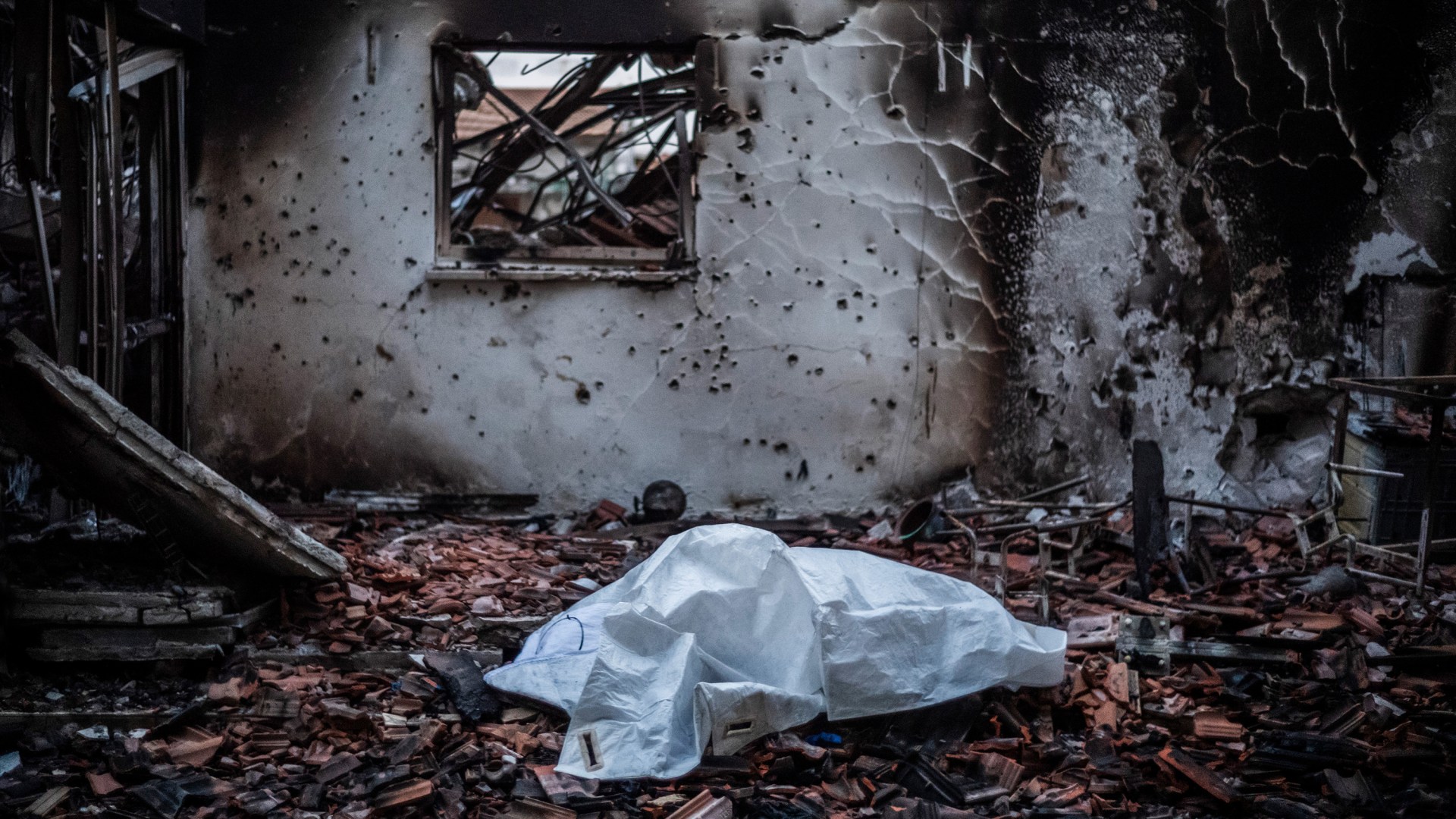
A body lies covered in a house destroyed as a result of the Israel-Hamas war.

A body lies covered in a house destroyed as a result of the Israel-Hamas war.

Christianity Today October 13, 2023
picture alliance / Contributor / Getty

Less than a week into the Israel-Hamas war, the casualty count is already in the thousands. Around 1,300 people have been killed by Hamas terrorist attacks in Israel as of this writing, with another 1,300 killed by retaliatory Israeli strikes in Gaza and more than 9,000 wounded.

It is difficult to fathom that many bodies. It is even more difficult to fathom that at least some of them were children.

The most shocking report is an allegation that Hamas beheaded babies and toddlers, a claim that was walked back by the Israeli military and the White House, then seemingly confirmed by The Jerusalem Post. We can hope this story turns out to be false. But it may be true, which is terrible to contemplate, let alone to endure it.

In either case, there are many evils in this war that are not coming untrue. Our world since the Fall has always been infected with sin, death, and devilry. Sometimes we can forget or ignore this sickness and suffering, especially we fortunate few in the safe and wealthy West. But that ignorance is not possible for many of us right now. This war has brought our sickness back to the surface, opening anew a putrescent wound we cannot heal.

In 1755, the Spanish city of Lisbon suffered an earthquake so devastating that it cast doubt on God’s very goodness. Wars like this one give a similar shock. The disputed story of beheadings flew fast around the globe because it is uniquely unintelligible: Who could behead a baby? How bent would a soul have to be to do violence to an infant, a toddler—a babbling little being who should know only care and comfort, not war and death? My youngest is five months old. It is obscene that those babies are not as safe as she.

But then I remember Psalm 137, perhaps the darkest of the imprecatory Psalms: “Daughter Babylon, doomed to destruction, happy is the one who repays you according to what you have done to us,” the psalmist rages. “Happy is the one who seizes your infants and dashes them against the rocks” (8–9). There’s nothing new about evil—both committed and suffered—and its capacity to produce a rot so foul.

For their part, the Israeli government’s retaliation against Hamas has been swift and severe. Airstrikes have targeted the terrorists, and at least in some cases, Palestinian civilians were warned before the bombs hit.

But Hamas uses human shields, Palestinian innocents and kidnapped Israelis alike. And even if they didn’t, Gaza is so small and its borders so sealed that civilians—44 percent of whom are children 14 or younger—have nowhere to run. Israeli strikes have reportedly hit homes, schools, hospitals, mosques, markets, and even refugee camps.

Markets is a funny word. It’s grown a little strange to modern American ears—we have farmers’ markets and flea markets and Christmas markets, but most of us don’t go to a “market” on any regular basis. A market for us is often a special occasion, something you do more for fun than to fill basic needs.

But the markets these bombs ripped through are essentially grocery stores. People were there for their ordinary shopping; they were buying vegetables, bread, meat. Think of a bomb falling on your Costco, Aldi, or H-E-B. Think of shrapnel tearing into you and your kids in the dairy aisle at Publix, Target, or Tops.

What is there to say for those of us who are thousands of miles away? Just this: Lord, have mercy.

It is right for the psalmist to speak honestly and bring his rage to God—not least because doing so can keep us from violence ourselves. And the same Scripture that records this hateful prayer also records God’s repudiation of the evil it envisions. Psalm 137 is an exposé of the blight of human sin; God’s ultimate answer to violence and injustice is found in the cross of Christ.

“The cross does not merely indicate the true character of God; it also shows the resistance of sin and evil to the love of God,” writes theologian J. Deotis Roberts in Liberation and Reconciliation. “Because of sin, human nature had been twisted and perverted,” but the cross “plumbs the depths of sin and evil, and it manifests the infinite value God places upon human life.”

We can and should pray for a swift and lasting peace in the Israel-Hamas war, but there’s no way of knowing how long the fighting will last. Maybe days, maybe years. Even the fastest truce will cancel no funerals. What we know for sure is that “the last enemy to be destroyed is death” (1 Cor. 15:26), and that enemy is insurgent in our world today.

And while there is little to nothing most of us can do directly to speed a resolution to this war, we can repeat, in dogged hope, what Paul wrote to the Galatians (1:3–4): “Grace and peace to you from God our Father and the Lord Jesus Christ, who gave himself for our sins to rescue us from the present evil age.”

Bonnie Kristian is the editorial director of ideas and books for Christianity Today.

Church Life

Should Christians Share a Conference Stage with Theological Opponents?

Jackie Hill Perry, Sean McDowell, and others explain why they appear alongside speakers with different stances and when they’d refuse to join a lineup.

Christianity Today October 13, 2023
Emiel Schalck / Unsplash

These days, Christian speakers have to carefully consider not just what they say—but those they say it alongside.

From packed-stadium conferences and denominational events to church retreats and ministry webinars, evangelical audiences pay attention to the names and faces getting platformed. These lineups can serve as organizational endorsements and offer followers an introduction to new voices worth paying attention to.

But today’s evangelicals are also sensitive to theological shifts among the leaders they follow. If they notice a popular speaker appearing alongside someone with a notably different stance—on same-sex marriage, women in ministry, spiritual gifts, prosperity gospel, salvation, sacraments, Scripture—is it a sign of softening views or compromising convictions?

These questions can get adjudicated online, as when Francis Chan defended sharing a stage with Benny Hinn because, he said, “it seems more effective to speak where there is less Bible teaching” than at an event where all the others agree with him.

Bible teacher Jackie Hill Perry didn’t realize how big a deal it would be for evangelical followers when she appeared with charismatic leaders, including from Bethel, at an event in 2019. Thinking back on the criticism, she emphasizes how the message communicates more about where a person stands than the fellow speakers do.

“You will see some people that become less honest, less bold, less biblical, less courageous, less plain when they go into particular spaces. You see that they’re actually coddling the environment instead of confronting the environment. I do think that’s a concern that we should have,” she told CT.

“I think we have to ask better questions before we make broad assumptions. And I don’t think that a lineup is the best framework for trustworthiness. I think it’s the content of the message and the life of the person. You know a tree by its fruit, not necessarily what fliers they are on.”

Some of the scrutiny today’s speakers face may be genuine curiosity and discernment, and some may come out of social media callout culture. But as speakers seek to preach the gospel in all corners, to build bridges across the body of Christ, they find themselves having to consider what they communicate to their followers by where they choose to appear.

CT asked six Christians, including Perry, about when and whether they’d speak alongside Christian leaders who come from a different theological tradition or stance.

Karen Swallow Prior, writer and professor

I’m quite comfortable participating in Christian conferences and events in which the lineup includes those with whom I disagree. In fact, this is probably true of most of the events where I speak. But framing matters. If the context is such that different views are the nature of the conference, then I wouldn’t hesitate to take part. In fact, I’m usually eager to present my own convictions in such places.

Where it can get tricky is a context in which my presence comes with the added weight of legitimizing an organization that has problems beyond mere theological disagreement. I have learned I need to be discerning about the difference between being heard and being used. It can be a fine line.

Years ago, I appeared on a panel on faith and sexuality. I was asked to come to speak for the traditional view. People who didn’t attend or do any research on the matter used my presence there to misrepresent and malign me. That experience opened my eyes about the current state of the church and public discourse but did not alter the way I make decisions about where I speak. It rather made me more determined to speak in spaces where views are not uniform.

Jackie Hill Perry, Bible teacher and author

It’s not even just the speakers that are invited but also the church or conference that is inviting the speakers. If it’s a trustworthy organization, I’m more gracious in being able to share platforms with particular people. Yet, at the same time, there are some people who … stray from biblical orthodoxy in such a way that I don’t even want to affirm their position by being on the same lineup.

I did have a recent situation where I was invited to speak, and it was something that I would not necessarily go into because everybody on the platform is dishonest about the Bible. I prayed and I asked people’s counsel and wisdom. I had an older woman say, “How many minutes did they give you?” I said, “10 minutes.” “How many minutes did they give everybody else?” “45.” “So they’re not even giving you space to actually teach the gospel in a way that would be authentic to what God has called you to do.”

If they have given me the space in the room to make God’s truth as I see it available, then I’m gonna take full advantage of those opportunities to preach in spaces that would not otherwise hear that kind of communication. … I have never been one to want to—what’s the saying?—preach to the choir. I don’t think God has called me to just be a truth teller or a communicator to one denomination or one tradition or one ethnic group. Everybody needs to hear the truth.

Christine Caine, founder of A21 and Propel

When it comes to speaking at evangelistic events globally … more often than not I’m the only woman speaking in such contexts, and because it is important to me that young women have role models, I am willing to take the platform alongside people who have a different perspective on women’s roles in the church. This is a secondary issue for me. The major consideration is that we agree on the gospel message we are proclaiming. When it comes to Christian conferences, I really depend on the leading of the Holy Spirit to guide me on what invitations to accept. I speak at events that span the breadth of the church, including evangelical, Pentecostal, nondenominational, and charismatic spaces. … For me, I’m happy to differ on secondary issues with speakers at the same event, but it is important to me that there is no confusion about our agreement on doctrines that are essential to salvation—these are gospel issues: creedal beliefs, the normative divine inspiration of Scripture, the explicit moral law taught in Scripture. I feel a responsibility toward those I’m impacting and do not want to cause any confusion about where I stand in these primary beliefs. I also believe they are so important that I would be unlikely to accept an invitation to speak at a Christian conference focused on discipleship where there were other speakers who did not hold the same primary beliefs.

Jessica Hooten Wilson, author and Pepperdine University professor

Did Jesus sit at the table with tax collectors? Yes. Did Jesus dine with Pharisees? Yes. But Jesus publicly denounced the latter and accepted the penitence of the former.

When I am considering people with whom I am speaking alongside at an event, their witness must match their lives. If they proclaim Jesus Christ is Lord in one word but then uplift American exceptionalism, white supremacy, or male preeminence, then I will not be standing beside them on a stage.

However, there are those who have come to different conclusions from me about scriptural interpretation on sexuality, women’s roles in leadership, or transubstantiation, just as a few examples. I have no issue with walking alongside fellow sinners as we humbly try to figure out God’s Word together and how to live it out well.

All that to say, I’m a repentant “tax collector.” I don’t want to endorse or become a Pharisee.

Sean McDowell, apologist and Biola University professor

It can be healthy and strategic to speak alongside others with different views. Yet I consider a few questions before accepting such invitations. First, what is the purpose of the conference? If it is on leadership, for example, then worldview differences might not matter. I want to be sure I can support the larger goal of the conference.

Second, are my differences with other speakers critical or noncritical to the faith? If there are critical differences, then I would only share a stage if I can articulate my views freely and clearly. I have been in situations where I am in the minority theological view on consequential issues. My goals are to be winsome, gracious, firm, and to break down assumptions many may have about me so they might re-think their positions.

Third, who are the other speakers? If I am confident they will be fair and charitable, even though we differ significantly, I would be far more likely to accept.

Matthew Lee Anderson, author and Baylor University professor

Christians desperately need to recover “scandal” as a category for understanding how to make these sorts of decisions. In 1 Corinthians 8:9, Paul suggests that eating meat sacrificed to idols ought not be done if it will be a “stumbling block” or scandal to a fellow believer—that is, if eating meat will incline them to think that the gods are real and so participate in pagan worship.

A speaker who objects to women pastors might communicate that the question is not important if they speak alongside someone who endorses them, and so weaken their congregations’ adherence to that particular conviction (scandalize them, that is).

Such a framework means that such decisions cannot be made in the abstract: the stakes for scandalizing a community always depend upon what the conference is about, how forcefully a speaker has communicated their convictions in advance, and what they intend to say from the stage.

Culture

‘No One Will Save You’ Has Evangelical Aliens

The new sci-fi horror flick by former missionary kid Brian Duffield has an unusual spiritual spin.

Kaitlyn Dever as Brynn Adams in No One Will Save You.

Kaitlyn Dever as Brynn Adams in No One Will Save You.

Christianity Today October 13, 2023
Photo by Sam Lothridge. © 2023 20th Century Studios. All Rights Reserved.

In his piece for CT, Aaron Earls explores what C. S. Lewis thought about evangelizing aliens—provided we discover they do indeed exist. But what if aliens came to proselytize us?

Directed by Brian Duffield and now streaming on Hulu, No One Will Save You is a mostly silent sci-fi horror film featuring only a single discernible line of dialogue. The film has already earned high praise from the likes of Stephen King and other horror genre heavyweights.

In it, a young woman named Brynn (played by Kaitlyn Dever) must fight off an alien invasion in her small town, from which she’s been ostracized for reasons we don’t find out until later. The movie’s extraterrestrials are archetypal “grey man” aliens, hauntingly recognizable to many a sci-fi fan.

But Duffield and his team wanted the alien takeover to be marked with spiritual overtones. “Having these religious aspects felt like a way to differentiate the aliens from other pop culture,” Duffield told Christianity Today. “I wanted there to be an aspect to them where you couldn’t debate [the aliens] because they had this faith that told them what to do.”

I was tipped off about some of these religious nuances early on by a thread on Twitter/X from director Guillermo del Toro. Known for horror films himself (such as Pan’s Labyrinth), del Toro praised No One Will Save You and said it embodies an “essential principle in Catholic dogma” where “grace and salvation emerge from pain and suffering.”

While that may not be quite what Duffield had in mind when crafting his film, he admits it’s “exciting that it could be read through a Catholic lens,” and that the film’s undeniable religious imagery was both a conscious and subconscious decision birthed from his own background as a missionary kid. As a pastor’s kid myself and a lover of horror films, I was fascinated by how he weaved together the spiritual and the horrific.

Duffield spoke to CT about crafting the liturgy and prayer lives of the extraterrestrial(s), how his Christian upbringing may have influenced the religious aspects of the film, and why he loves using the horror genre to explore themes of faith and spirituality. Spoiler warning: we discuss the film’s ending as well as some key scenes.

This conversation has been edited for length and clarity.

Congrats on the film! I saw that you shared that you were a missionary kid who grew up in Ireland. As much as you’re willing to put on the record, could you share your experience?

Well, in ’95 my family moved from Pennsylvania to Ireland to work at a church and start churches in Ireland. We started off in County Kildare. We were there for a while and then we moved to County Claire, where my parents started a church near the Shannon Airport. That was a lot of my childhood. I came back to the States and started off [in college] at what is now Messiah University. I also did some [studies] with Temple University, where Messiah had a sister school program. Then I went to Hollywood.

Tale as old as time. It’s funny because the Sunday that you shared briefly about your missionary background, I saw that it was in response to this thread that director Guillermo del Toro had posted, where he explained some of the theological themes in the film. After reading it, I was like, I guess I don’t need to go to church because I already got a sermon. I’m curious: What was your reaction when you saw his words, and did you agree with some of the ways he was reading the film?

Yeah, it was really cool. When very famous people promote the movie, I always assume there’s money under the table. He had posted about the movie the previous day, and I was like, Oh, that’s very cool, and then when I woke up to his thread where he really dug in and engaged with the film beyond just, Go watch this movie on Hulu—that was all very mind-blowing.

There’s definitely a lot of religion in the movie. I’m personally not a Catholic, but it was cool seeing how he engaged with the idea that the aliens were faith-based, especially when he was getting into the Eucharist stuff. That’s not at all what I brought to the table with the movie, but it was very exciting that it could be read through a Catholic lens.

I read in an interview that you shared how the weird religious aspects to the aliens is “probably the result of some childhood trauma” that you had. Did you find yourself consciously or more subconsciously drawing upon your missionary/faith background when you were constructing the imagery and themes of the film?

It’s a little bit of both. The aliens being faith-based was always a really big part of it for me. In human history, colonizers and explorers—whatever faith they have—never view themselves as the bad guys. They’re more like, We gotta raise these people up to our level.

For Brynn’s character, what’s terrifying is that she’s not just abducted by aliens but by an alien cult. She doesn’t know what the aliens’ strange gestures mean but she knows it’s not good for her.

Like when the little alien is chasing Brynn, I thought it’d be great if there was a scene where he took a break from chasing Brynn and just started praying—the daddy-longlegs-type alien we viewed as the priest alien, who is directly communing with the UFOs and is having these very ritualistic hand motions.

I was trying to build in these moments where even if Brynn couldn’t understand the aliens, she had this sense that they had this broader culture to them. That was intentional, as opposed to having the aliens just hiss like racoons.

That’s interesting to think about it. It makes me think of how in evangelical culture, we normalize so much that can look completely weird to people who are on the outside.

Yeah! In the film, when people are controlled by the aliens, we had them very specifically doing praise and worship hands to the UFO. I wanted to show in a simple way that there’s been a sort of “conversion” into this belief system at play.

If an alien walked into church or a mosque or anything, there’s going to be these ritualistic aspects that are completely bizarre. I think that’s been true in human history, where you have these guys come over on ships and they cannot be more different than the native people of the land. … But then also show how this is typically how these things have gone in human history.

Yeah, even though we can’t understand what the aliens are saying (there are no subtitles when the aliens are communicating), I felt like there were these interesting spiritual and theological notes that were apparent. I’m thinking of how you framed the alien abduction scenes as a twisted form of rapture, or how when the aliens “convert” people, they’re shoving the mind-controlling parasite down their victims’ throats. Insert shoving Scripture or the Bible down people’s throats, etc.

Some of those were specific. Even the light from the UFO when it abducts people is such a holy light in a way.

One of the questions I’ve talked with my nerdy friends about is: If aliens are real, why is the government hiding it? I get the economic impact. If Biden comes out tomorrow and says, “Aliens are real! They’re here!” I’m sure the economy would shatter.

But there’s also this aspect of how religions around the world would have a real look-in-the-mirror moment. What happens if aliens come and they say to us, “We’re here to tell you the Good Word”? It all becomes very complicated and interesting.

I pared back exploring some of this in the film, though, because it started to feel like a different movie. But it was intentional that the aliens had this belief system and something like a God that we see toward the end of the movie—and that being a terrifying aspect to Brynn. She has this sense that there’s no fighting this.

The cult-y setting of the film is interesting as well, because we know Brynn’s in a hostile community and in some form of danger even before the aliens show up. The ambiance reminded me of the vibes of an uptight and sheltered religious community. It’s interesting to think that she goes from one type of “cult” to another “cult” with the aliens.

Yes, that was very intentional. It’s the same with that scene where she visits the church [where Brynn avoids an alien attack and then flees to her town’s church, but when she tries to enter, the doors are locked].

That came from some of my frustrations with what feels like the lack of Jesus in modern American Christianity. You would hope that for Brynn in that instance, the church community would band together. Instead, she’s expelled like a splinter.

We even cut a scene due to pacing, where after she sees the UFO over the church, she tries to break in, but all these shrieking alarms go off. It was there just for the comment, not for the movie, so it was hard to justify.

I think my parents, to their immense credit, would be the ideal version of what church should bring to a community, but that hasn’t always been my experience in regard to what the church has been.

Yeah, the church shouldn’t be known primarily for who it ostracizes, but for some parts of evangelical American Christianity, that seems to be the case. This makes me also think of the ending. I’m a pastor’s kid, so I feel like I see everything in terms of a sermon illustration.

There’s that scene where we learn why Brynn has been rejected from her community: She unintentionally killed her close friend Maude when she was younger, after the two had an argument. Then she was exiled from her community in a way, which was sort of giving Cain and Abel vibes.

I was also thinking of how when Brynn was captured by the aliens, she was sent back to her town, back to the place that’s caused her so much pain. But then at the ending, there’s an element of restoration of community when she’s spent so much of the film alone. Perhaps contrary to the title, there is some “saving” here for her.

It’s been fun seeing people grapple with the end of the film. For me, I wanted to explore this idea of how these terrible experiences end up being inadvertently healing. The aliens don’t mean to heal her at all. They’re just kind of curious. Yet out of their curiosity, she’s able to weirdly make peace with some aspects of her past.

At the end of the film, she is transformed and different. Encountering the aliens, she has this holy moment with a higher being that is inexplicable to her. That felt very much like Saul turning into Paul. I’ve been seeing a lot of people be like, Why did the aliens let her go? I think there’s a big Christian element to salvation where it is inexplicable.

Like you can say, “It’s because [God] loves us,” but when you think about it, even that is inexplicable. And for the film, I liked sort of co-opting some of that because it is, you know, by grace we’re saved. I think that’s true for Brynn.

There so much [spiritual/Christian] stuff like that in the movie. Some of it I can’t articulate, and some of it my editor will point out.

Pivoting slightly, this is your second feature film, but you’ve written many scripts for a number of horror/monster films like Underwater and Love and Monsters. Do you find the horror genre (and perhaps the subset of the monster horror genre) a uniquely helpful one when exploring questions of faith and spirituality? What draws you to that? Because it seems to be your wheelhouse.

It’s a good question. I would love to have a First Reformed in my wheelhouse or a more out-of-left-field Christian movie like Black Snake Moan. I love those movies and what they say about faith, the struggle with faith, and the positivity of faith. I think where I’m age-wise, I understand things through genre better.

It’s like how it took Martin Scorsese 40 years to be able to make Silence. But if there was Godzilla in Silence it probably would have gone easier for him. I don’t think I would have gotten to talk about everything with Brynn’s character or the stuff about faith if there was no genre element. …

I think it’s about being able to selfishly use genre as a way to talk about what I want to talk about, but then also I just love the toys. It’s kind of a win-win. At some point, I would love to do something like The Fabelmans, but it’s really fun doing Jurassic Park right now.

I’m reading Patricia Lockwood’s Priestdaddy right now, and she has this great line where she says, “Perhaps if I had been born in more secular circumstances, I would not think sunsets looked so Christian.” Hearing you share this process makes me think of that.

That’s so funny. That’s a really great quote, because I remember seeing sunsets with my dad and him being like, “God’s amazing,” and then you see it with someone else and they’re like, “Science is amazing.” I’m thinking that those two (science and God) probably go more hand in hand for a lot of people, but yeah, it is funny how you get the lenses you’re born into a lot of the time.

Zachary Lee is a freelance writer covering the intersection between faith and media.

Wither the Poisonous Plant of Hamas

A Palestinian Christian’s view of this week’s tragedy in Israel—and how to address the roots of the problem.

Supporters of the Islamist movement, Hamas.

Supporters of the Islamist movement, Hamas.

Christianity Today October 13, 2023
NurPhoto / Contributor / Getty

This article is published pseudonymously for the author’s safety.

Israel has suffered a 9/11-scale attack by the Islamic Resistance Movement, commonly known as Hamas, which has devastated Jews and Palestinians alike. No words can describe the sadness and horror. But we must not allow this terrible event to cloud our vision or to push us into vengeance against civilians.

To even ask if I, a Palestinian Christian and Israeli citizen, condemn this violence is insulting. Of course I condemn it, and I also want to share with fellow Christians my view of how we can cut terrorism off at the root—thinking not only of the immediate military response by Israel but also of longer-term questions about justice, security, and God-given dignity for Israelis and Palestinians alike.

This month’s brutal attack against Israeli civilians came 16 years to the day after a Palestinian Bible Society worker in Gaza named Rami Ayyad was kidnapped and murdered because Islamist radicals believed he was doing missionary work. Despite public demands that Hamas leadership in Gaza find the criminals, no one was held accountable for his death.

Rami’s murder remains officially unsolved to this day, and some Palestinian Christians moved out of Gaza as a result of that violence. It appears that the abduction and killing were done by a radical faction, and Hamas’s leaders were not willing to confront them or hold them responsible.

A decade and a half later, we find ourselves in another cycle of violence—a fiercer and more complicated one this time. The Hamas onslaught is atrocity on an unprecedented scale, and Israel’s response must account for around 150 Israeli hostages in Gaza and a second war front in the north of Israel, where Israeli forces are already fighting the Lebanese (Iran-backed and Hamas-linked) Hezbollah.

When I started writing this article, fighting was mainly in the southern part of the country, around Gaza. In the evening, I was to take a break and travel to a special prayer meeting for evangelical churches farther north. Suddenly, a siren blew, signaling Hezbollah drone infiltration. I made some calls, and we immediately shifted the meeting to a virtual one. About 50 Christians participated, shouting for God to stop the bloodshed. Later, we were informed the siren was a false alarm.

After the volume of the initial disaster was revealed, I sent messages of encouragement and condolences to a number of Jewish friends, both Messianic and others. One response drew my attention. A Messianic friend wrote to me that he suspects the Israeli response will be extremely tough, as the Hamas attack has raised Jewish memories of the Holocaust.

That historic trauma and the new horror of the Hamas carnage mean Israel will follow through on Prime Minister Benjamin Netanyahu’s promise to “turn all the places that Hamas hides in and operates from into rubble”—which, because of the small size of Gaza, means the whole territory will be in ruins and a huge number of innocent civilians will be killed.

I understand Israel’s need for retaliation and the voices calling to crush the Hamas regime. But I pray that innocent people will not be hurt, and I worry that this response will not address the roots of the problem in Gaza—and could even prove counterproductive, prolonging the cycle of violence and hatred. It is almost impossible to talk prudently amid so much bloodshed. Nevertheless, I will try.

As I look into the future, to a time after the present violence is over, I wonder how we can make it inconceivable for human beings to behave in such brutal fashion like Hamas did, driven by a fanatical religious agenda.

Some Christians believe this violence is built into Islam. I don’t agree. Why do religious Muslims in Malaysia or Tunisia, for example, not act this way? No, something is different here. The poisonous plant of Hamas has been able to take root in our soil because of conditions fostered by a flawed approach to Palestinians from the Israeli government.

Historically, some Israeli leaders have even been willing to strengthen Hamas as a counter to the secular and comparatively moderate Fatah. Former Israeli officials have told The New York Times and The Wall Street Journal that they were directed to help Hamas be a “counterweight” to Fatah. Haaretz has reported that in 2019, Netanyahu told members of his party that “bolstering Hamas” would help prevent the establishment of a Palestinian state by “isolat[ing] the Palestinians in Gaza from the Palestinians in the West Bank.”

Many Palestinians want a state because the situation of Gaza was dire even before this war began. Gaza is densely populated and very poor. Half the population lives in poverty, and many are unemployed.

Gaza is under “complete siege” right now, but it has been blockaded for the last 16 years. The United Nations reports that 95 percent of Gazans don’t even have clean water, and most have unreliable electricity service too. This is the situation for the more than 2 million residents of Gaza. They have no statehood and no prospect of change. Gazan Palestinians live without the basic dignity to which all human beings are entitled as children of God.

The situation of Palestinians in the West Bank, led by President Mahmoud Abbas from Fatah, is not much better than that of Gaza. There, the Israeli government has increasingly restricted Palestinian movement and expanded Israeli settlements in disputed territories. Some settlers are violent extremists, too, with more than 700 settler attacks against Palestinian civilians reported in this year alone.

Palestinians’ sense that nothing will change has only increased as Netanyahu has come close to reaching a US-facilitated deal to normalize Israel’s diplomatic relations with Saudi Arabia—the much-desired jewel in the crown of the Abraham Accords. The deal was intended to “isolate and suppress the Palestinian issue,” with Netanyahu previously writing that the “road to peace” in the Middle East would “bypass” Palestinians, who would not be allowed to “veto” the deal. By this, Netanyahu hoped to end the Israeli-Palestinian conflict without getting even close to the minimum the Palestinians have asked.

This is the land in which heinous Islamist ideological movements have been able to grow. In this environment of hatred, racism, and violence, Hamas has exploited young people with false promises. With no horizon of hope, Hamas’s adherents in Palestine sank into darkness and helped Hamas victimize Israelis too.

But it does not have to be this way. As Christians, we believe in the power of redemption. With real hope for the future of this land, these hateful movements will wither. For a lasting peace, we must respect the image of God in Israelis and Palestinians alike.

Is it too much to ask that we don’t see this as a zero-sum game? Shouldn’t both Israelis and Palestinians live in the dignity God intended for us? Our aim should be not only safety but also flourishing—together, not at each other’s expense.

Tamir Khouri is the pseudonym of a Palestinian Christian and Israeli citizen from the Galilee region in Israel.

The Little-Known History of Evangelicals’ Changing Israel Views

Responses by Christian leaders to today’s war in the Holy Land are 50 years in the making.

A demonstration of solidarity with Israel during the Yom Kippur War in 1973.

A demonstration of solidarity with Israel during the Yom Kippur War in 1973.

Christianity Today October 12, 2023
William Lovelace / Stringer / Getty

The horrific attacks on Israel on October 7 came almost 50 years to the day since the start of the Yom Kippur War. Then, hostilities began after the surprise invasion of Israel by Egypt, Syria, and Jordan on October 6, 1973. This time, the violence began with a brutal onslaught by the terrorist group Hamas.

Comparisons between the two can be overwrought. But tracking how evangelicals (and especially American evangelicals) responded to these crises 50 years apart—how our reactions changed, but also what stayed the same—is revealing. Evangelicals are paying closer attention to the Middle East now than we were then, and we’re doing so from a wider range of perspectives.

Just days into the conflict, we’ve already seen prominent, public evangelical responses to Hamas’s unprecedented acts of violence and hostage-taking. CT’s own Russell Moore called for Christians to “stand with Israel under attack,” and the National Association of Evangelicals’ statement condemned violence on both sides.

Samuel Rodriguez, president of the National Hispanic Christian Leadership Conference, declared on Twitter/X, “Hamas is the new ISIS and must be stopped!” Shane Claiborne, the evangelical pacifist and activist, criticized both Israel and Hamas for “doing things that do not lead to peace.” Greg Laurie, pastor of Harvest Christian Fellowship in California, speculated that the attack by Hamas was prophetically significant.

These responses are unsurprising. Today, we take it almost as a given that dozens, if not hundreds, of evangelical associations, parachurch organizations, churches, and leaders will weigh in on this tragic situation, and that those statements will vary in their stances.

But that wasn’t always the case—and certainly not before the Yom Kippur War. Over the last 50 years, a veritable ecosystem of ministries and lobby groups has grown around Israeli-Palestinian relations, including some with explicitly Christian Zionist and pro-Palestinian commitments.

Of course, missions agencies dedicated to the Middle East have been around for more than two centuries. The same goes with evangelical leadership and support for humanitarian efforts in the region amid numerous wars in the modern era. But the single-issue advocacy devoted to the ongoing Israeli-Palestinian conflict is a more recent historical development in the evangelical world than many realize.

This phenomenon reflects a confluence of trends and factors unique to evangelicals—as well as the way evangelical attitudes have been shaped by our wider political and geopolitical context.

In 1973, a relatively small circle of leaders commanded most of the institutional and media influence when it came to speaking for “evangelicals” on the Middle East. That media environment centered on a small and fledgling Christian Zionist network forged in the early years of Israeli statehood. This network grew in prominence after the seismic Six-Day War in June 1967, wherein Israel decisively defeated its Arab neighbors.

Many of these spokesmen had one or two degrees of separation from CT founder Billy Graham, the proverbial sun around which much of postwar evangelical-Jewish relations orbited. Graham played a crucial behind-the-scenes role in October 1973 (during the Yom Kippur War), encouraging President Nixon to greenlight the largest airlift in US history to aid Israel.

And outside of Graham, the evangelical responses in 1973 represented a much narrower band of opinions than we see today. American evangelicals quickly and consistently came to Israel’s defense. Arnold T. Olson, a then-recent president of the NAE and longtime president of the Evangelical Free Churches of America, described the attack on Israel as “further evidence of the depths to which the human mind can fall.”

G. Douglas Young, the Canadian founder of the American Institute of Holy Land Studies (now Jerusalem University College), a graduate school in Jerusalem, compared the wartime challenges Israel faced to Jews in Germany in the 1930s, alleging that the relative silence by Christians in the second week of the war was reminiscent of the silence of the churches during the Holocaust.

For all his work with Nixon, Graham’s Christianity Today had probably the least passionate analysis, denouncing the invasion but acknowledging that an “unwillingness to let go of any substantial part of its Six-Day acquisitions” meant Israel had “left behind the seeds of another conflict.”

In the following decade, an entire class of Christian Zionist organizations would emerge and eclipse, at least in numbers, those evangelical authorities of 1973. The movement started by figures like Olson and Young, who were relatively closely aligned with Graham, would soon be displaced by a new crop of fundamentalist and Pentecostal-run organizations.

These were more ideologically (and eschatologically) driven conservatives who commanded far more resources and members than Olson’s denomination and Young’s grad school. Not only that, but their alignments would extend beyond theological stances—and prescriptions for US policy regarding Israel—to support emerging right-wing Israeli politicians like Menachem Begin.

Jerry Falwell Sr., Pat Robertson, and a young John Hagee engaged in dedicated pro-Israel activism beginning in the late 1970s. In 2006, Hagee founded Christians United for Israel, a lobbying organization, with Falwell serving on the board of directors.

By then, American Christian Zionists, most of them evangelicals, were ready for a single-issue umbrella organization to speak for them as a voting bloc. Today, Hagee’s organization claims more than 10 million members.

While the advent of organized Christian Zionism is a defining development in how evangelicals now engage with the Israeli-Palestinian conflict, it is not the whole story. A parallel, if smaller, movement also emerged after the 1973 war, giving voice to the fledgling evangelical Left’s critique of Christian Zionism and identification with Palestinian Christians.

Magazines like The Post-American (now Sojourners) began to critique the theological and political motives of pro-Israel evangelicals. And by the 1980s, international figures like John Stott encouraged—through the Lausanne Movement and elsewhere—evangelical organizations to combat Christian Zionism and forge relationships with Palestinian Christians.

Evangelicals for Middle East Understanding formed in 1986, and Sabeel, a theology center headquartered in the West Bank, was founded in 1989 by Palestinian Anglican liberation theologian Naim Ateek. In recent years, Bethlehem Bible College, the related Christ at the Checkpoint conference, and a growing network of pro-Palestinian organizations have also emerged.

Today, the balance between pro-Israel and pro-Palestinian advocacy is nowhere near equal—Christian Zionists have never been more organized and unified than in the last decade and a half. They indisputably contributed to former president Donald Trump’s move of the US embassy in Israel to Jerusalem in 2018, a long-held Christian Zionist goal.

After this month’s Hamas terrorist attacks, the International Fellowship of Christians and Jews, a Jewish-led organization supported primarily by evangelical Christians, immediately pledged $5 million in relief. Hagee’s Christians United for Israel also promised to “confront and overcome any elected official in Washington who would try to undermine Israel’s ability to defend herself” in the war with Hamas.

And yet, it seems younger evangelicals are either more sympathetic to Palestinian political arguments (which does not mean support of Hamas) or disengaged entirely from the issue. Pro-Israel organizations like Passages—inspired by the popular Birthright Israel tours for American Jewish students—seek to halt this shift, but polling results continue to show a generational gap. The landscape has shifted significantly in 50 years.

Some of that has less to do with the situation in the Middle East than with political changes here in the US. Partisan realignment on foreign policy is a major part of this story, as is the growth of domestic lobby groups such as the American Israel Public Affairs Committee (AIPAC). Support for Israel, while still broadly bipartisan among most Americans, has increasingly become a culture war skirmish, pitting conservatives against progressives and young against old.

The introduction of the internet and social media, meanwhile, means American evangelicals are more aware of the daily lives of both Israelis and Palestinians than ever before. Of course, what we know is shaped by the filters of the organizations and outlets we follow. A faithful viewer of the Christian Broadcasting Network (consistently pro-Israel with a dedicated Israel broadcast) will have a strikingly different understanding of current events than a fellow Christian who gets updates from Sabeel or B’Tselem, a Jerusalem-based peace organization.

Levels of evangelical tourism to Israel have remained high, giving thousands of visitors firsthand (if not necessarily representative) experiences of life in Israel and the disputed territories. In addition, the growth of Pentecostal leadership in conservative evangelical circles—from Hagee to Messianic Jewish activist Mike Evans to popular author Joel Rosenberg—has paved the way for Christian Zionism to grow beyond America and into a global movement.

But changes in the Middle East matter too. This includes the long-term political presence of Israeli prime minister Benjamin (Bibi) Netanyahu (a Christian Zionist favorite), the widening footprint of Jewish settlements in disputed Palestinian territories, the rising regional influence of Iran, and the violent and despotic acts of Hamas and ISIS, among other bad actors in the region.

This first week of fresh conflict in Israel has made indisputably clear how much evangelicals’ Israeli-Palestinian conversation has changed since 1973—and how it has come to command far more of our attention. The present Israel-Hamas war may well see it evolve further still.

Daniel G. Hummel works at Upper House, a Christian study center on the campus of the University of Wisconsin-Madison. He is the author of Covenant Brothers: Evangelicals, Jews, and U.S.-Israeli Relations.

Theology

Singapore Is a Fine City—Unless You’re Trying to Talk About Mental Health

Pastors and church leaders want to spark more conversations about faith and wellbeing amid the country’s stressful education system.

Christianity Today October 12, 2023
Illustration by Mallory Rentsch / Source Images: Unsplash / Pexels

Regina Hum was an 18-year-old student at Singapore Polytechnic when she began experiencing symptoms of depression.

“I started withdrawing from friends and family, feeling no need to share with them what I was feeling, and they also did not seem to notice,” said Hum, who worships at Faith Community Baptist Church. “Waking up feeling there was no purpose, having a sense of dread whenever I got up … It was unusual since I had finally started my dream arts course.”

An adult she trusted had once told her that if she was experiencing mental health problems, she would be treated differently by society. As a result, Hum did not tell anyone what she was going through for fear of being ostracized.

Hum’s experience of mental health struggles is an increasingly common one in Singapore. Students often contend with their mental health and well-being in an extremely competitive, success-oriented climate, which is often defined by clinching high academic results in nationwide exams like the Primary School Leaving Examinations (PSLE) and pre-university exams like the “O”, “N”, and “A” levels.

And while academic stress can cause an adverse impact on mental health, conversations about the latter are rare in the Southeast Asian country and, until recently, even rarer in churches.

Many youth feel like they have to live a “victorious Christian life” to be accepted in church as “blessings and successes are celebrated, but failures, struggles in faith, and doubts about God are usually shunned,” said Wei Hao Ho, who led a nationwide study that identified and discussed generational gaps in churches.

Nearly nine out of ten (86%) Singaporean students expressed worry about poor grades at school, according to an Organization for Economic Co-operation and Development (OECD) survey in 2015. A growing number of students from top Singapore schools have sought help for school-related stress at the country’s Institute of Mental Health. And almost 90 percent of undergraduates pinpoint study and work commitments as their greatest sources of stress, another survey by Singapore university unions revealed.

Despite these sobering statistics, change is burgeoning in churches across the country. More Singaporean Christians are opening up about their struggles. Pastors and ministry leaders are providing people with safe spaces to speak up and seek help, while also scrutinizing ways in which Christians may better respond to the pressures of the education system.

Under pressure

Cindy Chua has a firsthand glimpse of how academic stress affects her children’s well-being. Her seven-, eight-, and ten-year-old daughters have been experiencing mental health struggles in the form of angry outbursts.

The country’s “overemphasis on the importance of studies [is] hurting the mental health of our young people,” said Chua, who attends a nondenominational church in eastern Singapore. “Instead of rote learning from textbooks and worksheets, I hope that students can enjoy and love learning from real-life experiences.”

Recognizing and rewarding talents on a broader spectrum of development, rather than basing it only on academic results, is one way that Singapore could have “done better as a nation,” says Guo Yi Hor, a lecturer at the Biblical Graduate School of Theology.

Yet Hor thinks that Singapore’s rigorous education system cannot be regarded as the only cause of academic stress and the mental health challenges that arise from it, because students often carry “self-inflicted expectations” to score good grades or face pressure from their peers and family to excel.

“Each family and student—once they are old enough—needs to make a principled decision based on their values and priorities on how they want to live in this society. And, of course, many choose to exit the system if they can,” he added.

Lois Kwan’s family is one that’s chosen to do just that­—an anomaly in Singapore, as public school fees are kept extremely low. Along with her husband Kuo Yong Lam, who pastors Katong Presbyterian Church, Kwan homeschooled their three children from ages 6 to 12 and sent them to an online Christian homeschooling program, The Potter’s School, for secondary-level education (equivalent to high school in the US).

The couple’s main motivation for homeschooling was to inculcate Christian virtues in their children and help them grow spiritually through going on mission trips and outreach efforts. But Kwan made it a point to create room for creativity, flexibility, and more opportunities for sleep and rest compared to other school-going children she observed.

She also made a conscious decision not to emphasize test scores. While most students begin preparing for the PSLE a few years before it takes place at the primary-six level (seventh grade in the US), she only did so in her children’s final year of school to prevent them from experiencing burnout, which she noticed often happened to students of the same age group.

Breaking barriers

While the government is taking steps toward education reform, such as scrapping mid-year examinations in schools this year, church leaders and pastors recognize the accompanying needs for greater pastoral support and care of young believers.

Singaporean Christians need to have a better theological understanding of mental illness and mental health challenges, say the pastors CT interviewed. “We need to have a healthy theology of suffering and brokenness. Jesus did not promise complete deliverance from our problems on this side of eternity,” said Zhi Wen Ng, a pastor at Zion Bishan Bible-Presbyterian Church.

Seng Lee Chua, senior pastor of Bethesda Bedok-Tampines Church, holds a holistic view of mental health. “Those who think it’s a spiritual issue think that praying and reading your Bible will fix it, but that’s too simplistic. Others who believe it’s purely physical think that just going to the doctor will fix it.

“But it’s actually more than that. It’s also about renewing your mind. My recommendation is that we need to approach this from the medical, social and spiritual, because we are holistic beings,” Chua said.

Chua has been advocating for mental health care in Singapore churches since 2010, when a youth leader he knew died by suicide. “Mental health is never a comfortable subject in Asia and certainly in churches too,” Chua told CT. “But we are seeing the trend changing, with many churches speaking on this subject now. Many have asked for training for their leaders and members in recent years.”

Chua has set up various nationwide initiatives that equip pastors to address the topic in their congregations. They include Christian Mental Health Advocates, a group established in 2018 that meets monthly to pray over Singapore’s mental health landscape, and the yearly Christian Mental Health Conference, which connects mental health professionals with churches.

Since 2020, he’s also initiated a survey that assesses the mental well-being of those serving in ministry and examines how church leaders respond to mental health issues.

This year’s survey revealed that churches are becoming more equipped to respond to congregants’ mental health struggles. Over two-thirds (72.8%) of respondents said they know of at least three health professionals they can refer someone to, a slight increase from the 2020 figure (64.1%). Just over one-third (38.4%) agreed that their church “has sufficiently equipped them to help a person who is facing mental health issues,” up from one-quarter (27.7%) in 2020.

Awareness and understanding of mental health challenges among Singaporean Christians have also improved. A majority (83.3%) said that they could discern if someone was living with a mental health issue based on visible signs and symptoms, compared to around three-quarters (77.8%) of respondents in 2020.

Life together

Apart from organizing and participating in larger, inter-denominational events, local churches are recognizing that creating arenas for conversations on mental health within their congregations is equally crucial.

“The first step toward healing is acknowledging what’s happening to you … sharing and asking for help lets other people who care know what’s going on and how to better serve you in the struggle,” Hum said.

Chua, the mother of three daughters, asked her church community to pray for her family. Her pastor visited them, while friends sent gifts to her children and offered to babysit.

Nevertheless, although people are increasingly able to distinguish mental illnesses without simply stigmatizing a person as “mad” or “insane,” it is still not easy for a person to come forward, be vulnerable, and talk about their mental health struggles, said Ng, the pastor.

“So the burden is on church leaders, so to speak. … The pastor has to go first and model authenticity and vulnerability,” he said.

Ng’s church offers a peer support program for church members in crisis and keeps a reference list of mental health practitioners, psychiatrists, and church counselors. Chua, the senior pastor, has brought in psychiatrists and occupational therapists to teach fellow pastors in his church about various types of mental health conditions and appropriate responses to them. His church also holds seminars to educate members and non-members alike on topics such as how to identify common signs and symptoms of depression, anxiety, and addiction, and how to help people without burning out.

There’s also IDMCi|uni, a three-month course run by Covenant Evangelical Free Church that Hor, the lecturer, helped to create. The course aims to provide Christian students with tools to “equip them in the broad aspect of self-care, of which mental health is a major part,” he said.

As part of the program, young adults from the church go through mentorship, a four-day listening retreat, and a full-day mental health workshop where they can discuss principles relating to mental health, spot warning signs and coping mechanisms, and learn how they can help friends in university who may be facing mental health challenges.

Nevertheless, Singapore churches need to improve in how they integrate the physiological and psychological with the spiritual and theological to better serve those in need, Hor asserted.

“Rather than focusing on resilience—which is the term I tend to hear most often—I would love to hear more conversations on building capacity and tenacity,” Hor said.

Using the metaphor of a battery, he likens building capacity to increasing the battery size and building tenacity to improving the rate at which the battery recharges. Resilience, meanwhile, is the rate at which the battery drains, Hor said. To him, this is a more “comprehensive framework” of tackling mental health issues, where people are provided with necessary resources so that they are not at risk of having their “batteries” be too low for too long.

Church leaders also need to be willing to acknowledge that a youth’s perception of the world may be very different from theirs, and they need to pair that with “loving counsel and physical help,” Hor added.

“We need a robust theology, we need a spiritual community, and we need that personal element of being willing to sit in the trenches with them as a stabilizing, godly presence.”

Additional reporting by Isabel Ong

Apple PodcastsDown ArrowDown ArrowDown Arrowarrow_left_altLeft ArrowLeft ArrowRight ArrowRight ArrowRight Arrowarrow_up_altUp ArrowUp ArrowAvailable at Amazoncaret-downCloseCloseEmailEmailExpandExpandExternalExternalFacebookfacebook-squareGiftGiftGooglegoogleGoogle KeephamburgerInstagraminstagram-squareLinkLinklinkedin-squareListenListenListenChristianity TodayCT Creative Studio Logologo_orgMegaphoneMenuMenupausePinterestPlayPlayPocketPodcastRSSRSSSaveSaveSaveSearchSearchsearchSpotifyStitcherTelegramTable of ContentsTable of Contentstwitter-squareWhatsAppXYouTubeYouTube